Fact and fiction as sources.

You can only trust the totality and synthesis of certain data (this data is collected by various highly specialised amateurs or professionals) that are the hardest to falsify. For me, it is primarily rivers (river basins and waterlines), architecture and etymology (for you, it may be something else ubiquitous that is close to you). All of the above, I see as parts of a whole rather than as independent and separate fragmented elements.

Translating into plain language. I see in South America (for example) a definite river basin pattern, classical ancient architecture (both buildings and logistics systems) and the Latin language (which, our contemporaries most often attribute to European culture). Each of these elements can be inconspicuously forged (if desired and appropriately equipped). Each of these elements is the result of highly productive intellectual forces (laser beam or rotor technology for building rivers; knowledge in geometry, physics, chemistry, logistics, mathematics, ergonomics, design for architecture; complex matrix mathematics and understanding of basic rhetoric, laws of consonance and rhythmics for creating complex language). But it is simply impossible to fake all three (or more; word to botanists, gardeners, florists, zoologists, etc.) elements unnoticed (assuming that our world was not created 200-300 years ago from scratch, and we were only prescribed the necessary history and legends).

Following. We see a similar pattern in Europe, residential North and Central America, Asia (and many other places). Where we do not see this, we most often see a scorched or bombed field.

A logical conclusion follows, about a single developed civilization. I rely on this foundation (each person has his own unique life experience, so for you, these may be other fundamental prerequisites that are closer to your soul; when many independent people conduct a lot of research, it will be possible to identify common fundamental signs that future independent researchers can rely on; in order for them to find inconsistencies at a deeper level; for example, my critical approach to considering history and energy is based on articles by Alexei Anpilogov, wakeuphuman, the tart-aria website and interest in stadiums, architecture, rivers, etymology and family history).

But for some reason, "someone" needs us not to see this unity. Where this unity cannot be overlooked, this unity is presented solely under the guise of colonisation (I do not deny the fact of colonisation; while I am sure that much of what is attributed to the colonisers was not built from scratch by the colonisers) or unverifiable "ancient" civilisations.

What is the point of this passage? In my opinion, it is necessary to create/identify conditional "credibility criteria" that will determine the truth of the information (without any dating, so that the method is as pure as possible; having created such a method, it will be possible to test it on the history that we know well enough from 1930; modern history will be used as one of the experimental research samples to test the credibility of the method). Later, on the basis of these "criteria", it will be possible to construct a system which includes chronology, real dynastic and other sequences, real scientific, architectural and other schools (traces of these schools all over the world), etymology and ethnography, real cartographic data (I am very curious about the percentage of real old maps), real archaeological data, etc.

I see with my own eyes, from personal experience, how deception is produced, how inaccurate information is massively and centrally spread (in my opinion, the picture is similar for Russia, USA, Europe and China; we live in a world where politicians' word and signature are worthless; Merkel and Hollande, have stated it outright; but I am sure that the words "politician" and "honest" cannot be put together in the same sentence; the only thing a politician can do honestly is to deceive honestly; and it is politicians and political/corporate institutions that use science as a tool to achieve their goals) how psychological operations are conducted. And all this relates to the events of our time (I'm not talking about the fact that there are people in the world who trust official population information). One wonders, willy-nilly, whether the older data can be trusted.

Considering that in the past it was often not possible for ordinary people to get relatively independent information (now, one can watch a video of walks from any city, visit small city social media groups etc. to know a more or less realistic picture in relatively developed countries). Plus, the common people, more often than not, do not understand (and do not even want to understand) the information that is presented to them (events are considered in the moment, not in a broader context). Because of that, the media (and the groups that control it) can plant false narratives in the mass consciousness (in the same way credible information can be planted in the mass perception; it creates the right foundation for the moment when fake information has to be planted).

All of this is built on the foundation of educational systems that aim to develop only short-term (at best tactical) thinking. When you see something irrational (so it seems to you), it is worth wondering about the purposefulness of the person from whom the "irrationality" comes (surely you have met situations in life when one person started slowly, but gradually he picked up speed and he subsequently overtook those who started more briskly). It is quite possible that a person with inoculated short-term thinking is not even capable of explaining the "irrational" in a logical way. That is why he puts certain labels on everything incomprehensible. Of course, it is important to be able to identify and distinguish people who are capable of long-term goal-setting. There is no need to see hidden meaning in every element of a simple person's behaviour (unless, of course, they are part of a larger collective system).
 
As far as I know he never commissioned an artist to draw his machines, his type or anything else.
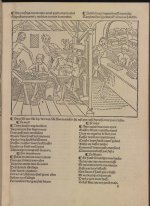
Allegedly, the earliest extant depiction of a printing press is from the 1499 Lyons "Danse Macabre":

1499 Lyons Danse Macabre pg19 (dpul.princeton.edu).jpg

One article [0, 1] says that
The danse macabre illustration that includes the earliest surviving depiction of a printing press in fact consists of two scenes associated with bookmaking.

As described by the source [2],
The Lyons Danse macabre, one of two surviving copies, contains the earliest depiction of a printing shop: one skeleton of death seizes the surprised compositor, another the pressman, and another, in adjacent scene, a dismayed bookseller standing at his counter. Only the young apprentice, wielding his ink balls, escapes. The picture book known as the Danse macabre, whose verses emphasize that death comes to all, from popes and emperors to plowmen, was first printed in Paris in 1486. The scenes derive from a lost sequence of Dance of Death murals painted in the cemetery of the Holy Innocents in Paris. The many Paris editions of Danse macabre do not include the printing shop. It is one of three new scenes, with corresponding verses, added to this Lyons version.

Looking through De Vinne's 1876 The Invention of Printing [3, 4], there are some good stories about John Gensfliesch (Gutenberg) and printing (indulgences, feuds, secrets), but, as discussed at length above, they are at this point stories to me, so I refrain from relaying even a thing more now.

Sources
[0] "Early depictions of the printing press: a model source.." The Free Library. 2015 The American Printing History Association
[1] Perry, T. P. J. (2015). Early depictions of the printing press: a model source. Printing History, (18), 27+.
[2] LA GRANT DANSE MACABRE. [Lyons: Mathias Huss], 18 February 1499 (1500), The Scheide Library, Princeton University
[3] De Vinne, 1876, The Invention of Printing, Internet Archive
[4] De Vinne, 1876, The Invention of Printing, Project Gutenberg
 
You can only trust photos reliably if you have a large number of photos of the same place from different angles. It is advisable to have as many photo sources as possible. Many of you are probably aware that many old photographs that are in the public domain have been retouched. It is possible that the retouching of the original photo was done on a chemical level. If so, by identifying the retouching methods, it may be possible to identify who did the retouching and when.

Plus, with today's technical capabilities, it is possible to create fake "old" photos and videos which are dumped on the Internet to discredit the critical history movement (or to steer them in the direction the beneficiaries of a possible centralized historical deception want).
 
Last edited by a moderator:
More on the Chinese, or in this case Korean connection:

200 years before Gutenberg: The master printers of Koryo
The first set of woodblocks, completed in 1013, was destroyed two centuries later when the Mongols invaded Korea in 1232. The invaders ravaged the entire country except for the island of Kanghwa off the west coast, where the king and the court took refuge. It was here that the government-in-exile began the mammoth task of restoring the destroyed Buddhist books. The work went on for sixteen years and resulted in over 80,000 woodcut blocks which are today preserved in the Haein-sa Temple. A precious source for the study of Buddhism, the Tripitaka has a strong claim to be considered Koryo's finest product in the arts.


Whatever the truth of this claim, it is indisputable that the invention of movable metal type was Koryo's overwhelming contribution to science and technology. The technological capability existed by the early thirteenth century in the form of suitable papers and inks and in the availability of sufficient metalworking knowledge. The need for books to be produced in a number of copies was driven home when the royal palace of Koryo, along with tens of thousands of books in the royal library, was twice destroyed by fire, in 1126 and 1170. At the same time China, a major source of book supply, was preoccupied with wars which caused a decline in book output. Further stimuli included a growing scarcity of wood suitable for making printing blocks, an abundance of bronze, and the prospect of reduced costs from using a type font on many occasions.


And yet the promoters of movable metal type were initially to be disappointed, for their innovation did not win general acceptance. To the Koreans a book was both a store of knowledge and a work of art, and the unsurpassable beauty and fineness of detail achieved with wood was to relegate this new technique to the status of a minor oddity for the next one hundred and seventy years.


It was not until 1403 that T'aejong, the second king of the Yi dynasty, revived the neglected technique when he initiated the casting of bronze type for the printing of Confucian classics and historical literature with the aim of helping government officials to rule wisely. His type font was revised by his son, King Sejong, the most beloved of all Korean rulers, and there ensued a series of technological improvements which by the end of the fifteenth century resulted in the printing of books as beautiful as any produced with wood.

It should be pointed out this Professor of ancient Korean printing methods didn't feel it important enough to leave a bibilography or supporting documents when these claims were made, though I'd imagine it would take someone who knows Chinese to track it down.

1673145701435.png

Obviously these aren't swap-able blocks, but if some of these are preserved and made of wood it would at least be plausible to date it with some accuracy. Do they look 1000 years old? No, but apparently these were preserved with extreme prejudice. I've seen shelves of 100 year old books that look in much worse shape than this.

Russia and China/Korea are neighbors so from a logistical standpoint wouldn't it stand to reason that if printing presses came out of Asia that one of the first places it went to was Russia?

The ‘Russian Gutenberg’: Who started book printing in Russia and when
At the invitation of the Russian Tsar, Hans Messingheim, a Dane, arrived in Moscow. Ivan Fyodorov, a deacon in one of the Kremlin churches (no longer in existence) was assigned to him as an apprentice, along with Pyotr Mstislavets and engraver Vasyuk Nikiforov as assistants. (Nikiforov probably executed the letters and made the engravings.) A printing press was ordered from Poland, where Russian books had already been published before.

Why did it take 500 years for Russia to get a printing press if they were China's first stop in overland trade? Not to mention they purchased their press from Poland, not from China.

Where the first Russian books were printed
Located only 500 meters from Red Square, the Moscow Print Yard is considered to be one of most extraordinary buildings in Moscow, as well as one of the earliest secular constructions in the city. Russia Beyond has descended into its dungeons to show you a secret glimpse of ancient Russia.
The building was established at the behest of Ivan the Terrible in 1553 and became the birthplace of Russian publishing. The first publication ever printed in Russia, with a known date, was The Acts and Epistles of the Apostles (also known as Apostle). It was completed in 1564 and printed at the State Print Yard by Ivan Fyodorov (the father of Eastern Slavonic printing) and Pyotr Mstislavets (a Belorussian printer).

Unsurprisingly the Russians used their press for exclusively liturgical material, and did it right in the heart of Red Square. Regarding the connection to the control scheme, this fits just about every marker. And if I may: brief offtopic but still deliciously stolenhistory moment discovery about this Moscow Print Yard -

Here, we have reached the ruins of the very first Print Yard, now about 15 meters under ground.

A little further down, we could see a blocked passageway that the archeologists obviously haven’t reached yet. We carefully climbed over the pit, filled with broken bricks and trash. It appears to be a pathway to the oldest wall of Moscow.

1673146450292.png
 
As promised I am reading the 1897 Encyclopedia and have copied some out for scrutiny of those interested. There is more to follow on the type itself and the press but takes me a while to read and type it out.

-----------------------------

Printing is one of the arts which have done most for the prosperity of the human race. It lies at the bottom of the refined and comprehensive civilization of the Western races.

It may seem strange that any doubt should prevail as to who was the inventor of printing, but with most great inventions a similar difficulty exists.
Gutenburg invented printing; that is, he carried out the cruder ingenuity of Laurens Coster and others.
The invention of printing took place in the fifteenth century; but the principle on which it was founded were known to the fathers of civilization the ancient Assyrians.
Among the ruins of Babylon have been discovered entire bricks stamped with symbolic figures and hieroglyphic characters.

Printing letterpress from engraved blocks of wood, though not movable type, has been practised in China for 2000 years. A similar mode of printing playing-cards and rude scriptural illustrations was in vogue in Europe in about the middle of the fourteenth century.
The great discovery in printing, which rendered it so important an agency in the work of civilization, was that of ,movable types; of forming each alphabetical character separately, so that it could be used in countless combinations, the same types being involved in the "setting up" of successive pages. It was the discovery which rendered cheap books possible.
Previously their enormous cost had entirely confined them to the libraries of the wealthy. In 1272 the pay of a labourer was 1 and 1/2d per day. At that time the price of a Bible, fairly written, was 50 marks, or £33, a sum equal to £660 at the present value of money.

About 1423 one Laurens Janszoon Coster, of Haralem, printed with blocks a book of images and letters called "Speculum Humnae Salvationis", for which he employed an ink more tenacious and more viscous than common ink. The leaves of this book were printed on one side only, and afterwards pasted together. A few years afterwards John Gutenberg, of Mainz, entered into a partnership with an opulent Goldsmith named John Faust or Fust and after numerous experiments, printed the first book from cut or movable metal types -- namely, an edition of the Vulgate Bible, which was begun about 1450 and completed in 1460.

In 1452 Peter Schöffer, son-in-law of Faust, cast the first metal types in matrices and was therefore the actual inventor of complete printing. Cast-metal types, according to some authorities, were first used for a second edition of the Mainz Bible.
These were the principa italics the beginnings of the art. The partnership between Gutenberg and Faust was soon dissolved; and the former being unable to repay part of the capital advanced by the latter, the whole of the printing apparatus fell into the hands of Faust, who printed off a considerable number of copies of the Bible, to imitate those commonly sold as MS, and undertook the sale off them at Paris. It was his interests to conceal the discovery and to pass of his printed copies for MS. " But," says D'Israeli, "enabled to sell his Bibles at 60 crowns, while the other scribes demanded 500, this raised universal astonishment when he produced copies as fast as they were wanted and even lowered his price. The uniformity of the copies increased the wonder.
He was denounced as a magician. The peculiarly brilliant red ink which embellished his work was said to be his blood; and it was seriously asserted that he head sold himself to the Evil One. Faust, to save himself from a bonfire, was compelled to reveal his art to the parlement of Paris, by whom he was discharged from further prosecution, in consideration of the wonderful nature of his invention.


Faust now took into partnership his son-in-law Schöffer, and the two commenced printing from cast-metal types.
In 1457 they issued an edition of the Psalter; and in this says Hallam the invention was announced to the world in a boasting colophon, though certainly not unreasonably bold.
In 1465 they published an edition of Cicero's "De Officiis", the first tribute to the new art of polite literature.
Two pupils of their school, Sweynheym and Paunartz, migrated the same year to Italy, and printed Donatus' grammar and the works of Lactantius at the monastery of Subiaca in the neighbourhood of Rome.
Venice had the honour of bestowing her patronage on John of Spiral, the first who applied the art on an extensive scale to the publication of the classical authors.
Several Latin authors came forth to his press in 1470; and during the next ten years a multitude of editions were published in various parts of Italy, Germany, and France.
The art reached Paris in 1469, England in 1474, and Spain in 1475. Its introduction was coeval with a remarkable intellectual movement in Europe. The days of feudalism had passed.
 
As promised I am reading the 1897 Encyclopedia and have copied some out for scrutiny of those interested. There is more to follow on the type itself and the press but takes me a while to read and type it out.

-----------------------------

Printing is one of the arts which have done most for the prosperity of the human race. It lies at the bottom of the refined and comprehensive civilization of the Western races.
...
"Faust now took into partnership his son-in-law Schöffer, and the two commenced printing from cast-metal types.
In 1457 they issued an edition of the Psalter; and in this says Hallam the invention was announced to the world in a boasting colophon, though certainly not unreasonably bold."

This reads like a novel, not an encyclopedia. All that's missing is 'two guys walk into a bar'
 
As promised I am reading the 1897 Encyclopedia and have copied some out for scrutiny of those interested. There is more to follow on the type itself and the press but takes me a while to read and type it out.

-----------------------------

Printing is one of the arts which have done most for the prosperity of the human race. It lies at the bottom of the refined and comprehensive civilization of the Western races.

It may seem strange that any doubt should prevail as to who was the inventor of printing, but with most great inventions a similar difficulty exists.
Gutenburg invented printing; that is, he carried out the cruder ingenuity of Laurens Coster and others.
The invention of printing took place in the fifteenth century; but the principle on which it was founded were known to the fathers of civilization the ancient Assyrians.
Among the ruins of Babylon have been discovered entire bricks stamped with symbolic figures and hieroglyphic characters.

Printing letterpress from engraved blocks of wood, though not movable type, has been practised in China for 2000 years. A similar mode of printing playing-cards and rude scriptural illustrations was in vogue in Europe in about the middle of the fourteenth century.
The great discovery in printing, which rendered it so important an agency in the work of civilization, was that of ,movable types; of forming each alphabetical character separately, so that it could be used in countless combinations, the same types being involved in the "setting up" of successive pages. It was the discovery which rendered cheap books possible.
Previously their enormous cost had entirely confined them to the libraries of the wealthy. In 1272 the pay of a labourer was 1 and 1/2d per day. At that time the price of a Bible, fairly written, was 50 marks, or £33, a sum equal to £660 at the present value of money.

About 1423 one Laurens Janszoon Coster, of Haralem, printed with blocks a book of images and letters called "Speculum Humnae Salvationis", for which he employed an ink more tenacious and more viscous than common ink. The leaves of this book were printed on one side only, and afterwards pasted together. A few years afterwards John Gutenberg, of Mainz, entered into a partnership with an opulent Goldsmith named John Faust or Fust and after numerous experiments, printed the first book from cut or movable metal types -- namely, an edition of the Vulgate Bible, which was begun about 1450 and completed in 1460.

In 1452 Peter Schöffer, son-in-law of Faust, cast the first metal types in matrices and was therefore the actual inventor of complete printing. Cast-metal types, according to some authorities, were first used for a second edition of the Mainz Bible.
These were the principa italics the beginnings of the art. The partnership between Gutenberg and Faust was soon dissolved; and the former being unable to repay part of the capital advanced by the latter, the whole of the printing apparatus fell into the hands of Faust, who printed off a considerable number of copies of the Bible, to imitate those commonly sold as MS, and undertook the sale off them at Paris. It was his interests to conceal the discovery and to pass of his printed copies for MS. " But," says D'Israeli, "enabled to sell his Bibles at 60 crowns, while the other scribes demanded 500, this raised universal astonishment when he produced copies as fast as they were wanted and even lowered his price. The uniformity of the copies increased the wonder.
He was denounced as a magician. The peculiarly brilliant red ink which embellished his work was said to be his blood; and it was seriously asserted that he head sold himself to the Evil One. Faust, to save himself from a bonfire, was compelled to reveal his art to the parlement of Paris, by whom he was discharged from further prosecution, in consideration of the wonderful nature of his invention.


Faust now took into partnership his son-in-law Schöffer, and the two commenced printing from cast-metal types.
In 1457 they issued an edition of the Psalter; and in this says Hallam the invention was announced to the world in a boasting colophon, though certainly not unreasonably bold.
In 1465 they published an edition of Cicero's "De Officiis", the first tribute to the new art of polite literature.
Two pupils of their school, Sweynheym and Paunartz, migrated the same year to Italy, and printed Donatus' grammar and the works of Lactantius at the monastery of Subiaca in the neighbourhood of Rome.
Venice had the honour of bestowing her patronage on John of Spiral, the first who applied the art on an extensive scale to the publication of the classical authors.
Several Latin authors came forth to his press in 1470; and during the next ten years a multitude of editions were published in various parts of Italy, Germany, and France.
The art reached Paris in 1469, England in 1474, and Spain in 1475. Its introduction was coeval with a remarkable intellectual movement in Europe. The days of feudalism had passed.

Interesting how in a short 60 years the origin of the printing press goes from "hell if we know where it started" to this "historically settled" version. At the very least, this version manages to make the Chinese connection which is saying more than the sources I came across from the early 1800s.
 
Interesting how in a short 60 years the origin of the printing press goes from "hell if we know where it started" to this "historically settled" version.
Replying to you as well because i believe you'll like the screenshot i mentioned to dreamtime. Unfortunally idk the book's name....
Screenshot_20230105-013026_Instagram.jpg
 
Allegedly, the earliest extant depiction of a printing press is from the 1499 Lyons "Danse Macabre":


One article [0, 1] says that


As described by the source [2],


Looking through De Vinne's 1876 The Invention of Printing [3, 4], there are some good stories about John Gensfliesch (Gutenberg) and printing (indulgences, feuds, secrets), but, as discussed at length above, they are at this point stories to me, so I refrain from relaying even a thing more now.

Sources
[0] "Early depictions of the printing press: a model source.." The Free Library. 2015 The American Printing History Association
[1] Perry, T. P. J. (2015). Early depictions of the printing press: a model source. Printing History, (18), 27+.
[2] LA GRANT DANSE MACABRE. [Lyons: Mathias Huss], 18 February 1499 (1500), The Scheide Library, Princeton University
[3] De Vinne, 1876, The Invention of Printing, Internet Archive
[4] De Vinne, 1876, The Invention of Printing, Project Gutenberg
Referent. Do the stories in your book tally at all with the ones in the Encyclopedia?

From your post and the encycvlopedia its looking like Gutenburg is at beset a 'bit player' not the founder of the printing press.
 
Referent. Do the stories in your book tally at all with the ones in the Encyclopedia?

From your post and the encycvlopedia its looking like Gutenburg is at beset a 'bit player' not the founder of the printing press.
The Invention of Printing (De Vinne, 1876) ought to tally with some encyclopedia versions, since I found it in the bibliography of the 1911 Encyclopedia Britannica article on "printing". (Apologies for omitting the reverse attribution originally--after skimming the article, I wanted more in-depth sources to look at, particularly whatever the 1911 author [who happens to be Charles T. Jacobi of Cheswick Press] pointed to.)
  • While I hope to take a look at the changes in the story over time, I will not be able to look in any depth for at least a couple of days (I haven't yet gotten to compare De Vinne to the kindly typed out National Encyclopedia text).
  • In the meantime, while on the topic of reviewing the development of official/encyclopedic versions of the story over time, for anyone interested: one resource that may aid in doing so is the following website, with links to various volumes by letter over time: OldEncyc.com.
 
Last edited:
Allegedly, the earliest extant depiction of a printing press is from the 1499 Lyons "Danse Macabre":
1499 Lyons Danse Macabre pg19 (dpul.princeton.edu).jpg
The Lyons Danse macabre, one of two surviving copies, contains the earliest depiction of a printing shop: one skeleton of death seizes the surprised compositor, another the pressman, and another, in adjacent scene, a dismayed bookseller standing at his counter. Only the young apprentice, wielding his ink balls, escapes. The picture book known as the Danse macabre, whose verses emphasize that death comes to all, from popes and emperors to plowmen, was first printed in Paris in 1486. The scenes derive from a lost sequence of Dance of Death murals painted in the cemetery of the Holy Innocents in Paris.
1486...

Just adding to the sequence of dates:
The great discovery in printing, which rendered it so important an agency in the work of civilization, was that of ,movable types; of forming each alphabetical character separately, so that it could be used in countless combinations, the same types being involved in the "setting up" of successive pages. It was the discovery which rendered cheap books possible.
Previously their enormous cost had entirely confined them to the libraries of the wealthy.

About 1423 one Laurens Janszoon Coster, of Haralem, printed with blocks a book of images and letters called "Speculum Humnae Salvationis",
A few years afterwards John Gutenberg, of Mainz, entered into a partnership with an opulent Goldsmith named John Faust or Fust and after numerous experiments, printed the first book from cut or movable metal types -- namely, an edition of the Vulgate Bible, which was begun about 1450 and completed in 1460.

In 1452 Peter Schöffer, son-in-law of Faust, cast the first metal types in matrices and was therefore the actual inventor of complete printing. Cast-metal types, according to some authorities, were first used for a second edition of the Mainz Bible.
Faust now took into partnership his son-in-law Schöffer, and the two commenced printing from cast-metal types.
In 1457 they issued an edition of the Psalter; and in this says Hallam the invention was announced to the world in a boasting colophon, though certainly not unreasonably bold.
In 1465 they published an edition of Cicero's "De Officiis", the first tribute to the new art of polite literature.
Several Latin authors came forth to his press in 1470; and during the next ten years a multitude of editions were published in various parts of Italy, Germany, and France.

The art reached Paris in 1469, England in 1474, and Spain in 1475. Its introduction was coeval with a remarkable intellectual movement in Europe. The days of feudalism had passed.

From Parchment and Glove Making in Havant, Ralph Cousins, 2017, p7, describing the parchment makers of Havant, Hampshire, supplying Oxford University:
The next century witnessed a considerable falling off in a trade which had evidently flourished in the thirteenth century. During 1556 and 1594 only five names occur of men engaged in the industry.
But by the seventeenth century it is probable that white paper for books was well known, though Macpherson would place the date of its introduction at the end rather than the beginning of that period.

In other words: books were made from skin into the century before 1700. Then paper completed its take-over.

From Tentering Tower, Ramsbottom, Bury:
Local author Richard Peace in his book Lancashire Curiosities writes that in later days Stubbins Vale Mill moved away from woollen manufacturing and began to produce textiles for the printing industry. They produced items such as filter fabrics, printing blankets and felt. Filter fabrics allow water to pass through them but prevent solids from going through. Printing blankets are textile that act like a printing block. They take ink from a roller and transfer it on to paper, and in this way they can be a disposable template that can used many times to mass produce leaflets. Felts are used in the production of hand made paper to absorbs any excess water produced.

My point is that demand for raw materials by the publishing industry shifted away from skin products towards wool and cellulose products. As seems to have also occurred in the clothing industry with wool and then cotton. Britain's materials production seems to have switched from butchery side-products (skins) to annually harvestable products: sheep fleeces and cellulose.

Followed shortly afterwards by mechanised production.

Why? And why then?

Perhaps 'natural' selection began to do a lot more selecting:

2000+_year_global_temperature_including_Medieval_Warm_Period_and_Little_Ice_Age_-_Ed_Hawkins.jpg
Ice Age fashionistas went wool for leather. Source: Little Ice Age

Perhaps sources of skins became much rarer as the 16th century unfolded. Perhaps only cold-resistant, hairy flocks could be reliably farmed.

Climate change may not have been the only factor:
All that's missing is 'two guys walk into a bar'

Download Video

Two gods walk into a bar... Source: Westworld

First god says:
Your hominids-as-feedstock business is giving all of us a bad name.
Second god gets up to leave, saying:
The Gilds will agree with me.

Love the Latin decor in that scene.

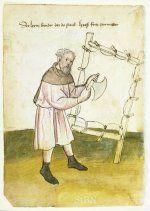
I wonder if the origin of metal type is related to a possible evolution from leather industry tool and buckle-making into coin minting. For example, parchment-makers use a 'lunar' to scrape hair from skin:
parchment-maker-with-crescent-shaped-scraping-tool.jpg

the-lunar-and-the-frames_orig.jpg

It's kinda funny that Erasmus Darwin created the Lunar Society in 1765. With buckle-maker turned coin-caster Matthew Boulton. Then in 1778 went on to invent 'a copying machine'.
 
Last edited:
I just wanted to say that some may take "print" to be a wonderful invention, and yes it is helpful sometimes, but reading something and writing something doesn't always send the exact message that is wanted. The basis of this thread is to establish the first printing I guess, and I think that is great, I just see sometimes that print or the written word creates chaos more so than it being helpful. I don't mean to turn this into a philosophical conversation, but what if this is where the human went wrong. What if we were duped in to this form of communication?


1486...

Just adding to the sequence of dates:


From Parchment and Glove Making in Havant, Ralph Cousins, 2017, p7, describing the parchment makers of Havant, Hampshire, supplying Oxford University:


In other words: books were made from skin into the century before 1700. Then paper completed its take-over.

From Tentering Tower, Ramsbottom, Bury:


My point is that demand for raw materials by the publishing industry shifted away from skin products towards cellulose products. As seems to have happened in the clothing industry too. Britain's materials production seems to have switched from butchery side-products (skins) to annually harvestable products: sheep fleece and cellulose.

Perhaps 'natural' selection began to do a lot more selecting:

View attachment 27081
Ice Age fashionistas went wool for leather.​

Perhaps sources of skins became much rarer as the 16th century unfolded. So much so that only hairy flocks could be reliably farmed.

Climate change may not have been the only factor:


Two gods walk into a bar. First god says to the other:


Second god says:


And so the Reformation began.

I wonder if the origin of metal type is related to a possible evolution from leather industry stamp- and buckle-making into coin casting. It's kinda funny that Erasmus Darwin's 1765 Lunar Society started with buckle-maker and coin-caster Matthew Boulton. And that a lunar is a tool parchment-makers used for scraping hairs off skin:
The reason why paper replaced parchment is down to the differences in preparation time. Parchment goes through many processes reliant on the skill of the individual processor to produce parchment of sufficient quality to write on. Also the time intervals between these processes are what they are. In short it is a lengthy process all done by hand to take a skin and refine it into parchment.
It seems obvious this alone limits the production and the supply. Add in the reality the same skins can be used for leather goods then it is beyond doubt parchment has always been of limited use as a medium of record.

Paper production is by contrast a quick process. First there is the manufacture of the pulp and then there is the manufacture of the paper. Much of the work can be done by unskilled labour with the skilled labour being used at key points only.
The volume of parchment in comparison to the volume of paper produced in the exact same time frame is so marked the production of paper quickly rendered the production of parchment obsolete once the paper manufacturing process was invented or introduced.

According to the 1897 Encyclopedia it is again uncertain as to when the pulp and paper process arose in England but it says paper used for writing purposes can be shown to known as early as 1309.
Sadly it doesn't mention where or what form this 1309 example takes.

A person of the name of Tate is said to have had a paper mill at Hertford early in the sixteenth century and another is said to have been established in Kent by a German who was knighted by Queen Elizabeth.
Again sadly it doesn't name this German and of course we are in John Dee territory and it is claimed he had hundreds, or thousands of books in his library at one point.
They could have all been parchment bound with vellum but I for one doubt all of them were. As the dating is wooly at best its odds on paper books were replacing parchment if there were paper mills in existence.

The fact paper was required for the printing press and its method of operation and we cannot ignore the relative ease and speed by which it is bound into book form its production must have been well enough developed to be providing a quality product at some volume assuming the claims made for Faust and his son in law plus students of the pair are true or even just near the mark.
What if we were duped in to this form of communication?
How would anyone know?
 
Last edited:
I wonder if the origin of metal type is related to a possible evolution from leather industry tool and buckle-making into coin minting. For example, parchment-makers use a 'lunar' to scrape hair from skin:
Many old looking coins were stamped as far as I can tell from looking at them. They seem to be of metal discs of sufficient softness to be stamped by a stamp made of a harder material which has been inverse carved with the design. By what means this harder material was carved I know not.
And of sufficient hardness to hold the design once stamped.
Perhaps the blank disc was heated, stamped, cooled to set the design in place in which case the stamp need not be much harder than the metal disc.
No way to tell if the disc was placed on the stamp which was held fast and then struck with a hammer or a press was involved. Equally the stamp could have been the thing struck with a hammer or held fast in a press and the hot metal disc could go in a disc shaped holder to keep it in place as its stamped.

To my mind such individual stamping of metal discs is as slow to produce copies of anything let alone coinage.
As for it being a source of the route to the creation of metal type it could be. We would need to find a route for coin manufacturers to become involved with the wooden press importer/ creator. I haven't found one. Faust being a goldsmith shows a knowledge of metallurgy in relation to alloys. That makes sense on a practical level as he would have experience of both casting and stamping.
I'm sure coin manufacturers would have similar knowledge of alloys, stamping and I would argue casting.
Casting of coins can be done in multiples in one pour in one mould and would seem to me something that would be recognised as a faster more effective process involving much less effort than stamping.


This is the sort of journey I go on when mentioning the logistics of things. I suppose its a case of "how is it practical to do this?"
At least its a base common to every avenue of investigation.
It requires some assumption not least that which assumes us humans alive today are in essence body and soul, mind, brain, imagination abilities our practical nature the same as our predecessors.
The best clue for me this is so is the amount of built infrastructure all of which is built to the level and plumb.
 
Last edited:
It is often said that history is written by the winners.

A quick web search shows that history has recorded over 10,000 battles, and 4,000 wars. Today, a mere 10 cultures have subsumed every other culture that has preceded it.

If we assume that half of the history of these prior cultures have been deliberately distorted or destroyed, how much of our current history is accurate?

.5 ^10 = <0.1%

Because less than 1% of our history is likely to be accurate, I no longer believe anything 100%. Today, I remain skeptical of all things.
 
It is often said that history is written by the winners.

A quick web search shows that history has recorded over 10,000 battles, and 4,000 wars. Today, a mere 10 cultures have subsumed every other culture that has preceded it.

If we assume that half of the history of these prior cultures have been deliberately distorted or destroyed, how much of our current history is accurate?

.5 ^10 = <0.1%

Because less than 1% of our history is likely to be accurate, I no longer believe anything 100%. Today, I remain skeptical of all things.
Sorry but I cannot see the point of repeating mainstream menes, themes, statements such as this
"It is said history is written by the victors".
What have you done to establish this statement to be anywhere near true?

I'm pretty certain most people who arrive in this place have heard or read these words more than once, even the Legion of Lurkers and am equally sure none have done anything to establish any truth to the statement.
It is accepted without question as the de facto way history is produced.

And yet many people realise that red and blue in any political environment are in reality the same thing but for some reason they do not take this knowing into the historical record and how it might be created.
Winners and losers is the dichotomy pushed by hierarchical authority. That is on show every single day through every aspect of life. Schools, parents, contemporaries all parrot it and teach it. Media, governments, corporations all scream it all practice it.
This constant repetition tells me its both bogus and fragile. Once a critical mass is reached of people who just ignore the dichotomy its game over for those who push it and they know it.

For myself I used to believe and parrot the same meme, history written by the victors, did it for years however in the past decade or so I have read and heard more and more articles, books, statements from people supposedly on the losing side which shows actually anyone who experienced the event can and does write about it and are able to get their story out.
It will not be officially sanctioned, which basically means the incest agreement of state run academia creating and certifying a version of events which promotes hierarchical authority, but these accounts can be found with a bare minimum of diligence.
 
When it comes to primary sources (the very most ancient book from which a narrative is derived) it would be great to have a sort of encyclopedia mentioning where and when they were found, if it is not implied that they were always at disposal. In any case I would suggest to go and read those books (the texts at disposal on the internet or the hard copy) in order to have an idea of how much the academia is interpreting and/or manipulating words. Believe me if I tell you there's a lot of surprises!


good point. the 'point of reference'.

the written word is problematic when it tries to function as the sole authority over the facts.

lets say you and i have a business, and i start stealing from the register, and you catch me and break the partnership, then i write an autobiography where i say you fired me out of envy for my business skills, and you wrote nothing and told no one since you never knew i had written this autobiography.
 
Sorry but I cannot see the point of repeating mainstream menes, themes, statements such as this
"It is said history is written by the victors".
What have you done to establish this statement to be anywhere near true?

I'm pretty certain most people who arrive in this place have heard or read these words more than once, even the Legion of Lurkers and am equally sure none have done anything to establish any truth to the statement.
It is accepted without question as the de facto way history is produced.

And yet many people realise that red and blue in any political environment are in reality the same thing but for some reason they do not take this knowing into the historical record and how it might be created.
Winners and losers is the dichotomy pushed by hierarchical authority. That is on show every single day through every aspect of life. Schools, parents, contemporaries all parrot it and teach it. Media, governments, corporations all scream it all practice it.
This constant repetition tells me its both bogus and fragile. Once a critical mass is reached of people who just ignore the dichotomy its game over for those who push it and they know it.
Very, very well said.
For myself I used to believe and parrot the same meme, history written by the victors, did it for years however in the past decade or so I have read and heard more and more articles, books, statements from people supposedly on the losing side which shows actually anyone who experienced the event can and does write about it and are able to get their story out.
Quite often they do. But it does seem on a lot of occasions that if the truth is too damning, the real story will get buried over time.
It will not be officially sanctioned, which basically means the incest agreement of state run academia creating and certifying a version of events which promotes hierarchical authority, but these accounts can be found with a bare minimum of diligence.
And it often gets the label of 'conspiracy theory' ironically.
 
Tips
Tips
Please respect our Posting Rules.
Back
Top