
You are using an out of date browser. It may not display this or other websites correctly.
You should upgrade or use an alternative browser.
You should upgrade or use an alternative browser.
Flat Earth
- Thread starter grav
- Start date

Bogdan
Member
Do you have a link for this video? I guess the parabolic lines are chosen for aesthetic reasons by the art director and/or the motion graphics artist to emphasize "flight".A question.
Why parabolic lines in this UN presentation overlaid on a flat map?
Yes here it is but turn the sound down as the blokes voice is LOUD!
https://www.brighteon.com/e10f6df0-6f67-4ec6-8e1d-62991b33bad1
https://www.brighteon.com/e10f6df0-6f67-4ec6-8e1d-62991b33bad1

- Joined
- Oct 7, 2020
- Messages
- 509
- Reaction score
- 1,207
@Bogdan, can you "round" this image? I can't insert it, even after refreshing and doing all the steps that work sometimes --- when the internet gods favor me and no bird lands on my "satellite" dish.
[edit: I was able to embed the image after all.]
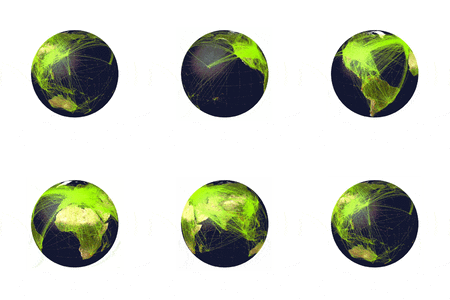
It's interesting to see how airplanes fly in the southern hemi'sphere', such as from South America to Africa.
https://stolenhistory.net/attachments/oip-2-jpeg.3061/?hash=049b3014c836ef62260ea28f6e8f0464

[edit: I was able to embed the image after all.]
It's interesting to see how airplanes fly in the southern hemi'sphere', such as from South America to Africa.
https://stolenhistory.net/attachments/oip-2-jpeg.3061/?hash=049b3014c836ef62260ea28f6e8f0464
Last edited:
- Joined
- Oct 7, 2020
- Messages
- 509
- Reaction score
- 1,207
10 reasons for thinking the world is not a spinning ball in a vacuum
1. Curvature. Spherical trigonometry dictates that the globe should exhibit a curve of 8 inches per mile squared. No experiments on land or water have ever proven this math to be accurate. On the contrary, with proper telephoto lenses, objects can be detected far beyond the expected curvature. Example: Photos of Chicago from across Lake Michigan.
2. Atmosphere vs space vacuum. Space theoretically begins 62 miles above the earth’s surface, at the Karman Line. The laws of physics say that a vacuum can not exist next to an atmosphere. Without a barrier to separate the two areas, the atmosphere would instantly escape into the hard vacuum of space. Example: open a tank of compressed air; the oxygen or other gases inside the tank will rush outside to achieve equilibrium of air pressure. A vacuum cannot exist next to the atmosphere.
3. Water. Liquid water always seeks its own level. Gravity, which is really the function of density (weight) of objects over distances, cannot cause oceans to curve around the globe. Sea level must be consistent throughout the world. Water, in other words, can not curve. Example: the Pacific Ocean, sea level.
4. Centrifugal force. If earth rotated at 1000 mph at the equator, nothing could withstand being thrown off of it along a curved or tangential path. Gravity is said to be the weakest force in the universe. It is, under any circumstances, unable to overcome the extreme speed of rotation. Gravity is actually the ratio of densities of adjacent objects, such as the density of water compared to that of air.. Examples include insects, clouds, smoke, other low density-objects which rise above the earth despite the alleged gravity and centrifugal force. Example: merry-go-rounds.
5. Authorities. Professionals in many fields --pilots, engineers, surveyors, gunners, artillerymen, radar operators, etc. -- do not account for curvature in any manner. Example: surveyors never adjust for earth curvature when they design canals, causeway bridges, railroad lines.
6 Moon and sun. Both objects appear to the eye to be the same size, though the moon is around 238,000 miles away and the sun is 93 million miles distant. Sunlight beams deny the claim that rays enter earth’s atmosphere in parallel beams. Using simple geometry, one can determine that the triangular pattern results in a distance of only 3000 miles above. The moon emits a cooling light which illuminates only the clouds which are near it, not those that are further away. Example: sunlight beaming rays through clouds (crepuscular rays) form a triangle with a base of less than 8,000 miles miles
7. Constellations. Star patterns have not altered appreciably in human history. Considering speeds of celestial objects which travel billions of miles per year in multiple directions, as well as earth’s own rotation, revolution around the sun, following the sun through the universe, we should observe some changes in as little as 6 months (stellar parallax). But no such changes have been seen in 6000 years. Example: Orion, Polaris in the same locations for millennia.
8. Airplane travel. Flights to and from countries in the southern hemisphere always pass over countries in the north, even though they could refuel in places along a direct route. When plotted on the flat earth map, the planes show that they follow a straight line. Example: flights between South America, Africa, Australia..
9. No Sensation of movement. If earth actually rotated and revolved around the sun at 67,000 mph, we should hear sonic booms and be swept away by winds far beyond hurricane strength. Examples: quiet, calm days, east-to-west winds
10. Photographs of earth from space. There are no legitimate pictures or videos of earth. All pictorial evidence is computer-generated, as are almost all photos of celestial objects. NASA even says that these photographs were created to “match people’s expectations.”
Other evident fakery from space agencies, including the ISS and the Space Shuttle, further supports the argument that our ideas about space are entirely faked.
http://tse3.mm.bing.net/thid=OIP.x2Ym3dHd4c34mQo2wAauqAEsCd&pid=15.1
Gravity is density
1. Curvature. Spherical trigonometry dictates that the globe should exhibit a curve of 8 inches per mile squared. No experiments on land or water have ever proven this math to be accurate. On the contrary, with proper telephoto lenses, objects can be detected far beyond the expected curvature. Example: Photos of Chicago from across Lake Michigan.
2. Atmosphere vs space vacuum. Space theoretically begins 62 miles above the earth’s surface, at the Karman Line. The laws of physics say that a vacuum can not exist next to an atmosphere. Without a barrier to separate the two areas, the atmosphere would instantly escape into the hard vacuum of space. Example: open a tank of compressed air; the oxygen or other gases inside the tank will rush outside to achieve equilibrium of air pressure. A vacuum cannot exist next to the atmosphere.
3. Water. Liquid water always seeks its own level. Gravity, which is really the function of density (weight) of objects over distances, cannot cause oceans to curve around the globe. Sea level must be consistent throughout the world. Water, in other words, can not curve. Example: the Pacific Ocean, sea level.
4. Centrifugal force. If earth rotated at 1000 mph at the equator, nothing could withstand being thrown off of it along a curved or tangential path. Gravity is said to be the weakest force in the universe. It is, under any circumstances, unable to overcome the extreme speed of rotation. Gravity is actually the ratio of densities of adjacent objects, such as the density of water compared to that of air.. Examples include insects, clouds, smoke, other low density-objects which rise above the earth despite the alleged gravity and centrifugal force. Example: merry-go-rounds.
5. Authorities. Professionals in many fields --pilots, engineers, surveyors, gunners, artillerymen, radar operators, etc. -- do not account for curvature in any manner. Example: surveyors never adjust for earth curvature when they design canals, causeway bridges, railroad lines.
6 Moon and sun. Both objects appear to the eye to be the same size, though the moon is around 238,000 miles away and the sun is 93 million miles distant. Sunlight beams deny the claim that rays enter earth’s atmosphere in parallel beams. Using simple geometry, one can determine that the triangular pattern results in a distance of only 3000 miles above. The moon emits a cooling light which illuminates only the clouds which are near it, not those that are further away. Example: sunlight beaming rays through clouds (crepuscular rays) form a triangle with a base of less than 8,000 miles miles
7. Constellations. Star patterns have not altered appreciably in human history. Considering speeds of celestial objects which travel billions of miles per year in multiple directions, as well as earth’s own rotation, revolution around the sun, following the sun through the universe, we should observe some changes in as little as 6 months (stellar parallax). But no such changes have been seen in 6000 years. Example: Orion, Polaris in the same locations for millennia.
8. Airplane travel. Flights to and from countries in the southern hemisphere always pass over countries in the north, even though they could refuel in places along a direct route. When plotted on the flat earth map, the planes show that they follow a straight line. Example: flights between South America, Africa, Australia..
9. No Sensation of movement. If earth actually rotated and revolved around the sun at 67,000 mph, we should hear sonic booms and be swept away by winds far beyond hurricane strength. Examples: quiet, calm days, east-to-west winds
10. Photographs of earth from space. There are no legitimate pictures or videos of earth. All pictorial evidence is computer-generated, as are almost all photos of celestial objects. NASA even says that these photographs were created to “match people’s expectations.”
Other evident fakery from space agencies, including the ISS and the Space Shuttle, further supports the argument that our ideas about space are entirely faked.
http://tse3.mm.bing.net/thid=OIP.x2Ym3dHd4c34mQo2wAauqAEsCd&pid=15.1
Gravity is density

- Joined
- Aug 31, 2020
- Messages
- 76
- Reaction score
- 610
The very idea that earth has a thin envelope of air defies all laws of physics.
. You just can't have a breathable atmosphere smack dab next to a total vacuum a mere 62 miles up. Gas laws require a container to keep air from escaping. Gases are required by law to equalize according to equations which all have a v (volume). Infinite space does not qualify as a volume.
. Then, the earth ball spins 1000 mph and orbits the sun at 66,600 mph, which requires molecures of oxygen and nitrogen to match those ginormous speeds.
. And then we have astro-nots, aka fake space actors, who again defy physics by floating outside the ISS. This flimsy structure absurdly maintains a pressurized cabin without exploding outwards , even when a meteorite punctures a wall.
The problem I have with this sequence is that your third supposition, relating to space travel, is rejected on its apparent incompatibility with physical principles you have just said are wrong. I am not vouching for NASA's integrity by any means, but there's something circular in that logic and it's not the earth.
And this relates to a broader "all or nothing" tendency I notice in this thread. From the conjoined conclusions that (a) the upper atmosphere and outer space, so-called, are entirely different from what mainstream science says and (b) NASA lies about everything, there is an evident temptation to proceed directly to the "it's all fake" camp. That seems to me to be a mistake. For one thing, the possibility of space travel or satellites doesn't necessarily rise or fall with any conjectured terrestrial topology or cosmos. For another, the evidence attesting to the existence of space travel and satellites is enormous. Finally, keep in mind that dissimulation, like the serpent, is a most subtle thing.
I believe that the evidence shows that: the space program is very real; that it was conceived and developed for military purposes; that its public-facing benevolent ambitions had the purposes of concealing its military character, engendering public support, distracting the public as necessary, and sustaining the orthodox scientific world-view; and that whatever evidence of the real space program happens to drift into public sight is explained away in terms of mundane phenomena. As far as satellites go, I am referring only to vehicles semi-permanently positioned at very high altitude and am not presupposing any theoretical conceptions of outer space or gravitational orbit; indeed, most of these vehicles can be regarded more correctly as "electrogravitic platforms."
Here's a timeline of space activities I will vouch for:
1960s - US space program rockets launching from islands in the South Indian Ocean begin secretly moving men and materials to the moon's Copernicus crater for construction of a moon base.
1960s - NASA films a series of movies, notably the popular Apollo franchise, and releases them straight to television. The Hollywood film Planet of the Apes provides cover for the creation of the set for Apollo 11.
1977 - Russian manned satellites attack the US moon base with neutron particle beam weapons; Russia then inhabits the base and fortifies it with directed-energy howitzers. (See Moonraker).
1980s - The US Space Shuttle program, conceived as a response to Soviet domination in space, is engaged in a series of (mostly losing) battles with futuristic Soviet Cosmosphere spacecraft (or, as the public calls them, UFOs)
1990s - Israel's fleet of fusion-powered killer DEW satellites begins its reign of terror
??
Space-X was reputed to be engaged in Antisat intrigues; no idea what's happening right now. Oh, and there's this:I'm still skeptical of Space-X
- Joined
- Oct 7, 2020
- Messages
- 509
- Reaction score
- 1,207
@emperornorton, you say I use circular reasoning, while your proof of Nasa's veracity is moon bases? maglev satellites? etc.?
A whole lot of speculation there, to put it mildly.
Below, we see another example of Nasa's handiwork. Will you "vouch" for the far side lunar transit as you did for the Russian howitzers?
Enjoy the view.
View: https://m.youtube.com/watch?feature=youtu.be&v=DMdhQsHbWTs
1. clouds don't move during the 5-hour transit
2. size of the US is wrong -- at 3000 miles wide, it should be 3/8th the diameter of the blue sphere (8000 miles)
3. moon is 2-dimensionally flat and does not rotate clockwise as advertised by Nasa
4. moon travels in a straight line while the EPIC "geostationary" satellite maintained an amazing fixed position
5. earth exhibits a curious pareidolia in the appearance of an angry clown with one eye closed and the other one open and baleful (the dark object off the coast of California)
Overall, a slipshod product, its many glaring peculiarities a test of human discernment.
A whole lot of speculation there, to put it mildly.
Below, we see another example of Nasa's handiwork. Will you "vouch" for the far side lunar transit as you did for the Russian howitzers?
Enjoy the view.
View: https://m.youtube.com/watch?feature=youtu.be&v=DMdhQsHbWTs
1. clouds don't move during the 5-hour transit
2. size of the US is wrong -- at 3000 miles wide, it should be 3/8th the diameter of the blue sphere (8000 miles)
3. moon is 2-dimensionally flat and does not rotate clockwise as advertised by Nasa
4. moon travels in a straight line while the EPIC "geostationary" satellite maintained an amazing fixed position
5. earth exhibits a curious pareidolia in the appearance of an angry clown with one eye closed and the other one open and baleful (the dark object off the coast of California)
Overall, a slipshod product, its many glaring peculiarities a test of human discernment.

No spacecraft of any size or description carries enough water with it to meet the needs of any stated mission. The weight argument alone negates any space bound water tanker from getting off of the ground.
View: https://youtu.be/fV1HkTTlZ_I

Bogdan
Member
@Bogdan, can you "round" this image? I can't insert it, even after refreshing and doing all the steps that work sometimes --- when the internet gods favor me and no bird lands on my "satellite" dish.
List of map projections.
I found the map of which you took a screenshot from youtube in highres. I hope we are clear that those kind of maps are for illustration purposes only, they don't depict the actual flight paths of planes. This map was done on a sphere and then unvrapped to this most common "equirectangular" projection which we all grew up with. Just a line has been drawn from airport A to airport B. Here's the original map and the converted ones:
AEP:
Projected onto a sphere:

Below is an example of a real flight path from Baltimore to San Juan. Comparison of an illustration to the actual tracking of the flight:
The Great Circle Mapper
Non-stop flight route from Delhi to San Francisco:
Actual flight route from Delhi to San Francisco:
The explanation is, that they are making use of the northern/polar jet stream to save fuel...
Here's how the actual flight path back to Delhi looks like:
Attachments
- Joined
- Oct 7, 2020
- Messages
- 509
- Reaction score
- 1,207
No one's discussing the monolith they just found in Utah? Sorry for posting here, I couldn't find the relevant thread.
The 2001 monolith, lol. Maybe a real Nasa stunt, in which case, this thread is as good as any. Maybe a Hollywood prop, prank.
Bogdan
Member
This supposed "EPIC View" is an insult to my intelligence. It's not a real view. As a professional 3d artist and motion-graphics designer, doing this type of stuff for over 15 years, I can assure you without even going into the details, that this is rendered and not taken by a camera as suggested. I know from my own experience, that it's easy to fool people with these kind of images and with the right caption. The vast majority of people who don't have a trained eye, will mistake this for a real view. The fact, that it has an "official" stamp on it because it's from NASA, doesn't change the fact that this is digitally made. The landmass alone is a huge composite.
The only convincing picture of earth NASA ever put out, was the first one in 1967. Apparently taken from 22300 miles above the surface of the earth . It looks more convincing because CGI didn't exist yet, and all that special effects stuff had to be hand drawn, painted, cut, pasted, overlayed and multi exposed. Hence the more organic look:
Stormy earth there. That's alot of clouds. Oh and there's a video WITH moving clouds which goes along with it. Gotta give it to Disney and his team, they did a good job:
- Joined
- Oct 7, 2020
- Messages
- 509
- Reaction score
- 1,207
@Bogdan, thank you so much.
Your graphics and animation work is much appreciated.
I need to add "equirectangular" to my vocabulary.
Yes, I understand the perspective issue when looking at lines in a sphere.
A 2d straight line is necessarily curved in 3d.
Regardless the map, pretty much all flights for southern latitudes (South America, Africa, Australia) travel north before heading back south to their destinations.
There are no direct flights, e.g. between the 3 southern continents.
Plotted on the Flat Earrh map, azimuthal_equidistant, the flights make sense.
[automerge]1606269470[/automerge]
There are no (0) real photos of earth from space.
Nasa cranks out ludicrous images of the blue marble and gets away with these cgi cartoons, which insult Bogdan's intelligence. mine too.
But as we see in the "news", the Powers That Be can convince the people that the government knows best. If the MSM told people to wear paper bags over their heads, 95% would do it.
Nothing to see here, folks. Move along, little dogies. Mask up and social distance.
This is your world, until we tell you different.
Your graphics and animation work is much appreciated.
I need to add "equirectangular" to my vocabulary.
Yes, I understand the perspective issue when looking at lines in a sphere.
A 2d straight line is necessarily curved in 3d.
Regardless the map, pretty much all flights for southern latitudes (South America, Africa, Australia) travel north before heading back south to their destinations.
There are no direct flights, e.g. between the 3 southern continents.
Plotted on the Flat Earrh map, azimuthal_equidistant, the flights make sense.
[automerge]1606269470[/automerge]
There are no (0) real photos of earth from space.
Nasa cranks out ludicrous images of the blue marble and gets away with these cgi cartoons, which insult Bogdan's intelligence. mine too.
But as we see in the "news", the Powers That Be can convince the people that the government knows best. If the MSM told people to wear paper bags over their heads, 95% would do it.
Nothing to see here, folks. Move along, little dogies. Mask up and social distance.
This is your world, until we tell you different.
Last edited:
- Joined
- Aug 31, 2020
- Messages
- 76
- Reaction score
- 610
@emperornorton, you say I use circular reasoning, while your proof of Nasa's veracity is moon bases? maglev satellites? etc.?
A whole lot of speculation there, to put it mildly.
Below, we see another example of Nasa's handiwork. Will you "vouch" for the far side lunar transit as you did for the Russian howitzers?
Enjoy the view.
No. I believe that nearly everything NASA presents to the public is either fake or misrepresented. For instance:
- Apollo moon landings? Fake.
- Challenger shuttle explosion? Real, but destroyed by Soviet spacecraft, not faulty O-rings (and manned by clone crew.)
- Skylab crash? Real, but again caused by Soviet spacecraft and not "orbital decay."
- Mars rover? Remote controlled car in remote Irish headlands.
- Blue marble photographs of earth? Fake.
- ISS drama? Fake.
- Columbia shuttle explosion? Prevarication. Shuttle occupants were transferred to a second vehicle headed to Mars.
- Joined
- Aug 31, 2020
- Messages
- 76
- Reaction score
- 610
The subterfuge creates the illusion of a finite ball earth confinement.
I agree in a general way that is a plausible motive for deception. However, I am not concerned with arguing for either a flat earth theory or a globe earth theory here. I was specifically addressing claims made in reference to space flight insofar as they relate to the narrative promulgated by NASA et. al.
Thus, in consideration of the following narratives
- beneficent scientists driven by curiosity hang out in a zero-gravity space fort, play golf on the moon, and use robots to measure dirt on Mars (mainstream narrative); and
- space flight is fake, satellites are fake, space stations are fake, nobody ever travelled to the moon, etc. (militant skepticism narrative)
So while it is true that the mainstream narrative does reinforce the "spinning globe theory," the program of deception orchestrated by NASA and its cohorts is plotted mainly on lines of technological secrecy. The corresponding lesson to be found in facile Miles Mathis-tier hoax propaganda would be that the joke is on you.*
*I mean this in a general sense; I'm not referring to anybody in this thread
Point is the defining of the shape of earth into a ball that can only be left by using technology to enter the skies above us, which get labelled space, confines the mind into a "no escape" sort of thinking be it held consciously or sub-consciously.
If the truth is all we have to do 'escape' is to wander off in any direction for long enough the confinement evaporates and with it everything we are told is true.
The theorising about shape is rooted in the same source that gains something from the confinement thus propaganda writ large run for reasons unknown.
The fakery of space travel said to be in use is self evident once the logistics of what they say is going on is examined.
Overt space tech fails the water supply test every time and the same test would fail the covert space tech should such a thing exist and should such a thing come to light. Water is the fundamental for life and we live in a watery environment.
The same fakery is used in the earth shape theories which become clear once the practical reality we live in is examined.
Trouble is for most people they have 'too much going on in their lives' to take the time to just sit and look into such things.
If the truth is all we have to do 'escape' is to wander off in any direction for long enough the confinement evaporates and with it everything we are told is true.
The theorising about shape is rooted in the same source that gains something from the confinement thus propaganda writ large run for reasons unknown.
The fakery of space travel said to be in use is self evident once the logistics of what they say is going on is examined.
Overt space tech fails the water supply test every time and the same test would fail the covert space tech should such a thing exist and should such a thing come to light. Water is the fundamental for life and we live in a watery environment.
The same fakery is used in the earth shape theories which become clear once the practical reality we live in is examined.
Trouble is for most people they have 'too much going on in their lives' to take the time to just sit and look into such things.
Bogdan
Member
Have you seen this experiment? This force is not even close to what's supposedly in outer space.
2:20
Without even arguing about the shape of the earth or if space exists, the physics they tell us make space flight (in a conventional way) impossible. For me it is unfathomable how you would be able to counter the almost perfect vacuum of outer space (which we can't reproduce on earth) with some metalpanels and some rubber suits... I heard somebody theorising about liquid helium being up there. Found that an interesting idea to consider.
Moon facts from NASA:
"Surface pressure (night): 3 x 10-15 bar (2 x 10-12 torr)"
From Wikipedro:
"
The atmosphere of the Moon is a very scant presence of gases surrounding the Moon. For most practical purposes, the Moon is considered to be surrounded by vacuum. The elevated presence of atomic and molecular particles in its vicinity compared to interplanetary medium, referred to as "lunar atmosphere" for scientific objectives, is negligible in comparison with the gaseous envelopes surrounding Earth and most planets of the Solar System. The pressure of this small mass is around 3×10⁻¹⁵ atm (0.3 nPa), varying throughout the day, and in total mass less than 10 metric tonnes. Otherwise, the Moon is considered not to have an atmosphere because it cannot absorb measurable quantities of radiation, does not appear layered or self-circulating, and requires constant replenishment due to the high rate at which its gases get lost into space.
Roger Joseph Boscovich was the first modern astronomer to argue for the lack of atmosphere around the moon in his De lunae atmosphaera (1753)."
... who was a Jesuit Priest.
"The standard atmosphere (symbol: atm) is a unit of pressure defined as 101325 Pa (1.01325 bar). It is sometimes used as a reference or standard pressure. It is approximately equal to Earth's atmospheric pressure at sea level."
Then we have the largest vacuum chamber here:

Wiki:
"Space Power Facility (SPF) is a NASA facility used to test spaceflight hardware under simulated launch and spaceflight conditions. The SPF is part of NASA's Plum Brook Station, which in turn is part of the Glenn Research Center. The Plum Brook Station and the SPF are located near Sandusky, Ohio (Oxford Township, Erie County, Ohio).
The SPF is able to simulate a spacecraft's launch environment, as well as in-space environments. NASA has developed these capabilities under one roof to optimize testing of spaceflight hardware while minimizing transportation issues. Space Power Facility has become a "One Stop Shop" to qualify flight hardware for manned space flight. This facility provides the capability to perform the following environmental testing:
The Space Power Facility (SPF) is a vacuum chamber built by NASA in 1969. It stands 122 feet (37 m) high and 100 feet (30 m) in diameter, enclosing a bullet-shaped space. It is the world's largest thermal vacuum chamber. It was originally commissioned for nuclear-electric power studies under vacuum conditions, but was later decommissioned. Recently (?), it was recommissioned for use in testing spacecraft propulsion systems. Recent uses include testing the airbag landing systems for the Mars Pathfinder and the Mars Exploration Rovers, Spirit and Opportunity, under simulated Mars atmospheric conditions.
The facility was designed and constructed to test both nuclear and non-nuclear space hardware in a simulated Low-Earth-Orbiting environment. Although the facility was designed for testing nuclear hardware, only non-nuclear tests have been performed throughout its history. Some of the test programs that have been performed at the facility include high-energy experiments, rocket-fairing separation tests, Mars Lander system tests, deployable Solar Sail tests and International Space Station hardware tests. The SPF is located at the NASA Glenn Research Center at the Plum Brook site.
The facility can sustain a high vacuum (10−6 torr, 130 μPa); simulate solar radiation via a 4 MW quartz heat lamp array, solar spectrum by a 400 kW arc lamp, and cold environments (−320 °F (−195.6 °C)) with a variable geometry cryogenic cold shroud.
The facility is available on a full-cost reimbursable basis to government, universities, and the private sector.
In Spring 2013 SpaceX conducted a fairing separation test in the vacuum chamber."
Here's a table for vacuum pressure comparison:

They say the atmosphere on the moon is 0.3 nPa (10-12 torr or even lower when they say "For most practical purposes, the Moon is considered to be surrounded by vacuum.") while the largest vacuum chamber can only produce 130 μPa or 10−6 torr? The LHC at CERN uses 10-10 torr they say.
This what happened to one of the CERN vacuum chambers:


Here about a vacuum Accident at General Electric.
And here another one.
They want to tell us, that some dudes flew in a tincan 384400 km through space, able to counter this enourmous force, landed, then rode a makeshift caddy in rubber suits and played golf on there? Then flew back again? Give me a damn break.
2:20
Without even arguing about the shape of the earth or if space exists, the physics they tell us make space flight (in a conventional way) impossible. For me it is unfathomable how you would be able to counter the almost perfect vacuum of outer space (which we can't reproduce on earth) with some metalpanels and some rubber suits... I heard somebody theorising about liquid helium being up there. Found that an interesting idea to consider.
Moon facts from NASA:
"Surface pressure (night): 3 x 10-15 bar (2 x 10-12 torr)"
From Wikipedro:
"
The atmosphere of the Moon is a very scant presence of gases surrounding the Moon. For most practical purposes, the Moon is considered to be surrounded by vacuum. The elevated presence of atomic and molecular particles in its vicinity compared to interplanetary medium, referred to as "lunar atmosphere" for scientific objectives, is negligible in comparison with the gaseous envelopes surrounding Earth and most planets of the Solar System. The pressure of this small mass is around 3×10⁻¹⁵ atm (0.3 nPa), varying throughout the day, and in total mass less than 10 metric tonnes. Otherwise, the Moon is considered not to have an atmosphere because it cannot absorb measurable quantities of radiation, does not appear layered or self-circulating, and requires constant replenishment due to the high rate at which its gases get lost into space.
Roger Joseph Boscovich was the first modern astronomer to argue for the lack of atmosphere around the moon in his De lunae atmosphaera (1753)."
... who was a Jesuit Priest.
"The standard atmosphere (symbol: atm) is a unit of pressure defined as 101325 Pa (1.01325 bar). It is sometimes used as a reference or standard pressure. It is approximately equal to Earth's atmospheric pressure at sea level."
Then we have the largest vacuum chamber here:
Wiki:
"Space Power Facility (SPF) is a NASA facility used to test spaceflight hardware under simulated launch and spaceflight conditions. The SPF is part of NASA's Plum Brook Station, which in turn is part of the Glenn Research Center. The Plum Brook Station and the SPF are located near Sandusky, Ohio (Oxford Township, Erie County, Ohio).
The SPF is able to simulate a spacecraft's launch environment, as well as in-space environments. NASA has developed these capabilities under one roof to optimize testing of spaceflight hardware while minimizing transportation issues. Space Power Facility has become a "One Stop Shop" to qualify flight hardware for manned space flight. This facility provides the capability to perform the following environmental testing:
- Thermal-vacuum testing
- Reverberation acoustic testing
- Mechanical vibration testing
- Modal testing
- Electromagnetic interference and compatibility testing
The Space Power Facility (SPF) is a vacuum chamber built by NASA in 1969. It stands 122 feet (37 m) high and 100 feet (30 m) in diameter, enclosing a bullet-shaped space. It is the world's largest thermal vacuum chamber. It was originally commissioned for nuclear-electric power studies under vacuum conditions, but was later decommissioned. Recently (?), it was recommissioned for use in testing spacecraft propulsion systems. Recent uses include testing the airbag landing systems for the Mars Pathfinder and the Mars Exploration Rovers, Spirit and Opportunity, under simulated Mars atmospheric conditions.
The facility was designed and constructed to test both nuclear and non-nuclear space hardware in a simulated Low-Earth-Orbiting environment. Although the facility was designed for testing nuclear hardware, only non-nuclear tests have been performed throughout its history. Some of the test programs that have been performed at the facility include high-energy experiments, rocket-fairing separation tests, Mars Lander system tests, deployable Solar Sail tests and International Space Station hardware tests. The SPF is located at the NASA Glenn Research Center at the Plum Brook site.
The facility can sustain a high vacuum (10−6 torr, 130 μPa); simulate solar radiation via a 4 MW quartz heat lamp array, solar spectrum by a 400 kW arc lamp, and cold environments (−320 °F (−195.6 °C)) with a variable geometry cryogenic cold shroud.
The facility is available on a full-cost reimbursable basis to government, universities, and the private sector.
In Spring 2013 SpaceX conducted a fairing separation test in the vacuum chamber."
Here's a table for vacuum pressure comparison:
They say the atmosphere on the moon is 0.3 nPa (10-12 torr or even lower when they say "For most practical purposes, the Moon is considered to be surrounded by vacuum.") while the largest vacuum chamber can only produce 130 μPa or 10−6 torr? The LHC at CERN uses 10-10 torr they say.
This what happened to one of the CERN vacuum chambers:
Here about a vacuum Accident at General Electric.
And here another one.
They want to tell us, that some dudes flew in a tincan 384400 km through space, able to counter this enourmous force, landed, then rode a makeshift caddy in rubber suits and played golf on there? Then flew back again? Give me a damn break.

Similar threads
F
- Replies
- 9
- Views
- 16K

F
- Replies
- 10
- Views
- 10K