SH Archive Fou-Sang & 1870s board game: Voyage from New York to San Francisco upon the Union Pacific Railroad

SH.org OP Username
KorbenDallas
SH.org OP Date
2019-12-31 03:27:26
SH.org Reaction Score
59
SH.org Reply Count
19

KD Archive

Not actually KorbenDallas
Active Member
Joined
Sep 22, 2020
Messages
4,691
Reaction score
1,500
The front page of the David Rumsey Map Collection is the one to thank for this thread. I noticed "From NYC to SF" image, and decided to post it to solicit some comments. Instead, I ended up commenting on it myself. Could not really help it, and the process of commenting made me think of a few thing. My thoughts are below.

Anyways, as per the source:
  • Date is estimated, not indicated in the printed materials.
  • An unusual board game based on the "new Union Pacific Railroad."
    • The original company, the Union Pacific Rail Road was incorporated on July 1, 1862
    • The Union Pacific Railway would later declare bankruptcy in 1893
    • A new Union Pacific "Railroad" was formed and Union Pacific "Railway" merged into the new corporation.
  • The game board shows forty five beautifully executed views of places along the Union Pacific route, starting with "Rail road depot in New York" and ending in "San Francisco, the metropolis of California."
  • ... and other bla-bla-bla you can read in the description section here.
LOL factor: The cover of the game box has a lovely colored litho view of two women joining hands across the American Continent, one representing America and the other Asia.

While it's somewhat funny that they are misrepresenting Gods...
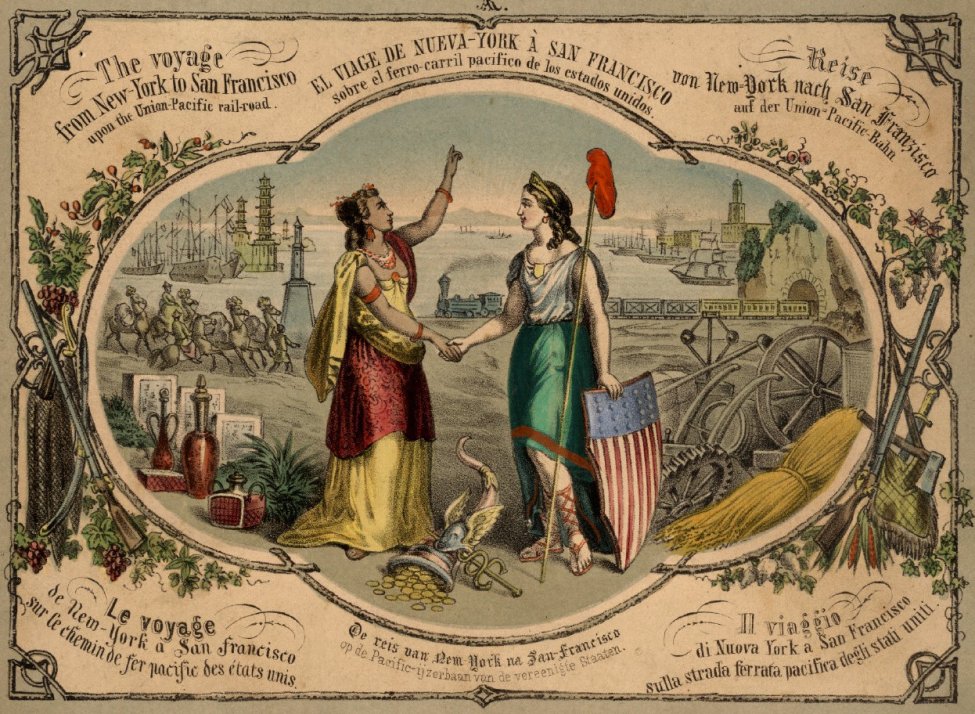
... there is something very peculiar in the below image and its description. Why Asia? Are we talking about India (Indians or Indiens?) or China here?

Voyage from New York to San Francisco upon the Union Pacific Railroad.jpg
This is what in their 1870s opinion the city of San Francisco looked like. Of course, we know that it looked totally different, but they wanted to "educate" the masses, right?
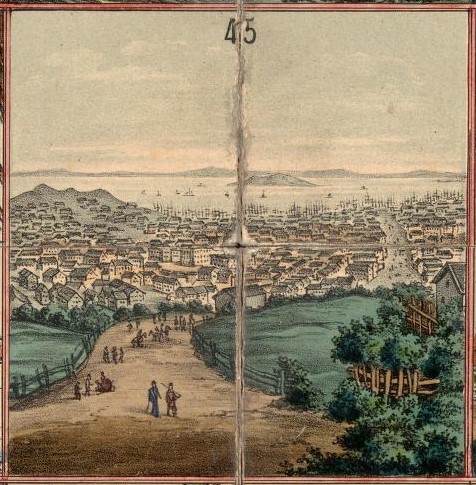
4781002.jpg
And then we have a few other places in between, starting with the NYC.
  • Along the way, we have, among others, views of Pittsburgh, Omaha, "surprise by savage Indians," "wild heard of buffalloes," "railroad bridge over the Platte river," Cheyenne, Green River, Humboldt Valley, "Trukee" Valley, Sierra Nevada and Sacramento.
So we have this trip from New York City to San-Francisco. And then we have these two so-called "women", one representing America and the other Asia.
  • Hence, we somehow ended up with (@Apollyon) pagodas on the way from NYC to SF.
  • Additionally, we (@Plissken) have this Horn of Plenty, and other Roman-Greek type stuff, including one of the women.
So... who lived in San Francisco just prior to the time when this photograph was made?

And one more little detail I have to add to the mix... but this is an interesting one. To understand what I'm talking about you need to disregard our regular "from within the US" orientation, and approach it globally.
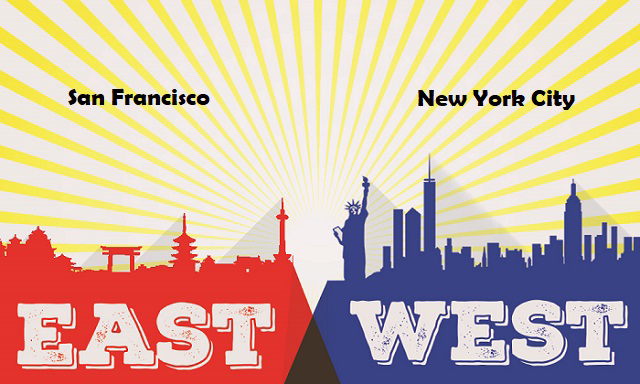
east vs west.jpg

In other words East is West, and West is East, but globally. And here is what we have, as far as city founded-ation goes.

On the Right (West):
  • New York - 1624​
    • New York state - admitted to the Union in 1788
  • Boston - 1630​
    • Massachusetts - admitted to the Union in 1788
  • Baltimore - 1729​
    • Maryland - admitted to the Union in 1788
  • Charleston - 1670​
    • South Carolina - admitted to the Union in 1788
On the Left (East):
  • Vancouver, Canada - 1884, generously​
  • Portland - 1845​
    • Oregon- admitted to the Union in 1859
  • Seattle - 1851, generous date
    • Washington - admitted to the Union in 1889
  • Tacoma - 1875​
  • San Francisco - 1848, ok date
    • California - admitted to the Union in 1850
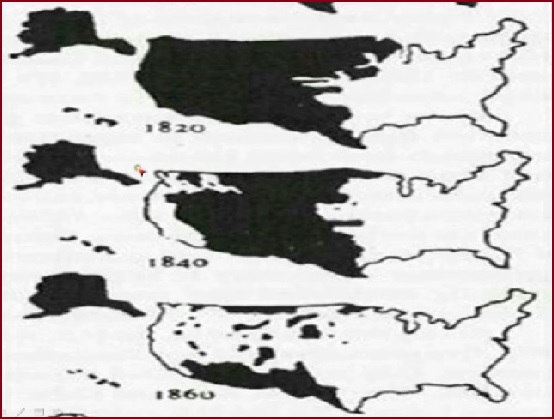
As you can see we have this wonderful ~200 to 300 year long settlement time gap. We do have an official explanation for that, but I do not trust it. Anyways, here is what the advancement looked like.

westward_1.jpg
From Here

Fusang
A country named Fusang was described by the native Buddhist missionary Hui Shen in 499 AD, as a place east of China. Hui Shen went by ship to Fusang, and upon his return reported his findings to the Chinese Emperor. His descriptions are recorded in the 7th-century text Book of Liang by Yao Silian, and describe a Bronze Age civilization inhabiting the Fusang country.
  • The Fusang described by Shen has been variously posited to be the Americas, Sakhalin island, the Kamchatka Peninsula or the Kuril Islands.
  • ...a land almost twenty thousand li, or ten thousand kilometers, away, and ten thousand li, or five thousand kilometers, across. The book also describes plants such as corn and tobacco, habits of aboriginal Americans, and geographical features that correspond so closely to those of Mexico and America’s west coast that you’d practically have to worship Fox News to call it coincidence.
  • The American hypothesis was the most hotly debated one in the late 19th and early 20th century after the 18th-century writings of Joseph de Guignes were revived and disseminated by Charles Godfrey Leland in 1875.
  • The American hypothesis was all but refuted by the time of the First World War.
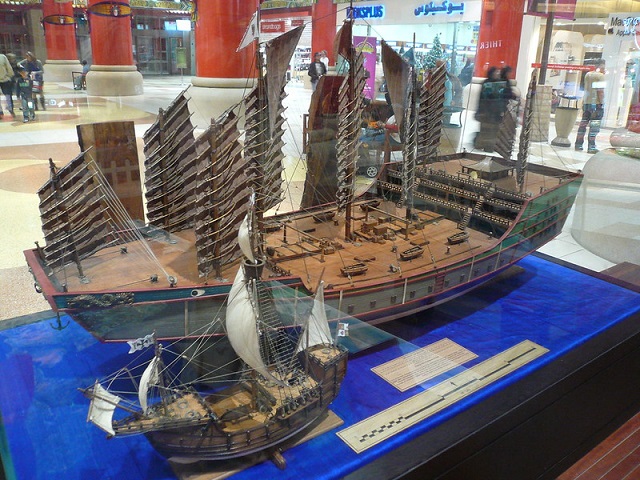
1400s: Chinese/Tartarian ship vs. Columbus's ship
...food for thought...
ZHENG HE vs columbus ship-1.jpg
Source

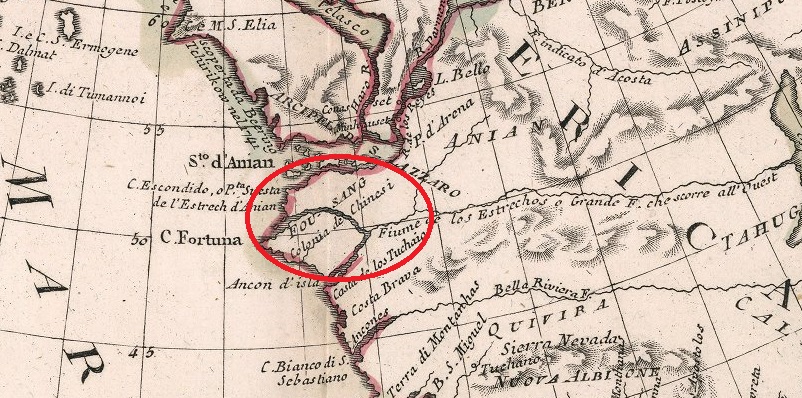
1752 Map
Engraved colored in outline map of the northern Canada, Alaska and Arctic region Map of the northern Canada, Alaska and Arctic region showing glaciers, oceans and sea currents. and sea currents. Philippe Buache (map author) was a French geographer. He was trained under the geographer Guillaume Delisle, whom he succeeded in the Academie des sciences in 1730. Buache was nominated first geographer of the king in 1729.
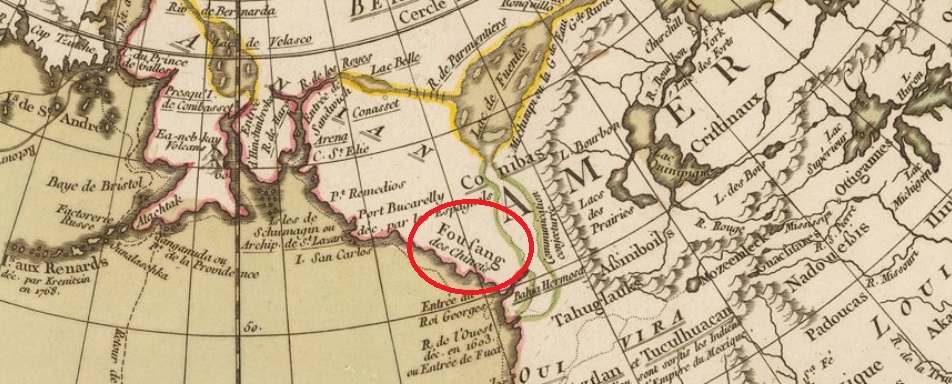
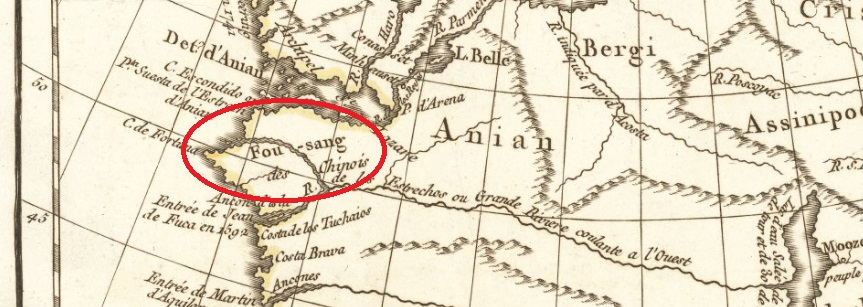
  • This 1753 map by Philippe Buache locates Fusang ("Fou-Sang des Chinois", "Fusang of the Chinese") north of the State of California.
1752-fou-sang.jpg
Source

1776 Map
Engraved hand-colored in outline, double-page map of the northwest coast of North America and northeast Asia including the North Pacific Ocean to the Bering Strait and the Kamchatka Peninsula. Alaska shown by a group of islands off the coast of Russia, identified as Isole Alessiane.
  • There is a notation of the Chinese colony of Fou-Sang in the vicinity of Vancouver Island.
  • Map shows political divisions, cities, towns, coastal towns, mountains and rivers.
1776-fou-sang.jpg
Source

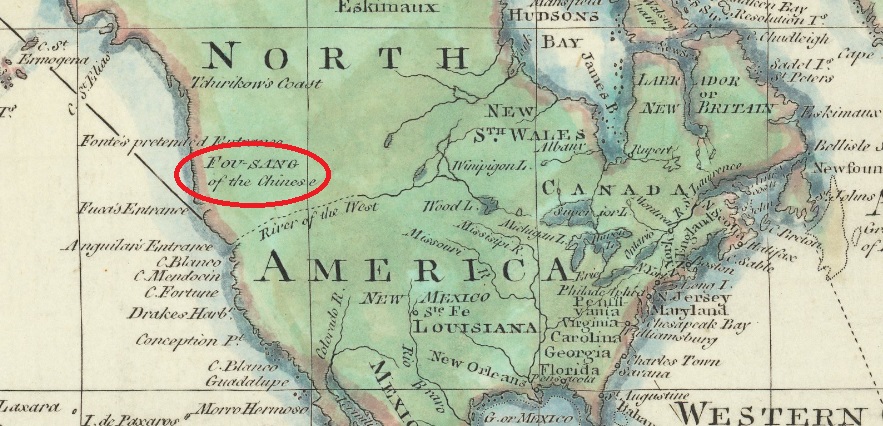
1778 Map
Finely colored map of the world on Mercator's projection, showing the tracks of Captain James Cook's first voyage and shows the "Corean Sea". The map shows a number of fascinating details along the Northwest Coast of America, including:
  • Fou-Sang of the Chinese, a reference to the theory that Chinese mariners colonized America in the late 5th Century that led to the mythical "Fou-Sang".
    • KD: Including 1,200 y.o. info was normal back then, right?
1778-fou-sang.jpg
Source

1781 Map
Rare map of the Northwest Coast of America and Northeast Coast of Asia, showing Cook's Tracks through the Pacific. This map is an updated version of the map which originally appeared in Philippe Buache's rare work, Considerations géographiques et physiques sur les nouvelles découvertes au nord de la grande mer, appellée vulgairement la Mer du Sud, published in Paris 1753-54, one of the rarest and most influential works on the discoveries along the Northwest Coast of America in the mid-18th Century.

1781-fou-sang.jpg
Source

1783 Map
1783-fou-sang.jpg
Source
What I also find interesting about some of the above maps is the fact that some of them have nautical routs going from the Chinese and Russian Tartaries to the west coast of the future United States states of Alaska, Washington, Oregon and California.

So, naturally thinking about this time gap between when east/west American cities/states were founded. Why do we have this time gap? What forces were guarding the western side of the North American continent to prevent it from being occupied by the "Declaration of Independence" Americans? And I think there could be a hypothesis to be made. Before I voice my opinion, there is one more interesting fact to be mentioned.

Anti-Chinese Activities
Now and then we would run into info about those mysterious Chinese smuggling tunnels, as well as other information pertaining to the 19th/early 20th century US West Coast Chinese laborers. Officially the cheap work force inundated Western United States coast starting with approximately 1850s. I guess the California Gold Rush which started in 1848 could be a more precise date. Here is what we have.
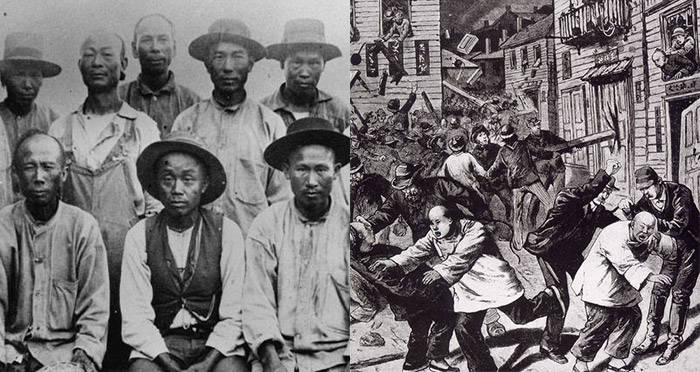
LA Chinese massacre of 1871
The Chinese massacre of 1871 was a race riot that occurred on October 24, 1871, in Los Angeles, California, when a mob of around 500 white and mestizo persons entered Chinatown and attacked, robbed, and murdered Chinese residents. The massacre took place on Calle de los Negros (Street of the Blacks/Black Street) also referred to as "Negro Alley". The mob gathered after hearing that a policeman had been shot and a rancher killed by Chinese. An estimated 17 to 20 Chinese immigrants were hanged by the mob in the course of the riot, but most had already been shot to death. At least one was mutilated, when someone cut off a finger to get his diamond ring. Ten men of the mob were prosecuted and eight were convicted of manslaughter in these deaths. The convictions were overturned on appeal due to technicalities.
chinese-massacre.jpg

Discrimination had been rising against the increasing number of Chinese immigrants living in California. It has been described as a root cause of the massacre. White and mestizo residents of Los Angeles resented the expansion of the Chinese population, considering them an alien group. In 1863 the state legislature had passed a law that Asians (defined as Chinese, Mongolian, Indian, etc.) could not testify in court against whites, making them vulnerable to abuse and injustice, and putting them beyond reach of the law.
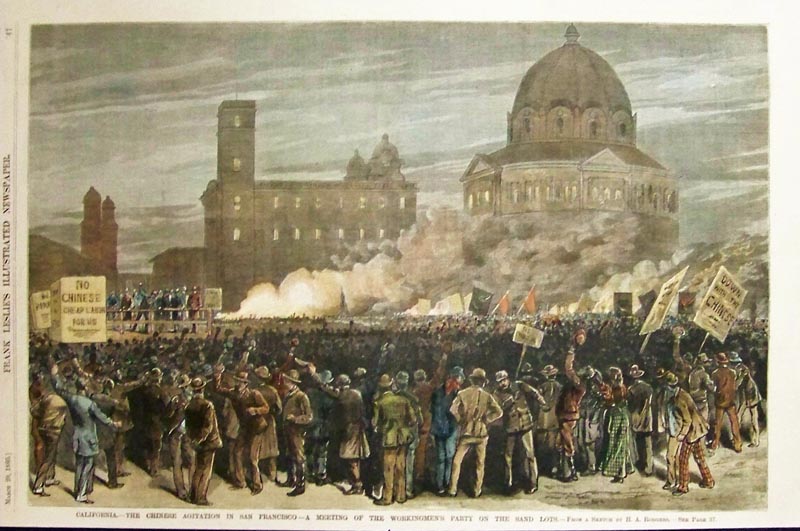
San Francisco Riot of 1877
The San Francisco riot of 1877 was a two-day pogrom (a russian word in 1877 CA?) waged against Chinese immigrants in San Francisco by the city's majority white population from the evening of July 23 through the night of July 24, 1877. The ethnic violence which swept Chinatown resulted in four deaths and the destruction of more than $100,000 worth of property belonging to the city's Chinese immigrant population.
San Francisco riot of 1877.jpg

From 1873 through the rest of the 1870s a severe economic crisis swept the United States of America known to history as the Long Depression. Economic contraction in the eastern United States proved the motivation for many to pull up stakes and try to reestablish themselves in the West coast mecca of California. Indeed, between the years 1873 and 1875 an estimated 150,000 workers made their way to the "Golden State," many of whom settled in the state's only metropolis, San Francisco.

Vancouver, CA anti-Chinese riots of 1886
The Vancouver anti-Chinese riots of 1886, sometimes called the Winter Riots because of the time of year they took place, were prompted by the engagement of cheap Chinese labour by the Canadian Pacific Railway to clear Vancouver's West End of large Douglas fir trees and stumps, passing over the thousands of unemployed men from the rest of Canada who had arrived looking for work.
In January 1886 Chinese workers were camped on the shore of Vancouver Harbour, near the present north end of Burrard Street. Chinese were hired to clear the trees and stumps then still standing in Vancouver's West End, at the usual much lower rate paid to Chinese labour. In January 1886, an angry mob of whites, who had been unemployed and hungry for weeks with no work and angered that potentially-available employment and payscales were undercut by Chinese labour, stormed the Chinese camp in the West End at night, then camped in their tents. Many were injured, and some fled into the icy sea to escape their assailants.
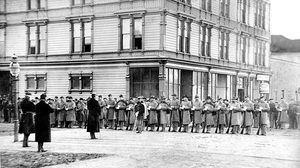
Seattle anti-Chinese riot of 1886
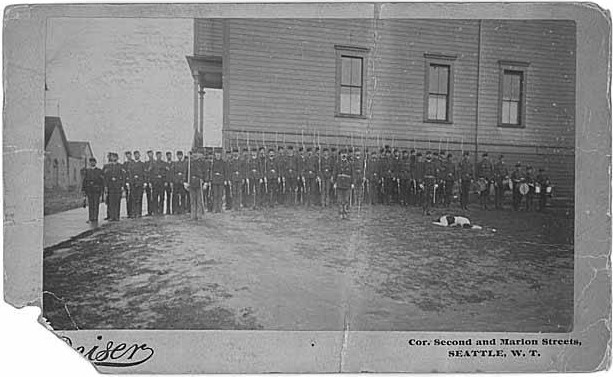
The Seattle riot of 1886 occurred on February 6–9, 1886, in Seattle, Washington, amidst rising anti-Chinese sentiment caused by intense labor competition and in the context of an ongoing struggle between labor and capital in the Western United States. The dispute arose when a mob affiliated with a local Knights of Labor chapter formed small committees to carry out a forcible expulsion of all Chinese from the city. Violence erupted between the Knights of Labor rioters and federal troops ordered in by President Grover Cleveland. The incident resulted in the removal of over 200 Chinese people from Seattle and left 2 militia men and 3 rioters seriously injured.
In the mid-1880s, soldiers were called to the neighborhood around Main Street and what was then still Second Avenue (now Occidental) in downtown Seattle to deal with anti-Chinese agitation.
  • When these soldiers were photographed, the distinguished Pacific House behind them was nearly new. It appears in the city’s 1884 bird’s-eye drawing, thanks to artists who were smart enough to include structures that were only in the planning stage.
    • LOL. It's always fun catching an unrelated construction lie.
seattle-1886-1.jpg

During the 1840s, the California Gold Rush brought many Chinese to the United States. Many had come in the hopes of improving their economic conditions, and their arrival was initially welcomed due to labor shortages. According to information from the U.S. Census, the Chinese population increased at a dramatic pace until 1890, though they never accounted for more than 0.2 percent of the U.S. population through the 1800s.

After the Gold Rush, many Chinese people moved into the northwest territories of Oregon, Washington, and Montana in search of work, especially with the new mining opportunities and railroad expansion. The Chinese workers developed a reputation for being efficient and willing to work long hours, but also for accepting less pay than white workers. This increased racial tensions in the West, as companies recruited Chinese workers in order to undercut higher-paid white workers.

Violent outbreaks against the Chinese occurred as early as the 1860s and continued to intensify in the 1870s, especially in California. As corporations continued to flood the labor market with Chinese workers, many Chinese were excluded from or refused to join unions in the fight against capital, which angered and threatened the white European immigrants who constituted these organizations. Unions such as the Knights of Labor and the American Federation of Labor supported legislation that limited or excluded Chinese immigration. By the mid-1880s, a wave of anti-Chinese violence grew and spread into the Pacific Northwest.
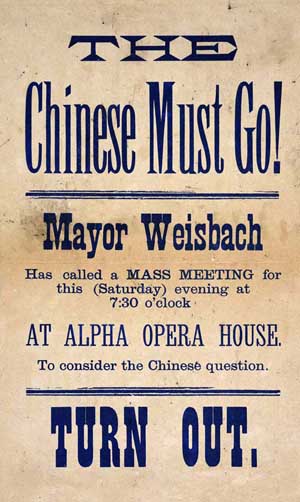
1885 Chinese expulsion of Tacoma
The Tacoma riot of 1885, also known as the 1885 Chinese expulsion of Tacoma, involved the forceful expulsion of the Chinese population from Tacoma, Washington Territory, on November 3, 1885. City leaders had earlier proposed a November 1 deadline for the Chinese population to leave the city. On November 3, 1885, a mob that consisted of prominent businessmen, police, and political leaders descended on the Chinese community. The mob marched Chinese residents to a railroad station and forced them to board a train to Portland. In the following days, the structures that remained in the Chinese community were razed. The event was the result of growing anti-Chinese sentiment and violence throughout the American West.

Tacoma_Chinese_expulsion_poster_1885.jpg

This organized action became known as the "Tacoma method", and despite national and international outcry, it was used as an example of how to forcibly remove Chinese residents from cities and towns throughout the American West. The anti-Chinese sentiment in Tacoma and Washington Territory more broadly made it so that those involved did not face repercussions for their actions.

kd_separator.jpg

KD: Now I'm gonna try to formulate my hypothesis related to all of the above, and then some.
  • I do not believe that the official dating of the Fou-sang colony with 499 AD is accurate. Whether deliberate, or not, such dates have no proper documentation to get backed up. All the documents were either "located", or created after 1400 AD. Fou-sang colony dated closer to 1500-1600s would make way more sense.
    • I think this Fou-Sang colony could be a smoke screen used in the 18th and 19th centuries to misrepresent the presence of something like Tartary in North America.
    • On the other hand, may be Fou-sang citizens were the first ones to reclaim the area after some great 15th century catastrophe.
    • Chinese, Russians and Inide(a)ns were not immigrants. They were natives.
  • In the 1850s, the West Coast was heavily populated with Chinese Tartarians, and Russian Tartarians (taking nautical routes into consideration).
    • Their allegiance was not to the Union.
    • Russian Tartarians were different from the Imperial Russians.
  • The "reasons" cities like San Francisco, Seattle, Portland, Vancouver were established some 200 years after their Eastern counterparts are as follow:
    • These cities were not conquered by the PTB yet.
    • These cities were already there. See this wonderful debate about the 1878 city of San Francisco.
  • The Pacific Coast of the future United States belonged to a different established political system, or systems. Meaning there were either countries, or empires occupying the area.
  • The PTB was at war with the current political establishments occupying the West Coast of the North American Continent.
  • The area was a bloody mess, which resulted in abandoned cities like our San Francisco. Were there any survivors? I do not know.
  • To prevent any unwanted (by TPTB) architectural and/or other questions, our Pacific Coast cities went through a certain "disinfection" process known today as Urban Fires.
  • And if the Pacific area was indeed purged of its population, TPTB had enough tools to get it re-populated.
P.S. We need to remember that Cortes and Pizzarro accompanied by a few soldiers, and armed with allegedly inferior weapons, had no issues conquering millions of Aztecs and Incas. They did so in the beginning of 16th century.

Our narrative compliant indigenous population (Indians per Columbus) of the future United States either had to have some very advanced arrows and tomahawks, allowing for a very effective defense of their territories, or... or the narrative is bogus.
  • May be I live in Fou-sang, and Washington state is just a cover-up name for it.
  • If you spot any 19th century Pacific Coast pagodas, please share.
Note: This OP was recovered from the KeeperOfTheKnowledge archive.
 
I came across a reply I made to this post back in SH1

During the time of Columbus, we are told that, as far as Europe was concerned, China, Japan and India were collectively known as ‘The Indies.’
Columbus' Confusion About the New World
The official story tells us that Columbus believed the distance between Europe and the East Indies to be shorter if he sailed west from Spain.

In 1600 The British East India Company comes along followed by the Dutch East India Company two years later, then we get the French East India Company in 1664. The British Imperialist version had total control of India by 1858 and went on to destroy the former civilisation, not through invasion, but by economic control and a multitude of dirty tricks. China and Japan fell to them later.

By 1600 you would think that all this East India and East Indies confusion would have been sorted out, but apparently not.

Then we get the flag. This was the flag of the The British East India Company between 1668 and 1801

320px-Flag_of_the_British_East_India_Company_(1707).svg.jpg
Source

Then we get The First Official United States Flag at the time of the Declaration of Independence in July 1776. The flag contemporaneously known as "the Continental Colors" has historically been referred to as the first national flag.


Now here we have this board game once again linking America with the EAST and INDIA.

So, it really does looks like there was already a civilisation in America known as The East Indies and the British, Dutch and French all set up companies designed to infiltrate it through commercial skulduggery and the same vicious tactics that were used in India and China.

That board game was a really excellent find.

In 1863 the state legislature had passed a law that Asians (defined as Chinese, Mongolian, Indian, etc.) could not testify in court against whites, making them vulnerable to abuse and injustice, and putting them beyond reach of the law.

This shows that asian people were a significant group within California at that time.

According to Wikipedia:

Terminology
In the Americas, historically, the term "Indian" has been most commonly used to refer to the indigenous people of the continents after European colonization in the 15th century. Qualifying terms such as "American Indian" and "East Indian" were and are commonly used to avoid ambiguity. The U.S. government has since coined the term "Native American" to refer to the indigenous peoples of the United States, but terms such as "American Indian" remain popular among both indigenous and non-indigenous populations. Since the 1980s, Indian Americans have been categorized as "Asian Indian" (within the broader subgroup of Asian American) by the United States Census Bureau.[7]
"While "East Indian" remains in use, the term "South Asian" is often chosen instead for academic and governmental purposes.”

Why East Indian? They have that term as a link and if you follow it, you go to their India page where the term only appears in reference to The East India Company.

From Indigenous, Aboriginal, Fugitive and Ethnic Groups Around the Globe

A number of Indians were brought to the United States by seafaring Captains who worked for the East India Company to serve in their households as servants. Only a trickle of other Indian merchants, seaman, travelers, and missionaries followed, amounting to a total population of less than a 1000 by 1900 ([4], p. 3). Many of these transplants were born in British-ruled in India after having either completed their military service or jumped ship in port.”​

From A historical perspective of Americans of Asian Indian origin 1790-1997, By Srirajasekhar Bobby Koritala:

The earliest record of an Indian traveling to the USA is that of a young Indian man from Madras who may have visited Massachusetts in 1790. As Salem developed its trade with India during the next decade, young Indians worked on the India wharves at Crownshield and Derby, two of the larger shipyards. In 1851, six Indians marched in the Salem Fourth of July parade under the banner of the "East India Marine Society". Most of these men are believed to have married American women of African origin and integrated themselves into that community.

[This society has been officially whitewashed as an American version of The British East India Company.]

This period [1800s] was also witness to burgeoning interest in Indian culture, philosophy and religions among American intellectuals. Ralph Waldo Emerson and Henry David Thoreau studied Indian philosophy and religions with great zeal. Walt Whitman wrote the poem "Passage to India" in 1868. The number of people in Boston who were interested in Indian philosophy and religions grew to the extent that it led to the coining of the term "The Boston Brahmin". "The Rajah's Daughter" and "Cataract of the Ganges" were plays performed at the Boston theater during this period. The song "The Hindu Girl" was quite popular. Not only did the Boston Brahmins read about India, but they also bought Bengal ginghams and other fine goods on India Street. The ships that brought these goods tied up at India wharf. This period of interest in things Indian reached a high point when Swami Vivekananda, a fluent English speaking Hindu monk, addressed the World Parliament of Religions in Chicago in the year 1893. The interest he generated led to the establishment of "The Vedanta Society" centers all across America.”

The Vedanta Society is a poisoned version of Hinduism.

The Boston Brahmins or Boston elite

Descendants of the earliest English colonists, such as those who came to America on the Mayflower in 1620 or on the Arbella in 1630, are often[quantify] considered to be the most representative of the Boston Brahmins.
The doctor and writer Oliver Wendell Holmes, Sr. coined the term "Brahmin Caste of New England" in an 1860 article in the Atlantic Monthly.[3] The term Brahmin refers to the highest-ranking caste of people in the traditional Hindu caste system in India. In the United States, it has been applied [by whom?] to the old, wealthy New England families of British Protestant origin which became influential [when?] in the development of American institutions and culture.

(not my [comments] btw, Wikipedia’s)

Many of the Brahmin families trace their ancestry back to the original 17th- and 18th-century colonial ruling class consisting of Massachusetts governors and magistrates, Harvard presidents, distinguished clergy and fellows of the Royal Society of London (a leading scientific body), while others entered New England aristocratic society during the 19th century with their profits from commerce and trade, often marrying into established Brahmin families.” Source

This really sounds to me like in-your-face taking the p*ss. The original Asian East Indian Brahmins of New England (which I’m sure had another name then) got infected by the colonial interlopers - the Pilgrim Fathers advance scouting party. This is exactly what happened in India, except it was the Jesuits not the Quakers.

From Boston Brahmin Origin:

some men in these families became eventually known as Merchant Princes in history.
"Holmes also coined the phrase Hub of the Solar System, which to this day is still a nickname for the city of Boston, although modernized to The Hub of the Universe or compressed to just The Hub."

From the comments on that page:

Some of the attributes of Boston brahmins like intellectual pursuit, strict moral conduct, selfless service to the society (praying for the welfare of all the living beings), etc were true of the brahmins of Hindu society. One noteworthy exception is, the brahmins were never known as wealthy class. Rather, a poor brahmin was proverbial. This was in tune with pursuit of knowledge, service, striving towards realization of Brahman (the supreme consciousness), etc. Among the six scriptural duties ( shatkarmas) of brahmins were pursuit of knowledge through studies and teaching the larger community."
Caste in philosophical Hinduism is by inclination and not birth.”

From Do you know how India got her name as “Bharat”

“the name Bharata is derived from the ancient Indian texts, the Puranas which refers to the land that comprises India as Bharata Varsam. They used this term to distinguish it from other varsas or continents.
“Amazing is that this Bharat Empire i.e. Bharatvarsha or India includes [included] the present day of Pakistan, Afghanistan, China, Iran, Tajikistan, Uzbekistan, Kyrgyzstan, Russia, Turkmenistan, North-West Tibet, Nepal and Bangladesh.

am-map.jpg
Source

From The Naming Of America: Fragments We've Shored Against Ourselves

This map is the first known map, printed or manuscript, to use the name America, and also the first to depict clearly a separate western hemisphere, with the Pacific as a separate ocean. The entire New World portion of the map roughly represents South America, and when later mapmakers added North America, they retained the original name; in 1538, the great geographer Gerard Mercator gave the name America to all of the Western Hemisphere on his Mapamundi.”

This webpage has an interesting take on the discovery of the New World.
The Naming of America

SH2​

There used to be a remarkable blog by an Indian sea captain who knew a great many things - all totally unsubstantiated, but interesting all the same. The link I have has now vanished, however I found this in some old notes:

"Hey, Rotshchild even created Brahmins in Boston USA - called Boston Brahmins.
TO QUALIFY YOU HAD TO BE A OPIUM DRUG RUNNER."

http://ajitvadakayil.blogspot.in/2010/12/dirty-secrets-of-boston-tea-party-capt.html
 
What did California mean? A Calif is an area. Waki says this: "describes a fictional island named California, ruled by Queen Calafia, east of the Indies.[ " about California being named after a fictional place, that would sit exactly where the writer dreamt it up to be.
 
I have a piece of information that may be interesting for this topic.
  • An unusual board game based on the "new Union Pacific Railroad".
The cover of the game box has a beautiful color lithographic view of two women joining hands on the American continent, one representing America and the other Asia (India).
  • A country called Fusang was described by the native Buddhist missionary Hui Shen in 499 AD as a place east of China.
Fusang is 20,000 li eastward from the country of Dahan (literally 'great Han'), and situated in eastern China (literally, 'half a country'). [...]
In ancient times, the people of Fusang knew nothing of the Buddhist religion, but in the second year of Emperor Da Ming of the Liu Song dynasty (485 AD), five monks from Kipin (Kabul, in the region of Gandhara/Afghanistan and Pakistan today) traveled by ship to that country. They propagated Buddhist doctrine, distributing scriptures and drawings, and advised people to renounce worldly attachments. As a result, the customs of Fusang changed. Fusang - Wikipedia

HB: I'm not sure about that time frame, but I imagine these Buddhist monks from Tibet perhaps the way they were presented more recently, with those huge rosaries (Yapa Mala). Japamala - Wikipedia
It is used in the Buddhist tradition, mainly in Tibetan schools, for the recitation of mantras.
Sikhs also pray and meditate regularly by repeating the Naam (the name of God), or some mantra, such as the biya mantra "Sat Nam" ('eternal name') or "Wahe Guru", often with the help of a beaded rosary or yapa-mala. The founder of the religion, Guru Nanak, is often portrayed with a mala in his hands and around his neck.
Etymology: from the verb yap, 'to say in a low voice, to mutter (especially prayers or incantations), to pray in a low voice'.
Similar objects from other religions bear some parallels to the mālā, such as the rosary, the Christian prayer cord or the Muslim tasbih. I feel that this rosary of beads may be related to King Tartarrax of Quivira. SH Archive - 16th century Tartarian King Tartarrax ruled Quivira Regnum in North America

109468614_1437297483143882_7863536218209358687_n.jpg
Now let's go to Mexico, the traditional costume of Mexican women is known as the "china poblana". China poblana - Wikipedia
The origin of the costume as well as the peculiar name in a kind of legend:
It is the nickname of an Asian slave belonging to a noble lineage of India, whose name was Mirra, who was attributed since the Porfiriato the creation of said costume of "china poblana". When she arrived in Mexico she was named Catarina de San Juan.
According to wiki, at this time it was common to use the term 'Chinese' to refer to people of Asian descent, regardless of their actual ethnic origin.
The personality of the china poblana that became a national emblem
The attributes of good cook, religious devotee and embroidery expert were promoted as the ideal of the good Mexican woman of the late nineteenth and early twentieth centuries.
She added a personal touch to her way of dressing.
She was already a Catholic before arriving in Mexico.
She is sometimes referred to as a Mogul princess.
The poblano origin of the dress of the Chinese poblana has been questioned on many occasions. In fact, the chinas are well defined as a popular type in the 19th century, a little more than a century after the death of Catarina de San Juan alias Mirra.
In the same 19th century, the portrait of La china by José María Rivera for the book of customs Los mexicanos pintados por sí mismos (1854) pointed out that this character could be seen in the trajineras of Santa Anita Zacatlamanco competing in beauty with the flowery sowing fields of the countryside of the Valley of Mexico. A decade earlier, Manuel Payno had pointed out that to find the authentic china, it was necessary to search in cities such as Puebla or Guadalajara.
HB: This costume seems to have been popular for half a century in Mexico.

800px-Fuente_del_Salto_del_Agua.jpg
Un fandango mexicano del siglo XIX..jpg
Los mexicanos pintados por sí mismos..jpg
China_poblana.jpg

It is said that the partner of the "China Poblana" were other characters known as "Chinacos". They are the Chinacos who over time become the famous Mexican Charros, they participated in every war that Mexico book that they are allowed not to take off their hats to any military authority. Chinaco - Wikipedia, la enciclopedia libre

HB: The first Chinacos have a very oriental look and that hat and pants reminds me of the Samurais.

Chinaco_Vestimenta_(1861).jpg
Chinaco Clothing (1861)
Chinacos was the name given to Mexican liberal guerrillas during the War of Independence, the war against the United States and the French intervention in Mexico. They distinguished themselves for their courage and skill despite their lack of military discipline.
During the independence struggles in rural communities of strong Spanish influence, some insurgent guerrillas from the south of the Mexican Republic, recognized for their courage in combat, received this name, which for many is an invention, or it was because some Mexicans had indigenous influence, which caused them to have Asian eyes.

HB: How curious that these men had slanted eyes, it is too much of a coincidence.

chinaco y su china.jpg
A chinaco and his China
A national hero used to dress like a Chinaco: Vicente Guerrero Vicente Guerrero - Wikipedia

The clothing of the chinacos, who wore colorful sarapes, was similar to that of the Andalusian campero. With a hat similar to the "castoreño", but with wider brims, and long blanket trousers covered by another pair of suede pants, open on the outer sides, which were fastened by a buttoning that gave rise to the one later used by the "charros", the "chaparreras", which at that time were a little more similar to the "chinaco", but more ostentatious. He used the reata de ixtle (ixtle rope) to herd cattle, and in combat he used the lance for his fearsome cavalry charges. Another characteristic was the use of a handkerchief knotted on the head.
There were some Indians of the north of Mexico with Paliacates.

In the style of another national hero: Jose Maria Morelos y Pabon. José María Morelos - Wikipedia

morelos cuautla.jpeg
Here Morelos is seen in the battle called: Siege of Cuautla, Morelos. This city appears to have a fort in the shape of a star and coincidentally next to a river. Siege of Cuautla - Wikipedia

Mapa_Cuautla.jpg
Morelos had a banner that reminds me of the Pirates flag, although it is a very frequent symbol in the Mexica culture, I even remember reading that the Aztec-Mexicas were after the fall of the famous pirates that attacked the Spanish ships loaded with gold.
The flag was called "The mourner of Hidalgo", this flag does not appear in wiki, they say it was the mourner of Hidalgo, for the recent execution of those who initiated the independence but also coincides with the place where Morelos came from, which is between the states of Morelos and Hidalgo.

82227766_10158177067841454_4239733131810177024_n.jpg
morelos.jpg
83033291_10158177096391454_1200979723337859072_n.jpg

It is said that the "China Poblana" was born in Cochin, a city in the south of India and that she was also evangelized to Catholicism in Cochin. I remember that in an atlas of flags, Imperial China and Cochin China appear as flags for China once Tartary disappeared from these atlases of nations.
Also the word for "Chinaco" sounds like China-Cochin to me.
It would take a map of the time to see what nations made up Asia. And it turns out that there is Great Tartary, Independent Tartary, Tartar China, China, Mughal Empire (Tibet), India.

1865 cochin china.png
1865

Flags_of_all_nations_1865 - copia.jpg
1865

14.png
15.png
1716

1702 Willdey, George. asia-europa.png
1702 Willdey, George.
About this way of dressing in Mexico, it turns out that the same thing happened all over South America.

  • In Argentina the women of the countryside, when their partner refers to them, they are called "mi china" even today and it comes from the colonial times, and regarding the dresses they are very similar. It would be necessary to compare paintings and engravings to be more exact.
In the Argentinean movies of the thirties there was the phrase "She went to Cochin China".
In Argentina, the china was the gaucho's wife.
In Argentina we also hear in the gaucho history that the gauchos, the gauchos, when referring to their partner, used to say "mi china".
  • In chile the female folklore costume is called: "vestido de china", the peasant woman is identified as "chinas".
  • In Colombia children are called "chinos", it is common to say "en la china" and "la conchinchina" to refer to a very distant place.
The Mexican Chinacos dress just like the traditional Colombian peasants. Much of the music of this region is very similar to traditional Chinese music. The indigenous people in the Colombian Amazon also have Asian features.
In (cundinamarca) Colombia they called strangers Chino and china.
  • In Peru the Creole adults refer to women as "china" with affection and appreciation, the characteristics of these ladies are like those of the China Poblana, the chinaco reminded me of the famous radiant and elegant mounted chalán.
  • In Bolivia many have Asian features, half robust with slanted eyes.
  • In Guatemala chinas are the ones who take care of small children.
  • In Brazil, in the state of Rio Grande do Sul, the traditional gauchos call their women Chinas. Chinas' dresses are also long and colorful.
  • In Paraguay he also calls his wife, che china = in Guarani it means my china.
HB: It is curious that a great part of Latin America uses the same denomination, there must be some kind of connection. The chinacos were excellent fighters in spite of not having military training, everything indicates that they were martial artists. The Chinese were already in America before in the old world order? (Tartary for lack of a better name) Ethnicities were mixed, there were many blacks and Orientals in America?
It is not surprising the customs in both countries, all the province of Cuyo and all Patagonia was Chilean, the peasant woman dressed in that dress with skirt, is called China, an aspect that even today could not be ignored; part of the American people have oriental physical features, starting from the low and wide frame, square body, broad head, straight hair and the most distinctive, slanted eyes. Therefore, it is easy to guess the reason for such a nickname "China", putting themselves in the place of the Spanish aristocracy and then mestizo, they will have been contemptuously called Chinese, like the Indian men. Just as there is the term sambo or mulatto, I believe that this topic goes something like that. But undoubtedly, there is some underlying theme, the overlapping of two or more castes, in the Indian style.

I also feel that if we follow the path of the warriors called: Hussars or "Polish Angels of Death", we will also end up in America. It is only a question of going forward in time and we will see how these warriors also ended up in America. Hussar - Wikipedia
  • The Polish Angels of Death remind me so much of the Apache feather headdress.
apaches.jpg
2.jpg


800px-thumbnail.jpg
Confederate hussar from the 1st Virginia Hussar - Wikipedia
 
Last edited:
engagement of cheap Chinese labour by the Canadian Pacific Railway to clear Vancouver's West End of large Douglas fir trees

And yet immediately next door

the park board didn’t leave much of the park in a truly natural state. There is very little old growth forest in Stanley Park. In nature, the park had a mix of trees, but over time the park board replaced many of them with Douglas firs.

“There was this argument that Stanley Park was this little island of forest, it couldn’t sustain a healthy northwest coast forest, so what the park board should do is remove all the hemlock and spruce, and replace it with Douglas fir, which they thought was more resilient for park purposes, and looked nicer,”
Stanley Park, the natural wonder of Vancouver, was shaped by humans


https://www.thesundayhistorian.ca/post/trees-of-british-columbia

Deep within Vancouver’s Stanley Park, there once existed a grove of immense trees known as the “Seven Sisters”. The grouping consisted of seven impossibly tall Western Red Cedars and Douglas Fir. For a time, it was one of the park’s most popular attractions, drawing revellers from the end of the nineteenth century until the mid-twentieth century. The trees were ultimately deemed dangerous as the copse's many visitors walked on their roots. The “Sisters” were cut down in the 1950s

From the first link there is also this.

The most popular tourist attractions today are the totem poles.

The first four poles were brought down from the North Coast in 1924 and erected at Lumbermen’s Arch by the Arts and Historical Society — ironically, about the same time the park board was in court trying to evict the last natives living in the park.

“They had two sets of prejudices,” said Barman. “One was that they didn’t like indigenous people as such. Secondly, they thought the ones from the North Coast were eminently superior, in part because they were further away, in part because they built really nifty totem poles. So they started collecting totem poles.”

The totem poles were moved to Brockton Point in 1960. Several more poles have been added over the years


Stanley Park, Vancouver, BC
first artists to wide recognition for their totem poles commissioned by museums, cities
 
Tips
Tips
Please respect our Posting Rules.
Back
Top