- Joined
- Nov 17, 2021
- Messages
- 320
- Reaction score
- 2,018
PART ONE: INTRODUCTION
Some of the most interesting posts here are the deep dives on specific cities and buildings. New Orleans, Louisiana is a very special place and deserves to be examined, so I would like to start a thread about it, which I have divided into five parts as I have unearthed a lot of surprising information.
First, the official story. Louisiana was supposedly first explored in the late 17th century by Le Moyne, Sieur d'Iberville. Okay, we're one sentence in and we've already been lied to. Columbus found Cuba in 1492 but it took them two hundred years to follow the coast a few hundred miles north? My theory is that by starting the story off with a bald-faced whopper like this the mind is flash-hypnotized and primed to accept anything. The genius hypnotist Milton Erickson used to do this. When he met people he would just grab their arm unexpectedly to paralyze the conscious mind, utter a command, and presto, instant hypnotic induction.
New Orleans was supposedly officially founded in 1718. Louis XIV had died in 1715 and France was being ruled by his nephew and son-in-law, the Duke of Orleans. The kingdom was broke (supposedly because Versailles cost so much to build) so he and the "Scottish" banker John Law (made Controller General of Finances by Orleans) hatched a plan. Let me add in passing that Law is an important historical character who is credited with inventing paper money in its modern form.
 Years ago I dove deep on Law and remember reading a paper somewhere making the case that he was actually a Sephardic crypto-Jew. Sorry, I've lost the reference. In any case he is spooky as hell. Let me add that I am still not sure that any of these people really existed. The story goes that Law and Orleans decided to sell shares in a colonial enterprise in Louisiana. This was the East India Company M.O. and the suckers bit on it every time the scammers rolled it out. They still do. Law and Orleans put posters up all over Paris showing friendly Indians presenting settlers with platters of gold and diamonds in front of a mountain. I have tried to find a copy of this poster but have only succeeded in finding descriptions of it. The "Mississippi Company" ad campaign is considered to be the very first example of modern marketing (hypnosis) on record. The suckers of Paris lined up to give Law and Orleans their gold in exchange for paper shares in the company. The only problem is that it was all a complete lie. There are no mountains in Louisiana. It's completely flat. There is no gold. There are no minerals. What there was in Louisiana was alligators, snakes, yellow fever, and Indians (and maybe a few ruined cities, more below). The weather in New Orleans is tropical for half the year. It's very hot and humid and swampy and unhealthy. Law and Orleans knew this because they had received reports from Iberville and other settlers.
Mississippi Company - Wikipedia
To keep the con going, Law and Orleans had to maintain plausible deniability. They filled a few ships up with hookers and convicts and sent them to the mouth of the Mississippi, where the local Indians had pointed out a propitious site for a city. New Orleans is still called the "Crescent City" because it sits in the middle of a huge round crescent bend in the river a few miles upstream from the mouth. A few miles to the north is Lake Pontchartrain. Pay attention to the grid right above the I in "River". That's the French Quarter, supposedly the historical kernel of the city. We will come back to that.
 Before continuing with the official history of the city, I would like to make a brief digression about the site. In another thread, I bring up the theory of a Russian blogger named Yyprst that there are certain geoactive sites on Earth from which energy radiates upwards. He suggests that large river bends curve around such sites. Well, New Orleans fits the bill perfectly. There is another very unusual detail here. In Grid of the Gods, Dr. Joseph Farrell argues that the power nodes on the surface of the Earth follow a certain geometry. Now, it so happens that both the latitude and longitude of New Orleans line up exactly, and I mean exactly, with two of the most important ancient sites Farrell discusses. The first is the Giza pyramid complex. Look at Google Earth. The latitude line upon which the Great Pyramid is situated cuts straight through the center of New Orleans. Let me say right away that I am highly skeptical of anything pyramid-related. It looks to me like they were built in the early 17th century. However, that doesn't mean that they aren't "real" in the sense that they don't have a real energetic function. I don't buy the hypothesis that they were just built to fake people out. The second site that lines up with New Orleans is the Tikal temple complex in Guatemala. Here the match is not quite so perfect, with the longitude line hitting about five miles to the east of the city, in the Gulf of Mexico. Still, this is startling and suggests the possibility that New Orleans is situated on a very active and important site on the Earth's surface. New Orleans has the reputation of being a "magical" place and I can confirm that there is something very unusual about the energy there, although of course this is a purely subjective datum.
Wikipedia gives us this artist's rendition of pre-colonial New Orleans with no source. We have an earth mound with a rudimentary ball pasmoid generator temple on top. After checking, I see this is actually a site in Alabama.
 Back to Law and Orleans. In 1720, the suckers in France finally catch on to the con. The value of their shares drops from 10,000 pounds to 500 pounds and the crypto-Jew Law flees France with a bag full of ca$h. He dies in Venice.
Everyone involved with the founding of New Orleans appears to be a spook. The Count of Pontchartrain, after whom the huge lake that forms the northern boundary of New Orleans is named, was the Navy Minister under Louis XIV and director of the East India Company from 1690 to 1693. He died in 1727 so was around for this episode.
If these people are even real.
Louis Phélypeaux was born on 29 March 1643 as son of Louis I Phélypeaux de Pontchartrain, and became an advisor to the Parliament of Paris by request on 11 September 1660. On 16 June 1677, he bought the post of First President of the Parliament of Brittany. (...) On 25 April 1687, he was recalled to Paris at request of king Louis XIV to become Controller-General of Finances, which began his career as minister. (...) From 6 November 1690 to 2 July 1714, Louis became Secretary of State of the Maison du Roi (Chief of the King's Household), and from 6 November 1690 to 5 September 1699 became Secretary of State of the Navy. From 13 November 1690 to 27 December 1693, Louis became Perpetual Head, President, and Director of the East India Company. (...) Phélypeaux served as Chancellor of France from 5 September 1699 to 1 July 1714.
So...this guy is big time. I notice some spookery in the numbers. Why do they include all these dates that no one cares about if not to signal stuff? Otto Didactic at Its-All-Fake claims that for spook signaling purposes, the number 1 can be read as whatever other numbers are next to it. The big spook numbers are of course 33, 77, 13 (33), 47, and 666 as well as any doubled or tripled numbers. Nine and six are interchangeable. So September 11, 1660, becomes 9/11/1660, which becomes 666666. Next we have June 16, 1677, which becomes 6/16/1677 or 666677 (or 666 77 if we write the date as 6/16/77). Finally we have November 6, 1690, which becomes 6/11/1690 or again 666666. Of course you have some other dates in there that seem to have no numerology attached. Maybe this is all delirium but I have seen enough evidence that spooks really do use these codes (the 33-saturated corona rollout being the most obvious), so who knows. In any case, we know this guy is a spook anyway because he was the head of the East India Company.
Short version: New Orleans was founded by a crypto-Jewish con artist banker (Law), the former Navy Minister and head of the East India Company (Pontchartrain), and the Duke of Orleans, who in addition to being regent of France also happened to be "Grandmaster of the Ordre du Temple", in other words, the head of the Templars. You could not find a spookier group of conspirators.
Back to the story. What's left after the bubble bursts in 1720 is a small little fortified town measuring six by eleven blocks, built next to the river.
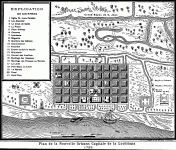
Here’s a map from 1718-20, marked 1728 and only published in 1753. What's the real date? Who knows. We see five horizontal blocks by nine vertical blocks. There is a building called “Government” that is separated from the city to the left. It does not appear on later maps. I think I know what this building is, and we will come back to it in Part Four.
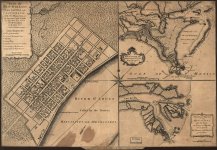
 Here's a map from 1720 with four horizontal blocks and eleven horizontal blocks, published for some reason in 1759 in London. Somehow we lost a horizontal block while gaining two vertical blocks.
 Next is 1728. Dedicated to the India Company. Now the city measures six by eleven blocks and has a fort.
 Here’s a map dated 1731. But it’s missing two horizontal blocks. I guess it's older.
 Let's jump to the city in 1798 now:
 The fort is different here and we picked up a few blocks, but it's still basically the same. The "Government" building is also gone. This "original" fortified village is today the French Quarter, where tourists go to drink Hurricane cocktails, barf in the gutter, and get robbed. I suspect that most of the French Quarter, now considered the historical heart of the city, was indeed built when they say it was. The buildings here are almost all old two- or three-story brick or wooden colonial buildings with galleries. It's very charming and picturesque. I say “almost” because there are at least two buildings in the French Quarter that strike me as possible salvage jobs, one of which might be the “Government” building that disappears after the first map. I will get to that. But first I want to point out something unusual. In senenty years the city doesn't grow at all. That's strange and now strikes me as a possible continuity error in a fabricated story. In that time Louisiana passes From French to Spanish control (in 1762), suffers two Great Fires (in 1788 and 1794), then passes back to France under Napoleon (in 1800), who turns around and sells it to Jefferson (in 1803).
Let’s look at the fires. The first one occurred on Good Friday, March 21 (3/21 which can be reduced to 33 or 322) at 1:30 PM (13 or 33), at 619 Chartres St. (666) and destroyed 1100 buildings (11). "Because the fire started on Good Friday, priests refused to allow church bells to be rung as a fire alarm." I can't believe I used to swallow stuff like this. What a joke. I guess this is just gratuitous mockery of Christians. At the Wikipedia entry we also get an overly dramatic description of the fire that sounds like fiction.
Great New Orleans Fire (1788) - Wikipedia
When you go to the Wikipedia entry for the 1794 fire, they tell us that the 1788 fire took place on March 12, not March 21. Busted. The date is made up, all that matters is that it adds up to 33/322. 12, 21, same difference. Also, the number of buildings that burned down is not the same in the two entries. Either this is a basic continuity mistake or the spooks are mocking us. I vote for the latter. I’ll be curious to see if it gets fixed soon.
Compare the following passages. First, from the 1794 fire entry:
The fire started on December 8, 1794, and stretched across 212 buildings, including the royal jail, though it stopped short of the riverfront buildings facing the Mississippi River. Among the buildings spared were the Customs House, the tobacco warehouses, the Governor's Building, the Royal Hospital, and the Ursulines Convent.
Now, the 1788 fire entry:
The fire area stretched between Dauphine Street and the Mississippi River and between Conti Street in the south and St. Philip Street in the north. It spared the riverfront buildings including the Customs House, the tobacco warehouses, the Governor's Building, the Royal Hospital, and the Ursuline Convent.
Busted again. The same five buildings in the same order were spared each time. The 1794 fire is just a fake copy of the also fake 1788 fire. I love catching the scriptwriters getting lazy and messing up the continuity.
Like San Francisco, New Orleans then has a suspicious “boom” period. From Atlas Obscura:
In 1803, when the United States bought New Orleans, along with the rest of the land in the Louisiana Purchase, the city had only about 8,000 people living in it. Planned on a tight grid, the city stretched just eleven blocks along a curve of the Mississippi River and six blocks back from the levee, to Rampart Street.
A little more than three decades later, New Orleans had become a world port, and in 1836 edged out New York City as the busiest export center in the United States. The population had grown to more than 60,000 people—many of them Anglo-Americans who, to the alarm of the city’s Francophone natives, had flocked to the port to make their fortunes.
For 15 Years, New Orleans Was Divided Into Three Separate Cities
That was fast. From a few shacks to a port bigger than New York in...how many years was that? Oh yeah, thirty-three.
The population of New Orleans doubled in the 1830’s and by the 1840’s the population was approximately 350,000, almost half of which were people of color or slaves, making it the fourth largest city in the United States at the time.
New Orleans's Golden Age
I would like to pause here and shift gears. Over the course of the next few posts, I will examine the classic “Stolen History” hypothesis, namely that all this is a coverup for the fact that New Orleans is a rehabilitated remnant city. When I first encountered the hypothesis that the New World had actually been recolonized with cities empty but more or less intact after either a natural catastrophe or a war using some kind of energy weapons (in my opinion the latter hypothesis is more probable), I immediately checked out New Orleans, but after looking at old maps and drawings, I told myself that the idea was crazy and forgot about it. Now I think it's possible that I just got my ass fooled by a handful of fake maps that could have all been fabricated in about a week and retroactively inserted into the archives, so I am revisiting the New Orleans file with more experience as a "researcher" under my belt, even if I do not feel worthy of that title yet.
If the Stolen History hypothesis is true, we ought to find out that the history of New Orleans was fudged, if not fabricated, to fit the recognizable buildings that we see in the first photographs from the 1850's. In other words, they started with the real city and retroactively created or modified a series of maps and photographs that would explain how the city went from being a little fort to one of the biggest and richest cities in the United States, complete with monumental architecture, in just thirty years.
The first obvious possible reset date is 1803, when the US took control of Louisiana. Here once again we have one of those magic dates right around 1800 in which "everything changed" because of Napoleon. The second obvious one is 1815, the date of the Battle of New Orleans, said to be the final battle of the War of 1812. You could probably ask a hundred educated New Orleanians to explain the Battle of New Orleans and the War of 1812 and no one would be able to tell you anything beyond “Andrew Jackson”. This war is some kind of black hole. I have no cognitive mapping for it whatsoever. Right off the bat at Wikipedia we get spook signaling. The battle took place on January 8, 1815. That’s 1/8, aces and eights, fake event code according to Miles Mathis. Remember, Moscow got nuked with some kind of DEW in 1812. Supposedly the Battle of New Orleans was more like a little skirmish that took place five miles outside of the city. Is this a cover story? Was the Battle of New Orleans bigger than we are told? Was New Orleans an important city that was also nuked in 1815 and then rebuilt? Were the French, British, Americans, etc. just squabbling over the postwar partitioning of New Orleans after they had collectively eliminated the “Tartarians”, a word which I simply use as shorthand for “whoever was there first and lost the war”? Kind of like Berlin in 1945, with French, American, British, and Soviet sectors? Were the “Creoles” the descendants of the original people who lived there? In New Orleans, “Creole” historically functioned as a catch-all term for anyone of any color with mixed non-Anglo heritage, with every possible variation of Black, Indian, French, Spanish, etc. present in the city. Still today one can find a lot of “light-skinned blacks” with blue or green eyes and “Indian” features, all on the French Quarter side of town. Some of them even still speak French (not many). I put “black” and “Indian” in quotation marks because I am not sure they are accurate terms. The Anglo-Americans were known for imposing strict racial segregation once they took over in 1803. It is almost as if one of their first jobs was organizing the mixed-race people they found there into fabricated categories based entirely on skin color and pitting them against each other: divide et impera. In other words, perhaps the multiracial Creoles were remnants of the previous civilization, and only later were they separated out into artificial racial groups and given new collective identities. As I once heard an older light-skinned black man joke on a bus, “Ain’t nothin pure come out of Louisiana”. The existence of the Mardi Gras Indian culture might also be an artifact of this original (botched) triage:
Mardi Gras Indians (also known as Black Masking Indians) are black carnival revelers in New Orleans, Louisiana, who dress up for Mardi Gras in suits influenced by Native American ceremonial apparel. Collectively, their organizations are called "tribes". There are about 38 tribes which range in size from half a dozen to several dozen members. (...) Mardi Gras Indians have been practicing their traditions in New Orleans at least since the mid-19th century, possibly before. The history of the Mardi Gras Indians is shrouded in mystery and folklore.
Mardi Gras Indians - Wikipedia

This is not some kitsch costume thing. These people trace their history back to the Indians and take it seriously.
This is just an introduction. In Part Two we will begin to look at some old photos and hard evidence for an architectural coverup.
ADDED: I found a few very unusual Dutch caricatural engravings of John Law and his financial shenanigans. They have that "Roman"/pagan/Piranesi/"world before" look. I can't read them, but maybe someone else can. Perhaps there's something interesting here:


Some of the most interesting posts here are the deep dives on specific cities and buildings. New Orleans, Louisiana is a very special place and deserves to be examined, so I would like to start a thread about it, which I have divided into five parts as I have unearthed a lot of surprising information.
First, the official story. Louisiana was supposedly first explored in the late 17th century by Le Moyne, Sieur d'Iberville. Okay, we're one sentence in and we've already been lied to. Columbus found Cuba in 1492 but it took them two hundred years to follow the coast a few hundred miles north? My theory is that by starting the story off with a bald-faced whopper like this the mind is flash-hypnotized and primed to accept anything. The genius hypnotist Milton Erickson used to do this. When he met people he would just grab their arm unexpectedly to paralyze the conscious mind, utter a command, and presto, instant hypnotic induction.
New Orleans was supposedly officially founded in 1718. Louis XIV had died in 1715 and France was being ruled by his nephew and son-in-law, the Duke of Orleans. The kingdom was broke (supposedly because Versailles cost so much to build) so he and the "Scottish" banker John Law (made Controller General of Finances by Orleans) hatched a plan. Let me add in passing that Law is an important historical character who is credited with inventing paper money in its modern form.
Mississippi Company - Wikipedia
To keep the con going, Law and Orleans had to maintain plausible deniability. They filled a few ships up with hookers and convicts and sent them to the mouth of the Mississippi, where the local Indians had pointed out a propitious site for a city. New Orleans is still called the "Crescent City" because it sits in the middle of a huge round crescent bend in the river a few miles upstream from the mouth. A few miles to the north is Lake Pontchartrain. Pay attention to the grid right above the I in "River". That's the French Quarter, supposedly the historical kernel of the city. We will come back to that.
Wikipedia gives us this artist's rendition of pre-colonial New Orleans with no source. We have an earth mound with a rudimentary ball pasmoid generator temple on top. After checking, I see this is actually a site in Alabama.
Everyone involved with the founding of New Orleans appears to be a spook. The Count of Pontchartrain, after whom the huge lake that forms the northern boundary of New Orleans is named, was the Navy Minister under Louis XIV and director of the East India Company from 1690 to 1693. He died in 1727 so was around for this episode.
If these people are even real.
Louis Phélypeaux was born on 29 March 1643 as son of Louis I Phélypeaux de Pontchartrain, and became an advisor to the Parliament of Paris by request on 11 September 1660. On 16 June 1677, he bought the post of First President of the Parliament of Brittany. (...) On 25 April 1687, he was recalled to Paris at request of king Louis XIV to become Controller-General of Finances, which began his career as minister. (...) From 6 November 1690 to 2 July 1714, Louis became Secretary of State of the Maison du Roi (Chief of the King's Household), and from 6 November 1690 to 5 September 1699 became Secretary of State of the Navy. From 13 November 1690 to 27 December 1693, Louis became Perpetual Head, President, and Director of the East India Company. (...) Phélypeaux served as Chancellor of France from 5 September 1699 to 1 July 1714.
So...this guy is big time. I notice some spookery in the numbers. Why do they include all these dates that no one cares about if not to signal stuff? Otto Didactic at Its-All-Fake claims that for spook signaling purposes, the number 1 can be read as whatever other numbers are next to it. The big spook numbers are of course 33, 77, 13 (33), 47, and 666 as well as any doubled or tripled numbers. Nine and six are interchangeable. So September 11, 1660, becomes 9/11/1660, which becomes 666666. Next we have June 16, 1677, which becomes 6/16/1677 or 666677 (or 666 77 if we write the date as 6/16/77). Finally we have November 6, 1690, which becomes 6/11/1690 or again 666666. Of course you have some other dates in there that seem to have no numerology attached. Maybe this is all delirium but I have seen enough evidence that spooks really do use these codes (the 33-saturated corona rollout being the most obvious), so who knows. In any case, we know this guy is a spook anyway because he was the head of the East India Company.
Short version: New Orleans was founded by a crypto-Jewish con artist banker (Law), the former Navy Minister and head of the East India Company (Pontchartrain), and the Duke of Orleans, who in addition to being regent of France also happened to be "Grandmaster of the Ordre du Temple", in other words, the head of the Templars. You could not find a spookier group of conspirators.
Back to the story. What's left after the bubble bursts in 1720 is a small little fortified town measuring six by eleven blocks, built next to the river.
Here’s a map from 1718-20, marked 1728 and only published in 1753. What's the real date? Who knows. We see five horizontal blocks by nine vertical blocks. There is a building called “Government” that is separated from the city to the left. It does not appear on later maps. I think I know what this building is, and we will come back to it in Part Four.
Let’s look at the fires. The first one occurred on Good Friday, March 21 (3/21 which can be reduced to 33 or 322) at 1:30 PM (13 or 33), at 619 Chartres St. (666) and destroyed 1100 buildings (11). "Because the fire started on Good Friday, priests refused to allow church bells to be rung as a fire alarm." I can't believe I used to swallow stuff like this. What a joke. I guess this is just gratuitous mockery of Christians. At the Wikipedia entry we also get an overly dramatic description of the fire that sounds like fiction.
Great New Orleans Fire (1788) - Wikipedia
When you go to the Wikipedia entry for the 1794 fire, they tell us that the 1788 fire took place on March 12, not March 21. Busted. The date is made up, all that matters is that it adds up to 33/322. 12, 21, same difference. Also, the number of buildings that burned down is not the same in the two entries. Either this is a basic continuity mistake or the spooks are mocking us. I vote for the latter. I’ll be curious to see if it gets fixed soon.
Compare the following passages. First, from the 1794 fire entry:
The fire started on December 8, 1794, and stretched across 212 buildings, including the royal jail, though it stopped short of the riverfront buildings facing the Mississippi River. Among the buildings spared were the Customs House, the tobacco warehouses, the Governor's Building, the Royal Hospital, and the Ursulines Convent.
Now, the 1788 fire entry:
The fire area stretched between Dauphine Street and the Mississippi River and between Conti Street in the south and St. Philip Street in the north. It spared the riverfront buildings including the Customs House, the tobacco warehouses, the Governor's Building, the Royal Hospital, and the Ursuline Convent.
Busted again. The same five buildings in the same order were spared each time. The 1794 fire is just a fake copy of the also fake 1788 fire. I love catching the scriptwriters getting lazy and messing up the continuity.
Like San Francisco, New Orleans then has a suspicious “boom” period. From Atlas Obscura:
In 1803, when the United States bought New Orleans, along with the rest of the land in the Louisiana Purchase, the city had only about 8,000 people living in it. Planned on a tight grid, the city stretched just eleven blocks along a curve of the Mississippi River and six blocks back from the levee, to Rampart Street.
A little more than three decades later, New Orleans had become a world port, and in 1836 edged out New York City as the busiest export center in the United States. The population had grown to more than 60,000 people—many of them Anglo-Americans who, to the alarm of the city’s Francophone natives, had flocked to the port to make their fortunes.
For 15 Years, New Orleans Was Divided Into Three Separate Cities
That was fast. From a few shacks to a port bigger than New York in...how many years was that? Oh yeah, thirty-three.
The population of New Orleans doubled in the 1830’s and by the 1840’s the population was approximately 350,000, almost half of which were people of color or slaves, making it the fourth largest city in the United States at the time.
New Orleans's Golden Age
I would like to pause here and shift gears. Over the course of the next few posts, I will examine the classic “Stolen History” hypothesis, namely that all this is a coverup for the fact that New Orleans is a rehabilitated remnant city. When I first encountered the hypothesis that the New World had actually been recolonized with cities empty but more or less intact after either a natural catastrophe or a war using some kind of energy weapons (in my opinion the latter hypothesis is more probable), I immediately checked out New Orleans, but after looking at old maps and drawings, I told myself that the idea was crazy and forgot about it. Now I think it's possible that I just got my ass fooled by a handful of fake maps that could have all been fabricated in about a week and retroactively inserted into the archives, so I am revisiting the New Orleans file with more experience as a "researcher" under my belt, even if I do not feel worthy of that title yet.
If the Stolen History hypothesis is true, we ought to find out that the history of New Orleans was fudged, if not fabricated, to fit the recognizable buildings that we see in the first photographs from the 1850's. In other words, they started with the real city and retroactively created or modified a series of maps and photographs that would explain how the city went from being a little fort to one of the biggest and richest cities in the United States, complete with monumental architecture, in just thirty years.
The first obvious possible reset date is 1803, when the US took control of Louisiana. Here once again we have one of those magic dates right around 1800 in which "everything changed" because of Napoleon. The second obvious one is 1815, the date of the Battle of New Orleans, said to be the final battle of the War of 1812. You could probably ask a hundred educated New Orleanians to explain the Battle of New Orleans and the War of 1812 and no one would be able to tell you anything beyond “Andrew Jackson”. This war is some kind of black hole. I have no cognitive mapping for it whatsoever. Right off the bat at Wikipedia we get spook signaling. The battle took place on January 8, 1815. That’s 1/8, aces and eights, fake event code according to Miles Mathis. Remember, Moscow got nuked with some kind of DEW in 1812. Supposedly the Battle of New Orleans was more like a little skirmish that took place five miles outside of the city. Is this a cover story? Was the Battle of New Orleans bigger than we are told? Was New Orleans an important city that was also nuked in 1815 and then rebuilt? Were the French, British, Americans, etc. just squabbling over the postwar partitioning of New Orleans after they had collectively eliminated the “Tartarians”, a word which I simply use as shorthand for “whoever was there first and lost the war”? Kind of like Berlin in 1945, with French, American, British, and Soviet sectors? Were the “Creoles” the descendants of the original people who lived there? In New Orleans, “Creole” historically functioned as a catch-all term for anyone of any color with mixed non-Anglo heritage, with every possible variation of Black, Indian, French, Spanish, etc. present in the city. Still today one can find a lot of “light-skinned blacks” with blue or green eyes and “Indian” features, all on the French Quarter side of town. Some of them even still speak French (not many). I put “black” and “Indian” in quotation marks because I am not sure they are accurate terms. The Anglo-Americans were known for imposing strict racial segregation once they took over in 1803. It is almost as if one of their first jobs was organizing the mixed-race people they found there into fabricated categories based entirely on skin color and pitting them against each other: divide et impera. In other words, perhaps the multiracial Creoles were remnants of the previous civilization, and only later were they separated out into artificial racial groups and given new collective identities. As I once heard an older light-skinned black man joke on a bus, “Ain’t nothin pure come out of Louisiana”. The existence of the Mardi Gras Indian culture might also be an artifact of this original (botched) triage:
Mardi Gras Indians (also known as Black Masking Indians) are black carnival revelers in New Orleans, Louisiana, who dress up for Mardi Gras in suits influenced by Native American ceremonial apparel. Collectively, their organizations are called "tribes". There are about 38 tribes which range in size from half a dozen to several dozen members. (...) Mardi Gras Indians have been practicing their traditions in New Orleans at least since the mid-19th century, possibly before. The history of the Mardi Gras Indians is shrouded in mystery and folklore.
Mardi Gras Indians - Wikipedia
This is not some kitsch costume thing. These people trace their history back to the Indians and take it seriously.
This is just an introduction. In Part Two we will begin to look at some old photos and hard evidence for an architectural coverup.
ADDED: I found a few very unusual Dutch caricatural engravings of John Law and his financial shenanigans. They have that "Roman"/pagan/Piranesi/"world before" look. I can't read them, but maybe someone else can. Perhaps there's something interesting here:
Attachments

Last edited:




 well done sir!!! It's refreshing tbh