SH Archive Rhumbline Networks on Portolan Charts

SH.org OP Username
Banta
SH.org OP Date
2020-03-04 20:13:22
SH.org Reaction Score
8
SH.org Reply Count
8

Archive

Old SH Archive
Joined
Sep 8, 2020
Messages
17,737
Reaction score
3,167
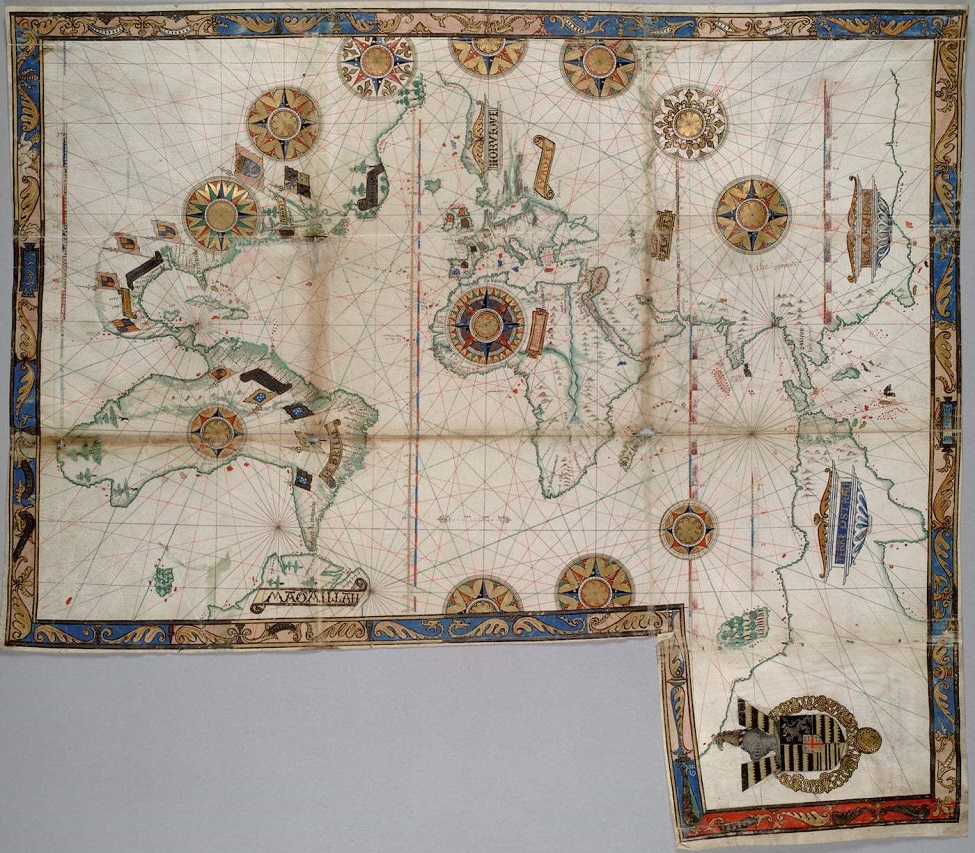
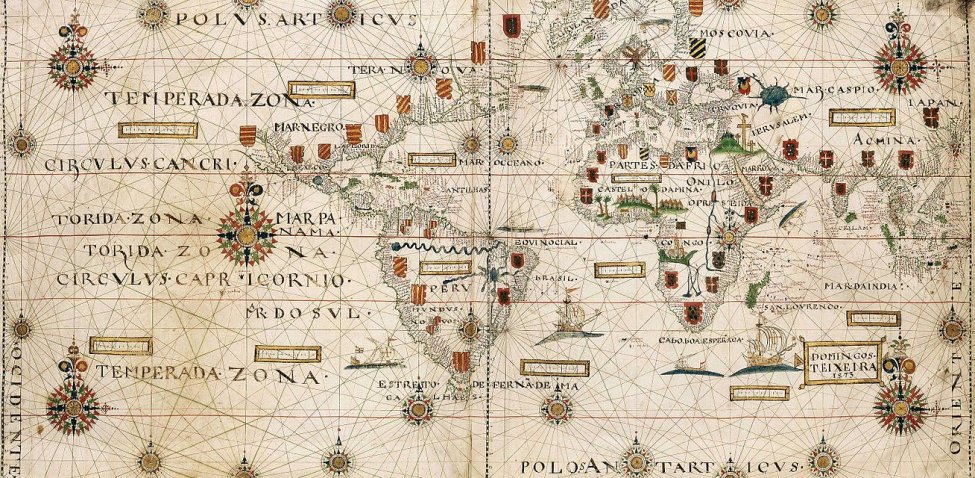
KorbenDallas brought this up in response to questions about what the lines represented on the map posted here. It seems interesting and pretty confusing, so I thought it could warrant it's own thread. The lines in question appear on most portolan charts dating back to the 13th century. They're referred to as a rhumbline (or windrose) network. A couple examples recently posted on this website:


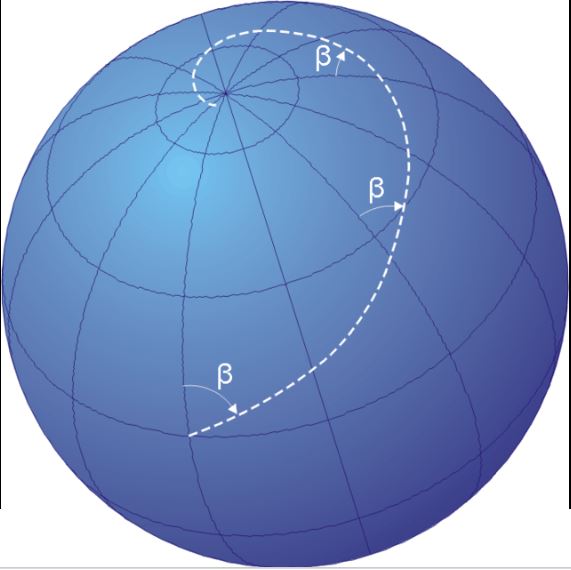
So, to clarify, the reason that it is said that these are not true rhumb lines is that modern rhumb lines take into consideration the curvature of the Earth.
rhumb.JPG
Image of a loxodrome, or rhumb line, spiraling towards the North Pole

So, basically the idea is if you're sailing around a sea, these older "windrose" lines would be accurate, but once you get out into the ocean, not so much. How did one use these aides then?

Now, I'm probably just missing something, but on these maps, several of the Compass roses are located in the middle of the ocean. How would someone at sea know when they approached the Compass rose to change directions? Simple estimation ("sail for about two weeks then change your bearing")?

How did mapmakers know where to place the various nodes? According to wiki:
And what essentially are the compass roses representing?
I'm very confused and I'm hoping someone can explain all of this a bit better. Can someone explain how this practically would have worked? Are the nodes/compasses roses representing major changes in magnetic declination? If their primary function was sea navigation, why do many nodes start in the middle of continents? If they didn't function on a "global" scale, why did mapmakers include them on full world charts? Could our modern definition of rhumb lines be obscuring the purpose of these older "windrose lines"?

(I thought this thread might go under Maps and Transformations, but none of the subheadings seemed appropriate.)
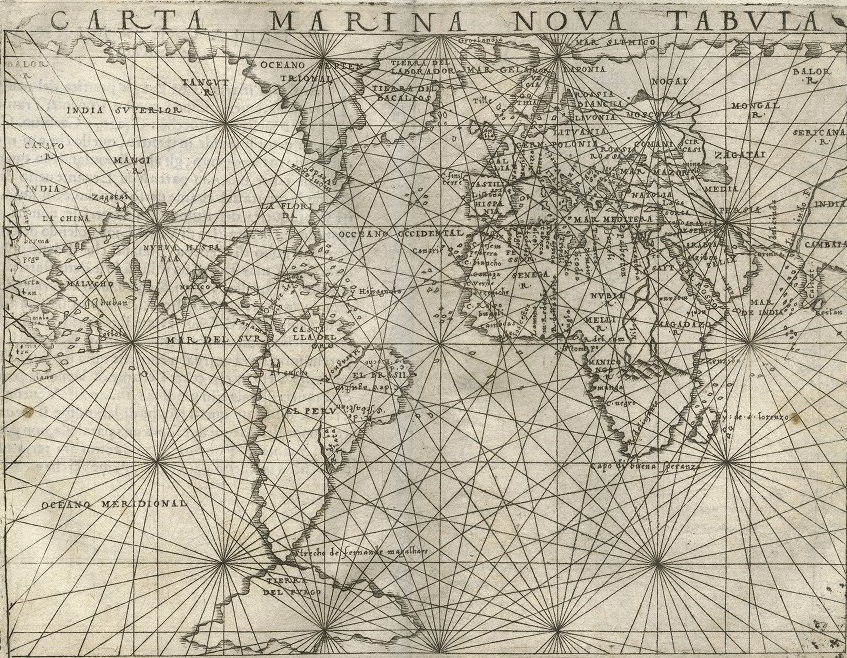
Note: This OP was recovered from the Sh.org archive.
Note: Archived Sh.org replies to this OP are included in this thread.
 
Note: This post was recovered from the Sh.org archive.
Username: KorbenDallas
Date: 2020-03-04 21:14:18
Reaction Score: 9
We have a new subforum now: Cartography

And I’m struggling to understand how these lines are supposed to assist with navigation.
 
Note: This post was recovered from the Sh.org archive.
Username: Banta
Date: 2020-03-05 00:25:53
Reaction Score: 5
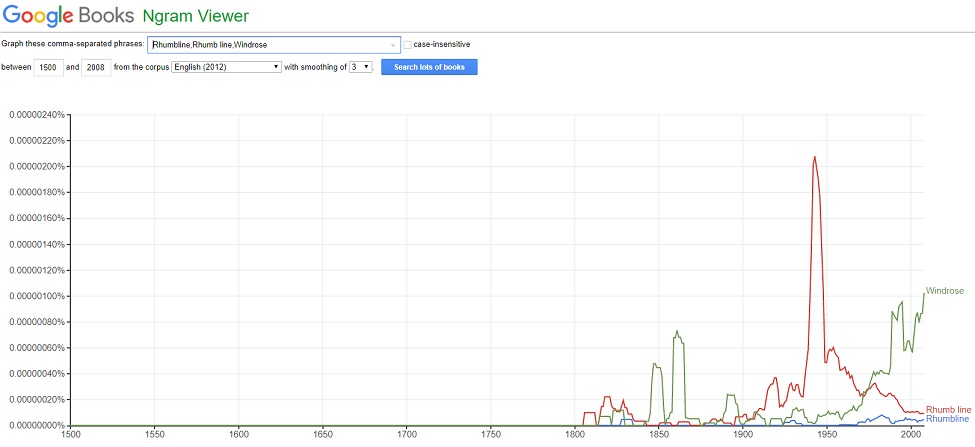
Thank you for the new subforum. And I'm glad I'm not the only one who is confused. There is very little information on the historical use of these lines, beyond comparing them to what we consider rhumb lines to be now (which is still kind of confusing on how practical such a grid would be for navigation, if that and a compass was all you had to go on). The terminology itself only seems to originate in the (da dum daaaa!) 19th century:

 
Note: This post was recovered from the Sh.org archive.
Username: BrokenAgate
Date: 2020-03-18 22:13:37
Reaction Score: 1
Do these have anything to do with ley lines?
 
Note: This post was recovered from the Sh.org archive.
Username: PairAlleles
Date: 2020-03-19 09:41:26
Reaction Score: 2
some of the airline flight tracks and times don't quite make sense as well ... recall reading somewhere about multiple "portal" regions akin to something like the Bermuda triangle but supporting data as I recall was a bit thin - perhaps there was knowledge or a functioning network of these that used to function for transportation - air or otherwise - utilizing something like that?
 
Note: This post was recovered from the Sh.org archive.
Username: DrPaul Ruth
Date: 2020-03-19 10:06:07
Reaction Score: 1
I find this hypothesis plausible, especially now that I am convinced that there are fossilized traces of ancient technology, attributable to various machines or mechanisms.
There are videos on the Wise Up channel that left me very impressed.
 
Note: This post was recovered from the Sh.org archive.
Username: Banta
Date: 2020-03-19 15:16:19
Reaction Score: 3
Possibly, but it would be worth noting that the "node" point of these maps are rarely at the same location. So if it was a network or networks, it appears it was constantly changing locations.

Still interested in some sort of explanation on how these would be practically used for sea travel, as conventionally asserted. I doubt it's even out there though, as I read things like this:

Portolan Chart PDF

Of course they mean the mainstream view of the capabilities of people in the medieval period...


Adding on, here's some key selections from a pretty good article:

With this [portolan] map, it’s as if some medieval mapmaker flew to the heavens and sketched what he saw — though in reality, he could never have traveled higher than a church tower...

That first portolan mapmaker also created an enormous puzzle for historians to come, because he left behind few hints of his method: no rough drafts, no sketches, no descriptions of his work. “Even with all the information he had — every sailor’s notebook, every description in every journal — I wouldn’t know how to make the map he made,” says John Hessler, a specialist in modern cartography at the Library of Congress...

Hessler pictured the first portolan mapmaker at work, methodically working out some way to improve ships’ odds of making it safely from port to port. He suspected the mapmaker began with one sailor’s notes and sketches from a single voyage, starting at a single port — say, Naples. Then, perhaps, he drew a line to the next port, using the recorded sailing direction and time as his guide. He would have traced the journey to the next port, and then the next, making a circuit of the Mediterranean until his pen brought him back to Naples.

But the mapmaker would have run into a problem: The vagaries of wind, sea and imperfect records inevitably threw off the measurements, so that upon completing his vicarious journey, the mapmaker wouldn’t land exactly on his starting spot. So he would have had to nudge his ports around to spread out the error. If he did the same thing again using a different set of sailing records, he would end up with ports in slightly different locations, and he would need to tweak the results again. No two of his charts would be exactly the same, and none would be quite right. The mystery is how he managed to reconcile all this contradictory, incomplete information into one brilliantly precise chart of the Mediterranean that allowed mariners to visualize, for the first time, the sea on which they’d spent their lives sailing....


Rhumb lines

These lines run out in 16 directions from points on the chart. It is unknown why these particular points were chosen and why certain points are illustrated with a compass rose whereas others are not....

Between 1300 and 1350, the [magnetic] declination in the Mediterranean fell by 2 degrees — and in keeping with that change, portolan charts drawn by the end of that period were about 2 degrees less rotated. By 1500, declination was back at 8.5 degrees, and so were most of the charts Hessler examined. Over the next 150 years, the declination shifted again, to 11 degrees, and the rotation of the charts followed suit.

To track how portolan charts’ accuracy changed over time, Hessler drew again on the methods he used to quantify butterflies’ evolutionary relationships. As with the butterflies’ wings, he imagined each chart drawn on a metal plate and simulated bending it to move the landmarks on the medieval chart to meet their locations on a modern map. The less energy required to distort the metal into the new shape, the more accurate the chart. (????)

Curiously, he found, in the first several decades after the first portolan chart was drawn, subsequent charts’ accuracy declined a bit. Hessler speculates that the first portolan mapmaker’s technique spread quickly, but those who adopted his methods initially lacked his skill, so their efforts were less precise. As mapmakers’ skills steadily improved over the next two and a half centuries, so did the accuracy of their maps.


The Mystery of Extraordinarily Accurate Medieval Maps

So, obviously a few issues here. Are we confident we are properly projecting our magnetic declination readings backwards to ascertain a baseline to compare to? Does it make sense that the charts were be more accurate initially and then decline? Also, I am still basically clueless on how one actually uses this map for navigation. Maybe I should reach out to uh, is it just Mr. Specialist Kessler to conjure me up an explanation.

It seems confusing to me if we don't even know why nodes were placed where they were and why some differed in appearance on the same charts how we're deriving anything of value from the lines themselves.
 
Note: This post was recovered from the Sh.org archive.
Username: JWW427
Date: 2020-07-02 02:01:45
Reaction Score: 2
I've stared at these maps for years. Intriguing to say the least. Precociously advanced for their day.
As a sailor myself, I wouldn't trust them to get me across the harbor––they are all different.
However, I do think its a distinct possibility that the "Windrose Network" truly represented Ley Lines, not prevailing winds.

As I've stated in another post, the 19th century Union Pacific Railroad followed these electromagnetic telluric energy lines in order for the railroad telegraphs to work, and performing this task was the role of US Govt. geomancers. What instruments did they use? Dowsing rods of copper, maps, sextants, and compasses. Telluric energy is extremely low frequency, and is found both on land and under the ocean. So I think, maybe, hopefully this bit busts the Ley Line "pseudoscience" claims by the mainstream PTB. (Does it?).

Milestones:Transcontinental Telegraph, 1861 - Engineering and Technology History Wiki

Electric Telegraph and Telluric Energy

Excerpt:
"The earth energies observed by the engineers of telegraphy and telephony in the mid-1800s behaved exactly like the powerfully surging earth currents described by Kircher. The engineers observed earth power so enormous it could not be attributed to electrostatic accumulations, nor to the weak electrical strains induced in ground systems by auroral discharges. These currents were fiery and potent. World-connecting energies of vast, mysterious, and intelligent content. According to the alchemists, Kirchner, and many of the engineers of the mid 1800s, these energetic flows were direct representatives of Creation, direct evidence of the Divine in operation.
Indeed, the “Telluric Energy” of Kircher far exceeded the frail power of mere electrical currents, as large as that power might be considered to be, by some. Kircher’s writings brought about an inference that, contained in these energies, were the awesome secrets of the processes of Creation, the Power by which the real world was both constantly generated, and sustained. Those enterprising engineers who endeavoured to draw their communicative power from the Telluric currents, found themselves engaged in surpassing technologies, empowered by the world-generative Source."

To me, the telluric telegraph is a potent clue. And that may mean a lost technology for following these lines has been hidden from us. For Medieval sea navigation, it may have been a more complicated amalgam of an astrolabe, compass, sextant, and some type of copper dowsing rods or brass Egyptian-style dowsing pendulum. Maybe a primitive magnetometer of a kind, the first one being invented by Gauss in 1833, or so we are told. (Dowsing rods are used to find wells, since running water is electromagnetic).
Would a chronometer be needed for longitude calculation? I'm not sure.

How this Medieval mystery arrangement would have worked in the open ocean is anyone's guess, but perhaps it was akin to an old-style radio beacon for aircraft navigation. In any case, I feel very strongly that the above instruments are much older than we are taught. Who knows what's hidden in some castle archive? Or...it may be a familiar instrument hidden in plain sight, the instructions on using it properly hidden away for good.
Modern scientists measure these telluric currents with precise tools like magnetometers, as well as newfangled "quantum sensors."

If we surmise the Ley Line theory to be a good one, Medieval sailors must have had an instrument (s) that allowed them to use the map lines for darn good navigation. Magellan's worldwide circumnavigation in 1519 may be a clue. Ten bucks on the table says he had hidden knowledge and exotic instruments of some type. Well, I hope he did!

And finally, are these portolan maps cobbled together from much older sources? It's a possibility.
We all know we've been lied to about our history on a grand scale, so I presume this topic is a victim of an ill-conceived cover-up.

astrolabe 2.jpegastrolabe 3.jpegastrolabe.jpeg
portolan map spain.jpegportolan 5.jpegUntitled.jpegleys.jpegquantum mag.jpegold mag.jpeg
 
Sylvie showed these parallel lines in forests deep in siberia where no trees grow, and they're also in forests in the US, then running across deserts in Nevada and through marshlands in Florida. Don't know if these are "ley" lines, "telluric" lines, or other; but they're sure visible on Google earth and when you're out hiking.
 
Tips
Tips
Please respect our Posting Rules.
Back
Top