Archive
Old SH Archive
- Joined
- Sep 8, 2020
- Messages
- 17,737
- Reaction score
- 3,168
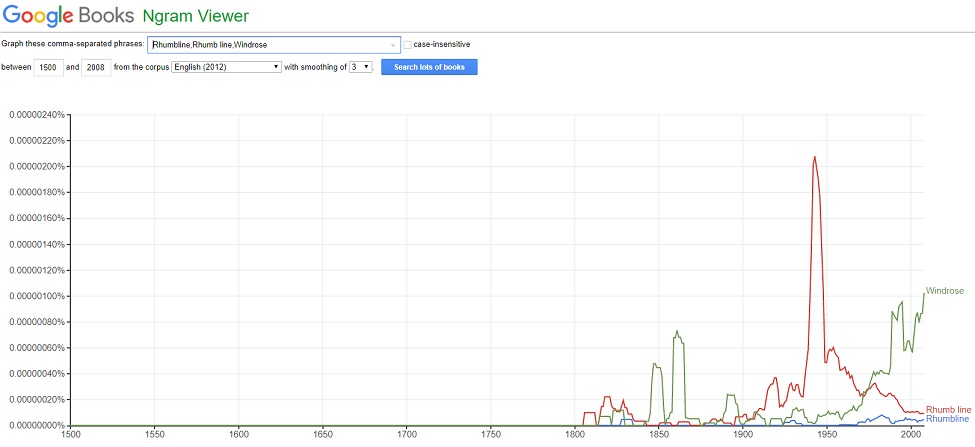
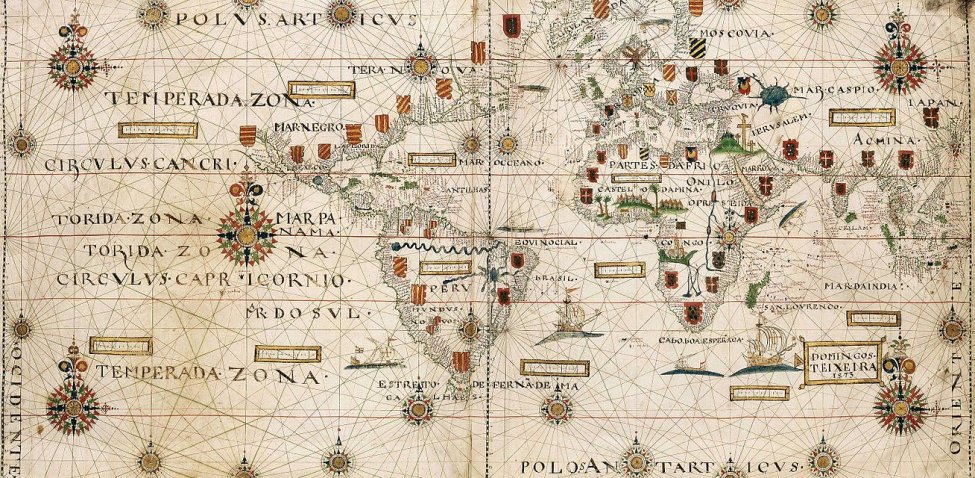
KorbenDallas brought this up in response to questions about what the lines represented on the map posted here. It seems interesting and pretty confusing, so I thought it could warrant it's own thread. The lines in question appear on most portolan charts dating back to the 13th century. They're referred to as a rhumbline (or windrose) network. A couple examples recently posted on this website:
So, to clarify, the reason that it is said that these are not true rhumb lines is that modern rhumb lines take into consideration the curvature of the Earth.
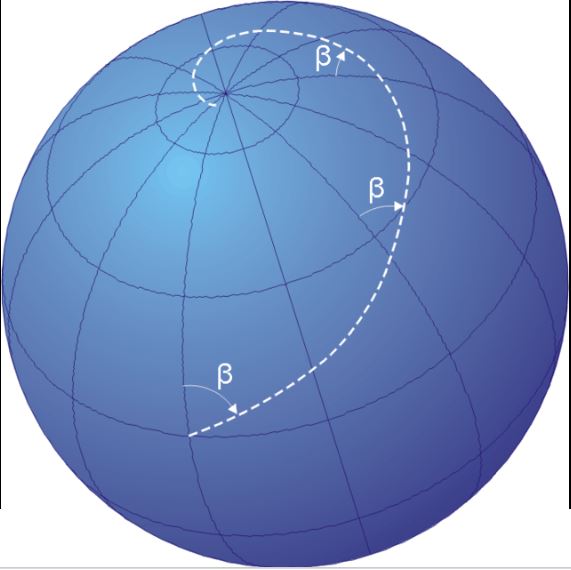
Image of a loxodrome, or rhumb line, spiraling towards the North Pole
How did mapmakers know where to place the various nodes? According to wiki:
(I thought this thread might go under Maps and Transformations, but none of the subheadings seemed appropriate.)
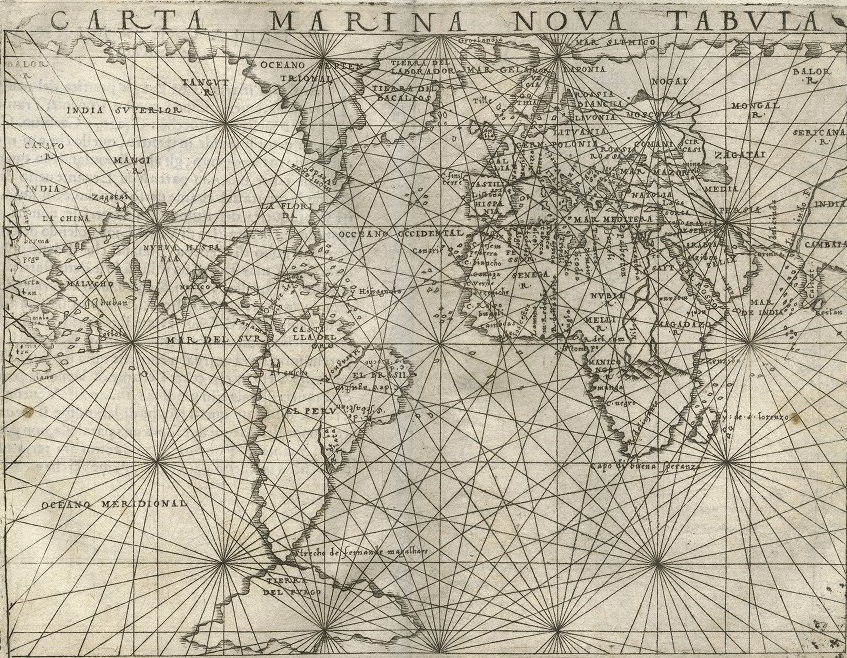
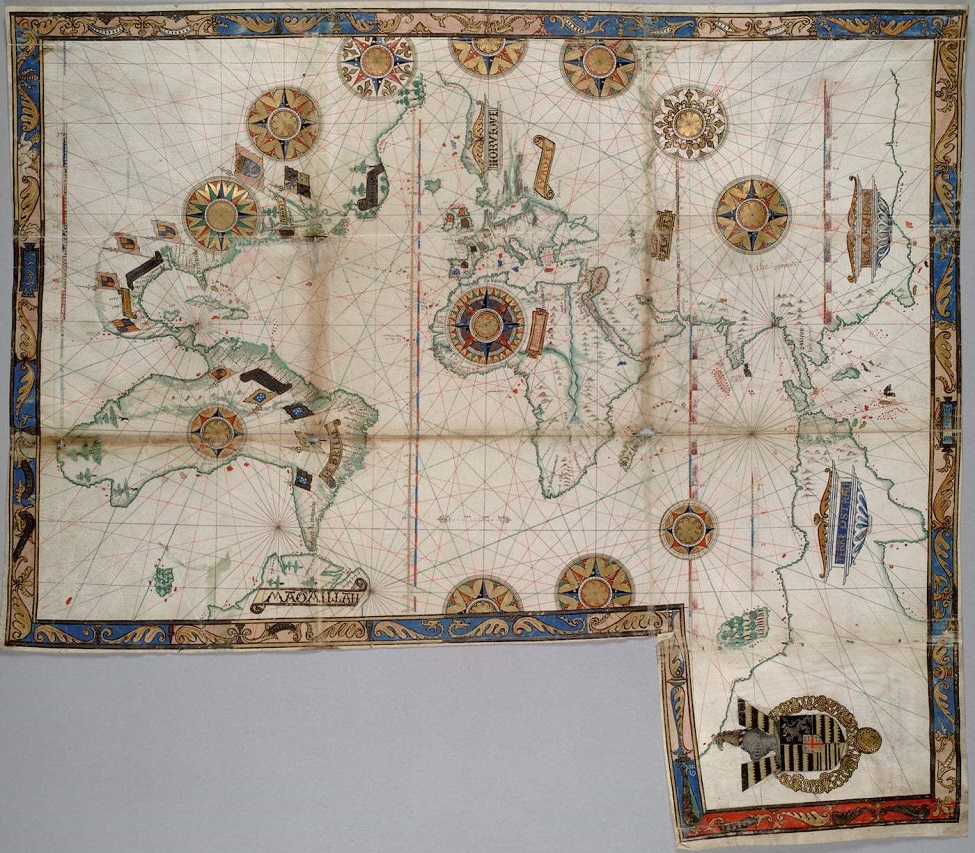
A rhumbline network, or more properly called, a windrose network, is a navigational aid drawn on portolan charts. This network is like a web (see picture) forming a grid on the map. The grid can be easily spotted (as parchment is quite translucent) by observing the map from its rear face, with a light source illuminating the other side. The hole in the center of the circle, origin of the whole network, is also clearly visible from the rear.
The lines are not true rhumb lines in the modern sense, since these can only be drawn on modern map projections and not on 13th-century charts. They were close to true rhumb lines in the Mediterranean area but highly inaccurate in the Teixeira planisphere and the other planispheres drawn in any pre-Mercator projection.
So, to clarify, the reason that it is said that these are not true rhumb lines is that modern rhumb lines take into consideration the curvature of the Earth.
So, basically the idea is if you're sailing around a sea, these older "windrose" lines would be accurate, but once you get out into the ocean, not so much. How did one use these aides then?A misunderstanding could arise because the term "rhumb" had no precise meaning when it came into use. It applied equally well to the windrose lines as it did to loxodromes because the term only applied "locally" and only meant whatever a sailor did in order to sail with constant bearing, with all the imprecision that that implies. Therefore, "rhumb" was applicable to the straight lines on portolans when portolans were in use, as well as always applicable to straight lines on Mercator charts. For short distances portolan "rhumbs" do not meaningfully differ from Mercator rhumbs, but these days "rhumb" is synonymous with the mathematically precise "loxodrome" because it has been made synonymous retrospectively.
Now, I'm probably just missing something, but on these maps, several of the Compass roses are located in the middle of the ocean. How would someone at sea know when they approached the Compass rose to change directions? Simple estimation ("sail for about two weeks then change your bearing")?To calculate on a portolan chart the course to follow from a point of origin to a point of destination, one should transfer — using a parallel rule — the "line of course" drawn from the point of origin to the point of destination, on top of the Compass rose closest to the ship's position, obtaining on it the theoretical course to be followed when sailing towards the destination. This theoretical course may have to be modified (as many times as needed) when tacking if the wind is right ahead of you, or to correct the effects of leeway, currents, etc... that a sailor with experience should be able to calculate empirically.
How did mapmakers know where to place the various nodes? According to wiki:
And what essentially are the compass roses representing?Portolan charts all share the characteristic rhumbline networks, which emanate out from compass roses located at various points on the map. These, better called "windrose lines", are generated by observation and the compass, and designate lines of bearing (though not to be confused with modern rhumb lines and meridians).
I'm very confused and I'm hoping someone can explain all of this a bit better. Can someone explain how this practically would have worked? Are the nodes/compasses roses representing major changes in magnetic declination? If their primary function was sea navigation, why do many nodes start in the middle of continents? If they didn't function on a "global" scale, why did mapmakers include them on full world charts? Could our modern definition of rhumb lines be obscuring the purpose of these older "windrose lines"?The straight lines shown criss-crossing portolan charts represent the sixteen directions (or headings) of the mariner's compass from a given point, which became thirty-two directions since around 1450. The principal lines are oriented to the magnetic north pole. Thus the grid lines varied slightly for charts produced in different eras, due to the natural changes of the Earth's magnetic declination.
(I thought this thread might go under Maps and Transformations, but none of the subheadings seemed appropriate.)
Note: This OP was recovered from the Sh.org archive.
Note: Archived Sh.org replies to this OP are included in this thread.