Sixteenth century maps from Tuscany

  • Thread starter Deleted member 37
  • Start date
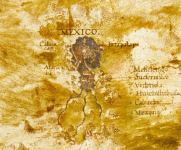
Map of New Spain (Nvova Spagna) by Ignazio Danti for @HELLBOY. You're not gonna find anything remarkable though, imo.
Mexico - Egnazio Danti - Google Arts & Culture

The country of new Spain is similar to the old except for its harsher mountains, which are not as easy to climb and some of them extend for more than 500 miles. In this province there are great rivers, beautiful springs of fresh water and rich woods of Pines, Cypresses, Cedars, Oaks and other types of trees in the mountains and plains. In said province are many mines of Gold, Silver, Tin, Copper and Iron. There are very pleasant Hills and countrysides, and they are always covered with green grass, in all the seasons* of the year and in many places they gather from … …*, to be …* during the Equinox.
Among the biggest and major cities of this province the chief city is the great city of Mexico, which floats in water as Venice
(Vin...ia) but in a lake whose Southern (Ostro) side, where big ships** enter, is composed of fresh water, while the Northern (Tramontana) half where the city is located is composed of salt water. This lake is surrounded by mountains on all sides except between North-East (Greco) and North and its circumference is about 120 miles. The inhabitants of such city are today all christians. Men of scarse acumen*** but peaceful, they learn with great ease everything is taught to them, thing I can tell by personal experience … friar Alfonso fr. Dis. Domenico**** (born in said city by mexican father) who came in Spain and Italy (Italia) and in a short time made great improvements not only in languages but also in philosophy and Theology. And as the aforementioned has told me, it’s already many years that the King (Re) of Spain ordered the construction of a university where are more than 4000 students. In this city there are 100025 houses as some write and how the aforementioned friar Alfonso confirmed me, who, having seen Venice, said it was two-thirds smaller than Mexico, even though Cortes (Cortese) said there were only 70000 souls, unless the printing***** is wrong and means 700000.
This map was made using the coastlines drawn by the Castilians
(Castigliani) in their nautical Charts while the remaining interior was taken from the reports of Cortes and others who went there, and from some maps of said province.

* can't read what is written:cry:

** not sure he is talking of ships, because the term is unreadable. So I’m just saying ‘ships’ based on what I already know and what is logic for the context.

*** Don't shoot the messenger!!! The text uses the word ‘invetion’, with a trait upon the ‘e’ probably indicating a following ‘n’. Therefore we have ‘invention’, possibly meaning ‘acumen’… but hey, translate it as you want!

**** can’t tell why he repeats ‘fr.’ two times and what ‘dis.’ means:cry:

***** it’s not very clear what is written. I think ‘unless the printing’ is the best fitting scenario, possibly hinting at a mistake done in various books of that time reporting wrong datas.

Danti's maps are quite meager in terms of historical informations, when compared to those by Bonsignori. They are hard to translate mostly due to the worse condition of the maps and the use of lines in the captions probably to write sentences without going up and down with words and letters (problem is that the ink of those lines covers the letters making it difficult to understand sometimes).
Overall the history contained in these maps is more in line with that taught in the XVII century, after the 'new wave' of historical matters started by Scaliger at the end of the XVI century. It seems a little weird to see how both the history told and the language used by Danti seem more modern than those used by Bonsignori!

When it comes to this map I can't add anything. Maybe you @HELLBOY can say something, although I think we are dealing with details...
True, there is nothing out of the already known.
  • What I was noticing, is the fact that it depicts Tenochtitlan as Mexico 1565 only 43 years after the fall of Tenochtitlan and in fact places a Tenochtitlan city below Mexico City.
9.png

  • If you align the map of Cortes 1521, the map of Upsala 1550 in this placement, they coincide with the Temix - Titan of Cortes. They all have Chapultepec in the lower left corner.


  • I have a current timeline of the city and I believe it did not grow at all for centuries. I also placed the images in the same perspective, the difference is that in this one the lake of Texcoco is present on the right.

308405169_595827709000192_3169293595771564740_n.jpg
307982308_595828069000156_4509380607553391267_n.jpg
308541569_595828085666821_612790865064810962_n.jpg
308456229_595828089000154_6205869541694575759_n.jpg

  • You can see how what is now the historic center was kept at bay and the city did not begin to grow until after 1850. 1810 Independence of Mexico, 1910 Mexican Revolution.

  • I see how in the ancient maps they do know the size of Lake Chapala but not the size of Lake Texcoco, only the small area of Tenochtitlan is shown.
10.png
Composite Map: Tome VI. No. 30. Page 117. Carte tres curieuse de la Mer du Sud. North and south sheets
11.png
12.png
  • I remember that in Ogilby's engravings of old and new Mexico you can see a lake already drying up in 1671 and the transformation of the city with architecture out of the ordinary.​
Well, that's mainly what I emphasize. How the city doesn't start to grow until 1850 onwards.
The rapid transformation from one city to another.
The absence of pyramids that crowned the center of the city.
Although today there are quite a few around the city. Tlatelolco Google Maps b1!8m2!3d19.4523693!4d-99.1384147!3m4!1s0x85d1f92383c87ca7:0x179e8c60050933eb!8m2!3d19.4512852!4d-99.1375018


There in the Parish of Santiago Apostol, I think it is old enough to have some alternative history, it has murals of San Cristobal el Cinocéfalo, no more, there I leave related links of mine. They also have the eagle ridden by someone, which reminds me of Vishnu riding Garuda and Zeus riding the Eagle. I think this may be related to Preste Juan - San Cristobal - Cristobal Colon.
Sixteenth century maps from Tuscany
The secret of the twins Quetzalcoatl and Xolotl
 

Attachments
  • 8.png
    8.png
    817 KB · Views: 143
Last edited:
This is going to be interesting for the few people interested in history on stolenhistory. Third map titled ‘L’Egitto’ by Stefano Bonsignori.

Saturn (Saturno), namely Ham (Cam) called Camese, the youngest son of Noah (Noe) of those born before the flood, was the First King (P° Re) of the very noble and famous Province (Provincia) of Egypt (Egitto), in which since the beginning all sciences and good arts flourished, sciences and arts which all the other Provinces took up claiming to be the inventors. This Province was not ruled by an absolute monarchy as the other ones but was ruled by more people, which moderated the royal actions for certain definite periods, and this government was called Dynasty (Dinastia) or Potentate (Potetato), which at first changed frequently. Later however those rulers, seduced by the well-being, began to stay more time in power sometimes even without a King. But during the 25th (XXV) dynasty the Ethiopians (Etiopi) killed King Bocchoris (Boccoro) and occupied Egypt. Afterwards it was freed and then taken back and kept by the Persians (Persi) during the 27th (XXVII) dynasty, until it passed under Alexander the Great (Alessandro il Grande) when he subdued them, whose successors left the title of Pharaohs (Faraoni) behind and called themselves Ptolemies (Tolemei). These ruled not only upon most of Africa (Affrica), but also upon the island of Cyprus (Cipri) and Phoenicia (Fenicia), until the Romans (Romani) took Egypt and reduced it into a Province. But it was taken away from them in the time of Emperor Heraclius (Eraclio Imperadore) by the Arabs (Arabi) and Saracens (Saracini), who brought it back under one Prince (Principe) called Sultan (Sultano) by them. But Selim (Selimo), great Lord of the Turks (Signore dei Turchi), obtained it and turned it into a Province during the rulership of the Emperor Maximilian (Massimiliano). The Sultans put out the ancient nobility and virtue of this land, but the superb pyramids still bear testimony to its greatness and power. And its inhabitants still enjoy the extraordinary fertility of the soil due to the Nile (Nilo), that every year inundates the entire country. Since it becomes very capacious due to its springs being located beyond the equinoctial in those places where it’s winter during the month of June (Giugno), the Nile was called Ocean (Occeano), after Ocean son of Noah, and the Province was called Aeria, which took a different name after its King Egypt. Contiguous to Egypt is the Province of Marmarica, fertile near the sea and barren elsewhere, celebrated for the famous temple of the great Jupiter Ammon (Gioue Ammone), to which the whole world longs for* an answer from its oracle.

* I'm not sure if the author meant this verb in the present or past tense. The word is concor, with a sort of 'crescent' upon the r. I will eventually add something if I encounter again this symbol pointing to one solution or the other, since the way I translated implies the temple was still used in the XVI century.


There are many things to say here, but the most important is probably the one about the egyptian dynasties. I didn’t expect that a map from the XVI century would somewhat confirm what Velikovsky said in his ‘Ages in Chaos’. There he stated that egyptian history was shorter than what commonly believed (this is not stated in the map obviously) because many of the various pharaohs actually lived and reigned in the same period of time upon various parts of Egypt.
Here I think the explanation, whatever the original source was, is even more convincing. The ‘dynasties’ were not the succession of pharaohs related by blood. A ‘dynasty’ was a government, and one which was elected in its components at first!
The only example that comes to my mind is that of current Italy, where we not officially had a ‘first republic’ from the end of WW2 to the fall of the Soviet Union and a ‘second republic’ from the Soviet Union untill now. Someone not-not-officially says a third one started these years (and I think they are right).
If I have to give an historical parallel to this system of power, where an unelected King was ‘supported’ by a government, Magna Charta England comes to mind, where the government was already composed of ereditary nobles. Another example could be the Roman Empire, where the emperor was supported by a Senate.
Whatever is the explanation these ‘dynasties’ probably coincided with the so-called priestly caste of ancient Egypt, drawing a parallel between this caste and the strange similarity in terminology between the Roman senate and the Christian clergy offices. A caste of priests-senators-nobles.
It seems that this caste managed to survive the various changes in rule of the Egyptian history, since dynasties survived after the Ethiopian conquest or the Persian one. But it was apparently ended by Alexander or his successors. What happened?

Aside this, another relevant thing is that the Nile was called Ocean (another son of Noah!!!). This could lead to some heavy confusion in terms of geography. Not going to expand my thoughts here though.

And last but not least, here Ham is said to be Noah’s youngets son before the Flood, implying many others after it! How could Bonsignori, who was a monk, be so ignorant. Why were there so many priests telling another story back then? Was the Bible really Jewish?
I came upon this book quoted by someone in the forum (can't remember what thread).

https://ia601504.us.archive.org/28/...15.98292/2015.98292.Book-Of-The-Knowledge.pdf

I decided to try and match some names of cities on the map and since the Egypt map is one of the first, I checked out Egypt (pg. 22 of the book).

This is what I found so far:

Egypt1.png
Egypt2.png
Egypt3.png
Egypt4.png

This is what it looks like on the map (I couldn't find Ribas Aluas);

Map1.png

Map2.png

When you look at the description of the flags and relationships in that book, it doesn't seem to match the history written for those times, whatever they may be.

It would be interesting to see what else matches up with the voyage described in that book, not to mention matching up some of the flags and relationships between kingdoms.

If anyone has sufficient interest and time on your hands, try having a go at it. :)
 
Ribas Aluas" = "Ripe Bianche"
You are correct, there's in fact a 'Ripe Bianche' on the map.

It would be interesting to see what else matches up with the voyage described in that book, not to mention matching up some of the flags and relationships between kingdoms.
I've found various names used in that time and now belonging to myth or to that presumably not interesting part of history which historians miserably fail to see. I frankly don't have the stamina to do such a job, even though it would be extremely interesting and possibly revealing.

A passing by thing I noticed while looking at the map, apart from Luchon being Luco on the map, is that it's showed the location of Apollonia, the 'ancient' Greek city now called Susa (Susa, Libya - Wikipedia). It's interesting that here on the map it is assumed to be a location still populated despite historians telling us it fell into ruin in 'ancient' times. And not only it was inhabited but it had a new name, Bonandria, which is not acknowledged anywhere...

Immagine 2022-10-31 142055.png
 
I've found various names used in that time and now belonging to myth or to that presumably not interesting part of history which historians miserably fail to see. I frankly don't have the stamina to do such a job, even though it would be extremely interesting and possibly revealing.
Hence why I see the only realistic alternative is to start to match some of these places in the map, which do not in any way fit into the current historical narrative, and this to be done sporadically by those interested in their local environs or those of others.

The next step would be to research the chronological discrepancy in the logos/standards/flags and their relationship, and see how they may fit the 'legends and myths' from old books that still may have some of this information.
 
Tips
Tips
Please respect our Posting Rules.
Back
Top