Note: This post was recovered from the Sh.org archive.
Username: Divine Wind
Date: 2020-07-31 16:19:24
Reaction Score: 0
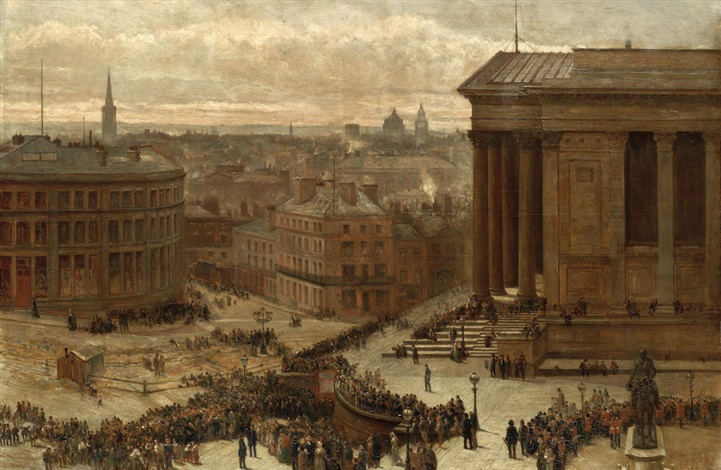
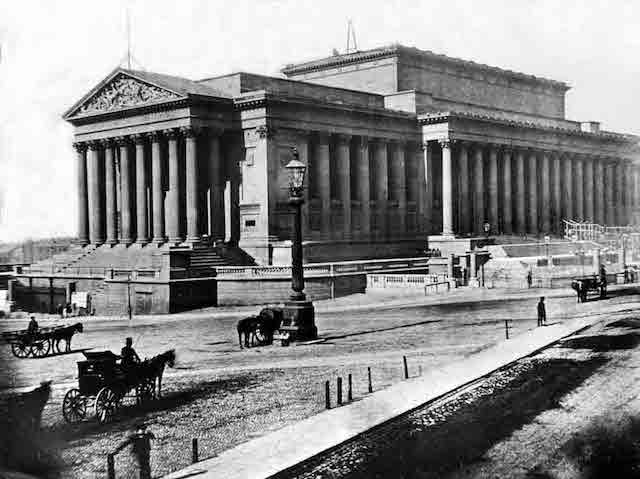
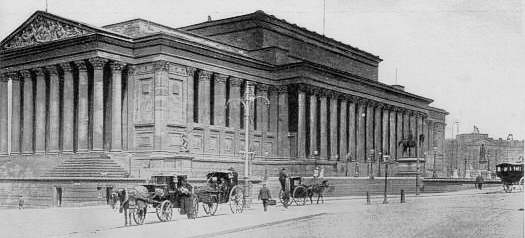
Came across this on facebook just now. States 1866, but could be anywhen looking at the carriages. What would those ariels/ masts be for in 1866?
View attachment 49837
Edit to add. 12 years open in 1866, it appears extremely old and aged, imo
That photo is i believe the best old photo that ties in with my hypothesis below. ie the south east coner has been recently extended. I believe the northern end is too far away to clearly show that section as a new build, but it does appear brighter than the mid section with the round columns. And, these are the days before the 'Industrial revolution' and all the soot being layered on buildings, therefore parts of the building even look old without all the soot.
Note, the frieze looks new as well, which again ties in with my theory.
Recognition beat ya to it!
St George's Hall, Liverpool.
Or my eyes aen't rendering properly.
Windmills in Lime Street
St George's Hall, Liverpool.
More on Liverpool windmills
St George's Hall, Liverpool.
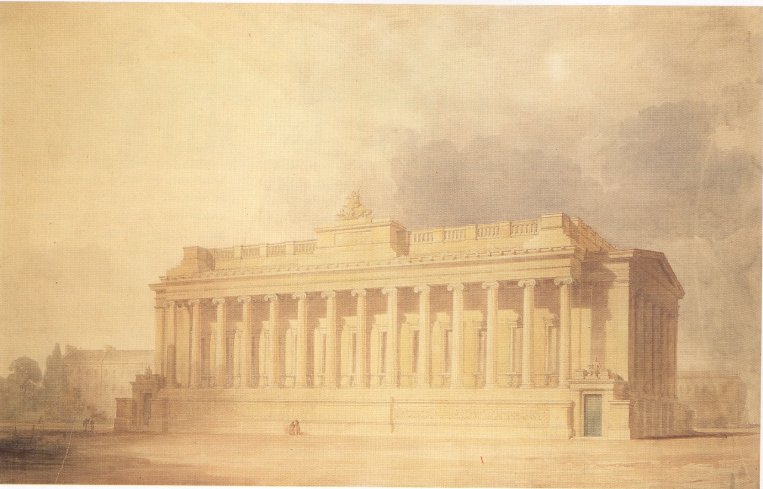
Another painting.
Source
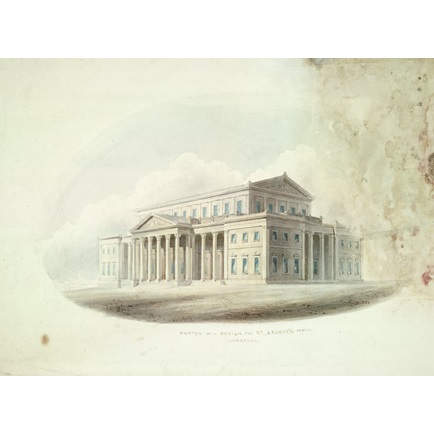
A design or architectural drawing.
Source.
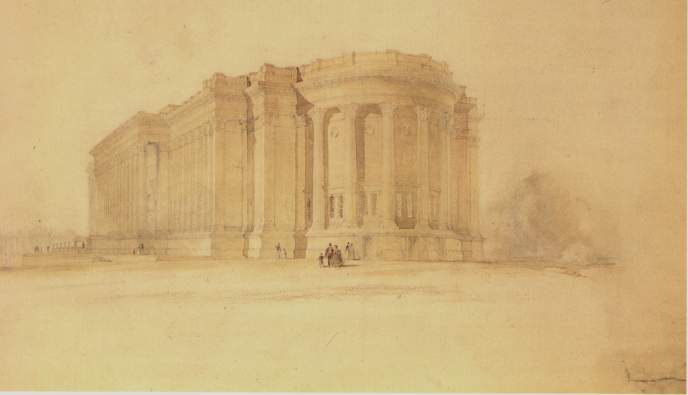
"A design or architectural drawing"? I was wondering the same about these two drawings (not the photo)
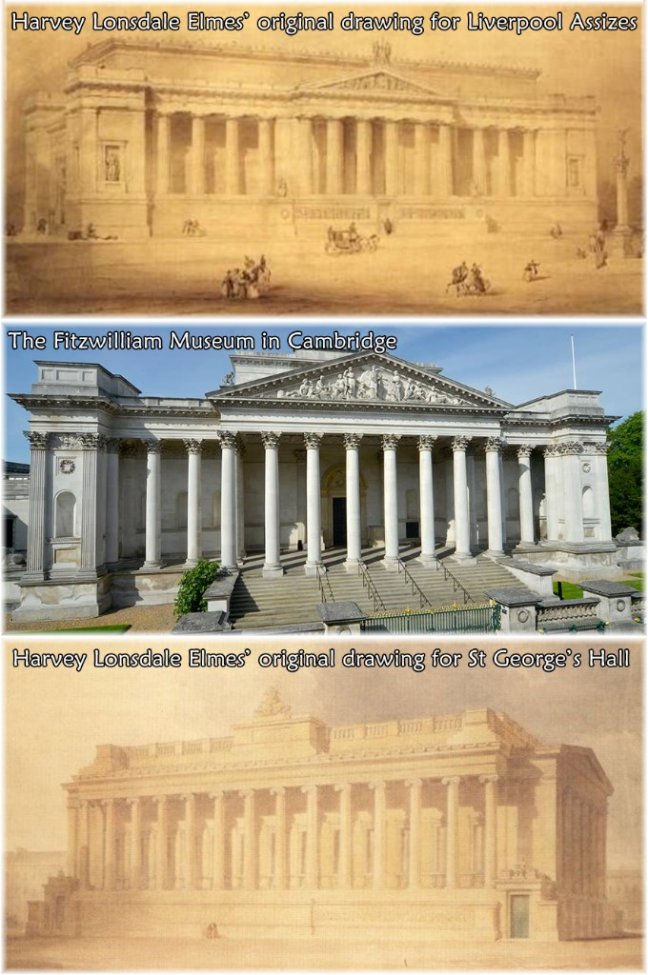
This is the source site
St George’s Hall Missing Pediment Sculpture – Independent Liverpool
"During the building of St George’s Hall, the original Architect, Harvey Lonsdale Elmes was taken ill with consumption and died in 1847 before seeing its completion. In 1851, Elmes’ mentor, Charles Robert Cockerell was asked to design the interior decoration. Whilst doing this, he also added a couple of his own flourishes to the building – one of which being a sculptured pediment on the South Entrance.
It should be noted that Elmes’ original sketches for his competition entry for an assizes did have a rough sketching of a sculpture in the pediment on the portico (as he had no doubt been inspired for his design by the Fitzwilliam Museum in Cambridge (which, incidentally, Cockerell had worked on)".
I am wondering whether both of these sketches above are in fact the prior to the building being expanded in 1841 ie the bottom one is the oldest sketch, maybe hundreds or more years old, and the top stage was prior to 1841 (round columns are on the west side). Would it be surprising if the building was extended northwards and the Corinthian columns moved from the west of the building to the east such that the building was a showpiece for the new Train Station which was complete in 1836. ie 5 years before the Hall was expanded.
This may seem crazy, but it would allow for the architects to completely revamp the Hall and be able to name it a Victorian Building. It does also fit in with the shiny new square columns on the more than one drawing. Consider this, if the ancient round corinthian columns were moved to the east and south side, they would still look old, but any new square columns being constructed would look new ie
First sketch has dull east and south round columns, but shiny eastern square columns. (date unknown but church is still there - prior to 1890)
Second sketch of 1851 is exactly the same, but with slighly different south east corner. Windmill shown on the right, how about the left?
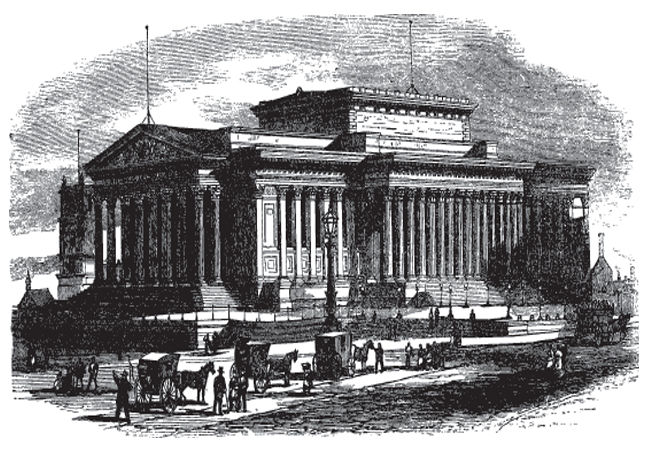
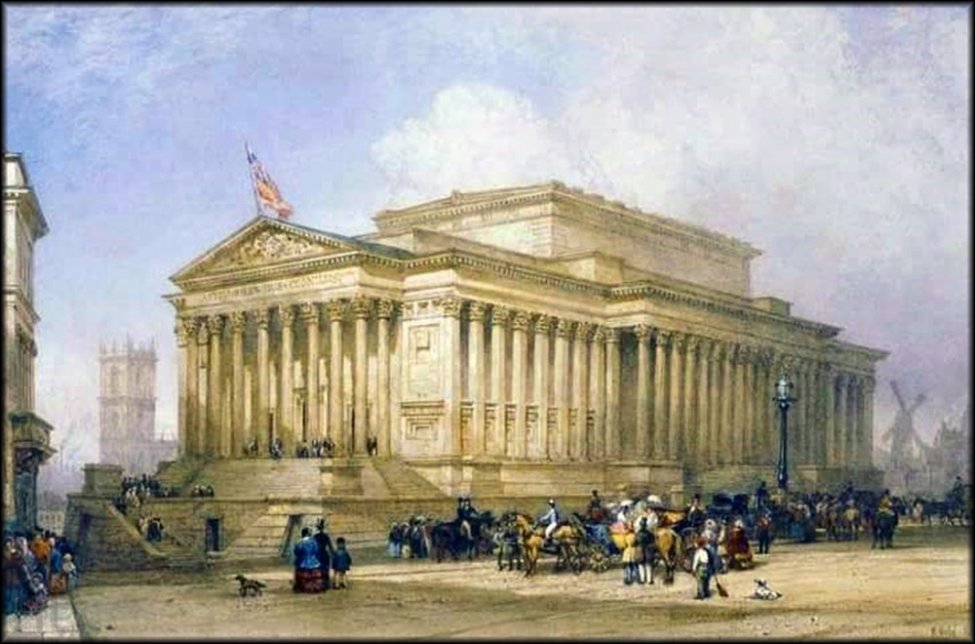
The first article above has Queen Victoria stating the following
"Described by Queen Victoria as a building ‘
worthy of ancient Athens’, the neo-classical St George’s Hall,
Liverpool, is the epitome of Grecian grandeur".
It could be that the expansion consisted of the following:
1. Main facade to the East was extended outwards, and existing columns were moved to the Station side.
2. North end was extended to include rounded end, and also include new square columns at the north east.
3. South east side was extended slightly out to include suquare columns.
4. South end was extended outwards and fitted with a frieze and exisiting old round columns.
5. Main Hall now has upper galleries
6. South end steps constructed.
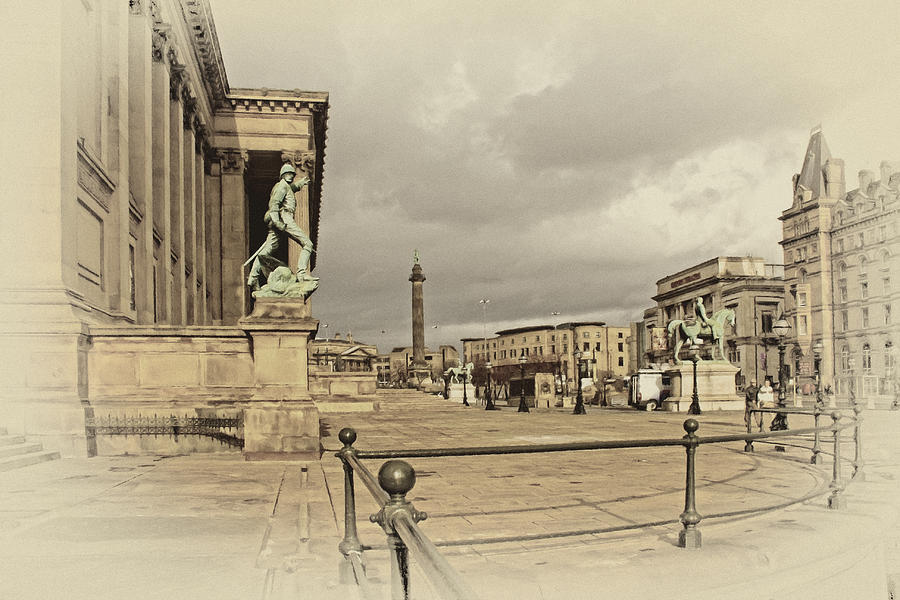
The South- East
This is a newish photo from 1964 (cars - spot on), the south east corner may have just been cleaned, but maybe it hasn't. Either way it shows what i am on about with the ancient corinthian columns, and the new south east extension, which I believe was mirrored but as a totally new extension on the north east and north west ie with square columns. The frieze has apparently been stolen, or disappeared, as nobody seems to know where it is.
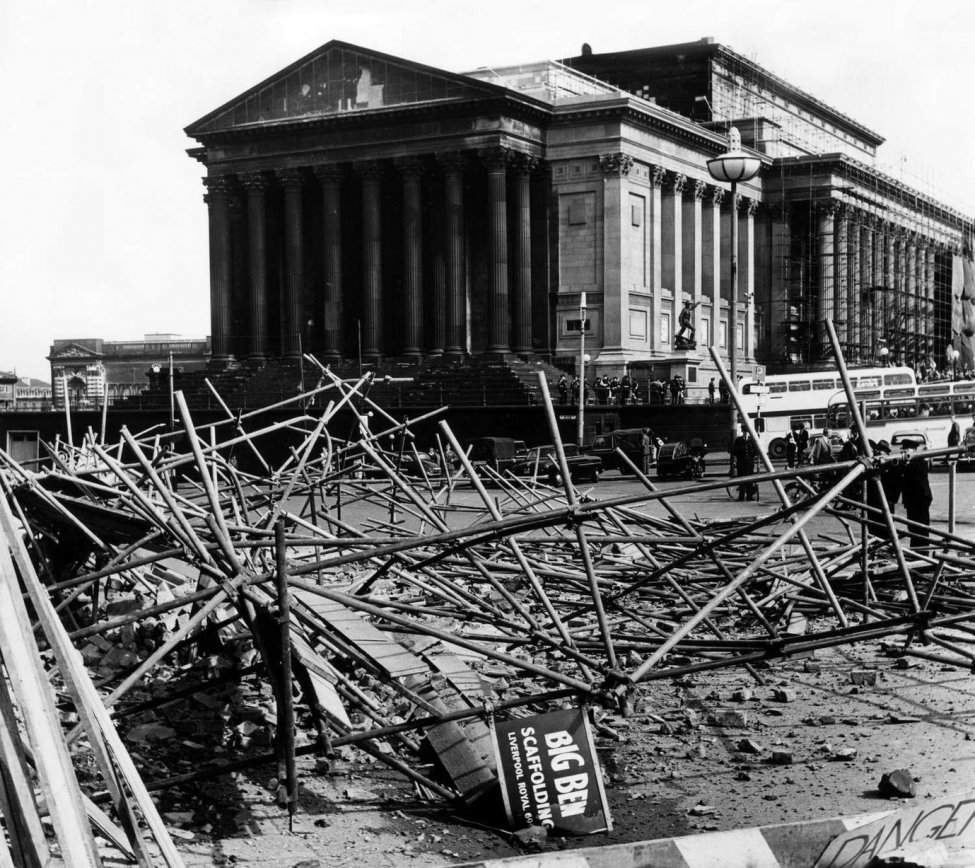
Then you have
touched up photos. The upper one (1854) has been tarted up so that everything looks the same age, but unfortunately they forgot to make the south east columns look square. The lower one has made all the columns look similar, but remembered to make the SE columns square.
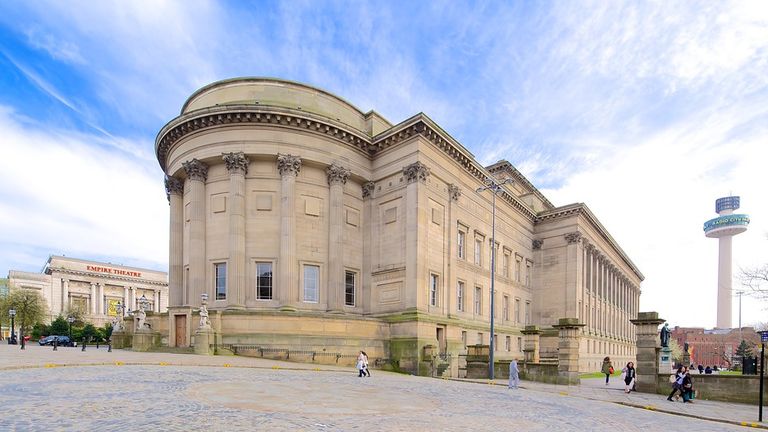
 West Side
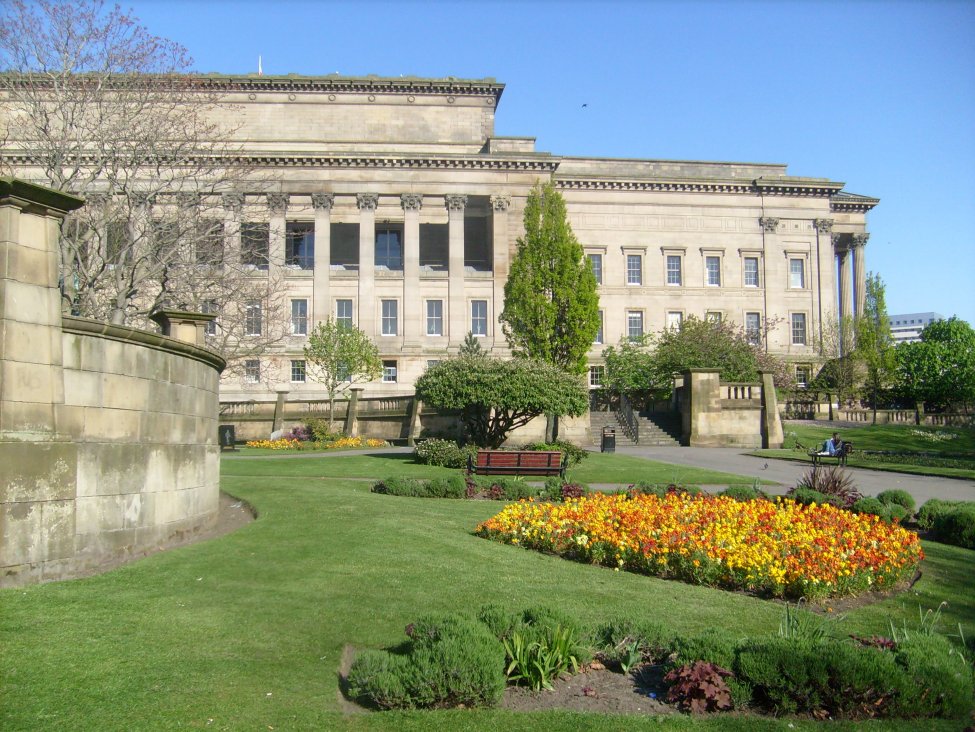
Here you have both ends, of which the SE may have been extended outwards, and the NE might be a completely new construction in 1841. Both ends have square towers, as they have been moeved to the new south end, and the middle of the east side. All in all, the building has been greatly expanded, and people are calling it a new build. No photos though. Photos sidelined as cover up?
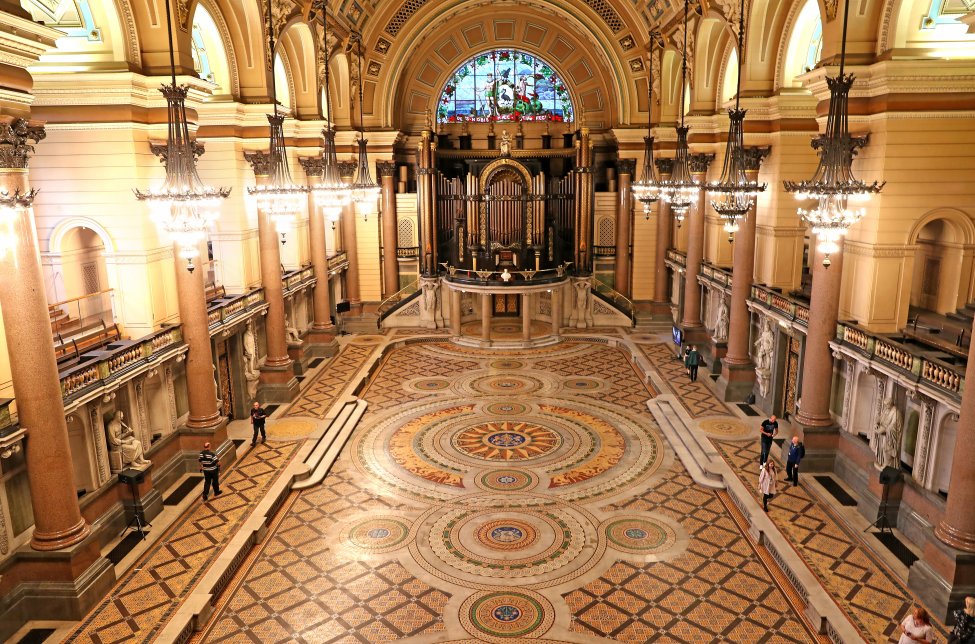
 Interior of Main Hall
Then you have the whole point of the extension east and west, the upstairs gallery which backs onto the new high level window (now 1 of 2)
The Architect : possibly a lot of truth in this article : St George's Hall (1841-54), Lime Street, Liverpool
St George's Hall (1841-54), Lime Street, Liverpool
This article talks of the possible skullduggery of the young Architect who got the commision, but is as suspected by some on here that there is a building provenance cover up, then he will just be a name to go with the 'new building'
"In 1837 the Government had decided that both Liverpool and Manchester should have their own Assize Courts (previously all Crown Court matters had been dealt with in Lancaster) and a Liverpool Assize Courts Building Committee was formed. The two Committees, one for the Concert Hall and one for the Assize Courts, had joint discussions as early as 1837 about how the two buildings might together form part of a public forum using John Foster's neo-classical façade of Lime Street Station to form the enclosure.
A competition inviting architects to submit design proposals for the new concert hall, which the Committee had by now decided should be called St George's Hall, was announced in The Times in March 1839. Harvey Lonsdale Elmes was announced as the winner of this competition in July 1839 at the age of just 25. The façades of his winning entry bear a strong resemblance to the concert hall designed by Joseph Hansom in 1834 to be used for a Triennial Music Festival in Birmingham and known as Birmingham Town Hall. This, in turn, is said to have been inspired by the Temple of Castor and Pollux in Rome.
A competition inviting architects to submit design proposals for an Assize Court Building was announced in The Times in July 1839, the deadline for submission of entries being 1st January 1840. Elmes also entered this competition but after he had won the first one and, as was said at the time 'it is rather singular that that gent should have chosen to enter a second competition immediately after succeeding in the previous one, unless he had a particularly good reason for anticipating success'. The Concert Hall was his first major commission and would have been a monumental undertaking on its own for such a young and relatively inexperienced architect. It was indeed strange that he should feel able to enter the competition for the Assize Courts as well unless he knew something that none of the other entrants knew!
Suspicions might be raised further by the fact that Elmes was not announced as the winner of the second competition until 8th October 1840, 9 months after the closing date. Further suspicions might have been justified over the next few years when Elmes went on to design houses for a number of the members of the Building Committee, including the Lord Mayor! His winning entry for the Law Courts Building is clearly based on the Fitzwilliam Museum in Cambridge designed by George Basevi in 1835 and finished, following Basevi's accidental death, by Elmes' mentor, Charles Robert Cockerell, a close friend of Elmes' father, James. (James Elmes was also an architect who had written extensively about the buildings of nineteenth-century London, in particular the works of Sir Christopher Wren.)
It is traditional to think that Elmes was inspired by the classical buildings of Athens and Rome but the inspiration for Elmes' competition entries was clearly neo-classical buildings, not classical buildings. It is difficult to see how he could have been influenced by classical buildings when he never visited Greece or Italy! Cockerell, on the other hand, had completed a 'Grand Tour' and spent several years in Greece, his travelling companion for most of the time being John Foster Junior. Foster, with his father, was responsible for the design of a number of important buildings in nineteenth-century Liverpool. It was no coincidence that the building contractors for many of these were also called Foster since this was the family business.
The interior of the Great Hall is considered to have been influenced by the Baths of Caracalla in Rome which may explain the sunken floor, but, again, this building had not been seen by Elmes and is, in any event, largely a disjointed ruin. However, Cockerell had produced a large painting of what he thought the interior of these baths would have looked like. Was this Elmes' inspiration? It seems very likely.
In fact Elmes' first entry for the Assize Court Building was so flawed in terms of its circulation, especially considering the necessity to separate the different parties involved in criminal trials, that it was passed over to Joseph Franklin, City Surveyor, for dissection and revision. Elmes was then permitted to submit a second version well after the deadline and it was this that won him the first prize of 300 Guineas. Elmes was then asked by the Council to explore different arrangements of the two buildings in relation to the site and Lime Street Station, it was also suggested that a new Daily Courts Building incorporating a Bridewell might be included in the development.
While Elmes was considering the various possibilities,
the Concert Hall Committee realised that it had not raised enough capital for the building and approached the Law Courts Committee with the suggestion that the two buildings should be combined and the costs proportioned between them. Elmes was asked to consider the possibility of combining his two buildings into one and the various options were considered by a joint meeting of the two committees. This meeting agreed to the combining of the two buildings and it was only at that stage that Elmes began to design the building we see today. Elmes was by then 27 years old.
Eventually the Law Courts Committee agreed to undertake 'the whole outlay of the erection and future management' and all subscriptions made to the Concert Hall Committee were returned to the donors.
Original Ancient Building, or new Azzize Law Courts . . . . . . . new Concert Hall combined with law Courts (or Ancient Building)
Conclusion
If part of St Georges' Hall is truly ancient, then I believe the scenario below is somewhere near the truth.
1. Liverpool required a new Law Court, due to the expanding population, and lancaster was now unable to cope with the volume.
2. A competition was held, an a very young establishment Architect won which was based on someone else's design in Cambridge.
3. A Concert Hall was also required, and it was decide to 'join them together', and the section of new build was to be called St George's Hall
4. A new mainline station had just been built next door, and the opportunity existed to adapt the existing ancient building to align with it.
5. The existing ancient building was expanded, with columns being moved, and the final design was 'similar' to the Cambridge design
5. Liverpool was responsible for 90% of the British Slave trade, and the city was awash with money. It was a perfect time to bury the old building.
6. The whole of the new building was just called St George's Hall, and was eventually just called a monumental Victorian Building.
7. The old sketches rather than adulterated photos hint at the new construction.
8. Cockerell was really the architect, he had worked on Wren's buildings, had done the grand tour, and was happier working 'under cover'. ie no association with similar happenings in London.
A number of Questions
A. Where did the original Corinthian/ round Columns come from, elsewhere or were they originally built at that site?
B. If elsewhere, where would they have come from? Fishbourne ie the largest Roman Domestic dwelling in Northern Europe or or elsewhere?
C. Is this a Roman structure, or from a later time?
D. Who pinched the frieze?
E. Are there any construction sketches anywhere to be seen?
F. Is there anywhere in the UK where two buildings have been combined like this ie new/ new or new/ ancient?
G. How many ancient building are there in London or esewhere in the UK?
Links
St Georges Hall, Liverpool Great 'Timeline' of photos/ sketches
Hall of fame – Liverpool’s St George’s Hall
Harvey Lonsdale Elmes (1813-47)
St George’s Hall Missing Pediment Sculpture – Independent Liverpool
St George's Hall (1841-54), Lime Street, Liverpool
The Temporary Houses of Parliament and David Boswell Reid’s Architecture of Experimentation | Architectural History | Cambridge Core