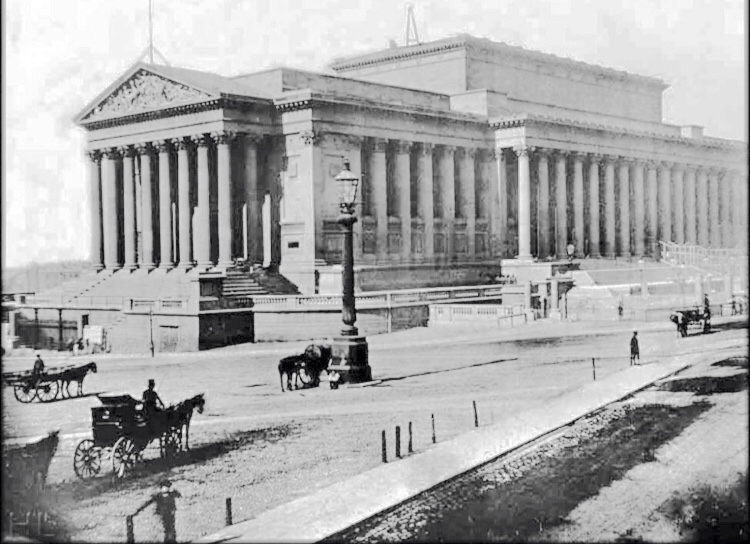
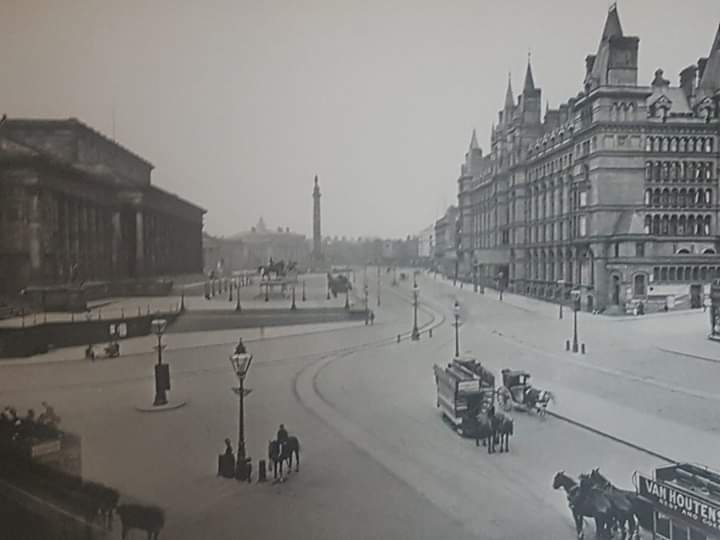
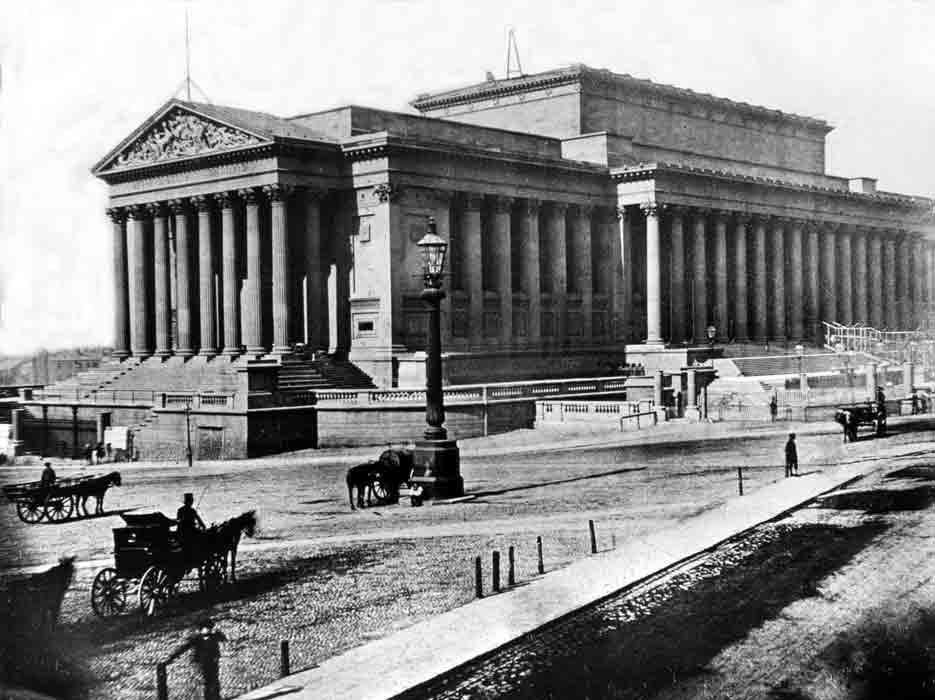
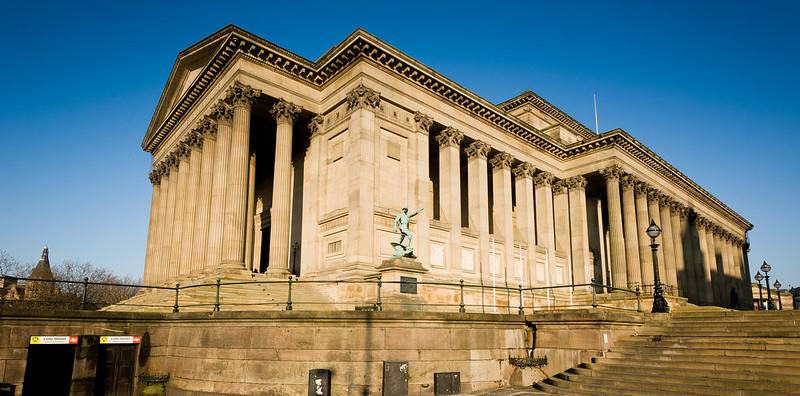
St George's Hall, Liverpool.

SH.org OP Username
Timeshifter
SH.org OP Date
2019-11-01 12:35:37
SH.org Reaction Score
101
SH.org Reply Count
101
Note: This post was recovered from the Sh.org archive.
Username: Recognition
Date: 2019-11-10 19:42:31
Reaction Score: 2
IMG_7580.jpg

"Construction" looks drawn in. (I played with contrast). Love it that this is one of the only pics available of it supposedly being built. ? Such a great thread!
 
Note: This post was recovered from the Sh.org archive.
Username: Beedubya
Date: 2019-11-19 18:17:37
Reaction Score: 1
This was in a Facebook group. Nice clean streets.

FB_IMG_1573659989800.jpg
 
Note: This post was recovered from the Sh.org archive.
Username: jd755
Date: 2019-11-19 19:20:36
Reaction Score: 1
My feeling about this image and the many like it is they are fakes produced for reasons I don't know by people I don't know, when I don't know.
As every photograph on here is in digital form then obviously in computer fakery is a prime candidate for how. Beyond photoshop or photoshop version 77.9 for example if you get my drift produced in my lifetime but equally post processing after the photograph was taken by mechanisms unknown today could be in play.
The shadows and the way the light falls on everything in the image and the shadows or lack of them seem to scream manipulation.
 
Note: This post was recovered from the Sh.org archive.
Username: Beedubya
Date: 2020-01-07 18:08:29
Reaction Score: 2
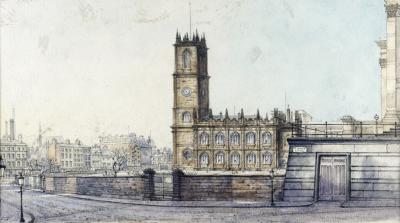
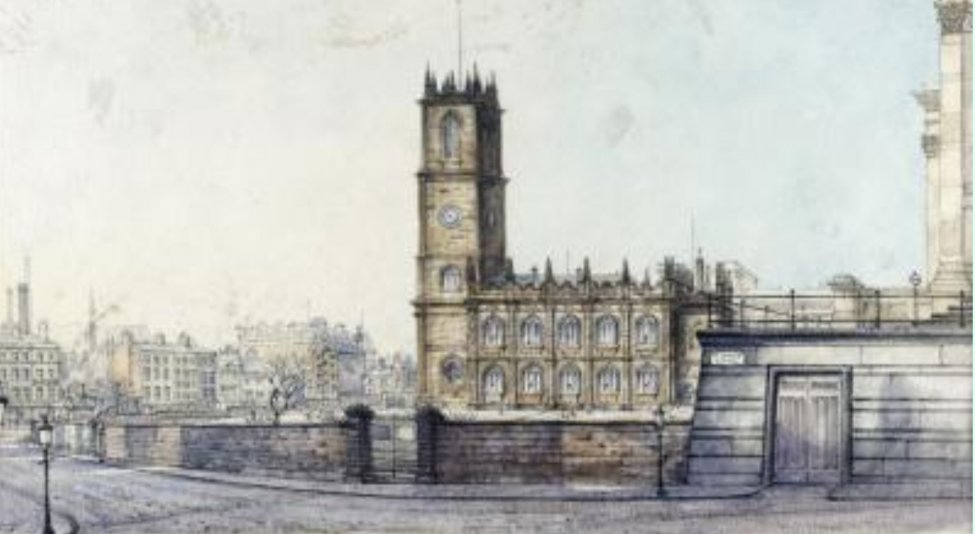
Today I was doing some family history research and came across St John's Church and it's burial grounds and remembered the conversation on here about the poverty at the time (please see the attachment) . My 3 x great grandfather is buried in St John's Gardens unless his body was one of those removed though that might only have been for the better off. I phoned my 91 year old mother to tell her and she believes St George's Hall has been there for many, many hundreds if not thousands of years.
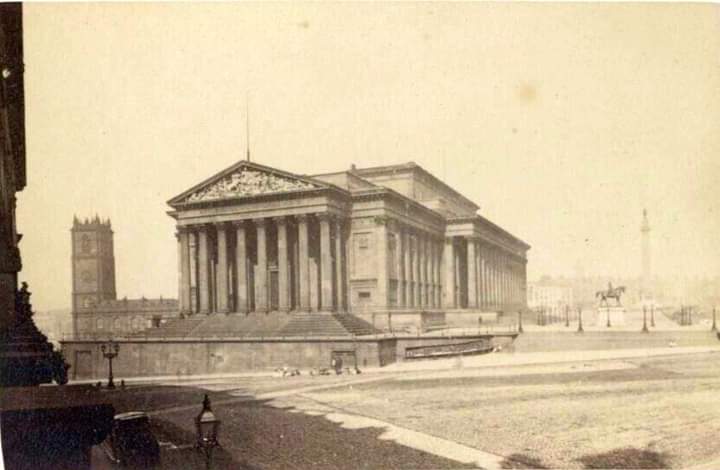
The church was completed in 1784 yet if you expand the image above you can see the columns of a very large building ?
  • St. John's Church stood against St. George Hall, on the site of what is now St. John's Gardens. The burial ground for the church, with a small chapel, was consecrated and opened for use in 1767 but the church itself was not completed until 1784. The architect of the church building was Timothy (sometimes given as Thomas) Lightoler.
  • In the year it was completed, St John’s served one of the most crowded and poorest areas of the city. Mid-1780’s Burial records indicate the degree of abject poverty to be found locally. Nearly one-in-two of the deaths that occurred were of children whilst in only one–in-four cases were people able to fund their own, or a relative’s, funeral. One-in-four burials were of paupers, two-in-three of whom were from the Poorhouse.
  • St. John's churchyard was closed for burials on 11th June 1865, 82,491 bodies having been interred in the grounds. St. John's Church was closed under the terms of the Liverpool City Churches Act 1897 The last Sunday service took place in St. John's on 27th March 1898.
  • When he church was demolished, Peet wrote, 'For more that a century this unsightly structure has been allowed to disfigure the landscape ... as an example of ecclesiastical art the church of St. John has not a single redeeming feature....'. Under a facility granted on 11th December 1888 Liverpool Corporation was empowered to lay out the churchyard as the public gardens to be known as St. John's Gardens.
  • Early Baptismal records contain a number of mentions of people from Africa, Jamaica, New Guinea and other countries. These record possible mariners or, reflecting that most unsavoury aspect of Liverpool’s past, slaves given English names.
  • Lancashire OnLine Parish Clerk Project - District of Liverpool
StJohnHaymarket.jpg
 
Note: This post was recovered from the Sh.org archive.
Username: Starmonkey
Date: 2020-01-07 18:18:09
Reaction Score: 1
Gotta keep paying! From the cradle BEYOND the grave. So many great scams over the ages... So many gullible people.
I'd like to go somewhere in nature. Not worry about the continuation or marker. The cycle can have this body back.
Guess I'll have to come give the old "mother land" a toss here soon. Touch a few things. Try and REMEMBER.
 
Note: This post was recovered from the Sh.org archive.
Username: Beedubya
Date: 2020-01-07 18:18:21
Reaction Score: 1
The church was completed in 1784 yet if you expand the image above you can see the columns of a very large building ?
 
Note: This post was recovered from the Sh.org archive.
Username: Starmonkey
Date: 2020-01-07 18:19:29
Reaction Score: 0
That foundation for the back is enormous!
 
Note: This post was recovered from the Sh.org archive.
Username: Beedubya
Date: 2020-01-07 18:21:45
Reaction Score: 1
Of course the painting of the church could have been done after St George's Hall was built but it's all a bit strange.
 
Note: This post was recovered from the Sh.org archive.
Username: Timeshifter
Date: 2020-01-07 18:47:19
Reaction Score: 3
That is definately the corner of St Georges! Would love to hear more from your Ma!

20200107_184525.jpg
 
Note: This post was recovered from the Sh.org archive.
Username: Beedubya
Date: 2020-01-07 19:03:28
Reaction Score: 3
Not much more to report but she pooh poohed it when I said St George's was built in 1841 she was like no those history books are wrong lol. Maybe we need to get to libraries and look for old history books.
 
Note: This post was recovered from the Sh.org archive.
Username: ScottFreeman
Date: 2020-01-07 19:19:49
Reaction Score: 1
No I don't believe that either. The "US of A" referenced can be said to be the first two branches of America's contracted government. Those being the British Territorial and the Papist Municipal that are combined to mean "federal". There is another branch, the one that isn't talked about, called National (actual Americans on the soil jurisdiction). So no, Britain was never 'at war' with itself. And, since 1066 there has been no true royalty running Britain anyway (the Queen abdicated three days after her coronation and accepted the office of The Chair of the Estates (from the Holy See))...if the things we're told about that war are true.
 
Note: This post was recovered from the Sh.org archive.
Username: El Mesías
Date: 2020-01-07 20:09:37
Reaction Score: 1
I was always confused by the name of the park on the Western side of St.George's Hall - 'St.John's Gardens'. It wasn't until last year that I found out it came from the church that previously occupied the site.

The church and the hall co-existed for a number of years. It is said to be the reason for the more 'simple' design on that side of the hall.

St John Church and St Georges Hall.jpg
 
Note: This post was recovered from the Sh.org archive.
Username: whitewave
Date: 2020-01-08 02:17:06
Reaction Score: 5
Gotta read the fine print on the burial plot contracts. "Forever" legally equates to 100 years. Then they can dig you up and bury someone else in that spot. Found that out when, as a teenager, I drove past an old cemetery plot that wasn't very large and I wondered how they still had room for new burials after all this time. Next time I attended a funeral I asked the director and he explained it. Cemetery plots seem like a waste of perfectly good real estate to me. Plant a tree over each biodegradable cremation urn and make a memorial wall for all the names/dates. These older churches with "sacred ground" cemeteries on church grounds must not be burying anyone else cuz the old headstones are still in place...so, not digging up the old and burying new ones. As for finding old history books, I was excited to find a 1901 American history book last week only to get 3 pages into it and realize it might as well have been written yesterday. Haven't finished it as the discouragement of reading how Columbus discovered America was not motivation to continue reading further. So we know that by 1901 history was already corrupted. Have to see if I can find older ones.
 
Note: This post was recovered from the Sh.org archive.
Username: Timeshifter
Date: 2020-01-13 10:16:47
Reaction Score: 1
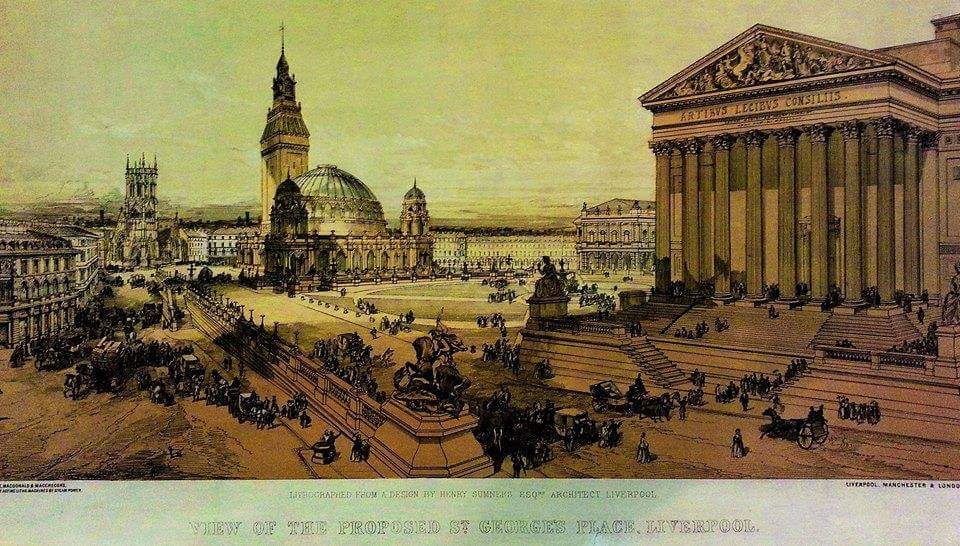
I came across this Design for 'St Georges Place' by Architect Henry Sumner which apparently never made the cut... Apparently Mr Sumner was also a failed inventor...

Source for the article below.

This act of reflection was also done back in January 1911 when a local newspaper reprinted a marvellous artist’s impression of long-lost engineering works that had once been set to totally transform the city.

Cdx-LbDW8AAK0Lb (1).jpg
From the Article:

'With the completion of the magnificent St George’s Hall in the autumn of 1854, Liverpool entered an era of confidence not unlike our own which followed the Capital of Culture optimism.Our Liverpudlian predecessors wished to see a continuation of their town’s progression with the creation of more grand, more respectable surroundings for their new neo-classical masterpiece.

The ambitious plans that followed were the brainchild of architect Henry Sumners.
He envisaged massive changes to the Haymarket, St Johns, William Brown Street, Queen’s Square and Williamson Square.

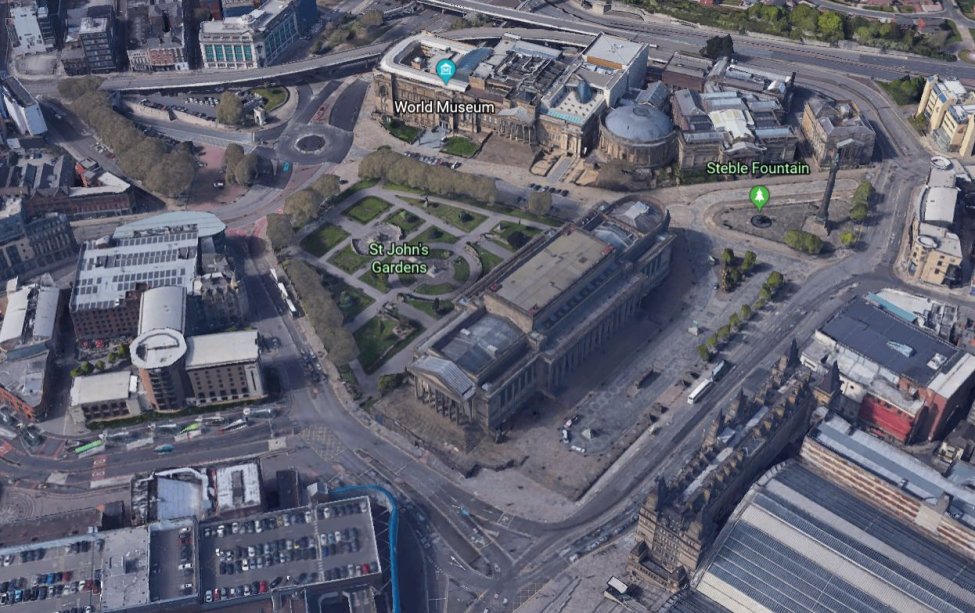
The most prominent feature of his urbanite dream was a huge salt water bath-house, complete with 150 foot dome and bell tower. This would have occupied the site of the Gladstone Memorial and the entrance to the Mersey Tunnel.

He also pictured a union between the Williamson and Queen Squares to create one large fruit, flower and vegetable market along with an adjoining hotel. Sumners was reported to have been very forward-thinking in regards to his view of Liverpool, far in advance of certain members of the council.

His Latin motto ‘Artibus Legibus Consiliis Locum Municipes Constituerunt Anno Domini MLCCCXLI’ (For Arts, Law and Counsel the townspeople built this place in 1841) is still clear to see on the south façade of the hall, but this was not by unanimous choice. One councillor wished to see something more representative of Liverpool’s trade endeavours, such as rum, sugar cotton and corn, while another put forward the rather direct slogan, "The land we live in and those who don’t like it may leave it."

What a charming message for visitors to Lime Street Station that would have been!

Hopes for William Brown Street to be filled with a library and museums did come to pass, but ideas towards relocating the Georgian church of St Johns to the corner of Hatton Garden were less successful.

This was eventually torn down in 1898 and gardens now occupy the former sacred site. Nevertheless, the image above does give us a precious insight into the stately and imposing sights Sumner had in mind for us and in some sentimental way we can now appreciate what could have been. Who knows how Liverpool will fair in another century and a half, but as the light of 2013 dawns over the hopeful waters of the Mersey, we surely wish her the best of luck'

How do we know this in not another actual drawing of what was actually there at some point?

The view today


st georges place.JPG
 
Note: This post was recovered from the Sh.org archive.
Username: El Mesías
Date: 2020-03-01 20:50:52
Reaction Score: 1
Where did the Frieze go?
 
Note: This post was recovered from the Sh.org archive.
Username: Timeshifter
Date: 2020-03-02 08:13:50
Reaction Score: 1
Do you have a date for this one? The relief is still present on the end, however I am not sure how much it looks like this....

ERzuZvxXYAEV5hZ.jpg
Found this just now Link sounds like fairytales to me....

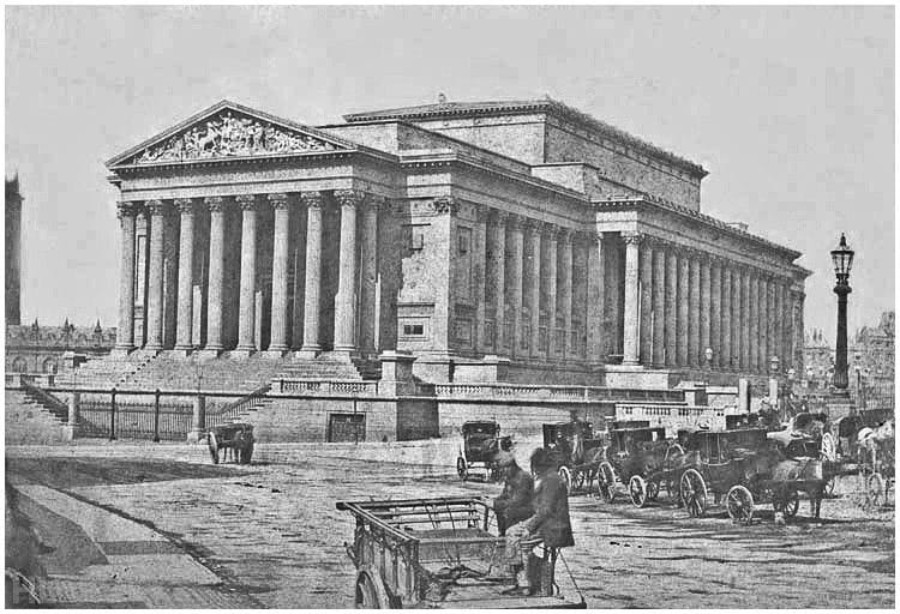
2-St-Georges-Hall-1854-900x614.jpg

This is one of the earliest photographs of St George’s Hall and we can date it relatively accurately due to two facts. Firstly, because of the steps up to the South Entrance. We know, because of newspaper reports at the time, that they had been removed by the December of 1854. Secondly, we also know the name of the photographer – it is accredited to a ‘Mr Forrest’. Now, under normal circumstances, that wouldn’t be overly helpful, but, we know that photographs were a relatively new medium and that a Mr James A Forrest is listed as one of the founding members of the Liverpool Photographic Society that was started in March 1853. So using that information, and the additional fact that the shadows cast are sharp from the sun being very high in the sky, we can hazard a pretty good guess that it is the summertime of 1853 or 1854.

So, what happened to the steps? Simply put, they were removed because they didn’t fit in with what the architect who was working on the building wanted to achieve. Harvey Lonsdale Elmes, the original architect of St George’s Hall died in 1847. In 1851, Charles Robert Cockerell was called in to deal mainly with the internal decoration of the Hall. Cockerell also had several ideas to improve upon the designs of Elmes for the exterior that he pitched to the Corporation (the governing body of Liverpool). They were excited about these ideas and allowed him to proceed.

Cockerell remodelled St George’s Plateau and removed the steps during this process. His idea was to have St George’s Hall look like the Parthenon atop the Acropolis in Athens and the steps spoilt the overall effect.

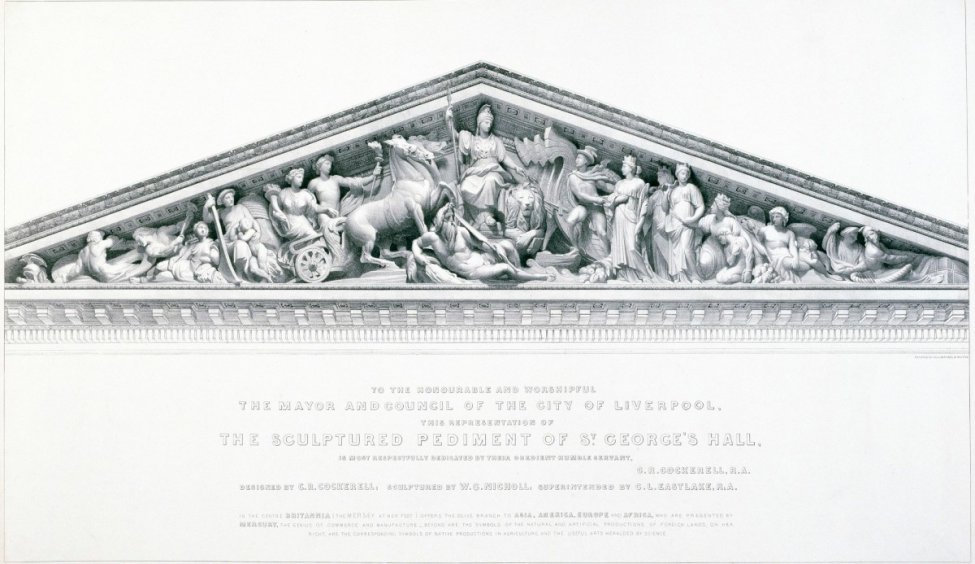
Cockerell also had another idea – to place a sculpture within the empty tympanum that was above the South Entrance. The sculpture can be seen clearly in the above photograph.

That sculpture, and what happened to it, is what we will now look at in more depth:

During the building of St George’s Hall, the original Architect, Harvey Lonsdale Elmes was taken ill with consumption and died in 1847 before seeing its completion. In 1851, Elmes’ mentor, Charles Robert Cockerell was asked to design the interior decoration. Whilst doing this, he also added a couple of his own flourishes to the building – one of which being a sculptured pediment on the South Entrance.

It should be noted that Elmes’ original sketches for his competition entry for an assizes did have a rough sketching of a sculpture in the pediment on the portico (as he had no doubt been inspired for his design by the Fitzwilliam Museum in Cambridge (which, incidentally, Cockerell had worked on)

Whereas his original sketch for the hall shows an empty tympanum. On combining the hall with the assizes, he translated the central tympanum to the south entrance of the hall along with the pediment idea for the assizes.

Even though his amended design showed a rudimentary sculptured pediment in the tympanum, Elmes had personally inspected the finished stone works and – allegedly – declared that the space was never meant to be hidden.

As mentioned earlier, during C R Cockerell’s involvement in the decoration of the building (from 1851), along with ideas such as an extended Plateau, Minton floor, Grand Organ and Small Concert Room, he also wanted a sculpture for the empty tympanum. He based it on a drawing that he had previously completed which was entitled ‘Idea for the Frontispiece of a Public Building in England’ that had greatly impressed Elmes. To have it carved, Cockerell turned to William Grinsell Nicholl, a sculptor who had held his patronage for some time. (Nicholl also designed the Lions and mermaid and merman lampholders that are on the plateau.

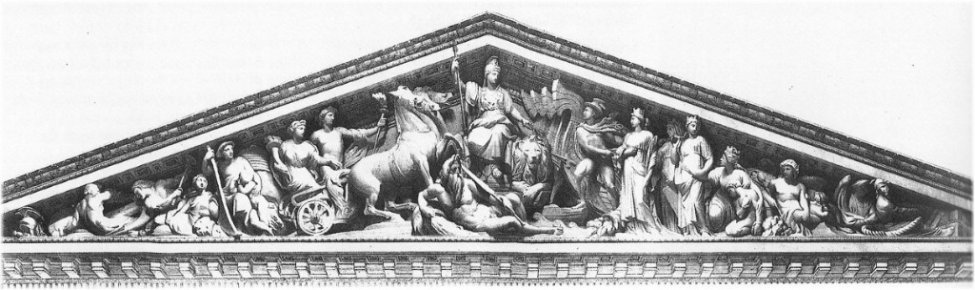
The completed sculpture has the following written description: “Britannia armed, her lion by her side, and seated on a rock, forms the centre: she holds in her left hand the olive-branch, and in her right the spear. She hails the four quarters of the globe, presented to her by Mercury; the last of whom, Africa, inclines with the form of the pediment and, with her negro children, acknowledges her obligations to the queen of freedom, who laboured so long and successfully for their emancipation: beyond are the vine and foreign productions; the husbandman and his plough, his wife with the distaff, and her child, express industry, manufacture, and domesticity: at the end are labourers at the anvil, the anchor, and the arms of mail, which she has not forgotten how to use”

So what on earth happened to it?!

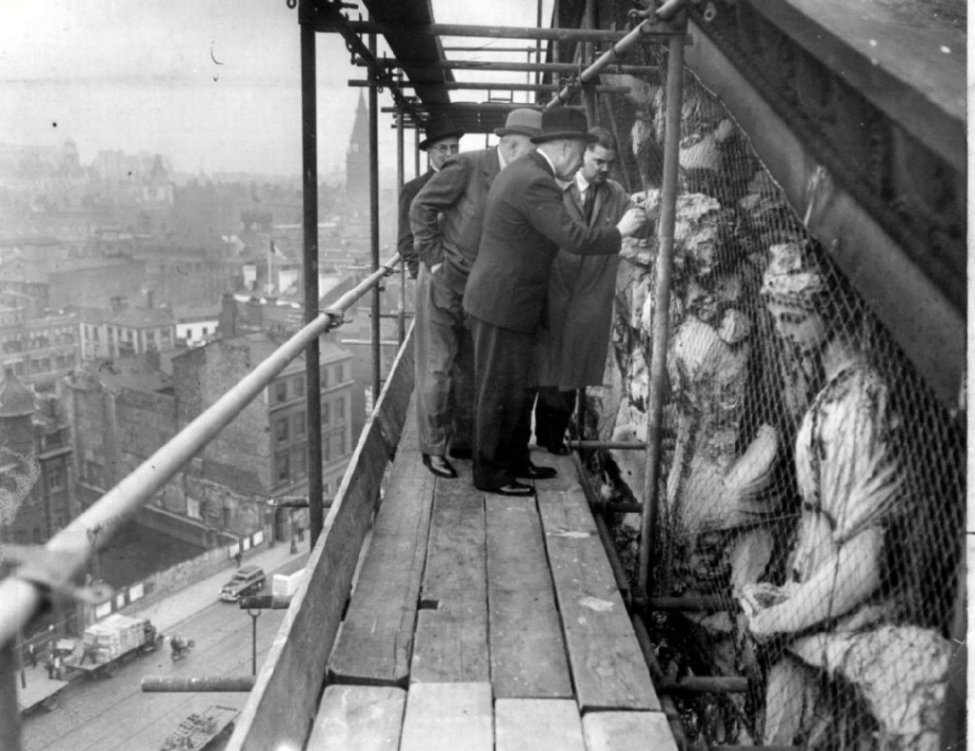
The sculpture was carved in Caen limestone, a relatively soft stone. Over the years, acidic rain had damaged it badly and in August 1950, large chunks of stone, some weighing around 50lb, fell more than 100ft to the ground below. Luckily, no one was injured.

The plan was to have it sorted by the following year in time for Festival of Britain, but on inspection it was discovered that the sculpture was too badly damaged to repair – at least in situ. The decision to take it down and put into temporary storage was made, but subsequent inspections showed that it was irreparable and therefore the sad decision to break it up for hardcore road-fill was made.

The missing pediment sculpture has been a great source of controversy for the city. There are many stories of why it was removed that neglect the fact that it was basically rotting and falling down anyway.

The most commonly repeated story is that it was removed or sanded off the hall because it depicted black slaves bowing before the might of Britannia. Now as the description above shows, this could not be further from the truth as it showed the role of Britain in the abolition of slavery. But nevertheless, it’s still a subject of great controversy.

Another tale is that it was secretly sold to an American, and there are also stories of the council denying that there ever was a sculpture in the pediment in the first place. Now, this I can believe! Not because the council is hiding the fact that it was ever there, but the denial is simply down to ignorance. Not everyone is interested in the history of the city’s buildings, so why should we expect every person on the council to have knowledge about them? It’s likely that the persons who have been challenged are simply unaware of its existence… Never attribute to malice that which is adequately explained by stupidity (or ignorance)

Since the removal of the sculpture, a few attempts to have it replaced have been made. In the 1980s, a suggestion to recreate it in stone-faced, reinforced plastic was put forward. However, austerity was biting hard and this was dismissed due to the “city’s economic climate”.

In the 1990s, political correctness scuppered plans by a group of sculptors to recreate it. Anti-racist groups jumped onto the rumour that the black figures kneeling before Britannia symbolised the slave trade and felt that recreating the pediment would offend the city’s black population. The same group also petitioned the council to change the names of all the roads related to the slave trade, but that is a story for another time!

A more recent attempt to recreate it had a new design made where the controversial figure that was causing all of the ruckus was changed to be “more like a chieftain, more like a king. Instead of kneeling down he is sitting in a more regal manner”. That was back in the early 2000s, and kind of just lost impetus from, I’m guessing, a lack of funds.

We will never know with 100% certainty if Harvey Lonsdale Elmes did actually want a sculpture in the pediment of St George’s Hall, or whether Cockerell decided to add it on his own. However, we do know that Elmes was relatively minimalist when it came to the decoration of his masterpiece – his completed rooms are plainly decorated and fit well with the Victorian ideal that the look of something should not detract from the purpose for which it was designed. Whereas, Cockerell with his Minton Floor, Grand Organ and the beautifully over-the-top gold Concert Room displays a love of decoration and flamboyance.

7-Inspection-1024x788.jpg

With these two facts taken into account, it seems likely that Cockerell himself decided to fill the pediment with a sculpture. That fact that he used a design that was liked by Elmes may have been a nod to his mentee who had sadly died only a few years earlier.

So, should the sculpture be replaced? If Elmes was indeed happy with the empty tympanum, should we leave it as, or should we follow Cockerell’s lead and put in a sculpture. And if a new sculpture is to be made, should we stick with the original design, or perhaps have a new one that shows a different scene?

6-Sculpture-Detail-1024x304-1.jpg
 
Note: This post was recovered from the Sh.org archive.
Username: Timeshifter
Date: 2020-07-21 06:29:12
Reaction Score: 1
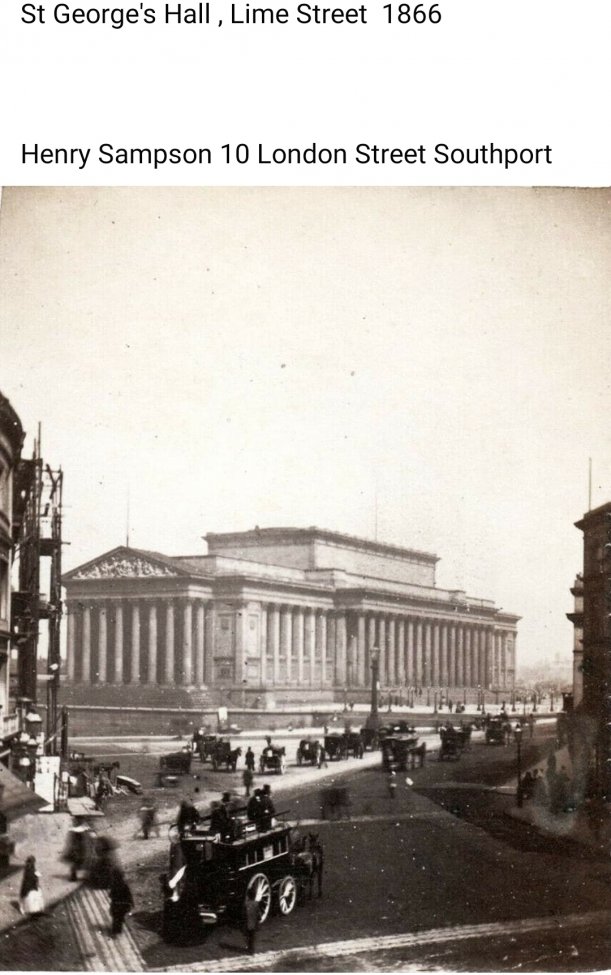
Came across this on facebook just now. States 1866, but could be anywhen looking at the carriages. What would those ariels/ masts be for in 1866?

Screenshot_20200721-071355_Facebook.jpg

Edit to add. 12 years open in 1866, it appears extremely old and aged, imo
 
Note: This post was recovered from the Sh.org archive.
Username: Timeshifter
Date: 2020-07-30 08:57:41
Reaction Score: 1
Discovered another, much earlier. This one supposedly 1851, 3 years prior to its completion. (A lantern slide of the original) Some work going on mid image to the right, construction or repair? I would say the latter,. Does this look like a new build (Ok, ten years of construction or so) ? Look at that sky...

Oldest Photo of Liverpool

St-G-1851.jpg
 
Note: This post was recovered from the Sh.org archive.
Username: Divine Wind
Date: 2020-07-30 13:58:50
Reaction Score: 1
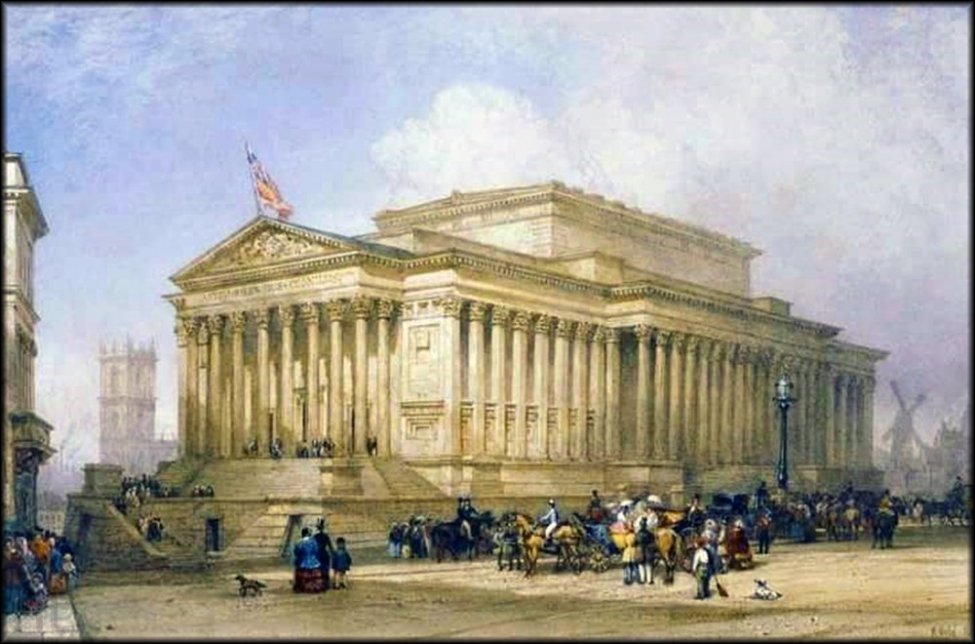
Do the in situ windmills help in anyway to place the construction date? Your first drawing shows 2 windmills, and it appears they are in and around present day Mill Lane (but perhaps only one would be visible from the perspective below).
Google Maps


This ties up with this painting, labelled as 1851 by William Wyld. William Wyld - Wikipedia (Well connected : Establishment painter?)
St Georges Hall.jpgst_-georges-hall shiny corner.jpg

The building does look a bit shiny on the nearest corner, and still does! (and doesn't match up with the present corner construction - artistic license, later expansion?), but the windmill is also clearly visible, as is the building in the foreground. When was that windmill demolished, if real? (possibly in Mill Lane) as I can't find it on this list below, and when was the building in the foreground to the left demolished?
St Georges Hall, Liverpool

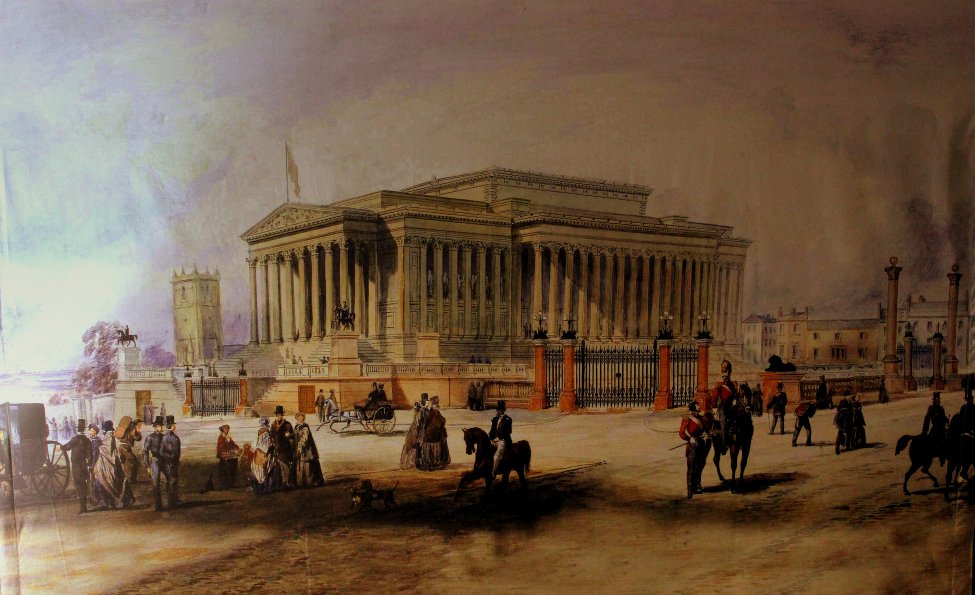
Then, another painting with the same corner arrangement as the '1851' painting. Is it just a lazy artist thing? as the real columns are not equally spaced. No shiny columns. It is noticeable that there is a gated arrangment around the building, and no windmill is detailed. The painting is shown in wiki, and is 'from the 1800's'. How old is the church behind, what church is it?
Assume this one demolished in 1890 St. John's Parish Church in Liverpool, Merseyside - Find A Grave Cemetery

st georges hall painting.jpg
File:A PAINTING ON CANVAS AT ST GEORGES HALL OF ST GEORGES HALL LIVERPOOL IN THE 1800.S TAKEN JAN 2013 (9615323017).jpg - Wikimedia Commons

Why would the building be gated off, it's almost as if it's a very important building, even at that date. No windmills, was this prior to any windmills? Is this an old painting that is being put on display that is actually showing some form of truth? When was this painted, and by whom?


List of windmills, where are the windmills detailed in and around Mill lane?
Liverpool Windmills can't tie any of these in
List of windmills in Lancashire - Wikipedia any of these tie in?
 
Tips
Tips
Please respect our Posting Rules.
Back
Top