- Joined
- Aug 31, 2020
- Messages
- 1,141
- Reaction score
- 2,177
You might also include the Orange men from Northern Ireland too! I think that is a form of masonic institution.
Orange Order - Wikipedia
Orange Order - Wikipedia
Here's a nice article that gives some depth to modern myth that the ancient Greeks new all about a globe earth
Ptolemy's lost manuscript discovered in book found in medieval abbey
Complete with the old medieval abbey , maybe this and maybe that , spilt tea on the manuscript ( see Philomena Cunk's marvellous take on history). Build a big machine plans too.
Incredible fake nonsense.
People will only recall the title - although it is rubbished in the first sentence.
Seriously I think that this is an attempt to give validity to those endless ancient philosophers quotes whose works no longer exist or are quoted in other peoples work that no longer exists.
Could have posted this in a different thread but this seems it's true home.
That is the entirety of the text they have uncovered.ἥ τε ἀπολαμβανομένη α̣ὐτοῦ π̣εριφέ̣ρε̣ι̣α̣ ἡ̣ μεταξὺ τοῦ τε ἡλίου καὶ τοῦ κατὰ κορυφὴν (about 3 incompletely legible words) ὑ̣π̣ο̣τ̣[ί]ν̣ο̣υ̣σ̣α̣ (l. ὑποτείνουσα) [τὴν] γωνί̣αν τη̣ν̣ ὑ̣φ᾿ ἡμῶν καλουμένην κ̣αταβατι̣κὴν κα̣ὶ τὴν λείπουσαν εἰς τὴν μίαν ὀρθὴ̣ν̣ ⟨ἣν⟩ οὕτως ὠνόμ̣ασαν οἱ̣ πρὸ̣ ἡμῶν, καὶ ἔτι ἡ ἀπ̣ολαμβανομένη περιφέρεια τοῦ ὁρίζοντος μεταξὺ τοῦ τε μεσημβρινοῦ καὶ τοῦ παγκλινοῦς, ὑποτίνουσα (l. ὑποτείνουσα) καὶ αὐτὴ τὴν γωνίαν <τὴν> ὑπὸ τῶν παλαιῶν ἀντίσκιον καλουμένην …
… the arc of it (scil. the all-tilter) cut off between the Sun and the zenith (about 3 incompletely legible words) which subtends the angle named by us katabatikê (“downward-heading”) and the remaining (angle to complete) one right angle, to which our predecessors gave this name (scil. katabatikê), and moreover the arc of the horizon cut off between the meridian and the all-tilter, which itself subtends the angle that was named antiskios (“counter-shadow”) by the old ones…
Finally, we may also argue by elimination. The three most plausible candidates for authorship are Ptolemy and his commentators Pappus and Theon of Alexandria.

Cave art of a lion with a luscious mane drawn deep in a Puerto Rican cave about 500 years ago might have been created by an enslaved African, new research suggests.
"We have an image that looks like a lion — but in Puerto Rico, we don't have lions," project researcher Angel Acosta-Colón, an adjunct professor of geophysics at the University of Puerto Rico at Arecibo and an expert on the island's caves, said in a statement.
Instead, the drawing may have been made by someone who'd seen one in Africa before they were enslaved and taken to the island by the Spanish.

But how do they know he was enslaved? They just do.
Or that he was African...because Spanish children were never educated about lions? O that it was 1500? A few decades before slavery truly began...or...or...that a geophysicist "thinks" blah blah blah.But how do they know he was enslaved? They just do.
You might also include the Orange men from Northern Ireland too! I think that is a form of masonic institution.

More like Tanged...remember the "Astronauts drink Tang" psyop?However, it's certainly possible that Freemasonry has been "Fantad" I suppose.
More like Tanged...remember the "Astronauts drink Tang" psyop?


"idiots tend to be unaware of their own idiocy".It’s the (apparent) tendency for unskilled people to overestimate their competence. Discovered in 1999 by psychologists Justin Kruger and David Dunning, the effect has since become famous.
...
Everyone ‘knows’ that idiots tend to be unaware of their own idiocy. Or as John Cleese puts it:
If you’re very very stupid, how can you possibly realize that you’re very very stupid?
Except there’s a problem.
The Dunning-Kruger effect also emerges from data in which it shouldn’t. For instance, if you carefully craft random data so that it does not contain a Dunning-Kruger effect, you will still find the effect.
Autocorrelation occurs when you correlate a variable with itself. For instance, if I measure the height of 10 people, I’ll find that each person’s height correlates perfectly with itself. If this sounds like circular reasoning, that’s because it is. Autocorrelation is the statistical equivalent of stating that 5 = 5.
No one is checking anything...The point of this story is to illustrate that the Dunning-Kruger effect has nothing to do with human psychology. It is a statistical artifact — an example of autocorrelation hiding in plain sight.
What’s interesting is how long it took for researchers to realize the flaw in Dunning and Kruger’s analysis. Dunning and Kruger published their results in 1999.
.. so the only people suffering from the Dunning-Kruger effect are Dunning and Kruger.However, there is a delightful irony to the circumstances of their blunder. Here are two Ivy League professors arguing that unskilled people have a ‘dual burden’: not only are unskilled people ‘incompetent’ … they are unaware of their own incompetence.
The irony is that the situation is actually reversed. In their seminal paper, Dunning and Kruger are the ones broadcasting their (statistical) incompetence by conflating autocorrelation for a psychological effect. In this light, the paper’s title may still be appropriate. It’s just that it was the authors (not the test subjects) who were ‘unskilled and unaware of it’.

That's the most Catholic thing I've ever heardI am reminded of a story I once heard regarding an archaeological discovery made in Ireland back in the 1970s. It was near the small village of Aghaboe, County Laois and the site was declared to be of ancient 'Celtic' origin. There was a skull excavated which was claimed to be that of Saint Canice dated to the sixth century.
This created much interest, particularly in Kilkenny, Ireland, where the same saint was venerated. The Bishop of Kilkenny's St Canice's Cathedral made a visit to examine the newly discovered skull of Aghaboe. The leader of the archaeological excavations near the small village was dismayed when the Bishop declared the skull to be a fake. He explained that the true skull of Saint Canice rested within his cathedral and that the newly discovered one was much smaller. The head archaeologist replied that the one he and his team had found was Saint Cancie and the reason it was smaller is because it's him as a child.
(Source: Dave Allen)
Markings used to coordinate the movement of enslaved workers and blind-folded animals were found on the bakery’s floor. The home was divided into a residential part adorned with lavish frescoes, and the bakery, where enslaved people were forced to grind the grain needed to produce bread. The bakery was cut off from the outside world, with the only exit leading to the main hall of the house.
“It is, in other words, a space in which we have to imagine the presence of people of servile status whose freedom of movement the owner felt the need to restrict,” said Gabriel Zuchtriegel, the director of Pompeii archaeological park. “It is the most shocking side of ancient slavery, the one devoid of both trusting relationships and promises of manumission, where we were reduced to brute violence, an impression that is entirely confirmed by the securing of the few windows with iron bars.”
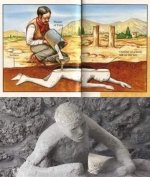
Wait, who is saying that's what it is? I've never heard that one. Vesuvius destroyed the bodies and left body-shaped holes in the ground? Body-shaped holes that somehow people knew from the surface were body-shaped holes? That no man or animal ever stepped on and no plant ever spread their roots into?One of the other mainstream versions for the bodies of pompeii is this, somehow the volcanic ashes destroyed the bodies (????), leaving just an empty space that was filled with plaster, and that's why the so called originals look like that...... well, i guess we're set to figure which of the mainstream versions is the most stupid '-'
View attachment 30881
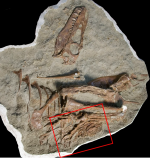
Proof.For the first time, scientists have unearthed direct proof of what a tyrannosaur—often thought of as the epitome of fearsome predators—actually ate.
fossil preparator, finds and prepares the discovery of his lifetime.Darren Tanke, a fossil preparator at the Royal Tyrrell Museum of Paleontology in Alberta, found the specimen in the province’s Dinosaur Provincial Park and delicately removed it from the rock in which it was encased. He called it “the discovery of his life,” according to study co-author François Therrien, the museum’s curator of dinosaur palaeoecology.
Evidence, not proof now...“Direct evidence of diet in dinosaurs is frustratingly rare,” says Lindsay Zanno, head of paleontology at the North Carolina Museum of Natural Sciences and an associate research professor at North Carolina State University, who was not involved in the new research.
Gorgosaurus lived in the late Cretaceous period, approximately 80 million to 66 million years ago. Leggy and slender with bladelike teeth in its youth, it developed into a massive apex predator as an adult, almost twice the height of a giraffe and weighing as much as an elephant.
The differing amount of stomach acid etching on the prey remnants indicates the animals may have been consumed within hours or days as separate meals. And the fact that the remnants included fully articulated legs from two oviraptorosaurs of the same age, size and species suggests the animals were a favored menu item of this particular tyrannosaur
feathers are a more recent turn in the dinosaur narrativeGorgosaurus probably “dismembered the small prey, swallowed the legs and left the rest of the body out there,” Therrien says. He suggests these legs may have been “the meatiest part” of the animal and wonders, with a laugh, if perhaps this Gorgosaurus “didn’t want to be bothered having to cough up some feathers.”
“With the discovery of this remarkable specimen, we have direct, irrefutable evidence of not only what this species was snacking on,” Zanno says, “but the gory details of how it went about it.”
Seasonal!Oviraptorosaur nests typically contained at least 30 or more eggs. With such large broods, “you could imagine, at certain times of year, depending upon the species and when their breeding season is, this would not be an uncommon prey for predators,” Zelenitsky says. That’s why she isn’t surprised to find remains of this species in this Gorgosaurus’ stomach, especially because she “can’t see the adults going after these tiny little chicken-sized or turkey-sized dinosaurs.”
I think they were making a tourist pier - perhaps with an amusement arcade and snacks.Rarely has a single find changed scholars’ views of the capabilities of people of the past as radically as the discovery of the world’s earliest known wooden architecture, which dates to nearly half a million years ago. The pair of interlocking logs joined by an intentionally cut notch was unearthed beneath a bank of Zambia’s Kalambo River by a team led by University of Liverpool archaeologist Larry Barham. Researchers believe the logs may have formed part of a walkway or the foundation of a platform built over wetlands. Prior to this discovery, the oldest known surviving wooden structures were built by people living in northern England around 11,000 years ago.
Its not even human really..The 476,000-year-old log structure predates the appearance of the first modern humans by some 150,000 years and was likely the handiwork of the archaic human species Homo heidelbergensis.
I hope they're not walking back the 476,000 year claim..At the same site, the team unearthed stone axes as well as four wooden tools dating to between 390,000 and 324,000 years ago. These included a digging stick, a wedge-shaped object, a notched branch, and a flattened log. Marks on the log, notes Barham, resemble nothing so much as tool nicks on a work bench, inviting speculation as to what other structures an imaginative H. heidelbergensis woodworker might have fashioned.
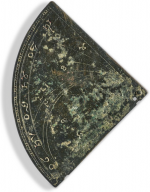
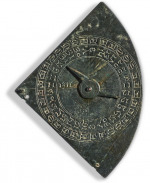
A copper horary quadrant, a timepiece, calendar and altitude calculator, inscribed with the year 1311 on the reverse side, making it the oldest dated English scientific instrument, will be going under the hammer at Christie’s on December 13th.
I hadn't heard that in the past it was considered that the day always had 12 segments, but that the length of the segments differed.It also contains a sundial that tells the time, which in medieval England was commonly divided into 12 hour-long segments between sunrise and sunset. This meant that each hour was longer in summer than in winter — which was useful when daylight was crucial to working the land.
The pre-sale estimate is £100,000–£150,000 ($125,000–$188,000). Even the high estimate is modest. A medieval quadrant dating to 1388 that was discovered in Canterbury in 2005 sold for £138,000. The buyer applied for an export license and the Culture Minister placed a temporary ban on export as an object of exceptional cultural interest. The British Museum was able to raise the matching funds in time and it is now on display.