D
Deleted member 1432
Guest
The bankers who create accounts of numbers. The same people who installed Dutch William.
If you have any sources for that I'd be very interested to see them. Thanking you in anticipation.
The bankers who create accounts of numbers. The same people who installed Dutch William.

If you have any sources for that I'd be very interested to see them. Thanking you in anticipation.
Back about ten to fifteen years ago when I went down the fmotl rabbit hole a memory was triggered from grammar school history days of the early seventies. Back then goldsmiths were mentioned as being the bankers of the royalists.If you have any sources for that I'd be very interested to see them. Thanking you in anticipation.
What was being used to purchase precious metal with if the precious metal was the thing the coins were made from?The English Civil War broke out in 1642. The eventual victory of the Parliamentarians led to the English Commonwealth, a period of republican rule in Britain. Backwell’s financial career began in this period; state records show his purchasing large amounts of precious metals brought from abroad. When he and Thomas Vyner purchased metal captured from the Spanish, just the preliminary advance paid to the government in order to secure the opportunity came to £50,000.
Nothing to see here, move along, move along.On 6 July 1665 Pepys noted that 'Alderman Backewell is ordered abroad upon some private score with a great sum of money; wherein I was instrumental the other day in shipping him away [to Antwerp]. It seems some of his creditors have taken notice of it, and he was like to be broke yesterday in his absence; Sir G[eorge] Carteret telling me that the King and the kingdom must as good as fall with that man at this time' had the Exchequer not provided support, such was the Crown's dependence on him.
He visited Holland in 1680 ‘in the King’s special service to the States General’, and may have remained there to avoid arrest for debt. In 1682, after Carteret’s death, Backwell’s lands were extended for over £60,000, which he had pledged to the navy in 1667 but had been unable to pay. He died in Holland in 1683, but his body was brought back to England and buried at St. Mary Woolnoth on 16 June.
The house thats Call'd Buxton Hall wch belongs to ye Duke of Devonshire its where the warme bath is and well, its the Largest house in the place tho' not very good; they are all Entertaining houses and its by way of an ordinary-so much a piece for yr dinners and suppers and so much for our Servants besides; all ye ale and wine is to be paid-besides, the beer they allow at the meales is so bad yt very Little Can be dranke
And from the Parliamentary History we see why she endured such conditions.You pay not for yr bed roome and truely the other is so unreasonable a price and ye Lodgings so bad, 2 beds in a Roome some 3 beds and 4 in one roome, so that if you have not Company Enough of your own to fill a Room they will be ready to put others into the same Chamber, and sometymes they are so Crowded that three must Lye in a bed
He quarrelled with a courtier named Colepeper and was provoked into striking him in Whitehall, for which he was sentenced to pay a fine of £30,000
Always in debt these aristocratic types.His father feared that his late hours in town might destroy him, and complained that he could not obtain a clear list of his debts, though he was in danger of arrest.
He signed the invitation to William of Orange, and took a prominent part in the Revolution.
Any names on the death warrant of Charles Isponsors leap out?Any information you have that implies Charles I or Charles II were also funded by the same Dutch source as Cromwell (Manasseh Ben Israel) would represent a major twist in the plot.
We went 3 mile off in the afternoone to heare another yt was in a meeteing and so 3 mile home againe. Ye hills about ye town and all about ye town is rocks of ye finest marble of all sorts-huge Rock. I took some of it and shewing it to severall they think it Comparable to any beyond sea.
Thence to Buxton 9 mile over those Craggy hills Whose Bowells are full of mines of all kinds off Black and white and veined Marbles, and some have mines of Copper, others tinn and Leaden mines, in wch is a great deale of silver.
I have some wch Looks full of silver, its so bright just brought up out of one of ye mines. They digg down their mines Like a well for one man to be let down wth a Rope and pulley, and so when they find oar they keep digging under ground to follow the oar wch lies amongst the stone yt Lookes like our fine stones
In yt mine I saw there was 3 or 4 at work and all let down thro' ye well; they digg sometymes a great way before they Come to oar.
There is also a sort of stuff they dig out mixt wth ye oar and all about the hills they Call Sparr, it looks like Crystal or white sugar Candy, its pretty hard; ye doctors use it in medicine for the Collick; its smooth like glass but it looks all in Crack's all over.
They Wall round the Wells to ye mines to Secure their Mold'ring in upon them, they Generally Look very pale and yellow that work Underground, they are fforc'd to keep Lights wth them and sometymes are forced to use Gunpowder to break ye stones, and yt is sometymes Hazardous to the people and destroys them at ye work.
The house thats Call'd Buxton Hall wch belongs to ye Duke of Devonshire its where the warme bath is and well, its the Largest house in the place tho' not very good; they are all Entertaining houses and its by way of an ordinary-so much a piece for yr dinners and suppers and so much for our Servants besides; all ye ale and wine is to be paid-besides, the beer they allow at the meales is so bad yt very Little Can be dranke.
You pay not for yr bed roome and truely the other is so unreasonable a price and ye Lodgings so bad, 2 beds in a Roome some 3 beds and 4 in one roome, so that if you have not Company Enough of your own to fill a Room they will be ready to put others into the same Chamber, and sometymes they are so Crowded that three must Lye in a bed
Few people stay above two or three nights its so Inconvenient. We staid two nights by reason one of our Company was ill, but it was sore against our Wills for there is no peace nor quiet with one Company and another going into the bath or Coming out; that makes so many strive to be in this house because the bath is in it.
Another wonder is that of Pooles hole, thats just at ye towns End, a Large Cavity under ground of a Great Length. Just at the Entrance you must Creep, but presently you stand upright, its Roofe being- very Lofty all arched in the Rocks and sound with a great Ecchoe. Ye Rocks are Continually droping water all about, you pass over Loose stones and Craggy Rocks. The dripping of the water wears impression on ye Stones that forms them into Severall Shapes, there is one Looks Like a Lyon wth a Crown on his head, ye water trickling on it weares it into so many shapes; another place Lookes just Like ye shape of a Large organ wth ye severall Keys and pipes one above another as you see in a great Cathedrall; there is also a Stone wch Looks white and in shape Like a salted flitch of Bacon wch hangs down from the Roofe of ye Arch wch is very Lofty in this place. There is another Rock Looks like a Chaire of State wth ye Canopy and all glistring like diamonds or starrs; thus does all ye sides of the Rock all shine Like Diamonds. Ye Rocks are very Large and Craggy and Indented, some Looks like ye outsides of Cockle shells, others are smooth all Caused I believe from ye dripping of ye Water. I was as farre as ye Queen of Scotts pillar, wch is a Large white stone, and ye top hangs over your head Like a Cannopy all great white Stones and in spires or Large jceickles and glistring as the other. They may go farther but I had no such Curiosity, I had ye Light Carry'd that shewed me to St Anns Needle after wch is only sand. This white stone is very Like Chrystall of wch there is a stone Like a Bason or Large ffont wherein drops Continually ye water wch runns over and trickling down does as it were Candy in jceickles and points, under wch is a pillar of this white stone. We had some broken off which Looks like ye jnsides of oystershells or mother of pearle, some Looks like alabaster. As I went I Clamber'd over the top of all ye stones and as I Came back I pass'd under severall of ye arches Like bridges; they are both wayes full of Loose stones and the water dropping makes them slippery, it being also very uneven by reason of ye Craggs.
How it should Come none Can give any good acco; its Call'd Pooles hole from a man of that name that was a Robber and use to secure himself in yt place like a house, and so ye Country people imagined he made it, but some think it was dug to find mines or marble or Chrystal because ye mettle mines are full of stone as I sd before; only this Enters in ye side whereas the mines they make now are as a well perpendicular for severall yards before it spreads, and yt not till they Come to find metal, but ye difficulty appears as to this hole how so large a Cavity should be Left, as in some places ye Roofe is as lofty as you can see and all stone; now how it should be fixt so as not to tumble in by ye weight of ye Earth or stone on ye top: as to ye waters dropping yt is but what is Customary among rocks and stones, there are many springs wch run in ye veines of ye Earth and allwayes are running in such subteraneus vaults in the Earth, wch gather together and runns in a little Channell in ye bottom of this Cave as you may step one.
The fifth wonder is Mamtour wch is a high hill that Looks Exactly round, but on the side next Castleton wch is a Little town in the High Peake on that side its all broken that it Looks just in resemblance as a great Hay-Ricke yts Cut down one halfe on one side-that describes it most naturall. This is all sand, and on that broken side the sand keeps trickling down allwayes Especially when there is the Least wind of wch I believe this Country scarce Ever is wth out; many places of the hill Looks hollow and Loose wch makes it very dangerous to ascend and none does attempt it, ye sand being Loose slips ye foote back againe.
The 6th wonder is at Casleton 4 mile from Elderhole; its a town Lyes at ye foote of an Exceeding steep hill wch Could not be descended by foote or horse, but in a Compass and yt by ye Roads returning to and agen on ye side of ye hill at Least 4 tymes before we Could gaine ye bottom or top of sd H ill.
This is wch they Call the Devills Arse a peake, the hill on one End jutting out in two parts and joyns in one at ye top, this part or Cleft between you Enter a great Cave wch is very Large, and severall poor Little houses in it built of Stone and thatch'd Like Little Styes, one seemed a Little bigger in which a Gentleman Liv'd and his wife yt was worth above 100? a year wch he left to his brother, Chooseing rather Like a hermite to Live in this sorry Cell.
Arse is now considered a profanity or slang term not a descriptive on.
In this Country they burn all this tyme of ye year July, their ffern and make ye ashes up in balls and so keep to make Lye for driveing their Ruck of Cloth's wch whitens them much.
The minster is a stately structure but old, ye outside has been finely Carv'd and full of Images as appears by the nitches and pedistalls wch remaine very Close all over the walls, and still just at ye front remaines some Statues of ye Kings of Jerusalem and some angels and Cherubims. At ye door is a Large statue of King Charles ye Second, and all about ye door is fine Carving of flowers Leaves, birds and beasts and some saints and apostles statues.
She is describing the minster at Lichfield now.
At ye door is a Large statue of King Charles ye Second, and all about ye door is fine Carving of flowers Leaves, birds and beasts and some saints and apostles statues. The Inside of ye Church is very neate being new but there is but Little painting; there are two Quires, one old one wth organs and seates, ye other new wch is very Large wth Organs and fine Carving in ye wood; here are 2 organs.
Coventry stands on the side of a pretty high hill and as you approach it from the adjacent hill you have the full prospect. The spire and steeple of one of the Churches is very high and is thought the third highest in England. In the same Church yard stands another large Church wch is something unusuall two such great Churches together; their towers and the Rest of ye Churches and high buildings make the town appear very fine, the streetes are broad and very well pitch'd wth small stone.
The Cross is noted and ye finest building in England for such a thing, and in my phancy it very much resembles ye picture of ye tower of Babel, its all stone Carv'd very Curiously, and there are 4 divisions Each being less than another to ye top, and so its Piramidy forme.
In Each partition is severall nitches for statues quite round it where are kings and queens, and just on Each side before Each statute is their arms and ye arms of England and the arms of ye town, and so its adorn'd wth Coullours and gilding in their proper places as in the garments and Crowns or Coronets, and finely Carv'd wth angels and Cherubims and all sorts of beasts, Birds' flowers in garlands, and Leaves-this in Every division; there is variety quite up to the top wch is finely Carv'd and Gilt
There is a water house at the End of ye town wch from springs does supply by pipes ye whole town wth water in ye manner that London is.
There is also a water wch serves severall mills yt belong to the town; it seems to be a thriveing good trading town and is very Rich.
They have a great publick stock belonging to ye Corporation above 3 thousand pound a year for publick schooles, Charity and ye maintenance of their severall publick Expences, of their Magistrates and Companyes, the majority of the heads are now in ye sober men, so its Esteem'd a ffanatick town, and there is Indeed the largest Chapple and ye greatest number of people I have ever seen of ye Presbiterian way.
There is another meeteing place in ye town of ye Independants wch is nott so bigg, but tho' they may differ in some small things, in ye maine they agree and seeme to Love one another wch was no small sattisfaction to me, Charity and Love to ye brethren being ye Characteristicall marke of Christs true Disciples.
Coventry has one thing remains Remarkable not to be omitted, the statue of a man Looking out of a window wth his Eyes out, and is a monument as history tells us of some priviledges obtein'd by a Lady wife, to the nobleman who was lord of ye town, and she was to purchase them by passing on horse back through ye town naked wch he thought she would not do, but out of zeale to relieve ye town from some hard bondage she did, and Commanded all windows and doores to be shutt and none to appear in the streete on pain of death wch was obey'd by all; but one man would open a window and Looke out and for his impudence had this judgment on him to be struck blind; this statute is his resemblance and one day in a year they Remember ye good Lady by some rejoyceing.
The town of Warwick by means of a sad fire about 4 or 5 years since yt Laid ye greatest part in ashes, its most now new built, wch is wth brick and Coyn'd wth stone and ye windows ye same.
There still remaines some few houses of ye old town wch are all built of stone. Ye streetes are very handsome and ye buildings Regular and fine, not very Lofty being Limited by act of partliamt to such a pitch and size to build ye town.
Ye ruines of ye Church still remaines, ye repairing of which is ye next worke design'd; Ye Chancell stands still in wch was all the fine monuments yt were preserv'd from the fire
Warwick Castle is a stately building, its now the Lord Brooke's house.
At ye Entrance of ye first Court ye porter diverts you wth a history of Guy Earle of Warwick, there is his walking staff 9 foote long and ye staff of a Gyant wch he kill'd thats 12 ffoote long; his sword, Helmet and shield and breast and back all of a prodigious size, as is his wives jron slippers and also his horses armour and the pottage-pott for his supper-it was a yard over the top; there is also the bones of severall Beasts he kill'd, the Rib of ye Dun-Cow as bigg as halfe a great Cart Wheele:
there is also his will Cut out on stone, but ye letters are much defaced; these are the storyes and meer ffiction, for the true history of Guy was that he was but a Little man in stature tho' great in mind and valour, which tradition describes to posterity by being a Gyante.
Such will the account be of our Hero King William the third tho' Little in stature yet Great in atchievements and valour.
Thence to Stony Stratford, so Cross ye river Aven again 12 mile, and Enter Buckinghamshire. At Stony Stratford wch is a little place built of stone they make a great deale of bonelace and so they do all here about, its the manuffactory of this part of ye Country, they sit and worke all along ye streete as thick as Can be.
6 mile to Horwood, thence we pass by a lofty pile of Building Called Salden, a gentlemans house, and by the Rich Mrs Bennets House, Remarkable for Coveteousness wch was ye Cause of her death-her treasures tempted a Butcher to Cut her throate who hangs in Chains just against her house.
Thence to Oxborn and Enter Bedfordshire 13 mile. The duke of Bedfords house we saw wch stands in a fine parke full of deer and wood, and some off the trees are kept Cut in works and ye shape of severall beasts.
There are 3 Large Gardens, fine Gravell walks and full of fruite. I Eate a great quantety of ye Red Coralina goosbery wch is a large thin skin'd sweete Goosebery.
you pass under an arch into a Cherry garden in the midst of wch stands a figure of stone resembling an old weeder woman used in the garden, and my Lord would have her Effigie wch is done so like and her Clothes so well that at first I tooke it to be a Real Living body.
Thence to St Albans and so we Enter Hartfordshire 12 mile.
The great Church wch is dedicated to St Albans is much out of repaire, I see the places in the pavement that was worn like holes for kneeling by the devotes of ye Religion and his votery's as they tell you, but the whole Church is so worn away that it mourns for some Charitable person to help repaire it.

Don't mention the worn pavement to usselo he may think they were evidence for butchering humans for food.
 Busy with lynchets at the moment. Keep it coming though - it's fascinating.
Thank you for all the quotes - your book is quite a find!Now then. Apricots are too tender to grow to fruit. most years. over my lifetime. They need heat and long days to ripen properly yet here is Celia in 1697 writing of apricots being grown outside which alludes to a warmer climate than it is today.
I think they could still have been re-purposed - Fashion as an explanation always seems too convenient and self-referential to me. Rooms with old black/white/red tiling often seem quite cool - maybe the material of the tiles themselves had an intrinsic purpose, and wasn’t just aesthetically pleasing and tough.The domes an cupolas were built to allow the owner to show off how skilled he was at choosing a place to build his house which afforded greater view than another. The better the placement the greater the status coming from the amount of land seen which is in the ownership of the owner.
This description of black and white marble flooring appears time and again. These days and especially in these forums much is written about black and white floors being masonic symbology but in 1697 they are the fashion status symbol of the day. All the new houses she encounters seem to have had black and white marble floors installed in their halls. The older, lower, buildings seem to have them too but in nowhere near the number of the stone built houses.
Sir Robert Dashwood was the cousin of degenerate Sir Francis Dashwood (Hellfire Caves, Buckinghamshire). Both were created 1st Baronets, and the family seems neck-deep in the opportunistic financial and political rape and pillage of England of the 1600's, acquiring property and land in central south England. Sir Robert's grandson, Sir James, also "built" Kirtlington Park, Oxfordshire.Which suggest Dashwoods are an old family.
This must be the Sheldonian Theatre:The Theater is a Noble Pile of building, its Paved with Black and White Marble, exceeding Large and Lofty, built Round and Supported by its own architecture all stone, noe pillars to support it; itt has windows all round and full of Gallery's ffor the Spectators as well as Disputants when ye acts are at Oxford.
A theatre in the round though Celia doesn't use the term. Black and white marble mentioned again. Its walls being load bearing, from her description, which is evidence of architectural and building know how being used by its architect/builder.
And Acts is the term she uses not actors or actresses or plays.
Acts on stage Acts of Parliament. Are they the same thing. make believe/
I would argue yes, most definitely.
Right next door to the Sheldonian Theatre is the History of Science Museum - must be this place!Just by it is a little building wch is full of Antiquityes wch have many Curiositys in it of Mettles, Stones, Ambers, Gumms.
This little building, its contets and its location right by the theatre containing a printing press make for very interesting reading.
I suggest Celia is describing what we today call a museum. Wonder when that word was actually invented. She doesn't name the travelling gentleman so perhaps he was not of the aristocracy. Similarly she doesn't name the Prince across the sea, which to my mind refers to a Prince not of Europe.
The colleges in Oxford cover quite large areas, with all sort of buildings, often around a large, flat, square courtyard (they call them Quads), including a lodge at the entrance with iron gates, a dining hall, accommodation halls, and sometimes chapels (usually more church-scale than the more cosy chapel image).I get confused here. She mentions colledges and chapple as though they are one and the same building.
Great Tom is the name of the bell in Tom Tower in Christ Church College. Christ Church also has the cathedral that gives Oxford its city status - it's a very grand college. It is on a road called St Aldate's, which leads down to the Thames. I suspect the bell was transported from London on the river.The Courts large, ye buildings large and lofty; in one of the Courts is a tower new built for to hang the Mighty Tom, that bell is of a Large size, so great a Weight they were forced to have engines from London to raise it up to the tower.
And now Courts. If this and the preceding sentence dont show legal, education and religion are in essence the same thing I don't know what does.
Engines brought from London to raise a bell. I can only guess as to what the engines in question were, cranes of some kind or winding drums or windlasses seem most likely but tis but a guess. Thing is the road from Oxford to London must have broad and well pitched enough to allow the wagons carrying the engines to make passage in both directions. Perhaps the engines were disassembled for travel much the same as large cranes of today travel in bits on truck trailers.
I would also guess that the tower itself was the support aka the literal tower of tower crane and the engines provided the lifting power whilst the tower bore the weight of the bell.
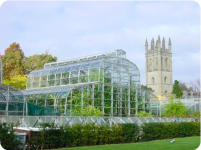
This must be the Botanical Gardens - odd place for a triumphal arch...The Physick garden afforded great diversion and pleasure... these are nice plants and are kept mostly under Glass's, ye aire being too rough for them.
Under glass refers to a greenhouse so it would seem the greenhouse was built prior to the introduction of the Glass Tax in 1696 unless greenhouses were exempted from the tax.
Totally with you! It's a very, very dark place...I feel that Oxford is used to house the inventors of history quite frankly.
Chimneys feature in Celia’s description of the Dean’s house in Salisbury, opposite the Cathedral:Celia never mentions fireplace so it was a term unknown to her. Chimney on the other hand gets frequent mention along with mantle and mantle piece. She never mentions iron stoves being within and I for one am certain she would have if they had been there.
Describing what we call chimneys as tunnels is much more accurate. Looking up from inside them reveals them to be tunnels.
The etheric energy stuff doesn't fly I'm afraid. If it were possible you do not need a fixed device built into a house that has to "see the sky" to work.
I now have a picture in my mind of a sort of “Twilight Bark”, as in The 101 Dalmations, by Dodie Smith, but delivered via chimney - perhaps you could call it the Evening News… do you think it could catch on? Why would she bother when she knows what the heat source was as did everyone else. Coal.Nothing in the descriptions implies a heat source
Why hang intricate lace and exquisite paintings above a coal fire? They seem to have used plumbing a lot - maybe the coal was used to heat water which was then pumped where required; I've seen that method used to heat greenhouses, using compost rather than coal. It seems to have been warmer times, in any case - apricots, for example, grown outdoors - so maybe the need for indoor heating wasn't so great.Why would she bother when she knows what the heat source was as did everyone else. Coal.
She mentions coal numerous times throughout the journal but doesn't mention what it is used for. Does this mean coal was used for unknown purposes or did they just dig it and cart it for the hell of it.
You are reading things that aren't there.I remember the refutation relying on the fact that coal was being mined at the time of the writing of the journal, and must therefore have always been burned inside houses (instead of safer, more elegant, and less smelly solutions such as hypocausts, and the use of hot water radiators) and that house built in 1920s were built with fireplaces and therefore all houses ever built beforehand must also have used the same primitive heating methods. Not convincing enough for me.
This only makes sense from an occupier's viewpoint, but not for the original builders.Steps are a prominent feature of her descriptions of houses. The specific number seems to be a measure of wealth an or status of the principal resident of the house.
You link my idea or more truthfully my observation about the number of steps being suggestive of wealth or status of whoever commissioned them to the "size of the basements".This only makes sense from an occupier's viewpoint, but not for the original builders.
Let's imagine that you are a young, recently-landed member of the gentry, looking to create your stately home. Perhaps you have married your cousin, and are soon expecting the pitter-patter of little webbed feet. Your patron has granted you some land, and all you have to do is build your dream home, setting out your stall as a prominent and wealthy influencer.
Your workmen prepare the ground, and "naturally" start digging a huge hole to build your house in. In due course, they have dug a hole of a couple of feet' depth. This is the optimum depth according to the "Big Number of Steps = Best" theory. With a shallow basement, the number of steps is maximised. It is also economically more sensible - fewer man-hours than digging a deeper hole to indicate a lower social status, and the attendant expense - obviously quicker, and also allows for better ventilation and lighting.
What conceivable reason is there to dig any further? The deeper the hole, the fewer the steps. Did some owner builders, say, Hang On, let's not be too ostentatious and proud! Let us show our humiility and lack of social aspiration by spending a small fortune on dropping our houses over six feet into the ground?
If the "Big Number of Steps = Best" theory was indeed the primary reason for building basements, then it surely provides evidence for the ravages wrought to the mind by generational inbreeding!
1. I had assumed that the steps Celia was constantly banging on about were the prominent steps to the front door from the ground. How are these not are directly related to the depth of the basements?You link my idea or more truthfully my observation about the number of steps being suggestive of wealth or status of whoever commissioned them to the "size of the basements".
If you truly believe large houses have footings that go down "a couple of feet" then crack on my son crack on.
"lowest story of a building, wholly or partly underground," 1730, from base (v.) + -ment. also from 1730
base (v.)
1580s, transitive, "make or serve as a foundation for;" by 1841, of arguments, etc., "place (on or upon) a foundation," from base (n.). Related: Based; basing.
-ment
common suffix of Latin origin forming nouns, originally from French and representing Latin -mentum, blah, blah blah,,,
Used with English verb stems from 16c. (for example amazement, betterment, merriment, the last of which also illustrates the habit of turning -y to -i- before this suffix).
Coleshill House was a double-pile building, influenced by [Inigo] Jones's Queens House in Greenwich, and combining Italian, French, Dutch and English architectural ideas. It measured approximately 120 by 60 feet (37 m × 18 m), with two main floors of nine bays, above a rusticated basement, and an attic with seven prominent dormer windows and four tall chimney-stacks on each side of the hipped roof. The roof was topped by a flat deck surrounded by a balustrade with a central belvedere cupola. The main floors had equal heights, unlike the Palladian emphasis on the piano nobile. [Piano nobile is the architectural term for the principal floor of a palazzo. This floor contains the main reception and bedrooms of the house.] ...The services on the basement floor included an early example of a servants' hall, so the servants could eat away from the great hall. (ibid.)