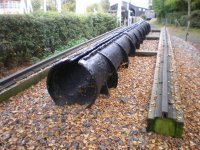
We know that corona motors are real and can be powered by a simple wire being held up a few hundred meters. This topic is connected to the idea of power lines harnessing atmospheric energy and the fact that all old tram systems do all seem to be similar in design as noted in this thread.
Now unfortunately I don't have an old tram to dissect and I doubt there are any still in existence which haven't been gutted and converted to running on modern power supplies so I can only go by what I have realised so far. I do believe it is worth considering that perhaps these trams were using such corona motors as their source of locomotion. Consider that a tram network consisted of overhead wires high enough and spread enough to collect a fair few thousand volts, possibly tens of thousands with the rails serving as a good ground contact. These corona motors may not produce a lot of torque but with the correct gearing it is possible to increase the torque at the cost of speed and these trams didn't have to go fast they simply had to be able to move people around.
It seems to me that in some parts of the world the tram networks were still using this method in the early 20th century. They had to keep things running after all but then a lot of the old tram networks got dismantled and we're told it's because of the "rise of the automobile". I can't help but feel this was yet another excuse to dismantle old world technology.
I would like to add that in places where the trams were kept (but converted to not use the old technology anymore) you will notice some familiar shapes on the tops of the old poles that were used to hold the wires up.
Now unfortunately I don't have an old tram to dissect and I doubt there are any still in existence which haven't been gutted and converted to running on modern power supplies so I can only go by what I have realised so far. I do believe it is worth considering that perhaps these trams were using such corona motors as their source of locomotion. Consider that a tram network consisted of overhead wires high enough and spread enough to collect a fair few thousand volts, possibly tens of thousands with the rails serving as a good ground contact. These corona motors may not produce a lot of torque but with the correct gearing it is possible to increase the torque at the cost of speed and these trams didn't have to go fast they simply had to be able to move people around.
It seems to me that in some parts of the world the tram networks were still using this method in the early 20th century. They had to keep things running after all but then a lot of the old tram networks got dismantled and we're told it's because of the "rise of the automobile". I can't help but feel this was yet another excuse to dismantle old world technology.
I would like to add that in places where the trams were kept (but converted to not use the old technology anymore) you will notice some familiar shapes on the tops of the old poles that were used to hold the wires up.
Last edited: