Trams used atmospheric electricity

Tetromino

Core Member
Active Member
Joined
Sep 21, 2023
Messages
127
Reaction score
342
We know that corona motors are real and can be powered by a simple wire being held up a few hundred meters. This topic is connected to the idea of power lines harnessing atmospheric energy and the fact that all old tram systems do all seem to be similar in design as noted in this thread.

Now unfortunately I don't have an old tram to dissect and I doubt there are any still in existence which haven't been gutted and converted to running on modern power supplies so I can only go by what I have realised so far. I do believe it is worth considering that perhaps these trams were using such corona motors as their source of locomotion. Consider that a tram network consisted of overhead wires high enough and spread enough to collect a fair few thousand volts, possibly tens of thousands with the rails serving as a good ground contact. These corona motors may not produce a lot of torque but with the correct gearing it is possible to increase the torque at the cost of speed and these trams didn't have to go fast they simply had to be able to move people around.

It seems to me that in some parts of the world the tram networks were still using this method in the early 20th century. They had to keep things running after all but then a lot of the old tram networks got dismantled and we're told it's because of the "rise of the automobile". I can't help but feel this was yet another excuse to dismantle old world technology.

I would like to add that in places where the trams were kept (but converted to not use the old technology anymore) you will notice some familiar shapes on the tops of the old poles that were used to hold the wires up.
 
Last edited:
Approximately four or five years ago, before I had ever heard of alternative history, I found a whole cache of atmospheric railway posters on google images. These posters all purported to be original posters for real railway systems that existed in the 1800s, and all of them said things like 'Powered by the atmosphere' or 'Powered by the ether.' I also found a video on YT talking about how a London underground line had originally been powered by the Aether.

Obviously, all the posters could have been made up in photoshop. Unfortunately I didn't keep any record of them, and now I can't find them any more. In fact I've looked for them many times over the last few years but with no success.

If you search for 'Atmospheric railway' now, the only thing you will find is Brunel's railway that was powered by air pumped through a tube. This seems like such an obviously bad idea to me, I wonder if it was a psyop?
 
Approximately four or five years ago, before I had ever heard of alternative history, I found a whole cache of atmospheric railway posters on google images. These posters all purported to be original posters for real railway systems that existed in the 1800s, and all of them said things like 'Powered by the atmosphere' or 'Powered by the ether.' I also found a video on YT talking about how a London underground line had originally been powered by the Aether.

Obviously, all the posters could have been made up in photoshop. Unfortunately I didn't keep any record of them, and now I can't find them any more. In fact I've looked for them many times over the last few years but with no success.

If you search for 'Atmospheric railway' now, the only thing you will find is Brunel's railway that was powered by air pumped through a tube. This seems like such an obviously bad idea to me, I wonder if it was a psyop?

If you look on Wikipedia you will notice the entire page for "Atmospheric Railway" was only created in May 2020. Something does seem odd and I always thought that concept was called a Pneumatic Railway. The pressure is apparently kept in the pipe using nothing more than a strap of leather? The pipe would be leaking air all over and though it may work at first it won't last very long before the whole stretch will need replacing with new leather. Now all I can find are apparent historic examples of attempts to create these railways that were quickly abandoned because of their many obvious issues.

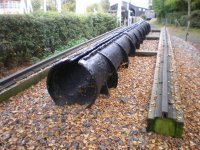
Below is supposedly a section of Brunel's "Atmospheric Railway" but it just seems like a load of bollocks to me and if you read the section on his Wikipedia page it even admits the system never managed to prove itself.

ap3.jpg
 
Last edited:
Five years ago is when the censorship of the internet began in earnest. Before that you could find unlimited amounts of info about 9/11 on YT, for example.

Can you make a case that Brunel's pneumatic railway concept was never called 'Atmospheric' in the 1800s? Is that a new label for it, since 2020?

The pneumatic railway is a bonkers idea. You have a tube that stretches the length of the track, potentially miles, with a slot in the top. A torpedo suspended below the train sits inside the tube. You pump air in at one end of the tube and it's supposed to push the train along.

There are two air seals

1) The seal along the entire length of the slot, which is made of leather.

2) The seal between the torpedo and the inside of the tube. The tighter you make this, the more friction is created.

You are going to have to put a tremendous amount of air in at the end of the tube to make up for all the losses and create any workable air pressure on the surface of the torpedo.

You can calculate the propulsion force by multiplying the cross sectional area of the tube in square inches by the air pressure in pounds per square inch. It's hard to see how you could get very many pounds of effective propulsion force.

I can't imagine why anyone would attempt to build such a thing.
 
This pneumatic cash moving system was only removed from the local Tesco in 2018. Sealed tubes of course.

There were lots of these kind of things in service at one time. You can see how moving a lightweight torpedo inside a tube could be made to work. What's hard to imagine is attaching a train to it.
 
This pneumatic cash moving system was only removed from the local Tesco in 2018. Sealed tubes of course.

View: https://m.youtube.com/watch?v=0_BCeWbHMBg

They still have the pneumatic system in the local ASDA but I don't think it's used anymore.. If you ever went to a Wacky Warehouse when you were little you might remember the tubes that you put the balls in and it would suck them through and blow them out the other end. Of course that only worked because the balls were so light you couldn't put anything heavier in them.
 
Last edited:
When I was little there was no such thing nor name. Surprisingly some of us here are over thirty years of age.

And some of us can more than double that :)

There was an operational Atmospheric / Pneumatic railway in the grounds of The Crystal Palace in Sydenham, Kent. It operated from the 27th August 1864 to October of the same year. There was also an underground Pneumatic Despatch Railway used by the Post Office in London until it was destroyed in an explosion n December 1928.

If nothing else, this highlights the difficulty of knowing exactly what's implied by the term "Atmospheric Railway" as air is of course atmospheric.

atmosphericrailway.jpg

Above from: http://www.xenophon.org.uk/cppr.html
More info:
Crystal Palace pneumatic railway - Wikipedia
https://www.postalmuseum.org/blog/the-pneumatic-despatch-railway-the-surviving-record/
 
There was a Pneumatic Transit Railway in New York City that they say lasted for 3 years and I guess was at a time used for the mail?
I believe they tried to put a human in there but there wasn't enough air?
I think this was in another thread, but not to be repetitive, there is a piece of this tunnel that was in the movie Ghost Busters.
 
There were lots of these kind of things in service at one time. You can see how moving a lightweight torpedo inside a tube could be made to work. What's hard to imagine is attaching a train to it.
It’s still used in my local hospital for sending blood samples for testing and receiving the results back quickly.
 
From the National Encyclopedia of 1897 some bits pertinent to this thread.

Pneumatics.
This name is given to that subsection of physical science which treats of the physical properties of elastic fluids, and especially of common air.
The first property observable in gases is that they tend to fill the entire space open to them, a fact which causes them to be specially distinguished as the elastic fluids.

Rails.
In 1676 certain collieries near Newcastle-on-Tyne were using tramways consisting of rails of timber for the conveyance of coals between the pit and the river, and by the beginning of the eighteenth century the practice had been adopted in many other places.
The rails originally were formed of oak scantlings, connected by cross timbers of the same material, and fastened with oak treenails, and in the course of time plates and bars of wrought iron were added to the upper surfaces of the rails in order to increase their durability.
Cast-iron rails were first tried by way of experiment at Coalbrookdale Iron-Works, in Shropshire, about 1767, and afterwards became very generally used.
The next improvement was the introduction of a flange to the rails, by means of which the wheels were confined to their place on the track, and this method in its turn gave way to the edge-rail, which was raised above the ground far enough to allow a flanged wheel to run over it.
Wrought iron rails were first tried in 1805 by Mr. Nixon, but they did not entirely supersede cast-iron rails until 1820, when Mr Birkenshaw patented machinery for rapidly rolling them resembling that which is still in use today.

Pneumatic dispatch railway and pneumatic tubes.
After the introduction of railways stationary steam-engines were used on some lines called Atmospheric, to exhaust air from a tube lying between the rails, containing a piston to which the train was attached, so as to be dragged by atmospheric pressure, but that mode of propulsion was afterwards abandoned.
An improved application of a similar principle appears in the Pneumatic Despatch Railway, in which the entire carriage or train of carriages is driven through a tube or tunnel of sufficient size by a blast of air produced by a suitable blowing apparatus, which works by forcing or by exhaustion, according as the train is to be propelled from it or towards it.
The Electric and International Telegraph Company first introduced the pneumatic system of transmission into London. Iron tubes were laid from the central to the branch stations, and bundles of messages for distribution from the latter were enclosed in a suitable case and driven through the tubes by a current of air.
Since the government undertook the telegraphs there has been enormous development of business, and the pneumatic despatch tubes are consequently now an invaluable accessory of the General Post office.
More from the National Encyclopedia of 1897.
Tramways.
In the cities of Northern Italy the practice of laying down smooth tracks of hard marble in the ordinary paving of the streets, which prevails in those cities to the present day, appears to have been applied for centuries. The object of constructing such roads, is by diminishing the friction, to make a less amount of power adequate either to impel a carriage with greater velocity or to urge forward a greater load.

Modern street tramways, as generally understood, are however, in reality railways laid at the surface of the roads. They are intended to facilitate the movement of omnibuses or vehicles for the conveyance of passengers, the vehicles having flanged wheels or wheels especially constructed to run upon them, the motive power used being generally that of animals, and not locomotives as on ordinary railways.
The rails are laid level with the road, and only break its surface by a groove so narrow that neither the wheel of an omnibus, cab, phaeton or even a bakers handcart can be caught in it. The tramway companies lay their lines and pave the space between them and for 18 inches on each side, and are bound to keep this part of the road in repair as long as their occupation lasts.

The tramways are placed in the centre of the road, and with a double line the cars pass each other without difficulty or interruption. The cars are very light, handsome and, commodious vehicles, constructed to carry seventy passengers.
Each car runs on four wheels, which are contained within its width, and is hung on springs formed of blocks of india-rubber. Access to the roof is made by means of a light ladder. The horses are harnessed by collar and traces only to two splinter bars pivoted to a cross piece at the carriage end of a common pole, and this is secured to the car by a bolt that is dropped through an opening.
When the car arrives at the end of its journey the bolt is lifted, the horses, with their pole and splinter bars are marched to the opposite end.

The driver stands upon the platform that happens to be in front and at his right hand he has the handle of a break, by which the car can be stopped in its own length. The horses are spared the whole of of the painful labour of arresting the motion they have caused; for while he checks them with one hand, the driver applies the break with the other, and the car is stopped immediately.
It is calculated that the effect of the tramway is to diminish draught to one-third, or to enable one horse to do the work of three; and the advantages possessed by the tramway system over the ordinary street locomotion as regards dead weight may be understood when it is remembered the common omnibus weights 25 cwts., and carries twenty-six passengers, or with the conductor and driver twenty-eight persons, or at fourteen to the ton, 2 tons.
The tramway cars weigh 2 tons, and carry seventy persons, including the driver and conductor, or 5 tons of paying weight. Passengers can therefore be carried at a considerably cheaper rate than previously, and at the same time enjoy a superior amount of comfort, owing to the quick smooth movement, and the entire absence of shaking and noise.
The strain upon the horses employed to draw the tramway cars is very severe (they are "worn out," on an average, in four years), and therefore several attempts have been made to substitute steam-power, compressed air, and electricity, though as yet they have not been successful.
Cars drawn by steam are quite common in America, and they are also used in Paris and other suburbs in Europe, and in Birmingham, Leeds, and a suburb of London.
 
Last edited:
Can I ask what any of these have to do with the topic of atmospheric electricity?

If you look on Wikipedia you will notice the entire page for "Atmospheric Railway" was only created in May 2020. Something does seem odd and I always thought that concept was called a Pneumatic Railway. The pressure is apparently kept in the pipe using nothing more than a strap of leather? The pipe would be leaking air all over and though it may work at first it won't last very long before the whole stretch will need replacing with new leather. Now all I can find are apparent historic examples of attempts to create these railways that were quickly abandoned because of their many obvious issues.

Below is supposedly a section of Brunel's "Atmospheric Railway" but it just seems like a load of bollocks to me and if you read the section on his Wikipedia page it even admits the system never managed to prove itself.
 
Yes, the whole concept of a pneumatic railway is complete bollocks but Wikipedia wants you to think that's what an atmospheric railway is.
 
They still have the pneumatic system in the local ASDA but I don't think it's used anymore.. If you ever went to a Wacky Warehouse when you were little you might remember the tubes that you put the balls in and it would suck them through and blow them out the other end. Of course that only worked because the balls were so light you couldn't put anything heavier in them.
I used to use this type of pneumatic system when I worked at a Caterpillar Dealership, in Canada, about 40 to 45 years ago. I worked on the main floor in the parts warehouse area where the clients used to come in to get their orders. I used to have to take a solid plastic tube, open the end, roll up the paper document and slide it into the plastic tube, then put the lid back on. Then open the end cap of the pneumatic tube and place my tube with the document inside, and it would simply "suck up" my plastic tube with the document in it to the 2nd floor accounting office. The plastic tube would get emptied by someone on the 2nd floor and then put in the down tube, where we would take it out again to reuse. It saved someone from physically having to take the papers up to the 2nd floor office. The last time I went there, about 5 years ago, for a quick visit, everything had been renovated and the tube was gone.
 
Tips
Tips
Please respect our Posting Rules.
Back
Top