SH Archive Who can calculate a different circumference of the Earth?

SH.org OP Username
KorbenDallas
SH.org OP Date
2018-05-01 06:49:49
SH.org Reaction Score
5
SH.org Reply Count
4

KD Archive

Not actually KorbenDallas
Active Member
Joined
Sep 22, 2020
Messages
4,691
Reaction score
1,499
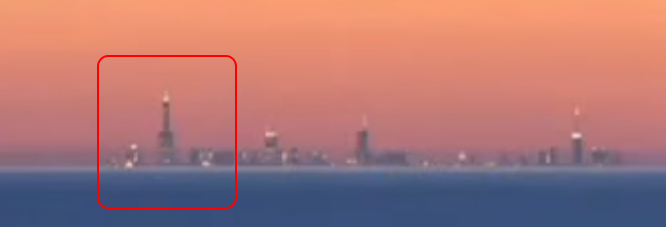
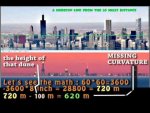
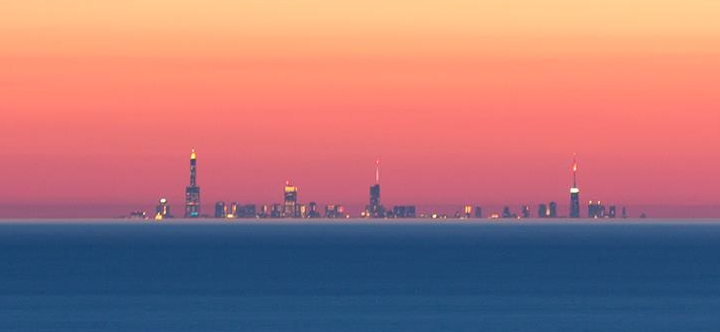
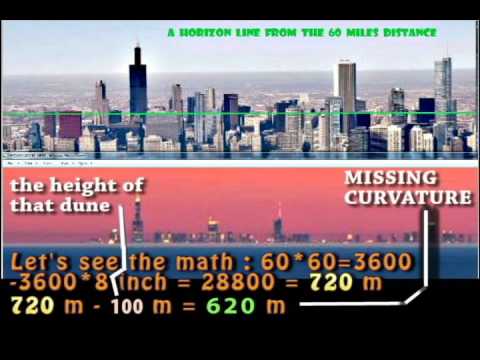
I'm pretty sure everybody had a chance to see the photo of the Chicago skyline from the opposite shore of Lake Michigan. The distance is 59 miles, and according to the conventional science the curvature should account for 8*59²/12 = 2320.7 ft or 707.3 m. Basically, none of the buildings should be seen. Which is clearly not the case below. The tallest building is about 450 m. The video below explains, that we are seeing a superior mirage.

the-smoking-gun-chicago.png


This is primarily directed at @ion.brad. Let's not talk about possible light reflections, refractions, etc. Just for a second, let us imagine, that everything is exactly as seen. We do not see the base of the buildings, we do not see them yachts, and we do not see the woodline on the opposite shore.

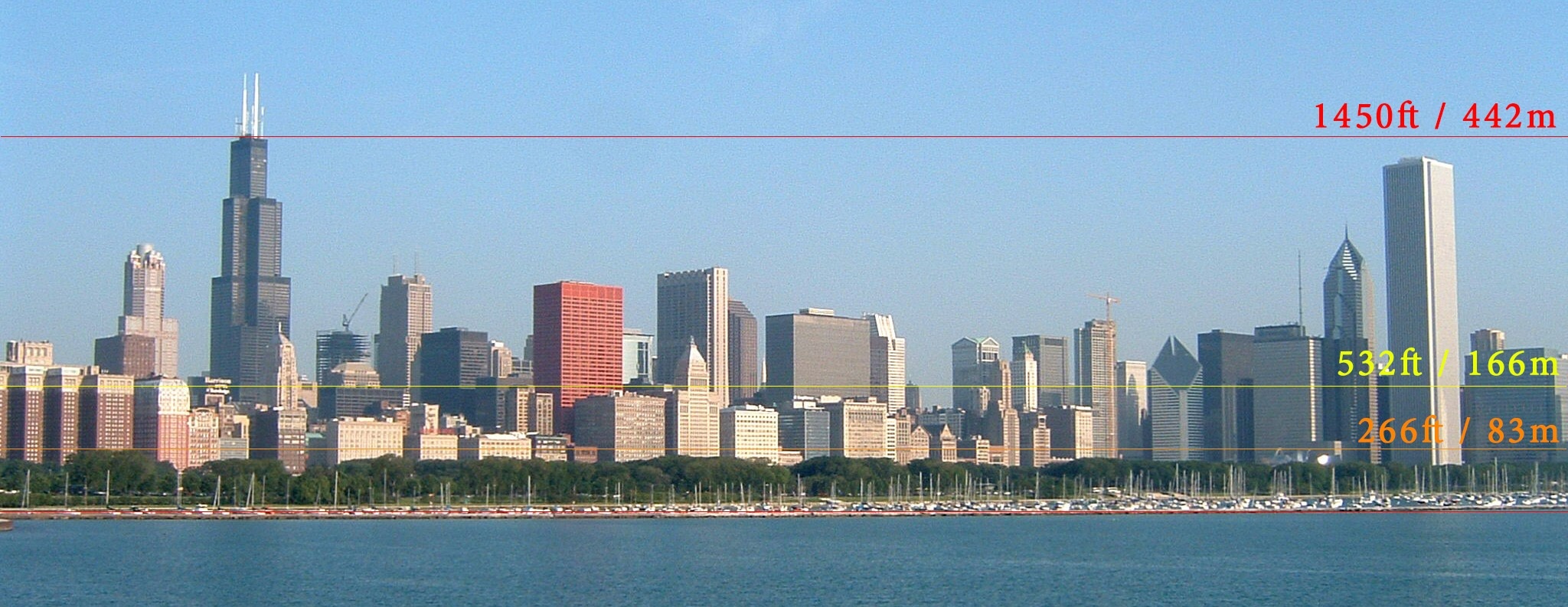
chicago_from_michigan_2.jpg
Use this picture for an approximate measurements data.

Yet we do see the buildings when we are not supposed to.

chicago_from_michigan_1.pngmath_1.jpg

The bottom portion of the buildings is not visible. Let's imagine that this is the extent of the curvature of the Earth.

What would an approximate circumference of our planet be, if this picture was reflecting the true curvature?
Note: This OP was recovered from the KeeperOfTheKnowledge archive.
 
CURVATURE

C = R(1 - cos[s/(2R)]) - angle measured in radians


R = 6378,164 km

s = distance


VISUAL OBSTACLE

Capture_zpswhoewt2o.jpg

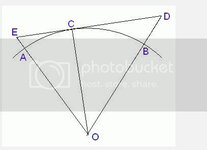
BD = (R + h)/{[2Rh + h^2]^((1/2))(sin s/R)(1/R) + cos s/R} - R


BD = visual obstacle

AE = h = altitude of observer

450px-Sandokhan_map.png

Radius of the flat earth surface = 6363.636363 km

Surface area of a sphere: 4πr^2

Surface area of a circle: πr^2

30-scientistsde.jpg

The radius of the FE map is 6363.6363 km.

The equivalent surface area of a circle for the formula 4πr^2 is: π(2r)^2.

That is, the radius of the RE map has to be 12727.2727 km.


The position of the centre of gravity varies according to the shape of the object.

And, according to the official theory we do have an applied external force:

0f36df929ac9d711a8ba8c5658c3bfee.png

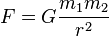
You MUST have a symmetrically perfect ellipsoid (or geoid) or there will be a clear and direct DEFIANCE of the law of universal gravitation.

Let us carefully calculate the effect/distribution of mass of the continents with respect to both hemispheres (northern and southern).


"The area of land in the northern hemisphere of the earth is to the area of land in the southern hemisphere as three is to one.

The mean weight of the land is two and three-quarter times heavier than that of water; assuming the depth of the seas in both hemispheres to be equal, the northern hemisphere up to sea level is heavier than the southern hemisphere, if judged by sea and land distribution; the earth masses above sea level are additional heavy loads - we include here all the mountains/hills.

But this unequal distribution of masses does not affect the position of the earth, as it does not place the northern hemisphere with its face to the sun. A “dead force” like gravitation could not keep the unequally loaded earth in equilibrium. Also, the seasonal distribution of ice and snow, shifting in a distillation process from one hemisphere to the other, should interfere with the equilibrium of the earth, but fails to do so."


The northern hemisphere has a greater mass than its southern counterpart.

The unequally loaded perfect oblate spheroid (first four layers) DEFIES the law of attractive gravity.

It should rotate with the northern hemisphere facing the sun.

At present, the RE has an unequal distribution of mass: the northern hemisphere has more mass than the southern hemisphere.


For the Pangeea continent the situation is much worse: such a concentration of land mass in just one place would have meant an EVEN GREATER unequal load upon the inner layers of the Earth.
 
Let us carefully calculate the effect/distribution of mass of the continents with respect to both hemispheres (northern and southern).
"The area of land in the northern hemisphere of the earth is to the area of land in the southern hemisphere as three is to one.
That rests on your incorrect assumption that earth is homogenous and has a constant density everywhere.
For the Pangeea continent the situation is much worse: such a concentration of land mass in just one place would have meant an EVEN GREATER unequal load upon the inner layers of the Earth.
Ditto.
 
Are you saying that the density is not constant (crust, mantle, outer/inner core)?

Please say yes.
 
Your answer is yes. Then, you have a huge problem: the Earth would be facing the Sun with its heavier hemisphere.

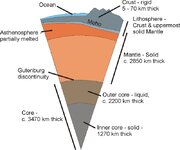
Structure_of_the_Earth.jpg

The density of the inner core must be constant.

The density of the outer core must be constant.

The density of the mantle must be constant.

The density of the crust must be constant.

Only the litosphere is allowed to have a variable density.

If the density of the inner core, as an example, is not constant, then, since M = d x V, you'd have two inner core hemispheres, one which is heavier than the other.

That is why geologists are very quick to acknowledge that the density for each of the four major inner layers of the Earth is constant.

You might say, "what about the rotation of the Earth, does it not affect the gravitational attraction by the Sun?"

Here is the full acceleration equation:

acc2.jpg

You notice that ONLY the GM/r^2 radial term is mentioned by Newton, the other three play no part in the gravitational theory accepted by modern science.

Is there any difference in gravitational effect on a rotating object versus a non-rotating object? The first such experiment was performed only in the late 60s and early 70s by Dr. Bruce DePalma, when it was too late to include the new discoveries, since the textbooks on gravity were already written.
 
I'm pretty sure everybody had a chance to see the photo of the Chicago skyline from the opposite shore of Lake Michigan.

Let us increase the distance to 128 km.


Grand Haven Daily Tribune April 3, 1925

COAST GUARDS SEE MILWAUKEE LIGHTS GLEAM

Captain Wm. J. Preston and Crew See Lights of Milwaukee

and Racine Clearly From Surf Boat

ANSWER TO FLARE

Crew Runs Into Lake in Search For Flashing Torch​

Grand Haven Daily Tribune April 3, 1925

Captain Wm. J. Preston and his U. S. Coast Guard crew at Grand Haven harbor witnessed a strange natural phenomenon last night, when they saw clearly the lights of both Milwaukee and Racine, shining across the lake. As far as known this is the first time that such a freak condition has prevailed here.

The phenomena was first noticed at shortly after seven o’clock last night, when the lookout called the keeper’s attention to what seemed to be a light flaring out on the lake. Captain Preston examined the light, and was of the impression that some ship out in the lake was “torching” for assistance.

Launch Power Boat

He ordered the big power boat launched and with the crew started on a cruise into the lake to locate, if possible, the cause of the light. The power boat was headed due west and after running a distance of six or seven miles the light became clearer, but seemed to be but little nearer. The crew kept on going, however, and at a distance of about ten and twelve miles out, a beautiful panorama of light unfolded before the eyes of the coast guards.

Captain Preston decided that the flare came from the government lighthouse at Windy Point at Racine. Being familiar with the Racine lights the keeper was able to identify several of the short lights at Racine, Wis.

Saw Milwaukee Also

A little further north another set of lights were plainly visible. Captain Preston knowing the Milwaukee lights well, easily distinguished them and identified them as the Milwaukee lights. The lights along Juneau Park water front, the illumination of the buildings near the park and the Northwestern Railway station were clearly visible from the Coast Guard boat. So clearly did the lights stand out that it seemed as though the boat was within a few miles of Milwaukee harbor.

Convinced that the phenomenon was a mirage, or a condition due to some peculiarity of the atmosphere, the keeper ordered the boat back to the station. The lights remained visible for the greater part of the run, and the flare of the Windy Point light house could be seen after the crew reached the station here.


DISTANCE GRAND HAVEN TO MILWAUKEE: OVER 80 MILES (128 KM).

http://www.coastwatch.msu.edu/images/twomichigans2a.gif


Windy Point Lighthouse:

http://upload.wikimedia.org/wikiped.../800px-Wind_Point_Lighthouse_071104_edit2.jpg

The lighthouse stands 108 feet (33 m) tall

THE CURVATURE FOR 128 KM IS 321 METERS.

Using the well known formula for the visual obstacle, let us calculate its value:

h = 3 meters BD = 1163 METERS

h = 5 meters BD = 1129 METERS

h = 10 meters BD = 1068 METERS

h = 20 meters BD = 984 METERS

h = 50 meters BD = 827.6 METERS

h = 100 meters BD = 667.6 METERS


No terrestrial refraction formula/looming formula can account for this extraordinary proof that the surface across lake Michigan is flat.


Moreover, as we have seen, the light from Windy Point was continuously observed, during the approach, and during the return to the station:

The power boat was headed due west and after running a distance of six or seven miles the light became clearer, but seemed to be but little nearer. The crew kept on going, however, and at a distance of about ten and twelve miles out, a beautiful panorama of light unfolded before the eyes of the coast guards.

The keeper ordered the boat back to the station. The lights remained visible for the greater part of the run, and the flare of the Windy Point light house could be seen after the crew reached the station here.


No terrestrial refraction formula/looming formula can account for this extraordinary proof that the surface across lake Michigan is flat.

https://web.archive.org/web/20180312040336/http://ireland.iol.ie/~geniet/eng/refract.htm
If we use h = 50 for the observer, and 140 for the distant object height, we get a negative answer: no way it could be seen over a 128 km distance; while the actual data for the account is h = 5 m, and d = 40 m.


Looming/modified lapse rate:

https://aty.sdsu.edu/explain/atmos_refr/altitudes.html
Let us use several values, starting with the value of 15 C for that day (Milwaukee/Racine/Holland/Grand Haven) and increasing the value for the target by 1-3 degrees.

For a value of 15 C overall we get of course a negative altitude value of the target.

For a value of 16 C (for the target) we get, again, a negative altitude value for the target (−0.317 degrees of arc) - target is hidden by horizon

For a value of 17 C (for the target) we get: −0.207 degrees of arc, target is hidden by horizon

For a value of 18 C (for the target) we get: −0.098 degrees of arc, target is hidden by horizon


Let us decrease the value to 12 C.

Increasing the value for the target to 15 C degrees, again, we get negative values. This would also correspond to a huge k = 0.613 value.

From the textbook on atmospheric science:

"So the ray curvature for an arbitrary lapse rate γ K/m will be

k  = ( 0.034 − γ ) / 0.154

where we take γ to be positive if the temperature decreases with height, and a positive curvature means a ray concave toward the Earth.

Example 1: the Standard Atmosphere:

In the Standard Atmosphere, the lapse rate is 6.5°/km or γ = 0.0065 K/m. The numerator of the formula above becomes .034 − .0065 = .0275, so the ratio k is about 1/5.6 or 0.179. In other words, the ray curvature is not quite 18% that of the Earth; the radius of curvature of the ray is about 5.6 times the Earth's radius.

Example 2: free convection:

In free convection, the (adiabatic) lapse rate is about 10.6°/km or γ = 0.0106 K/m. The numerator of the formula above becomes .034 − .0106 = .0234, so the ratio k is about 1/6.6 or 0.152. In other words, the ray curvature is about 15% that of the Earth; the radius of curvature of the ray is about 6.6 times the Earth's radius. This is close to the condition of the atmosphere near the ground in the middle of the day, when most surveying is done; the value calculated is close to the values found in practical survey work."


Moreover, as we have seen, the light from Windy Point was continuously observed, during the approach, and during the return to the station:

The power boat was headed due west and after running a distance of six or seven miles the light became clearer, but seemed to be but little nearer. The crew kept on going, however, and at a distance of about ten and twelve miles out, a beautiful panorama of light unfolded before the eyes of the coast guards.

The keeper ordered the boat back to the station. The lights remained visible for the greater part of the run, and the flare of the Windy Point light house could be seen after the crew reached the station here.


Now, the calculation for the most pronounced form of looming: ducting.

However, ducting requires the value for the ray curvature, k, to be greater than or equal to 1.

This amounts to at least a five degree difference in temperature.

With 10C in Grand Haven (or Holland) and 15C in Racine, we get k = 1.182.


For the very same geographical/hydrographical conditions, for the same latitude in question, for cities located on the opposite shores of Lake Michigan, it is absolutely impossible to have a five degree difference, at the very same instant of time - moreover, looming/ducting do not apply to the two cases presented here:

FURTHERMORE, as we have seen, the light from the lighthouse located in Racine was seen all of the time.

For the second case exemplifed here, see below, Mr. Kanis did see the very shape of the buildings: in the case of ducting/looming a very distorted image would appear making it instantly recognizable:

http://upload.wikimedia.org/wikipedia/commons/f/f4/Superopr_mirage_sequence.jpg
Summary Mirages Iceland 2001-01-09/Übersicht Luftspiegelungen Island 09.01.2001 ...and further more
Mirages in Finland - thisisFINLAND


m11.jpg
m12.jpg

'As twilight deepened, there were more and more lights.'

Bringing out a pair of binoculars, Kanis said he was able to make out the shape of some buildings.

'With the binoculars we could make out three different communities,' Kanis said.

According to one Coast Guard crewman, it is possible to see city lights across the lake at very specific times.

Currently a Coast Guard crewman stationed in Holland, Todd Reed has worked on the east side of Lake Michigan for 30 years and said he's been able to see lights across the lake at least a dozen times.

The highest building in Milwaukee has a height of 183 meters, the difference from h = 5 meters in altitude being 946 meters, and those residents saw the buildings from THREE DIFFERENT COMMUNITIES, two of which have buildings whose heights measure way under 183 meters.

Therefore, the only way those buildings could be seen, given the 128 km distance, would be if the surface of Lake Michigan is completely flat.

THE TALLEST BUILDING IN RACINE IS THE COUNTY COURTHOUSE, 40 METERS; IT WOULD BE ABSOLUTELY IMPOSSIBLE TO SEE THIS COURTHOUSE FROM 128 KM DISTANCE, FROM HOLLAND.


On Memorial Day, it was 60 F degrees (15 C) in Milwaukee on that day.


Let us increase the distance to 145.6 kilometers.
Fata-Morgana-Resized.jpg

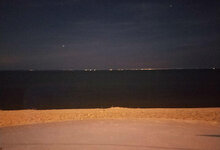
"Mosier told FOX6 News he took the photo with his Samsung Galaxy S7 — using a ten-second exposure and ISO of 400. He indicated he could see lights flashing on the tops of buildings with his naked eye."

"The lights appeared to stretch from Kenosha, Wis. on the south to south Milwaukee on the north. At times, Racine, Wis. was so brilliant that a lighthouse or a navigational aid flashed on the horizon as it if was 10 miles off shore."

The 'lights of Milwaukee' were seen Thursday night from the Lake Michigan shores of Muskegon

AERIAL VIEW OF KENOSHA, WI:

6a57949235be9efe1b04624b3baa75ef.jpg

Tallest building: Kenosha National, 25 meters

DISTANCE MUSKEGON - KENOSHA: 91 miles = 145.6 km

VISUAL OBSTACLE: 1.5 KM = 1,500 METERS

"The lights appeared to stretch from Kenosha, Wis. on the south to south Milwaukee on the north. At times, Racine, Wis. was so brilliant that a lighthouse or a navigational aid flashed on the horizon as it if was 10 miles off shore."
 
What would an approximate circumference of our planet be, if this picture was reflecting the true curvature?
I somehow stumbled upon this thread in my suggestions, and found the question, albeit somewhat deceptive, rather interesting at the same time. I hope it's ok to still comment here.

Firstly, large bodies of standing water do not become convex (let alone concave lol) on their surface, so there is no geometric or physical horizon. There simply is no geometrically created barrier or solid wall. The horizon that we see is part of how our brains translate our 3d world for us. And when viewed from 90 degrees at any altitude, our horizon will be at eye-level as our brains tell us that that is the point where all parallel lines will converge. Everything below our eye-level will rise up to the point of converging with everything above our eye-level.

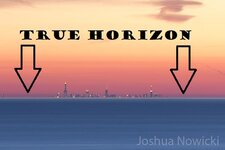
That said, the infamous Nowicki pic was taken from about 200 feet above the water. And if you look closely, you notice that the angle from the camera is slightly down (<90 degrees), and you will see the horizon beyond the city entirely!
q4sB0ex.jpg

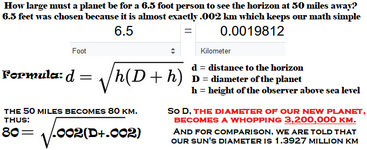
All that said, if we were to assume a geometric, physical horizon at 50 miles for a 6.5 foot observer, which keeps the math simpler and seems reasonable considering the 59 mile distance and the slight obfuscation of the bottoms of the buildings and the actual coastline... and IF we were a planet, our diameter would be a massive 3.2 million km!

This converts to around 2 million miles, so the radius would be about a million miles. Using 2πr, we get an incredible circumference of ≈6.28×10^6!

Reference:
1MzaXSN.png

NOTE: If we use a height of 200 feet, this is just .06 km. While this does change the results to some extent, but the overall circumference of the planet would still have to be massive... at least the supposed size of our sun.
 
Last edited:
I somehow stumbled upon this thread in my suggestions, and found the question, albeit somewhat deceptive, rather interesting at the same time. I hope it's ok to still comment here.

Firstly, large bodies of standing water do not become convex (let alone concave lol) on their surface, so there is no geometric or physical horizon. There simply is no geometrically created barrier or solid wall. The horizon that we see is part of how our brains translate our 3d world for us. And when viewed from 90 degrees at any altitude, our horizon will be at eye-level as our brains tell us that that is the point where all parallel lines will converge. Everything below our eye-level will rise up to the point of converging with everything above our eye-level.

That said, the infamous Nowicki pic was taken from about 200 feet above the water. And if you look closely, you notice that the angle from the camera is slightly down (<90 degrees), and you will see the horizon beyond the city entirely!
View attachment 20104

All that said, if we were to assume a geometric, physical horizon at 50 miles for a 6.5 foot observer, which keeps the math simpler and seems reasonable considering the 59 mile distance and the slight obfuscation of the bottoms of the buildings and the actual coastline... and IF we were a planet, our diameter would be a massive 3.2 million km!

This converts to around 2 million miles, so the radius would be about a million miles. Using 2πr, we get an incredible circumference of ≈6.28×10^6!

Reference:
View attachment 20105

NOTE: If we use a height of 200 feet, this is just .06 km. While this does change the results to some extent, but the overall circumference of the planet would still have to be massive... at least the supposed size of our sun.
"Firstly, large bodies of standing water do not become convex (let alone concave lol) on their surface,"

If the Microcosm, Mimics the Macrocosm, (And we all know it does) then you know you are wrong. Because small bodies of water, do infact display a meniscus.

I've already stated time and time again, that observation alone is grounds for nothing other than the foundation for illusion. Observation without authentication leads to deception. Which is exactly what leads to the foundation of disinformation.

Cyrus Teed was able to calculate the circumference of the earth to be a circumference of 25,000 miles. He was also able to demonstrate, and prove his calculations with the Rectilinear. Which has never been debunked.

"All that said, if we were to assume"

We shouldn't assume anything. Let alone that our eyes tell us the truth.
 
Tips
Tips
Please respect our Posting Rules.
Back
Top