Note: This post was recovered from the Sh.org archive.
Username: RedFox
Date: 2020-06-21 08:56:13
Reaction Score: 2
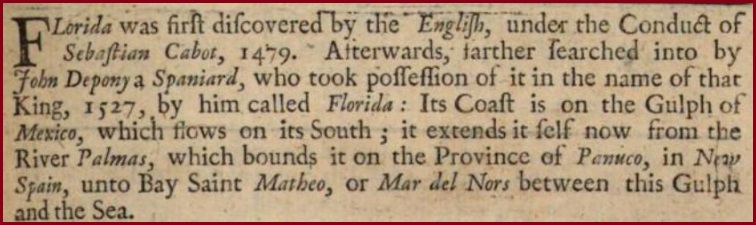
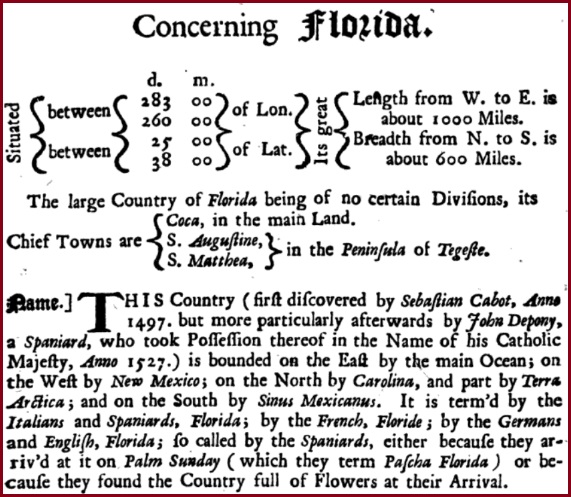
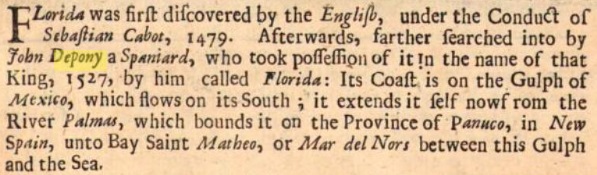
I'm going to give more credit, for better or worse, to the first clipping because it's older than the second so we'll assume the date of 1479 is more accurate than 1497 (interesting that they reversed 79 into 97 in the later clipping)
Sebastian Cabot (explorer) - Wikipedia
Whackypedia lists the birth of Cabot at 1474. According this, he would've been an infant when he led an expedition to Florida just 5 years later. Hmmmm.
No mention of Florida anywhere in the official narrative.
" From the later sixteenth century until the mid-nineteenth century, historians believed that Sebastian Cabot, rather than his father John, led the famous Bristol expeditions of the later 1490s, which resulted in the European discovery, or rediscovery after the Vikings, of North America. This error seems to have been attributed to Sebastian's accounts in his old age"
We know of any sources from the 1500s onward that relate him to "rediscovery" of "Vikings"? They're already attributing it to yet another error, because you know, people were so stupid back then. So I instantly distrust that and assume he's getting the same treatment the cartographers got. Curious that they bother to mention that at all and discredit it, but don't mention anything of Florida at all or how he would've discovered it at age 5.
What's with the interchangability of s and f too? It doesn't seem completely random.
We have this painting of him as well as another image dated at 1824 apparently. Which one comes first, I don't know, but look at those proportions. This fella looks pretty big. Seems like he was born a lot earlier than we're told, and he lived a surprisingly long time, compared to the narrative of typical lifespans we're given for people in the past. Might be hinting at something there too. And then we have two more depicting a different version. (Weird how there are several versions of old prints like this for so many people.)
Additionally, I found this
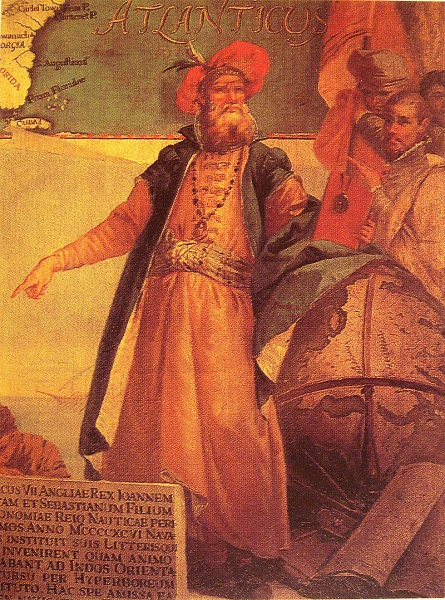
image. An alleged Sebastian looking quite different to his other depictions where we notice a familiar arch to the door frame and a curious map. It's being sold on amazon right now nonetheless, with absolutely no information whatsoever except the claim that it's true to the original, that I can't find.
"Sebastian Cabot, Italian Explorer is a licensed reproduction that was printed on Premium Heavy Stock Paper which captures all of the vivid colors and details of the original. The overall paper size is 24.00 x 36.00 inches. This print is ready for hanging or framing and would make a great addition to your home or office decor. "
Like many figures, he's depicted for a long time as several different people.
May be worth matching the map he's next to up to some of the maps from the late 1400s in the recent map thread as well. So several depictions of one person and a clear mismatch with older sources and newer ones regarding his age as well as discrediting an alleged discovery by him.
Lived before/longer than we thought, check.
Discredited in some fashion, check.
Multiple artistic depictions, check.
As for as that John fellow, nothing at all. Zip. Nothing at all. Most I could find worth pointing out was the above inconsistencies. For all the attention TPTB have given Sebastian, John seems to be entirely erased despite his associations with someone who was important enough to go down into history despite being rewritten and discredited.
And as far as it's depiction in any maps, Florida (And America, consisting of Florida and Nveva Hispa - Nevada?) first appears in Giacomo Gistaldi's 1548 map but it is labeled as to imply it was the
entire eastern side of the United States, separate from Nveva Hispa which is would nowaways be the southern half of the country from coast to coast. The labeling also implies present day Florida was part of Nveva Hispa, if the width of the text is any indicator to the breadth of the regions it's labeling. If true, the state of Florida may be worthless as far as finding any evidence or matching up accounts to the modern region...
St. Augustine and St. Matthews still exist. The former in the state of Florida and the latter in South Carolina. Both old towns with old architecture if you look for it.
Something drastic may have happened between 1548 and 1553, according to Apain's map where the continent looks completely different. No mention of Florida. Curiously, in 1572-4 the continent is back to resembling it's state in 1548 but Florida is much more marginalized and while it exceeds the panhandle is relegated to that general region. Chicago has also appeared. America is labeled "America Sine India Nova" which is quite curious.
I recently recall seeing mention of a map in a thread where America and Asia were connected but I can't easily find it right now. I'd be interested in knowing the date of it to see if Florida is mentioned. I could find no trace of it in maps before 1548 but I may be reading them wrong. Given the clippings provided in OP I was surprised the map from the 1490s didn't depict America.
Edits: corrected some things and went back to check for Florida's first appearance on a map. This may be my first real contribution as far as putting anything together that other people may not have before me so sorry for any sloppiness!