Accommodating the Mudflood & Reset

  • Thread starter Deleted member 1432
  • Start date
D

Deleted member 1432

Guest
I was recently researching in the UK’s National Archive:

“Discovery holds more than 32 million descriptions of records held by The National Archives and more than 2,500 archives across the country. Over 9 million records are available for download.”

Discovery | The National Archives

The records include the following information:
  • Army and militia
  • Births, marriages and deaths
  • Census and other national surveys
  • Civilian occupations
  • Courts, criminals and prisoners
  • Domestic politics
  • First World War
  • Maps
  • Medals and awards
  • Merchant Navy
  • Migration
  • Military courts and conscription
  • Prisoners of war
  • Royal Air Force and other air services
  • Royal Navy and Royal Marines
  • Second World War
  • Wills and death duties

For example the Wills and death duties section details the following information:

“These records are Prerogative Court of Canterbury (PCC) wills in series PROB 11 made between 1384 and 12 January 1858.

“These PCC wills are all registered copy wills. They are the copies of the original probates written into volumes by clerks at the church courts.

“Until 12 January 1858 all wills had to be proved by the church and other courts. The PCC was the most important of these courts dealing with relatively wealthy individuals living mainly in the south of England and most of Wales.”

The information found in Wills and death duties records includes the following:
  • where they lived
  • name of person responsible for carrying out the wishes (executor)
  • date of will
  • witnesses to the will
  • chief beneficiaries
A search for all archives from the period 0001 to 1858 gives the following results:
  • Dates unknown (2,390,293)
  • 1800 - 1899 (4,567,803)
  • 1700 - 1799 (3,078,393)
  • 1600 - 1699 (1,943,665)
  • 1500 - 1599 (678,077)
  • 1400 - 1499 (214,542)
  • 1300 - 1399 (215,156)
  • 1200 - 1299 (72,905)
  • 1100 - 1199 (13,994)
  • 1000 - 1099 (24,578)
  • 1 - 999 (64)
(Source)

This date range covers the proposed time period of the Mudflood/Reset – 1700 to 1850. As can be seen from the above, there was a significant and incremental increase in public records from 1500 to 1899. One would expect the opposite, or rather a dramatic drop, or even a cessation of public records, if there had been a total collapse of society, or ‘reset’.

Therefore, I wonder what the explanation could be for this? Are all of these archived records fake? How long would it take to forge 12,497,522 documents? Is there anywhere to accommodate a ‘reset’ in the above figures?
 
This date range covers the proposed time period of the Mudflood/Reset – 1700 to 1850. As can be seen from the above, there was a significant and incremental increase in public records from 1500 to 1899. One would expect the opposite, or rather a dramatic drop, or even a cessation of public records, if there had been a total collapse of society, or ‘reset’.

Therefore, I wonder what the explanation could be for this? Are all of these archived records fake? How long would it take to forge 12,497,522 documents? Is there anywhere to accommodate a ‘reset’ in the above figures?
I didn't realise there was a proposed time period for the mudflood/reset, reducing them all to one event between 1700 to 1850. Has Gavin Williamson requested an addition to the History curriculum?
 
One would expect the opposite, or rather a dramatic drop, or even a cessation of public records, if there had been a total collapse of society, or ‘reset’.


blasphemer.jpeg

Sandokhan has this to say. Sandokhan's Link and Post Collection

I put his link into google translate 'cos I am nice like that. Google Translate
 
I didn't realise there was a proposed time period for the mudflood/reset, reducing them all to one event between 1700 to 1850. Has Gavin Williamson requested an addition to the History curriculum?

Here you go.

This thread is for collecting interesting videos, articles, and other sources related to the reset of the 18th/19th Century, Year Without a Summer and Mudflood
Collaborative Research on Mud Flood and Reset for Documentary Series
 
I didn't realise there was a proposed time period for the mudflood/reset, reducing them all to one event between 1700 to 1850. Has Gavin Williamson requested an addition to the History curriculum?

If you have data showing when it -or multiple resets - may have happened, please share it there. We aren't focused on a specific time frame.
 
If you have data showing when it -or multiple resets - may have happened, please share it there. We aren't focused on a specific time frame.
That's a lot of data to share. Perhaps an efficient way to share it would be to show how often certain marker dates come up in British history. Those dates are:
  • 1285: which seems to mark a wet physical reset era running from 1250 to 1312. (see bottom of this link and Tim Cullen's An Ancient Vessel, and the last two paragraphs of this post). You usually see it as flood events dated 1285, 1287, 1290 or a 'dissolution' event dated 1308-1312.
  • 1540: which seems to mark a wet physical reset era running from 1536 to 1541, followed by a long political/legal reset. Conventionally labelled 'The Dissolution'.
  • 1649: Marker for a 1630-1651 event. In Britain this is the English 'Civil War'; in Europe it's the Thirty Years War et al. I suspect its British version may be the same event as the 1540 event but even if that proves too wild, the physical destruction that accompanied it is remarkable.
  • 1765-1790: This shows up in England as a storm and fire event, usually burning or lightning-struck churches, castles, buildings etc. I suspect this is part of the event Will Scarlet referred to as "the Mudflood/Reset – 1700 to 1850".
The big clue that mudflood/reset events have been excised out of official British history is that Dutch, Flanderian and Frisian history has vast floods that Dutch accounts sometimes say were even worse in England. Or see 500,000 drowned. Look for those events in English history and, if you find anything at all, you find purely political, ecclesiastical power shifts, and land-ownership changes.

Items 11 and 21 in the post at Cannibalism in humans, Great Apes, Prion diseases, and mRNA therapy introduces this missing history and discussion of it continues in that thread (eg), in the IHASFEMR thread and in discussions like the one around this post: https://stolenhistory.net/threads/where-did-the-topsoil-go.5319/post-98789. I've re-posted the North-West Europe flood spreadsheet discussed in that last post at Lufi on Nomagic. (I think you want '.xlsx' files to be attachable to posts but the board software is currently set to allow '.xslx' files.)

Another clue to suppressed or encrypted aspects of the 1765-1790 event seems to be the appearance and activities of Sir Francis Dashwood and 'the Dukeries/the Dukes'.

Although this is a question about reset dates and reset evidence in Britain, the first three events clearly affected north-west Europe. For example, the 1287 event created the Zuider Zee, and the event I label as '1649' is likely linked to orthodox-acknowledged events like the Thirty Years War but also to orthodox-denied events like Pompeii in 1631.

I could speculate about how Britain's National Archives were managed into their current state (and did in a draft response to the OP) but the apparent assumption of one mudfood/reset event in British history should be ironed out first.

The funny thing is: I do think it feasible that the four major events above are simply a single 1765-1790 event whose components have been massaged back in time. But to address the question about Britain's archives as though it were one mudflood event, that manipulation would have to be better evidenced than it currently is.
 
Last edited:
We aren't focused on a specific time frame.

This is all a lie. Instead, sometime between 1700 and 1850, a worldwide cataclysm occurred by which the unified culture broke apart and most knowledge about free energy and high culture was lost. People were collectively thrown into a dark age in which they began to focus on survival and experienced a period of suffering and deprivation.
 
@Will Scarlet This is our current understanding, but as everything is a work-in-progress this isn't set in stone. it's a working theory that may develop once new data comes in. That's why I created a new thread to invite everyone to join the research.
 
This is our current understanding,
If you don't mind just who is contained within this 'our' in your statement above. You obviously are there but who else comes to this understanding?
 
If you don't mind just who is contained within this 'our' in your statement above. You obviously are there but who else comes to this understanding?

Me and @Mosaic, we are the primary authors of the texts. Sorry, should have made it clearer. She is mostly active in the german forum, as we are running that one together.

There's also a lot of discussions happening internally with the video producer, the narrators, and the sh admins/moderators all giving their input and feedback on the text.
 
Revision of the OP in the light of what now turns out to have been a "working theory:"

As can be seen from the above, there was an incremental increase in public records from year 1 to 1899. One would not expect this, but rather dramatic drops, or even cessations of public records, if there had been one or multiple total collapses of society, or ‘resets’.

Therefore, I wonder what the explanation could be for this? Are all of these archived records fake? How long would it take to forge 12,497,522 documents? Is there anywhere to accommodate one or multiple mudfloods and/or ‘resets’ within the above figures?
 
Me and @Mosaic, we are the primary authors of the texts. Sorry, should have made it clearer. She is mostly active in the german forum, as we are running that one together.

There's also a lot of discussions happening internally with the video producer, the narrators, and the sh admins/moderators all giving their input and feedback on the text.
Thank you.
 
As can be seen from the above, there was an incremental increase in public records from year 1 to 1899. One would not expect this, but rather dramatic drops, or even cessations of public records, if there had been one or multiple total collapses of society, or ‘resets’.

Therefore, I wonder what the explanation could be for this? Are all of these archived records fake? How long would it take to forge 12,497,522 documents? Is there anywhere to accommodate one or multiple mudfloods and/or ‘resets’ within the above figures?

A number of known techniques could be brought together to create voluminous official records. There are probably many more unpublicised techniques and technologies that are beyond our imagination. For an example of the latter that has apparently just crept into our ability to conceive, consider the micro-brush strokes that have apparently been found in works attributed to Leonardo da Vinci. What technology did this? Could it be used to forge written records? Could other not-yet-identified techniques also be used to forge records?

We could each ask ourselves: what don't I know about how to forge records?

Turning to known techniques, we have accounts of monks, abbots, etc forging ownership documents. Rev George Oliver is one source of these claims. But there are others: here are a couple of quotes from A History of the Toft cum Lound and Manthorpe Parish by the Witham on the Hill Historical Society just north of Stamford:

There is a record in the National Archives dated early 14 th century of a “Quitclaim” in which

“Clarice and Matilda, daughters of William of Billeford give all rights and claims which they have in the land which Ralph the son of John of Burthorp, gave to the monks of Croyland in the town of Burthorp and Manthorpe, Lincolnshire to the Church of Saint Guthlac of Croyland and the monks of the same”. Witnesses are “Lord Reginald de Welle, Lord Alexander de Pointon, Nicholas de Flora, Reginald de Berch, Peter de Lekeburne, Peter de Brumford, William de Lardar, Osbern de Cellar, and Nicolas, his son”.

A quitclaim - for those unfamiliar - is a formalised giving up on a claim to possess land (or title to land). So how very generous of Clarice and Matilda. One hopes they were not under duress. Perhaps they had died and title to their former land was being 'provenanced' before any relatives or incoming new farmers showed up.

And:
The Spalding Gentleman’s Society has a handwritten book with translations from the Latin of legal documents that include the villages of Manthorpe and Bowthorpe (Manthorp and Burthorp). These transcripts, mostly dating from the 14 th century in the reigns of Edward III, Richard II and Henry IV (covering 1312 to 1413), are records re-written by the monks at Crowland of earlier documents. A suspicion exists that the monks may have been trying to establish a formal title to lands only loaned to them, and as very few outside the church were literate they could get away with it. There is an entry for the tenth year of the reign of Henry III, which would be 1217, listing many transactions of assets passed by noblemen to Abbot Henry and the Abbey at Croiland (Crowland) for the good of their souls, mostly in the form of Quitclaims and Frankalmoins giving plough land, tofts (cottage with a garden), oxgangs, woods, ridges, meadows, pastures, waters, fisheries, marshes, even villein-ages and the service of free men.

Claims like this cast suspicion on archive records that claim to be:

copies of the original probates written into volumes by clerks at the church courts

Another problem with 'church courts' is that we moderns think the English church goes back before, say, 1815. There is reason to wonder if the institution now thought of as the English church was largely fabricated between 1812-1840 from the remnants of different institutions and physical structures left over (in very dilapidated form) from earlier. In which case, when do these church courts really date from? Perhaps they are just constructs of the same authors who wrote and edited the Victoria County Histories (which so often read like surveys, as if they were notes of the newly found).

A technique that may have been used to create human-seeming records was to take records created for/by other entities and simply pretend the entities were humans. For example, English archives should contain claims, statements and testimony on behalf of well-known entities John O' Gaunt and Gilbert de Gaunt (AKA Gant). I very much doubt they were human in the sense we understand it. If we follow that line of questioning then we could ask if the archives are truly records of humans and human activities. Other threads here discuss red-headed, six-fingered and double or fang-toothed entities who may appear human in the archives but may well not have been human as we understand it. Another set whose records would be worth examining carefully for fraud are those of the big early 19th century landholders: the 'Dukes'. One can conceptualise similar for 'the gentry'.

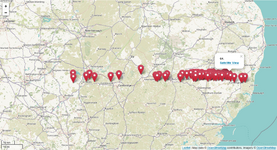
Prior to their coming - say 1750 - it seems the country was covered with something more like 'manors' and 'baronetcies'. Fortified houses and halls occupied by who knows what, predating on who knows what. Or maybe the dukes were predating. Oddly, very few of these fortified houses, their occupants and the activities of their occupants are well-described in public records. This map suggests there were enough of them that they should be:
one line of moated houses map.png
64 moated houses and halls on a random 20km high line
It shows the locations of remnants of moated houses/halls on a line from a random location in the downs north of Bedford to the east coast of Suffolk. There are more (way, way more) remnants of these structures north and south of this line but I am only showing the 64 that fall into a 20km high visor.

The above points matter because of this National Archives statement:

“Until 12 January 1858 all wills had to be proved by the church and other courts. The PCC was the most important of these courts dealing with relatively wealthy individuals living mainly in the south of England and most of Wales.”

Monasteries, manors and 'Church' appear to be very different entities than we're told. If the PCC was 'Church' it may have been a post-1812(ish) creation and - regardless of its creation date - what seems to have been its staffers appear much less honest with records of contracts, etc, than we've been sold. I have my own conjectures about what this sentence was originally conceived to explain, which boils down to: why so few individuals held title after the end of foodalism and how so much ended up in the hands of so few after 1785-1790.

Does the changing size of your archive record-count reflect changing size of the population? And changing size of its recordable legal activities?

A few finds (made while researching) make me think the growth-rate of Britain's archives should be very, very variable if the archives reflect recordable legal activity and if recordable legal activity reflects human numbers.

While looking at the history of the Fens, for example, I found five examples of researchers (geography, history and older 'antiquarian' researchers) complaining that Fenland records had been removed, stolen and lost (where the researchers thought they should normally have been carefully protected and passed on into national and local archives). If we assume the records are missing but the people and their recordable legal activities existed, how far short are the records from the recordable facts? Should the archives be bigger?

The northern and western fens were once very heavily populated (Rev George Oliver claims) and Lincolnshire is certainly famous for its abandoned 'plague' villages. At the time John Clare wrote The Ruins of Pickworth, he was employed picking human bones out of a field and burning them for lime. Whether reduced by plague or 'other', we have plenty of physical evidence of larger populations in the past. If the British records are complete, can we mine the archives to collate the possible names of the original owners of those Pickworth bones? I don't think so, So, again, should the archives be bigger than they currently are?

Among the techniques for preventing archives from reflecting reality is to prune the archives heavily and then prate on about how big and all-encompassing the remainder is. Do the archives reflect massive pruning of what should theoretically have been a much larger archive?

Given we have discussions about missing people, is it possible that a great many humans existed in the past but never reached recordable status?

Based on what I find while researching along IHASFEMR lines, I'd suggest the earlier archives largely represent non-human activities and do not reflect most human existences and activities. My sense is that only in the last 500 years or so - at best - have they begun to reflect human activities. Obviously, many board members aren't working with as gruesome a model as I am. They may well have their own thoughts and explanations for the archives' characteristics.

Summary: all these factors are in play. Along with others I haven't conceptualised. And what's missing from the archives is likely bigger than what is present.
 
Last edited:
All I have done is trace two of my family lines back to the 1700's 1800's changeover. Cannot recall precisely how far back one went but the other went to 1790. I didn't go any further because I lost interest in genealogy. I went through census returns, transcribed at first on index cards, yes it was a long time ago the 1980's, then through scanned returns on CD's (remember them?) microfiche! not CDs then online scans.
The other main source of documented events were baptism, marriage and death registers. I actually read through register after register the real books not scans or copies. A real treasure trove that more often than not sidetracked me by the copious side notes by the vicars and parish clerks. Using these two sources I was able to go back to 1840 and the church registers themselves took me back to 1790.

I can state that for me the registers were absolutely genuine. I saw nothing in any of them that made me doubt their authenticity. The same has to be said for the censuses. The originals were written out by the enumerators and again nothing in them smacked of forgery. The fact my parents and some older members of their families who were alive back then confirmed the census contents and often added in anecdotal experiences that tallied with things such as occupations and locations thus, to my mind cementing the authenticity of the records.
These 'old heads' had never read the census returns ergo the returns are authentic.

Add in some wills going back to the 1800's 1900's crossing points all bearing family information confirmed by my 'elders' and some old birth certificates and a sprinkling of Banns then it becomes blindingly obvious to me that at least everything from 1790 (and a few years earlier as although I lost interest at 1790 I did push back to about 1760 in the registers just because it was an interesting read).

Some really interesting things did come out and sharing a couple here as it seems relevant to the op.
I found zero evidence in my family records of any of them serving in the military until WW1 despite most of the men were eligible for conscription or paid military service for many of the wars said to have been running between 1790 and 1914. And for the most part they were labourers, farm workers or tradesmen so assuming they were in paid employment, (never came across any evidence any of them were until the late 1800's) the pay of the soldiery was clearly not enough to tempt them and conscription seems not to have been a thing either.
None died during the Spanish Flu pandemic of anything let alone Flu.
Lots and lots of children died young as in under ten years of age.

So whilst I am happy with the idea of history being faked my experience of state documentation from a family history perspective shows no evidence of a reset by any method, no world changing events occurring, no widespread catastrophe leading to death by the millions and hardship/deprivation.
Granted a very personal lens but the 'wider margin comments' and other entries in those church registers show no such events either.

One final thing this idea that we are 'living longer' is complete bollocks as the church registers show!

Edit micofiche not CD's added
 
Last edited by a moderator:
I am in the same boat as kd. I personally researched my family and traced our lineage back to the 1500s in both the United States and in Europe. While the European lineage was traced back via online archives, the United States lineage was traced back using original documents found in the DAR archives in Washington, D.C.

While I did not find any evidence of a reset in this time as evidenced by the documents, I was able to identify several family members who died of "The Grip" during the Spanish Flu Pandemic. It was only recently that I heard this was a slang term in the United States for the 1918 pandemic deaths.

Much like kd, this was through my personal experience researching my own family, with some side distractions found while coming through registers and wills. That doesn't help explain the various questions and concerns I have with the historical record, but it did help me understand the movements and life of some of my more recent ancestors.
 
Well, I'm Scottish. I grew up in exactly the same place as all of my grand-parents and, when I was young, I knew two of my great-grandparents, too. My family had not moved more than five miles in the last two hundred years (apart from my Dad getting evacuated to New Zealand which is another story)

1783 is the furthest back I can go on my father's side - although there is a whole genome project, based upon on my father's surname, at St Andrews University. They say that we are Flemish weavers - but every single man in that family, as far back as I can go, went to sea - out of Culross or Kincardine - on the Firth of Forth.

There are no gravestones, in any Scottish kirkyards, before mid 1700s and few records of baptisms. On my mother's side, I found, in the Kirk records, that her, Fraser, family used to be called Frizell...and they baptised their first baby in 1694. Surprising for a miner.

Anyway, the miners' rows and the mine-shafts were/are still in evidence. The tower houses still have their doors half-way up their walls.

I'm not buying the mud-flood in Scotland...but, I think that there was a climate event during the reign of Mary Q of Scots, assuming that she did exist at the time.
 
I would just like to point out that whether a few documents are forgeries or not isn't really the issue - it's when they where forged. For example, if certain unscrupulous medieval clergymen forged an official document to steal land, then it would have been done at the time and not hundreds of years later in the 19th or 20th century. Therefore, the fact that they were able to do it at all means there wasn't a catastrophic mudflood or reset going on at that time.

My own surname is pre-Conquest Anglo-Saxon and one of the very first surnames used in England. Therefore, my family history goes back a long way. As others have mentioned above, there is no abnormal break in the lineage, no missing period of time and no apparent forgery or evidence of alien beings.
 
My own surname is pre-Conquest Anglo-Saxon and one of the very first surnames used in England. Therefore, my family history goes back a long way. As others have mentioned above, there is no abnormal break in the lineage, no missing period of time and no apparent forgery or evidence of alien beings.
When looking up my own lineage I only reached the early 19th/late 18th century. It's an assumption though, because there were no dates of birth or death, sometimes not even a surname. I guess no one would want to write a biography of a common man in the Russian empire (before the abolition of serfdom), but it's still worth mentioning that the documentation and memory just doesn't go that far back.

How hard is it to just make up a person anyway? Imagine you have an orphan that only knows his name - call him by some common family name, say he had some grandparents and you're done.

Also the fact that we are alive, so even if there was a reset of some kind, our ancestors obviously survived. I'm not saying that the lack of detailed documentation proves a "tartarian nuclear mudflood", but I'm giving those statements a huge benefit of the doubt, considering some of those catastrophes might have been artificially induced on specific territories at a specific time, so clergy doesn't just cease to exist everywhere.
 
Tips
Tips
Please respect our Posting Rules.
Back
Top