Evidence humans were created and traded as slaves, food, entertainment and material resources (IHASFEMR)

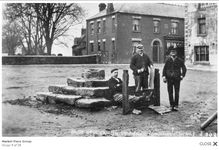
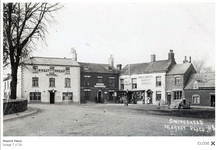
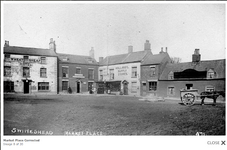
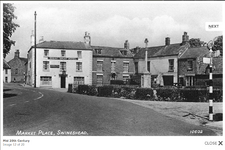
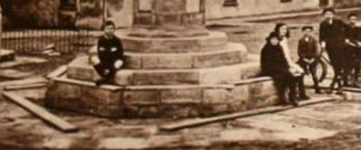
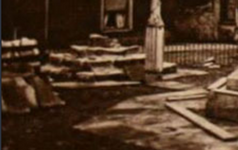
We should probably clarify for anyone who doesn't look at the links, that the 'cross' in the image immediately above is not the same one as in the preceding three images
No it looks to me to be the same one in with the kids sitting on the planks on the steps. Save the disappearance of the long house to the right of the shop. Here it is towards the end of the construction or the installation of the paving around it as evidenced by its location in relation to the stocks.

Screenshot 2021-12-05 at 19-01-48 Swineshead History Photos - The Thorpe Family Collection.png
And here it is today. The shop front has expanded but everything else looks to be the same as the photograph with the police officer in it and the one with the kids on the steps. Pehaps, only perhaps the kids on the steps photo was taken not long after the paving was laid and is therefore contemporary to the image above?
Swineshead.jpg

I must say that although B&W photos romanticise things to a degree the influence of the car culture on Swineshead has not done it any favours.
Screenshot 2021-12-05 at 19-16-21 swineshead wheatsheaf at DuckDuckGo.png
 
Last edited by a moderator:
No it looks to me to be the same one in with the kids sitting on the planks on the steps. Save the disappearance of the long house to the right of the shop. Here it is towards the end of the construction or the installation of the paving around it as evidenced by its location in relation to the stocks.

And here it is today. The shop front has expanded but everything else looks to be the same as the photograph with the police officer in it and the one with the kids on the steps. Pehaps, only perhaps the kids on the steps photo was taken not long after the paving was laid and is therefore contemporary to the image above?

I must say that although B&W photos romanticise things to a degree the influence of the car culture on Swineshead has not done it any favours.
Part of the challenge is that I talked about crosses, when what I really mean is 'a cross and a possible former cross base'. That may be enough to clear things up But if not, I'm interested to hear how this works:

Across the range of B&W and colour photos, I see two 'crossy' base structures and a set of stocks. Using Google Maps, I get their coordinates as:
  1. New cross: (Google Maps), (OpenStreetMap)
  2. Possible former cross base: (Google Maps), (OpenStreetMap)
  3. Stocks location: (Google Maps), (OpenStreetMap)
Mapping those labels and coordinates to the images posted before I commented about clarification:

old cross base Screenshot_2021-12-05_16-23-02.png
Possible former cross base and stocks location

old cross base Screenshot_2021-12-05_16-21-53.png
Possible former cross base

think old cross base Screenshot_2021-12-05_16-22-30.png
I think this is also the 'Possible former cross base'

new cross but old cross base hidden by hedge Screenshot_2021-12-05_16-23-57.png
New cross. Possible former cross base to right, hidden by hedge.

new cross base Screenshot_2021-12-05_15-55-34.png
New cross

old cross base to left new cross base off right Screenshot_2021-12-05_15-57-10.png
Possible former cross base centre-ish left; new cross base off-right
Hopefully, I've provided the clarification I thought might be needed. What do you think?
 
Aah I see what you are saying. The stocks or rather the stones behind them which I said were likely for the auctioneer to be stood on during an auction you are arguing they are the base of a former market cross?
My take on that is the stones behind the stocks look to me to be well worn down presumably from use. Given the market square is or rather was a market and the Wheatsheaf pub was a coaching in it would seem highly likely they were used frequently enough to be worn away. Although not knowing the native stone of the area does throw some doubt into the mix but that wear is often seen on old stone steps all over the places I have visited on these islands.
Perhaps there was originally a wooden market cross in the midst of the stones or even a wooden signpost as clearly signage would be of use to people travelling through by cart, private coach horse of foot and possibly for those driving animals to markets.
An outside bet is a gibbet of some sorts given the proximity of the stocks to the stones. Certainly someone placed in the stocks for whatever reason with a gibbet rising above them would more often than not enable said miscreant to 'see the error of their ways' or 'contemplate their finality' when all 'are abed' and the night closes in, so too speak.

For myself whatever the purpose of the stones behind the stocks were originally it must have been popular going off of the wear. I wonder which war the so called War Memorial commemorates?
My guess would be WW1 as it seems that only then did the glorification of war by memorial seems to have taken hold. Indeed the War memorials round here do not predate WW1.
Maybe that was when the cross we see today was first erected and prior to that there was the simple wooden or possibly stone market cross sat on top of the stocks stones.

In any case I really do not think we today can comprehend what a busy market square looked like back in the day. Not only would it be used for markets but also all manner of festivals fairs and get togethers in numbers we cannot imagine in our refined politically correct health and safety/insurance restricted existence.
I am just about old enough to have experienced some of these events but they were well on the wane and a fraction of the number and scale they were when my grandfather was a boy prior to WW1.
 
Aah I see what you are saying. The stocks or rather the stones behind them which I said were likely for the auctioneer to be stood on during an auction you are arguing they are the base of a former market cross?

For myself whatever the purpose of the stones behind the stocks were originally it must have been popular going off of the wear. I wonder which war the so called War Memorial commemorates?

In the past, arguing hasn't proven a very effective way to express my ideas. Especially when I'm unsure of the evidence and my logic. Being funny seems to get people's attention. Having - at last - realised this, I'm working on being funny intentionally. So I'll proceed in that vein.

You suggested the steps may have been an auctioneer's stump and/or the base a gibbet. But perhaps, like me, you are still wondering:
What is that? What is that for?
It would be in the spirit of the IHASFEMR thread to answer with shorthand like:

Yes, it may well have been for auctioneering. Cattle -> chattel -> the Mayor of Casterbridge's wife...

But given the difficulties we face when trying to recover so much missing history, a different approach might help with this one. It's just possible that some irrelevant-seeming thought might prove very relevant to our recovering the real purpose of those Swineshead steps. And perhaps to recovering missing parts of the history of technology.

I'd also guess the memorial commemorates WWI. I'll visit Swineshead and report back. And I think you are completely correct to highlight the wear on the steps. In fact you could have taken the words right out of my mouth. Step wear on old structures is possibly a useful clue to solving one of Life's Big Questions: for how long was chewmanity around before mudflood's complex mother-catastrophe changed things? I'll take a straight edge to see if I can measure the step wear. I think 'depth of wear (millimetres)' would equal something like:

The product of:​
'Variable A: traffic level'​
x​
'Variable B: length of time in use'​
x​
'Factor C: type of footwear' (hobnails or leather)​
x​
'Factor D: weight of average step-user'.​

I used to know a pharmaceutical industry statistician who could take a list of measurements for quantities like 'depth of wear (millimetres)', then derive from it the value of each of its individual factors. A skill that looked like magic to me. I think she's busy promoting vaccines now.

I hadn't thought of the intimidatory nature of having a gibbet looming over the stocks. It's a very good point. Nevertheless, I still think there may be more to those worn steps than a well-used gibbet. And to the stocks. However, for the moment I'll leave the stocks out and take a swing at the gibbet:

Gibbet:
  1. gallows
  2. an upright post with a projecting arm for hanging the bodies of executed criminals as a warning
I question the narrative around gibbets and the rest of the hangman's tool-set. Along with hanging as a useful method of execution. I accept that it's showy. And, as the video captioned 'Freshly cut ingredients, attractively presented' in post-101535 demonstrates, showy is effective. Showy draws happy, expectant crowds. I also accept that still-warm - perhaps still jerking - bodies may have been slit open; their blood drained and sold as 'merch' at the end of the show.

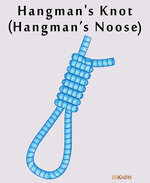
But I suspect hanging may - of all things - be the most cargo cult-ish of all our cargo cults. In particular, the hangman's knot has always puzzled me. It's over the top. It is uses a lot of rope to fashion a Rolls Royce among knots. Why do it? When hanging was allegedly as common as a trip to Tesco, why roll out the Roller? A Ford Fiesta would be good enough and weigh less on the rope budget.

I suspect we've been strung along and that real hangings used the scaffold knot. It has a slightly higher failure rate - but not much higher - and fatigues less rope. Its failures might not be a bad thing. Failures - especially sporadic and unpredictable failures - are a guaranteed crowd pleaser. They are the casino's business model. Handled appropriately, every failure could be turned into viral marketing for your gibbet.

If you really wanted to hang people as a lesson or a spectacle - or both - you wouldn't use thick rope. It's too valuable. You'd use the same materials, techniques and mind-set used for snares. Sinew and cord so thin it can barely be seen. Perhaps later into the Industrial Revolution you'd switch to the thinnest viable piano wire. You'd plan for it, equip for it, and rehearse it over and over again. You would use technology to enhance the drama until the visual severity of a well-executed hanging was indistinguishable from magic.

I could be wrong. Maybe it's the showman in me that thinks this way. Perhaps I should get a life. I do need to hang out more.

I don't want to underplay the important clue that is the hangman's knot. I am not claiming it is merely a 'show' knot. I think the hangman's knot could unravel the very real mystery of gibbets. A cargo cult clue we can use to ensnare this thoroughly-sanitised aspect of chewman history and splatter it with Truth.

Another weird aspect of gibbets is their location. Often way out of the village; often on a hill. Why? I get why you'd put them where the toiling peasants could see them. But if your slaves really have such poor memories, why not site the gibbet amid their hovels? Where everyone can see its gruesome payload every time they check the weather? Indeed, use it to check the weather.

Well, that is - of course - the case at Swineshead. And, as you noted, the Swineshead gibbet is close to a coaching inn. This is another clue to one of its real, original functions. I'll come back to this once I've finished cleaning our minds of mainstream nonsense about how hangings worked.

A few years ago, one of the Sunday newspapers ran an article that described - in loving detail - the process of hanging. The journalist dangled in front of his readers a systematic and thorough preparation process ideally suited to the sensitivities of 20th Century England. It included:
  • Inspection of the gallows' integrity.
  • Inspection of the rope's integrity.
  • Creation of the perfect noose and knot combination.
  • An artisanal - yet perfect - assessment of the required drop.
  • Followed - about 15 minutes later - by the start of a quite astonishing clean-up process.
The last two parts of cleanup were:
  • Careful washing of every single part of the corpse and its soiled crevices.
  • Placing the now perfectly clean body in a pit of quicklime, then covering it - reverently of course - with shovel-loads more quicklime.
I expect a human body would achieve peak-productivity in such pre-mortem moments. Mine would. But the described level of care went far beyond even today's Health and Safety biohazard handling requirements. Especially for bodies about to be transformed into miniatures of the Chilterns.

It brought me up with a jerk.

I thought:
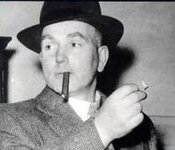
Albert_Pierrepoint,_English_hangman.jpg
Albert Pierrepoint. Source

When I checked Wikipedia's Albert Pierrepoint page, I saw my second fear confirmed:
an English hangman who executed between 435 and 600 people in a 25-year career that ended in 1956.

What kind of record-keeping is that?

To my ever-lasting regret, I was so caught up in this revelation, I forgot to check Wikipedia's page about the journalist. Nevertheless, that article spawned IHASFEMR. It conceived the first thought - the neuronal equivalent of first cell division.

I thought: perhaps the Pierrepoints - aided by the British State - were selling corpses to medical universities. It's not unthinkable: the State specifically formalised that sideline on 22 May, 2020. But, given the stories you hear about Dennis Nielson and all that, I began to wonder if the Pierrepoints had tapped a market that only buys from the most discreet suppliers. The 'leisure market' if you see what I mean. If so, then limited supply and the need for utmost discretion would guarantee premium prices. This is the kind of low cost, high-price market sector that business adores. I thought perhaps I had discovered - over-shadowed by the celebrated economic contributions of the 'Pink Pound' - a small, highly profitable contribution made by the 'Stink Pound'.

Two circumstantial pieces of evidence supported this conjecture:
  1. The Government (meaning the Prison Service and the then Inland Revenue) turning a blind eye to the obvious book-cooking - and perhaps crook-cooking - by the Pierrepoints. I presume the authorities got their cut.
  2. There is a visible sub-sector of this market. Only just visible, it hides in plain sight as the 'realistic fake corpse' market.
If the realistic fake corpse market is new to you, see:
On these two sites, you will see advanced 'Halloween dummies' on open sale. But turn up your intuition level... Turn your intuition level right up to volume 11 and you will see love dolls being openly sold to people who are 'exploring their relationship' with putrefaction.

It would be unfair to call these products 'gateway corpses for beginner necrophiliacs'. So I won't. You make your own call. The main thing is: we should not judge 'The Other'.

If what I am saying seems 'out there', I assure you it isn't. I was introduced to Distefano over 20 years ago by my corpse-obsessed then-wife. Its product line seems to have been more upmarket in those days. My then-wife became my ex-wife and went on to become a respected cop, which proves these interests are as Establishment as it gets.

By my count, that is three pieces of evidence that support my conjecture.

Anyway, that's how we got to here, to IHASFEMR. So let's now take a look at a similar word to 'gibbet': 'giblet'.

Giblet:
  1. an edible visceral organ of a fowl —usually used in plural
  2. giblets plural, archaic: odds and ends: "the great ladies with their grace, lace, and giblets" - Peter Hawker
I don't know who Peter Hawker was or where he wrote that. But I do know who John Byng was and where he wrote the below. From John Byng's The Torrington Diaries, Vol III, p98, at Skipton Castle:
a most inconvenient, miserable, tatter'd place it is, with neither beauty of building, nor pleasing antiquity; but a melancholy wretchedness of bad old rooms, some miserable tapestry, and some (basely) neglected pictures, especially one of the Countess, with a child in her hand

Yes. She had big hands.

Now, adding to feralimal's findings about liquor and gravy:
To make gravy, you may want to fortify it with neck and giblets while the turkey cooks (or chop the giblets and saute them with some shallot…
Source

OK, let's board the gravy train:

Britain, 1908:
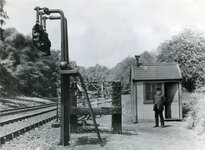
Travelling-Post-Office-apparatus-4.jpg
Iron Age gibbets. Note the bowler hat. Source

Britain, 1934:
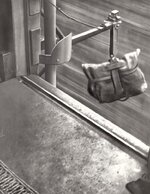
Travelling-Post-Office-apparatus-3.jpg
My proposal for replacing the NHS home care service with McDonalds rail deliveries. Source

America, 1908:​

Note the bowler hat. Source

For the interested, details of more American mechanisms are here. In short, this is how you engineer pick-up and drop-off of cargo by a moving vehicle. Without requiring it to stop.

Referring back to the Lincolnshire Life quote in post-106260.
Later on, coaches would also leave their mailbags at the Wheatsheaf and it was from here that villagers would collect their letters – in effect the hotel was Swineshead’s first Post Office.

That was part of my response to your very relevant question in post-106259:
Was it a coaching inn at one point prior to the houses construction?

Yes it was. And it was a mail pick-up and drop-off station too. Among John Byng's most common diary entries are his references to picking up his mail, replying to it, and talking with innkeepers about postal delivery times.

Hotels and inns that acted as post offices were called 'posting stations'. From a page about Thorney, Cambridgeshire:
Thorney was, during this time a Posting Station and the Dukes Head Inn stood on the south west corner of the traffic lights at Abbey Place and the Wisbech Road. It was demolished after it fell in to disrepair towards the end of the nineteenth century.

I think you're going to tell me I've made a great case for Swineshead's old cross base being the remnant of a parcel pick-up and drop-off point. And Thorney's too. But I think you're also going to tell me - gently and sensitively - that there was no railway line running past Swineshead's Wheatsheaf, nor past Thorney's Dukes Head Inn. That I should drop my case. But that you'll hang on a little longer to hear what I think Pierrepoint's ridiculously over-sized knot was really about.

I thought we might reach this point. I feared a post whose only obvious merits are its gallows humour and hard-earned knowledge of the sexual preferences of necrophiliacs would quickly lose reader interest. People want facts. Preferably facts about things they find interesting, not facts about things I find interesting.

So I've cut and pasted a short diversion into materials science. Specifically, bow-making. Bow-making and what bow-making tells us about the suppressed history of materials science.

All bows are equal but some bows are more equal than others. Or at least, are better-known than others. We begin with a quick examination of the English longbow. Starting with a quote I'm sure I once heard at the dinner table in the mid-90s. That the simple longbow:

Download Video

Simple because it is made from a natural laminate. Source

yewcross2-296x300.jpg
English longbow staves combine the contrasting properties of yew's sapwood and heartwood. Source

Just to drive the point home:
  • Yew heartwood tolerates and recovers from compression very well.
  • Yew sapwood tolerates and recovers from tension very well.
So, cut correctly, yew staves supply two woods pre-bonded to each other. From one tree.

We're told English warbows - the taller man's version of today's 1.8m (72 inch) longbow - presented draw-weights up to 150lbs. Possibly more. This tolerance for being tensioned and compressed, then released into super-fast recovery, is what makes yew's natural lamination so suitable for warbows.

The Japanese used short bows and longbows. The french also fought with longbows. So-called 'English' longbows are made from European Yew (Taxus baccata), which is found all over western Europe. References to yew and yew woodworkers can be found as far south as Évora in Portugal. Says Wikipedia, the 'celt' word for yew - 'ebura' and its variations - is found all over western Europe. Eboracum was the Latin name for York. Which itself isn't a million miles from the word 'yew'.

Conclusion: Whatever your longbow heritage, European yew's qualities were appreciated from York in northern England to Évora in southern Portugal.

We've seen some bow shooting. But we focused on the bow. Let's have a squint at accuracy:

Download Video

Byron Ferguson demonstrates his eye for circle packing. Source

With that, we've drawn a picture of the basics of archery. We know yew's natural lamination mixes and matches properties of two different tree parts. We can also envision range and accuracy.

Longbows are powerful, accurate and even romantic... but you can't prance around on verandahs with them:

Download Video

A laminate bow receives its final layer: a simple human shield. Source: Westworld S02 Ep05

Most bows are short compared to longbows. Why? Some 'exhibition' archers claim traditional archery is a misrepresentation. That archery was fast-moving, dynamic and often, very close range. Requiring skills like this:


Unfortunately, using bows in this way is controversial today. Source

Among archers, this video is controversial. Apparently, some say, it's unrealistic. Some say it's faked. Assuming it is genuine, then in my opinion, there are only two appropriate responses to this video: awe (a feeling) and appreciation (a cognition).

Perhaps as a result of buying so many ready-to-use items during their lives, consumer-humans no longer experience the feeling of 'awe' as awe was meant to be felt. That is: as the feeling experienced when we see the abilities someone has developed from their personal struggle with innumerable failures. Instead, consumers confuse the feeling called 'awe' with the feeling called 'jealousy'. I think this may be because consumers don't fail enough. They think achievement is easy. As a result, they are unable to process 'awe' when they encounter it. Their sense of "I can't do that" is transformed into jealousy. Then into anger instead of appreciation. This is not a natural, built-in, fault. It is a stress condition, a symptom of capabilities left undeveloped by insufficient exposure to personal failure, insufficient survival of personal failure, and insufficient overcoming of challenges. Individually and mutually.

Like bows, we humans need to be tillered as part of our development. Tillering develops balance. Beyond that, we need to be stretched if we are are to develop our full power.

Anyway, let's avoid arguing with angry aficionados of weaponry. Armed angry people get killed while arms manufacturers get rich, so we'll look at bow-making instead.

You can make a field-expedient short bow out of a single stave of wood. Some woods are better than others. But most short bows perform much better if you laminate together materials with different properties. In other words, if you imitate yew's natural lamination.

Usual materials for this?
  • Various woods and bamboos
  • Hide
  • Sinew
  • Horn
  • Bone
I left ivory off the list. I'm not a materials scientist but I understand ivory's brittleness more or less excludes its use in highly-stressed, flexing laminates. And also excludes it from laminates that must take a bashing. Ivory might have potential as a reinforcement in static laminate applications. But if low weight is required, ivory loses to bone.

Choice depends on what you've got and what you want. Stronger bow? More stable bow? Lighter bow? Stiffer bow? Cold temperature bow (think "Artic")? Bone was usually used as a stiffener. It helps laminates resist flexing. Which you might want if all you have is sinew and seal skin.

This clip - from Making The Lakota Bow, A Bow Maker's Journey - shows sinew being used to increase a bow's stiffness:

Download Video

It's not as good but it's better. Source

Manufacture can get quite complex:
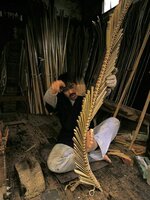
laminations_yumi1.jpg
Laminating a Japanese longbow. Source

It reminds me of a human spine. And then comes the thought: well, what was your body designed to do?

Consider what he's using his body to do. He probably didn't wake up one Saturday morning thinking:
Got the whole weekend ahead. What do to? I know! I'll make a bow out of slivers of wood and bamboo while practicing yoga.

No. He is using techniques taught and learned over time. His knowledge of materials is coeval with his knowledge of technique. That is the essence of materials science and laminates. Knowledge of materials, knowledge of technique. Slivers of knowledge laminated together in the human mind, then expressed through applied expertise into usable products.

And now we close in on the point.

All over the world, there is evidence of a pool of knowledge about the properties and processes required to laminate organic materials. The more difficult the conditions, the more sophisticated the knowledge. I couldn't quickly find clips of Artic bow-making to demonstrate this but I read that Inuit bow laminating techniques are among the most innovative.

Permanent laminates require glue. Knowledge of materials science and of materials processing goes into making - and using - glues. Another sliver of acquired knowledge. And I'd suggest that even the hangman's rope is another, simple example of lamination science.

From these concepts, we see a mystery grow. From knowledge of materials to knowledge of technique to the mystery of 'how?' How did humans acquire their knowledge of materials science?

IHASFEMR says: humans were taught this. But that's not the only mystery about it. Another mystery is captured by these questions:
  • Why do you see this advanced engineering knowledge applied only to bows?
  • Why does Western Europe show so very little evidence of advanced lamination techniques?
I appreciate various products use laminates. Some structural elements and laminated containers do reflect knowledge of advanced lamination materials techniques. But these products are generally for static use. Laminated bows are designed to deliver power, stability, and lightness under high-stress, highly dynamic conditions.

As the gibbet and the catapult and the waterwheel and the cart and wooden ships all demonstrate, a great deal of pre-industrial expertise developed into the heavy engineering of robust wooden products. Strength through chunk. Funktionalität durch Solidität. Awe-inspiring as they are, they distract us from noticing the expertise that goes into making a laminate bow.

Why do we see no record of that expertise being routinely used to solve other pre-industrial age engineering problems? Or to innovate new pre-industrial age products?

I suspect the answers to these questions go something like this:
  1. Lamination techniques were used.
  2. Lightweight, highly stressed, highly performant products were built.
  3. We see only one class of them because the others were suppressed.
Can I prove item three: the suppression claim?

No.

Pointing to something that isn't there and shouting typing: "Look! See?" won't work. That's the goal of suppression. But I can highlight some enigmas that may show us the edges of suppression.

1. English churchyards almost always have at least one yew tree. Usually more than one. The explanations for this don't adequately explain why so many yews would be planted in churchyards and not around other old buildings.

2. English churches - and churches in other countries - often have crypts. More than 60 English churches are known to have stored bones their crypts.

Conclusion: We see yew - a component of springy laminates - being grown on the same sites in which bones - a component used to stiffen flexible laminates - were seemingly cleaned, sorted and stored. Could churches have been workshops? Could their alleged function as power generators have been a by-product of needing electricity for laminate materials processing?​

3. On his tours, John Byng often comments that all the furniture is missing from old halls and mansions. He mentions furniture in 'the old taste'. Visiting Louth, Lincolnshire, he describes the furniture and extensive grotto built by 'Mr Jolland', the vicar of Louth's St James' Church (Google Maps), (Google Streetview), (OpenStreetMap), (Flickr images). Probably Wolley Jolland, vicar from 1780 to 1840. On p354 of The Torrington Diaries (Abridged Selection), Byng says Jolland built the grotto and its furniture from tree roots and polished horses' bones. Was Jolland eccentric? Or simply a craftsman in the old taste?

4. Clues in the odd use of nouns.
Portuguese word 'bone' (noun form). Source

'Osso' is the root of 'ossuário' or 'ossário', the Portuguese word for 'ossuary.'

Évora's famous ossuary (Google Maps), (Google Streetview), (OpenStreetMap), (Flickr images) is the source of the image used earlier in this thread. Famous for its 'Roman' ruins, Évora also held a large part of the slave population of Portugal.

Évora. Portuguese pronunciation. Source

Which sounds a bit like:
Ivory. English pronunciation.

And not much like:
Marfim. Portuguese word for 'ivory'. Source

The closest Portuguese word I found for 'ivory' is the word for off-white colour:
Ebúrneo. Portuguese pronunciation. Source

But it's unlikely the entities who named Évora mistook its ossuary for a stash of ivory. Ivory is easily distinguished from bone by its hatching patterns and absence of the dark flecks that are characteristic of bone. There are good Youtube videos on this but the following clip is more relevant for IHASFEMR:

Download Video

"No. It's bone." Source: Inferno, 2016

It seems more likely to me that Évora was a place laminate materials were processed. A place as familiar with ivory as it was with bone. And yew. Perhaps it was always named after ivory, but only the bones and the yews remain.

5. Why did the entity who allegedly initiated Portugal's African slave trade - Henry the Navigator - have his navigation school built high on a cliff? Why not at sea level, preferably where river currents meet tides to create more realistic sea conditions to teach sailing and position-fixing?

6. Stolen History researchers draw our attention to vanilla sky photographs. How do we explain them? How do we explain this seemingly botched photograph of Mount Wilson observatory from post-102149 and the mainstream version of the telescope's journey up the mountain?

screenshot-at-2021-03-27-07-17-02-png.png

7. Gasbags have a lot to tell us:

Download Video

One man and a small gasbag. Source: Skankpunk's airship series.

And another:

Download Video

One man and his rather larger gasbag. Source: Skankpunk's airship series.

I wondered about many aspects of these two clips:
  • The gasbags look small. Did they use hydrogen as we know it? Ozone? Corpse gas?
  • Are the gasbags roughly the same size?
  • What weight is each gasbag lifting?
  • Were their experimenters reverse engineering an earlier culture's technology?
  • How did these experimenters feel during the moments we see in the two clips?
The word 'joy' wouldn't capture it for me. 'Exaltant' or 'a little scared but exaltant' describe how I would have felt.

Dissatisfied that the nearest I could get to 'a little scared but exaltant' would be to calculate the respective sizes of two gasbags, I set out to design an autonomous airship drone. I wanted to explore an airship's 'challenge environment'; the problems around sensing and control. Using parts from my parents' hoard of trash discarded appliances.

Working out the algorithms required for the controller code, I began to appreciate the difficulty of reducing risk for airships operating close to ground at zero - or near-zero - ground speed. Like a sailing dinghy, they can't reliably maintain position if they are not making way. And there's no 'heaving to' for airships. Other than being tethered.

And, as you can see in the second airship clip, handling would become even more difficult if you are moving cargo around.

Discovering this problem helps us make sense of some strange stories. Stories about flying ships that trailed 'anchors' on long ropes. Anchors that get hooked on churches and have to be freed. Perhaps it even explains Jack and the Beanstalk.

Thorney is home to an interesting legend. From: Village History | Thorney Museum:
Legend says that the religious settlement of "Ancarig" (the original name of Thorney) – the place of the anchorites

William of Malmesbury described Thorney as "a little paradise, delightsome as heaven itself may be deemed, fen-circled, yet rich in loftiest trees..."

"A vast solitude is here the monk's lot, that they may the more closely cling to things above. If a woman is there seen, she is counted a monster, but strangers, if men, are greeted as angels unawares."

A reference on that page to 'quiet' and 'contemplative life' made me wonder if the anchorites thought the gods were listening in on their conversations. Perhaps the anchorites were plotting their escape from the manor farm system. The quote: "the more closely cling to things above." caught my eye. Maybe they were trying to escape this domain using the same techniques that desperate Afghanis allegedly used at Kabul International Airport. Clinging on to airships ranging over pre-roads Lincolnshire.

But it seems more likely to me they were simply farmers air-shipping sentient produce.

8. In his comments about Jolland's root and bone grotto in Louth, Byng notes that among Jolland's inscriptions and decorations there is:
not one cross; probably he might fear to give offence.

The destruction of 80% of Britain's 12,500 market crosses by the end of the 18th Century implies widespread cultural revulsion. Does our understanding of the symbolism of crosses allow that used inside Divine Workshops, they may have been stretching frames for the careful extraction of hide, sinew and bone? Does it allow that, outside, they may have been hitching posts for airships? Perhaps Swineshead's worn steps were the slipways of the gods?

And, sometimes, perhaps gibbets support structures for the pick-up loops attached to cargo awaiting pick up?

9. To me, the hangman's knot looks like a marlinspike sailor's hitch. It seems designed to withstand high loads and rough handling. I wonder if the rope winding was there to help it stand upright; to hold its loop upwards ready to catch a hook. Propped up, or perhaps even manually offered up, to a hook trailed from an airship. That airship would have to be built by entities with a wonderful knowledge of lighter-than-air gases and lightweight laminates.

So no, kd-755, I'm not arguing it was the base of a former market cross. I think the available evidence - and the evidence of missing evidence - supports an entirely different use case.
 
Last edited:
That's a hell of a long way to get to an answer of sorts. Given the nature of this thread I guess you feel the wear comes from killing humans. Fair enough I have no idea what or indeed where the stones came from or what there purposes were. They could simply be reused steps taken from a defunct building or they could be the steps used when people got into or out of a coach or even a way of loading and unloading heavy articles of goods from and onto carts. Its all speculation though.

I'm doing nothing more than looking at these photographs and imagining.

As for your iron gibbet theory well I have seen them in real life and the are built to allow a moving mail train to collect mailbags without stopping says an awful lot about the engineering skill that used to be employed once upon a not so long ago.. The mail carriage sorting office was equipped with a fold out net device to effect a good catch. Ingenious actually.

The role of the cross in marketplaces as always seemed to me to symbolise some sort of control or order as well as being an obvious symbol to itinerant sellers such as chapmen and tinkers, drovers etc where the best place to do business is. Would be interesting to find out when Swineshead market cross came into being if such information exists on the web.

The disappearance of market crosses en mass in a short period of time simply says to me they were obsolete much in the same way in my lifetime the 'shop on every corner' has become obsolete. Much like markets themselves actually. Few survive and of those that do even fewer are of the scale and frequency they were even just 50 years ago.

I sit nobbut a mile away from the extant remains of the building in which the first British airship was built for the Royal Navy. I emerged from its shed pulled out by three or four small boats and was moored onto a specially built mooring mast in Cavendish Dock. A wind 'got up' which was well within the design tolerances of the airship and it swivelled on its mast and broke its back.
A total loss.
The fundamental flaws with airships really is quite obvious their massive size makes them vulnerable to even light winds and their carrying capacity in terms of weight is tiny in comparison to their scale. Basically because the airship obviously has weight in and of itself which it has to keep airborne and all cargo has weight and this necessitates ever bigger vessels which increase the odds of structural failure due to the wind.
Add in another obvious failing in that they are almost uncontrollable when moving and cannot react quickly to anything much like a supertanker and their sheer bulk makes it a very dangerous thing to bring down to a tiny in relative terms mooring mast even if the weather plays fair.
That they existed is beyond question for me as my best friends grandmother saw the Hindenburg fly low and slow over the town when she was a teenager and my own grandfather saw one fly over his home town though he didn't say if it was German or British .
 
Given the nature of this thread I guess you feel the wear comes from killing humans.
I think the wear is mostly from usage. For the contextual reasons set out above, I lean towards the idea they were worn down by long usage as a parcel/cargo pick-up 'gibbet' at a 'postal station'.

As for whether the gibbet was iron, or wood, or other, I don't have enough evidence to say. The above image of an iron 'gibbet' illustrates iron being used in a gibbet-like role. But it doesn't solve the case.
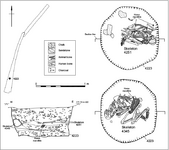
That's a hell of a long way to get to an answer of sorts.
I was once complimented by my then boss. Only once, which is why I remember it so well. He said I was tenacious.

I did notice though, that tenacity was frowned upon by many, especially outside of work:

Download Video

My days as a simp. And my nights. Source: Annihilation, 2018

Perhaps tenacity is in the eye of the beholder.
 
Last edited:
I think the wear is mostly from usage. For the contextual reasons set out above, I lean towards the idea they were worn down by long usage as a parcel/cargo pick-up 'gibbet' at a 'postal station'.
My observation of what is depicted in the photographs runs as far as the are made of stone that has worn. What type of stone where it came from, what if any use it had previously is anyone's' guess but in the absence of this information all there is is speculation.

The pub was a coaching inn. Horses can go around 15 miles at a walk without requiring food and water for this reason coach horses were changed at these inns. If the horses were pushed into cantering then they would need changing more frequently and galloping horses even more frequently.
As the coach has to stop moving for the ostlers and stable hands to change the horses there is no need for a gibbet type affair to be used. All that is required is two humans one on the coach and the other on the ground. Anything heavy is not placed on the roof for the simple reason to maintain stability on anything fitted with wheels the weight is always greatest nearest the axles otherwise the wheeled vehicle will fall over very easily.
Coach and horses do not run on rails so a moving coach would rarely be in the right position to collect a hanging mailbag. Loading and unloading a stopped coach is very easy and can be done within the time it takes to change the horses so the postal gibbet idea holds no merit.

Edit to add missing p's.
Keyboard is playing silly buggers.
 
Last edited by a moderator:
The pub was a coaching inn. Horses can go around 15 miles at a walk without requiring food and water for this reason coach horses were changed at these inns. If the horses were pushed into cantering then they would need changing more frequently and galloping horses even more frequently.
According to Deep Hollow Ranch, expectations for the distance a horse can travel have fallen from 35 miles to 25 miles. You can see why a stop after around 15 miles would have been vital for watering, resting and probably changing horses. Presumably that would be around lunch-time.

Byng has a curious quote about the stamina expected of horses in old times. It has implications for the logistics of the day too: the coaching inns and stables required to provide and maintain a large number of horses. From The Torrington Diaries (Abridged Selection), p33:
Could a coach and six have come further than to Huntingdon from London in two days? I should have liked the travell of those times: the reception, and comfort at an inn ;
and
Tho' yet, the posting on horseback might have been very quick; as we know from several accounts ; particularly in that entertaining life of Henry Carey Earl of Monmouth. [17]
'Who to outstrip his fellows, and gain the favor of the new Monarch - set out from Whitehall betwixt 9 and 10 o'clock in the morning of March 24th, 1603, and reach'd Doncaster that night.'​

[17]: This is a mistake in the Christian name. It is Robert Carey, 1st Earl of Monmouth (1560-1639), who recounts the journey in his Memoirs.

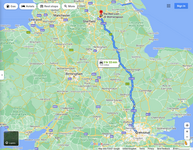
Whitehall - Doncaster route map.png
Whitehall to Doncaster route today. Source: Google Maps

Assuming 'that night' means 21:30, and the route was more or less as it is today, that's 195 miles in 12 hours. 16.25 miles per hour. Slightly faster though to give Robert Carey time to leap from saddle to saddle.

My observation of what is depicted in the photographs runs as far as the are made of stone that has worn. What type of stone where it came from, what if any use it had previously is anyone's' guess but in the absence of this information all there is is speculation.
You're right: speculation is just ballast we must jettison as we fill our holds with evidence.

There are many possible sources for Swineshead's stones. A lot of stone was freighted across the flooded Fens, judging by accounts of Thorney Abbey's ruins being used for Cambridge's colleges and similar about stone being shipped from the southern Fen shores to the northern shores. Former ports like Swineshead have sandstone available nearby but given the gradients around the southern Wolds it might have been as easy to bring in those stones by boat or make use of dumped ballast.

I'll let you know what I find when I visit.

Anything heavy is not placed on the roof for the simple reason to maintain stability on anything fitted with wheels the weight is always greatest nearest the axles otherwise the wheeled vehicle will fall over very easily.
Understood. Keep the centre of gravity low. Increase the energy required to tip the vessel. Like ballast in a ship. Is that what you mean?

We don't usually see this because ships' hulls are solid, though we can divine it by watching ferries loading and unloading. There's even specialised software for calculating container loading and unloading order to keep weight as low down as possible as the ship loads and unloads at different ports on its route. I don't know about these days, but 25 years ago that software was notable for running on Macs rather than Windows 3.11.

Anyway, this clip might help folks envision the equipment used to attach heavy freight during pick up:

Download Video

Sikorsky CH-53E picks up a light armoured vehicle. Source

helicopter freight hook.pngHangmans-Knot-Noose.jpg
Hmmm... Source

Nice to see a crozier in action from 35 seconds in. You can still buy croziers. This one comes with a snap-out user manual:

crozier_405_33.jpg
Recommended by St Michael! Source

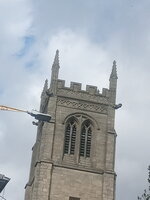
In relation to this, I've been thinking about the knobbly bits on church steeples:

IMG_20210925_145346_694.jpg
Knobbly bits. Uffington, Lincolnshire

IMG_20210925_141121_895.jpg
St Marys, Stamford

IMG_20210925_141240_380.jpg
The church opposite the pub.

The knobbly bits' external surfaces usually have quite a distinctive shape, like the groove fashioned into porcelain electrical insulators. I wondered if, in the past, these grooves supported electro-luminescent wire.

As I looked at church steeples and church towers I also wondered: do we see unique combinations of:
  • tower features
  • steeple features
  • corner pinnacle features?
So far I would say, we do. At least in the areas I move around in.

So, if illuminated at night - as some of those crazy Stolen History folks speculate was possible - and if approached from the air - as one of those crazy Stolen History folks speculates was possible - each church would show a unique pattern of light.

The pattern would be unique whether seen from the side or seen from above. From the side, they would appear like bands of light, with a different band count and perhaps different patterns of bands for each church. From high above, looking down, each set of bands would appear like concentric octagons of light. Again, the patterns would vary from church to church.

Naturally, I wanted to see how that might look if I were flying over eastern England at night. I wanted to see if it would be worth spending cash on a 2D graphic showing multiple different patterns of octagonal light bands.
Download Video


A 2D graphics artist made up a prototype using some flashing beacon images to stand in for the more complex octagonal patterns of lights. The above cost £15. I think it would be possible to work out what the patterns of lights would be for, say, each of the churches south of the Fens. You could then - theoretically - position them on black background and simulate flying over them in darkness.

But it would only be worthwhile if you wanted to see how illuminated church steeples and towers would have looked at night.

From the cabin of a medieval airship.
 
Last edited:
Dear Usselo :)

It's time for me to let you know: I feel Gratitude for all the unique ideas you are sharing, Brother.

I think about your thoughts daily: https://stolenhistory.net/members/usselo.1032/#latest-activity

I've pondered, repeatedly and deeply, every idea you've shared at this site: your ideas are logical.

Some folks haven't invested the energy to neutrally consider, chronologically, all your lovely posts.

Some simply lack the ability to recognize & admit reality, even when it's right in front of their face.

Some are limited by their loyalty loop, and some simply cannot boldly jump to logical conclusions.

Please ignore such self-limited characters, and please continue your grand thoughts without limits.

What you have realized is reality, and your tenacious sharing with humanity is altruistic and worthy.

So, in summary, please remember: there are humans existing who are Grateful for your idea sparks.

Sincerely,

Observer :)

tinyurl.com/My-ideas-shared-at-CluesForum
tinyurl.com/Evidence-1-WTCvicsims-were-CGI
tinyurl.com/Evidence-2-WTCvicsims-were-CGI
tinyurl.com/Evidence-3-WTCvicsims-were-CGI
tinyurl.com/each-floor-12feet-man-too-tall
tinyurl.com/My-ideas-shared-at-WildHeretic
tinyurl.com/My-ideas-shared-at-DebitoJapan
tinyurl.com/scroll-down-Click-Load-More
tinyurl.com/GreenHouse-1
tinyurl.com/GreenHouse-2
tinyurl.com/simple-Health-Reality-Summary
 
A coach and four cannot do 35 or 25 miles a day. on one set of horses.
Over here the village layout is on a loose 15 mile grid pattern for the most part. This easy to check using old OS maps and it golds good for most but not all areas of the islands.
The horses used for coach and cart work were not of the same build as personal transport on horseback. Each use had its own breeds which were maintained and reinvigorated and most are still around today so it is easy to see the difference in the animals body size and shape.
Basically the more thicker set the horse breed the more suited it is to carts and carriages with carriage horses being the lighter build of the two. Cartage horses are hooked up to far heavier loads than carriage horses and the move at a slower pace.

If the stones turn out to be sandstone then it would be wise to try and establish which specific stone as sandstone comes in a wide range of hardness. Perhaps a comparison with other sandstone in the immediate area such as the stone on the pub or the cross may shed some light on the steps being contemporary with both or either. Will be an interesting read when it appears.

Yes ballasting is all about stability and as a slight aside given the proximity of the fens an improper ballast on an otherwise empty ship will render it unseaworthy as effectively as a moving cargo would. Wheeled vehicles get their stability in the exact same way. There are slow motion videos of container ships being unloaded and loaded in a very specific order that are fascinating to watch.
With any thing heavy requiring transport using horsepower just above the axle is optimum as this puts the weight more or less chest height on the horse and as it pushes forward into its harness the push force is exerted in a straight line through the load. Once moving it then become relatively easy in terms of effort to keep moving.

Incidentally oxen were often the choice beast of burden for cartage as pound for pound they can move more weight for longer per day than a horse can and they are low maintenance as their feet provide more ground contact therefore traction than a horse. Obviously they cannot travel as quickly as horses so are useless for carriage work.
 
800px-Saint_Nicolas_Heures_d'Anne_de_Bretagne.jpg

Ho ho ho!

As it is coming up to Christmas, I thought I'd share this little observation from Father Christmas's wiki:
One story tells how during a terrible famine, a malicious butcher lured three little children into his house, where he killed them, placing their remains in a barrel to cure, planning to sell them off as ham.[29][55] Nicholas, visiting the region to care for the hungry, saw through the butcher's lies[29][56] and resurrected the pickled children by making the Sign of the Cross.[29][56] Jona Lendering states that the story is "without any historical value."[40] Adam C. English notes that the story of the resurrection of the pickled children is a late medieval addition to the legendary biography of Saint Nicholas[36] and that it is not found in any of his earliest Lives.[36]

Though this story seems bizarre and horrifying to modern audiences,[56] it was tremendously popular throughout the late Middle Ages and the Early Modern Period and widely beloved by ordinary folk.[56][29][40] It is depicted in stained glass windows, wood panel paintings, tapestries, and frescoes.[56] Eventually, the scene became so widely reproduced that, rather than showing the whole scene, artists began to merely depict Saint Nicholas with three naked children and a wooden barrel at his feet.[56] According to English, eventually, people who had forgotten or never learned the story began misinterpreting representations of it.[57] The fact that Saint Nicholas was shown with children led people to conclude he was the patron saint of children;[57] meanwhile, the fact that he was shown with a barrel led people to conclude that he was the patron saint of brewers.[58]
(from Saint Nicholas - Wikipedia)

... "the fact that he was shown with a barrel led people to conclude that he was the patron saint of brewers."

Perhaps I'm too cynical.... but could this be yesteryear's spin (ie history written by the victors)? I find myself wondering was he really the butcher or the patron saint of curers?

Of course the other name we have for him is Santa, and he has a grotto:
a grotto is a natural or artificial cave used by humans in both modern times and antiquity, and historically or prehistorically.
and
The word grotto comes from Italian grotta, Vulgar Latin grupta, and Latin crypta ("a crypt").
(from Grotto - Wikipedia)

Another troglodyte (cave dweller) then? And then there's the simple wordplay to convert Santa to Satan. And that satanists' 'place of worship' is also often called a grotto.
Within the Church of Satan, a Grotto (from Italian grotta, a type of cave) is a clandestine association or gathering of Satanists within geographical proximity for means of social, ritual, and special interest activities.[1] The Black House, the founding place and headquarters of the Church of Satan from 1966 to 1997, was effectively the first grotto, and was for a time referred to as the "Central Grotto".
(from Grotto (Satanism) - Wikipedia)

Sigh... reading more on his wiki about his relics, we find:
After the relics were brought to Bari, they continued to produce "myrrh", much to the joy of their new owners. Vials of myrrh from his relics have been taken all over the world for centuries, and can still be obtained from his church in Bari. Even up to the present day, a flask of manna is extracted from the tomb of Saint Nicholas every year on 6 December (the Saint's feast day) by the clergy of the basilica. The myrrh is collected from a sarcophagus which is located in the basilica vault and could be obtained in the shop nearby. The liquid gradually seeps out of the tomb, but it is unclear whether it originates from the body within the tomb, or from the marble itself; since the town of Bari is a harbour, and the tomb is below sea level, there have been several natural explanations proposed for the manna fluid, including the transfer of seawater to the tomb by capillary action.
That sounds like liquor again!
 
Last edited:

Ho ho ho!

As it is coming up to Christmas, I thought I'd share this little observation from Father Christmas's wiki:

(from Saint Nicholas - Wikipedia)

... "the fact that he was shown with a barrel led people to conclude that he was the patron saint of brewers."

Perhaps I'm too cynical.... but could this be yesteryear's spin (ie history written by the victors)? I find myself wondering was he really the butcher or the patron saint of curers?

Of course the other name we have for him is Santa, and he has a grotto:

and

(from Grotto - Wikipedia)

Another troglodyte (cave dweller) then? And then there's the simple wordplay to convert Santa to Satan. And that satanists' 'place of worship' is also often called a grotto.

(from Grotto (Satanism) - Wikipedia)

Sigh... reading more on his wiki about his relics, we find:

That sounds like liquor again!
Al this post reminded me of Sean Hross's work on the deeds of the aristocracy. The video is timestamped to Sean's discovery of a metal plate depicting what we have been told is a blood libel scene mounted to the side of Worb Castle.


View: https://youtu.be/dZOZ3ukKlJo?t=769
 
Michael Portillo's Great British Railway Journeys S04 Ep17 visited the John Boyd Textiles factory in Castle Cary. Boyd's hard-wearing fabric was used to upholster train seats. Boyd provided an income for impoverished children. From the John Boyd Textiles website:
The horsehair fabrics were initially woven by hand. This would require a weaver to stand at a loom all day and a small child would sit in the loom with the horse tail, serving the hair to the weaver.

glum_lets_sell_our_hair.jpg
But what else could we sell? Source

Download Video

"It's the tail hair from, erm... from horses." Source: Great British Railway Journeys S04 Ep17

The camera-work in the mill sequence is stuffed with hair gags. The show also said the last remaining hair mills are Boyd's and a mill in France.

Perhaps they made upholstery in what John Byng called: 'the old taste'.

Perhaps that's why British and French women still prefer shaved armpits.

agutter_hair_frontal.jpg
Tuppence a tuft! At that price you can shave me upstairs AND downstairs! Source
 
Last edited:
Aliens eat Humans.

Download Video

"No, we're not from outer space..." Source: Society, 1989

Though it depends what you mean by 'eat'. He adds:
It's a matter of good breeding, really

Breeding humans. Links:


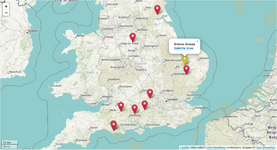
Now, looking at mainstream hints that we were eaten. First, let's orient ourselves to the locations mentioned in this post:

Butchery sites map.png
Clockwise from top:
You may get more out of this post if you are familiar with Sibved's conjecture that hillforts were slurry processing sites for quarried material. Eg:
There are many more similar articles here and here.

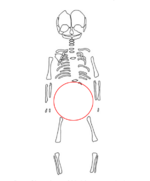
Moving on, we've met this little fellow before. In post-103162:

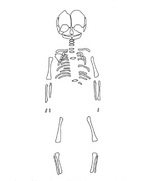
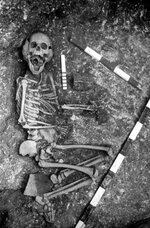
Hambleden baby remaining skeleton.png
Yewden, Hambleden's most famous butchered baby embryotomy. Source

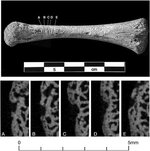
He owned this femur:

Hambledon 38 cut marks-002.jpg
Yewden baby femur showing five cut marks. Source

Notice anything missing?

Here's a hint:
clue_Hambleden baby remaining skeleton.png

He's not the only young male in Britain to lose his ass:
Download Video

Male pelvis found at Danebury Hill Camp. Source: Mystic Britain Human Sacrifice S01 Ep07

Rump steak never goes out of fashion.

Also found at Danebury Hill Camp were pits containing 25 human skeletons. That was quite a find because Iron Age bodies are hard to come by:
Download Video

"We don't know where they were disposed of or how." Source: Time Team Carsington, Derbyshire S10 Ep03

And:
Download Video

Human 'sacrifice' at Iron Age Danebury Hill Camp. Source: Mystic Britain Human Sacrifice S01 Ep07

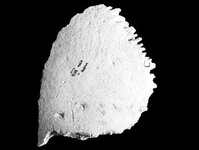
Looks like something was eating them. A few miles west of Danebury Hill Camp is Battlesbury Camp, where these were found:

Canid gnawed parietal -034.jpg
Fang puncture marks on human baby skull. Source

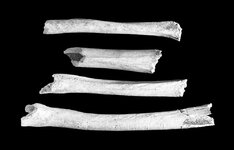
Gnawed human bones -035.jpg
Gnawed human bones. Battlesbury Camp. Source

Dr Stephanie Knight analysed Danebury Hill Camp's many animal bones to find out what they say about Iron Age butchery. In Butchery and Intra-Site Analysis of Animal Bone - A Case Study from Danebury Hillfort - Hampshire - England.pdf, she concluded the two most common methods of slaughtering animals were:
  • Poleaxing (hitting the animal on the head)
  • Sticking (cutting the animal's throat - only detectable if the butcher nicks the hyoid bone)
And the common signs of subsequent butchery are:
  • Decapitation (Cutting off the animal's head)
  • Removing (and discarding) the animal's feet
  • Skinning marks (cut marks on the animal's bones)
Fair enough. Let's apply these indicators to the human remains found at Britain's ancient sites and see what they tell us.

This fellow was about ten when he died at Battlesbury Camp Iron Age fort:

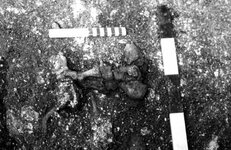
ten year old in pit -012.jpg
Battlesbury Camp ten year old, pit 4332. Source

His big grin is fake - the back of his head appears to have been cracked open. Found with him were the stone seen next to his left shoulder, another stone near his hips, various animal bones. And another person's foot:

pit 4332 intact foot bones -013.jpg
Discarded right foot, pit 4332, Battlesbury Camp. Source

Pretty much every photograph and inhumation diagram in the Battlesbury paper shows a cracked skull. Check this double adult find in Battlesbury's pit 4223:

Dual inhumation pit 4223.png
Two humans with cracked skulls, pit 4223, Battlesbury Camp. Source

Maybe they were poleaxed. Or maybe brains were a delicacy. From: The Vintage News about Jamestown, Virginia, USA:
summer of 2012 that historians made a disturbing discovery. In a hole that also contained butchered horse and dog skeletons, they found a body of a fourteen-year-old English girl, who died in the winter of 1609.
...
The young girl found in 2012 was one of the victims of starvation. Researchers discovered strikes at the back of the girl’s head—apparently an effort to reach her brain tissue, the most desired part.

Given the problems with chronology and radiocarbon dating, and the evidence for the destruction of Pompeii in 1631, there's no reason to believe Britain's "Iron Age" events occurred very much earlier than 1609.

No point in looking for sticking - Knight's second slaughter indicator - because bloodletting doesn't leave scars. Collection troughs are the evidence most likely to be found. Possibly associated with offal collection. For reference, here's what bloodletting looks like in a modern abattoir:

Download Video

Bloodletting stunned pigs. Source: AMI Tour of a Pork Plant

Do we find evidence for post-slaughter human butchery? Starting with Knight's first indicator: decapitation?

We do:
Download Video

Decapitation evidence from unidentified site 13 miles from Maiden Castle hillfort. Source: Mystic Britain Human Sacrifice S01 Ep07

They also found animal bones in this 'burial' pit. Many human 'burials' are mixed with animal bones. This one was particularly ornate. The osteo says this kind of 'sacrifice' occurred every 20 years. They can't date bones with anything like that level of precision. So that information comes from unidentified sources, or it's a fabrication.

Other human decapitation sites:
OK. Is there any evidence of human feet being removed other than the Battlesbury pit 4332 find shown earlier?

Yes.

From page 97 of the Battlesbury paper:
Articulated bones, representative of redeposited, partial skeletons (such as the articulated foot from pit 4332) have been reported from several Iron Age sites. A ‘burial’ from Stanton Harcourt, Oxfordshire was recorded as having been ‘dismembered’; only the foot bones remaining articulated and placed over other disarticulated elements.

In other words, low-meat/high-bone body-parts like human feet, were discarded intact. Ie, they offer a low return-on-investment for further butchery. But no problem - give the dog a bone...
  • Discarded feet are associated with animal butchery at Battlesbury and Stanton Harcourt.
  • Discarded feet are associated with so-called human burials at Battlesbury and Stanton Harcourt.
Animal forelegs are also often found mixed with human remains. From page 55 of Knight's Butchery and Intra-Site Spatial Analysis of Animal Bone: A Case Study From Danebury Hillfort, Hampshire, England:
A late Iron Age pit at Flagstones (Dorchester), in which was deposited an adult skeleton and infant skull, also contained articulated cattle and horse limbs (Hill 1995a: 121). The distinction between pits and burials appears to merge here, and articulated animal limbs and human remains are commonly found in pits at Danebury.

And from page 275:
Individual graves in Iron Age cemeteries in East Yorkshire (probably a reference to the Walkington Wold 'execution cemetery' site) often contain the remains of animal parts (Stead 1991). It is uncertain whether these parts could represent habitual meat ‘cuts’, or a specific funerary rite either as a sacrifice or a funerary meal. The parts include whole pig forelimbs and so do not correlate with the butchery patterns from Danebury, which show disarticulation at all joints on the leg.

In other words, human and animal parts that were inefficient to fillet (to disarticulate) were discarded 'buried'. If they were animal, it's called 'butchery'. If they were human, it is called 'sacrifice' or even 'ritual acts of rational violence'.

Do we have evidence of cut marks caused by skinning or disarticulation? Besides the Hambleden baby, the two missing pelvis finds, and discarded feet, that is?

Cut marks, a few. Hack marks, plenty.

Iron Age animal butchery shows few cut marks on bones. So few cut marks, in fact, that when they are found they are interpreted as evidence of an inexperienced butcher. Experienced butchers took bodies apart the easy way - at the joints - usually leaving no marks at all. Presumably to preserve their blade edges.

Download Video

Source

When humans are found hacked up, the hack locations suggest less meaty parts were being removed:
Download Video

A bizarre prehistoric practice. Source: Time Team Carsington, Derbyshire S10 Ep03

Download Video

Source: Time Team Carsington, Derbyshire S10 Ep03

Time Team's Carsington cave dig found 26 identifiable individuals, 12 of them babies, eight of which were newborns. From Time Team at Carsington caves:
Download Video


"Isn't this weird!". Source: Time Team Carsington, Derbyshire S10 Ep03

(There's a visual gag at the end. When Alice Roberts says "That is part of a child's skull again", the editors cut to a shot of Tony Robinson's head.)

And there's more. From Bodies, Bones, Objects and Stones: Investigating Infancy, Infant Death, Deposition and Human identity in Iron Age Southern England, Michael Lally, page 253:
The archaeological record for Iron Age southern England demonstrates that acts of violence were not limited to adult bodies alone. Evidence exists to show that children were treated in similar ways. Direct evidence for this has been found at Viables II (Jay’s Close) in Hampshire, where infant deposition L1037, a six to seven month old, had been intentionally split in half from the head to the groin, either resulting in death or at some point soon after death (Baxter and Duhig 2004, 24).

A similar example was reported at Wandlebury, where the remains of a dismembered six year old child were found (Hartley 1957; Cunliffe 2005, 573; Green 1998; 2002, 53-54). Here, analysis suggested that the child had had his legs ‘hacked off’ before being deposited in a pit feature. A second, ‘drastically mutilated’ (Hartley 1957, 15) deposition was also uncovered in another of Wandlebury’s pits. This took the form of an adult female, whose head lay apart from her trunk and whose femurs had been deliberately broken off a few centimetres below the pelvis.

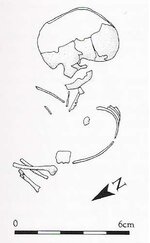
A sketch of the halved baby found at Jay's Close:

halved baby parts missing -024.jpg
Note only a fragment of its pelvis remains. Source

Why would you split a baby in half?
Download Video

Making bacon. Source: AMI Tour of a Pork Plant

Maybe the baby was shared between two diners.

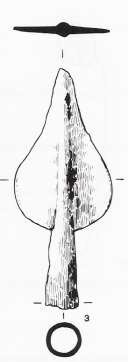
This is the so-called 'spear head' that was found alongside the remaining half:

spearhead or rotisserie head -022.jpg
Source

For the hunted, this 'spear' tip's rounded base would make it easy to remove. This looks more like the tip of a rotisserie paddle - a tool for holding a joint above a fire without the carcass slipping when the rotisserie is turned.

It's not the only tool from the past that doesn't look like a good fit for its described use. Take chainmail. From Chain mail - Wikipedia:
Its invention is commonly credited to the Celts

From Medieval Life and Times:
Shirts made of Chain Mail Clothing weighed up to 25 kilograms, depending on the size and the number of Chain Mail Clothing garments worn.

How did soldiers stay mobile through battles with hand-carried weapons while wearing up to 25kg (60 lbs) of chainmail? Especially when chainmail doesn't even protect its wearer from arrows:

Download Video

Arrows penetrate chainmail. Source and Lars Anderson archery clip in post-106374

From Boyac.com:

Paco-Rabanne-Unwearable-dress.png
Paco Rabanne Unwearable dress, 1966. Source

So chainmail appears impractical for its most well-known purpose as medieval Kevlar. But chainmail is still used today for its less well-known purpose. From Boyac.com:
Going to buy meat from your local butcher, you may have seen them with a chainmail apron or chainmail gloves used a protective gear.

Download Video

Apron and chainmail. Source: AMI Tour of a Pork Plant

So, does mainstream media offer us any hints about what was butchering us? And what was eating us?

Like Grimes Graves, Carsington cave is on the site of a quarry. First lead, then limestone. 400m away is the remains of a barrow mound.

Just as in the cave, Time Team found human bones buried in the barrow:
Download Video

"The barrow serves the community in the next valley". Source: Time Team Carsington, Derbyshire S10 Ep03

Serves the community to whom? Or what?

From Walkington Wold burials - Wikipedia:
Such barrows were thought to be the haunt of dragons, goblins and the like

And from Polly Hewat's retelling of the Lincolnshire tale of Sir Hugh Barde:
In the 12th century the countryside was plagued by this [dragon], who captured and ate the people of Castle Carlton.
...
The dragon's lair was empty, except for a pile of bones and a heap of skulls, the beast itself being several miles from home, digesting two men and a child which had been its dinner.

Or take Ludham, Norfolk, famous to folklorists for its dragon, which harried residents from numerous tunnels under the village. Ludham also has tales of a quarrying Devil, who digs deep pits and spills gravel as he carries the tailings away. The killing of Ludham's dragon was reported on page two of the Norfolk Chronicle on Saturday, September 28th, 1782:
On Monday the 14th inst. a snake of an enormous size was destroyed at Ludham in this County by Jasper Andrews of that place. It measured 5 feet 8 inches long, was almost 3 feet in circumference and had a very long snout. What is remarkable there were two excrescences on the forepart of the head which very much resembled horns. The creature seldom made its appearance in the day time but kept concealed in subterranean retreats, several of which have been discovered in the town, one near the bake-office and another on the premises of the Revd. N. V. Jeffrey and another in the land occupied by Mr. Popple at the Hall.

Carsington cave's layout is intriguing:
Download Video

Layout of Carsington warren burrow cave. Source: Time Team Carsington, Derbyshire S10 Ep03

Let's listen to the first part of that clip again:
Download Video

"You have to be a worm." Source: Time Team Carsington, Derbyshire S10 Ep03

From The Hearse Song:
The worms crawl in. The worms crawl out.
They crawl in thin and they crawl out stout.

But worms don't fill wormholes with human bones. Maybe the explanation lies in the fact that 'worm' can mean 'monster', serpent' and 'dragon'.

Time Team's Carsington episode also contained this uncommented two-second sequence showing a limbless skeleton:
Download Video

Source: Time Team Carsington, Derbyshire S10 Ep03

Maybe it was a visual gag - the thing doesn't look much good at scrabbling through rocks. And it's easy to ignore folklore. Until you see some of the reconstructed faces from Carsington cave:
Download Video

Not your ordinary garden gnome. Source: Time Team Carsington, Derbyshire S10 Ep03

Originally, both the barrow and the terrain around the cave were raised so both locations were visible on the skyline. They were easy to find.

Download Video

Feeding the dragon: a how-to. Source: Time Team Carsington, Derbyshire S10 Ep03

A sacred space. A circular area into which human bodies may be brought.
...
You may even come along and pick up the big bones.

Not having a worm, serpent, dragon or goblin to hand, I asked the Internet for help:

Download Video

"A sacred space. A circular area into which body parts may be brought."
 
Last edited:
Great post.

Tangential to your post, in some of the clips, they are saying that they are surprised that they do not find more 3000 year old bones.

"Despite an iron age population of over 1 million archaeologists have found just a handful of complete burials"
(from "Human 'sacrifice' at Iron Age Danebury Hill Camp. Source: Mystic Britain Human Sacrifice S01 Ep07")

I am struggling with this idea of being able to find bones from the Iron age. Bones decompose, right? When I dig in the ground, I do not often find bones of animals. However, I did find a hip bone on an allotment once, presumably from a cow - it was going to dust and had a pumice stone feel. It was a different thing to bones we see when we buy meat at the butchers. And this is entirely expected! If they are in the ground, even if left uneaten by animals, there are still microbes, fungus, insects, etc. And in a damp place like the UK, the moisture would also break them down. Surely it would be the rule that there would be 'no bones' after 3000 years; that bones would only be found in highly abnormal circumstances.

Fwiw, this is wikipedia's take - Skeletonization - Wikipedia:
In a temperate climate, it usually requires three weeks to several years for a body to completely decompose into a skeleton, depending on factors such as temperature, humidity, presence of insects, and submergence in a substrate such as water. In tropical climates, skeletonization can occur in weeks, while in tundra areas, skeletonization may take years or may never occur, if subzero temperatures persist. Natural embalming processes in peat bogs or salt deserts can delay the process indefinitely, sometimes resulting in natural mummification.
After skeletonization, if scavenging animals do not destroy or remove the bones, acids in many fertile soils take about 20 years to completely dissolve the skeleton of mid- to large-size mammals, such as humans, leaving no trace of the organism. In neutral-pH soil or sand, the skeleton can persist for hundreds of years before it finally disintegrates. Alternately, especially in very fine, dry, salty, anoxic, or mildly alkaline soils, bones may undergo fossilization, converting into minerals that may persist indefinitely.
This seems right to me - that after 20 years you would be unlikely to find skeletons. Perhaps they would last longer if covered by lots of mud unexpectedly.

This must be close to your thinking too:
Given the problems with chronology and radiocarbon dating, and the evidence for the destruction of Pompeii in 1631, there's no reason to believe Britain's "Iron Age" events occurred very much earlier than 1609.

Anyway, whatever it is they are finding and we are talking about, it seems to me to be in the recent past - just a few generations ago.
 
Last edited:
Tangential to your post, in some of the clips, they are saying that they are surprised that they do not find more 3000 year old bones.

Anyway, whatever it is they are finding and we are talking about, it seems to me to be in the recent past - just a few generations ago.
Working through this material, I sometimes wonder if the Props Department is on the scene. Bones lasting 3,000 years in England's damp soil is a bit humerus.

Another interesting moment in Time Team's Carsington episode was this one about the skull find that gave 'Yorick' chamber its name:
Download Video

"Stalagmites don't grow overnight". Source: Time Team Carsington, Derbyshire S10 Ep03

They don't necessarily need thousands of years either:

limestn_cwby453.jpeg
Not your everyday butchered foot. Image source

From: How Fast Does Stone Form? (Russian) (English), which seems to have used images from 'The Limestone Cowboy'.
 
Last edited:
Im not very well read in this theseis, but have you lot found anything about The Guild, The mans choire 🧱 etc. when studying this topic?
 
There are tunnels under Stamford (England). See Secrets of Stamford School and Secret tunnels.

The thing with tunnels under universities is that the illuminati have their secret soldier programs, of course in league with negative aliens, as well as other programs, mkultra etc, that they want to keep hidden from the public. Hence the secrecy.

You can read Andy Pero's story in Project Superman, A "Victim" of the illuminatis Super-Race Projects & Montauk Experiments Speaks Out. He says he was regularly taken into a secret room in the university, which no one knew about. Here's a short Interview with Andy Pero, Montauk 'Superman' Programming Victim. And of course there would be secret tunnels...elevators that go deep into the ground.

Then we have The Ruiner blog, an illuminati family born male who speaks out. Here, I'll excerpt a bit from his "Background" post.

"About a month after that I was taken to "Camp" for the first time. On the way to the "camp" my Grandfather started to explain how our family was not like other families. That he and my aunts and cousins were all "special" but my mother and father are not. He told me I am "special" like he is and therefor will be educated like the other "special" members of the family. That I would be shown "secrets" and I couldn't ever tell anyone.
It was not long after arriving that the first "secret" was revealed to me.
The "camp" was just outside of a town in Ontario Canada called Port Perry. The "camp" appeared to be a Bible Studies camp. A small campground with a handful of cabins all about the same size and a couple portables. One cabin was larger than the others and that is the one one entered.

My Grandfather moved a table from the middle of the room to a side, and told me to stand where the table was. He stood next to me with his arm around me and immediately I thought "why is he holding me so tight?". I received my answer when the floor began to sink into the ground below the cabin. Within a few seconds I saw that this floor was actually an elevator, and once it dropped below the level of the cabin floor we were in an elevator shaft that after about 20 feet revealed glass walls that provided a view into what was a very large area which looked like the inside of a warehouse. This was my first view of what is now known to most reading this as an Underground Base."


Illuminati, religion, politics and money are all connected to alien interference into our world. If you would like, I could link you to a video (or more) about how the aliens are involved in the super soldier and etc situations.
Oh and I forgot to mention, the medico society, and of course the laboratory of scientists that work hand in hand with it. I was always wondering about that bloodletting they use to do, how it just made no sense. But now it does. And this link, with a not pretty picture of bloodletting from Sweden in 1918.

And why would they call the movie the "Red Dragon"?
Wikipedia: "Hannibal Lecter is a serial killer who eats his victims. Before his capture, he was a respected forensic psychiatrist."


"A true hog..." of, what did he say?
 
Last edited:
The thing with tunnels under universities is that the illuminati have their secret soldier programs, of course in league with negative aliens, as well as other programs, mkultra etc, that they want to keep hidden from the public. Hence the secrecy.

You can read Andy Pero's story in Project Superman, A "Victim" of the illuminatis Super-Race Projects & Montauk Experiments Speaks Out. He says he was regularly taken into a secret room in the university, which no one knew about. Here's a short Interview with Andy Pero, Montauk 'Superman' Programming Victim. And of course there would be secret tunnels...elevators that go deep into the ground.

Then we have The Ruiner blog, an illuminati family born male who speaks out. Here, I'll excerpt a bit from his "Background" post.

"About a month after that I was taken to "Camp" for the first time. On the way to the "camp" my Grandfather started to explain how our family was not like other families. That he and my aunts and cousins were all "special" but my mother and father are not. He told me I am "special" like he is and therefor will be educated like the other "special" members of the family. That I would be shown "secrets" and I couldn't ever tell anyone.
It was not long after arriving that the first "secret" was revealed to me.
The "camp" was just outside of a town in Ontario Canada called Port Perry. The "camp" appeared to be a Bible Studies camp. A small campground with a handful of cabins all about the same size and a couple portables. One cabin was larger than the others and that is the one one entered.

My Grandfather moved a table from the middle of the room to a side, and told me to stand where the table was. He stood next to me with his arm around me and immediately I thought "why is he holding me so tight?". I received my answer when the floor began to sink into the ground below the cabin. Within a few seconds I saw that this floor was actually an elevator, and once it dropped below the level of the cabin floor we were in an elevator shaft that after about 20 feet revealed glass walls that provided a view into what was a very large area which looked like the inside of a warehouse. This was my first view of what is now known to most reading this as an Underground Base."


Illuminati, religion, politics and money are all connected to alien interference into our world. If you would like, I could link you to a video (or more) about how the aliens are involved in the super soldier and etc situations.
Oh and I forgot to mention, the medico society, and of course the laboratory of scientists that work hand in hand with it. I was always wondering about that bloodletting they use to do, how it just made no sense. But now it does. And this link, with a not pretty picture of bloodletting from Sweden in 1918.

And why would they call the movie the "Red Dragon"?
Wikipedia: "Hannibal Lecter is a serial killer who eats his victims. Before his capture, he was a respected forensic psychiatrist."


"A true hog..." of, what did he say?

Tunnels rumored between Brookhaven Lab (an operation paperclip research node on Long Island NY) and Montauk.

Universities? Told there is a tunnel under San Francisco Bay between Stanford and Cal Berkeley.
 
Tips
Tips
Please respect our Posting Rules.
Back
Top