Evidence humans were created and traded as slaves, food, entertainment and material resources (IHASFEMR)

This makes me think of the hypnosis techniques developed by Milton Erickson:

"A famous example of using resistance and a “double bind” occurred when Erickson was a boy. One day Erickson was helping his father coax a stubborn calf into the family barn. Try as they might to pull the calf into the barn, it didn’t budge. He realized that the calf wished to resist, accepted it, and pulled the opposite end on it’s tail – away from the barn. The new input of the boy pulling on the tail negated the father pulling on the head and the calf went into the barn. He used this as a classic psychological example of a double bind – where the subject becomes overwhelmed and is emotionally “pulled” in two conflicting directions. Thus, the confused individual successfully accepts one form of resistance and fails to respond to the other."

Note that the calf will sooner or later be eaten.

It is a little unusual to read this post today, because not two hours ago I was sitting at home in front of the fire when I heard someone banging on the door. I opened it, expecting to see my girlfriend home early or perhaps the neighbor asking for another onion. Instead I saw two cops, just like in the movies, brandishing badges. "Polizei. What is your name?" barked the man in front of me without saying hello. Short-circuited by this completely unexpected question and situation, I told him my name like a programmed automaton without thinking to inspect the badge. If he had asked me to empty my pockets, take off all my clothes, or bark like a dog, I probably would have done it without even knowing what I was doing. That is a humiliating thing to realize. I mention the badge inspection because this happened to me once before, in France, except the two "cops" were actually actors filming a hidden camera prank. One of these two cops was a "sexy lady cop" whose badge turned out to be an obvious plastic fake. Although I saw it, I was incapable of perceiving it until I had already been apprised of the deception, at which point I realized how obviously fake the setup was. In both cases there were two cops who alternated rapid-fire questions (although I suspect one cop would be enough to do the trick). There is a reason they use the "good cop/bad cop" routine to bully people. It turns out today's cops were looking for the guy on the floor below me. I have not done anything particularly illegal recently, but as both Kafka and Freud point out, we are all inherently guilty before the Law whether or not we have actually done anything wrong. One of the ways governments force compliance is by making the Law subtly or explicitly self-contradictory so that no matter what one does, one is always guilty of SOMETHING. Ultimately, legal "authority" is not grounded in some political or philosophical necessity as we learn in school but in the pre-installed feeling of shame that is inevitably activated when we are faced with avatars of Power. Or to put it in the language of this thread, the Law is just the elaboration of a mechanism, the loyalty loop, which exists solely to trap prey. It is a pure sadism-masochism hypnotic program, in my opinion, one that I now believe has been installed on purpose, thanks in large part to Usselo's work. Freud argued that criminals are, as a general rule, masochists who are unconsciously convinced of their own infinite existential guilt. As a result, they tend to seek out opportunities to be caught and punished; having their chronic free-floating, objectless guilt transformed into a concrete accusation, for a concrete crime, associated with a concrete punishment, is the only way for them to "contain" and metabolize this original "transcendental" guilt and shame.

Here are the last two paragraphs of Kafka's "The Trial". For those unfamiliar with the classic novel, it begins with the protagonist, K, being arrested without explanation. We then follow his absurd and confusing journey through the incomprehensible legal machine, which ends with him being executed, having never understood what the charges against him were. Notice again we have two executioners who engage in a hypnotic back-and-forth ritual.

Then one of the gentlemen opened his frock coat and from a sheath hanging on a belt stretched across his waistcoat he withdrew a long, thin, double-edged butcher's knife which he held up in the light to test its sharpness. The repulsive courtesies began once again, one of them passed the knife over K. to the other, who then passed it back over K. to the first. K. now knew it would be his duty to take the knife as it passed from hand to hand above him and thrust it into himself. But he did not do it, instead he twisted his neck, which was still free, and looked around. He was not able to show his full worth, was not able to take all the work from the official bodies, he lacked the rest of the strength he needed and this final shortcoming was the fault of whoever had denied it to him. As he looked round, he saw the top floor of the building next to the quarry. He saw how a light flickered on and the two halves of a window opened out, somebody, made weak and thin by the height and the distance, leant suddenly far out from it and stretched his arms out even further. Who was that? A friend? A good person? Somebody who was taking part? Somebody who wanted to help? Was he alone? Was it everyone? Would anyone help? Were there objections that had been forgotten? There must have been some. The logic cannot be refuted, but someone who wants to live will not resist it. Where was the judge he'd never seen? Where was the high court he had never reached? He raised both hands and spread out all his fingers.

But the hands of one of the gentleman were laid on K.'s throat, while the other pushed the knife deep into his heart and twisted it there, twice. As his eyesight failed, K. saw the two gentlemen cheek by cheek, close in front of his face, watching the result. "Like a dog!" he said, it was as if the shame of it should outlive him.


First, I believe that great artists are in contact with universal fantasies, experiences and memories, and I think it is possible that Kafka is here channeling a real collective trauma, that of submitting voluntarily to sacrifice by blade. Note also that the "ontological" feeling of shame is so strong that over the course of the novel the main character never once really questions whether or not he deserves what is happening to him. He just accepts it. It has been suggested here at IHASFEMR that the mechanism by which victims are tricked into self-sacrifice is religious exaltation. I would like to suggest that shame may be just as effective a means of pushing human cattle to offer themselves as literal food for their masters. Or even better, by creating two irreconcilable poles (shame and exaltation) between which the individual is made to cycle with no possibility of resolution, a "gap" is opened into which pure, naked, sadistic authority can be poured. Look at the paradox of Protestantism, for example. Grace cannot be "purchased" through either indulgences or good works. One either has divine grace or one does not and nothing can change that. You can't "buy" your way into Heaven. One would think that a theology like this would lead people to live apathetically or even anarchistically, but the contrary is true. Since there is no external mechanism in place to guarantee whether one has been saved or not (such as the blessing of a Catholic priest, corrupt or not), Protestants lose themselves in rule-following and virtue-signaling paroxysms. They have to, because they are trying to prove to themselves that they are saved, not to an institution limited by rules and traditions. Obviously they will never encounter any guarantee, so they must continue until they exhaust themselves in orgies of gratuitous morality and finally die. It's a much more clever mechanism for creating self-farming animals than, for example, Catholicism. Perhaps this Protestant logic could be described as not just a loyalty loop, but a triple octane self-catalyzing loyalty spiral. There is a reason the Northern European countries are so excited about the new Green Slave System: it is just Protestantism 2.0 with The Climate in the place of God. Make no mistake, many of the Germans who are freezing at home right now are pleased as punch that they have this new opportunity to prove to themselves and each other how good they are (not to mention the even more exciting opportunities for snitching it presents). The supplicants are (probably) not going to be eaten this time, but the demand from Power is the same as it always was: SACRIFICE YOURSELF. Actually, I do find convincing the theory that disembodied entities feed on energy released through suffering and death, and suspect that the "human on human" (or "unknown chimerical biological entity on human") cannibalism so horrifically detailed here is more a case of humans imitating gods than humans simply indulging in forbidden gourmandise. In other words, cannibalism has a "cargo cult" element since the disembodied "gods" never actually ate the flesh, as ancient texts make clear, just the energy. (This also explains why the Covid measures were more nakedly authoritarian in Catholic Europe. They had to be, since Catholics still function within an external loyalty loop paradigm rather than an internalized loyalty spiral. They need to be beaten every once in a while, otherwise they will cheat. Hence also the constant anti-Catholic propaganda: the NWO control grid is fundamentally Protestant in its functioning in that it is self-policing, masochistic, and horizontal, with very few priests necessary, whereas the older, more sadistic Catholic control structure depends on a hierarchy of priests that always risk being lured into venal corruption.)

There is also the hypnotic technique known as "anchoring", in which the would-be hypnotist presents two options to the target ("Do you want to eat at McDonald's or Burger King?") in order to lock him into a false binary choice and most of all, to subtly establish dominance. Abusive spouses alternate tenderness and violence to create a bond of complete hypnotic dependence. Derrida's "deconstruction" technique starts from the idea that all texts are structured around more or less hidden "binary oppositions" that subtly hypnotize the reader into identifying with the point of view of the author, which can also be seen as a form of submission. By finding and exploding these false "anchored" oppositions the reader is released from the tyranny of the author. (My endorsement of the deconstruction technique ends there because ironically, Derrida used this constant undermining of all pretension to objective signification to establish his own guru-like authority over his untethered followers.)

Usselo, moderators, I hope this post does not digress too far from the topic of loyalty loops in the context of IHASFEMR, if so I will move it elsewhere.
Like I stated in a different thread, I'm more of the mind that humans have an innate need for veneration. This might be expressed as loyalty or respect (as lesser forms of worship, though outright fanaticism is becoming more common) and causes issues when different targets of their veneration come into conflict. Of course, since it is intrinsic to humans, it's easily exploited by those who understand the mechanism. We are taught to venerate our "heroes," our (s)elected leaders, specific diversions, and the cultural icons of our day, almost straight out of the womb. Obviously this is an issue, as it requires an expenditure of our personal resources - be they physical, mental, or more metaphysical in nature (such as time or emotional energy), which leaves us vulnerable to more influences and with a decreasing (or outright obviation of) ability to avoid becoming trapped in loyalty loops or binaries.

Also, in order to be hypnotized or mesmerized, one has to allow themselves to be by willingly giving up their focus and attention. Given the amounts of well...everything, blaring at us at all times in all spheres of our lives, our focus and attention cannot hold - unless we keep our eyes on a singular goal or purpose. It's nigh impossible given the state of things. Regardless of one's personal views on religion, one has to respect that The Bible basically hammers that point home all throughout it, albeit to venerate God and stay focused on Him, as doing so prevents one from befalling many issues. But we can even step away from religion, and look at the old adage: "If you don't stand for something, you'll fall for anything." If we venerate everything like we are taught to do, a quality that should be a strength and provide personal conviction is reduced to an exploitable weakness that will eventually result in an internal conflict, leaving us even more at the mercy of those who would exploit us.
 
“…our descendants will experiment and succeed. An impersonal generation will take the place of Nature’s hideous system. In vast state incubators, rows upon rows of gravid (pregnant) bottles will supply the world with the population it requires. The family system will disappear; sapped at its very base, will have to find new foundations; and Eros, beautifully and irresponsibly free, will flit like a gay butterfly from flower to flower through a sunlit world”. Mr Scogan discussing the goddess of Applied Science and how it has the means of dissociating love from propagation, CH 5 of Crome Yellow (1921) by Aldous Huxley.
 
so if "they" have the knowledge to make "intelligent" slaves (how did that work out for them? LOL)
to mine stuff, how come they could not stabilize matter from lets say, plants, to turn into whatever they needed
the highly technological "intelligent" slaves to mine for them?

they can make man and woman, but can't turn coals into diamonds or led into gold?
 
so if "they" have the knowledge to make "intelligent" slaves (how did that work out for them? LOL)
to mine stuff, how come they could not stabilize matter from lets say, plants, to turn into whatever they needed
the highly technological "intelligent" slaves to mine for them?

they can make man and woman, but can't turn coals into diamonds or led into gold?

For what its worth - our civilization can grow human fetuses in cows, and create (though relatively unsuccessfully) human animal hybrids - but so far haven't touched turning lead into gold.

I get what you are saying, but you are comparing apples and oranges when it comes to scientific endeavors.
 
For what its worth - our civilization can grow human fetuses in cows, and create (though relatively unsuccessfully) human animal hybrids - but so far haven't touched turning lead into gold.

I get what you are saying, but you are comparing apples and oranges when it comes to scientific endeavors.

hello,

physics and chemistry are like history, if you only go by what the academia accepts, you fail to get the full picture.

we can stabilize matter and turn it into gold, matter from plants for example, don't need led.
 
"create (though relatively unsuccessfully)"


For what its worth - our civilization can grow human fetuses in cows, and create (though relatively unsuccessfully) human animal hybrids - but so far haven't touched turning lead into gold.
macroevolution : Eugene M. McCarthy : Free Download, Borrow, and Streaming : Internet Archive

Eugene M. McCarthy, discussed previously, argues that humans are natural hybrids of simian and pig.

Chiron (before merging with Bayer) was a major biotech firm with the man/horse hybrid as its logo.

If their project was successful it is classified.
 
"create (though relatively unsuccessfully)"


macroevolution : Eugene M. McCarthy : Free Download, Borrow, and Streaming : Internet Archive

Eugene M. McCarthy, discussed previously, argues that humans are natural hybrids of simian and pig.

Chiron (before merging with Bayer) was a major biotech firm with the man/horse hybrid as its logo.

If their project was successful it is classified.

in the rabbinical literature, lots of the men and women associated with the tower of babel were turned into simian and pig.
 
I have been farming and ranching for most of my 75 years on this planet.
I have raised and butchered so many different kinds of animals for food.

A cow is raised for 12-16 months and weighs about 1200 pounds at the end. From that there is about 500 pounds of meat. The cost today is about $4 a pound if it is pastured and $7 if it is fed hay.

A goat is raised for 12 months and yeilds about 70 pounds at the end of its life. If fed hay it costs nearly $12 a pound.

A pig is raised for 6-8 months and a 350 pound pig yeilds about 220 pounds of meat. It is the cheapest animal to raise. The grain it is fed brings its cost per pound to about $2 now.

Now contrast that to a human
It weighs 7 pounds at birth and by 12 years old only reaches 100 pounds. 12 years of real food that costs much more than grass hay or grain means you feed a human about 2 pounds of food a day and pay about (today) 600 a year (conservatively) - that is $7200. The yield from a 100 pound child would be about 40 pounds. That is $72 a pound you paid. Feed them more and they get fat, make them work out to create muscles and that doubles the cost of the food.

People cannot eat the cheap foods that grow animals. They also have many times more illnesses and diseases to contend with.

When I was young I worked in child development and as a nutritional counselor. They are never content as children to stay in a pen or confined area and if they do they become lethargic and lose weight.

The hypothesis that people were raised for food, is very unlikely. Eating captives of conquered enemies, maybe, but not raising people for food. As a farmer, that just does not make sense.
There is a tendency in human nature to be attracted to the things that scare us. Books and articles that are shocking evoke fear and responses are not always reasoned and logical when that adrenaline starts running.
Cannibalism is one of those abhorrent possibilities that raise a specter of fearful possibilities -- But in this case I think it is highly unlikely.
 
I have been farming and ranching for most of my 75 years on this planet.
I have raised and butchered so many different kinds of animals for food.

A cow is raised for 12-16 months and weighs about 1200 pounds at the end. From that there is about 500 pounds of meat. The cost today is about $4 a pound if it is pastured and $7 if it is fed hay.

A goat is raised for 12 months and yeilds about 70 pounds at the end of its life. If fed hay it costs nearly $12 a pound.

A pig is raised for 6-8 months and a 350 pound pig yeilds about 220 pounds of meat. It is the cheapest animal to raise. The grain it is fed brings its cost per pound to about $2 now.

Now contrast that to a human
It weighs 7 pounds at birth and by 12 years old only reaches 100 pounds. 12 years of real food that costs much more than grass hay or grain means you feed a human about 2 pounds of food a day and pay about (today) 600 a year (conservatively) - that is $7200. The yield from a 100 pound child would be about 40 pounds. That is $72 a pound you paid. Feed them more and they get fat, make them work out to create muscles and that doubles the cost of the food.

People cannot eat the cheap foods that grow animals. They also have many times more illnesses and diseases to contend with.

When I was young I worked in child development and as a nutritional counselor. They are never content as children to stay in a pen or confined area and if they do they become lethargic and lose weight.

The hypothesis that people were raised for food, is very unlikely. Eating captives of conquered enemies, maybe, but not raising people for food. As a farmer, that just does not make sense.
There is a tendency in human nature to be attracted to the things that scare us. Books and articles that are shocking evoke fear and responses are not always reasoned and logical when that adrenaline starts running.
Cannibalism is one of those abhorrent possibilities that raise a specter of fearful possibilities -- But in this case I think it is highly unlikely.
Hi. Welcome to the site.

I took a week to read this thread and follow all the links when I joined. The premise is a bit shocking, but well supported.

The cannibalism would have started after a cataclysm as necessity. After necessity it seemed to be limited to the elite, as shown by tunnels from tavern to church and manor.
 
... and also, there is the fact that the food element can be considered as just one part of the design - there is also entertainment, work and other non-food resources. Humans are more useful than most animals and can turn their hands and minds to lot of different types of things - so, more akin to a of swiss army knife in terms of utility, of which 'food' is one element.
 
I have been farming and ranching for most of my 75 years on this planet.
I have raised and butchered so many different kinds of animals for food.

A cow is raised for 12-16 months and weighs about 1200 pounds at the end. From that there is about 500 pounds of meat. The cost today is about $4 a pound if it is pastured and $7 if it is fed hay.

A goat is raised for 12 months and yeilds about 70 pounds at the end of its life. If fed hay it costs nearly $12 a pound.

A pig is raised for 6-8 months and a 350 pound pig yeilds about 220 pounds of meat. It is the cheapest animal to raise. The grain it is fed brings its cost per pound to about $2 now.

Now contrast that to a human
It weighs 7 pounds at birth and by 12 years old only reaches 100 pounds. 12 years of real food that costs much more than grass hay or grain means you feed a human about 2 pounds of food a day and pay about (today) 600 a year (conservatively) - that is $7200. The yield from a 100 pound child would be about 40 pounds. That is $72 a pound you paid. Feed them more and they get fat, make them work out to create muscles and that doubles the cost of the food.

People cannot eat the cheap foods that grow animals. They also have many times more illnesses and diseases to contend with.

When I was young I worked in child development and as a nutritional counselor. They are never content as children to stay in a pen or confined area and if they do they become lethargic and lose weight.

The hypothesis that people were raised for food, is very unlikely. Eating captives of conquered enemies, maybe, but not raising people for food. As a farmer, that just does not make sense.
There is a tendency in human nature to be attracted to the things that scare us. Books and articles that are shocking evoke fear and responses are not always reasoned and logical when that adrenaline starts running.
Cannibalism is one of those abhorrent possibilities that raise a specter of fearful possibilities -- But in this case I think it is highly unlikely.
Thank you very much for that. From the horses mouth beats theory every time. Thanks again.
 
I have been farming and ranching for most of my 75 years on this planet.
I have raised and butchered so many different kinds of animals for food.

A cow is raised for 12-16 months and weighs about 1200 pounds at the end. From that there is about 500 pounds of meat. The cost today is about $4 a pound if it is pastured and $7 if it is fed hay.

A goat is raised for 12 months and yeilds about 70 pounds at the end of its life. If fed hay it costs nearly $12 a pound.

A pig is raised for 6-8 months and a 350 pound pig yeilds about 220 pounds of meat. It is the cheapest animal to raise. The grain it is fed brings its cost per pound to about $2 now.

Now contrast that to a human
It weighs 7 pounds at birth and by 12 years old only reaches 100 pounds. 12 years of real food that costs much more than grass hay or grain means you feed a human about 2 pounds of food a day and pay about (today) 600 a year (conservatively) - that is $7200. The yield from a 100 pound child would be about 40 pounds. That is $72 a pound you paid. Feed them more and they get fat, make them work out to create muscles and that doubles the cost of the food.

People cannot eat the cheap foods that grow animals. They also have many times more illnesses and diseases to contend with.

When I was young I worked in child development and as a nutritional counselor. They are never content as children to stay in a pen or confined area and if they do they become lethargic and lose weight.

The hypothesis that people were raised for food, is very unlikely. Eating captives of conquered enemies, maybe, but not raising people for food. As a farmer, that just does not make sense.
There is a tendency in human nature to be attracted to the things that scare us. Books and articles that are shocking evoke fear and responses are not always reasoned and logical when that adrenaline starts running.
Cannibalism is one of those abhorrent possibilities that raise a specter of fearful possibilities -- But in this case I think it is highly unlikely.
Great retort, however, it is given on the assumption that some outside source pays for the food a human eats. I’m reality, more often than not, humans go out and do what is needed to procure their own food, unlike other farm stock that we raise which rely on us to feed them.

The point that if you cage a human they become lethargic and lose weight does not take into consideration that the PLANET is our pen in this theory.

As stated by OP, this thread is a theory. That theory is based on a macro scale, when in comparison to this, even our biggest industrial farms do not begin to reach the size of our possible planet sized farm for human meat consumption. Your points are very good at proving human farming for consumption does not work in our current model of livestock farming, however, I believe they fall short when applied to a planet size scale.
 
Thank you very much for that. From the horses mouth beats theory every time. Thanks again.

There are specialty meats today that cost quite a lot to raise or catch. And the people who want that taste or that status will pay premium prices.
Examples would be the beer-fed Japanese cattle and rare or dangerous sushi fish.
 
The farming system that is in place today is a direct consequence of concentrating human beings into large groups where providing food and I must add water for themselves is impossible.
I have lived my entire life in the same town and have a ringside seat of this concentrating effort and the effects it has on all aspects of life, not least food and water provision.
As a boy there were no supermarkets in the town. There were three market gardens in the town boundary supplying vegetables mainly direct at the gate and to small shops in town.
Chickens seemed to be on every allotment that was under cultivation. There was at least a dozen sites of varying sizes full of allotments most as I recall were under cultivation.
There was a potato wholesaler, two fruit merchants, two dairies, bakeries, butchers, fishmongers, greengrocers, grocers, over forty co-op stores of all kinds, a thriving indoor and outdoor market.

The milk from the cows grazing the land that began at the edge of town and ran out into then hinterland was collected locally and processed locally. The animals were slaughtered at at two abattoirs within 13 miles of the town. The furthest out was adjacent to a cattle market where all the animals from the peninsular farms and the grains, cereals, a large proportion of the farmed vegetables and likely fruit were bought and sold. I do not recall any orchards in town or on the peninsular but I do recall groups of apple trees band pear/plum trees in gardens, on allotments and around farmhouses though no commercial sized orchards come to mind.

There was three Italian run ice cream manufacturers making ice creams from local milk for local consumption.
There was three retail/wholesale seed merchants and two feed merchants.

There was a brewery in the town and there were numerous springs none of which I recall being used for drinking water by people so the water for the town must have been coming from the reservoir system and the diverted streams that feed them as it does today.

The population of my youth was around 60,000 and according to the official count is still around 60,000 today.

As I progressed through my teenage years everything began to disappear. A supermarket arrived in the mid seventies and the direct result was all the wide variety of shops selling local produce and groceries etc from further afield began closing. Even the co-ops entered what turned out to be a prolonged period of closing shops down.
By the time I was married in 1987 I had been here for 27 years. All that was left of the former diversity was one market garden the allotment sites, though the number under cultivation was much less, the brewery though it to would shortly after go, the co-ops own dairy, bakery, pork factory. Roughly two thirds of the co-ops.
The abbatoirs and cattle market continued. Local milk was now being sent on a 100 mile journey for processing.
The indoor market was demolished and replaced with a pale shadow of its former self. Then outdoor market all but disappeared.
The amount of locally grown produce that stayed local diminished year on year.

Today next to nothing that is produced locally on farms, the market gardens have long been covered in roads and houses, is processed locally or sold locally. One farmer has a green grocer stall in the indoor market where he sells vegetables from his farm but half his stalls produce comes from wholesalers many miles beyond the peninsular.

The population peaked at 75,000 in the early eighties as the government ran all sorts of schemes to attract people to live in the town by creating jobs by giving business incentives, usually cash, to set up here. Since then it has been in decline to today where it is hovering at 60,000 and falling.

The population may be broadly similar so the concentrating effort I mentioned above doesn't seem to hold water but the town is very different. Everywhere I used to play as a boy and teenager has disappeared under housing estates. People that used to live in a house in extended families now seek to live apart from each other at the earliest opportunity.
Schools have been closing or shrinking for over forty years. Of the three schools I attended just one defies the housing estates and remains in use as a school.
The town centre went from roads and streets lined with shops, cafes, barbers, hairdressers, pubs, many pubs were run by local breweries including the one in town to an abomination of large units either purpose built in an arcade or by knocking two or three smaller shops into one.
It is an easy matter to walk the streets of the town and recall where shops once were out amongst the houses.

The big box stores joined the supermarkets and it is now their turn to begin closing and pulling out.
It is fair to say all but all the food consumed in this town of 60,000 be it in the home or in the business is trucked in from hundreds of miles away.

That is why industrial farming came into being. The state through its agents offered the people a way to behave differently and they lapped it up. Also the states constant devaluation of the currency helped enormously.

On YouTube there is a series of programmes called Jacks Country. They date from the eighties. The man presenting is Jack Hargreaves and he said something in one which struck me smack in the chops.
He said when he came back from the war in 1946 he did not recognise farming. All the labour had gone, some was trickling back out of the forces like he was but there was one change above the others that smacked him in the face. The horses were gone.
They had been replaced by petrol powered tractors in the thousands all sold to the United Kingdom government by the United States government.
In 1946 he watched a superb pair of shires win the last ploughing competition and the very next day the farmer sent them to the abbatoir to be turned into pet food.
Most farmers he said were happy to embrace the tractor as its running costs were lower than horses and their grooms and the tractor could keep going for longer hours and it was quicker than horses.
Around that time he said the farming landscape began changing as the hedgerows which are much more than field boundaries were being grubbed up by these tractors to increase the amount of cultivated area and make it even more economic for the usurpation of the horse by the tractor.
Farmers least all the ones I have known over the years concentrate on the bottom line above all else.

So to bring this ramble to some sort of end.
Over my 62 years of life in this town its people have gone from being able to be fed by and large from locally grown or locally produced produce to being 100% reliant on the articulated truck.
The population has fluctuated but not by much. The amount of children in the town has fallen through the floor. The older end people seem more or less stable the difference is in breeding age peoples behaviour. They are not having children at the same rate. They prefer to consume rather than procreate.
The available land for growing plants and animals on has shrunk and that shrinkage is accelerating as the town is now quite filled with houses so new estates are once again being built on gods farm land that industrial farming renders uneconomic to farm. And so the process rolls on.

Scale this up across this island and very very few towns cities and villages can feed themselves.
Not sure if all I have written has any bearing on the premise of the op but left to our own devices market gardening, orchards, agriculture, livestock farming, permaculture etc in other words small scale production for local consumption can easily feed the local population with highly nutritious food whilst providing highest quality water from springs and most importantly a beautiful environment to live life in.
Feed the soil is all we need to do but our individual and collective stupidity seems to be beyond bounds.

Edit to add;
The reason why the population has failed to concentrate is the town has since its arising in the early 1800's has always been dominated industrially by a large corporation. All incentives to get people here run by the government over my lifetime have collapsed into failure with the businesses that do turn up literally take the money and run, at an appropriate time. Decorum in all scams!

Today the biggest employer is the shipyard. It employs at least twice as many office people than tool using people, which is a fact that repeats in the towns second biggest employer the NHS. So in actual fact the towns two major employers are in truth one, the government. The shipyard is run by a government approved contractor and the NHS is a government run operation.

Private corporations are of no size in employment turns although collectively their employees outnumber the NHS employee level and maybe even the shipyards. Hard to get a handle on things.
The money spent in the town is overwhelmingly spent in supermarkets and big box national changes so it all goes out of town.
A proportion stays in the employees of these chains but then they to patronise their employers store along with the chains and supermarkets.
Its really a giant ponzi scheme in operation.
The two big employers are in a constant struggle to get employees and to hold on to them. They are always running recruitment campaigns and that problem has spread in recent years into all the lesser government departments located here.
The shipyard operator has responded by becoming the sponsor of all manner of educational establishments in the town. From infant, through primary, secondary to college all receive sponsorship from the shipyard in one form or another and all without exception drive their pupils in the direction of the shipyard as the best future career path on offer.
Naturally lots of these young people have no interest in jointing a shipyard so they tend to up sticks and leave the town as they pass out of college and onto university or employment.
This is why the population does not become more concentrated at first blush.
Despite these efforts by these employers the town population of people remains in churn but as I said the towns population of houses goes up at a pace.
 
Last edited:
The farming system that is in place today is a direct consequence of concentrating human beings into large groups where providing food and I must add water for themselves is impossible.
I have lived my entire life in the same town and have a ringside seat of this concentrating effort and the effects it has on all aspects of life, not least food and water provision.
As a boy there were no supermarkets in the town. There were three market gardens in the town boundary supplying vegetables mainly direct at the gate and to small shops in town.
Chickens seemed to be on every allotment that was under cultivation. There was at least a dozen sites of varying sizes full of allotments most as I recall were under cultivation.
There was a potato wholesaler, two fruit merchants, two dairies, bakeries, butchers, fishmongers, greengrocers, grocers, over forty co-op stores of all kinds, a thriving indoor and outdoor market.

The milk from the cows grazing the land that began at the edge of town and ran out into then hinterland was collected locally and processed locally. The animals were slaughtered at at two abattoirs within 13 miles of the town. The furthest out was adjacent to a cattle market where all the animals from the peninsular farms and the grains, cereals, a large proportion of the farmed vegetables and likely fruit were bought and sold. I do not recall any orchards in town or on the peninsular but I do recall groups of apple trees band pear/plum trees in gardens, on allotments and around farmhouses though no commercial sized orchards come to mind.

There was three Italian run ice cream manufacturers making ice creams from local milk for local consumption.
There was three retail/wholesale seed merchants and two feed merchants.

There was a brewery in the town and there were numerous springs none of which I recall being used for drinking water by people so the water for the town must have been coming from the reservoir system and the diverted streams that feed them as it does today.

The population of my youth was around 60,000 and according to the official count is still around 60,000 today.

As I progressed through my teenage years everything began to disappear. A supermarket arrived in the mid seventies and the direct result was all the wide variety of shops selling local produce and groceries etc from further afield began closing. Even the co-ops entered what turned out to be a prolonged period of closing shops down.
By the time I was married in 1987 I had been here for 27 years. All that was left of the former diversity was one market garden the allotment sites, though the number under cultivation was much less, the brewery though it to would shortly after go, the co-ops own dairy, bakery, pork factory. Roughly two thirds of the co-ops.
The abbatoirs and cattle market continued. Local milk was now being sent on a 100 mile journey for processing.
The indoor market was demolished and replaced with a pale shadow of its former self. Then outdoor market all but disappeared.
The amount of locally grown produce that stayed local diminished year on year.

Today next to nothing that is produced locally on farms, the market gardens have long been covered in roads and houses, is processed locally or sold locally. One farmer has a green grocer stall in the indoor market where he sells vegetables from his farm but half his stalls produce comes from wholesalers many miles beyond the peninsular.

The population peaked at 75,000 in the early eighties as the government ran all sorts of schemes to attract people to live in the town by creating jobs by giving business incentives, usually cash, to set up here. Since then it has been in decline to today where it is hovering at 60,000 and falling.

The population may be broadly similar so the concentrating effort I mentioned above doesn't seem to hold water but the town is very different. Everywhere I used to play as a boy and teenager has disappeared under housing estates. People that used to live in a house in extended families now seek to live apart from each other at the earliest opportunity.
Schools have been closing or shrinking for over forty years. Of the three schools I attended just one defies the housing estates and remains in use as a school.
The town centre went from roads and streets lined with shops, cafes, barbers, hairdressers, pubs, many pubs were run by local breweries including the one in town to an abomination of large units either purpose built in an arcade or by knocking two or three smaller shops into one.
It is an easy matter to walk the streets of the town and recall where shops once were out amongst the houses.

The big box stores joined the supermarkets and it is now their turn to begin closing and pulling out.
It is fair to say all but all the food consumed in this town of 60,000 be it in the home or in the business is trucked in from hundreds of miles away.

That is why industrial farming came into being. The state through its agents offered the people a way to behave differently and they lapped it up. Also the states constant devaluation of the currency helped enormously.

On YouTube there is a series of programmes called Jacks Country. They date from the eighties. The man presenting is Jack Hargreaves and he said something in one which struck me smack in the chops.
He said when he came back from the war in 1946 he did not recognise farming. All the labour had gone, some was trickling back out of the forces like he was but there was one change above the others that smacked him in the face. The horses were gone.
They had been replaced by petrol powered tractors in the thousands all sold to the United Kingdom government by the United States government.
In 1946 he watched a superb pair of shires win the last ploughing competition and the very next day the farmer sent them to the abbatoir to be turned into pet food.
Most farmers he said were happy to embrace the tractor as its running costs were lower than horses and their grooms and the tractor could keep going for longer hours and it was quicker than horses.
Around that time he said the farming landscape began changing as the hedgerows which are much more than field boundaries were being grubbed up by these tractors to increase the amount of cultivated area and make it even more economic for the usurpation of the horse by the tractor.
Farmers least all the ones I have known over the years concentrate on the bottom line above all else.

So to bring this ramble to some sort of end.
Over my 62 years of life in this town its people have gone from being able to be fed by and large from locally grown or locally produced produce to being 100% reliant on the articulated truck.
The population has fluctuated but not by much. The amount of children in the town has fallen through the floor. The older end people seem more or less stable the difference is in breeding age peoples behaviour. They are not having children at the same rate. They prefer to consume rather than procreate.
The available land for growing plants and animals on has shrunk and that shrinkage is accelerating as the town is now quite filled with houses so new estates are once again being built on gods farm land that industrial farming renders uneconomic to farm. And so the process rolls on.

Scale this up across this island and very very few towns cities and villages can feed themselves.
Not sure if all I have written has any bearing on the premise of the op but left to our own devices market gardening, orchards, agriculture, livestock farming, permaculture etc in other words small scale production for local consumption can easily feed the local population with highly nutritious food whilst providing highest quality water from springs and most importantly a beautiful environment to live life in.
Feed the soil is all we need to do but our individual and collective stupidity seems to be beyond bounds.

Edit to add;
The reason why the population has failed to concentrate is the town has since its arising in the early 1800's has always been dominated industrially by a large corporation. All incentives to get people here run by the government over my lifetime have collapsed into failure with the businesses that do turn up literally take the money and run, at an appropriate time. Decorum in all scams!

Today the biggest employer is the shipyard. It employs at least twice as many office people than tool using people, which is a fact that repeats in the towns second biggest employer the NHS. So in actual fact the towns two major employers are in truth one, the government. The shipyard is run by a government approved contractor and the NHS is a government run operation.

Private corporations are of no size in employment turns although collectively their employees outnumber the NHS employee level and maybe even the shipyards. Hard to get a handle on things.
The money spent in the town is overwhelmingly spent in supermarkets and big box national changes so it all goes out of town.
A proportion stays in the employees of these chains but then they to patronise their employers store along with the chains and supermarkets.
Its really a giant ponzi scheme in operation.
The two big employers are in a constant struggle to get employees and to hold on to them. They are always running recruitment campaigns and that problem has spread in recent years into all the lesser government departments located here.
The shipyard operator has responded by becoming the sponsor of all manner of educational establishments in the town. From infant, through primary, secondary to college all receive sponsorship from the shipyard in one form or another and all without exception drive their pupils in the direction of the shipyard as the best future career path on offer.
Naturally lots of these young people have no interest in jointing a shipyard so they tend to up sticks and leave the town as they pass out of college and onto university or employment.
This is why the population does not become more concentrated at first blush.
Despite these efforts by these employers the town population of people remains in churn but as I said the towns population of houses goes up at a pace.
Thank you for that piece of history. Very well said. I am sure there are nefarious reasons why TPTB wanted to separate families and change food distributions, but you put it in a time structure that really shows the long term process of change.
 
... and also, there is the fact that the food element can be considered as just one part of the design - there is also entertainment, work and other non-food resources. Humans are more useful than most animals and can turn their hands and minds to lot of different types of things - so, more akin to a of swiss army knife in terms of utility, of which 'food' is one element.
Humans can be trained to sit up straight, fight, speak different tongues, and to mask up on command.

Well, some (80/20 rule?) can be.
 
The hypothesis that people were raised for food, is very unlikely. Eating captives of conquered enemies, maybe, but not raising people for food. As a farmer, that just does not make sense.
There is a tendency in human nature to be attracted to the things that scare us. Books and articles that are shocking evoke fear and responses are not always reasoned and logical when that adrenaline starts running.
Cannibalism is one of those abhorrent possibilities that raise a specter of fearful possibilities -- But in this case I think it is highly unlikely.
This is very well put. I also don't think that humans were grown in order to be slaughtered like cattle or used as entertainment. There is no rendiment and incentives into it compared to the cost of managing billions of intelligent beings for the necessity of eating them or having fun with them.

Cannibalism might have happened in the past due to lack of food as a result of a possible cataclysm or reset and elites might still do it to this day, but it's not economic in the long run because if they (the controllers) would want a source of continuous protein supply, they'd simply grow cattle or cows, which are easier to manage and have far more protein yield per pound than a human. You don't need to lie to cows or invent political systems to make them develop in a certain way. You just need a lot of hail and a couple of dogs.

My idea about the controllers stems from the same TV show, "Westworld" which much of this thread relies on and the film "Jupiter Ascending".
If other people whom are better than us and are immortals is it because they might use human blood. Adrenochrome comes to mind and the stories about immortal vampires who drink fresh human blood.

Obviously they made the elixir of life in blue color, because if they'd showed it in bright red color, everyone would notice that it is human blood. It takes 100 refined humans to fill just one bottle. I highly think that this is exactly what's going on on planet earth. We're meant to be harvested every time our numbers reach the tens of billions I'm afraid. And we might be genetically modified for this purpose by other humans who consider us less than human, because genetically we're not 100% as them. Which it means legally that we're not human as them, we're hybrids, and as such the law which they might use, sees us as animals with a conscience but expendable because they need to live longer.

We're a product of some kind of corporation meant to be harvested and we are prohibited to leave this place called planet earth.
 
Last edited:
Thanks for the link.

...big iron ring mounted in the ceiling, a fireplace, and what looks like some sort of grill.

Yeah. :rolleyes:

I like how newspaper articles about tunnels downplay their purpose but hint there is more - much more - to them. And of them:
Simon has also discovered vaults hidden beneath a nearby hairdressers, a barber shop, and an estate agent.

He believes these crypts, which have been likened to those beneath 11th century Durham Cathedral, would’ve been part of a wider network of basements and tunnels dating back nearly 700 years.

Maybe it's a guided, slow-release of the IHASFEMR narrative. The unpalatable part of Disclosure.

Regarding the lack of profit from farming humans, as discussed above...

Humans have a unique bottom line: their unusual anatomies. Unusual human features enabled farmers to make profits that couldn't be made by farming other animals. I've begun to expand on the technology involved in this in the 'Away in a Manger' pieces on ihasfemr.net:
You can click on the first and, after that, just click on the 'Next' button at the end of each piece.

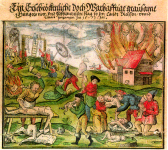
A couple more are simmering on the back-burner. This image had me puzzled for a long time:

Cannibalism_1571.png
Cannibalism in Latvia/Muscovy, 1571. Source: Human Cannibalism

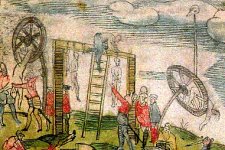
This detail in particular:
crucifix_wheels_on_poles.jpg

The construction of the pole on the right is a puzzle. I think I've finally got an understanding of the multiple purposes of the two wheels.

Researchers could do a lot on skin alone. I'm currently sorting out evidence human skin was supplied as vellum to Europe's 'ecclesiastic' colleges. That looks to have been a big business. I don't really go into the effect on profit margins of producing top-dollar vellum by farming hairless white primates instead of hairy primates who've been out in the sun and the wild. But hopefully the implications are obvious.

Also, showing the possible links between 'woad-painted' Celts, tattooing, The Pillow Book and living manuscripts you could cut up and keep. Remembering that souvenirs seem to have been popular with pilgrims. It's a challenge to illustrate that argument while keeping things family-friendly.

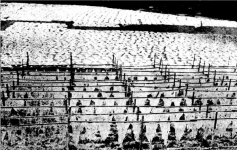
Researching The Skin Trade also led to the origins of placenames like Tenterden, Kent (and Tentercroft Street, Lincoln), among many others:

parchment_drying_in_havant_tenter_field.png
Parchment drying in a tenter field, Hampshire.

and placenames starting with 'Thorn' and 'Fern'. Which I'll get around to writing up at some point.

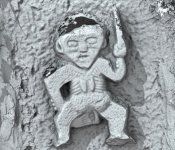
Several posts from earlier in this thread have been updated. Usually with maps and more imagery. They are in the IHASFEMR collection at ihasfemr.net. The two sheela na gig discussions are probably the most popular on the IHASFEMR site:
 
Last edited:
@usselo I read some of the articles you posted on your site - it looks great. What are you planning to do with it? Is there a book or something like that on the way?

One thing, I was struck by a couple of the images. I'm not concerned with the representation, I'm making a point about potential editing or fakery of the images:

aghadoe-sheela-3d.jpg
(from Sheela Na Gig Clues to Retail of the Past | IHASFEMR)

The black bit around the head (and elsewhere) looks edited or odd to me, and out of keeping with the rest of the photo style.

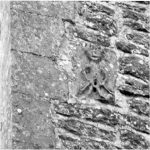
church_wall_advert_hc.png
(from Shop Signs of the Brothel-Keepers | IHASFEMR)

This also looks edited - the black bit is not in keeping - it seems too black. I guess this is to do with the source, or maybe I'm being oversensitive?

Please don't take offence at my raising this with you - I just can't help noticing and then mentioning oddities like these.
 
Tips
Tips
Please respect our Posting Rules.
Back
Top