Right you are,
@Worsaae, as it is difficult to put optical effects into words.
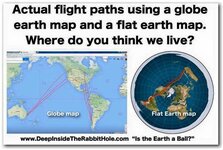
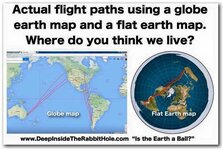
From one viewpoint looking down and into the horizon, distant objects will become more and more compressed. You go to a lot of bother to show the limits of human eyesight to visualize huge areas of real estate.
Not my favorite discussion point, because of the complexities of perception.
But I can at least copy and paste understandable text from a writer who combines history with geology and science. Real history? haha, on this forum? Real science? Velikovsky was a believer of the heliocentric model.
I've been reading Immanuel Velikovsky's Worlds in Collision.
I have a hardcover edition and Kindle. It's available free on Internet Archives in different formats.
Imo, comets are the agents of world age resets. Antiquitech is a pimple on the little toe of cometary catastrophism.
Comets of "antiquity" upheavaled mountains, flooded the earth, and abolished the old sun and moon.
Velikovsky insists that one great comet became a planet. Venus, which erupted from the head of her father, Jupiter.
A sample:
Full text of "Immanuel Velikovsky books - Worlds in Collision (1950), Earth in Upheaval (1955), Stargazers and Gravediggers (1983)"
Nations and tribes in many places of the globe, to the
south, to the north, and to the west of Egypt, have old
traditions about a cosmic catastrophe during which the
sun did not shine; but in some parts of the world the tradi¬
tions maintain that the sun did not set for a period of time '
equal to a few days.
Tribes of the Sudan to the south of Egypt refer in their
tales to a time when the night would not come to an end. 7 -
Kalevala, the epos of the Finns, tells of a time when
hailstones of iron fell from the sky, and the sun and the ’
moon disappeared (were stolen from the sky) and did not
appear again; in their stead, after a period of darkness, a
new sun and a new moon were placed in the sky. 8 Caius
Julius Solinus writes that “following the deluge which is
reported to have occurred in the days of Ogyges, a heavy
night spread over the globe.” 0
In the manuscripts of Avila and Molina, who collected
the traditions of the Indians of the New World, it is related
that the sun did not appear for five days; a cosmic collision
of stars preceded the cataclysm; people and animals tried to
escape to mountain caves. “Scarcely had they reached
there when the sea, breaking out of bounds following a
T L. Frobenius, Dichten imd Denken im Sudan (1925), p. 38.
* Kalevala (transl. J. M. Crawford, 1888), p. xiii.
® Caius Julius Solinus, Polyhislor. French transl. by M. A. Agnant,
1847, Chap, xi, reads: "a heavy night spread over the globe for nine
consecutive days.” Other translators render: "nine consecutive
months.”
] 76 [
terrifying shock, began to rise on the Pacific coast. But as
the sea rose, filling the valleys and the plains around, the
mountain of Ancasmarca rose, too, like a ship on the
waves. During the five days that this cataclysm lasted,
the sun did not show its face and the earth remained in
darkness.” 10
Thus the traditions of the Peruvians describe a time when
the sun did not appear for five days. In the upheaval, the
earth changed its profile, and the sea fell upon the land. 11
East of Egypt, in Babylonia, the eleventh tablet of the
Epic of Gilgamesh [Gilgamish] refers* to the same events.
From out the horizon rose a dark cloud and it rushed
against the earth; the land was shriveled by the heat of the
flames. “Desolation . . . stretched to heaven; all that was
bright was turned into darkness. . . . Nor could a brother
distinguish his brother. ... Six days ... the hurricane,
deluge, and tempest continued sweeping the land . . . and
all human back to its clay was returned.” 12


![[Image: 54428309_873683486303616_396981474386195...e=60CCDACA]](https://scontent-den4-1.xx.fbcdn.net/v/t1.6435-9/fr/cp0/e15/q65/54428309_873683486303616_3969814743861952512_n.jpg?_nc_cat=104&ccb=1-3&_nc_sid=110474&efg=eyJpIjoibCJ9&_nc_ohc=c725ebKPXeMAX_EEMqa&_nc_ht=scontent-den4-1.xx&tp=14&oh=5e24b6edc83480e7e4563790864e5de3&oe=60CCDACA "[Image: 54428309_873683486303616_396981474386195...e=60CCDACA]")