Note: This post was recovered from the Sh.org archive.Username: RowOfElevenDate: 2018-08-01 21:33:30Reaction Score: 10
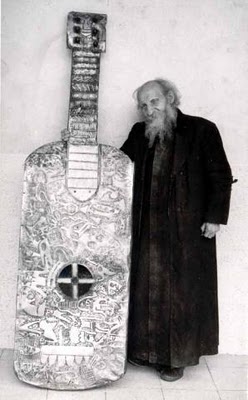
To be frank, I immediately came to comment about the Octobass and that you are wildy off base for suggesting the origin be tied to giants... but then I realized that everything I know about the Octobass is from the incestuous circle of academia (I hold degrees in this field). I looked into this further and found that this truly is a mysterious instrument in it's origin, not even to speak of its odd and mysterious design!
I was taught that the Octobass is a young instrument (invented in 1850) and was never designed to be played without it's elaborate pedals, hammers/frets, and pedestal. What we are told in music academia is that it was a thought experiment first and secondarily an experiment in creating a sound that would be
felt by the orchestra and audience. And it is felt, the lowest string is below the range of human hearing, tuned to 15Hz.
The string instead sounds rhythmic, as we can only hear the overtones above the fundamental (regular/main) pitch of the string. When it's played, you can feel it in your chest. (I had the honor of being in person with one of these while a musicologist played it.)
It really is a head scratcher, the instrument is beyond odd and no one (minus very recent composers) have written for it. Heck, there are only 7 in the world. It's been said that Hector Berlioz wrote for it in the mid-late 19th century, but after an exhaustive search I was unable to find anything written
for or about it beyond a mere mention in
Berlioz' Orchestration Treatsie, written in 1848.
The luthier who crafted it was a very famous violin maker from Paris,
Jean Baptiste Vuillaume. He made instruments that are still coveted to this day by many musicians. Without the login info for my old uni, I am unable to delve into this much further that I already have, but it doesn't seem completely nonsensical that Vuillaume would craft such an instrument... just unlikely. Especially considering the lack of information on the topic of this weirdo bass.
Now, about those giant books... What I was taught was that the time and resources put into making a book in these times was high enough, such that they found it easier to make books rather large and with big print, so that a group of people could read them at one time.
This idea is specifically about very old notated gregorian chant music. In this one utilization,
as sheet music, I can totally see the explanation they gave being feasible. A choir would read it all at once.
Just an aside, these (gregorian chant) books would have been made in the 16th century according to standard music history. The Uni I went to had one in their main library. I can confirm that they are very very big in person!