The Daily Fake

A Pint for the Alewives - JSTOR Daily

Until the Plague decimated Europe and reconfigured society, brewing beer and selling it was chiefly the domain of the fairer sex.

As the old sexist saw goes, “Beer is a man’s drink.” Yet, until the fourteenth century, women dominated the field of beer brewing. And the alewife, as she was known, was responsible for a high proportion of ale sales in Europe.
Could be! How can we know?
Ale was virtually the sole liquid consumed by medieval peasants,” writes Judith M. Bennett in a chapter in the edited volume, Women and Work in Preindustrial Europe. “Water was considered to be unhealthy, [so] each household required a large and steady supply of this perishable item.”
"Ale was virtually the sole liquid consumed by medieval peasants" yes... but how do "we" know this?
Most households alternated between making their own ale and buying from and selling to neighbors. Women—wives, mothers, the unmarried, and the widowed—largely oversaw these transactions, writes Christopher Dyer.
got it... women made it... but how do we know this?
Ale-making was a revolutionary trade for women. “We have heard much in the recent past about the weak work-identity of women, … [how] women were/are dabblers; they fail to attain high skill levels [and] they abandon work when it conflicts with marital or familial obligations,” writes Bennett. But for women of the Middle Ages, making ale was “both practical and rational.”
ok.. any evidence?

Basically - there are lots of imaginative flights of fancy - that might or might not have anything to do with the truth.. This is as close as we get to evidence:
It allowed married women to contribute to household incomes and offered both single women and widows a means to support themselves. This was true, for example, in the English villages of Redgrave and Rickinghall, about 100 miles northeast of London, where records suggested that ale sellers were both poor and single or widowed.

Further west, records from the manorial court of Brigstock show the domestic industry of ale-making to be entirely female dominated.

We don't see the records from these 3 places...

There are links to other articles, eg:
2 The Village Ale-Wife: Women and Brewing in Fourteenth-Century England Women and Brewing in Fourteenth-Century England from Women and Work in Preindustrial Europe on JSTOR

where we can read more info - eg:
1702466080765.png
But where does that table come from? In fact, where does the whole narrative come from? Does "alewife" even mean what we think? If drinking ale was more common than water - why was anyone fined at all? Etc.
 
The 476,000-year-old log structure predates the appearance of the first modern humans by some 150,000 years and was likely the handiwork of the archaic human species Homo heidelbergensis.

I think there's a typing error in the above - "modern humans" should read "wooden humans." Turns out that Homo heidelbergensis was in fact completely wooden...

th-2147338555.jpg

He was later superseded by Homo Pinocchionosius...

th-3594617768.jpg

Current survivors of this species now work as archaeologists, scientists and historians.
 
Rare Bronze Age axe heads found in ‘sensational’ discovery

Five immaculately preserved bronze age axe heads have been unearthed in a forest near Szczecin.

Described by foresters in the Starogard Forest District as ‘sensational’, the discovery by an amateur treasure hunter date from between 1700 and 1300 BC according to Igor Strzok, the Pomeranian Provincial Conservator of Monuments.

1702472323427.png
Vigorously dig up those axe heads!

1702472312316.png
5 brown, 3500-year-old axe heads

1702472333806.png
1 green, 3500-year-old axe head

So looking just at the photos provided. We can see 5 brown, scruffy-looking, brown axe heads in one photo. And then a pleasing green-coloured axe heads in another.

So, did they really find 6 axe heads? Is the green one a 'stock photo' nothing to do with the find? Or is this what the axe head looks like once cleaned up (it goes green) and then artfully placed back on the ground, with some dirt sprinkled over it to help set the scene?

We don't know! So, we should just accept that 5 3,500-year-old axe heads were found! Hurrah.
 
Earliest Carpenters - Archaeology Magazine

This article is a follow up on this earlier post, or 476,000 year old wood:
The Daily Fake

What are we learning now?

Left: "wood structure", right: "notch".

"Wedge-shaped object", "digging stick", and "flattened log"

I hope they're not walking back the 476,000 year claim..
Found near a river bank aka really moistured soil, the type of soil that degrades wood faster than i'm writing but somehow it survided for over 400k years, i used to have a little bit of respect left for archeology but not anymore, the entire field is a joke rulled by liars & clowns
 
Found near a river bank aka really moistured soil, the type of soil that degrades wood faster than i'm writing but somehow it survided for over 400k years, i used to have a little bit of respect left for archeology but not anymore, the entire field is a joke rulled by liars & clowns
It depends on the conditions. In North America there is a whole industry that dredges up fallen old-growth trees that have been submerged in mud at the bottoms of lakes for 100 or more years.
 
It depends on the conditions. In North America there is a whole industry that dredges up fallen old-growth trees that have been submerged in mud at the bottoms of lakes for 100 or more years.
Oh i know, but the article claims the wood to be 476.000 years, quite the difference
 
Archaeologists reveal life stories of hundreds of people from medieval Cambridge
A lovely example of history creation.

1703167890969.png
Wat?

Archaeologists at Cambridge University have reconstructed the “biographies” of hundreds of the city’s ordinary medieval residents by examining their skeletons in detail, using a wealth of scientific data to fill out the life stories of poor or disadvantaged people whose names were never recorded.
Science!
"You tomato, I say tomato" - you say reconstructed, I say constructed.

They also gained clues to how the charitable institution operated its medieval “benefits system” and decided who was worthy of help in what must have been an overwhelming “sea of need”.
'medieval benefits system'

A new website, launched on Friday to accompany a research paper published in Antiquity, tells the stories of some of the people they found there. They include a stocky, dark-haired man experts have speculatively named “Wat”, who grew up with a good diet and survived several waves of the Black Death, but seems to have fallen on hard times and died with cancer around the age of 60.
What Wat? Maybes it was a turbo cancer, cos he took a medieval vaccine.

Science + historian = subaltern history.
 
Last edited:
Here's a challenge feralimal. Post a story you feel is real. Finding the fakes is as easy as falling off a log it seems.
As easy as falling off a 476,000 year log... I agree. I will keep an eye out.

I quite liked this one on time:
The Daily Fake

this article didn't have the usual feel - there was an interesting idea there - that the 12 parts of the day remain, but the duration shrinks or increases with the time of year.

The real issue though, imo is that what we seek - truth, presumably - cannot be found in the places we are looking. Its all interpretation. The history we are given, is the academic interpretation. This interpretation has 2 jobs to do - it has to not break the previous narratives too much as it has to continue to carry the people along, and yet it also has to direct the people towards the goals of the present. Creating a new history to bridge that is exactly what all that subaltern stuff is doing. Its a narrative that takes its cue from whatever is put forward by science, previous history writings, artifacts, etc - and then runs with it towards the goals of the present - eg: they didn't have good medicine/food/enough government/etc and so this or that bad thing happened to them.

I humbly accept that the past is not knowable. So when talking to others - eg when posting things here - I try to point out this or that problem with these stories that are presented as true. Occasionally, one is able to show how the story fails within its own terms - ie it is logically impossible. More often it is possible to show how a narrative is guiding the story in a way that isn't really merited by the data - ie you can get a strong sense of the 'guiding hand'.

Having accepted that the past is not knowable, and that academia is working (perhaps unintentionally) towards an agenda, what next? What would good history look like?

For me, 'next' is trying to find alternative research - I like when people present their work eg as they do on this site. Of course, there is the possibility that one can fall into auto-believing an alternative history. But really, what one wants to do is to try to develop the personal discernment for evaluating information.

I would love to see one thousand historical interpretations bloom. I could point out @usselo and @Will Scarlet + felix noille's work - these people are trying to put things together in their way - and these personal ways are the only ones that count with me. They present evidence, show their workings - great! I don't think I have that in me to attempt to develop a mega theory - but I like to read it. Mainly I like destroying BS, truth be told. At least I feel I'm working with a clean slate - that's enough for me.
 
Last edited:
Karl Marx - Wikipedia
First of all... very interesting and enjoyable thread. Thanks to everyone involved.

Here is an amusing speculation based on the meaning of the words that make up the name "Karl Marx":

Karl (also Carl) is an originally Germanic variant of the male given name Charles meaning free man, or simply a man.
Karl etymology on Wikipedia

Marx is a masculine name of German origin. Coming from the name Marcus, it translates to “Of Mars,” forever connecting baby to the Roman god of war.
Marx: meaning of name

The Elon Musk character (no way to know if these presented character are real) stated that people will reach Mars in 2030 or earlier. The dates shift occasionally. Elon is not sure on the dates... big surprise... but he does affirm that generation Z will be alive and kicking when humanity reaches Mars.

This may not have anything to do with 'space travel', whatever these people mean by that, but simply a push to disseminate the idea that the whole world will embrace Karl Marx's phylosophy by 2030 or earlier. At least, that is what these sustainable goals nonsense seems to be about, phylosophically speaking: simple collectivism.

Personally, I bet on it being more of the same: keep feeding confusion to reap economic advantage.

Still, it is remarkable that Mars has been in the forefront of the space nonsense... while Marxism has been on the forefront of political nonsense.

Karl Marx, or 'the man from Mars' may be the theme for the current season of teh neverending augmented-reality soap opera that is presented to us people as 'reality'.
 
https://archive.is/1pXzb
NYT: What Lies Beneath the Vatican of the Zapotecs?

1703587685133.png
The Church of San Pablo, built by the Spanish in 1590 directly on top of the ruins of Mitla.

The ruins of Mitla sit about 30 miles from Oaxaca in the mountains of southern Mexico, built on a high valley floor as a gateway between the world of the living and the dead. The site was established in roughly 200 A.D. as a fortified village, and then as a burial ground by the Zapotecs, the so-called Cloud People, who settled in the region around 1,500 B.C.
2200 years old
In 1674, Francisco de Burgoa, a Dominican friar, wrote an account, based largely on church documents, of Spanish missionaries who had explored a sprawling labyrinth of tunnels and burial chambers beneath the ruins of a monumental palace. A century earlier, secular clergy had blocked the doorways to the sunken complex with bricks and mortar, presumably either to keep the masses out or the ghosts in.
Hard by the courtyards was the Church of San Pablo, a Catholic house of worship. The church was built in 1590, seven decades after Spanish conquistadors arrived in the Oaxaca Valley. Members of the Dominican order assembled it atop the sacred ruins, repurposing stones from the palace. By severing the Zapotecs from their pagan deities, the missionaries hoped to convert them to Christianity. “Instead of trying to kill off the Zapotec’s religious beliefs,” Dr. Argote said, “it was easier just to wash their brains with new beliefs.”
"Instead of trying to kill off the Zapotec’s religious beliefs, it was easier just to wash their brains with new beliefs" - quite probably true!

@Jd755 here is some info - nothing about it is difficult to accept so far.. but then neither can it be known. I would expect that there really are tunnels under this structure. But then - as I look at the people involved, I become very suspicious about what is being presented. We have already read that: "secular clergy had blocked the doorways to the sunken complex with bricks and mortar".

The researchers were denied permission to set up equipment inside the church, so they had placed seismic sensors — electrodes and geophones — in a horseshoe arrangement on the patio, to peer down through layers of soil. By early afternoon a tangle of cables covered the yard like mangrove roots.
Last year the researchers used a combination of three scanning technologies — ground-penetrating radar, electrical resistivity tomography and seismic noise tomography — to generate three-dimensional images of what lay below. The surveys revealed a mysterious underworld, confirming the presence of a large void under the sacristy that extended to the west and northwest.
fair enough they don't want to disturb this or that... But this does mean we just have their say so on whatever-it-is - we cannot verify anything. A site that the church has had controlled access to since 1590.

1703589468256.png
Is this evidence?

Tall and angular, Mr. Vigato talks about the Zapotec culture with the boyish enthusiasm of an Eagle Scout describing his merit badges. He grew up comfortably in Milan and traveled widely with his parents. He attended Harvard Business School, during which time he met Daniela Thions Meyer, a native of Mexico who was getting her M.B.A. at Dartmouth College in New Hampshire. They married and eventually moved to Mexico City, where he became a Walmart executive for a while. His fortune comes largely from his family, and from his work in retail and as a strategy consultant.
In his spare time he wrote “The Empires of Atlantis,” an alternative history of the origins of civilization in which he proposed that “Atlantis, not Africa, was the true cradle of mankind.” The theory elicits a chuckle from Dr. Argote, the National Institute researcher. “I will only believe in lost civilizations when I see material remains of them,” she said. “In the Mitla project, we are only using scientific methodologies whose applicability and success have been proven in previous research and supported by peer-reviewed scientific publications.”
Marco Vigato, right, the research team’s sponsor, with Ludovic Celle, left, an illustrator, and Mr. Ruiz, the caretaker, in a room of Zapotec stone mosaics.
So Marco Vigato sponsors the project. Who is he?
Marco M. Vigato is an Italian born author, researcher and explorer who has dedicated the last 15 years of his life to the task of uncovering the truth about the origins of civilization. Educated at Harvard and Milan's Bocconi University, he lives in Mexico City.
He is the author of The Empires of Atlantis, published by Inner Traditions, and has appeared on numerous documentaries, podcasts and TV shows as an expert in ancient Mesoamerica and the worldwide megalithic phenomenon.
In 2020, he founded the ARX Project (www.arxproject.org) with the objective of uncovering more evidence of what he believes was once an advanced global seafaring culture that vanished at the end of the last Ice Age.
from Marco M. Vigato: books, biography, latest update

Seems like a rich guy with a version of history he likes. A conspiracy history evangelist - with a focus on Mesoamerica. And he can get articles in the NYT.

And then take a look at his team, lolol:
Marco M. Vigato | Founder
Born in Italy and living in Mexico City, Marco has studied at Harvard and Milan’s Bocconi University. He has been researching ancient civilizations as an independent researcher for the past 15 years. He is an expert on ancient Mesoamerica, as well as a regular contributor to the Ancient Origins online magazine and to various other print and on-line journals and podcasts. He is also the author of books and publications on various subjects of history and prehistory related to the origins of civilization.
online magazine and to various other print and on-line journals and podcasts, author
Ludovic Celle | Co-Founder
Born in France and living in Oaxaca, Ludovic holds a degree in architecture from the Grenoble School of Architecture. He has been an illustrator specialized in architecture for 12 years, since 2017 with a focus on Precolumbian visualization and iconographic investigation. His detailed 3D reconstruction of the postclassic Zapotec city of Mitla has won him praise in the archaeological field. His central investigation is the wide world of stepped-fret designs throughout the American continent.
illustrator, degree in architecture (not history)
Aleksander Tokarz | Co-Founder
Born in Poland and living in Mexico City, Aleksander attended California College of the Arts in San Francisco where he graduated with a Bachelor of Architecture. He spent several years working in Denmark with Bjarke Ingels Group, Henning Larsen Architects, and 3XN Architects. Afterwards he received a Master of Arts in Architecture from the Arkitektskolen Aarhus in Denmark. With his own design studio he has built many projects in Mexico including participation in the reconstruction efforts after the September 19, 2017 earthquake.
another architect, has built projects in Mexico
Alejandro Saavedra | Director of Digital & Museography
Born in the indigenous community of San Gregorio Atlapulco, Xochimilco, in Mexico City, Alejandro holds an Economics degree and is currently studying for a second degree in Architecture from the Universidad del Valle de México. He has been a participant in various seminars, diplomas, certifications related to the protection and conservation of cultural heritage, and continuing education programs from the following institutions: Pontificia Universidad Javeriana, Colombia; Harvard University, RWTH Aachen, Germany; Universitá di Napoli Federico II, Italy, Pontificia Universidad Católica, Chile; Escuela Nacional de Conservación, Restauración y Museografía INAH, Mexico; in addition to developing projects related to the documentation and registration of cultural heritage in Mexico.
studying to be an architect

(from: The Team | Arx Project)

Would you expect architects to feature so heavily in a historical mission? At this point I want to link to my first thread here, about David Rumsey and his map collection:
Meta history - Who provides the data?

Remember all those maps that being uncovered, flat earth british with all those photos, etc? Its great entertainment... but as to whether the maps, the underground scans, the architecture are anything to do with the truth, is a totally different question.

Back to the article
But the church committee, an elected body largely independent from church hierarchy and the diocese of Oaxaca, has repeatedly turned down requests to conduct more research around that portion of the site. Its opposition appears to be motivated by a fear that the church would be razed to allow for archaeological digs, and that any riches found would be requisitioned.
“All these concerns are unfounded,” Dr. Argote said. “By federal law, no one can demolish an historical monument to recover pre-Hispanic remains. And any so-called treasures would mostly consist of ceramics, human remains or lithic artifacts, not gold or jewels as the locals believe.”
Neither the church nor the law seem to be helpful to any of this research.

There's then an account of 33 year old Omar Santiago who went into the tunnels as a boy:
Lacking a flashlight, they navigated the narrow stairway, slowly, carefully, holding onto the decorative friezes that studded the stone walls. At the bottom of the stairs, they panicked. “I felt I was trespassing where the living should not be,” Mr. Santiago said. He and his brother scrambled up the steps and didn’t look back. Eight years later the entrance was capped with a concrete slab, and, for good measure, sheathed in floor tile.
When a spooky-looking woman offered the man a tamale, he turned around and fled. “The man later described the woman to his wife,” Mr. Santiago said. “His wife was shocked: The woman had died many years before.”
There was the slightest of pauses.
“My mother said, ‘Remember, Omar: Never accept tamales from dead people.’”
Spooky ghost story from Omar. Good thing the entrance was concreted over etc.
 
Last edited:
Also an interesting article:
Collections: How Many People? Ancient Demography
But I can lead with the upshot here: despite the apparent confidence of works purporting to present historical populations over broad periods, we really don’t know the population of most of these places at most of these times. In particular, venerable books like the McEvedy and Jones, Atlas of World Population History(1978) are mostly built on sand1 and yet they in turn get used as the foundation for all sorts of social science work by social scientists who assume the confident conclusions presented in these sorts of books are, you know, confident and who lack the area-specific skillset to assess them.
Honest!

And yet:
The gold standard for reported figures is, of course, the Roman census. In that case, we know that the Romans did in fact count and that our authors reporting those figures are doing so with access to the official records. Moreover, we know that the documents produced didn’t just render a number, but rather a list of citizen-households, with their members, age and property, which makes an accurate count more likely; that relative accuracy was a product of the census being essential to the conduct of Roman taxation in Italy (before 167 when tributum ended in Italy) and Roman conscription. So while those census figures aren’t perfect (historians in particular debate what percentage of the population might have been missed), they’re pretty damn good.
We know so much. Except that, on this site at least, we don't even know if the Romans were around 2000 or 1000 years ago - as we are open to the timeline having been falsified. It seems uncontentious to me to say, history cannot be known, but perhaps its a terminology thing..

And then there is the hot mess that is the sources on Athens. You might imagine that the best attested polis in the whole of the ancient world would have some reliable population figures, but what we have is messy. Thucydides (2.13) gives an overview of Athens’ military strength; the difficulties with that approach are discussed below. Meanwhile, Athenaeus (6 272cd) quotes a census reported by another source (Ctesicles) taken by another figure (Demetrius of Phaleron) in the late fourth century which reported 21,000 citizens, 10,000 metics and 400,000 slaves.
Can we get some sources for this cascade of references? Where does one check them? Answer:
L’économie de la Grèce des cités (2007/8), now in translation as The Making of the Ancient Greek Economy: Institutions, Markets and Growth in the City-States, trans. Steven Rendall (2016), 459, n.144.
(Someone else can go and do the no doubt fruitless book search, and fail to find anything like a primary source - I've wasted time doing that.)

Anyway - there are problems with this or that process for counting up the numbers.. the uncounted are a problem.

But we have to approach our own meager powers and the meager powers of our evidence with due respect. We can estimate, in a very rough order-of-magnitude sort of way, about how many people may have lived in antiquity, but for any approach that requires even extremely modest precision, the evidence simply will not support such efforts.

We have to be willing to admit what we do not and indeed cannot know.
"We have to be willing to admit what we do not and indeed cannot know."
Yes, my point exactly - but historians already know so much!

And, as ever, there is no consideration given to the idea that historical records themselves could be falsified for the present day. Historians simply accept licensed history with only the most blatant lies/falsifications/errors coming under any scrutiny. And it has ever been thus.
 
First of all... very interesting and enjoyable thread. Thanks to everyone involved.

Here is an amusing speculation based on the meaning of the words that make up the name "Karl Marx":


Karl etymology on Wikipedia


Marx: meaning of name

The Elon Musk character (no way to know if these presented character are real) stated that people will reach Mars in 2030 or earlier. The dates shift occasionally. Elon is not sure on the dates... big surprise... but he does affirm that generation Z will be alive and kicking when humanity reaches Mars.

This may not have anything to do with 'space travel', whatever these people mean by that, but simply a push to disseminate the idea that the whole world will embrace Karl Marx's phylosophy by 2030 or earlier. At least, that is what these sustainable goals nonsense seems to be about, phylosophically speaking: simple collectivism.

Personally, I bet on it being more of the same: keep feeding confusion to reap economic advantage.

Still, it is remarkable that Mars has been in the forefront of the space nonsense... while Marxism has been on the forefront of political nonsense.

Karl Marx, or 'the man from Mars' may be the theme for the current season of teh neverending augmented-reality soap opera that is presented to us people as 'reality'.
Karl Marx - most famous work Das Kapital - died in 1883 and released vol 2 and 3 of the trilogy after his death ,as late as 10 yrs after for the third . Fits stolen history to a T ,or tea ,maybe tee depending on your passion. I'm loosing confidence in the meaning of words lately .
Subaltern??

Marx, the man who attempted to remove spirituality from communism . Engels parasitic controller who had married into German aristocracy.
That's how it seems to me
Communism and marxism are different things but do get lumped together in the great brainwashing scheme, which incudes space travel to the planet Marx.
 
https://archive.is/k4IgX
WSJ ‘The Egyptian Book of the Dead’ Review: An Ancient Guide to the Afterlife

1703768730749.png
3500 years old

About 3,500 years ago, did the Egyptian woman named Webennesre feel comforted at all being accompanied in death by a papyrus now on display at the Getty Villa exhibition “The Egyptian Book of the Dead”? Dating from between 1479 and 1400 B.C., the papyrus contains a “spell,” an incantation, perhaps entombed with her, that she had to recite after death (but which she also had to learn in advance—with the papyrus serving as a posthumous crib sheet).
between 1479 and 1400 B.C.
The Book of the Dead was given its name by a German Egyptologist, Karl Richard Lepsius, in 1842. He called the compilation the “Todtenbuch,” but it is not really a book at all, as this potent single-gallery exhibition (created by Sara E. Cole, assistant curator of antiquities here) tells us from the start. Over 1,500 years, some 200 “spells” (as Lepsius dubbed them) were written on the walls of tombs and carved into stone and onto scarab and funerary figurines—and ultimately inscribed, with copious illustrations, onto papyrus and mummy wrappings.
1842
This exhibition is drawn from the Getty’s Book of the Dead collection of seven papyri and 12 fragments of linen mummy wrappings—all donated by a book dealer in 1983 from a collection originally acquired by the 19th-century English collector Thomas Phillipps. None has been displayed until now, and all are undergoing scholarly study for the first time. Four papyri are shown here; all belonged to women, three of whom were priestesses at Thebes. There are also three linen strips from two mummies inscribed with spells, dating from the “later phases” of the Book of the Dead (about 400-100 B.C.). Sections of the same wrappings are now in collections around the world.
1983
 
Discovering Malmesbury's 'gangster' medieval monk

Another one for @Jd755

I won't even dispute the presented facts. Let's just look at the interpretation.

The abbot is the gangster. So, what did he do?
Then in the 1320s, the abbey became embroiled in a feud involving £10,000, which, by today's standards, would have been millions.
The monasteries at the time had political allegiances and at Malmesbury they supported a local noble family called the Despensers.
The family left a large amount of cash with the abbey for safekeeping.
However, when the tide turned against them, the head of the family was executed and the monastery decided to keep quiet about the money they had stored.
They even had a royal visit while they had the cash stashed there, likely in their living area, the only part of which remains in the basement of Abbey House in the town.
"The monks must have been terrified that they had this dark secret," Mr McAleavy said.
"They kept quiet about it, and then ten years later it came to light. Somebody obviously ratted on them."
As the right-hand man of the Abbot at the time, John was hauled in front of royalty once again and placed in custody.
In the end though, the monks of Malmesbury were pardoned: "Extraordinarily, the King took the 10,000 and let him off. Basically, they all got away with it."

My question is, which person is the gangster? My answer is the king! Not the abbot.

In what world does the king have a rightful claim to the Despensers money? Only in the one where he writes the rules and calls the benefits he receives from those rules 'right'.

And here is an example of the leaps historians can make. Apparently the abbot accepted that he had murdered someone, but we find out he also had a guilty conscience:
There is evidence in the Vatican archives that John of Tintern did feel some guilt though.
He applied to the Pope for something called an "indulgence".
Mr McAleavy explained this meant "approval from the Pope that at the moment of his death all his sins would be forgiven.
"That was just a standard transaction at the time in return for money.
"I think maybe he had something of a guilty conscience."
His buying an indulgence indicates he had a guilty conscience. Does it really though? Maybe this was a common place action people took then, akin to lighting a candle nowadays. I'm saying we cannot know what his thoughts were - we are free to imagine what we like.

It was a long research journey for Tony McAleavy who said: "You have to pinch yourself when you look at these documents.
"How can this possibly be true? How can this man of religion have behaved so incredibly badly?"
Nice signoff.
 
Last edited:
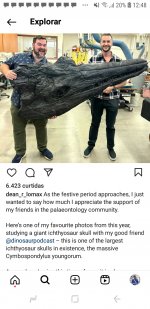
Screenshot_20231228-124859.jpg
Well, isn't it true that fossilized bones are quite heavy due to the minerals? Yet the 2 dudes are holding this massive thing like it's nothing...... ok
 
Obtaining Source Documents

I think this is your own work. Nice one!

It's it possible to update and give a bit of info to explain why it's relevant? Thanks.

Well, isn't it true that fossilized bones are quite heavy due to the minerals? Yet the 2 dudes are holding this massive thing like it's nothing...... ok
Fossil = stone, not styrofoam, lol
 
Last edited:
Tips
Tips
Please respect our Posting Rules.
Back
Top