The different history of the Roman Empire

Let me get this straight. Your argument appears to go something like:

This book was written by Russians, one of whom has a Jewish name, so they're KGB agents. Also, the etymology of the word medieval is fake and actually based on an Irish word. Therefore, we know that no such thing as a medieval empire of the Israelites ever could have existed, and there's no reason to read the book or even allow one's curiosity to be piqued by the titular claim. QED

There isn't a single book or author in this field that is beyond suspicion, from Fomenko to Tamansky to Korben Dallas to anyone posting here. Does that mean we shouldn't read anything?


Are deceivers who are incapable of inventing anything also incapable of inventing deceptive systems of economic exploitation and then paying artists to dress them up with cool statuary? Because that's what "empires" are.

Friend, if you thought your idea through to the end, namely that "Jews" have been ruling the world for a long time (an idea which I basically share), you should logically come to the conclusion that there must have been a moment in history when that imperium was established. It might therefore be fruitful to explore the possibility that this empire once exercised its dominion openly, in one way or another. How else do you explain the fact that their law makes up 80% of the book that went on to dominate all of Europe? Why do tribes in Nigeria practice a scapegoat ceremony nearly identical to the Jewish Yom Kippur ritual? Why does the tomb of Pope Julius II feature statues of Moses, Rachel, and Leah but no Jesus? Why do Shinto shrines in Japan follow the exact same layout as the Jewish Tabernacle? Why does the Greek myth of Phrixus resemble the Biblical story of Abraham and Isaac? You seem to believe that all of our old cities were found empty and repurposed. Okay, that still begs the question. Who made giant sculptures of Moses like this one in Rome (1588) after overthrowing the previous civilization? When did they do it? Come on, let's get concrete, I want a rough date, a builder, a construction technique, and a reason for choosing precisely this figure. Please, no cop-outs like "the parasites caused it to materialize when they invaded this realm after the last reset".

View attachment 35330

View attachment 35329
If you really believe that benevolent Irish civilizers were usurped at some point by wicked Jews, an idea everyone here is open to, shouldn't you be interested in precisely how, when, and where it happened? And if you know, tell us (but in the relevant thread that is, not here, please).

Here we are breaking our heads, trying to figure this stuff out on our own, and some guy in Russia wrote an entire book about it twenty years ago. It's next on my reading list.

Go back and reread this claim of mine that caused you to LOL, with your paranoia turned down a notch this time. Do you really think I meant, "Okay guys, we can finally stop speculating, turn off our brains, and simply feast on this delicious Soviet Jewish propaganda"? Or does it make more sense that I was suggesting something more like: "By digesting as much relevant prior research as possible we can avoid wasting our time reinventing the wheel"? This thread centers around the ideas of Alexander Tamansky (have you read his book? Or maybe you know he's a deceiver because he's Russian?) showing that the religion of the "Roman Empire" was proto-Judaic before becoming Christian.


Okay, let's say you don't believe in the "Roman Empire" as it has been taught to us. Fine, call it "the occult Jewish empire hiding behind the fake Roman empire". It doesn't change anything. You still have to engage with concrete texts and concrete artifacts and explain them. You still need to explain who invented these precise fictional characters, when they invented them, and why. Tamansky offers us a reading that obviates the need for any kind of deus ex machina to explain how we got from 1500 to today. I like theories that do not require me to bridge factual gaps with metaphysical hypotheses.

The tentative hypothesis I am working with is something like: the fictional Old Testament was written by a group of Hellenized Jews affiliated with the Platonic Academy sometime around the 15th century, and then used to herd people around the world into a system of economic exploitation. I believe that this is when the big Reset happened, and when the lies began. I have no idea what came before that. Right now I'm just trying to reconstruct a coherent story that leads from that Moses statue to 2025, because I suspect we have enough clues to be able to do so. I do not think we have enough clues to figure out what happened much earlier than that, which is where more metaphysical speculation must begin. That's important too, but here are other threads for that.
Why you get angry? My post was about the subject, not about you.

What I said (I didn't argue) is in my post, not this nonsense you rewrote.

All this mix of subjects, but no evidence or facts were presented about this mystical empire.
Instead of writing against me and distorting what I wrote, what I think (which is hilarious) let’s keep simple please provide evidence and facts to support your claims.

Medieval - refers to an era that never existed. Israelites - refers to a people that never existed.
 
Why you get angry? My post was about the subject, not about you.

What I said (I didn't argue) is in my post, not this nonsense you rewrote.

All this mix of subjects, but no evidence or facts were presented about this mystical empire.
Instead of writing against me and distorting what I wrote, what I think (which is hilarious) let’s keep simple please provide evidence and facts to support your claims.

Medieval - refers to an era that never existed. Israelites - refers to a people that never existed.
Hello;
A very simple question is ; Have you read the book " The Medieval Empire of the Israelites" or not.
 
Hello;
A very simple question is ; Have you read the book " The Medieval Empire of the Israelites" or not.
Hell o

A very simple answer is: I have no interest in reading Deception. But I have nothing against those who want to.
 
This is a short update. I've finished the (really excellent) Grishin and Melamed book and hope to find the time to summarize its contents at some point. In my opinion it dovetails well with the research of Tamansky to which this thread is dedicated.

I'm writing today to link to another Russian source which I've never seen discussed on this site, namely Andrey Pustogarov's 2017 "1492: The Beginning of History", another New Chronology-adjacent book which starts from the premise that our history was mostly written in the 15th-16th centuries. I'm about halfway through. It's a little drier and more Russia-focused than the works of Tamansky, but full of excellent insights. Part four, which I haven't read yet, appears to be the juiciest section of the book. (Pustogarov argues that Peter the Great was a Dutch merchant.)

Like Grishin & Melamed, Pustogarov argues that there was an original merchant empire originating from Constantinople, that this empire spread a monotheistic religion, that this religion was based on the law of Moses and was political in essence, and that this religion later split into Christianity, Islam, and Judaism.

But even more remarkable than the Treaty of Christoburg is the Treaty of Kruszwitz of 1230, by which Prince Konrad of Masovia and Kuyavia ceded the lands of Culm or Helm to the German Order, as well as everything the Order would subsequently conquer in Prussia. The treaty contains the following phrase: "contra Prutenos et alios Sarracenos nobis conterminous" (quoted by Caterina Bruschi, Peter Biller. Texts and the Repression of Medieval Heresy, Boydell & Brewer Ltd, 2003, p. 39), which translates as "against the Prussians and other Saracens bordering us."
[...]
But how could Islam from distant Arabia penetrate to the shores of the Baltic Sea? Everything falls into place if we accept that the Saracens were not Muslims, but representatives of the original religion of God Almighty, which was replaced by Christianity. (Islam later evolved from this same religion - see 4.9.8). According to the Old Testament, this original religion was spread by the Sons of Israel and was called the Mosaic Law. Therefore, for example, in the "Life of the Holy Great Prophet Moses," contained in the Chronographic Paleia, it is said that Moses was king of the Saracens for 40 years (Dictionary of Scribes and Bookworms of Ancient Rus. Issue 1, Leningrad: Nauka, 1987. Apocrypha about Moses). See also 4.10.11.


Both Grishin/Melamed and Pustogarov believe that "paganism" (at least in its "constructed" form of a pantheon of interlocking lesser gods) emerged after the fall of the original monotheism and preceded Christianity. In other words, the sequence is:

Mosaic monotheism ->
Original empire falls ->
Paganism ->
Christianity/Islam

The following insight is typical of the style of reasoning Pustogarov (like Tamansky) deploys, probably inherited from the Marxist material dialectic, which privileges economic and political explanations over spiritual or metaphysical ones:

We are almost ready to agree with J. Kessler and I. Davidenko, who noted that "a [trade] fair – German Messe, Swedish Masse, Norwegian messe – was originally a meeting place...from this meaning arose the religiously charged words "mass" and "mosque" (Myths of Civilization M., Esmo, 2005, p. 109). With the only caveat that the temple was originally a trading post (see 3.5.7-10).


Luckily for us, this work is available in its entirety online (in Russian, but the Google machine translation is excellent).

I for one am very thankful for the Google translate function. Not everything in this "new" world is bad.

ÐаÑало ÐÑÑоÑии / ÐÑоза.ÑÑ

It seems like a lot of history researchers in Russia were influenced by the Fomenko revolution, but found his reconstruction too Russia-centric, so they attempted to correct his errors by shifting the focus back to the West, or at least back to the Mediterranean/Black Sea rim, while keeping his basic framework.

Maybe someone here would like to read it and summarize it for this thread, since I might not have the time to do so in the near future.

Between Fomenko, Tamansky, Marfull, Grishin & Melamed, and now Pustogarov, we're starting to assemble a pretty sizable body of high-quality research that coheres into a strong thesis in my opinion.

Also...I submitted a new thread a week ago and the mods still haven't approved it. I wrote them but received no response. I'm not sure what's going on...is anyone there?
 
Last edited:
Thanks for this, Frosty. I enjoy this line of research so it’s good to have more material to check out. When I was looking for an archive of an English translation and looking into the book title, a link to an sh post from 2020 came up that has an interview with the author, I haven’t watched it yet, but I will when I can.
Andrei Stepanenko's research
 
Thanks for this, Frosty. I enjoy this line of research so it’s good to have more material to check out. When I was looking for an archive of an English translation and looking into the book title, a link to an sh post from 2020 came up that has an interview with the author, I haven’t watched it yet, but I will when I can.
Andrei Stepanenko's research
Oh crap, never mind. That’s not the same guy. Still may be interesting
 
This is a short update. I've finished the (really excellent) Grishin and Melamed book and hope to find the time to summarize its contents at some point. In my opinion it dovetails well with the research of Tamansky to which this thread is dedicated.

I'm writing today to link to another Russian source which I've never seen discussed on this site, namely Andrey Pustogarov's 2017 "1492: The Beginning of History", another New Chronology-adjacent book which starts from the premise that our history was mostly written in the 15th-16th centuries. I'm about halfway through. It's a little drier and more Russia-focused than the works of Tamansky, but full of excellent insights. Part four, which I haven't read yet, appears to be the juiciest section of the book. (Pustogarov argues that Peter the Great was a Dutch merchant.)

Like Grishin & Melamed, Pustogarov argues that there was an original merchant empire originating from Constantinople, that this empire spread a monotheistic religion, that this religion was based on the law of Moses and was political in essence, and that this religion later split into Christianity, Islam, and Judaism.

But even more remarkable than the Treaty of Christoburg is the Treaty of Kruszwitz of 1230, by which Prince Konrad of Masovia and Kuyavia ceded the lands of Culm or Helm to the German Order, as well as everything the Order would subsequently conquer in Prussia. The treaty contains the following phrase: "contra Prutenos et alios Sarracenos nobis conterminous" (quoted by Caterina Bruschi, Peter Biller. Texts and the Repression of Medieval Heresy, Boydell & Brewer Ltd, 2003, p. 39), which translates as "against the Prussians and other Saracens bordering us."
[...]
But how could Islam from distant Arabia penetrate to the shores of the Baltic Sea? Everything falls into place if we accept that the Saracens were not Muslims, but representatives of the original religion of God Almighty, which was replaced by Christianity. (Islam later evolved from this same religion - see 4.9.8). According to the Old Testament, this original religion was spread by the Sons of Israel and was called the Mosaic Law. Therefore, for example, in the "Life of the Holy Great Prophet Moses," contained in the Chronographic Paleia, it is said that Moses was king of the Saracens for 40 years (Dictionary of Scribes and Bookworms of Ancient Rus. Issue 1, Leningrad: Nauka, 1987. Apocrypha about Moses). See also 4.10.11.


Both Grishin/Melamed and Pustogarov believe that "paganism" (at least in its "constructed" form of a pantheon of interlocking lesser gods) emerged after the fall of the original monotheism and preceded Christianity. In other words, the sequence is:

Mosaic monotheism ->
Original empire falls ->
Paganism ->
Christianity/Islam

The following insight is typical of the style of reasoning Pustogarov (like Tamansky) deploys, probably inherited from the Marxist material dialectic, which privileges economic and political explanations over spiritual or metaphysical ones:

We are almost ready to agree with J. Kessler and I. Davidenko, who noted that "a [trade] fair – German Messe, Swedish Masse, Norwegian messe – was originally a meeting place...from this meaning arose the religiously charged words "mass" and "mosque" (Myths of Civilization M., Esmo, 2005, p. 109). With the only caveat that the temple was originally a trading post (see 3.5.7-10).


Luckily for us, this work is available in its entirety online (in Russian, but the Google machine translation is excellent).

I for one am very thankful for the Google translate function. Not everything in this "new" world is bad.

ÐаÑало ÐÑÑоÑии / ÐÑоза.ÑÑ

It seems like a lot of history researchers in Russia were influenced by the Fomenko revolution, but found his reconstruction too Russia-centric, so they attempted to correct his errors by shifting the focus back to the West, or at least back to the Mediterranean/Black Sea rim, while keeping his basic framework.

Maybe someone here would like to read it and summarize it for this thread, since I might not have the time to do so in the near future.

Between Fomenko, Tamansky, Marfull, Grishin & Melamed, and now Pustogarov, we're starting to assemble a pretty sizable body of high-quality research that coheres into a strong thesis in my opinion.

Also...I submitted a new thread a week ago and the mods still haven't approved it. I wrote them but received no response. I'm not sure what's going on...is anyone there?
"With the only caveat that the temple was originally a trading post (see 3.5.7-10)."

Trade indeed creates the modern world in which the richest people get richer and the poor get poorer.

Therefore, it's useful to have a separate language for trade, a separate script (and book!), so that trade runs a little more smoothly (for one party who get rich).

Indeed, temples are very useful as storage places for valuables, gold, and jewelry. They are stockpiles. (It also reminds me of a pyramid scheme; a trading system that is as corrupt as the plague.)

And indeed, the Phoenicians were quite adept at becoming rich through trade. Many large cities arose from these trading posts.

The world is apparently truly being destroyed by this trading mentality; just look at the present.

And think of the Dutch East India Company (VOC), the International Trade Organization (IOC), which all coincidentally arose after 1666. (?) The world is now (almost) completely in the hands of those traders, and that's why we're in trouble.

So I wouldn't be surprised if that trade is backed by so-called religion. Apparently, that excuse works well. (The Templars also come from trade, just like their banks, and other trade. Trade is destroying the world, that much is clear.)

I also sometimes think that if you want to know who the bastards are, you should look at which buildings have survived wars. Those who are like that belong with the bums!
 
"With the only caveat that the temple was originally a trading post (see 3.5.7-10)."

Trade indeed creates the modern world in which the richest people get richer and the poor get poorer.

Therefore, it's useful to have a separate language for trade, a separate script (and book!), so that trade runs a little more smoothly (for one party who get rich).

Indeed, temples are very useful as storage places for valuables, gold, and jewelry. They are stockpiles. (It also reminds me of a pyramid scheme; a trading system that is as corrupt as the plague.)

And indeed, the Phoenicians were quite adept at becoming rich through trade. Many large cities arose from these trading posts.

The world is apparently truly being destroyed by this trading mentality; just look at the present.

And think of the Dutch East India Company (VOC), the International Trade Organization (IOC), which all coincidentally arose after 1666. (?) The world is now (almost) completely in the hands of those traders, and that's why we're in trouble.

So I wouldn't be surprised if that trade is backed by so-called religion. Apparently, that excuse works well. (The Templars also come from trade, just like their banks, and other trade. Trade is destroying the world, that much is clear.)

I also sometimes think that if you want to know who the bastards are, you should look at which buildings have survived wars. Those who are like that belong with the bums!
What do you mean "if you want to know who the bastards are"? Everyone knows they are "the chosen ones".
And it has nothing to do with buildings as they never build anything.

Trade is essential to mankind. And we do it very well. But there's someone who can't stand seeing anyone trading without interfering and parasitizing.
 
What do you mean "if you want to know who the bastards are"? Everyone knows they are "the chosen ones".
And it has nothing to do with buildings as they never build anything.

Trade is essential to mankind. And we do it very well. But there's someone who can't stand seeing anyone trading without interfering and parasitizing.
"Everyone knows they are 'the chosen ones'."

That might be true, but I have to counter that—even though it might not be pleasant—that the majority opinion doesn't necessarily reflect the truth.

I mean this: what's smarter than constantly blaming someone else? Suppose there are some very clever people who invented a particular nation. They then attribute certain characteristics to a particular nation, such as stealing, lying, distorting things, and so on. They also write in their history books that that nation has done very nasty things like this and that, and that's why such people are often the enemies of the people.

Just imagine?I'm not saying that's the case now; I'm simply saying that there could very well be a group of clever people who have considered all this and apply it, so that the misery they themselves cause, can be blamed on another group.

And the majority of the people, of course, fall for the sleight of hand.

So that's why I say that what everyone thinks they know doesn't necessarily have to be true, but can be based on false indoctrination. Yes, I also see and read that certain people are quite a bit less social than is desirable in a Christian (normal) society. They prefer not to participate because they have their own rules.

Yes, I see that too.
But is that learned behaviour, even if it's the behaviour we see in practice, or is it behaviour that has been brainwashed within that group, so that another (even smarter group) has free rein?

People are clever, you know, and they easily come up with one or more false stories. They are magicians, who can distort reality as they please. That's why we must always be more critical than critical when analysing something.

Every variable and constant must be tested, as if it were mathematics. So also those variables in life, history, and so on. You know: in order to measure something as a human being (analysis is also a form of measuring), the human being itself must be beautiful. He himself is the instrument with which he measures, but he must be calibrated: a clear mind, clear eyes, and pure, unbiased information processing.

So, to think well, humans must first try to understand themselves. And not many people do that, which is why some discussions fail to yield a solution. This is partly due to the different spiritual perspectives people wear. Therefore, the mind must be clear (holy) if we are to think well. This also includes reflecting on human matters, such as people who want to have and keep power and avoid any deception or burden to achieve this. And we must take that into account, I think. So we must first examine ourselves.
 
"Everyone knows they are 'the chosen ones'."

That might be true, but I have to counter that—even though it might not be pleasant—that the majority opinion doesn't necessarily reflect the truth.
I mean this: what's smarter than constantly blaming someone else? Suppose there are some very clever people who invented a particular nation. They then attribute certain characteristics to a particular nation, such as stealing, lying, distorting things, and so on. They also write in their history books that that nation has done very nasty things like this and that, and that's why such people are often the enemies of the people.
Just imagine?I'm not saying that's the case now; I'm simply saying that there could very well be a group of clever people who have considered all this and apply it, so that the misery they themselves cause, can be blamed on another group.

And the majority of the people, of course, fall for the sleight of hand.

So that's why I say that what everyone thinks they know doesn't necessarily have to be true, but can be based on false indoctrination. Yes, I also see and read that certain people are quite a bit less social than is desirable in a Christian (normal) society. They prefer not to participate because they have their own rules.

Yes, I see that too.
But is that learned behaviour, even if it's the behaviour we see in practice, or is it behaviour that has been brainwashed within that group, so that another (even smarter group) has free rein?

People are clever, you know, and they easily come up with one or more false stories. They are magicians, who can distort reality as they please. That's why we must always be more critical than critical when analysing something.

Every variable and constant must be tested, as if it were mathematics. So also those variables in life, history, and so on. You know: in order to measure something as a human being (analysis is also a form of measuring), the human being itself must be beautiful. He himself is the instrument with which he measures, but he must be calibrated: a clear mind, clear eyes, and pure, unbiased information processing.

So, to think well, humans must first try to understand themselves. And not many people do that, which is why some discussions fail to yield a solution. This is partly due to the different spiritual perspectives people wear. Therefore, the mind must be clear (holy) if we are to think well. This also includes reflecting on human matters, such as people who want to have and keep power and avoid any deception or burden to achieve this. And we must take that into account, I think. So we must first examine ourselves.


You know what it is even better? Instead of inventing a whole story where you try to manipulate others about who exposed "the chosen ones" why not just present evidence or facts, like any regular people do. No, lets try to use very dated neurolinguistics tricks. And I love the ego never hides – "there are some very clever people who a particular invented a particular nation".

To be clear, no one has ever referred to that group this attributes. To "invent" a nation, you have to have a land.

Inteligencia and con artist are very different things
 
Alexander Nikolaevich Tamansky –Another History of the Roman Empire | Другая история Римской империи (1st Edition; 2018 Ed.) [goog]

BACKUP

Just keep in mind this is a work-in-progress (I'd say I'm close to 90% completed; still need to fix the ToC and ideally find better/higher resolutions of the pics in the book, especially replacing any black & white pics with colored pics, if available). As I recall, this 2018 edition was posted on rutracker.org as an OCR scan until some madlad created an impressive ePub (given the material at his disposal). However, it seems Alexander Nikolaevich Tamansky finally released his updated 2011 book in a digital format, so while I also kind-of have that book right now, it's not even worth posting considering:

A: It's miserable state, lack of pics, no ToC, etc.;

B: I just MIGHT be able to remove the DRM of this new 2011 Edition so and we can have a definitive Edition!

I really should make a list of all of the books I've either outright translated or Translated via "Google Translate" and brush-up any ambiguities via ChatGPT 5.1. In fact, IIRC, I posted a step-by-step guide on how to get procure these rare eBooks, where to search, how to remove DRM-protected files with plug-in's for Calibre, etc. One you have the EPub, FB2, MOBI, AZW3, KFX, et al., just convert it into a .docx file and, so long as the world-count isn't absolutely ludicrous, the .docx file >10MiB, and the language is supported (eg. High Middle German =, not supported) you can simply go to translate.google.com (if you're on a smartphone, request "Desktop Site") and then click "Documents." if you know the .docx file is, say, in modern Russian, click on that instead of detect language, and slap-a-da "Translate button."
PROTIP: if it's a regular sized book but it instantly finished translating, it almost certainly did NOT translate your intended book. Refresh the page and try "Detect language," instead; you'll known when it's actually translating. Afterwards, download the newly translated book and convert it back into .ePub. That's it!
[1/3]
 
Last edited:
I have a plethora of RARE Russian/German books regarding a variety of topics, albeit, New Chronology takes the cake when it comes to the sheer amount of never-before-translated non-English books re: Chronology so as to deepen and further my knowledge of this incredibly important but heavily suppressed/censored topic.

Honestly, the biggest hurdle right now is Amazon's new Kindle DRM protection, introduced earlier this month. It's a literal NIGHTMARE to remove their new DRM's but I found a viable-albeit-not-a-perfect-carbon-copy like you used to get from Amazon's Kindle only a few months ago (still easier than using a sketchy Russian chromium-based browser (Cent) that still runs on Manifest 2, allowing you to make the font as small as possible, widest margins, etc. and copy-pasting each tedious section–but solely in PLAIN TEXT, no less🤦–into a word .docx file. (shouldn't have to explain how cumbersome of a job this is).
[2/3]
 
As a review of the above-linked ePub, I'd say it goes right up there with the greatest of Fomenko (and Nosovsky)'s works. It's very similar in its stunning revelations that I have not found elsewhere, which puts him in the same camp as one of the most underrated 🐐's of all-time: Evgeny Yakovlevich Gabovich, and to a lesser-extent; Phister, Däppen, Uwe Topper, François de Sarre, Mikhail Mikhailovich Postnikov, Kammeier, Edwin Johnson's LAST posthumously published book, and Forster Fitzgerald Arbuthnot's essentially book-sized review of Edwin Johnson's last book + much added material, also making it easier digestible for newcomers.

/rant/quasi-guide(?)
[3/3]
 
This is a very quick recap of Pustogarov's reconstruction of history in Book Four of the previously linked work, which is a must-read. I suggest skipping the first three books and jumping straight to it unless you are very interested in Eastern European history.

Pustogarov provides a lot of missing pieces.

He believes that history begins with the expulsion of the Jews and Moors from Spain in 1492. For him, Moors = Jews = Saracens. At this point in history, there are no states as we know them. There is only a worldwide trade empire that rules through political monotheism and has "bases" around the rim of the entire known world. Wherever there are seas and rivers, there are trading posts manned by members of this more or less unified worldwide trading caste. The basic unit of colonization is the walled monastery in which (male) members of this worldwide guild set up trade and industrial operations in "barbaric" lands. The locals come to the "monastery" to trade, get drunk, and party. There are only two kinds of people: guild members (future Jews, more or less) and local pagans. There are no land states yet, only colonies and the worldwide distributed trade operation.

Pustogarov insists, quite logically, that the archetypal political conflict (even today) is between "Mercurians" (international traders) and "Apollonians" (land-based powers). As Mercurians (Jews) develop local economies for extractive purposes, it inevitably occurs that the natives attain a degree of wealth and education that allows them to envision throwing off the yoke of the Mercurians and establishing themselves as equals. This is quite precisely Hegel's Dialectic of the Master and the Slave, which for Hegel is the prime motor of history. We can see this playing out today in China. Forty years ago, China was set up as the world's new factory by greedy Mercurians who salivated over the arbitrage opportunities provided by a billion impoverished peasant workers with a culture of submission to authority. However, as the Chinese economy grows more complex and profits and education increasingly trickle down to the local populations, the desire to kick the Mercurians out and set up shop as an independent land empire can only get stronger.

For Pustogarov, the first place where the locals successfully banded together to drive out the traders was the Iberian Peninsula. This was possible for the first time in history thanks to the invention of firearms, which enabled large land armies to overwhelm the technologically superior "invaders" for the first time. He argues that "Mizraim" means simply "land of ravines and gorges", which he identifies with Spain, not Egypt. This was a castastrophe for the Mercurians. They took their ships and spread around the world, primarily heading for...Constantinople. This was the big "A-ha" moment for me because Pustogarov provides the "missing link" between Spain and Constantinople. The Spanish Jews also entered into conflict with the local Romaniote (Greek-speaking) Jews at this time.

Arabic, invented in Spain, is the first "Esperanto" of the Mercurians. Its fluid script shows that it was intended to be written by hand, whereas the block letters of the Greek, Hebrew, and Latin alphabets were clearly invented along with the printing press.

The forty-year Exodus therefore recounts the slow journey from Spain to Constantinople, with stops in France, Edom (Rome), Bashan (Bosnia), and a few other places. Jerusalem, the promised land, is Constantinople.

He believes the tomb at Yoros (Constantinople) which Fomenko attributes to Jesus is actually the tomb of Joshua. Moses fought in Spain, Joshua fought in Constantinople.

Gibraltar = Gebr-altar = Hebrew Altar (remember, G is pronounced like an H in Spanish).

So, the Mercurians regroup in Constantinople and then declare war against the people back in Iberia who kicked them out. "Pharaoh" is Ferdinand the Catholic. (Ferdinand - Fernan - Hernan - Pharaon - Faro). They bring knowledge of advanced weapons and industry from their original base in Spain and assemble an army to take back Iberia.

So we now have two power blocs: the Habsburgs/Romans/Catholics in the West, and the Jews in the East.

At some point, the same thing that happened in Spain happens in Constantinople. A land empire forms and once again kicks the Mercurians out. This is the story of David and Solomon (Suleiman the Magnificent). In other words, there was a brief period between the expulsion from Spain and the expulsion from Constantinople in which the Jews ruled the East.

Islam was created as the religion of the highest administrative elite of Ottoman society, preventing members of the Jewish community, as well as Greek and Armenian merchants, from penetrating into the supreme power.

When I was in university I used to have a buddy who worked in a chain restaurant. The manager of the restaurant was a woman named Sabrina. She let all of her friends as well as the friends of her employees eat there for free. She did this because she saw these people every day and had kinship ties with them. Eventually, corporate management (located in some faraway headquarters) found out and fired her. In other words, as any kind of commercial enterprise grows, a conflict inevitably develops between those who are loyal to the local economy, and those who are loyal to management (and profits).

So, this happens first in Spain (creating Catholicism) and then shortly afterwards in Constantinople (creating Islam). Both Catholicism and Islam are variants of the original political monotheism. With each revolution, a part of the Mercurian population breaks off and merges with a territory. Of course, every time this happens, the "religion" must be updated to include the locals. Judaism therefore emerges as simultaneously the first and the last of the three monotheisms. It is first in the sense that the people who refused to become either Catholics or Muslims could rightfully be considered the true heirs of the original religion, and it is last in the sense that it was necessarily rewritten after both the Catholic and Islamic revolutions to denounce them both.

I remember learning in biology class in university that marsupials in South America and mammals in North America evolved independently to fill basically identical niches in nature. So you get all kinds of uncanny "copies" like possums and raccoons who are sort of the same animal and were formed by similar processes but nonetheless retain differences due to the unique evolutionary path they took. Well, I'm not sure I even believe in evolution, but this is how I see Islam and Christianity, as the mammal and marsupial versions of the same religion.

Now there are three power blocs: Romans/Catholics/Habsburgs in the West, Ottomans/Muslims in the East, and Mercurians/Jews "on the water" who have now been completely deprived of any kind of land empire. If you go back in time far enough, all of these people are related to each other. As you can imagine, from this point onward, it gets incredibly complicated, with who knows how many different shifting fractal alliances forming and then dissolving, not to mention new independent mini-states separating out exactly the same way the Habsburg and Ottoman states formed. This is why my eyes glaze over past a certain point in the reconstruction of history. By the time you get to the 18th century and all the different rival groups, wars, treaties, etc., everything kind of melts together. I'm only really interested in the origins.

Assyria - Asuria - Aturia - Turkey. Pustogarov thinks the Biblical story of the Babylonian captivity is the story of the Ottoman Empire forming and kicking the Jews out a second time.

CONTINUED IN NEXT POST
 
Last edited:
CONTINUED FROM PREVIOUS POST

Where does Christ fit into this? We've all read the excellent research of Khrustalev showing pretty convincingly that the events of the New Testament occur in France. Well, remember that in Islam Isa/Jesus is the son of Mariam, who is the sister of Moses. Pustogarov belives that when the Jews were expelled from Spain, some of them went around the coast to Normandy. This is the "Christian" branch of the Exodus.

Of course, as time went by, everyone rewrote everything to serve as propaganda against the enemy. The Habsburgs invented the story of Christ being crucified in Constantinople to rally Western Europeans against the Ottoman Empire. The Ottomans later flipped the Christ story against the Habsburgs by blaming the Romans for his crucifixion. (Later, everyone agreed to banish these stories to the newly invented distant past.) Why were the Habsburgs and the Ottomans fighting? Simple, like all empires they both wanted to expand and take over profitable trade routes. Meanwhile Jews had insinuated themselves into many of the top positions in BOTH hereditary land empires.

Structurally, "Jesus" is nothing but the anthropomorphism of a process that must have occurred more or less identically in every single colonized territory once a certain level of economic sophistication had been attained, namely the process of revolt against the extractive merchant operation based in the local temple.

Jesus is the "son of God" to break any kind of continuity between his new order and the previous Jewish/corporate order.

Let us repeat once again: after the expulsion from Spain, the majority of Jews arrive in Constantinople. They bring with them military technology and, from Constantinople, begin a struggle against the Habsburgs to restore their dominance in Europe. Things are going quite well for them, and it seems that their goal is about to be achieved. In response, the Habsburgs employ an ideological weapon: they create Christianity, that is, the teaching that the great prophet Jesus was blasphemously murdered by the Jews in Jerusalem-Constantinople.
In response, the Ottomans in Constantinople transformed the former common religion of monotheism into what is now called Islam. (Once again, we note that the emergence of such a complex phenomenon as the Muslim religion on the outskirts of the world, amid the deserts of the peninsula now called Arabia, seems utterly fantastic to us. It's like the development of a developed religious doctrine among the Bushmen or Eskimos.)


It is interesting to note that all of these historians have a different focus and a different blind spot. Fomenko brings everything back to Russia. Grishin & Melamed focus on Constantinople. Marfull brings everything to Spain. Tamanksy brings everything to Italy. Pustogarov does a good job of linking different theaters of action together, but Italy is almost nonexistent in his "version" of the 15th-16th centuries. Which is why it is important to read all of these people and attempt to synthesize everything. Each person has a piece of the truth that the others don't have.

This is just a quick and dirty summary written so I don't forget what I've just read.

I can't recommend Book Four highly enough.
 
Last edited:
Regarding Alexander Nikolaevich Tamansky's newer? book, "The Other History of Roman Empire: This Book is for Those Who Not Only Want to Know but Also Understand History, Its Cause-and-Effect Relationships... (2nd. Ed.[?]) [2023];" I hesitate to call it an entirely seperated book because there is a good deal of repetition from the 2018 edition (although they are virtually all elaborated in greater detail). Until I can procure some more info, I'll refrain from considering this a Vol. II or Book II, even though the title is slightly different, and elongated.

If rutracker.org is correct, this book was published in Russian in 2021and was most likely translated into English by an unknown translator (I cannot find any info about him) in April of 2023, and most importantly, it's approximately TWICE the size of Another History of the Roman Empire!

Eternal thanks to whomever posted the Amazon Kindle link. After hours of sifting through obfuscated code, I was finally able to build upon an old Python script that would–without going into all of the technicalities–remove the DRM, allowing me to finally see that blessed KFX file in Calibre (as opposed to the dreaded ZIP-KFX = still DRM'd).

I've spent the last 2 days rebuilding the Table of Contents, backing up all of the URL's he leaves in his book via Internet Archive's Wayback Machine, fixed small gamatical errors, using 'æ' instead of 'ae', and most importantly, I am using a custom modded version of rs-zoomify to get the highest quality pictures availablefor posterity's sake (without that stupid Alarmy or w/e watermark), as Jewgle's Manifest V3 is making these tasks exponentially harder to do.

This will invariably make the ePub north of 1GiB! The standalone ePub alone is by far the largest non-PDF I've ever come across (~150MiB[!]).

Re: the English translation: I've compared small sections that are identical to the 2018 Ru>En Google Translation I did and this translation is by FAR superior! I'm working on many eBooks at the moment as Manifest V3 is getting harder & harder to bypass so I will (hopefully) have the book polished and completed within a week or so.🤞

I'm telling you, there is so much newly revealed information re: New Chronology from this guy, it's just 🤯! And while he's not 🇷🇺=OMNIPOTENT (like Fomenko [to a degree; still love the guy for all he's done re: the New Chronology), there's still some Russophilia embedded here and there which doesn't bother me, whatsoever.
 
Last edited:
Regarding Alexander Nikolaevich Tamansky's newer? book, "The Other History of Roman Empire: This Book is for Those Who Not Only Want to Know but Also Understand History, Its Cause-and-Effect Relationships... (2nd. Ed.[?]) [2023];" I hesitate to call it an entirely seperated book because there is a good deal of repetition from the 2018 edition (although they are virtually all elaborated in greater detail). Until I can procure some more info, I'll refrain from considering this a Vol. II or Book II, even though the title is slightly different, and elongated.

If rutracker.org is correct, this book was published in Russian in 2021and was most likely translated into English by an unknown translator (I cannot find any info about him) in April of 2023, and most importantly, it's approximately TWICE the size of Another History of the Roman Empire!

Eternal thanks to whomever posted the Amazon Kindle link. After hours of sifting through obfuscated code, I was finally able to build upon an old Python script that would–without going into all of the technicalities–remove the DRM, allowing me to finally see that blessed KFX file in Calibre (as opposed to the dreaded ZIP-KFX = still DRM'd).

I've spent the last 2 days rebuilding the Table of Contents, backing up all of the URL's he leaves in his book via Internet Archive's Wayback Machine, fixed small gamatical errors, using 'æ' instead of 'ae', and most importantly, I am using a custom modded version of rs-zoomify to get the highest quality pictures availablefor posterity's sake (without that stupid Alarmy or w/e watermark), as Jewgle's Manifest V3 is making these tasks exponentially harder to do.

This will invariably make the ePub north of 1GiB! The standalone ePub alone is by far the largest non-PDF I've ever come across (~150MiB[!]).

Re: the English translation: I've compared small sections that are identical to the 2018 Ru>En Google Translation I did and this translation is by FAR superior! I'm working on many eBooks at the moment as Manifest V3 is getting harder & harder to bypass so I will (hopefully) have the book polished and completed within a week or so.🤞

I'm telling you, there is so much newly revealed information re: New Chronology from this guy, it's just 🤯! And while he's not 🇷🇺=OMNIPOTENT (like Fomenko [to a degree; still love the guy for all he's done re: the New Chronology), there's still some Russophilia embedded here and there which doesn't bother me, whatsoever.
Jdooz, so if I understand correctly, you've almost finished preparing a PDF or Epub of the new, expanded, 2021 version of the Tamansky book, which is twice as long as the 2018 edition available in English on Amazon (which I bought and read)?

It makes sense that the new edition would be longer, since the videos after 2018 on his YouTube channel go beyond what was in the book.

Thanks for your effort, it's really appreciated. I can't wait to read the new version. Actually, I'm happy to be "forced" to reread it since it will help me remember some of the information there.
 
Hello everyone,

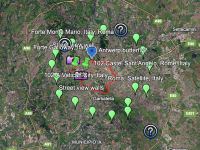
It’s interesting to note how many starforts seem to encircle Rome. Palmanova—the great Venetian trading hub to the north—was reportedly built in 1593, while Fort Saint Sebastian in Ghana dates back even earlier, to 1520. It really does look as though starfort construction accelerates sharply in the 1500s.

In North America, the first example appears much later: Castillo de San Marcos in 1692. If these structures were directly tied to the expulsion of the Jews from Spain, one might expect a starfort presence there sooner.

To Frosty’s point, it’s striking how the most remote starforts cluster along rivers, almost like waystations for traders pushing into harsher interiors—particularly across parts of Asia. This raises an ongoing challenge: Euro-centric alternative histories often struggle to align neatly with timelines from regions like China. Has anyone made progress in reconciling these parallel histories?
 

Attachments

  • Screenshot 2025-12-01 at 12.52.40 PM.png
    Screenshot 2025-12-01 at 12.52.40 PM.png
    1.9 MB · Views: 56
Approximately when was Prophet Muhammad born?
I guess it was around the 16th-17th century? Or maybe 15th? Then when were the Ottoman Empire and caliphates actually founded?

The influence of Islam stopped in northern India, in Xinjiang, and western Mongolia (Kazakhs). The Mongols and Tibetans are Buddhists. Islam spread into western mongolia via Kazakhs after the genocide of Dzungars.

By the way, weren't the Uyghurs Buddhists during the time of Genghis Khan? And I'm not talking about modern Uyghurs but nowadays Yugur people — still buddhists.

I found interesting that Dzungars were called Kalmyks. Apparently kalmak means "the remaining", "who left behind." What does it mean? It turns out it means "didn't convert to Islam" — an exonym by central asians who converted to Islam. And this was somewhere around the 17th-18th century.
 
A quick hit concerning the origin of the word "Caesar", which also exists in Germany (Kaiser), Russia (Czar), the Ottoman Empire (Kaiser-i-Rumi), and probably a bunch of other places as well. I've heard multiple explanations for the origin of the name. One claim is that the name originates from the fact that Caesar was born via Cesarean section. Compare for example to the French words "césure" which just means "cut" or "ciseaux" (scissors). If I remember correctly, Fomenko attaches a lot of importance to this.

Andrey Pustogarov presents a theory which I've never heard and which makes logical sense. He claims that the word "Caesarea" (spelled different ways in different languages) comes from an Arabic word that simply means "market". So the "Caesar" is nothing but the market master. He compares this to other noble titles such as "count" (which he derives from the verb "to count", i.e. a clerk) or the German "Graf", which can be connected to writing (graphism).

That's why we have Caesars everywhere. It was an important function in the primordial monotheistic empire, of which Arabic was the original lingua franca.

Before the emergence of absolutist dynasties and, indeed, states in the modern sense of the word, in the 15th century AD, merchant corporations or guilds were the dominant structures. (...) These merchants' strongholds or trading posts were temples, which served as merchant quarters and storage facilities, as well as for the merchant treasury. (...) We believe that the language of communication among these merchants was an artificially created Arabic. A similar merchant corporation existed in Spain among the Moorish Arabs, also known as the Spanish Sephardic Jews (in our book, we demonstrate that there is no difference between them). Expelled from Spain and resettled in Rome-Constantinople, the Sephardim eventually came to power there under the name of the Ottoman dynasty. The title of kaisar, however, remained from their former merchant life. (...)


Here is what the encyclopedia "History of Architecture" writes in the chapter "Architecture of the Arab Countries": "A developed network of public buildings was formed. Intensive caravan trade gave rise to the construction of inns, caravanserais, or funduks, in cities and along the routes. Medieval souk markets formed a system of covered streets with workshops and shops; special covered passages, kaisariya, were set aside for the sale of fabrics".


Here's what Josephus Flavius writes about King Herod: "And he built Caesarea in many cities".


However, today the term "Caesarea" (Caesarea) is also applied directly to markets in general. For example: Caesarea Bazaar is a large bazaar complex located in the historical district of the Iranian city of Isfahan; the Kaisariyya Bazaar in Irbil, Iraq; and the Al-Qaisariya Market in the city of Al-Hofuf in Saudi Arabia. Therefore, we believe that "Caisarea" also simply meant a place of trade without specifying the goods.


Рим на ÐоÑÑоÑе. ÑаÑÑÑ 1 (ÐаÑало ÐÑÑоÑии) / ÐÑоза.ÑÑ

Sounds logical to me. Bringing it back to the Roman Empire based in Italy, according to Pustogarov, it was founded by Jewish merchants in the 15th century and only became important due to nearby large deposits of alum, which was a crucial resource in the Renaissance. Presumably these Jewish merchants were rivals of the Sephardim based in Constantinople (Romi). The group in Italy basically stole and rewrote the history of Constantinople after their alum monopoloy put them at the center of global trade. Part of that theft must have included inventing a fake origin for the old merchant title "Caesar".

To Frosty’s point, it’s striking how the most remote starforts cluster along rivers, almost like waystations for traders pushing into harsher interiors—particularly across parts of Asia. This raises an ongoing challenge: Euro-centric alternative histories often struggle to align neatly with timelines from regions like China. Has anyone made progress in reconciling these parallel histories?

The ultra-short answer: the timelines of these other regions were imposed by Jesuits from the 16th-19th centuries as part of a "deal" offered by the dominant European merchant/colonial powers to whatever local representative they deemed most pliable to their interests. The deal went something like: "Here is our Rome- and Christ-based chronology. You can keep your history, but only in a rewritten and backdated form approved by us. Merge your calendar with ours, allow us to (re)create your archives, and you will be invited to make serious coin as a junior partner in our global trade network. Refuse, and we will get rid of you and find someone more reasonable to do business with. Bonus, your family will get to trace its origins back to the gods and we'll completely erase your rivals from the new history." Presto, China is "five thousand years old". The same thing happens today, look at the way the US bribes rando dissidents to run astroturfed "color revolutions" in countries they want to overthrow. There are no "ancient civilizations", everything everywhere is roughly 600-700 years old.
 
Last edited:
Tips
Tips
Please respect our Posting Rules.
Back
Top