250 years ago there was no Russian language yet

There are 3 Russian states in the Modern world. This is the Russian Federation; Belarus; Ukraine. They were invented by the communists (masons) in 1917. However, it was not an obligatory project. In fact, they wanted to create a "Free Cossackiya" from the Don Cossacks (the region of Rostov-on-Don) The problem is that they began to resist. The whole project ended with genocide :) The Jews were moving by the force of separatism in Ukraine and Belarus. True, the Belarusian Jews were less fortunate. They were destroyed during the Second World War. On the other hand, the state of Belarus calmed down and became stable. True, the local population is tortured with the "peasant" -Communist Language (BeloRussian language) :) Yes, this whole circus is paid for by Moscow and Putin, why can't he put it down, no one can answer Unfortunately, the USSR was not an independent state government. He was ruled by the same Habsburg-Holstein, from England (There is a hypothesis that Nicholas 2 did not die, but went to England and became George. Who knows? If you consider what spiders they are, coronavirus is when all the presidents on command do as ordered .. ..)

In 1914 there were more Russian states. Austria-Hungary. This is a Slavic state. In Prussia (a very good "German" word) Germanisation has already been completed There is also definite evidence of Slavic traces in the Ottoman Empire; in Moldova-Romania; in Sweden; in France. But this is all destroyed and "no one will believe you."

On the other hand, we already live in a world where all whites are simply destroyed. Destroy white French, white Germans. To destroy the Russian language (aka Slavic, aka Celtic) is not enough. By the way, it makes me smile that angry articles are being written from Switzerland. This is the family estate of the Habsburg-Holstein-Windsor line. The only Neutral country that does not take any Gas weapons of the First World War; nor World War II; there is a clean ecology, mountain milk, real chocolateade (all chocolate around the world is poisoned, you need to write letters to the Indians in America and beg them to sell you beans that have not been poisoned), diamonds and cans. As far as I understand, there is another secret place. This is the island of Cuba :) So there is a secret golden bank of presidents))))) (Let's remember the rumors that the President of Canada is the son of Castro) Another good place for such storage is North Korea.
 
I notice you use the terms "Russian" and "Slavic" interchangeably, as if they mean the same thing. I get the impression you're implying that Russia is the sort of "spiritual leader" of the Slavic world in your view? I'm not sure that's really accurate and sounds very political/nationalistic, that's akin to saying "English" and "Germanic" mean the same thing.

The Slavic languages/people originated in the Carpathian mountains, and expanded eastwards into what is now Russia, assimilating the Finno-Ugric and other native populations, Russia is not the origin of the Slavic language/culture despite being by far the largest "Slavic" nation today.
 
Russian is the real name of many countries. Rus` = Ros = Russia = Rossia = Rasia = Race
For example, Italy is Etrusia. Venice is Venedia. Northern Germany is Prussia. Etc. There was Carpathian Rus. Many of these countries are already forbidden to be called Slavic.

I believe that there was a single world with a single architecture. Then it was destroyed. On its ruins, BANDITS (Aristocrats) began to divide it into Gangs. By the way, none of the aristocrats hides that they are bandits, pirates, war crimers, slave traders etc. The kindest Aristocrats are officers and persons with fake-documents.

It is obvious that the world belongs to Several Families and One Religion. (Again. Christianity Muslims Judaism Freemasonry Buddhism is a single religion. I even read a book where a 19th century religious historian was surprised that Catholicism and Tibbetian Buddhism are very similar in rituals) To control, these religions are constantly dividing. The Calvinists beat the Lutherans :))) Wahhabis beat the Suffis. Even a country like Sweden-Norway-Denmark was divided between the sons of the Bandits. Instead of the Union, they came up with new languages throughout the 19th century, came up with documents "we found secret documents in the basement of Iceland." But do not rejoice, it is common knowledge that Swedish Masons do not have a chapter. Pyramids, strict observance of orders, but there is no head of this pyramid. That is, this system receives orders from nowhere :) I don't really like small countries, because they think like children. They believe that they want to kill, catch, force. They are offered to be an equal partner, and they go crazy. At the same time, the Coronavirus Crisis showed that their own governments want to kill them. That all presidents in all countries are carrying out a secret plan (all presidents are united and get back from the envelope) Most of all, it shocked the nationalist peoples, who thought that they were tough guys (Germany, England, etc.)

All the hatred of the Germans for the Czechs flies away, it turns out that the information that you are relatives and both of you will be killed is more important. So you need to look for something that will unite people above this For example, there are Croats and Serbs. THIS IS THE ONE LANGUAGE, Yugoslavian. (Serbo-Croatian or Croatian-Serbian) Again, the head of the "Serbian nationalism" of Yugoslavia was the croat Bros Tito. All that separates them is the Biblical Sects. And a different story that the Croats were Vatican border keepers.

And these phrases, "Guys, live together", "You are one people", "let's live peacefully between countries" as dangerous fascism. Regarding the Cyrillic Alphabet, it displays sounds well. 33 letters are better than 26. Czechs and Poles especially suffer from this, they have to change themselves to the alphabetical system.

The idea of settling Finns everywhere is the idea of the Holstein-Habsburgs. Moreover, these Finns are actually 5,000 people per tribe. Some of them are Chinese, others are White people who speak this Altai language. Even if we take Finland, it was the Swedish Holstein Masons - "Romanovs" who created the Finnish language. From a biological point of view, there are no Finns. But of them there were Servants :) That is, the population stands out, they tell them that they are KASTA-Finns, and this whole Casta works for the Land Lords. The same joke in Britain and Ireland. Irish, British, Northern Protestants, Southerners are not biologically visible. They just give out roles in the theater. "You will be a slave all your life, and your children will be slaves. And we will sniff cocaine and play the playstation" :))))) And they also say that there were Monkey People Irish. They had dog-like fangs and must be exterminated. This is a purely Indian Colony system :) "All 7 generations our family has been cleaning toilets" ...

If you study the Finns, it is obvious that this is not their culture. This is Gusli-Kantele; these are legends; it is Indo-European clothing embroidery, etc. This type of music was destroyed by the church in the 19th century and 1900s. Because their version of history contradicted the official one. (Guslars, Kantelisty, Skaldy and so on)

 
250 years ago there was no Russian language yet
Kinda yes, but also no.
Mainstream history agrees on that one. Before late 18th century, there was no written form of pure Russian. From the start, there was an official old-church-Slavonic in which most of the stuff was written. Old-church-Slavonic is old Bulgarian, presumably where the alphabet and orthodoxy came from to Russia. Now that doesn't mean that all Slavs there spoke or wrote in old Bulgarian. Whatever was the name, there was an older form of modern Russian where the eastern Slavs lived, now called "old Russian" , here's an example:

1618144812533.png
Translation to modern Russian:
`Грамота от Жизномира к Микуле. Ты купил рабыню во Пскове, и вот меня за это схватила (подразумевается: уличая в краже) княгиня. А потом за меня поручилась дружина. Так что пошли-ка к тому мужу грамоту, если рабыня у него. А я вот хочу, коней купив и посадив [на коня] княжеского мужа, [идти] на очные ставки. А ты, если [еще] не взял тех денег, не бери у него ничего'

Translation to English:
`A letter from Zhiznomir to Mikula. You bought a slave girl in Pskov, and now the duchess grabbed me for it (meaning: incriminating in theft). And then the squad vouched for me. So send a letter to that man if he has the slave. But I want to, having bought horses and put the duke's man on the horse , [go] to face-to-face confrontations. And you, if you haven't taken that money [yet], don't take anything from him '


They found hundreds, if not thousands of letters like that (mostly in Novgorodian region). I don't know how fast processed birch bark decays, so I'm not the one to judge their authenticity. Linguistically though, it makes sense. There was a growing disconnect between how people actually spoke and the official book language, so by the end of 1700s, something serviceable started to emerge (re-emerge?). Not a mish-mash of those two, but something resembling human speech

The church language, although consisting of some familiar words, sounds very convoluted because of the different rule-sets. Some of those rules and words have made their way into Russian though. From the top of my head:
Participles
instead of Russian золото - church-Slavonic злато (gold). ворота - врата (gate), волосы - власы (hair). голова - глава (head) etc
жд sound instead of ж (невежда - невежа (ignorant person), чуждый - чужой (foreign))
And some more

For why does modern Russian differ from the rest eastern Slavic ones, I'll quote this:
The country of Novgorod is a very curious place. it's the very first thing that came to mind when I started to look into the chronology shenanigans
Specifically the birch bark manuscripts, their discovery helped in uncovering the origins of Russian language. Back in the day the Novgorodian region had it's own distinct dialect (given more time to develop, it would probably become a distinct northern Slavic language). Independent Novgorod stopped existing in the 15th century (a recurring theme, isn't it?), it was conquered by Moscow. These manuscripts are a recent discovery, they mostly were simple casual conversations between people, much like chats are today***. Officially, people in Great Novgorod were highly literate (women too apparently, they always point it out for some reason), so they don't question the grammar in those writings, as it was consistent enough.

The dialect itself is a missing link between modern Russian and other eastern Slavic languages. Precisely half of Russian itself consists of Novgorodian rules and words. The Ukrainian and Belarusian are more in line with the southern old Russian dialect, they were separated by the border of the Grand Duchy of Lithuania, while the rest of Russia mixed and the modern language was born.

***Now Novgorod (where Alexander Nevsky was a duke) and it's periphery are situated in the north, those manuscripts were and are dug up there. Most of the above information comes from this channel, which is ironic, because he is a disciple of Andrey Zaliznyak, who was strongly advocating against Fomenko's theories and 'alternative' history. He was responsible for digging up a lot of those manuscripts. I haven't looked deeper into the contents of manuscripts themselves, but I heard they once found a message addressed to some high-ranking priest (why do we get so little historical snippets, I wonder). Take that for what you will

This early north-south and later east-west dichotomy is something to look into:
https://stolenhistory.net/threads/t...in-history-it-was-bigger-than-russia-once.38/https://stolenhistory.net/threads/the-hanseatic-league-who-were-they-really.1632/https://stolenhistory.net/threads/homer-in-the-baltic.4013/
 
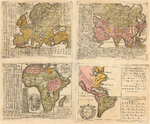
There's this weird linguistic map

Gottfried Hensel, b. 1689? “Europa poly glotta: Linguarum genealogiam exhibens, una cum literis, scribendiq[ue] modis, omnium gentium” ([Nuremberg]: Excusa prostat in Officina Homanniana, [1741]). Four copperplate maps, with added color, each 16 × 21 cm, on one sheet 51 × 57 cm [Historic Maps Collection]. From his Synopsis vniversae philologiae . . . (Nuremberg: Homann, 1741).

карта языков.jpg

(Same but more continents)
hensel-map.jpg

Correct me if I'm wrong, but do the letters of Slavic languages get more Greek-looking the further north you go? Is it because language reforms took longer to reach there or perhaps we need to ask Felice Vinci?

Interestingly, there's no Ukrainian one. The Poland has borders resembling those of late 18th century.

The northernmost part is dubbed Nova Zemblicæ, which I assume is Новая Земля - New Land/Earth (it may named be after a flower zembla :unsure:, who knows). The island with the same name is even further north. Recently, a bomb testing site.
1619700247094.png
1652-nova-totius-terrarum-orbis-geographica-ac-hydrographica-tabula_1 (2).jpg
1619701040185.png


However, the south-Slavic one (Slovenia, Yugoslavia) has a bit more modern look. Maybe that's what those pictures in the OP were hinting at, that the modern alphabet came from Slovenia?
 
It looks like the map suggests that present day Ukraine was "Tartaria" then?
There's no country separation between them, so here it's part of Russia. The lack of Ukrainians is weird though, maybe that's how Cossacks came to be?
 
By the way it says "Tartaria vocibus Teutonicis et Slavonicis mixta"... which is roughly "Tartaria where both Teutonic and Slavic languages are spoken"!!!
 
There's no country separation between them, so here it's part of Russia. The lack of Ukrainians is weird though, maybe that's how Cossacks came to be?

Is it possible that Ukrainians were originally non-Slavic and were Russified a lot later than the mainstream history says? Although as the Kievan Rus is supposedly the foundation of Rus history I guess that theory would not go well with the mainstream chronology.

I think it would explain the high level of anti-Russian sentiment in Ukrainian society, if in reality they are a non-Slavic people who were Russified.
 
And Italian proper is the language of northern Italy...

Cattura7.PNG
Pure blonde type (in blue) distribution (1859-1863)

biondo-puro.jpg
Is it possible that Ukrainians were originally non-Slavic and were Russified a lot later than the mainstream history says? Although as the Kievan Rus is supposedly the foundation of Rus history I guess that theory would not go well with the mainstream chronology.

I think it would explain the high level of anti-Russian sentiment in Ukrainian society, if in reality they are a non-Slavic people who were Russified.
I believe the distinction between slavic and germanic should be reconsidered when applied to ancient history. People want an ongoing WW2 by projecting it into the past no matter what. There could be some truth obviously, but I am against its use for political purposes
 
Last edited by a moderator:
Is it possible that Ukrainians were originally non-Slavic and were Russified a lot later than the mainstream history says? Although as the Kievan Rus is supposedly the foundation of Rus history I guess that theory would not go well with the mainstream chronology.

I think it would explain the high level of anti-Russian sentiment in Ukrainian society, if in reality they are a non-Slavic people who were Russified.

It may be possible that the Tartarians were the first who invaded, considering the name-change

I think that this modern sentiment is just that, modern. A further way of division
I believe the distinction between slavic and germanic should be reconsidered when applied to ancient history.
Yeah, there's some Gothic influence in Russian, the word хлеб (bread) for example, it has Gothic origins, but is one of the most common ones in use
 
It would be cool to have a section in this forum when one can put all the similar words without a proper explanation in modern linguistics. For example the Greek στρατιά (stratìa) means/meant army. But if you think that Romans built streets (strade in Italian) for military purposes, there you have it!
 
Last edited by a moderator:
It would be cool to have a section in this forum when one can put all the similar words without a proper explanation in modern linguistics. For example the Greek στρατιά means/meant army. But if you think that Romans built streets (strade in Italian) for military purposes, there you have it!
In Russian there's a word страсть (strast'), which means passion. Passion in the army? That sounds illegal
 
Another one I recently found, whether or not you believe in ancient technology or aliens (can I say this word or is it illegal:ROFLMAO:?) is the inside-meaning of the English words heaven and haven in relation to airports and flying machines (Biblical matters according to Biglino). But here we are going off-thread I suppose!
 
Last edited by a moderator:
Another one I recently found, whether you believe in ancient technology or aliens (can I say this word or is it illegal:ROFLMAO:?) is the inside-meaning of the English words heaven and haven in relation to airports and flying machines (Biblical matters according to Biglino). But here we are going off-thread I suppose!
Coincidentally, there's no English on this map. Someone with knowledge in Germanic languages should analyze this map somewhere separate
(Same but more continents)
Also, why some countries here are yellow, white, pink and green?
 
Last edited by a moderator:
It would be cool to have a section in this forum when one can put all the similar words without a proper explanation in modern linguistics.
So? (Russian). Word "Glaz-Глаз-Eye-Ай".

Русский язык как фундамент для будущего/прошлого единого языка.

For example the Greek στρατιά means/meant army. But if you think that Romans built streets (strade
In the Russian language there is the word "stroy" (military system - voenny stroy - военный строй), the word " rat' " (army - рать). / Read about " Nas orda, a nas rat' " -"Нас орда, а нас рать" / And in general, if you read "στρατιά" in Russian letters, you get "otratiya" (from rati - ot rati - от ратии).

Next, the word "strada" or "street" or "straße" (shtrasse - deutsch). Russian has the word "vstrecha" (meeting - встреча), in a number of Russian cities there is or previously there was a Sretenka Street (in honor of "Vstrecha/Sretenie Gospodnya" или "Встреча/Сретение Господня" - the meeting of the Lord). Previously, these streets were called Stretenki, but over time the letter "t" dropped. That is, the connection with the English "street" is established even within the historical Russian language. I'm not even talking about the fact that now the word street is used everywhere in the Russian language "street-art" (стрит-арт - уличное искусство или уличная культура), "street" (стрит - уличный баскетбол), etc.

And the English word "street" itself was previously (before the vowel shift) "stret".

Great Vowel Shift - Wikipedia

The same goes for the words "strasse" and "strada". In the Russian language there are similar borrowed, and culturally entered into everyday life, analogues - "trassa" (трасса - highway), "trassirovat' " (трассировать - trace), "avtostrada" (автострада - highway) , etc.

Also, the word "stroy" (build - строй) has the meaning of "stroit' " (build - строить), which very easily fits the word "street" (стрит).

In addition, the word "stroy" also means a "stroenie" (structure - структура - строение - both a building and an organism). The "structure of the organism" in the Russian language understands its system.

This is well expressed in Tyutchev's lines, which are present at the beginning of Vernadsky's book "Biosphere and Noosphere".

Невозмутимый строй во всём,
Созвучье полное в природе…

Nevozmutimy stroy vo vsöm,
Sozvučie polnoe v prirode…

An unruffled system in everything,
Consonance is complete in nature…
 
Last edited by a moderator:
Another one I recently found, whether or not you believe in ancient technology or aliens (can I say this word or is it illegal:ROFLMAO:?) is the inside-meaning of the English words heaven and haven in relation to airports and flying machines (Biblical matters according to Biglino). But here we are going off-thread I suppose!
Like german "hafen"? = harbor, became heaven? where the "sea✴️" harvest's maybe? etc. 😏

Anyway, can most non yoguslav slavs understand serbian today?
And did the gypsy language become influenced of either slavic or modern russian as they passed on their migration west? Their brothers, the juice, speak a strange form of dutch so.. I dont wish to derail this thread, im just curious what languages was in europe before united Rus came to be. Wouldnt it be great if Tartar and Romani (strange nameing) would have been related. Meaning, when the rus main language came about, there were no time for gypsys to take in theur words, or non left to do so.
 
Like german "hafen"? = harbor, became heaven? where the "sea✴️" harvest's maybe? etc. 😏

Anyway, can most non yoguslav slavs understand serbian today?
And did the gypsy language become influenced of either slavic or modern russian as they passed on their migration west? Their brothers, the juice, speak a strange form of dutch so.. I dont wish to derail this thread, im just curious what languages was in europe before united Rus came to be. Wouldnt it be great if Tartar and Romani (strange nameing) would have been related. Meaning, when the rus main language came about, there were no time for gypsys to take in theur words, or non left to do so.

Hafen (deu) = Harbor (eng) = гавань-gavan' (rus)

According to one version, the word "harbor" came into Russian from Dutch - "haven" (Hebrew, and not only, but they were often the carriers of languages from place to place, the mutual transition of "b" and "v"). "G" often goes to "h" and back. In Russia, this is clearly seen in the example of the southern dialect and the Ukrainian language, where the use of the letter "h" is found everywhere (the phenomenon is called "hekanie"). "V" and "f" are paired sounds, sonorous and deaf, at least in Russian, but I'm sure that in others too. So, the connection between Hafen and Gavan' is established, although it is so obvious to any Russian speaker.

The connection between "harbor" and "gavan'" is more complicated, but it also exists. "Harbor" goes back to "here breg". English speakers read it now as "here coast", but a Russian speaker (without using the rules of the English language) will read it as "here breg" by letters.

With the word "breg" everything is very easy - "bereg" (rus), but if you say "breg', then everyone will understand you, also the variation "breg" is often found in Pushkin's works.

With the word "here" everything is a little more complicated, but if you turn on the logic, then everything falls into place. The modern Russian letter "H" (X Russian), has the historical name "her" (xep russian). Until now, the origin of this letter is officially unclear, but analyzing your case (thank you for such an interesting task), - everything fell into place. The Russian letter "HER-XEP-X" has the meaning "zdes' - here". And how do they designate a place all over the world that is in the conditional "here"? That's right, a cross. Therefore, in Russian the letter "X", not "H". By the way, now in Russian, the word "xep" has the meaning "dick". Perhaps, from above, this is how they break the ties between our cultures.

So turning on the head, any Russian speaker will understand the meaning of the original English "here-berg", which later transformed into "harbor".

Further, in the Russian language there is a slang word "havka" (noun) or "havat'" (verb), which is understood by absolutely every Russian speaker. Now it is claimed that this word came to us from the dudes in the meaning of "people haves". There are also versions about Gypsy and Jewish origin. But in the Russian language there is a word "chavkat' " (= slurp - sounds that you make when you take food), which came from the Ukrainian "havkat' ".

Having established the previous part, we can conclude that heaven for people is a place where there is a lot of food (havka). Plus, "havka" is similar to "HLEB" (bread). You can also add the Russian word "halyava" = freebie here. Which somewhat depresses me))) Still, I want to believe in some higher ideals.

And the connection between "havka" (food) and "Haven" (harbor) is due to the fact that after reaching any shore, people could finally eat normally.

In the Russian language, there are expressions "molochnye reki", "kisel'nye berega" - "milk rivers", "jelly banks". These expressions mean "hlebnye mesta" - "bread or rich places". (I'm sure there are analogues in European cultures - for example, Pays* de Cocagne). Since the port is almost always in the most advantageous position, the connection can be traced.

* "Pays". In Russian there is a word "pay" or "payok". Meaning - part, lot, happiness. According to the accepted etymology, it originated from the Turkic languages. The word "payok" or "payka" in Russian is a common noun. It is most often used for those who work for the state or the army (for conscript soldiers).
 
Tips
Tips
Please respect our Posting Rules.
Back
Top