250 years ago there was no Russian language yet, in the European part of modern Russia they wrote in "Rossiyskiy language". 250 years ago there was no established "Rossiyskiy language", they often wrote at that time in "Slavensky language". For example, Zakhary Orfelin's work "The life and glorious deeds of the Emperor Peter the Great" was written in "Slavensky language":
"has now been written down and published for the first time in Slavensky language"
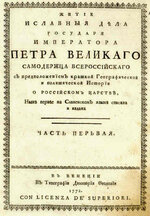 https://digitalna.nb.rs/wb/NBS/Star..._Zaharije_Orfelina/S-II-0888a#page/0/mode/1up
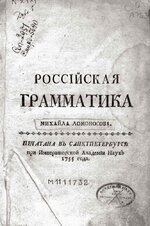
To all appearances, the Russian language was formed by the efforts of Alexander Pushkin, while the Rossiyskiy language was formed by Mikhailo Lomonosov ("Rossiyskiy Grammar"). In this aspect, Lomonosov's words concerning the Slavensky language are interesting:
 Source:
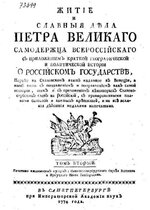
For comparison the title page of the 2 years later reprint of "The life and glorious deeds of the Emperor Peter the Great" written in "Rossiysky language":
 https://play.google.com/store/books/details?id=qwlhAAAAcAAJ&rdid=book-qwlhAAAAcAAJ&rdot=1
Also interesting that full title on Slavenskiy and Rossiyskiy languages principally differs only in one word: царествѣ/государствѣ.
Slavensky:
(with modern Russian it could be translated as: Vita and glorious deeds of Emperor Peter the Great All-Russian autocrat with the assumption of a brief geographical and political history of the Russian tsarstvo (kingdom, realm))
Rossiysky:
(with modern Russian it could be translated as: Vita and glorious deeds of Peter the Great All-Russian autocrat with a brief geographical and political history about the Russian gosudarstvo (state, government))
Tsarstvo - from Tsar
Gosudarstvo - from Gosudar
In modern Russian, by the way, there is a stable word combination "tsartstvo-gosudarstvo", used mainly in children's folklore:
https://www.google.ru/search?q=царство-государство&tbm=isch[automerge]1608411969[/automerge]
Pyzhikov: Russians were created by the Jesuits.
Aleksandr Vladimirovich Pyzhikov — Russian historian and statesman, doctor of historical sciences, professor.
(automated translated subtitles are available)
"has now been written down and published for the first time in Slavensky language"
To all appearances, the Russian language was formed by the efforts of Alexander Pushkin, while the Rossiyskiy language was formed by Mikhailo Lomonosov ("Rossiyskiy Grammar"). In this aspect, Lomonosov's words concerning the Slavensky language are interesting:
"Slavensky language at the time of the Ruriks, and according to the Rossiysky chronicles, and a lot of before that, stretched in length from the east to the Don and Oka rivers and to the west to Illyrik and to the Alba river, and in width from noon to the Black Sea and from the Danube river to the southern shores of the Varangian Sea, to the Dvina river and to the Bela lake; for they were spoken by Czechs, Lekhs, Morava, Pomors or Meranians, Slavs on Danube, Serbs and Slavic Bulgarians, Glades, Bujanes, Krivichi, Drevlyanian, Novgorod Slavs, Beloozercians, Suzdalians and so on. And for Slavensky language to spread only widely, it was necessary for a very long time and many centuries, and especially that the Slavensky language neither from Greek, nor from Latin, nor from other known does not origin; therefore, itself consists already of the most ancient times, and numerous of these Slavic peoples spoke Slavensky language even before Christ."
For comparison the title page of the 2 years later reprint of "The life and glorious deeds of the Emperor Peter the Great" written in "Rossiysky language":
Also interesting that full title on Slavenskiy and Rossiyskiy languages principally differs only in one word: царествѣ/государствѣ.
Slavensky:
Житіе иславныя дѣла государя императора Петра Великаго самодержца всероссійскаго съ предположенїемъ краткой Географичкской и политической Исторїи о Россійскомъ царствѣ
(with modern Russian it could be translated as: Vita and glorious deeds of Emperor Peter the Great All-Russian autocrat with the assumption of a brief geographical and political history of the Russian tsarstvo (kingdom, realm))
Rossiysky:
Житіе и славныя дѣла Петра Великаго самодержца всероссійскаго съ приположеніемъ краткой географичкской и политической исторїи о Россійскомъ государствѣ
(with modern Russian it could be translated as: Vita and glorious deeds of Peter the Great All-Russian autocrat with a brief geographical and political history about the Russian gosudarstvo (state, government))
Tsarstvo - from Tsar
Gosudarstvo - from Gosudar
In modern Russian, by the way, there is a stable word combination "tsartstvo-gosudarstvo", used mainly in children's folklore:
https://www.google.ru/search?q=царство-государство&tbm=isch[automerge]1608411969[/automerge]
Pyzhikov: Russians were created by the Jesuits.
Under Catherine the Great the Jesuit project in Russia begins. Catherine the Second decided to make a major ideological turn. She decided to form "one people" as soon as possible, one nation. In other words, to depict the unity of the ruling stratum and the population. That's what the rulers of other European countries were doing. It was the second half of the 18th century that was the peak of these efforts to create united nations. And the Order of the Jesuits participated and made a significant contribution. For example, the very understanding of Eastern Europe was shaped by the Jesuits. I shall mention only one surname of Serb Boskovich who was the Jesuit and actually it has generated concept "east Europe" in its Slavic sense. And in grinding of Slavic languages the other Jesuit Czech Joseph Dobrovsky has made the huge contribution. He did not have time to finish the novitiate, but he communicated with this audience. The Jesuit's contribution to the creation of the Slavic ideology can be seen everywhere.
What did Catherine want? Pugachev's uprising frightened the entire ruling stratum. And the main conclusion that Catherine made - there is no single nation. It showed all these events. The murders of landlords, bishops. There is no people with whom the ruling tier can consider itself one. And Catherine faced the task - we need a single people, which would include both the ruling stratum and the huge masses of indigenous people. Who will do it?
And so Catherine the Second, when she began to implement the idea of a single nation, she took advantage of the experience that had already been gained in other countries. Who made the greatest contribution to the creation of European nations, especially Slavic ones? And here the Order of the Jesuits soaked, especially it was banned and out of business. Catherine decided to use this opportunity and invited them here, entrusting them with the educational system. And for the sake of this, she even moved away from the education of the Orthodox Church, its hierarchs, believing that they can not cope with the task. The educational system is a Jesuit methode, and they started to create their own colleges, "Collegiums". And by the way, the first Minister of Education of the Russian Empire Zavadovsky was a graduate of a Jesuit college, and then the Kiev-Mohyla Academy. This bunch meets constantly - the Jesuit College and the Kiev-Mohyla Academy, which we declare the "heart of Orthodoxy. Jesuit educational institutions were very popular with the Russian elite.
Aleksandr Vladimirovich Pyzhikov — Russian historian and statesman, doctor of historical sciences, professor.
(automated translated subtitles are available)
Last edited: