250 years ago there was no Russian language yet

zlax

Banned
Joined
Dec 12, 2020
Messages
147
Reaction score
518
250 years ago there was no Russian language yet, in the European part of modern Russia they wrote in "Rossiyskiy language". 250 years ago there was no established "Rossiyskiy language", they often wrote at that time in "Slavensky language". For example, Zakhary Orfelin's work "The life and glorious deeds of the Emperor Peter the Great" was written in "Slavensky language":
"has now been written down and published for the first time in Slavensky language"
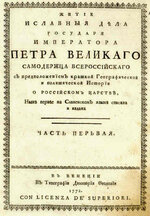
1583500890-a2240fa7d5a0b6f3030aec112bfc809c.jpg
https://digitalna.nb.rs/wb/NBS/Star..._Zaharije_Orfelina/S-II-0888a#page/0/mode/1up
To all appearances, the Russian language was formed by the efforts of Alexander Pushkin, while the Rossiyskiy language was formed by Mikhailo Lomonosov ("Rossiyskiy Grammar"). In this aspect, Lomonosov's words concerning the Slavensky language are interesting:
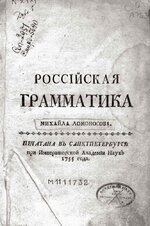
"Slavensky language at the time of the Ruriks, and according to the Rossiysky chronicles, and a lot of before that, stretched in length from the east to the Don and Oka rivers and to the west to Illyrik and to the Alba river, and in width from noon to the Black Sea and from the Danube river to the southern shores of the Varangian Sea, to the Dvina river and to the Bela lake; for they were spoken by Czechs, Lekhs, Morava, Pomors or Meranians, Slavs on Danube, Serbs and Slavic Bulgarians, Glades, Bujanes, Krivichi, Drevlyanian, Novgorod Slavs, Beloozercians, Suzdalians and so on. And for Slavensky language to spread only widely, it was necessary for a very long time and many centuries, and especially that the Slavensky language neither from Greek, nor from Latin, nor from other known does not origin; therefore, itself consists already of the most ancient times, and numerous of these Slavic peoples spoke Slavensky language even before Christ."
1583500885-eab68e78efbfb95f46cbaed8134a0295.jpg
Source:


For comparison the title page of the 2 years later reprint of "The life and glorious deeds of the Emperor Peter the Great" written in "Rossiysky language":
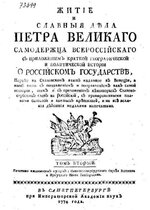
1608411754-c77968e3981d8939da50c67170ad57e8.jpg
https://play.google.com/store/books/details?id=qwlhAAAAcAAJ&rdid=book-qwlhAAAAcAAJ&rdot=1
Also interesting that full title on Slavenskiy and Rossiyskiy languages principally differs only in one word: царествѣ/государствѣ.

Slavensky:
Житіе иславныя дѣла государя императора Петра Великаго самодержца всероссійскаго съ предположенїемъ краткой Географичкской и политической Исторїи о Россійскомъ царствѣ

(with modern Russian it could be translated as: Vita and glorious deeds of Emperor Peter the Great All-Russian autocrat with the assumption of a brief geographical and political history of the Russian tsarstvo (kingdom, realm))

Rossiysky:
Житіе и славныя дѣла Петра Великаго самодержца всероссійскаго съ приположеніемъ краткой географичкской и политической исторїи о Россійскомъ государствѣ

(with modern Russian it could be translated as: Vita and glorious deeds of Peter the Great All-Russian autocrat with a brief geographical and political history about the Russian gosudarstvo (state, government))

Tsarstvo - from Tsar
Gosudarstvo - from Gosudar

In modern Russian, by the way, there is a stable word combination "tsartstvo-gosudarstvo", used mainly in children's folklore:
https://www.google.ru/search?q=царство-государство&tbm=isch[automerge]1608411969[/automerge]
Pyzhikov: Russians were created by the Jesuits.
Under Catherine the Great the Jesuit project in Russia begins. Catherine the Second decided to make a major ideological turn. She decided to form "one people" as soon as possible, one nation. In other words, to depict the unity of the ruling stratum and the population. That's what the rulers of other European countries were doing. It was the second half of the 18th century that was the peak of these efforts to create united nations. And the Order of the Jesuits participated and made a significant contribution. For example, the very understanding of Eastern Europe was shaped by the Jesuits. I shall mention only one surname of Serb Boskovich who was the Jesuit and actually it has generated concept "east Europe" in its Slavic sense. And in grinding of Slavic languages the other Jesuit Czech Joseph Dobrovsky has made the huge contribution. He did not have time to finish the novitiate, but he communicated with this audience. The Jesuit's contribution to the creation of the Slavic ideology can be seen everywhere.

What did Catherine want? Pugachev's uprising frightened the entire ruling stratum. And the main conclusion that Catherine made - there is no single nation. It showed all these events. The murders of landlords, bishops. There is no people with whom the ruling tier can consider itself one. And Catherine faced the task - we need a single people, which would include both the ruling stratum and the huge masses of indigenous people. Who will do it?

And so Catherine the Second, when she began to implement the idea of a single nation, she took advantage of the experience that had already been gained in other countries. Who made the greatest contribution to the creation of European nations, especially Slavic ones? And here the Order of the Jesuits soaked, especially it was banned and out of business. Catherine decided to use this opportunity and invited them here, entrusting them with the educational system. And for the sake of this, she even moved away from the education of the Orthodox Church, its hierarchs, believing that they can not cope with the task. The educational system is a Jesuit methode, and they started to create their own colleges, "Collegiums". And by the way, the first Minister of Education of the Russian Empire Zavadovsky was a graduate of a Jesuit college, and then the Kiev-Mohyla Academy. This bunch meets constantly - the Jesuit College and the Kiev-Mohyla Academy, which we declare the "heart of Orthodoxy. Jesuit educational institutions were very popular with the Russian elite.

Aleksandr Vladimirovich Pyzhikov — Russian historian and statesman, doctor of historical sciences, professor.


(automated translated subtitles are available)
 
Last edited:
"Rossiysky yazik" (Rossiysky language):
rossiysky.jpg
https://books.google.com/ngrams/gra...0;;Россійскій языкъ;,c0;;россійскій языкъ;,c0
It's all natural in my opinion.

...

Slavensky yazik (Slavensky language in 3 forms of spelling):
slavensky.jpg
https://books.google.com/ngrams/gra...0;;славянскій языкъ;,c0;;Славянскій языкъ;,c0It looks natural. But the first mentions appear later than the Rossiysky language, despite Sergei Ignatenko's suggestion that Slavensky probably is older than Rossiysky.

Russkiy yazik (Russian language in different forms of spelling):
russkiy.jpg
https://books.google.com/ngrams/gra...ыкъ;,c0;;Русскій языкъ;,c0;;Русскій Языкъ;,c0
Note the many peaks of references with decades of silence, it is typical for historical forgeries. And also the blue line is the modern form of writing adopted just 102 years ago. It couldn't have been written that way 200 years ago (but can be dated retrospectively if the forger was not sufficiently literate)
 
Last edited:
zlax,

Following up on possible evidence for khaoz's claim that Russian (or perhaps 'Slavensky') was a source language for English.

Page four of 'Notes on Bells, Bell Hanging, Bell Ringing and Bell Restoration' by Peter Woollam, Lichfield DAC Bell Adviser, says this of inscriptions on cast British church bells:

Foundry workers of earlier centuries were probably ill-educated, barely literate even, and it is not unusual to find evidence of this in the form of e.g. the letters “N” and “S” being reversed or upside-down.

Given that much online material has already disappeared and/or disappeared from search engines recently, I would quickly grab that PDF quickly.

The entire PDF is worth a careful read.

For example, in the contexts of this board's giants threads:
Giants Existed. Two Chronicles
SH Archive - Mudfossil University: Titans, Giants, Dragons...
SH Archive - Phrygia to Asia: Scythian Gold, UFOs, Giants and Gog and Magog
SH Archive - Giant "Ancient" Romans, Human Engineering and the Real Slavery

and giants and weapons thread:
Giants in Ancient Warfare

one might notice the bell's sponsors are identified as 'Gnt'. Ostensibly, 'Gnt' is short for 'Gentleman'.

I've put the links in so anyone who wants to follow up on those parts in the appropriate threads. Returning to this thread...

Although we English-speakers tend to hear Russian as very 'different', there are odd similarities between Russian and every-day English. For example, we hear the Russian formal greeting 'здравствуйте' as very foreign. And it is. You can hear it spoken in episode four of Mark Thomson's 'Russian Made Easy' course at:

Learn Russian: Russian Made Easy 4

However if we listen to an episode or two, we find some russian phrases sound remarkably like English. This earlier episode is a good start:

Learn Russian: Russian Made Easy 2

In the episode documentation we see:

это мой суп

It looks very foreign. But listen to the pronunciation in the episode. Many non-Russian English speakers could instantly understand the meaning from the sound of that phrase if they heard it spoken and had not been told it was russian. Even more so if they were from Somerset or East Anglia. Even more so if they were eating in a cafe or sitting at a dinner table.

There are quite a few other similarities in the first few episodes of the course but that is far as I have got. It may be that episodes four onwards disprove my observation completely!
 
Last edited:
Most Indo-European languages share masses of cognates with each other, that doesn't really mean one came from the other per se, just that they share a common ancestor.

It's also worth pointing out that Slavs are not originally native to Russia. The Slavic people/culture originated from the Carpathian mountains and moved eastwards into Russia. European Russia was originally Finno-Ugric and Turkic. All this "everything is Russian" stuff strikes me as an attempt to make the history and linguistics fit a modern Russian nationalist agenda. The reality is that in the grand scheme of things "Russia" is not a particularly old country and arguably a somewhat artificial country.
 
Foundry workers of earlier centuries were probably ill-educated, barely literate even, and it is not unusual to find evidence of this in the form of e.g. the letters “N” and “S” being reversed or upside-down.
Is that an allusion to the use of Cyrillic 'И'?
I would agree with this paragraph and add that often, apart from inverted letters, there is a mixture of Latin-Cyrillic-Greek letters in the same word or phrase. This is especially common on coins:
1NA7RhPDYVF_8VtRrGgiCv5z4a41pI3ESYmeOo4y3QmtHi7kGQvr5Nir1kfuwX-64bHaXbPH4DREatGSZUvlXXTo0OmNWEPDRv0G2-5VQRCyhTV5HDs9k8TkZp4dvFpNItWulKs

Although we English-speakers tend to hear Russian as very 'different', there are odd similarities between Russian and every-day English.
I think it's a credit to the translators and diplomats (broadly speaking). It was probably done deliberately.

Take for example the word "Корона" (Corona) - in Russian this word means crown, and when capitalised in the context of history it refers to a monarch, and now in publicity it refers to the British Crown.
Or let's look at:
https://www.etymonline.com/word/virusvirus (n.)
late 14c., "poisonous substance," from Latin virus "poison, sap of plants, slimy liquid, a potent juice," from Proto-Italic *weis-o-(s-) "poison," which is probably from a PIE root *ueis-, perhaps originally meaning "to melt away, to flow," used of foul or malodorous fluids, but with specialization in some languages to "poisonous fluid" (source also of Sanskrit visam "venom, poison," visah "poisonous;" Avestan vish- "poison;" Latin viscum "sticky substance, birdlime;" Greek ios "poison," ixos "mistletoe, birdlime;" Old Church Slavonic višnja "cherry;" Old Irish fi "poison;" Welsh gwy "poison"). The meaning "agent that causes infectious disease" is recorded by 1728 (in reference to venereal disease); the modern scientific use dates to the 1880s. The computer sense is from 1972.

Why is it poison in all European languages, and only in Slavic "cherry"? The Slavs are very fond of the cherry fruit, often associating it with love in poetry and songs (Зимняя вишня)
But such semantic confusions are not only present in English-Russian. For example the word "Chokhmah" in Russian means joke, but in Hebrew it means the Wisdom (on of the sephirotes).
Anagrams and palindromes are also very common. For example: "carnivorous-coronavirus" and "¿Мань, на хуя ухань наМ?".
Recent examples, in my view, show that such formations of interlanguage connotations are actively pursued. In my opinion, the most logical and simple explanation is that all this is done by governments and churches in a deliberate and coordinated, i.e. by the structures overseeing the dissemination of information.

On this occasion i'll qote you a chokhmah:
A new monk arrived at the monastery. He was assigned to help the other monks in copying the old texts by hand. He noticed, however, that they were copying copies, not the original books. The new monk went to the head monk to ask him about this. He pointed out that if there were an error in the first copy, that error would be continued in all of the other copies.
The head monk said, ‘We have been copying from the copies for centuries, but you make a good point, my son.’ The head monk went down into the cellar with one of the copies to check it against the original.
Hours later, nobody had seen him, so one of the monks went downstairs to look for him. He heard a sobbing coming from the back of the cellar and found the old monk leaning over one of the original books, crying.
He asked what was wrong.
‘The word is ‘celebrate,’ not ‘celibate’!’ sobbed the head monk.
"Celebrate Jubilee or Celibate Juvenile"

Or another Italian-Russian case:
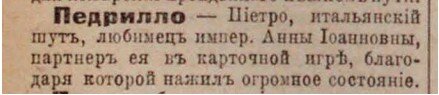
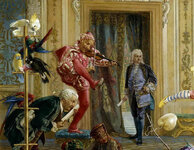
(dates of birth and death unknown) is the favorite court jester of Empress Anna Ioannovna.
He became the Empress's favorite jester and was her constant card game partner. He left Russia with a great fortune.
1573333134-2345186dd0050675bacad000cf5777c5.jpg
With a sense of humor and wit, he quickly became a favorite of the court. Anna Ioannovna's propensity for the court jester was also explained by the fact that he played cards well and quickly became her regular card partner. He was also a banker, who was instructed by the Empress at the banquets to pay in case of loss.
1573333323-593f2ec1314e10243d1beacdc12aab39.jpg
In contemporary Russian - "Pedrilo" is one of the most profane forms of designation for a homosexual, a maximally homophobic form.

Or another European example of such semantic connections:
Helvetti (Finnish), Helvíti (Icelandic), Helvede (Danish), Helvete (Swedish), Helvete (Norwegian) - translates to hell and has roughly the same meaning in the English language.
But: the data code for Switzerland, CH, is derived from Latin Confœderatio Helvetica (English: Helvetic Confederation).

Not only are there many links between many languages, but also such "crossemantic antagonisms".

It looks very foreign. But listen to the pronunciation in the episode. Many non-Russian English speakers could instantly understand the meaning from the sound of that phrase if they heard it spoken and had not been told it was russian.
I think this is a peculiarity of writing English. In most languages the letters directly represent sounds, but in English the grammar norms seem to have an additional undocumented function.
[automerge]1608478948[/automerge]
All this "everything is Russian" stuff strikes me as an attempt to make the history and linguistics fit a modern Russian nationalist agenda.
Karel Havlíček Borovský once wrote: "Russians call everything Russian as Slavic in order to call everything Slavic as Russian"
The reality is that in the grand scheme of things "Russia" is not a particularly old country and arguably a somewhat artificial country.
Russia is just part of Prussia, without the letter P.
 
Last edited:
Very good thread. I don't believe in a Proto-Italic language. It sounds to me as nationalistic propaganda to "italianize" a more ancient culture surely different from today's Italy.
But what do you think of the relationship between "slavic" and "germanic"? To me they were the same (they share a very similar epos) but separated later. In particular I always thought that "slavic" was in origin "germanic" but went to some changes after the Mongol (aka Muscovite-Ugro/Finnic) invasions, becoming "slavic". I have this thought because the Muscovites never went in Scandinavia and Germany, where the germanic languages were subsequently preserved. What do you think?
 
But what do you think of the relationship between "slavic" and "germanic"?
I can't say anything definitive, but i can point out that there is a connection. In my opinion, this can best be seen in the difference in the national descriptions of the Vandals:
https://en.wikipedia.org/wiki/Vandals"Some medieval authors applied the ethnonym "Vandals" to West Slavs: Veneti, Wends, Lusatians or Poles.[11][12][13] It was once thought that the Slovenes were the descendants of the Vandals, but this is not the view of modern scholars.[14]"
https://ru.wikipedia.org/wiki/Вандалы#Вандалы,_венды,_славяне._VIII—XVI_векаAnd there is a whole section in Russian Wikipedia with many references:
The Franciscan monk Guillaume de Rubruk probably read the same essays. In his description of his journey to the Tatar Khan in 1253 he noted: "The language of Russians, Poles, Czechs and Slavs is the same with the language of the vandals, whose detachment was all together with the Huns"[51].
Essays appear (N. Marshalk, 1521; S. Marshalk, 1521). Herberstein, 1549; A. Krantz, 1601; K. Gerberstein. Dure, 1613; F.Y.Spener, 1677)[52], where vandals are portray out through the Vikings by the ancestors of Russians.
The mixture of vandals and Slavs is still found in the works of historians of the 18th century, for example, in the popular book by E. Gibbon "History of the Decay and Destruction of the Roman Empire" (1776-1787). Of particular interest in this respect are the "History of the Ruthenians" published in Amsterdam in 1725, the genealogical studies of German scientists I. Hübner (1725), S. Buchholz (1753) and M. I. von Baer (1759)[54].

To me they were the same (they share a very similar epos) but separated later. In particular I always thought that "slavic" was in origin "germanic" but went to some changes after the Mongol (aka Muscovite-Ugro/Finnic) invasions, becoming "slavic". I have this thought because the Muscovites never went in Scandinavia and Germany, where the germanic languages were subsequently preserved. What do you think?
I reminded another Russian-language chokhmah in this case:
"Спорят викинг с раввином: - Бог один и это не Один. - Один - бог и не он один. В конце спора оба сошлись на том, что вся сила в Торе."
Literally:
"A viking and a rabbi argue: - god is the One and he is not Odin. - Odin is god and he is not the One. At the end of the argument they both agreed that in Thor-ah is the most power."
But in Russian "Odin" and "One" is "Один". And "in the Torah" and "in Thor" is "в Торе". So the whole phrase has logic in every sense.
 
Last edited:
This is great! That is why I started to learn russian, from my perspective it is so easy to learn most of slavic languages but o the other hand a 'russian' alphaphet is so unnatural or is because I was taught to use latin lettes? And yet now I am writing this thinking 'polish'. for me if you know english or german or a bit of both other are just a peace of cake. Fascinating! It is more complicated I think, our feelings, emotions attached to certain objects etc. that give meaning to words. I will keep learning, I enjoy your input thank you! Dziekuje! Danke! Correct me if needed no offence taken.
 
By the way it could be useful for you: aeiou (i wrote the code for this simple educational webapp by the request of my acquaintance).
That's a fascinating resource.

Taking just one example... For Portuguese speakers, navigate to the ж character and click on it until you get to ложа, meaning 'lodge'. Which, I assume, in Russian means 'to lodge' in the sense of 'to store (something)', 'to put (something) in place' or 'to settle (something) in place'. To my English ear the app's spoken word 'ложа' is indistinguishable from the Portuguese word 'loja', meaning store-room.

You could lose a lot of a Sunday evening investigating further.
 
"A viking and a rabbi argue: - god is the One and he is not Odin. - Odin is god and he is not the One. At the end of the argument they both agreed that in Thor-ah is the most power."
My addition: "The One is Odin and he is not God":LOL:
 
"A viking and a rabbi argue: - god is the One and he is not Odin. - Odin is god and he is not the One. At the end of the argument they both agreed that in Thor-ah is the most power."
haha thats a good Neo.

I can't tell you exactly what year it is, because we honestly don't know. There's nothing I can say that will explain it for you, Neo.
 
Very good thread. I don't believe in a Proto-Italic language. It sounds to me as nationalistic propaganda to "italianize" a more ancient culture surely different from today's Italy.
But what do you think of the relationship between "slavic" and "germanic"? To me they were the same (they share a very similar epos) but separated later. In particular I always thought that "slavic" was in origin "germanic" but went to some changes after the Mongol (aka Muscovite-Ugro/Finnic) invasions, becoming "slavic". I have this thought because the Muscovites never went in Scandinavia and Germany, where the germanic languages were subsequently preserved. What do you think?

I find it strange how Jews in Russia and Eastern Europe traditionally speak Yiddish, which is essentially German. If Jews migrated from Germany to Eastern Europe and Russia, as the mainstream history claims, it seems odd to me that they would carry on speaking German for centuries afterwards. Why would Jews have any particular attachment to Yiddish/German over the native language of other European countries they live in?

It seems even more strange when you consider the theories that the Ashkenazi Jews actually originated in Russia/Central Asia, such as the Khazar theory. This makes me wonder if Yiddish is actually a remnant of a closer relationship between Germanic and Slavic languages.
 
Very good thread. I don't believe in a Proto-Italic language. It sounds to me as nationalistic propaganda to "italianize" a more ancient culture surely different from today's Italy.
But what do you think of the relationship between "slavic" and "germanic"? To me they were the same (they share a very similar epos) but separated later. In particular I always thought that "slavic" was in origin "germanic" but went to some changes after the Mongol (aka Muscovite-Ugro/Finnic) invasions, becoming "slavic". I have this thought because the Muscovites never went in Scandinavia and Germany, where the germanic languages were subsequently preserved. What do you think?

I find it strange how Jews in Russia and Eastern Europe traditionally speak Yiddish, which is essentially German. If Jews migrated from Germany to Eastern Europe and Russia, as the mainstream history claims, it seems odd to me that they would carry on speaking German for centuries afterwards. Why would Jews have any particular attachment to Yiddish/German over the native language of other European countries they live in?

It seems even more strange when you consider the theories that the Ashkenazi Jews actually originated in Russia/Central Asia, such as the Khazar theory. This makes me wonder if Yiddish is actually a remnant of a closer relationship between Germanic and Slavic languages.

There's something really fishy here. I would say that the "Jewish question" will be the last to be solved. In Italy there is a controversy brought up by an author who claims that the word Elohim in the Bible is a plural (and many in this website will agree with that). But in a discussion with an Italian dogmatic person (a lot in Italy) I made a little research on the grammatical aspect of this word. Many of those who say that Elohim stands for God will tell that this is a "plural of excellence". The strange thing is that this grammatical category was developed/founded/discovered/invented (choose what you like the most) by Heinrich Friedrich Wilhelm Gesenius (Pluralis excellentiae - Wikipedia). How is it possible that this fundamental grammatical concept in the Bible was regulated by a Lutheran theologian only in the 19th century?
In this wiki article it is said that C. W. H. Pauli, a "converted" Jew tried to dismiss these claims by saying that Elohim is a singular. I am not an expert in this field, so I'll leave the judgement to you.
By the way, in Italy they say that these rules in grammar were set by emeritous writers such as Rabbi Saadia Gaon, David Kimhi, Abraham Ibn Ezra and Yehuda ben David Hayyukh, but these guys supposedly lived 1000 years ago, 700-800 years before Genesius returned on the subject. Do we believe their writings are true? I don't.
 
Last edited by a moderator:
This is great! That is why I started to learn russian, from my perspective it is so easy to learn most of slavic languages but o the other hand a 'russian' alphaphet is so unnatural or is because I was taught to use latin lettes? And yet now I am writing this thinking 'polish'. for me if you know english or german or a bit of both other are just a peace of cake. Fascinating! It is more complicated I think, our feelings, emotions attached to certain objects etc. that give meaning to words. I will keep learning, I enjoy your input thank you! Dziekuje! Danke! Correct me if needed no offence taken.
Im Polish, I had Russian in school, its pretty easy if you already know polish wich is much much harder to learn. :)
 
Imperial magazine "Razvedchik", 124 years ago:
df4b5ba9-d9ee-4ce6-99e5-967d61cf0904.jpg
Here is written about an imperial decree ordering to change the national colors of the flag on hats, border posts, etc. The decree proclaim the urgency of changing the colors of the flag from the old black-orange-white (the colors of the German Habsburg dynasty) to the new white-blue-red (according to the official history - the colors were borrowed from the Dutch).

The revisionist's comment: the official history claims that the white-blue-red flag was introduced in Russia by Peter (300 years ago), but this imperial military magazine shows that it happened just over 100 years ago. Why did the Oldenburg dynasty of the Romanovs trade the black-yellow-silver symbolism of the Germans for the colors of France? The war with Germany is not far off, all roles have already been written and allies are now French. Nothing personal and no merchant fleet of Holland has anything to do with it.

Source: (no title)

7bad9d74-493e-469f-91ed-4babf4126f9e.jpg

National flags of Russia before and after this imperial decree​
 
watched a "netflix documentary" show about the war against sweden and turkey i think it was, they didnt show the top flag much of the Tsar´s ship. Maybe because it was a yellow one they used those days. Maybe as a russian speaker its easier to find an original picture of the Czar Shtandart ship?
 
watched a "netflix documentary" show about the war against sweden and turkey i think it was, they didnt show the top flag much of the Tsar´s ship. Maybe because it was a yellow one they used those days. Maybe as a russian speaker its easier to find an original picture of the Czar Shtandart ship?
Here the list on Russian:
https://ru.wikipedia.org/wiki/Королевская_яхта#Российская_империяOn English:
https://en.wikipedia.org/wiki/Royal_yacht#RussiaSpecify which of these ships you are interested in.
Beggrow_036.jpeg
Polyarnaya Zvezda:
Habsburg Holy Roman black and yellow colours on top:
https://en.wikipedia.org/wiki/Habsburg_MonarchyOn the back is an inverted colors of Scottish flag or the flag of Nova Scotia:
https://en.wikipedia.org/wiki/Flag_of_Scotland#Related_flags
By the way:
1527105265-4c2e3ead5723188f7921d6c0882d7ace.jpeg

1527106834-4313db1e2115931b327c5bfbb7f2031e.jpeg
1527106958-3f7585a3aaca1df9abe1d6744d0f3246.jpeg
http://www.uniformology.com/HEAVY-CAV-04.html
 
Tips
Tips
Please respect our Posting Rules.
Back
Top