

- Joined
- Dec 17, 2020
- Messages
- 399
- Reaction score
- 1,152
Have you enjoyed reading through it?This thread has been quite thought-provoking to read through.
That's a good point on 'tun', as in 'cask' or 'barrel. I hadn't thought of that.When mentions of Nocton were made previously... I couldn't help myself by looking up the origins of "noc" and "ton" and the results invariably lead back to "night/darkness/death" and "wineskin/barrel/cask" respectively. Definitely makes one imagine more things in relation to talks of "frothy blood" and such.
The 'frothy blood' meme is interesting. Other than trying to understand Selenadia's texts I haven't tried to discover more about it. However, I'm playing around with the idea that red blood cells and/or hemoglobin may have been used as catalysts in Gild-run fermentation operations. So, for example, blood may have been added to decomposing organic materials to help bacteria and/or yeasts produce particular gases more efficiently.
I can find evidence that iron-bearing chemicals are used to boost fermentation reactions but I'm not chemist enough to make much sense of them. And 'catalysts' is probably not the correct technical term for 'chemical helpers in fermentation processes' but, hopefully, you get what I mean.
Monitoring and occasionally stirring a vat of frothy blood (perhaps in the Laird's mausoleum) may have been one of those chores that we or our predecessors got to do a few times each day.
ProfessorHotStuff said:
racial crime statistics shows that docility training has taken more in those races than others. If we were the ones descended from food animals and other locations' peoples are the descendants of early escapees that would explain it as well - they would have essentially recovered from their domesticated state to become feral for the purpose of survival in the wild.
I'm not sure any of us have ever escaped. An alternative way of seeing our position might be as like koi carp in a pond. We may no longer be eaten and we may even be the beneficiaries of a glorious, human-centred politico-economic system. However, we are constrained in a controlled zone and there are still fishing industries beyond the pond and beyond our ken. But I'm not knocking that point; I just think our ability to assess our visible and invisible realities are being restricted more than we realise.
Obviously the discussion on race issues expanded from your comment onwards. I do wonder about the physical differences between races and have researched them a little. That's because I'm trying to see the pragmatic benefits to our product managers of introducing our known racial anatomical differences. Personally I think the differences are more likely to have been about producing materials like vellum and contrasting hair colours/textures for upholstery, etc. But then, I would, given the 'Material Resources' part of IHASFEMR.
What we lack in discussions of race-based differences is hard data. The easily available data seems to be highly politicised. I've got some ideas about assembling evidence to get around that but it will take a while to collate and present.
feralimal said:
My working working hypothesis is that there are at least 2 entities here, humans and another. Perhaps we have one timescale of life, and they a longer one.
The Doom painting - from this post - at St Peter and St Paul's church in Chaldon, Surrey, tells a tale. A tale of selection:
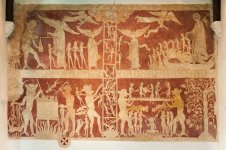
Close up:
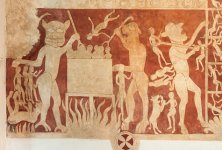
In the lower right of the top panel, one of the pig-demons is shown with bound wrists lying on top of a serpent or worm. Doom paintings usually show only humans being fed to serpents and worms.
Reading Stukeley, de la Pryme and Byng - and reading about Stukeley, de la Pryme and Byng - you can certainly see hints they had been alive for a very long time. For example, that Stukeley was 250 years old and that all of them had been involved with or seen times prior to the interdiction and final stages of the Roman Empire. By which I mean the so-called Holy Roman Empire. Qualifying that, of course, with the observation that their material on archive.org and elsewhere doesn't have a straightforward provenance.
I wonder if caricatures of gentlemen of these times show them as they actually were. With jutting chins, somewhat bony features and often a long-fingered, long-limbed appearance. Perhaps chalked wigs hid a lack of head hair. And then there are the creatures they claim to have seen or to have been told had been seen. Besides the sea serpents (Beccles, Suffolk) and the serpent-dragons (Ludham, Norfolk), there are accounts like this:
From The Torrington Diaries - A Tour In The Midlands, 1789, John Byng, p145, describing a fair at Sandy, Bedfordshire, dated 1789-06-01:
There were many Pharoahs lean kine and some nags with several Slight-of-Hand Men, and a Learned Pig; for since the first of these learned grunting-Gentry, that was so much admired, the Piggish Race have improved amazingly in wisdom; and disperse their knowledge over the Kingdom at the very cheap rate of One Penny per Head.
Their own fertility - or perhaps the poor fertility of recently hybridised humans - is often hinted at. Their poor respiratory and digestive health (Byng and many others), the many child deaths, and many lords, dukes, etc that die without issue or die without male issue.
Also from From The Torrington Diaries - A Tour In The Midlands, 1789, John Byng:
From this walk, a very hot one, I returned to another Glass of Brandy, and Water; overtaking upon the Bridge, a clean-looking Woman, leading two fine Boys, dressed in light Blue, the Livery of the great (Harper) Charity here; upon my admiring their Looks and Cleanliness, She Thanked God for her Luck in getting them upon so good a Foundation; and in giving her two such Healthy and well-disposed Boys, that were the comfort of her life.—There was something wonderfully pathetic in her Words and Looks; and her leading in either Hand, these her Hopes, Whom she alternately Survey'd with Fondness, and Transport.
IIRC, Byng refers to seeing 'six children created out of fermentation' or words to that effect. The Harpur quote above can be interpreted as a very conventional scenario. But it may also describe two 'incubator babies' or perhaps even fermentation babies.
feralimal said (quoting me):
Anyway, leaving my commentary out of it
...
I know I'm misconstruing this minor comment, but I think I have learnt not to leave my commentary out.
Well-spotted. It was a double-entendre; the joke being that pretty much all of the post was commentary.
Now, returning to the discussion of manufactured human docility... I commented that docility may or may not be the ultimate goal. That it may be an intermediate step in an attempt to shift humans away from the ogrish role models they witnessed (and may have learned from) in the past. I'm avoiding making the claim that docility was induced to make us more farmable. It may have been. I just don't know and others are welcome to make the claim and argue for it.
What I am suggesting is that we've been steered away from a set of learned behaviours (and possibly built-in behaviours). I'm suggesting the strict discipline involving hard work and poor reward may be part of the toolset that has been - and is being - used to achieve this steering away from an ogrish past. It's conceivable that the goal is to make us more amenable. More comfortable to associate with. As opposed to more comfortable to play games with (as we seem to have been in the past). And as opposed to easier to tax/farm (as we currently are).
Continuing along this imaginative line, it's possible that we present a training problem. The problem being that we are sentient and potentially even intelligent. We are capable of receiving huge amounts of data and acting upon our interpretation of it. We're not a like a micro-controller processing a set of variables that will always lie within known parameters. We're not like a script processing a handful of variables. Or a program processing millions of data-points in a modern 'data science' scenario.
No, we can handle a huge amount of data in real-time and can physically react to it. For good or bad.
Looking at what has been entrained in us, seemingly since around the time of Carlyle, and looking at the way we've been entrained... Looking especially at the current focus of BBC news reporting (it's a narrow slice of world-view I know), I'm tempted to think a lot of work is going into teaching us to feel empathy. That is, to know what suffering is. Not only what it feels like, but to know within ourselves what suffering enables and disables. If you were our design team, you wouldn't want a capable, engineered intelligence like us near you if we didn't already have empathy.
Could be wrong of course. I have been before.
One of the problems of teaching empathy is: where the Hell do you start?
Where the Hell do you start?
This is a very provisional idea. But it would explain the introduction and teaching of formalised and semi-formalised partner and team activities. From partner dancing to nationalism:
Dance training. Westworld, 2016. Source: Westworld S01 Ep08
Dance training, West London, 1958. Source: Can't Get You Out of My Head (2021)
I won't add a video of soldiers goosestepping in unison. But you can imagine it, I'm sure.
I don't know. What do you think? Is it possible humans were managed into docility and suffering at each other's hands so that we could begin to develop empathy?
Or am I simply being a docile supporter of the Authorities who farm us?

Last edited:


