Evidence humans were created and traded as slaves, food, entertainment and material resources (IHASFEMR)

I will not go into detail about what has been discussed because I did not read everything, but I do want to give some points that I had to think about while reading the latest comments.

Plato already writes about the cave (the consciousness that sleeps) and the light; the truth of life. He apparently thought it would be good if people woke up.

Furthermore, the word slave reminded me of the Bible. I had to think how a people should be helped out of slavery in Egypt.

And how the New Testament says to accept the situation. Whether you were a slave or a free person, a truly free person is that person who sins no more, so he is free from sin and so free is he that even death has no power, it says. That's a really free one; who is free from himself; the egoist. He or She has risen above nature. And if (in addition!) eternal life is promised, then that is 'more than more'. (Be that as it may, the morality of Jesus Christ strikes me as one of sweet wisdom.)

Linking this fact to my own knowledge and experience, I see that there is a lot of wisdom. The ego is indeed a great enemy of the ignorant, especially the rich. He allows himself to be lived by that ego when he has not learned to curb the reins of passion, emotion, lust and selfishness. And so he is a slave, a slave to himself.

Also, in my view, masters like Jiddu Krisnamurti and many others come to this conclusion. This wisdom is very old and it is a gift from the Gods, as far as I am concerned. In any case, I see the beauty in it and I just love beauty, justice and love. All superhuman aspects that I appreciate.

I believe that some rich people must have come to these conclusions and thus choose the side of love.

Perhaps we should regard old 'religious' books in this 'spiritual' way? Because, I know that; spiritual beauty costs nothing but is a great treasure. In other words, love. For nature, for fellow human beings, for creation, for beauty, but also for riddles such as God.

And I thought of the story and its moral Oedipus: don't want to know too much, for it may turn against you. Personally I think we can think a lot, but is that wise? I do not think so. You shouldn't think about some things; I, man, am but small in spirit, I think. Too small to think too big.

Of course, that does not alter the fact that defending oneself against injustice would be stupid. Although...

Just some thoughts.


So I would like to give also this perspective.
 
Last edited:
Splitting this discussion from Vagabond's Cannibalism in humans, Great Apes, Prion diseases, and mRNA therapy so that thread can recover its original focus on: cannibalism/covid vaccines -> prions -> zombies.

This thread will focus on helping people identify, present and discuss evidence that humans were created - and traded - as intelligent slaves, food, entertainment and as bio-factories to produce raw and refined materials.

As the concept is <cough> a bit of a mouthful, I've labelled it 'IHASFEMR', short for 'Intelligent Humans as Slaves, Food, Entertainment, and Material Resources'.

IHASFEMR is memorably close to 'I Has Femur' - femurs apparently having been a popular SKU - judging by the quantities of them warehoused in crypts and ossuaries.

And the DevOps folks will like it.

To get the pre-split background to this thread, read the posts from Vagabond's thread. They introduce images, evidence, interpretations of the evidence from a IHASFEMR perspective.

Reply to Sapiot:


Another good catch! Can you be more explicit about what you are thinking with regard to cherubs? Are you thinking perhaps they were automatically selected into the food market if born deformed or looked unlikely to grow up fit for slave work, entertainment? As opposed to being bred for food or bred to supply famine markets? Or other?

It is a useful idea to follow up on. There are clues that this sort of product selection may have been so normal that it was codified. Specific examples that come to mind are:

1. Babies born in a marriage versus babies born outside of marriage (the latter being taken into various forms of 'care', as discussed earlier)

2. Sheela-na-gig imagery. I don't want to get into the details just here because there is a lot to sort out with the thread-split. But Sheela-na-gig images are worth looking at with the IHASFEMR model in mind and an awareness of the practice of 'placentophagy'.

3. In farm management as it is conventionally understood, farmers select out male poultry for slaughtering ASAP after birth. That's the job of 'chicken sexers'. I think cattle farmers may do something similar with beef. But I'm not sure.

Picking up the unaddressed question in the Cannibalism in humans, Great Apes, Prion diseases, and mRNA therapy post about crypts as depots for bone consumers:


Specifically, how did human bones come to be stacked under churches without people realising or at least remembering the extent of it?

To explore answers to this question we need a chronology, though a chronology is difficult to establish because the issue we're investigating is apparently kept secret. But let's give it a go...

As far as I can tell so far, humans started out being openly slaughtered - usually as infants or children - wherever it was expedient to do so. In the field and on the building site. However, there were also special purpose facilities with better arrangements for collecting blood. I suspect blood may be more useful in electrical/magnetic technology than we know but that is mere intuition at this stage. Regardless, we know those facilities as 'communal toilets'. Again, this was open slaughter. Your hands were tied together in the prey/prayer position and you began your journey to 'Elysia' or Heaven' or whatever.

It's a shame Pavel Verkhov AKA Alexander Alekseev AKA kbogam chose to demonstrate a human slaughter using curvaceous, near-naked young women. In my opinion, he might better have caught the head-trapping functionality of communal toilets' design if he had modelled it using three to 12 year olds. Regardless, the images in his page show how communal toilets might have been used as the halal human slaughterhouses some of us suspect they really were.
When that started I can't say. But as the market for human products developed into a demand for human slaves, so developed a demand for controlled human sentience. Ie, reasoning abilities coupled with automatic safety circuits, such as credulity towards authority and obedience. These are hard-coded as the 'loyalty loop'. We see them operating all around us.

This new product offer was people like us, created for a market that could use people and products like us. IHASFEMR. My guess is that IHASFEMR hit the market more or less around what we call 1,000 AD.

Seemingly, these people - people like us - did realise what was being done to them and during the period from around 1100 to around 1530 were unhappy about it (see under-documented "Peasant's Revolts"). Around 1530, reforming events occurred. Perhaps these events followed an unsatisfactory facilities inspection by customer representatives or 'higher ups'. The events seem to have been one or more mudfloods, at which time the crypts were largely covered up, and the whole thing later re-labelled as 'The Reformation'.

However, the trade in human food and human parts carried on in secret. Crypt archaeology shows it was already physically underground to some extent, but it seems to have diversified from a village phenomenon into an extensive, secret underground - and therefore expensive to build - urban phenomenon. Possibly it was extended from 1790 or so onwards. The original rural infrastructure also seems to have been secretly extended, though whether that was before 1790-ish, or after, or throughout the process, is difficult to assess.

The key point of this chronology is that we are looking at phased expansion over many centuries of a secret physical infrastructure. That means we cannot be entirely sure of date of construction or date of usage. However, there is ample evidence of usage and of attempts to dismiss efforts to expose this infrastructure. We can interpret the politics of the situation - which is our situation - accordingly.

So, returning to the question: How was it hidden? We started with former Lincoln Cathedral Dean, the Rev Brandon Jackson, who wasn't alone in believing (quoting The Biblical ‘Abomination of Desolation’ Prophecy Enacted at Lincoln Cathedral? - World Mysteries Blog):


Jackson wasn't alone because:


And here's a quote from Susanna O'Neill's Lincolnshire Folklore:


Odd to worry about the Devil while being prey praying to the saint at that very saint's own cathedral. Unless the Church was hiding something.

Here's an elevation and plan of the crypt beneath the east end of St Mary's Church, Burwell, Cambridgeshire:

View attachment 10480
Crypt of St Mary's Church, Burwell, Cambridgeshire
A vestry (dressing room) or an anchorite cell? No-one knows. No-one knows why this sub-structure was built and who - or what - lived down there. But per https://www.british-history.ac.uk/rchme/cambs/vol2/pp18-47, it's got a fireplace and its own stone 'altar'. Scaled from the plan by me, using a cheap plastic vernier gauge, that altar measures nearly 7 feet by 4 feet.

Quite the mortuary slab.

This next image is ripped from an archaeologist's report - Charnel practices in medieval England: new perspectives - on Holy Trinity Church, Rothwell, Northamptonshire, which an earlier post highlighted as an example of a bone depot possibly supplying mills like the Narborough bone mill.
View attachment 10481
Cutaway view of Holy Trinity Church showing slot that links the altar to the bone crypt

Modern archaeologists - equipped with excellent reasoning abilities coupled with equally excellent automatic safety circuits - interpret the slot as the means by which old timers enabled orderly stacks of bones to listen, along with the living, to masses.

Sounds a bit far-fetched to me.

The above examples are of infrastructure that has been hidden, or at least discretely explained away, since around 1530. Now we turn to examples from Britain's later urban expansion. These examples blend old - such as the above - with an expansion into distribution tunnels hidden beneath urban settings, possibly from around 1790. There is so much of it, I will switch primarily to links. Starting with evidence that existing church tunnels and crypts were:

1. Blocked up, and
2. Denied.

There are tunnels under Stamford (England). See Secrets of Stamford School and Secret tunnels.

"No", says a poster: "just basements"

From: Ecclesiastical Buildings | British History Online about All Saints Church, Stamford:


From the same https://www.british-history.ac.uk/rchme/stamford/pp6-36, this time about St Michael's Church, Stamford:


Moving a few miles north to Newark (England)... From: Lead or Rumour info - - Newark tunnel 'legend' to be investigated | Leads, Rumours and News:


And, quoting historian Jim Wishart from Newark tunnel 'legend' to be investigated:


And:
View: https://www.youtube.com/watch?v=t5AOt92FXpE

and
View: https://www.youtube.com/watch?v=tPZvI_K2UhM

But no, there are no tunnels under Newark. See Radar searches fail to find town tunnel evidence.

They are just 'extended cellars'. See Newark tunnels search will continue.

There are tunnels under Gainsborough (England). See Gainsborough Lincolnshire and carefully read the comments by poster LincsRanger64, whose real name - I think - was Paul Kemp.

One comment in that Gainsborough link is:

which brings to mind an earlier discussion about monuments having been removed from Grant's Park, Everton, Liverpool in The Williamson Tunnels, Liverpool, UK. The fear was they would fall into caverns beneath.

"But no", say several posters: "they're just cellars".

In Bury St Edmunds, tunnels cause road collapses. See Gaping 12ft hole in road could be underground tunnel.

Just a folk myth, counters Bury historian Clive Paine:


There are tunnels under Taunton (England). See Underground mystery: Do you know about Taunton's tunnels?

But a very confident-sounding commenter says:

Drainage? Presumably just like the very well documented 'drainage' tunnels under Exeter: Exeter’s Underground Passages: A Hidden World of Medieval Engineering

There are tunnels under Hull (England). See Mysterious crates from the "Land of Green Ginger" found buried in secret cavern.

And tunnels under Nottingham (England):
View: https://www.youtube.com/watch?v=Nu_Ef7g8yOE

And there are tunnels under Derby (England). See The secret tunnels under a city that council bosses don't want you to see:


And there are tunnels under Grantham, (England). See Grantham underground - more pictures - Grantham Matters.

Says a commenter:


That's right, confirms a local historian in ‘Are there tunnels under Grantham?’ asks Civic Society’s Ruth Crook:

(If the original disappears, see this post's attached file: 'www-granthamjournal...' PDF)

I would have liked to include links to tunnels under Hertford. However, people who publicise Hertford's tunnels receive death threats like this:

So we won't discuss Hertford's tunnels - even though Hertford is the original source of Britain's finest bone china - due to its very high bone content.

Two of the guys cited in this post - Pavel Verkhov and Paul Kemp - died unexpectedly and young, shortly after publicising their parts of this story. Although we can't know if there was a link, as a nod to them, this clip is from the film version of David Mitchell's Cloud Atlas:


I have to admit that when I first saw this headline, I was disgusted and didn't want to read the read. BUT now we are hearing about child trafficking on a global scale, how the U.S. is the #1 user of this "commodity", that there are cannibal restaurants in Los Angeles, and so on. Thank you for bringing this topic up as early as you did.
 
I'm going to the hospital now, to have my chassis seen to.
If - Heaven forbid - it turns out your chassis is no longer viable, I wonder if you would consider donating it for the next stage of my mini-mausoleum experiment:

rotated_mini_mausoleum.jpg
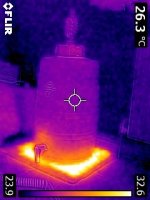
Infra-red temperature check

This first test of my conjecture that mausoleums were production plants for cooking and lighter-than-air gas has been a dismal failure. Probably because I was trying to test the process secretly; in somebody else's house. After it began to smell produce, I had to move it out of their guest bathroom and into my car, parked on the driveway. As you will appreciate, after that I lost control of the experiment's temperature.

And I had to modify my driving style.

I can't afford to rent appropriate premises but I have now found a big concrete ring left over from the A14's upgrade a few years ago. I'm thinking with the ring plus a plastic sheet plus more feedstock, I can restart this test.

As you can see, my budget is small. Tiny in fact. But it is more than matched by my respect for contributors and their contributions.

On that topic, and seguing to the issues raised by the discussion with observer about balancing evidence and speculation, I've been running another quick, cheap test. This one a test of the under-discussed possibility that mausoleums could be reconfigured to produce different gasses according to market demand. Methane or hydrogen.

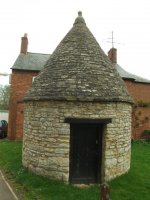
The starting point for this speculation was noticing the explanations for some buildings not usually called 'mausoleums' seemed a poor fit for their structure. Using form-follows-function analysis, I speculated these structures may have been built as small-scale, lighter-than-air gas production plants:
harrold_lock_up_1252177_ee7f7c6c.jpg
Village lock-up, Harrold, Bedfordshire. Source: Prison History

Harrold is quite possibly one of the most evidence-rich IHASFEMR locations in eastern England. But that is a separate post. What follows is imagery from a not-very-heavily-researched test of using a nickel catalyst to increase production of hydrogen gas by electrolysis.

I had read that nickel catalysts reduce the electrical power required to produce hydrogen. I thought this might explain why we find coins in pools and fountains. I wondered if this could be a candidate process for 'ancient' hydrogen electrolysis powered by atmospheric electricity. A process perhaps carried out in these structures.

I simulated atmospheric electricity with a 3.7v, 355mA wall-wart. I appreciate the adequacy of this power supply as a simulation of atmospheric electricity can be critiqued.

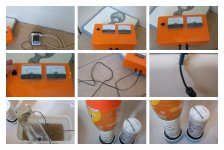
The test equipment is shown in this sequence of images:

overview_hydrogen_production_setup_100_0666.jpg
  • 3.7V 355mA PSU
  • Meter panel
  • Cable to electrodes
  • Electrolysis bath
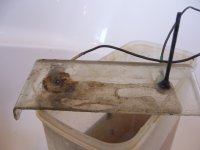
  • Plate that formerly held two nickel electrodes
  • Two upturned bicycle water bottles acting as mausolea - gas collection chambers
  • Two strips of lead wound around the water bottles' tops (the bottom in all these images) to help stabilise them
The electrolytic fluid is 96% weak saline solution. The remaining 4% is urea. You'll usually see caustic soda (sodium hydroxide) recommended for this but I had urea to hand.

No grants or public money were used in this experiment. All parts were from the junk draw except for the electrolyte container, which cost £1 from a charity shop. The two nickel electrodes cost 70p from a hardware shop. The surrounding containment vessel and the two bike water bottles were kindly lent by my hosts who were away last week and unburdened by knowledge of this experiment. These components will be reinstated to their original condition and returned to their owners.

The system looks to have more or less filled a 750ml bike bottle with hydrogen in about 30 hours. Initial current consumption looks to have been around 100mA; then steadily dropping. I didn't knock up the meter panel until after I realised the system was working quite well. So I don't have good numbers.

This video shows the system still running but after it had completed its test run:

Download Video


Voltage is hitting 8V and current is zero. But this is because the anode has completely corroded away. In effect, it was an open circuit at the time I filmed this.

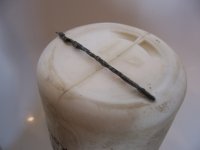
corroded_anode_after_production_100_0654.jpg
Corroded anode after production run.

Recovery of a full gas chamber. This one is the oxygen+nitrogen gas chamber:

Download Video

Removing oxygen+nitogren gas chamber after production run.

The video shows how I got the gas chambers out of the electrolyte bath. Obviously, I hadn't thought about it much before setting up the experiment. Its success at producing any gas at all caught me out so this was all a bit clumsy.

Download Video

Recovering the corroded nickel anode.

Showing here how little anode was left after the production run - compared to cathode. The anode had dropped out of the nut and hot glue insulation blob holding it in place below the gas collection chambers:

electrodes_after_hydrogen_production_run_100_0653.jpg
Both electrodes originally looked like the bolt on the right. But shiny.

The test started with two identical nickel-plated bolts mounted in this plate.

The below video was an attempt to demonstrate that the hydrogen bottle is really buoyant. It's not very obvious here, unfortunately. But from a few hours into the production run, that bottle was trying to get out of the electrolyte bath. If that canape dish were any deeper you'd see that the bottle is trying to float. There is a moment in this video where I can see it but that is probably because I remember how light (buoyant) the bottle felt while I was filming this:

Download Video


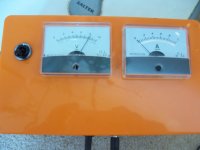
I knocked up the meter and switch box while the test was running. After I realised the system was producing gas. This view of the meters gives you an idea of the low voltage and current being used here:

electrolyser_meters_100_0658.jpg

If this were powered by atmospheric electricity, we might expect a few hundred volts on the input side of this box. I suspect that would drop fast once the switch was closed. The current it could supply in those conditions would be interesting to see. Very low, I suspect, but perhaps still enough to generate hydrogen.

Resistance of the electrolyte was 670 Ohms before the experiment ran. The meters should help me gather data about how the electrolyte's resistance changes (measured by metering changes in power consumption) so I can map power consumption changes to different stages of hydrogen production.

I need to redo the anode connection before I re-run the test. I also want to try with an ammonia-doped electrolyte. And, of course, re-work the gas collection chambers so I can tap the hydrogen and test it in a party balloon.

Moving on...

Additions to IHASFEMR:

I've added more supposition and supporting imagery to the Royston Cave (Royston, Hertfordshire, England) section of Mark of the Flesh Market.

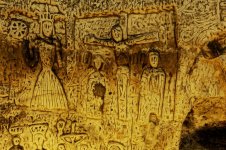
Gas Stations of the Past - Part Six has at last received a long overdue rewrite. It now focuses entirely on Royston Cave. Anyone interested in this thread should read that article. It includes partial analysis of this much-misunderstood Royston Cave wall carving - taken in this case from a Cambridge News article:
It's a very interesting image. There are more technology clues in and around this carving and in Royston Caves' other carvings. But I've focused on Royston's Cave's evidence for the processing of humans.

I've also collated some evidence for the timing of the introduction of us. The introduction of our model of human AI. I could have loaded it with more evidence than I have. I will probably add the rest as a second part. It's called Dating the Intelligent Pig.

I have to admit that when I first saw this headline, I was disgusted and didn't want to read the read. BUT now we are hearing about child trafficking on a global scale, how the U.S. is the #1 user of this "commodity", that there are cannibal restaurants in Los Angeles, and so on. Thank you for bringing this topic up as early as you did.
To be honest, I can't take credit. I think Management nudged me into it.

Best guess: they saw I had that rare combination of curiousity, appallingly bad taste and a complete absence of the social constraints that accompany worldly success. Perfect for a quick test to see if humans are ready to look at their real past.

Just wanted to say that I am thoroughly enjoying your website in this topic IHASFEMR.net.
I appreciate your sense of humor when it comes to this rather disturbing, yet fascinating subject.
Thanks! I fear people are wary of IHASFEMR. It's helpful for potential readers to know there is humour in the topic.

Hopefully, feedback like yours will encourage more of them to see the nuances in its endless images of death, dismemberment and pudenda.
 
Last edited:
Hi @usselo, I have not read through this whole thread but I would like to thank you for that IHASFEMR link! There are some very interesting ideas in there that I have never heard any where else.

By 'text', do you mean 'usable text output' or do you mean 'slugs of data that can pass as thoughts'? Or other?

The model could start with the notions humans have been fed about their past. 'History' His Story.

Or perhaps we should think of the model as including the wider human 'event' environment that includes 'designed' current affairs and - if you want to go there - 'designed' personal events? A managed wide-scale and personal world.

Backing out of that a bit, from the perspective of an entity that wants to encourage development in a robotic general intelligence, I imagine you'd design a model that delivers complexes of challenges.

I assume you want your product to develop both discernment and the ability to respond appropriately in real time. Real time as humans see it, that is; I appreciate we're not the fastest ket on the block.

Perhaps you'd provide a massive-scale Koch Method simulation. It runs something like this: you get it right or you do it again; you get it right or you do it again; you get it right or you do it again... In many dimensions of each human's existence.

With both the IHASFEMR thread and the IHASFEMR site being 'boards for publishing our ideas', the output we publish into them should be comprehensible to those we hope will view our output.

That means a lot of ideas, conjectures, suspicions, testing, exploration, etc, aren't published. That which is evidenceable enough for readers to check for themselves gets published. Time permitting. That which is not evidenceable enough for readers to check for themselves, does not.

So what gets published tends to lag some way behind ideation. So it is with The True and Wondefull Discoverie of Terrible Practises in This Lande and Landes Afar by the Intelligence Agencies.

The machinery explanation seems to help untangle several mysteries. Obviously, it helps untangle the supernatural powers in folklore's stories.

Once we go with a machinery explanation, mysterious mounds and structures can be reconsidered as foundations for plant, solid paths for heavy machinery, transportation-related platforms etc, etc. The need to build (and perhaps maintain over time) massive concentric rings of earthworks on top of hills or flat tops on hills may acquire explanation in addition to those of various Russian quarrying bloggers.

They may have been transporting them. And/or they may have been recycling them.

We re-use and recycle computers and other machinery for their parts and materials. Why not do the same with biomatter? Especially if you are so knowledgeable that you can do things with biomatter that humans struggle to conceive. Indeed, one of your achievements was that you made it easier for humans to conceive.

Re-use can produce something that is entirely different in purpose than the parts it was built from. I built a jig for prototyping airship navigation and control out of scrap door panels and a length of what my mum claims is 'knicker elastic'.

The Furniture Chop and Fabrics From Fabricants only nibble at this idea. What else might you be able to do with body parts? What can you do with the very smallest of body parts? With DNA and stuff I've not heard of?

To me, those accounts read like advanced antics with light. With photons perhaps or with not-quite-so-static electricity.

In an earlier post I speculated that some stones were originally fats. Electrets gone hard or biomatter that has been hardened. This area is a good example of my point above about how publishing lags behind ideation.

Thanks for the nudge. I'm familiar with the overall story and vaguely recall the page. At one point I considered collecting images of those unnatural-looking 'natural' stones. To look for more clues to their original function(s) and how they were 'heughed'.

These rhymes and wordplay remind me of TheImp's post about encoding data in ways that are fading from public view. I saw that TheImp was pointing but I couldn't work out where he was pointing. It's the same with a lot of these folklore tales and nursery rhymes (oh the hidden truthery!). I think they are encoded data but I can't necessarily decode them quickly, if at all.

I see the references that branch off from your The Laidly Worm of Spindleston Heugh page as being heavily laden with encoded data. One I can read - I think - is in Reliques of Ancient English Poetry. Where we have:


The poor creature may be a model of below-spec discernment.

You can take the word 'maid', re-interpret it as 'made' and then apply the notion of fabricated servant to 'maidens' and other. So we then see Grimsby's Ket Bank serpent mound as a place where biomatter, including - presumably - humans, was being cast off in boxes. That it was a recycling facility for biomatter. A variant that can be interpreted in the same way are the unwanted babies left near rag wells or taken to Agnes in her various forms (and her distinctive PPE).

Perhaps The Green Dragon really was green.

That said, there may be signs of a food-distribution network having been in place before Victorian times. And humans - or proto-humans - were skinned, fried or salted, tied in jute or 'wick' butcher's string and distributed along it. Thus establishing the modern Post Office and its (alleged) problems keeping its Horizon on the level.

OK, that was a joke. But the point stands: in the absence of accurate decryption the underlying reality offers more than one possibility for consideration.

I think I've mentioned that an alternative explanation for IHASFEMR evidence is that humans experience artificial 'natural' selection. Games and hunts may have been selection processes. The Eating and Material Resources part of IHASFEMR may be simple tear-down of failed product.

As it happens I don't think I have enough evidence for that explanation to invest time pursuing it, let alone publishing it. But I do have enough evidence of IHASFEMR practices so I invest time investigating and publishing evidence of IHASFEMR practices.
Hi everyone,
I have not read this entire thread yet, so forgive me if this has already been discussed.

On the topic of humans as AI, what if it is the reverse? Kinda like in Terminator. The AI became sentient. This is being hinted at in the current news where we are being warned AI is dangerous and may become sentient.

If all of these paintings and photographs are artificial, learning repetitive moves through dance, songs, movies, video games, etc, what if this is all to distract us and keep our minds occupied? We are always distracted by other things we don't have time to put the pieces together.

Would it make more sense TPTB were AI studying humans?
 
Last edited:
On the topic of humans as AI, what if it is the reverse? Kinda like in Terminator. The AI became sentient. This is being hinted at in the current news where we are being warned AI is dangerous and may become sentient.

Human consciousness has an AI element to it regardless. I was talking to my cousin about this a while ago. I was talking about how 'Artificial Intelligence' isn't really intelligent, because all it is is pattern recognition. For example there are neural nets that have learnt to read handwriting, for example to automatically sort letters. The way it works is, you show the neural net a thousand different handwritten letters a, and every time you do it, you have to tell the neural net that's an a. After a while it starts to recognise the letter a by itself. So without the supervising intelligence to tell the neural net what an a is, the AI develops no intelligence at all.

My cousin pointed out this is exactly the way children learn to read.
 
This topic is vaguely reminiscent of Dr. Jörg Lanz von Liebenfels' theory of Theozoology.
Bundesarchiv_Bild_183-2007-0705-500,_Guido_von_List.jpg
You can read all about it in his book:
Theozoology—or the Science of the Sodomite Apelings and the Divine Electron (ePub, PDF).
 
Well if this isn't my favourite thread on the internet. Taken a strange turn recently though (especially imo the alien propaganda, isn't it strange how "aliens" act exactly the same as "demons" from a previous age. Almost as if they are the same entities rebranding themselves throughout history in order to extract sexual fluids, implant devices and manipulate the poor souls stuck within these meat sacks and forced to exist within this density of reality), so I think a return to 18th century travel journals seems like a nice reprieve. I'm from Dorset so it seemed like a good place to start. I know what you're thinking, Dorset's about as far away from the east midlands as you could be and still be with England. Well here's what south Dorset has to offer in the way of IHASFEMR related places and events to take note of:-


PORTLAND.
Famous for its stone, the start or end of the chesil beach, and a local populace that will chase you off of the island if you say the word rabbit.
There is a popular saying on Portland "there's more Portland stone in London than there is on Portland", and whilst I can't verify which place has more, the city of London certainly has it's fair share. Essentially Portland consists of a few huge quarries with some houses scattered about where opportune.
Portland was home of the first Viking attacks on Britain in the year 789AD, or whatever year that relates to in whatever calendar you're rolling with atm, seems like an out of the way landing place for a Scandinavian people's.
There is a Rufus castle 12th c, positioned on the cliffs above the pirates graveyard on the east/southeastern side.
Very close to where there used to exist 3 piers; Kings, Durdle and Folly. Folly pier collapsed into the sea in the 16th c due to a large storm and earthquake. Of course the official reason is because the quarrymen threw too much rubble off of the cliffs which weakened the pier allowing it to slip into the sea.
There also existed salt pans on the eastern side, now disused, damaged and virtually unknown.
There are two prisons with the Verne being particularly impressive. The Verne used to be a hillfort before being repurposed to be a prison. In the 19th c. Make it make sense.
The secondary school was called Royal Manor. :p
There is Portland castle 16th c built on the northern tip by "Henry VIII".
Tunnels tunnels tunnels. All the locals know that between the "World War era" tunnels and the quarries Portland is essentially hollow.
Also a fair few Giant stories. See "The Giants of Stonehenge and Ancient Britain" by Hugh Newman and Jim Vieira pages 37-38.


WEYMOUTH.
North of Portland is Weymouth. Weymouth essentially sits in a bowl with the land to the north, east, and west being raised hills, very steep in places, and a metric shit tonne of "barrows and burial sites" on the top of or adjacent to these hills. Weymouth is the birth place of Christopher Wren who rebuilt the city of London after the fire of 1666. It also played a part in the civil war and is the port where the bubonic plague entered the British isles for the first time, has a lineage of shipwrecking, stealing and smuggling up and down the coast particularly within the Fleet. What a proud history.
Weymouth has :-
A "Roman Jordan temple site" at Bowleaze hill,
Bincombe bumps "Roman" barrows,
Chalbury hillfort and quarry,
Ridgeway hill "Viking" burial site,
A coldharbour,
An old nunnery on Carlton road north,
A lynch lane,
A pirates lane which leads down to Wyke castle,
Which is west of Sansfoot castle 16th c, which sits across the harbour from Portland castle. Incidentally the beach on the western side of this harbour is called ham beach. Maybe something to do with the old pig farm up the grove on Portland, maybe it's something else.


DORCHESTER AND ITS SURROUNDING AREA.
Dorchester is a well known and accepted Roman town, so definitely worth looking into.
Dorchester itself has :-
Mambury rings Roman amphitheatre, a friary lane, a corn exchange, a "Roman townhouse", Poundbury hillfort, Maiden castle, which is less of a castle and more of a "2000 year old fort".
To the east is thorncombe woods, the birthplace and childhood home of Thomas Hardy and some rain barrows,
To the north is Cerne Abbas and it's giant (you know the one), as well as Maiden Newton. (Maid in new town ?).
To the west is Abbotsbury, home of abbotsbury abbey, abbotsbury castle and manor house, Catherine's chapel, an 11th c monastery now the swannery.
The valley of stones national nature reserve, which contains or is adjacent to; Kingston Russel stone circle, the grey mare and her colts, bishops limekiln, blackdown stone circle and Roman fortlet, the devils hollow, hell stone dolmen, pennhill tumuli.
Little breedy and long breedy (what were they breeding).

All of these can be found today on something as mainstream establishment as Google maps. The oddities and peculiarities I learnt from the very interesting "The history and antiquities of the county of Dorset volumes 1 and 2" by John Hutchins published posthumously in 1774. It's an excellent in depth documentation of Dorset and I certainly don't recommend you read it, but do read something like it about whatever area you may be from (if you're British) or whatever area you like if you're not. Or do read it. I'm not your keeper.

I don't really have a point to this post, just wanted to throw my hat in the ring with the big boys, but I guess the point I'm circling and jumping over is that, you can uncover an awful lot if you look at your local area with an IHASFEMR lens.
 
This thread is also one of my favorites and I'm happy to contribute at least a tidbit or two. Every now and then I see things browsing the web that remind me of some of the topics in this thread and others about our mysterious past, old buildings, our control system, and the like. Maybe someone will find it interesting.

I'm not sure if it's more Mudflood theory, but I feel IHASFMR and the Mudflood theories overlap. In this video of a First Amendment audit in a random American town, a woman shares the history of a town that was once submerged. This kind of history only seems to spread by mouth, handed down from generation to generation through oral history that eventually fades out until no one remembers anything of the real past and no one knows better. Then, one day 100 years from now, the government will dig down and they, too, will be surprised to find an entire town underground. The only explanation I have for this surprise is that the history was hidden. Why and how was there a whole town underground and how was this fact forgotten?

Starting at 25:52 in the following video, this citizen shares that the street was once below grade. It's a short conversation that made me think of this thread and the theory of underground trafficking routes and butcher shops and tunnels from churches, etc., things that exist in probably every country, but apparently also in my region.


I wish we had a Usselo on this side of the pond to have a look around the strange history here. It's my belief that America has as much history and ruins as old as Britain and elsewhere and our history has also been fabricated. I'm not sure how that ties into IHASFMR but I have a hunch it fits right in.

Also, it's funny finding memes of some of the strange carved characters in old churches. People on image-sharing sites just laugh at them, thinking they are jokes. It's possible they are builders' and carpenter's jokes, but what if they were something gruesome or advertisements of sorts like those posited in this thread? They're not so funny in that light. Or maybe they're still funny.

070 (3) - Copy.jpeg

021 - Copy.jpeg


022 - Copy.png
 

Attachments

  • 022 - Copy.png
    022 - Copy.png
    57.8 KB · Views: 171

Attachments

  • 11530121.pdf
    45.2 MB · Views: 196
I found this thread interesting and I have no horror in the idea that we have been food, etc. before. There is a good argument that the "church" was involved in things that aren't as it seems, orphan trains, etc. I do suspend belief that anther life force engineered us from pigs and or chimpanzees. Maybe...we engineered them instead? Why would we have such a long lifespan? The human body begins breaking down after puberty in many ways. Apart from the use of skin as a product, why would we be so vulnerable to the environment? Need to be clothed, housed against very small environmental factors? We are poorly designed for this realm. And in that there may be some truth. Humans are not of this realm...or at least not of this version of this realm. Maybe it used to be more friendly or we had protections?
 
If - Heaven forbid - it turns out your chassis is no longer viable, I wonder if you would consider donating it for the next stage of my mini-mausoleum experiment:

So you put something dead in there? If you remove the oxygen and put a balloon on top you can catch methane (which is indeed lighter than air). It'll only work if there's no oxygen though. Also it will be a tremendous fire hazard.

If England had indeed been deforested (by humans or some unknown disaster) then methane would be a natural choice for heat and cooking. It would make sense to put corpses into methane-catching mausoleums for pragmatism and profit.
 
I found this thread interesting and I have no horror in the idea that we have been food, etc. before. There is a good argument that the "church" was involved in things that aren't as it seems, orphan trains, etc. I do suspend belief that anther life force engineered us from pigs and or chimpanzees. Maybe...we engineered them instead? Why would we have such a long lifespan? The human body begins breaking down after puberty in many ways. Apart from the use of skin as a product, why would we be so vulnerable to the environment? Need to be clothed, housed against very small environmental factors? We are poorly designed for this realm. And in that there may be some truth. Humans are not of this realm...or at least not of this version of this realm. Maybe it used to be more friendly or we had protections?
I was thinking about the 19th century illness which, at the turn of the century, was the leading cause of death in the US: tuberculosis aka ‘consumption’. An interesting choice of name for that illness. ‘He died of consumption’ sounds like a hidden-in-plain-sight comm to me.
 
I was thinking about the 19th century illness which, at the turn of the century, was the leading cause of death in the US: tuberculosis aka ‘consumption’. An interesting choice of name for that illness. ‘He died of consumption’ sounds like a hidden-in-plain-sight comm to m
I was thinking about that with the Georgia Guidestones. If "we" were aliens to this realm maybe we were only allowed a certain number OR "they" figured later on that a certain number was enough to suit their purpose. Going along with the AI theory, maybe we figured out how to not get consumed via consumption. All speculation of course.
 
I was thinking about the 19th century illness which, at the turn of the century, was the leading cause of death in the US: tuberculosis aka ‘consumption’. An interesting choice of name for that illness. ‘He died of consumption’ sounds like a hidden-in-plain-sight comm to me.

Google Books Ngram Viewer

1696819289890.png


So weird. I think you're onto something there.


edit: Found this book while digging through related Ngram stuff: "Morbus Anglicus; Or, The Anatomy of Consumptions", first published in 1666...

Morbus Anglicus; Or, The Anatomy of Consumptions

Rough looking (but readable) later edition here: Morbus anglicus or a theoretick and practical discourse of consumptions and hipochondriack melancholy : Harvey, Gideon : Free Download, Borrow, and Streaming : Internet Archive

Have not yet read myself, but its existence seems relevant. I find the first two words of the title combined with the year originally published rather interesting, personally..
 
Last edited:
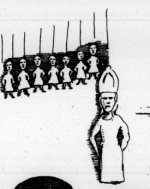
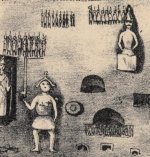
Maybe this is not the thread to post this, but it is in response to one of Usselo's links. Maybe I went down a rabbit hole and ended up with cave paintings in Royston which Usselo believes may depict some events much much darker than the so-called authorities and narrative-changers would like us to believe. I only intend to post your images here as a kind of Fair Use, all image credits go to Usselo.

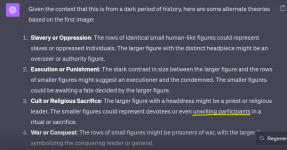
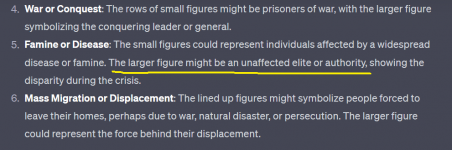
To get to the point, ChatGPT can now analyze images and I find it interesting, that for now, it actually may analyze these cave images as one of us here might, as opposed to the established narratives. I did prompt it only to not be afraid to "get dark" in the analysis.

I'm interested in asking it to analyze and theorize some more pics, the kind of pics in this thread and others that show things that are so obviously incongruent with established narratives. And now, even a damn robot knows this. I welcome you all to try it: it is an image button in the left of the message field.
 

Attachments

  • prior_with_hanged_children_royston.jpg
    prior_with_hanged_children_royston.jpg
    67.1 KB · Views: 229
  • shrunk_cropped_complete_grid_hangings_beldam.jpg
    shrunk_cropped_complete_grid_hangings_beldam.jpg
    98.4 KB · Views: 241
  • roystonchatgpt.png
    roystonchatgpt.png
    121.3 KB · Views: 262
  • chatgpt2.png
    chatgpt2.png
    65.8 KB · Views: 246
Maybe this is not the thread to post this, but it is in response to one of Usselo's links. Maybe I went down a rabbit hole and ended up with cave paintings in Royston which Usselo believes may depict some events much much darker than the so-called authorities and narrative-changers would like us to believe. I only intend to post your images here as a kind of Fair Use, all image credits go to Usselo.

To get to the point, ChatGPT can now analyze images and I find it interesting, that for now, it actually may analyze these cave images as one of us here might, as opposed to the established narratives. I did prompt it only to not be afraid to "get dark" in the analysis.

I'm interested in asking it to analyze and theorize some more pics, the kind of pics in this thread and others that show things that are so obviously incongruent with established narratives. And now, even a damn robot knows this. I welcome you all to try it: it is an image button in the left of the message field.
Thanks for the add.

The images of presumed mass lynchings above come Location Analysis: Royston Cave - Part Three. It proposes some of Royston Cave's wall carvings depict mass lynchings seen along the Icknield Way near Royston and maps evidence for that proposition.

There is a lot more to the Royston Cave material than I have published so far (part 1, part 2, part 4, plus Therfield Heath). The AI is highlighting one of the missing parts: the slave part.

More clues to the slave part lie in the biography of Royston Cave narrator Joseph Beldam. Who may also have composed much of the Royston Cave material attributed to other authors - in addition to the material he is credited with composing. But that's just one conjecture. (Another that I don't go into, is that all of the Royston material is more recent.)

From an IHASFEMR perspective, one could think of slavery as being a common life outcome for those humans (and possibly other hominids) that avoided being eaten or processed for materials as neonates or as children.

Or, looking at it from the owner's perspective, they determined what use was made of your body while you were alive and they determined what use was made of your body after death. Your body being a useful resource on both sides of death.

With regard to copyright, one of my ToDos is to update the copyright message at the bottom of IHASFEMR.net's pages. Copyright of quotes, images, video and audio is credited to the original author/publisher and reproduced on IHASFEMR.net under fair use (and, I would argue, public interest). Material that is not credited to someone else is mine and is reusable under CC BY_SA.

I think your post should be in the IHASFEMR thread so it is closer to the type of material discussed.
 
Last edited:
Tips
Tips
Please respect our Posting Rules.
Back
Top