I think you hit the nail on the head with the folklore about St Ippolyts actually being a
cover up story for (inland river) ship/vessel facilities, from a bygone technological advanced era.
I'll explain why, but I do have to incorporate some other subjects like Energy Circuits, Portals/Gates and the likes (briefly). Need to touch upon it, to connect it back to the IHASFEMR topic, and your question about the
Weston Hill Henge.
Don't think the IHASFEMR timeperiod / people were primarily responsible for developing and building the advanced infrastructure as of yet, which seems more like an inheritor post-reset feudalistic society to me (of course my views can change over time, and with gathered information).
But the inherited network/buildings etc. was still usable in regards to certain aspects (among others logistics of mineral resources like copper + tin, goods etc. and IHASFEMR produce).
- St Ippolyts Brook + River Purwell + River Hiz + River Houghton:
The St Ippolyts Brook is the remnant of an old dried up river, which meanders towards the Purwell Nine Springs in Hitchin (start of the River Purwell). The River Purwell streams North, where it joins with the River Hiz (where Hitchin gets its name from).
Above Hitchin it merges with the River Oughton, and with some others to become the River Ivel / Purwell. This river also joins with a river which originates near Baldock (dockyard).
Eventually the river Ivel will link up with the Great Ouse river, which later joins the river Cam at Ely and on towards the Wash/North Sea. St Ippolyts however lies at a higher elevation, so it must have had another source of water (will come back to that).
The rivers in and around Hitchin I believe are only navigable by canoe, so maybe they got filled partially in by the event(s) hundreds years ago, or there's less water release coming from the springs (or a combination).
River Ivel Catchment Area in & around Hitchin, with St Ippolyts in red (source):
Great Ouse and Tributaries - river Ivel (source):
As mentioned there's a hurdle when it comes to the elevation of St Ippolyts, and water flowing downstream. Once upon a time the source of the St Ippolyts river must have been the area of Warren Springs south of Stevenage, which isn't hard to find if you follow the Ippolyts and Langley Brooks.
Old Ippolyts River (from Warren Springs substation - Purwell Nine Springs):
I've also drawn in the River Beane which eventually together with other rivers will flow south toward London, and merge with the river Thames. This is because Warren Springs probably not only supplied water going North, but also to the South (Langley Brook is a remnant of this going both ways, with the area of Warren Springs being the highest point in the valley).
Super intruiging that this spring once could've been an important source connecting the Ivel / Great Ouse river valley (and Cam river valley), with the Thames estuary. And if they would've navigable 500 - 1000 (?) years ago, with perhaps a bit of locks and canals (now gone?), it would've been a great water shortcut.
What's funny is that
Ippolyts could also be a covered up name. Ippo-"
Lyts" at first reminded me of "
Lytes" as in "
Electrolytes", but there's an old word in the Germanic region that actually has to do with shipping:
- Ippo-Lyts;
- Leyts / Leits (Old language);
- (ge)Leiden / Loods (Modern Dutch);
- (to) Guide / Pilot (a ship out to sea) or a Hangar / Shed;
A form of "
Ship Shed" in Old Tongue could've been:
Shippe Leyts =>
Hippo Lyts.
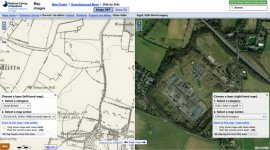
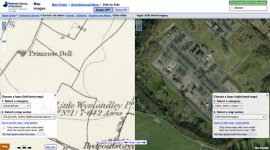
One of the 400 kV substations (3x 132 kV) of the United Kingdom National Grid is actually situated in St Hippolyts (
Wymondley Substation). For the sake of the topic, I will only hint at the fact that the Wymondley substation is actually pointing towards the area of the Weston Hill Henge.
Wymondley 400 kV substation in St Ippolyts, pointing towards the Weston Hill Henge:
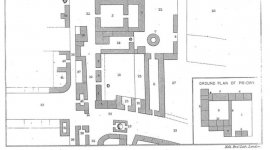
The BBQ Land store next to The Priory reminds me of the "
Burghers in the Priory Ovens" article on the IHASFEMR website, but noteworthy to the story is that the red lines pass Letchworth
Gate and the A1 - Letchworth exit/turn-on fly-over.
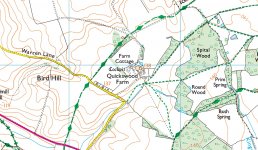
And they actually touch the Weston Hill Henge itself. There's a wildlife viaduct / motorway-tunnel going from the Weston Hills Nature Reserve, towards the area of the Weston Hill Henge.
In my line of work (involved with infrastructure building projects) we have a specific term when it comes to construction-solutions like tunnels or viaducts, that are meant to have no interference on the circuits that cross each other (for example highways, railroads, waterways):
- Art Work(s);
I honestly admit that I don't know what the origin is of the usage for tunnels, viaducts etc., but I imagine it has something to do with advanced science, human development, engineering, to understand and build such constructions etc.
That being said, this is the reason "
Art" in all sorts of forms can be found sometimes in or around tunnels and viaducts. It can be a statue, mural paintings, weird modern art, colored glazed tiles and such. A side effect of the smooth surfaces of tunnels / viaducts is that it ironically attracts a more vandalizing sort of art = Grafitti.
Here's an example from the research area. Specifically the railway crossing in Hitchin with the River Hiz - Groved Road.
Esoteric Star Art on railway arches in Hitching (left arch is River Hiz, right one is Grove Road):
There's something mysterious about the railway viaduct also, but that's for another thread. More importantly: a viaduct like this railway crossing in Hitchin is a passage from one side, through to the other. A gate or portal if you will.
From a tunnel the same thing can be said, but when you look at it from a movement-energy-gravity force diagram (simplified), a tunnel is actually the half portion of two toroid fields horizontally with a midpoint.
- Bike going down in the tunnel (increase of speed, if not too much friction slowing it down);
- Bike reaches the zero point (midway / gate), and energy is needed to get out (not considering vacuum);
So what I'm saying (my own personal views) about "
Art Works" like viaducts, tunnels, highway-flyover passages is, that they seem to be placed near possible energy wave nodes (portals). That's if we consider the possibility that Ley Lines and such exist.
The Weston Hills wildlife viaduct-passage (portal) is placed next to the Weston Hill Henge. And the red lines from the 400 kV substation in St Ippolyts passes Letchworth G
ate and the Letchworth A1 junction passage (portal).
That the Weston Hill Henge is named as a "
Henge", and not a hillfort like the "
Arbury Banks Hillfort" 7 km to the north is also very telling. A "
Henge" in certain circles is associated with travelling to / making contact with other dimensions. Sometimes through very dark practices.
World of Warcraft movie. The Horde enter the Portal (which is fueled by the sacrifice of living beings):
My guess is that the civilization(s) before the IHASFEMR era, were responsible for directly manipulating energy on an advanced scale. Maybe with equipment/constructions on certain places like the site of Weston Hill Henge, and I'm assuming (hoping) not with IHASFEMR as fuel.
Then something happened and the survivor elite inheritors took control of a post-reset world in feudalistic style, with IHASFEMR (mainly practiced by upper classes?). They remembered (stored?) all sorts of information, also about energy nodes and related devices/buildings.
The site of Weston Hill Henge (what remained of the advanced tech construction) then was used as a killing ground, because of its ritual (and perhaps still functional) significance. Also it's next to the Ickfield way. Could've been an arena, or a slaughter pen line (2x exits = in & out).
The sick ruling monsters from that IHASFEMR era likely thought it an efficient idea to:
- A. Kill (and further process in the area) at this Weston Hill Henge, as a waypoint on the Ickfield way;
- B. Semi shrouded by neighbouring hills;
- C. Make black magic sacrifices at the same time at this energy terminus, to accomplish whatever twisted desires and wishes;
I'm sorry for making it so long, but I'll close with an interesting fact:
A victim or casualty of a crime, war etc. in the Germanic area is called: "
Opfer / SlachtOffer".
In English this would literally translate to: "
Slaughter-Sacrifice". A battlefield would be a "
Slacht/Slag-veld" (
Slaughter Field in English).
Thanks for the extra information about Jack! I'm really flabbergasted at all those connections

Have a blessed day everyone!