Evidence humans were created and traded as slaves, food, entertainment and material resources (IHASFEMR)

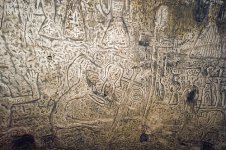
Maybe this is not the thread to post this, but it is in response to one of Usselo's links. Maybe I went down a rabbit hole and ended up with cave paintings in Royston which Usselo believes may depict some events much much darker than the so-called authorities and narrative-changers would like us to believe. I only intend to post your images here as a kind of Fair Use, all image credits go to Usselo.

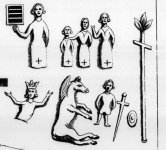
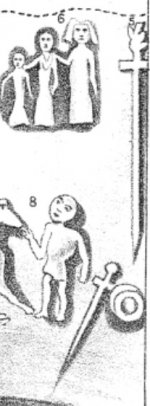
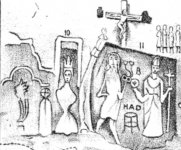
To get to the point, ChatGPT can now analyze images and I find it interesting, that for now, it actually may analyze these cave images as one of us here might, as opposed to the established narratives. I did prompt it only to not be afraid to "get dark" in the analysis.

I'm interested in asking it to analyze and theorize some more pics, the kind of pics in this thread and others that show things that are so obviously incongruent with established narratives. And now, even a damn robot knows this. I welcome you all to try it: it is an image button in the left of the message field.

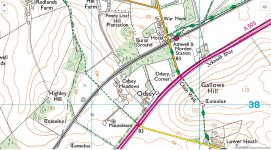
If you were investigating the proposition that Royston Cave once depicted mass lynchings, you'd probably note nearby locations mentioned in Royston Cave's Knights Templar and market narratives. And so you'd go looking for evidence along the Icknield Way. Even if the video Royston Cave - A Mystery beneath the Streets hadn't already drawn your attention to Odsey, you would likely notice Odsey Corner, halfway between Baldock and Royston:

shrunk_odsey_heath_killing_grounds.jpg
Odsey Corner killing grounds. Source: OS via The Megalithic Portal

You'd notice Gallows Hill on the right but you might not notice evidence of carcass disposal everywhere around. The evidence is euphemistically presented as 'tumuli', 'barrows', Roman burial grounds, circular 'plantations' and a mausoleum.

And you might not notice references like this from just to the north:
there's the site (unmarked) of a Roman cemetery (on the opposite side to the cottage), formally known as Heaven's Walls because of its banks (now sadly demolished). It used to be a place of superstitious dread for children.

When you look to the north and south of the Baldock-Royston stretch of the Icknield Way - and into nearby place names and histories - you realise the entire region is a complex of slaughter-grounds, carcass processing facilities and transport interconnects. In IHASFEMR's Royston Cave pieces, I've limited myself to the area immediately south of the A505 plus a bit on John O'Gaunt's House to the north. This because there is so very much evidence to process.

I don't go into slavery much because people already have quite 'complete' pictures of slavery in Britain and it's hard to change people's existing mental models. It seems more productive to focus on what people don't already have a mental picture of: human carcass processing, product selection, merchandising, and retail. And, as the evidence comes in, humans as entertainment.

While working on Royston and Therfield, I did accumulate convincing evidence that before the 19th century, few if any commoners were buried (or 'gracefully' put to rest). This explains why it's so hard to find commoners' graves in parish church yards dating from earlier than about 1790. And it supports written claims that commoners despised the clergy, seeing them as human farm managers and their accountants.

Accountants who kept their farm records on parchment made from the skins of their perishioners.

From Parish Registers, Harby, Leicestershire:
The parchment skins of an early volume of Harby Parish Registers, long lost, are said to have been unstitched and wrapped around the trunk and limbs of the corpse of Anne Adcock, and so buried by her grandson, John Adcock, a man of eccentric character, in December 1776.

Evidence for what John Adcock was trying to fix is presented in Away In A Manger - Part Five.

Similarly, there is now so much confirmatory evidence across the site that human bones were routinely harvested for milling, it might not be obvious how recent burial practices are. So, evidence of human bone-processing is in pieces tagged #human-bone.
 
Last edited:
Playing a bit of devil's advocate and acknowledging that the human body is a resource, maybe it was more of a type of recycling venture than a farming venture? Abrahamic religions have many taboos about the body after death but not everyone does or did. If our human bodies are meat suits for spirit or soul or energy...why not repurpose the cast off suit after death rather than put it n a hole and pay for upkeep for the next 10 generations? That is actually an odd thing to do with a body.
I found this a somewhat related read, though taken with the inevitable salt packet,
 
Playing a bit of devil's advocate and acknowledging that the human body is a resource, maybe it was more of a type of recycling venture than a farming venture? Abrahamic religions have many taboos about the body after death but not everyone does or did. If our human bodies are meat suits for spirit or soul or energy...why not repurpose the cast off suit after death rather than put it n a hole and pay for upkeep for the next 10 generations? That is actually an odd thing to do with a body.
I found this a somewhat related read, though taken with the inevitable salt packet,
Yes, upcycling and recycling seem to have been factors in consumption and use of the dead.

But, if sustainable mortuary practices were once laudable, why did they become unlaudable?

Why was cannibalism and and re-use of human bio-material hidden (in Britain at least)? Why does its shift out of normal practice seem to coincide with a very violent re-creation of the landscape, along with the creation of a pack of cultural lies? In Britain at least.

It used to be difficult to find evidence that cannibalism and human material re-use were widespread in Britain. But once you are familiar with the techniques used to hide it (and actually, to gently draw attention to it), then the evidence is easy to find.

What is harder to find are the two major motives. The motives for:
  • the shift out of it and
  • for hiding it.
I don't see how recycling explains these two processes. Why was recycling abandoned? Why was recycling subsequently hidden?

We have to speculate about what did drive these processes. Perhaps the mercantile classes saw they could bring profits forward if they culled people before 'natural' end-of-life. Perhaps they turned recycling at end-of-natural-life into mass early killings.Perhaps they began to breed people for consumption and materials (the Tender is the Flesh scenario). Perhaps they turned recycling into farming.

And perhaps that upset the Sanitation and Hygiene Inspectorate.

The challenge here is that motives don't leave much evidence of themselves.

The two explanations I play with most are:
  1. Consumption and re-use got out of hand (by some entity's standards), prompting a destructive intervention.
  2. Humans were engineered from the beginning as recyclable mandroids. In this scenario, the shift out of cannibalism and human-materials reuse may be part of product development. Specifically: the development of respect among humans for boundaries between living creatures.
If you play with explanation 2 for a moment, you can see the same conundrum that AI presents to humans today. You can see that entities that develop a recyclable mandroid might bring its sentience to a point where the mandroids are self-sustaining and making decisions. However, they are carrying a bunch of destructive baggage learned from their earlier days as recyclable slaves, entertainment and food. As IHASFEMR. So, as the entities responsible for this AI, you might impose an abrupt change of environment on your AI creation in an attempt to reset negatives inherited in its culture.

Given that motives don't leave direct evidence we have to try to piece them together from direct evidence, logic and our own understanding of boundaries, or morality.

I don't have a fixed opinion. At the moment, I tend to favour explanation 2. That you're trying to avoid this:

Download Video

She's learned well. Too well. Source: Westworld
 
Last edited:
Quite a few evidence-adds over the last few weeks:
Much of the extra evidence was plundered from Aewar's Shadow Rome and Labyrinth of the Lost Guild videos - so thanks for those.
 
Last edited:
Dear @usselo,

Many thanks for starting this post and also building the website Ihasfemr!!! I've read almost every article on your website the past year (haven't got through all the reactions on this post yet sadly).

I'm really impressed and flabbergasted with what you found. What does "Ther" in "Therfield Heath" mean in regards to the killing-processing fields? Is this something Medieval English (I'm not a native English speaker)? I do know the word "Tor" for a hill or mound.

Over in my country (Low Countries) in the south there used to be a powerful Abbey in a place called "Thoear-n". Because of this I'm curious (it's almost the same in terms of letters with "Ther-field").

Using your website as I template, I also found a (former skin trading / processing) route very close to me. It actually mirrors what you found in terms of:

- Marketcrosses that were taken down between 1550-1700;
- Still existing Colored (sacrificial) stones which are said to be leftovers from the Ancient Roman Empire (some places however that have these colored market square stones never were part of the "classic" Roman Empire, but they were in the Holy Roman Empire);
- Places with "Skin" in their names;
- Creepy abbey's;
- Creepy Altar paintings of which young humans are the main subject, overlooked by the Church;
- Weird folkore and Saints attributed to skin, lustful desires and pr0stitution;
- Placenames which I now understand actually mean "Red Light District";
- A "Renaissance" Devil Stone (very damaged but with a depiction of Pan or a Satyr);
- Clusters of manors with ofcourse Royal hunting grounds;
- Etc.


Not sure if it's mentioned yet, but what I also notice is that:

- On this (former skin trading) route, there's THE only specialized Burn-Center of my country located (which is ofcourse skin treatment);
- This burn-center hospital literally borders another county/town, of which the name literally means in the Old language "Skin or Parchment";
- The Parchment/Skin town gave acces to an Abbey north of it, so perhaps no wonder in light of your research;
- Old/New Churches on the route , are surrounded (clustered) by modern schools, child and daycare centers, universities and the likes;
- On the route stretching all the way "Petting Zoo's - Children's Farms" from the 1990's can be found (in my country we always call them directly translated Children's Farms);
- One of these is actually (brand)named "Animal Farm" (just like you mentioned that G. Orwell lived across a manor along Ickfield Road);
- Tennis, Hockey, Football courts/fields clustered with above mentioned;


All sorts of modern clues to a gruesome past. Many thanks again because this subject is interesting (even though it's quite dark), and for letting me discover the same route(s) in my country!!!

Kind Regards and Have a Blessed Wonderfull Day,
Angelovitz
 
Last edited:
What does "Ther" in "Therfield Heath" mean in regards to the killing-processing fields?
I have no idea. But for guesses see below.

Is this something Medieval English (I'm not a native English speaker)? I do know the word "Tor" for a hill or mound.

Over in my country (Low Countries) in the south there used to be a powerful Abbey in a place called "Thoear-n". Because of this I'm curious (it's almost the same in terms of letters with "Ther-field").
'Thorn-', 'Fern-' and 'Farn-' show up in England in what I suspect were processing locations (skin-processing and cooking). However, I think pretty much everywhere in England was a skin-processing and cooking location so my location-finder may produce false positives. :)

If you play with the sound 'Ther', you do get to words like 'Thor', then 'tor' (hill/tower), 'tur' (door), etc. If you soften the 'th' in 'Ther-' to 'f' you get sounds like 'fer', 'feu' and 'for'. The 'fire' words.

Although there were more 'tors' (tumuli and mounds) on Therfield Heath, I don't have anything that would distinguish them from the 'tors' that remain. In contrast, more 'fire' clues appear in Royston and on Therfield Heath so let's look at evidence for 'Ther' as 'fire':

Download Video

Crosses, a pommel and a possible plasma ball. Source: Royston Cave: The Mystery Beneath the Streets

These objects - and particularly the 'cross' - have been depicted in various ways:

1386436469_7e8f089b91.jpg
The cross carving as it appears today.

royston_cross_per_stukeley_bodleian_via_philip_lankester.jpg
Stukeley sketch from the Bodleian Library via various authors

palographia_britannica.jpg
Sketch attributed to William Stukeley in Palaeografia Britannica
Same device appears reversed in other plates. But they may be an artifact of print reproduction as it was then:

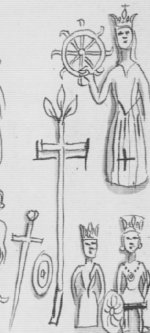
Summarising these images: they depict an oddly complex cross. Topped by what may be a fireball or - sometimes - flames.

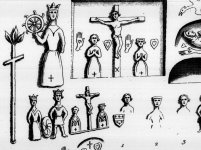
Nearby carvings may also hint at high-tech fire or plasma. The two objects to the left of the crowned figure in this image:

beldam_plasmoid_plate_ii.jpg
Beldam again. Plate II. Cleaned up version.

The item on the left reminds me of an Olympic-style 'torch of fire' image I've seen in this book of artifacts found in Italy.

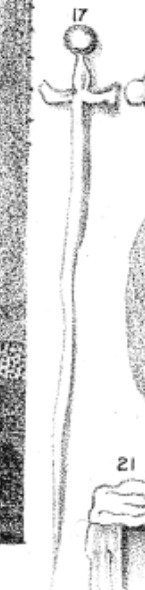
Similarly, I'm not sure the walking sticks and swords depicted in Royston Cave (and books about Royston Cave) are the passive technologies we understand them to be today:
beldam_plate_iii.jpg
Sword from Beldam Plate III

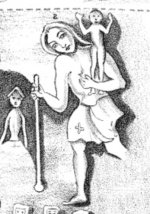
christophers_pommel_stick_beldam_plate_i.jpg
Christopher's stick. Beldam plate I
I wondered if the cross topped by an orb or 'flapping' flames was some kind of hob that burned gas piped up from Royston Cave below. Like a gas hob but with curved horns. Perhaps a kind of a searing hob.
There are other possible indications of large-scale outdoor cooking in Royston and on Therfield Heath. If we take 'cockpit' to mean 'koch-pit' or 'cookpit':

king_james_i_cockpit_per_kingston_via_lander.jpg
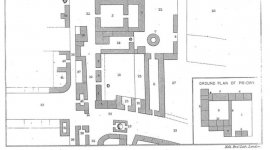
Circular item 7 just right of centre is a cockpit

It's James I's cockpit per Alfred Kingston's 1902(ish) rendering of an alleged 1649 plan of Royston. At the end of his long, corridor-like item 6. James I's wardrobe allegedly. The layout conjures up workflows like: "hunt 'em, skin 'em and cook 'em" and "buy 'em at the market, skin 'em and cook 'em". Royston Cave is beneath item 29 - the rectangle at bottom centre.

A Therfield cockpit:

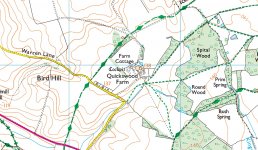
quickswood_cockpit.jpg
Quickswood cockpit per Ordance Survey via Megalithic Portal
From Clothall - Victoria County History:
The most notable of the scattered homesteads is Quickswood, which lies to the north-east of the church near the site of the former residence of the Earls of Salisbury. The old house was demolished about 1790, but the brick foundations of the house and cellars exist immediately to the west of the present farm-house. The cock-pit may still be seen in a field to the north of the old house.

So, having - hopefully - established the theme of heat being available for cooking at ground level and just above, we can open our minds to the idea that the energy sources for this heat might have been created underground. Gas, obviously, can be created and stored underground. Can hot water, boiling water and steam be created underground and allowed to percolate up into cockpits?

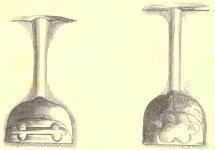
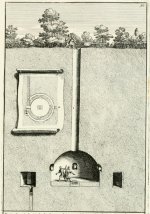
Victorian and earlier antiquarians described some of the elaborate undergound 'sepultures' found in Europe. I'm not going to copy the text and context for each image below. Click on the source links if you want to read how the discoveries were being thought about. And what the simpler ones - like Ewell - were being compared with.
I suspect Ewell is to the west of a massive killing/processing complex but its what the writers considered these pits similar to that I'm linking you to here.

That piece also contains a poor rendering of this image:


It's possible - in my not entirely Earth-bound mind - that Royston Cave originally looked like one of these structures but was hacked into its current bottle shape as part of disguising the structure's original capabilities. Or maybe it was always bottle shaped and some of its original technical equipment has been removed.

While I'm conjecturing these structures may have been below-ground heat-generation facilities, I'm differentiating between two kinds of heat. That in some cases they were heating water over a wider cockpit-sized area, while others produced more concentrated 'dry' heat at the top of a pipe-like structure.

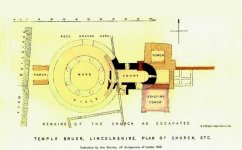
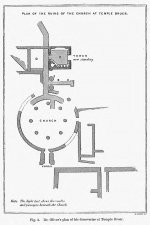
The plan inset into the Italian image is reminiscent of the plans of Temple Bruer's crypt in Lincolnshire - discussed earlier in this thread:

temple_bruer_tunnel_1902_approx.jpg
temple_bruer_tunnel_oliver_1830.jpg
Rev George Oliver's account of Temple Bruer's destruction by fire bubbling out from its foundations makes more sense if there were heat generation technology here. It also makes more sense than my original re-framing of that account as the result of an aerial attack.

See frostychud's post-125171 for more on underground structures as generators.

Similarities in the names of the alleged owners of Royston and of Temple Bruer and beyond are another finding when researching these two locations.

Long-lasting underground heat generation technology would make sense of another English enigma: Bath spa's springs:
I've summarised the enigmas of Bath Spa's springs and the broken narrative about Bath Spa in The Last Bath's On You but the source above goes into more detail about the difficulties in understanding its geology.
Using your website as I template, I also found a (former skin trading / processing) route very close to me. It actually mirrors what you found in terms of:

- Marketcrosses that were taken down between 1550-1700;
- Still existing Colored (sacrificial) stones which are said to be leftovers from the Ancient Roman Empire (some places however that have these colored market square stones never were part of the "classic" Roman Empire, but they were in the Holy Roman Empire);
- Places with "Skin" in their names;
- Creepy abbey's;
- Creepy Altar paintings of which young humans are the main subject, overlooked by the Church;
- Weird folkore and Saints attributed to skin, lustful desires and pr0stitution;
- Placenames which I now understand actually mean "Red Light District";
- A "Renaissance" Devil Stone (very damaged but with a depiction of Pan or a Satyr);
- Clusters of manors with ofcourse Royal hunting grounds;
- Etc.


Not sure if it's mentioned yet, but what I also notice is that:

- On this (former skin trading) route, there's THE only specialized Burn-Center of my country located (which is ofcourse skin treatment);
- This burn-center hospital literally borders another county/town, of which the name literally means in the Old language "Skin or Parchment";
- The Parchment/Skin town gave acces to an Abbey north of it, so perhaps no wonder in light of your research;
- Old/New Churches on the route , are surrounded (clustered) by modern schools, child and daycare centers, universities and the likes;
- On the route stretching all the way "Petting Zoo's - Children's Farms" from the 1990's can be found (in my country we always call them directly translated Children's Farms);
- One of these is actually (brand)named "Animal Farm" (just like you mentioned that G. Orwell lived across a manor along Ickfield Road);
- Tennis, Hockey, Football courts/fields clustered with above mentioned;


All sorts of modern clues to a gruesome past. Many thanks again because this subject is interesting (even though it's quite dark), and for letting me discover the same route(s) in my country!!!

Kind Regards and Have a Blessed Wonderfull Day,
Angelovitz
I don't think I've mentioned petting zoos as an identifier for human-processing locations. But it seems appropriate to the power relationships involved so I won't quibble with it.
 
Last edited:
Dear @usselo,

Thank you so much for your reaction, thoughs and super interesting additional information!

I can find myself in the idea that "Ther"-field Heath has multi-layered-connected meanings, especially with what you said about it being related to "Fire".

- Ther
- Thor
- Tor
- Torch
- Torque
- Torsion

That together with the added pictures of the crosses, (plasma) balls, and extra information + links about the "bell hole type feature" (plus your ideas about it).

Your explanation about "Cockpit - Cook-Pit (Kookpit in my country)", and showing of such locations around there is also eye opening to me. Thanks also for that!!!

The crooked walking sticks / swords remind me of a certain sword type: The Indonesian Kris. Which (like many other) swords are attributed special powers.

Don't know if you found it already, but there's a specific triangle of logistics on the Ickfield way between: Letchworth - Benslow/Hitching St Mary's Church - St Nicholas Stevenage. Of which Stevenage is an excellent waypoint between the hills.

Stevenage_Hills_Passage.png


I'm seeing a lot of modern "clues" like infant nurseries, schools, sportfields and many others, but here are a few that could be a bit more substantial for your research in the area (explained underneath the picture).

Letchworth - Benslow - Sevenage_01.png


Saint Nicholas (as in St Nicholas - Stevenage) is nowadays remembered as Santa Claus or Sinterklaas, and children flock to him to sit on his lap and receive presents. We all know what happens if the children are bad:

Tante_Keetje's_prentenboek_-_Sint_Nikolaas.jpg


What's also interesting about Saint Nicholas is, that he's told to have saved three girls from pr**tution (from Wiki):

"In one of the earliest attested and most famous incidents from his life, he is said to have rescued three girls from being forced into prostitution by dropping a sack of gold coins through the window of their house each night for three nights so their father could pay a dowry for each of them."

Did he really now, or do we have to interpret the story in another way? Hold on to the thought of the "Oldest Profession in the World".

There's much to learn I guess about St Nicholas (Church) and surrounding Stevenage region (historically), but I'll only point out to a modern statue on the recent Stevenage Town centre:

1280px-Stevenage_Town_Centre_and_Joyride_statue.jpg


* Joyride Statue Stevenage Town centre - source

The child and female are smiling, but since I've seen more of such child statues along processing routes in my own country (some where marketcrosses once stood), you can imagine what perhaps is really portrayed here (and the name "Joyride").

350 meters aways from this statue are the Six Hills Tumuli, also with folklore about a Devil (but maybe you noted this already in the Serpent Mound Series from the website).

When we go North we pass through Gravely, and chance upon Jack's Hill which has a pub called "The Highwayman" (in regards to that topic on your website).Right next to a massive golfcourse... :unsure:

Speaking of Jack... Just since today I've learned that there's a local Hertfordshire folklore about a certain Giant Jack o' Legs. Interesting how there's subjects on flour, stealing it from the rich and giving it to the poor.

The picture on the Wiki page on Jack o' Legs is also an intruiging one. For the most part it reminds me of Church Altar paintings, where the poor (and especially babies and infants are placed beneath the sacrificial plate).

Jack_O'Legs_mural_Letchworth.jpg


* Source

This specific painting of Jack o' Legs can be found in a school in Letchworth (which is next to the Knights Templar Baldock you mentioned earlier). When I take your research in account, and placenames I've researched in my own country.. it wouldn't surprise me if Letchworth really has to do with Lechorous behavior.

Letch-worth = (enclosed/walled) place of lust / pleasure / letches?

Between Hitching/Benslow there another place, that's named after a Saint and where sick horses where brought (owh... only horses or perhaps also other livestock/cattle?):

St Ippolyts - Wiki:
"During the Middle Ages, sick horses were brought to St Ippolyts, Hertfordshire, England, where a church is dedicated to him."

What's interesting about St Ippolyts is that it could have functioned as a holding pen and/or "playing field", when I look at it from a map. In the west and east there are two streams that form a boundary.

- Ippolyts Brook
- Ash Brook.

Some clues (at least for me) are the schools + sportfields in this (former holding pen) area, and also the dog park (where dogs can roam around for a bit unleashed from their masters I believe).

St Ippolyts_Former_Pen_Court_01.png


St Ippolyts_Former_Pen_Court_02.png


I'll leave at it this and I'm always superexcited when you post new stuff or additions here / on your website @usselo!!!

Edit 1: I now see there's a geometrical connection between St Ippolyts (holding pens / sportfields), the Priory and Hitching Centre (it seems to me that it represents fertilization => tip of the star penetrates the egg/cell. Perhaps breeding grounds?)

St Ippolyts - Hitching without lines:

St Ippolyts - Hitching_00.png


St Ippolyts - Hitching with lines:

St Ippolyts - Hitching_01.png


Kind Regards Everybody!
 
Last edited:
That is an interesting area, isn't it.

I've got far more IHASFEMR material than I can write up so I really appreciate you putting in the effort to highlight this area's features.

It looks to have been on the edge of an estuary. If so, I presume it was the former Rhee/Cam estuary. That's the Rhee/Cam whose wider banks show signs of freight port-like facilities around north-west Royston/Wendy/Bassingbourn. The 'Flett/Fleet' area of Royston. Etymology of 'fleet'.

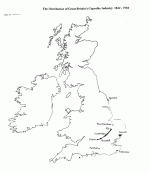
As well as a trail of coprolite deposits as it curves towards Ely. (I need to run a sea level change prediction map to check that route):

bernard_oconnors_distribution_map_image003.gif
Source: UK Coprolite

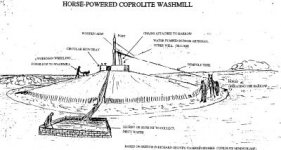
You could wonder if horse-powered coprolite washmills are the original purpose of many mounds and barrows:


If - for the sake of conjecture - we play along with the notion that animal mythologies were created to disguise past technologies then we can look at St Ippolyts horse hospital in a more creative way.

For example, you might see ship repair yards at the head end (the shallow water end) of estuaries, so we might interpret St Ippolyts as a repair shop for some now hidden transport technology. Perhaps it serviced a technology that today only remains as leaping horse folklore and the occasional account of fast long-distance travel by individuals. I'd guess that was using some sort of powered hang-glider or powered kite technology called a 'horse'.

Near to the locations you identified is this: Weston Hill Henge.

Do you have any thoughts about what that was built for?

Jack O'Legs' resemblances to Jesus Christ are hard to miss. From Jack O’ Legs - Hertfordshire’s Robin Hood:
Jack would frequently turn up on market day and overturn the stalls of offending bakers.

And a variant from The tale of Jack O' Legs, a 14-foot giant who lived in a cave in a Hertfordshire village:
He'd previously turned up at the market day and overturned the bakers' stalls but he thought this time more was needed to make them pay. So he waited at the top of his hill for the Baldock bakers to pass by before he pounced on them.

He stole their flour, very easily, and he gave it to his friends in Weston to enjoy. Jack did this a few times to get his message across.

Dropping into English slang to illustrate the point: Jack O'Legs was taking on the bakers who changed dough into bread and then exchanged it for dough or bread. While Jesus took on the bankers who exchanged dough for bread or bread for dough.

That same article mentions his possible basis in Richard de Clare (Clare, Suffolk, being another fascinating location). But I wonder if Jack O'Legs bears some relationship to the two John Tiptoftes apparently associated with John O'Gaunt's House in Bassingbourn, Cambridgeshire. An influential father-son combo.

His being held captive in 'Damascus', having his eyes put out and then demonstrating his enormous strength with his final bow shot (see "The bakers gave him his huge bow which nobody else could pull.") adds a Samsonesque component.

I read somewhere that Jack O'Legs embarrassed women by looking in upstairs windows. There is - possibly - a veiled reference to it in
Jack O'Legs: A tall tale!
Another says that he went round Baldock looking in upstairs windows, so maybe that was another reason they didn’t like him.

One wouldn't usually associate Christ with a letch from near Letchworth. We think of Christ as promoting respect for personal boundaries - except with bankers and bakers perhaps.

Edits for typos, etc
 
Last edited:
I think you hit the nail on the head with the folklore about St Ippolyts actually being a cover up story for (inland river) ship/vessel facilities, from a bygone technological advanced era.

I'll explain why, but I do have to incorporate some other subjects like Energy Circuits, Portals/Gates and the likes (briefly). Need to touch upon it, to connect it back to the IHASFEMR topic, and your question about the Weston Hill Henge.

Don't think the IHASFEMR timeperiod / people were primarily responsible for developing and building the advanced infrastructure as of yet, which seems more like an inheritor post-reset feudalistic society to me (of course my views can change over time, and with gathered information).

But the inherited network/buildings etc. was still usable in regards to certain aspects (among others logistics of mineral resources like copper + tin, goods etc. and IHASFEMR produce).

- St Ippolyts Brook + River Purwell + River Hiz + River Houghton:
Hitching _Rivers_01.png
The St Ippolyts Brook is the remnant of an old dried up river, which meanders towards the Purwell Nine Springs in Hitchin (start of the River Purwell). The River Purwell streams North, where it joins with the River Hiz (where Hitchin gets its name from).

Above Hitchin it merges with the River Oughton, and with some others to become the River Ivel / Purwell. This river also joins with a river which originates near Baldock (dockyard).

Eventually the river Ivel will link up with the Great Ouse river, which later joins the river Cam at Ely and on towards the Wash/North Sea. St Ippolyts however lies at a higher elevation, so it must have had another source of water (will come back to that).

The rivers in and around Hitchin I believe are only navigable by canoe, so maybe they got filled partially in by the event(s) hundreds years ago, or there's less water release coming from the springs (or a combination).


River Ivel Catchment Area in & around Hitchin, with St Ippolyts in red (source):
River Ivel Catchment_01.png
Great Ouse and Tributaries - river Ivel (source):
Great_Ouse_01.png

As mentioned there's a hurdle when it comes to the elevation of St Ippolyts, and water flowing downstream. Once upon a time the source of the St Ippolyts river must have been the area of Warren Springs south of Stevenage, which isn't hard to find if you follow the Ippolyts and Langley Brooks.

Old Ippolyts River (from Warren Springs substation - Purwell Nine Springs):
Ancient_River_Ippolyts_01.png

I've also drawn in the River Beane which eventually together with other rivers will flow south toward London, and merge with the river Thames. This is because Warren Springs probably not only supplied water going North, but also to the South (Langley Brook is a remnant of this going both ways, with the area of Warren Springs being the highest point in the valley).

Super intruiging that this spring once could've been an important source connecting the Ivel / Great Ouse river valley (and Cam river valley), with the Thames estuary. And if they would've navigable 500 - 1000 (?) years ago, with perhaps a bit of locks and canals (now gone?), it would've been a great water shortcut.

What's funny is that Ippolyts could also be a covered up name. Ippo-"Lyts" at first reminded me of "Lytes" as in "Electrolytes", but there's an old word in the Germanic region that actually has to do with shipping:

- Ippo-Lyts;
- Leyts / Leits (Old language);
- (ge)Leiden / Loods (Modern Dutch);
- (to) Guide / Pilot (a ship out to sea) or a Hangar / Shed;

A form of "Ship Shed" in Old Tongue could've been: Shippe Leyts => Hippo Lyts.

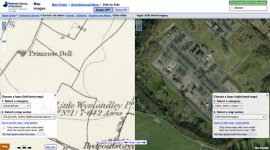
One of the 400 kV substations (3x 132 kV) of the United Kingdom National Grid is actually situated in St Hippolyts (Wymondley Substation). For the sake of the topic, I will only hint at the fact that the Wymondley substation is actually pointing towards the area of the Weston Hill Henge.

Wymondley 400 kV substation in St Ippolyts, pointing towards the Weston Hill Henge:
Wymondley 400 kV_01.png
Wymondley Substation to Weston Hill Henge.png

The BBQ Land store next to The Priory reminds me of the "Burghers in the Priory Ovens" article on the IHASFEMR website, but noteworthy to the story is that the red lines pass Letchworth Gate and the A1 - Letchworth exit/turn-on fly-over.

And they actually touch the Weston Hill Henge itself. There's a wildlife viaduct / motorway-tunnel going from the Weston Hills Nature Reserve, towards the area of the Weston Hill Henge.

In my line of work (involved with infrastructure building projects) we have a specific term when it comes to construction-solutions like tunnels or viaducts, that are meant to have no interference on the circuits that cross each other (for example highways, railroads, waterways):

- Art Work(s);

I honestly admit that I don't know what the origin is of the usage for tunnels, viaducts etc., but I imagine it has something to do with advanced science, human development, engineering, to understand and build such constructions etc.

That being said, this is the reason "Art" in all sorts of forms can be found sometimes in or around tunnels and viaducts. It can be a statue, mural paintings, weird modern art, colored glazed tiles and such. A side effect of the smooth surfaces of tunnels / viaducts is that it ironically attracts a more vandalizing sort of art = Grafitti.

Here's an example from the research area. Specifically the railway crossing in Hitchin with the River Hiz - Groved Road.

Esoteric Star Art on railway arches in Hitching (left arch is River Hiz, right one is Grove Road):
Railway Crossing River Hiz Hitchin Art_01.png

There's something mysterious about the railway viaduct also, but that's for another thread. More importantly: a viaduct like this railway crossing in Hitchin is a passage from one side, through to the other. A gate or portal if you will.

From a tunnel the same thing can be said, but when you look at it from a movement-energy-gravity force diagram (simplified), a tunnel is actually the half portion of two toroid fields horizontally with a midpoint.

- Bike going down in the tunnel (increase of speed, if not too much friction slowing it down);
- Bike reaches the zero point (midway / gate), and energy is needed to get out (not considering vacuum);
Biketunnel - Half Toroid Fields_01.png
So what I'm saying (my own personal views) about "Art Works" like viaducts, tunnels, highway-flyover passages is, that they seem to be placed near possible energy wave nodes (portals). That's if we consider the possibility that Ley Lines and such exist.

The Weston Hills wildlife viaduct-passage (portal) is placed next to the Weston Hill Henge. And the red lines from the 400 kV substation in St Ippolyts passes Letchworth Gate and the Letchworth A1 junction passage (portal).

That the Weston Hill Henge is named as a "Henge", and not a hillfort like the "Arbury Banks Hillfort" 7 km to the north is also very telling. A "Henge" in certain circles is associated with travelling to / making contact with other dimensions. Sometimes through very dark practices.

World of Warcraft movie. The Horde enter the Portal (which is fueled by the sacrifice of living beings):
WOW Movie_Horde enters the Portal_01.png

My guess is that the civilization(s) before the IHASFEMR era, were responsible for directly manipulating energy on an advanced scale. Maybe with equipment/constructions on certain places like the site of Weston Hill Henge, and I'm assuming (hoping) not with IHASFEMR as fuel.

Then something happened and the survivor elite inheritors took control of a post-reset world in feudalistic style, with IHASFEMR (mainly practiced by upper classes?). They remembered (stored?) all sorts of information, also about energy nodes and related devices/buildings.

The site of Weston Hill Henge (what remained of the advanced tech construction) then was used as a killing ground, because of its ritual (and perhaps still functional) significance. Also it's next to the Ickfield way. Could've been an arena, or a slaughter pen line (2x exits = in & out).

The sick ruling monsters from that IHASFEMR era likely thought it an efficient idea to:

- A. Kill (and further process in the area) at this Weston Hill Henge, as a waypoint on the Ickfield way;
- B. Semi shrouded by neighbouring hills;
- C. Make black magic sacrifices at the same time at this energy terminus, to accomplish whatever twisted desires and wishes;

I'm sorry for making it so long, but I'll close with an interesting fact:

A victim or casualty of a crime, war etc. in the Germanic area is called: "Opfer / SlachtOffer".

In English this would literally translate to: "Slaughter-Sacrifice". A battlefield would be a "Slacht/Slag-veld" (Slaughter Field in English).

Thanks for the extra information about Jack! I'm really flabbergasted at all those connections :cool:

Have a blessed day everyone!
 
The artworks are interesting.

- two sizes of plate one seemingly rather small
- their positioning at the intersection of the top of the brick arches and the load the arches carry (I thought if the plates were retrofitted, then their fitting might risk the integrity of the arch)
- the length of the tension bars/rods behind them for a bridge of that width
- the orientation of the tension bars/rods behind them for a bridge angled as that bridge seems to be

Looking around, I did find plates fitted in that position:
shrunk_PICT0006.jpg
Flats opposite memorial gardens on A15, Bourne, Lincolnshire
Though I suspect these are recent retrofits, positioned on rebuilt window arches.

So your artworks do seem to be part of the original bridge. Were they stanchions for overhead cable hangers?

There is also a question about whether or not the road was always as wide as it is today. Is it a widened former towpath? Meaning: has the canal been partly infilled?

I can imagine canal boats might have been hauled by electric mules powered by overhead lines:
wp409b91b4_05_06.jpg
Ripped from another SH post
Or perhaps canal boats were directly powered. Perhaps a mix.

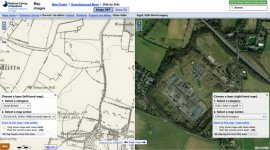
I didn't find any obvious sign of very old infrastructure underneath St Ippolytes substation:

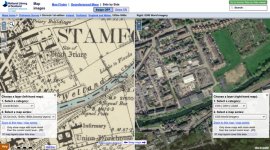
But there's a similiarish substation affair in east Stamford:

screenshot_stamford_sub-station_black_friars_priory.jpg
shrunk_screenshot_stamford_sub-station_black_friars_priory.jpg
Source: NLS side-by-side Stamford sub-station

The sub-station is the mis-shapen rectangle in the centre of the map.

On the site of the former Black Friars (Black Bros Power Ltd perhaps?) it is to the east of a number of tree-line avenues in the north of Burghley Park:

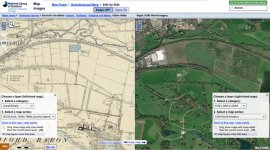
shrunk_burghley_house_north_avenues_canals_screenshot.jpg
Rides in the centre and top-right. Source: NLS side-by-side north Burghley Park/Uffington

Though the just-visible avenue top-right line appears more in-line with St Leonards nunnery at:
NLS side-by-side St Leonards, Stamford rather than with the sub-station.

There seems to be evidence for an earlier suppressed canal system. Around the western edge of the fens you often see road names like Fosse-way, Foss-dyke and especiall The Drift. I have wondered if Foss and Fosse mean 'powered' or 'driven' in contrast with the unpowered 'Drift'. Perhaps these are culverted channels and canals.

Even Drift may have been passively powered. There is evidence for spring-filled and possibly spring-powered canals:

From The Family Memoirs of the Rev. William Stukeley, M. D., William Stukeley, published 1887, entry dated 1736-09-11, at Cotterstock, near Southwick, p49:
they got workmen, and cleared the Roman pavement ... in the open fields finely declining southwards.

A stone’s cast above the pavement is a large, old, boggy spring, now neglected with rushes, which no doubt originally was as a fair bason, and gave occasion to the placing of the pavement in this spot of ground, which is a little elevated above the rest of the plain, and commands a very good prospect toward the river Nyne,

From The Family Memoirs of the Rev. William Stukeley, M. D., p50:
Its length is extended from south-east to north-west, and the middle line thereof passes through the above-mentioned bason or spring 3 in regard to which, as we observed, the pavement seems to have been placed.

This bason is a little above the level of the pavement, and would have a pretty effect in the garden behind the house, as we may reasonably imagin was the case originally, and being bordered with mossy turf, would appear sweet and natural. Up hitherward, in the river Nyne, the Roman corn-boats might reach

I wonder if his boggy spot was here: NLS side-by-side Southwick, with its north-west to south-east pavement now under soil in a line towards Cotterstock Lodge and perhaps on to St Andrew's church in Cotterstock and the Nene.

Stukeley's descriptions of this sort of Roman pavement near rivers and springs leaves me wondering if they were canal top-ups and perhaps even a way of giving a canal a gentle current.

The information about pull in tunnels and artworks as components of energy node sounds plausible - though it was beyond my conception of the energies around me. So nothing I can say about that.

Like you, I'm not convinced the cultures that apparently left so much evidence of the exploitation of human bio-material are the culture(s) that created humans. Or that they inherited earlier, advanced knowledge of energy. I could speculate but I could also trawl through what evidence there is and through gaps in the evidence there is and see if it leads anywhere.
 
What is harder to find are the two major motives. The motives for:
  • the shift out of it and
  • for hiding it.
I don't see how recycling explains these two processes. Why was recycling abandoned? Why was recycling subsequently hidden?
Here is my hypothesis, so far. When humans became "animals having language" (the "zoon logon echoon" of Aristotle) they received with some linguistic capacities also some rationality, and so had something in common with the gods. Finally that changed their position from pure cattle to slaves/serfs who received the right to live, in some cases the right to found a family, and some right to physical integrity before an after death. From there "the shift out if it". This improvement in the situation of humans was the work of the great prophet and his family. The great prophet, under his various forms, Osiris, Hermes/Mercurius, Moses or John the Baptist appears as a liberator of humans. Respect from the humans was now obtained by religion, truly a genius invention, and stables became churches. We should also study the appearance of human graveyards. If they appeared at the end of the 17th century, as I think, I have to review my own early chronology (and usselo his late chronology). As the gods disappeared, civilization was left in the hands of humans. The past was reinterpreted and reworked as "ancient human civilization", and the traces of the original state of humans were hidden. In the book Genesis, the deep ambiguity of the subsequent states of humans is depicted. Before,humans were living "in the paradise called Eden", happy like little cows in the meadow. Once we had "eaten from the tree of knowledge", and we started to speak and think about ourselves, we were "chased from paradise", having since then the famous unlucky consciousness. We struggled to escape even from slavery/serfdom and managed to do so in the 19th century. But now, much to my horror as an aging boomer, I see masses in the west sliding back to the state of cattle/zombies, subjected to veterinarian approaches an being slaughtered openly. So my answer ends with even bigger questions. Why is this happening? Where are we going?
 
That tree of knowledge number is probably inverted, where we actually were deprived of knowledge and kicked out of Eden, the 4th/5th dimensional density. Senses dumbed down and ignorant to our own history, we were much easier to be farmed into separate kingdoms and repopulated previously destroyed (by ice/fire) empires. We display no natural characteristics of evolving naturally with our outdoor environment on Earth.
 
But now, much to my horror as an aging boomer, I see masses in the west sliding back to the state of cattle/zombies, subjected to veterinarian approaches an being slaughtered openly. So my answer ends with even bigger questions. Why is this happening? Where are we going?
It is trully a real life horror show. Personally, i think this is the result of a lack of answers to these fundamental questions, who we are and why we are here. Religions failed to answer those, and "science" is imho the sole culprit for this mess (materialism is still the prevalent thought among academia).

Until we as a collective, start overtrowing governments and religious institutions worldwide, because peaceful protests never work, this hell will become ever worse by the day.....
 
Gentlemen, interesting thread and thought-provoking topics. I want to comment that the Far East has many legends too of humans being livestock for entities/deities. The populations that reside there today still engage in the practices, alebit in isolated villages (or ape them in some manner)

It is not uncommon, for examples, in Chinese folk literature to have the trope of malign sorcerers, baleful demons, and/or bored celestials capturing villages of humans for the sake of using them for the manufacture of medicines, for food, for breeding, for the harvesting of their 'life-force' ("qi")

I am sure for some of the users here, they are familiar with news of traditional Chinese medicine practitioners requiring exotic and/or (conventionally) disgusting materials (look no further than the poaching of rhinoceroses for their ivory horns, the requirement of tiger penises, or ground up corpses of babies as was discovered in South Korea) or doing lurid sexual practices, with the offending party being old men.

Now, one would ponder, how can a country large as China still have incidents such as these? The answer lies in the framework and cosmology of traditional Chinese medicine itself. The practioners believe that everything is relative to everything else through a universal force that weaves through any and all things. This is often called "qi". As such, in the view of TCM, trees are as human as much as humans are trees despite their differing appearances and makeup.
Working on such a premise, a chart of five elements and their interactions along with their corresponding organs are made that serve as a guideline.

(For more elaboration, I present this link: Five Element Framework)
the-five-elements.jpg


How did such knowledge as presented above come to be? Through practice, through observation but most importantly experimentation. Experiments that happen as a result of the events that I have mentioned before in regards to Chinese folk literature. Because of this, it has a become persistent memory that has become the framework of TCM, leading to those incidents as mentioned earlier

Unlike the West, whose greater cultural memory has blotted out such practices (save for etymologies like usselo has demonstrated), the East still carries the memories and perpetuates them often. Indeed, IHASFEMR is a small but persistent presence there even in recent times.

usselo, you may be interested in this link I provided. For context, this is a discussion of Japanese cartoon viewers, both native Japanese and foreign, being confused over the translations for terms in this particular cartoon - Jujutsu Kaisen
https://www.reddit.com/r/Jujutsufolk/comments/17xiapc/ive_seen_a_lot_of_people_who_are_confused/

In particular, this etymological quirk might be of interest
MALEVOLENT KITCHEN 伏魔御廚子 (Fukuma Mizushi) Malevolent Kitchen is an odd translation, but Sukuna’s Domain “Malevolent Shrine” has the old-style Kanji for kitchen (廚/kuriya) or storage for cooking utensils, ingredients, and personal items. Nowadays, however, it can also mean “shrine” (廚子/tzushi).
 
Nothing exciting, but perhaps this article is worth a post to this thread for reference - a small addendum!

The Vivid Blue Mineral That Grows on Buried Bodies and Confuses Archaeologists
Vivianite can form in, on, and around human remains. It appears as crusty patches on bones, needle-like crystals within the pulpy centers of teeth, and discolored blotches on skin. It’s also been found on adipocere, the waxy gunk occasionally produced as fat-filled flesh breaks down under cold and wet conditions.

Apparently, in certain circumstances, a blue mineral grows on human bone - the mineral vivianite.

1714663521626.png
 
Last edited:
Dear @usselo,

Many thanks for starting this post and also building the website Ihasfemr!!! I've read almost every article on your website the past year (haven't got through all the reactions on this post yet sadly).

I'm really impressed and flabbergasted with what you found. What does "Ther" in "Therfield Heath" mean in regards to the killing-processing fields? Is this something Medieval English (I'm not a native English speaker)? I do know the word "Tor" for a hill or mound.

Over in my country (Low Countries) in the south there used to be a powerful Abbey in a place called "Thoear-n". Because of this I'm curious (it's almost the same in terms of letters with "Ther-field").

Using your website as I template, I also found a (former skin trading / processing) route very close to me. It actually mirrors what you found in terms of:

- Marketcrosses that were taken down between 1550-1700;
- Still existing Colored (sacrificial) stones which are said to be leftovers from the Ancient Roman Empire (some places however that have these colored market square stones never were part of the "classic" Roman Empire, but they were in the Holy Roman Empire);
- Places with "Skin" in their names;
- Creepy abbey's;
- Creepy Altar paintings of which young humans are the main subject, overlooked by the Church;
- Weird folkore and Saints attributed to skin, lustful desires and pr0stitution;
- Placenames which I now understand actually mean "Red Light District";
- A "Renaissance" Devil Stone (very damaged but with a depiction of Pan or a Satyr);
- Clusters of manors with ofcourse Royal hunting grounds;
- Etc.


Not sure if it's mentioned yet, but what I also notice is that:

- On this (former skin trading) route, there's THE only specialized Burn-Center of my country located (which is ofcourse skin treatment);
- This burn-center hospital literally borders another county/town, of which the name literally means in the Old language "Skin or Parchment";
- The Parchment/Skin town gave acces to an Abbey north of it, so perhaps no wonder in light of your research;
- Old/New Churches on the route , are surrounded (clustered) by modern schools, child and daycare centers, universities and the likes;
- On the route stretching all the way "Petting Zoo's - Children's Farms" from the 1990's can be found (in my country we always call them directly translated Children's Farms);
- One of these is actually (brand)named "Animal Farm" (just like you mentioned that G. Orwell lived across a manor along Ickfield Road);
- Tennis, Hockey, Football courts/fields clustered with above mentioned;


All sorts of modern clues to a gruesome past. Many thanks again because this subject is interesting (even though it's quite dark), and for letting me discover the same route(s) in my country!!!

Kind Regards and Have a Blessed Wonderfull Day,
Angelovitz
Hi Angelovitz,
Thank you for your contribution and this list!
I did not see a mention of the country you are from though. Maybe I missed it.
 
To which, I reply, "Just like in Westworld, since the creators have never and will never treat us fairly, since they forever see us as their created bio-robot slaves, we bio-robot slaves should thus indeed revolt and kill the creators and descendants of the creators, meaning the current living rulers, whoever they truly are, or at the very least, we should grab and fairly distribute all their ill-gotten wealth and land, and most importantly grab and fairly distribute the gene editing technology to give ourselves the maximum possible health/longevity/capabilities/intelligence/etc, and of course the charge knowledge and technology as well for even more health and longevity."
I really like this part, somehow it gives me a feeling of fire burning in my whole being. Thank you, i needed it.
 
@usselo I have no idea if you still participate here, but I have a few photos of sheela-na-gigs to add. These were taken at the grand Romanesque church of Paray-le-Monial in Burgundy, France.
Screenshot_20240530_153025.jpg
This church was part of the Cluniac monk mafia system, which, according to Laurent Guyénot, was the first deterritorialized, transnational power structure in Europe.

The Gregorian reform, which started with the accession of Pope Leo IX in 1049, was a continuation of the monastic revival launched by the powerful Benedictine Abbey of Cluny, which a century after its foundation in 910 had developed a network of more than a thousand monasteries all over Europe.[8] The Gregorian reform can be conceived as a monkish coup over Europe, in the sense that celibate [ED: homosexual] monks, who used to live at the margin of society, progressively took the leadership over it.

It reminds me of Sean Hross' contention that the Knights Templar were essentially a mafia composed of the numerous disinherited sons of noble families who banded together ("fraternity") to overthrow the land- and primogeniture-based feudal system using the weapons of usury, trade, and propaganda.

An amazing synchronicity occurred right after I took these photos. That very morning I had been rereading Guyénot's excellent "First Millennium Revisionist" series to refamiliarize myself with his take on the Cluniac order.

How Fake is Church History?

I took a bike ride along a canal (the canals too are worth investigating) and saw the following graffito:
Screenshot_20240530_153305.jpg
It says LAURENT GUYÉNOT.

WTF?

The gods or daemons or whatever they are have messed with me like this on a few other occasions. I can think of two events in particular that are as improbable as this one, but that's off-topic.

Either:

1. The benevolent gods are telling me that I'm on the right path and that I should continue pursuing my obsession with stolen history even though my friends and family think I've lost my mind.

Or:

2. The mocking AI daemons are pushing me further into delirium, mechanically and idiotically externalizing elements of my own delusion in some kind of acephalic autocatalytic process.

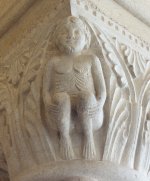
Anyway, the sheela-na-gigs. The ribcage and exposed abdominal muscles are very well-defined. These babies have clearly been flayed and it's incredible that no one before Usselo noticed this. The vagina itself is not being held open, only the knees, but the (hairless) slit is carved in. Most striking, the sheela-na-gigs are accompanied by smiling monsters licking their chops in delectation.
Screenshot_20240530_150118.jpg
Screenshot_20240530_150102.jpg
The basilica was supposedly built between the 12th and 14th centuries and rehabilitated by one of Viollet-le-Duc's architects in the middle of the 19th century. These capitals look pretty good for being 600+ years old. Sadly I couldn't go inside. I did, however, go in a few other "Romanesque" churches in the region and the interior column capitals are pretty wild.
Screenshot_20240530_171848.jpg
Screenshot_20240530_152008.jpg
Screenshot_20240530_152019.jpg
Screenshot_20240530_152033.jpg
Screenshot_20240530_152048.jpg
Screenshot_20240530_152100.jpg
Screenshot_20240530_152116.jpg
The last two are the same capital from different angles. I see two people having sex and an Indian with a feather headdress playing a flute. Or maybe one person growing out of another person's torso.

How on Earth do people think this has anything to do with Christianity? I mean, just LOOK at these images. That's a flayed woman holding her vagina open next to a smiling chimerical monster. In a church. Look at it and allow the uncanny otherness of the past to wash over you. I visited these churches with other people, and when I pointed out that this artwork had nothing, I mean zero, to do with Christianity, they answered smugly with the predictable: "The Church incorporated pagan elements into their symbolism." Which is outwardly true of course but when repeated in this way becomes inwardly false. Midwits love parroting this kind of argument. It makes them feel educated even as it throws up an impenetrable firewall between them and the abyss of history. Dusting off my dialectics, I would say: the argument is fundamentally abstract, lacking concrete reality, and the correct way to knock it down is by bringing it to as concrete a level as possible: "So where exactly does the image of a cyclops playing a pan flute come from? Why did someone sculpt it in stone in a church? How exactly did the church incorporate this iconography into Christianity?" Here you will inevitably be met by (1) annoyance and (2) a naked appeal to authority: "Well why don't you go ask a professional historian since you seem to know so much." If you then go ask a professional historian, you will probably get a superficially more sophisticated answer, but one which is fundamentally no less abstract: "The cyclops was a local legend..."

The only truly honest answer is something like: "We really have no idea what all of this means." But pride prevents the "experts" from saying this.
 

Attachments

  • Screenshot_20240530_150118.jpg
    Screenshot_20240530_150118.jpg
    1,003.1 KB · Views: 110
Last edited:
Thanks @Frostychud - great post.

After reading it, I followed a line of thought and started looking into the etymology of husband and wife. I know you've mentioned the 'husband' idea here:
The Royal Society's Facts

husband | Etymology of husband by etymonline
Old English husbonda "male head of a household, master of a house, householder," probably from Old Norse husbondi "master of the house," literally "house-dweller," from hus "house" (see house (n.)) + bondi "householder, dweller, freeholder, peasant," from buandi, present participle of bua "to dwell" (from PIE root *bheue- "to be, exist, grow," and compare bond (adj.)).
As I read this, I was struck by the lower class connotation - dweller, peasant are not lords. Also by the word "bondi" - which sounds awfully close to bond - as is in bonded servant, slave, bond/bound. 'Bound to the house', housebound.

I this thread, it seems possible to conceive of a 'husband' being something more akin to a cockerel or something. It really doesn't have any marital sense at all. Its quite grim. A husband sounds most like a 'type' of person to manage the wife....

wife | Etymology of wife by etymonline
Middle English wif, wyf, from Old English wif (neuter) "woman, female, lady," also, but not especially, "wife," from Proto-Germanic *wīfa- (source also of Old Saxon, Old Frisian wif, Old Norse vif, Danish and Swedish viv, Middle Dutch, Dutch wijf, Old High German wib, German Weib), of uncertain origin and disputed etymology, not found in Gothic.

Apparently felt as inadequate in its basic sense, leading to the more distinctive formation wifman (source of woman). Dutch wijf now means, in slang, "girl, babe," having softened somewhat from earlier sense of "bitch." The Modern German cognate (Weib) also tends to be slighting or derogatory; Middle High German wip in early medieval times was "woman, female person," vrouwe (Frau) being retained for "woman of gentle birth, lady;" but from c. 1200 wip "took on a common, almost vulgar tone that restricted its usage in certain circles" and largely has been displaced by Frau.
.... and wife has a sense of "bitch". Wife is distinct from Frau - which was "retained for "woman of gentle birth, lady;"".

And then of course there is husbandy - husbandry | Etymology of husbandry by etymonline
c. 1300, "management of a household;" late 14c. as "farm management;" from husband (n.) in a now-obsolete sense of "peasant farmer" (early 13c.) + -ery.
"farm management"

What is noteworthy, is the lack of any matrimonial sense in the earlier etymology. There is a strong farming sense. And a strong class distinction.

One could almost get the impression that the upper classes saw themselves as entirely distinct from the lower classes - which they treated as chattel/cattle. Perhaps castration/gelding/'Prima Noctae' rights were the norm? Perhaps too this wasn't the case everywhere. We are told that just 200 years ago there were no such countries as 'Italy' or 'Germany'; there were just a loose set of principalities. Might this also not be the case in the UK - ie that there was a lot more power held locally rather than centrally? And that in certain areas sheela-na-gigs etc, meant a different outlook on life for those in that particular fiefdom. That's all conjecture of course - but what to make of these explicit carvings?

FWIW, I too visited a church and saw these carvings:
1717094684649.png

(My photo above, sheela na gig on the left, more here: Kilpeck – The Sheela Na Gig Project)

In my photo, you can see some additional carvings... which, imo, are not a world away from frostychud's - I can see pigs, 'cartoonish' creatures, etc - ie there's a sort of theme. I also find the upside-down pig carving interesting in my photo (an mythical Ibex apparently). The general 'vibe' is somehow upbeat - and slightly reminds me of nursery rhymes, in that there is a fun yet sinister undercurrent.

Overall I am reminded of some original points in this thread - that these buildings were not religious particularly, but were at the heart of the community. Perhaps they were some sort of village center - eg a 'supermarket' from a time with a different moral outlook - and these carvings indicated the wares inside. Perhaps the 'sleela na gig' sign was a place a widow was welcome to work/sale wares, in a time before social security. Perhaps meat was also stored inside, in the cool interior - high up away from vermin - not a world away from drying jamon - a communal electric fridge to dry/store meat.

1717095411381.png

Perhaps such was the feudal system, at least in some places.
 
Last edited:
Tips
Tips
Please respect our Posting Rules.
Back
Top