- Joined
- Nov 17, 2021
- Messages
- 319
- Reaction score
- 2,010
This post is basically a book report. There has been much discussion on this site about the temples and cathedrals of Europe and their original functions. Were they "healing centers"? Were they designed to stimulate psychic energy and funnel it upwards so that it might be harvested by archons? Were they butcheries? Were they power stations that extracted electricity from either the air or the ground and provided it to the surrounding communities? Were they speculative boondoggles? Were they stone books encoding esoteric knowledge? Were they indoctrination centers? Were they different things at different times? Interesting arguments have been presented for all of these hypotheses.
I am starting this thread to present another hypothesis that I have not seen discussed on this site. It is not my hypothesis, but that of Dr. Konstantin Meyl. I first read about Dr. Meyl in Joseph Farrell's The Cosmic War. The physics is over my head, but perhaps there are people here who are better equipped than I to understand the nuts and bolts of his theory. Dr. Meyl is a "real scientist" from Germany who apparently regularly lectures at universities around the world. He is one of the many people out there working in the domain of aether-based Tesla physics and engineering. He has apparently gone as far to create "scalar wave" transmitters and receivers which he offers for sale on his website as demonstration kits. Despite having read Dr. Farrell's long chapter on scalar waves, I am still not sure exactly what they are, or if they are even real. My understanding is that they are some kind of zero-point energy source. In any case that is not the subject of this post.
When looking through Dr. Meyl's website (meyl.eu), I saw that he had written a book entitled Broadcasting of the Gods in which he argues that ancient temples and cathedrals were transmitting and receiving stations for radio communication. Intrigued, I ordered a copy and read it. It would appear that Dr. Meyl translated it into English himself, which is to say that the book is occasionally poorly written and difficult to understand. However, the basic thesis is extremely logical and straightforward. I will attempt to synthesize it here in order that others might react to it.
The book is written in the spirit of a Platonic dialogue between a teacher named Lactantius and his student, the young Constantine the Great, in the year 304 AD. Lactantius, the chief radio technician of the Roman Empire, is initiating Constantine into the secret history and functioning of radio broadcasting technology.
To start off with, the "gods" for Meyl were never anything but code names for radio frequencies controlled by people, hence their immortality. The different temples of the different gods were "locked" to one frequency by virtue of their construction dimensions. All of the golden ratios and harmonic proportions that we see in temple and church architecture were not put there in some vague esoteric "as above/so below" celebration of the order inherent in the cosmos. The whole purpose of a temple was simply to resonate at a specific frequency. This resonant energy was drawn off from the telluric currents in the Earth. Meyl suggests that these currents were once much stronger, and that their degradation over time eventually led to the abandonment of the original function of the temples and churches. He offers no explanation for why this weakening may have occurred. Perhaps antiquity collapsed because the broadcast technology that held the ancient world together gradually or suddenly failed, allowing it to descend into a "radio darkness" which indeed would have shifted the balance of power in favor of local "barbarians"?
Temple priests are broadcast technicians. Technical knowledge was kept secret through compartmentalization. None of the people involved in the transmission process knew the whole picture of how the technology functioned. This knowledge was a carefully guarded secret reserved only for a very few. The individual technicians only knew how to fulfill their specific job, be it encoder, transmitter, or receiver. This would suggest an interesting twist on Freemasonry. They are not just masters of the buildings, they are also and above all masters of broadcasting technology and propaganda, since that was the real secret of the ancient temples.
Meyl suggests that the first transmitters and receivers were natural caves. He appears to adhere to the theory that the Egyptian pyramids were power stations whose secret has been lost, and the best later humans were able to come up with in their reconstruction of the old technology was radio. "It is a certainly fascinating thought when power would be portable and usable anywhere through the ether at any time, but our technicians [he means the technicians of the 4th century] have also tried hard to use this lost technology; they were not able to reactivate the concept. Today, we only work with the technical use of information of the waves to pass radio signals." (67-68)
He argues that the Babylonian towers were constructed vertically, which for some technical reason makes it impossible for multiple frequencies to be used, something that only appears once someone had struck on the idea of laying the cella out horizontally. He offers a scientific argument for this which I can only take on faith.
He suggests that cedar wood is excellent for the construction of broadcasting stations, and that Gilgamesh's journey to the cedar forest has something to do with a battle over one of Enlil's stations.
He speculates that cuneiform writing was created as a telegraphic language. The scribe receiving the telegraphic signals was unable to read what he was writing down. That was the job of a separate priest. He suggests that many of the tablets we have are transcribed radio transmissions. He ascribes some of the differences in the different versions of the Epic of Gilgamesh, for example, to unreliable scribes making errors. "Each interpreter of oracles comes up with his own interpretation during the broadcast of the encrypted text. Therefore, often several different versions exist from ancient writings." (77) Speaking of writing, he goes on to say, "the Phoenicians have perfected this technology. They even adjusted the number of their letters of their alphabet to the number of transferable rhythms." (131)
The Phoenicians "brought the broadcast technology in the various corners of our world in this way. They encountered peoples who worshiped them like aliens sometimes, but at least as gods what they also actually were, and they explained the broadcast technology and its handling." (85) Here he includes a picture of Tihuanaco. He suggests that the Indian "deities" and the Phoenician "deities" agreed to set up a joint radio relay station on Easter Island to be able to communicate across the vast Pacific Ocean.
"When the ether still was scarcely used technically at the time of ancient civilizations, around each transmitter first developed a civilization who was dependent on this technology and of the god or was kept in dependence to be exact. The size of the sphere of influence was dependent on the range of the transmitter. (...) You can also notice that at first the transmitter was always at the center of attention and not the receiver as in Greek times afterwards." (78) Here he argues that the Greeks were the first to invert the power relationship between transmitter and receiver. Before Greek times, people simply followed the voices of the gods unquestioningly, but then something happened and the gods now had to please the people. Here Meyl suggests that Socrates had somehow discovered how the whole system worked and was attempting to "introduce new gods", that is, establish new frequencies and therefore upset the political and economic order.

"The journalistic prepared, published and handed down conflicts between the gods on duty has always been about broadcasting licenses today. It was about the stipulation of broadcasting hours, transmission codes, and transmitting frequencies." (28) When a community switched gods, the old temples had to be razed and rebuilt to pick up the new frequency coming from a different center. Temple offerings were broadcasting fees. Meyl suggests that the Greek period was characterized by a free-for-all of temple-building on different islands, each island trying to crowd out the others just like radio stations today might fight for listeners. This "free market" was eventually ended by the Roman takeover and the strict control over radio frequencies and broadcasts. More generally, Meyl suggests that the movement from polytheism to monotheism can be explained by the gradual monopolization of broadcast technology. He goes into great detail about many of the temples built starting in the 6th century BC. I would like to note that this is an interesting start date, as it coincides more or less with the date suggested by Velikovsky and other Electric Universe researchers for the catastrophic near passages of Mars (7th century BC) which finally put an end to the long period of regular celestial upheavals and left behind a transformed Earth. Did Mars somehow "charge" the Earth with telluric energy that has been slowly dissipating ever since then? Is this why there are fewer earthquakes, volcanos, and comets today?
"The smaller a temple and the higher its frequency is, the less terrestrial radiation can be used as excitation power, and its transmit power is correspondingly lower." (30) The cella of a temple is its cavity resonator. This powers the transmitter. In the ancient world, choosing the location and orientation for a temple was serious business involving augurs, land surveyors, and priests; this makes sense when we realize that temples could only function if situated on tellurically active sites. The lituus used by dowsers and augurs indeed resembles an antenna.

The Greeks adopted hexameter in their telegraphic transmissions as a redundancy method. If a signal was weak or garbled and a few pieces were missing, the requirement that the missing pieces fit into a certain rhythmic pattern made it easier to fill in the blanks. Transmissions were apparently very weak and needed to be decoded by oracles, who used a number of techniques to "hear" them, including temple sleep, sitting on resonant (frequency-specific) tripods, the ringing of an iron kettle, and especially extispicy, the practice of inspecting the internal organs of a freshly sacrificed animal. Meyl's theory is that the fine, still-wet membranes of the liver or spleen were the most accurate receivers of the subtle radio vibrations sent through the ether. Here he is vague and seems to accept that radio transmissions can actually be received more or less psychically. Is this the explanation for some of the more unusual priestly or royal accoutrements such as crowns and croziers? "You need to know that the secular rulers with these receiving antennas on the head perform as they are told by the broadcast technology. The coronation is a technical measure to telepathy by which the high priest as a representative of a god makes the rulers his mindless servants." (130) In any case, Meyl's account offers a possible explanation for a phenomenon that always perplexed me, namely the simultaneous rationality and superstition of the Greeks, who regularly went to war based on nothing but the ravings of a drugged-up oracle. What if they were not raving, but rather speaking in a pseudo-gibberish code which then had to be deciphered by a different priest as a compartmentalization protocol, with the soldiers none the wiser for the trickery?
Meyl never engages with the idea of really-existing gods or divine psychic voices, but I find the idea intriguing that this reversal takes place around the same time that Julian Jaynes situates the "silencing" of the hallucinated bicameral voices and the emergence of subjectivity proper. This is also around the time that Mars and the other planets finally leave Earth alone. As the planets got further away, were they weakened and forced to "seduce" humans rather than command them before finally disappearing?
Speaking of Carnac in Brittany: "This gigantic structure was technically groundbreaking. The main problem was the power supply of the transmitter. For this purpose, the technician erected menhirs from a material that performs high frequency self-oscillations. These stones were used as energy carriers and energy storages. To ensure that no valuable energy is lost, they left the stones unhewn as far as possible. It was also easier to adapt the soft wood to the irregular shape of the granite blocks than vice versa. (...) The real enemy of this wooden temple was not the human but only lightning and fire. A pure stone construction was ruled out because of the incredible dimensions. Unfortunately, the operators of the gigantic facility had to witness how their proud building burned itself down one day." (82) He suggests "Carnac" and "Karnak" are related.
"In the course of the conquest of Gaul, [Caesar] probably learned for the first time about the structures of transmitters which were constructed of stone circles and menhirs as it were just common in northwestern Europe. Unfortunately, he could not just take and activate it by himself because there intentionally existed no record, and the Druids took care [not] to reveal the secrets. Therefore, the Romans had only the one alternative to destroy the plants." (123)
Meyl mentions Caesar as the man who set in motion the eventual conquest and unification of the broadcast frequencies in Rome. The title of "Pontifex Maximus" refers to radio bridges. Francesco Carotta has made the argument that Jesus Christ was based on Julius Caesar. The argument has also been made that Jesus is a metaphor for the sun and his apotheosis a metaphor for the final stabilization of the sun at the center of the solar system after a period of planetary upheaval. Is it possible that these two stories got mixed up? In both cases we have a "divine unification" taking place, one political, economic, and technological, the other planetary. To this can be added a few other Christs, from Fomenko's Andronicus to Michael Hudson's debt warrior to Apollonius of Tyana, and so on. I suppose that this was the "big story" of the post-cataclysmic period: the disappearance of the old gods and the appearance of a new, more centralized order in all spheres of life, from psychology to economy to technology to politics. No wonder that all these unifiers would get jumbled together over time...
Next we get a big Roman technological breakthrough. "Compared with all previous temple designs, the new temples have no fixed length, width and height of the cella anymore as an architectural feature. Round apses and domes are used now as a typical and particular characteristic. Incidentally, this distinguishes the modern Roman temple from the classical Greek telegraphic transmitter. Just look more closely at the broadcast temple at the Imperial Fora in Rome. All are equipped with this round apse, the temple at the Forum of Caesar with 9.7 MHz, the temple at the Forum of Augustus with 7.6 MHz and also the temple of Trajan with 7 MHz." (144) Here he argues that the new round and domed architecture allowed the Romans to progress from mostly telegraphic AM transmission to voice broadcasting over FM. Again the science is beyond me. He also suggests that the Sunday sabbath has its origins here. On other days, the radio transmitter was available for use by private broadcasters (in exchange for a fee and approval by the state), but on Sunday the ether was left open for official broadcasts. Was Saturday monopolized by the Jews/Phoenicians and Friday by the proto-Muslims?
"A special contribution has been made by Hadrian who has forbidden to enter Jerusalem to the Jews for all time. He wanted the FM transmitter, which was the religious center, for himself and the Romans and wanted to make sure that his stated airtimes are strictly enforced. If there is only one god in the modern FM technology, he wanted to be this sole god." (148) Meyl then speculates that Constantine went on to adopt Christian monotheism as a simple "cover" for the final centralization of the broadcast technology.
The technological development ends with the Pantheon, which Meyl describes as a transmitter for all frequencies, and the cutting edge of current technology (although he then hints at the Hagia Sophia to come). I found the following quotation amusing: "You can then find the Romans in the thermal baths and watch them how they sit or lie half the day around under the dome and listen to the radio. They go home afterwards with the necessary pride of the technical achievements of their time and tell about the many news which they have received live from their gods over the air." (156)
The final part of the book is of particular interest. I will reproduce the following quotations at length. "Aristotle has taught us that 'God is energy'. If the energy with which our radios are operated continues to decline as in the last century, we should think about measures how to encounter this development in order that no godless time befalls us one day. In this case, all efforts come down to increase the power of the transmitter further." (164) "A power source is required for the operation of the transmitters. For this purpose, natural and location-dependent resources are exploited such as the so-called places of power which are unfortunately subjected to a temporary fluctuation. To my mind, they were created a long time ago, and I think that their power is of cosmic origin. However, this energy slowly decreases as we technicians have unfortunately proved. If the observable decrease continues as before, some Technicians already predict the end of the divine broadcast technology for the year 1000 AD. (...) In my experience, the energy source will change in a wavy, temporal, spatial and not completely uniform way. Therefore, the year thousand is not yet the end in my personal assessment of the future. (...) I had a terrible dream. The people were godless or desperately searched for places where they still can feel the previously present divine power. They even quarreled about the appropriate buildings. There should be a terrible darkness, and it was dark because the electromagnetic waves also have something to do with the light. The people had no enlightenments anymore. Some might remember the ancient broadcast technology of the gods [I think he means the "new" FM transmitters] and have taken possession of the old telegraphic technology again which works still much more reliable with much less effort. Therefore, they then have also distrurbed the sensitive FM-technique so that they have been called witches because they could fly through the air with their information and master the rituals of the telegraphy. In my dream, they were hunted, imprisoned, tortured and even burned alive! (...) Far away from Rome in the far north is no reception possible because of the large distance, and a countermovement develops there to reform everything and still further increases the mischief by fire and sword. I saw the entire hold broadcast technology in flames." (178-179)
So ends the book report. I would like to add a few more things. I like this theory for a few reasons. One, it offers a very elegant explanation for multiple different mysteries that does not require us to assume too much falsification of history. It explains why so many resources were used to build these temples and churches. It explains why they had to be so big. It explains all the resonant and harmonic properties in the architecture. It explains a lot of the unusual artifacts associated with the priesthood. It explains how these ancient empires were able to maintain coordination over long distances. It explains the power of the priesthood as well as its necessarily hidden nature. It explains the centrality of the strange practice of divination. It explains why the classical world fell apart. It does not force us to throw away too much of the "official" history we have. (Meyl is apparently not a chronological revisionist, but that takes nothing away from his theories as his dates can simply be "advanced".) It explains why there are so many churches with so many towers scattered all over Europe, every few kilometers. It explains the nature of the relationship between visible power structures and invisible power structures. It would appear that the whole thing stopped working for good after some catastrophe in the proto-Renaissance. I believe this account fits well with the evidence presented by Usselo and others in IHASFEMR that churches in Britain were at one point repurposed as butcheries and charnel-houses before becoming properly Christianized. Churches and temples would have become basically useless at some point, and perfect headquarters for cannibal mafia clans and defunct evil priesthoods to squat. Is it possible that Britain, being so far north, was cut off "first" and descended into cannibalism and monstrosity in a way that did not happen to such an extent elsewhere? My recollection of that thread is that much of the evidence for cannibalism and IHASFEMR practices comes from that region, as well as from Switzerland. Perhaps all those mountains also cut them off from the civilizing radio waves...?
Did pipe organs appear later in an attempt to artificially induce the lost resonance necessary for the long-defunct cathedrals to function? Was the incredible music of JS Bach and other composers nothing but the later by-product of a technological instrument, the organ, which originally had a purely mechanical function? I am a Bach lover and believe his music has the more or less magical power to act directly on the body. A Bach concert in an old cathedral is one of the great experiences in life. Is some kind of psychic transmission facilitated by this music?
His theory also fits with the theory that we were seeded by an advanced culture that eventually disappeared or merged with our own. What I wonder is if the "gods" who broadcast their telegraphic messages and voices through the temples and churches really were divine entities, located either in the other planets, in the aether itself, or simply somewhere hidden on Earth. At what point were the gods usurped by men speaking in their name? By "Ancient Greece" things had certainly changed and humans, or perhaps semi-divine humans, had begun to take over. I bring this up because Meyl's theory appears to be impossible without some form of direct psychic influence. Perhaps magic, telepathy, etc. has become so rare these days simply because the aether has gotten so weak that it just doesn't work anymore for any but the most gifted. Another possibility, and here I am just unscientifically speculating, but is it possible that some other kind of waves are at play here, not radio waves, but something that follows a similar principle? I say this because as far as I know, radio waves cannot be picked up directly by the brain...
I lack the scientific knowledge to evaluate this theory on a deep level, but perhaps others here can add more (or blow it out of the water).
I am starting this thread to present another hypothesis that I have not seen discussed on this site. It is not my hypothesis, but that of Dr. Konstantin Meyl. I first read about Dr. Meyl in Joseph Farrell's The Cosmic War. The physics is over my head, but perhaps there are people here who are better equipped than I to understand the nuts and bolts of his theory. Dr. Meyl is a "real scientist" from Germany who apparently regularly lectures at universities around the world. He is one of the many people out there working in the domain of aether-based Tesla physics and engineering. He has apparently gone as far to create "scalar wave" transmitters and receivers which he offers for sale on his website as demonstration kits. Despite having read Dr. Farrell's long chapter on scalar waves, I am still not sure exactly what they are, or if they are even real. My understanding is that they are some kind of zero-point energy source. In any case that is not the subject of this post.
When looking through Dr. Meyl's website (meyl.eu), I saw that he had written a book entitled Broadcasting of the Gods in which he argues that ancient temples and cathedrals were transmitting and receiving stations for radio communication. Intrigued, I ordered a copy and read it. It would appear that Dr. Meyl translated it into English himself, which is to say that the book is occasionally poorly written and difficult to understand. However, the basic thesis is extremely logical and straightforward. I will attempt to synthesize it here in order that others might react to it.
The book is written in the spirit of a Platonic dialogue between a teacher named Lactantius and his student, the young Constantine the Great, in the year 304 AD. Lactantius, the chief radio technician of the Roman Empire, is initiating Constantine into the secret history and functioning of radio broadcasting technology.
To start off with, the "gods" for Meyl were never anything but code names for radio frequencies controlled by people, hence their immortality. The different temples of the different gods were "locked" to one frequency by virtue of their construction dimensions. All of the golden ratios and harmonic proportions that we see in temple and church architecture were not put there in some vague esoteric "as above/so below" celebration of the order inherent in the cosmos. The whole purpose of a temple was simply to resonate at a specific frequency. This resonant energy was drawn off from the telluric currents in the Earth. Meyl suggests that these currents were once much stronger, and that their degradation over time eventually led to the abandonment of the original function of the temples and churches. He offers no explanation for why this weakening may have occurred. Perhaps antiquity collapsed because the broadcast technology that held the ancient world together gradually or suddenly failed, allowing it to descend into a "radio darkness" which indeed would have shifted the balance of power in favor of local "barbarians"?
Temple priests are broadcast technicians. Technical knowledge was kept secret through compartmentalization. None of the people involved in the transmission process knew the whole picture of how the technology functioned. This knowledge was a carefully guarded secret reserved only for a very few. The individual technicians only knew how to fulfill their specific job, be it encoder, transmitter, or receiver. This would suggest an interesting twist on Freemasonry. They are not just masters of the buildings, they are also and above all masters of broadcasting technology and propaganda, since that was the real secret of the ancient temples.
Meyl suggests that the first transmitters and receivers were natural caves. He appears to adhere to the theory that the Egyptian pyramids were power stations whose secret has been lost, and the best later humans were able to come up with in their reconstruction of the old technology was radio. "It is a certainly fascinating thought when power would be portable and usable anywhere through the ether at any time, but our technicians [he means the technicians of the 4th century] have also tried hard to use this lost technology; they were not able to reactivate the concept. Today, we only work with the technical use of information of the waves to pass radio signals." (67-68)
He argues that the Babylonian towers were constructed vertically, which for some technical reason makes it impossible for multiple frequencies to be used, something that only appears once someone had struck on the idea of laying the cella out horizontally. He offers a scientific argument for this which I can only take on faith.
He suggests that cedar wood is excellent for the construction of broadcasting stations, and that Gilgamesh's journey to the cedar forest has something to do with a battle over one of Enlil's stations.
He speculates that cuneiform writing was created as a telegraphic language. The scribe receiving the telegraphic signals was unable to read what he was writing down. That was the job of a separate priest. He suggests that many of the tablets we have are transcribed radio transmissions. He ascribes some of the differences in the different versions of the Epic of Gilgamesh, for example, to unreliable scribes making errors. "Each interpreter of oracles comes up with his own interpretation during the broadcast of the encrypted text. Therefore, often several different versions exist from ancient writings." (77) Speaking of writing, he goes on to say, "the Phoenicians have perfected this technology. They even adjusted the number of their letters of their alphabet to the number of transferable rhythms." (131)
The Phoenicians "brought the broadcast technology in the various corners of our world in this way. They encountered peoples who worshiped them like aliens sometimes, but at least as gods what they also actually were, and they explained the broadcast technology and its handling." (85) Here he includes a picture of Tihuanaco. He suggests that the Indian "deities" and the Phoenician "deities" agreed to set up a joint radio relay station on Easter Island to be able to communicate across the vast Pacific Ocean.
"When the ether still was scarcely used technically at the time of ancient civilizations, around each transmitter first developed a civilization who was dependent on this technology and of the god or was kept in dependence to be exact. The size of the sphere of influence was dependent on the range of the transmitter. (...) You can also notice that at first the transmitter was always at the center of attention and not the receiver as in Greek times afterwards." (78) Here he argues that the Greeks were the first to invert the power relationship between transmitter and receiver. Before Greek times, people simply followed the voices of the gods unquestioningly, but then something happened and the gods now had to please the people. Here Meyl suggests that Socrates had somehow discovered how the whole system worked and was attempting to "introduce new gods", that is, establish new frequencies and therefore upset the political and economic order.
"The journalistic prepared, published and handed down conflicts between the gods on duty has always been about broadcasting licenses today. It was about the stipulation of broadcasting hours, transmission codes, and transmitting frequencies." (28) When a community switched gods, the old temples had to be razed and rebuilt to pick up the new frequency coming from a different center. Temple offerings were broadcasting fees. Meyl suggests that the Greek period was characterized by a free-for-all of temple-building on different islands, each island trying to crowd out the others just like radio stations today might fight for listeners. This "free market" was eventually ended by the Roman takeover and the strict control over radio frequencies and broadcasts. More generally, Meyl suggests that the movement from polytheism to monotheism can be explained by the gradual monopolization of broadcast technology. He goes into great detail about many of the temples built starting in the 6th century BC. I would like to note that this is an interesting start date, as it coincides more or less with the date suggested by Velikovsky and other Electric Universe researchers for the catastrophic near passages of Mars (7th century BC) which finally put an end to the long period of regular celestial upheavals and left behind a transformed Earth. Did Mars somehow "charge" the Earth with telluric energy that has been slowly dissipating ever since then? Is this why there are fewer earthquakes, volcanos, and comets today?
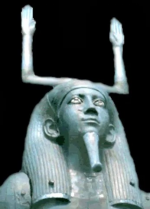
"The smaller a temple and the higher its frequency is, the less terrestrial radiation can be used as excitation power, and its transmit power is correspondingly lower." (30) The cella of a temple is its cavity resonator. This powers the transmitter. In the ancient world, choosing the location and orientation for a temple was serious business involving augurs, land surveyors, and priests; this makes sense when we realize that temples could only function if situated on tellurically active sites. The lituus used by dowsers and augurs indeed resembles an antenna.
The Greeks adopted hexameter in their telegraphic transmissions as a redundancy method. If a signal was weak or garbled and a few pieces were missing, the requirement that the missing pieces fit into a certain rhythmic pattern made it easier to fill in the blanks. Transmissions were apparently very weak and needed to be decoded by oracles, who used a number of techniques to "hear" them, including temple sleep, sitting on resonant (frequency-specific) tripods, the ringing of an iron kettle, and especially extispicy, the practice of inspecting the internal organs of a freshly sacrificed animal. Meyl's theory is that the fine, still-wet membranes of the liver or spleen were the most accurate receivers of the subtle radio vibrations sent through the ether. Here he is vague and seems to accept that radio transmissions can actually be received more or less psychically. Is this the explanation for some of the more unusual priestly or royal accoutrements such as crowns and croziers? "You need to know that the secular rulers with these receiving antennas on the head perform as they are told by the broadcast technology. The coronation is a technical measure to telepathy by which the high priest as a representative of a god makes the rulers his mindless servants." (130) In any case, Meyl's account offers a possible explanation for a phenomenon that always perplexed me, namely the simultaneous rationality and superstition of the Greeks, who regularly went to war based on nothing but the ravings of a drugged-up oracle. What if they were not raving, but rather speaking in a pseudo-gibberish code which then had to be deciphered by a different priest as a compartmentalization protocol, with the soldiers none the wiser for the trickery?
Meyl never engages with the idea of really-existing gods or divine psychic voices, but I find the idea intriguing that this reversal takes place around the same time that Julian Jaynes situates the "silencing" of the hallucinated bicameral voices and the emergence of subjectivity proper. This is also around the time that Mars and the other planets finally leave Earth alone. As the planets got further away, were they weakened and forced to "seduce" humans rather than command them before finally disappearing?
Speaking of Carnac in Brittany: "This gigantic structure was technically groundbreaking. The main problem was the power supply of the transmitter. For this purpose, the technician erected menhirs from a material that performs high frequency self-oscillations. These stones were used as energy carriers and energy storages. To ensure that no valuable energy is lost, they left the stones unhewn as far as possible. It was also easier to adapt the soft wood to the irregular shape of the granite blocks than vice versa. (...) The real enemy of this wooden temple was not the human but only lightning and fire. A pure stone construction was ruled out because of the incredible dimensions. Unfortunately, the operators of the gigantic facility had to witness how their proud building burned itself down one day." (82) He suggests "Carnac" and "Karnak" are related.
"In the course of the conquest of Gaul, [Caesar] probably learned for the first time about the structures of transmitters which were constructed of stone circles and menhirs as it were just common in northwestern Europe. Unfortunately, he could not just take and activate it by himself because there intentionally existed no record, and the Druids took care [not] to reveal the secrets. Therefore, the Romans had only the one alternative to destroy the plants." (123)
Meyl mentions Caesar as the man who set in motion the eventual conquest and unification of the broadcast frequencies in Rome. The title of "Pontifex Maximus" refers to radio bridges. Francesco Carotta has made the argument that Jesus Christ was based on Julius Caesar. The argument has also been made that Jesus is a metaphor for the sun and his apotheosis a metaphor for the final stabilization of the sun at the center of the solar system after a period of planetary upheaval. Is it possible that these two stories got mixed up? In both cases we have a "divine unification" taking place, one political, economic, and technological, the other planetary. To this can be added a few other Christs, from Fomenko's Andronicus to Michael Hudson's debt warrior to Apollonius of Tyana, and so on. I suppose that this was the "big story" of the post-cataclysmic period: the disappearance of the old gods and the appearance of a new, more centralized order in all spheres of life, from psychology to economy to technology to politics. No wonder that all these unifiers would get jumbled together over time...
Next we get a big Roman technological breakthrough. "Compared with all previous temple designs, the new temples have no fixed length, width and height of the cella anymore as an architectural feature. Round apses and domes are used now as a typical and particular characteristic. Incidentally, this distinguishes the modern Roman temple from the classical Greek telegraphic transmitter. Just look more closely at the broadcast temple at the Imperial Fora in Rome. All are equipped with this round apse, the temple at the Forum of Caesar with 9.7 MHz, the temple at the Forum of Augustus with 7.6 MHz and also the temple of Trajan with 7 MHz." (144) Here he argues that the new round and domed architecture allowed the Romans to progress from mostly telegraphic AM transmission to voice broadcasting over FM. Again the science is beyond me. He also suggests that the Sunday sabbath has its origins here. On other days, the radio transmitter was available for use by private broadcasters (in exchange for a fee and approval by the state), but on Sunday the ether was left open for official broadcasts. Was Saturday monopolized by the Jews/Phoenicians and Friday by the proto-Muslims?
"A special contribution has been made by Hadrian who has forbidden to enter Jerusalem to the Jews for all time. He wanted the FM transmitter, which was the religious center, for himself and the Romans and wanted to make sure that his stated airtimes are strictly enforced. If there is only one god in the modern FM technology, he wanted to be this sole god." (148) Meyl then speculates that Constantine went on to adopt Christian monotheism as a simple "cover" for the final centralization of the broadcast technology.
The technological development ends with the Pantheon, which Meyl describes as a transmitter for all frequencies, and the cutting edge of current technology (although he then hints at the Hagia Sophia to come). I found the following quotation amusing: "You can then find the Romans in the thermal baths and watch them how they sit or lie half the day around under the dome and listen to the radio. They go home afterwards with the necessary pride of the technical achievements of their time and tell about the many news which they have received live from their gods over the air." (156)
The final part of the book is of particular interest. I will reproduce the following quotations at length. "Aristotle has taught us that 'God is energy'. If the energy with which our radios are operated continues to decline as in the last century, we should think about measures how to encounter this development in order that no godless time befalls us one day. In this case, all efforts come down to increase the power of the transmitter further." (164) "A power source is required for the operation of the transmitters. For this purpose, natural and location-dependent resources are exploited such as the so-called places of power which are unfortunately subjected to a temporary fluctuation. To my mind, they were created a long time ago, and I think that their power is of cosmic origin. However, this energy slowly decreases as we technicians have unfortunately proved. If the observable decrease continues as before, some Technicians already predict the end of the divine broadcast technology for the year 1000 AD. (...) In my experience, the energy source will change in a wavy, temporal, spatial and not completely uniform way. Therefore, the year thousand is not yet the end in my personal assessment of the future. (...) I had a terrible dream. The people were godless or desperately searched for places where they still can feel the previously present divine power. They even quarreled about the appropriate buildings. There should be a terrible darkness, and it was dark because the electromagnetic waves also have something to do with the light. The people had no enlightenments anymore. Some might remember the ancient broadcast technology of the gods [I think he means the "new" FM transmitters] and have taken possession of the old telegraphic technology again which works still much more reliable with much less effort. Therefore, they then have also distrurbed the sensitive FM-technique so that they have been called witches because they could fly through the air with their information and master the rituals of the telegraphy. In my dream, they were hunted, imprisoned, tortured and even burned alive! (...) Far away from Rome in the far north is no reception possible because of the large distance, and a countermovement develops there to reform everything and still further increases the mischief by fire and sword. I saw the entire hold broadcast technology in flames." (178-179)
So ends the book report. I would like to add a few more things. I like this theory for a few reasons. One, it offers a very elegant explanation for multiple different mysteries that does not require us to assume too much falsification of history. It explains why so many resources were used to build these temples and churches. It explains why they had to be so big. It explains all the resonant and harmonic properties in the architecture. It explains a lot of the unusual artifacts associated with the priesthood. It explains how these ancient empires were able to maintain coordination over long distances. It explains the power of the priesthood as well as its necessarily hidden nature. It explains the centrality of the strange practice of divination. It explains why the classical world fell apart. It does not force us to throw away too much of the "official" history we have. (Meyl is apparently not a chronological revisionist, but that takes nothing away from his theories as his dates can simply be "advanced".) It explains why there are so many churches with so many towers scattered all over Europe, every few kilometers. It explains the nature of the relationship between visible power structures and invisible power structures. It would appear that the whole thing stopped working for good after some catastrophe in the proto-Renaissance. I believe this account fits well with the evidence presented by Usselo and others in IHASFEMR that churches in Britain were at one point repurposed as butcheries and charnel-houses before becoming properly Christianized. Churches and temples would have become basically useless at some point, and perfect headquarters for cannibal mafia clans and defunct evil priesthoods to squat. Is it possible that Britain, being so far north, was cut off "first" and descended into cannibalism and monstrosity in a way that did not happen to such an extent elsewhere? My recollection of that thread is that much of the evidence for cannibalism and IHASFEMR practices comes from that region, as well as from Switzerland. Perhaps all those mountains also cut them off from the civilizing radio waves...?
Did pipe organs appear later in an attempt to artificially induce the lost resonance necessary for the long-defunct cathedrals to function? Was the incredible music of JS Bach and other composers nothing but the later by-product of a technological instrument, the organ, which originally had a purely mechanical function? I am a Bach lover and believe his music has the more or less magical power to act directly on the body. A Bach concert in an old cathedral is one of the great experiences in life. Is some kind of psychic transmission facilitated by this music?
His theory also fits with the theory that we were seeded by an advanced culture that eventually disappeared or merged with our own. What I wonder is if the "gods" who broadcast their telegraphic messages and voices through the temples and churches really were divine entities, located either in the other planets, in the aether itself, or simply somewhere hidden on Earth. At what point were the gods usurped by men speaking in their name? By "Ancient Greece" things had certainly changed and humans, or perhaps semi-divine humans, had begun to take over. I bring this up because Meyl's theory appears to be impossible without some form of direct psychic influence. Perhaps magic, telepathy, etc. has become so rare these days simply because the aether has gotten so weak that it just doesn't work anymore for any but the most gifted. Another possibility, and here I am just unscientifically speculating, but is it possible that some other kind of waves are at play here, not radio waves, but something that follows a similar principle? I say this because as far as I know, radio waves cannot be picked up directly by the brain...
I lack the scientific knowledge to evaluate this theory on a deep level, but perhaps others here can add more (or blow it out of the water).
Last edited: