Evidence humans were created and traded as slaves, food, entertainment and material resources (IHASFEMR)

@usselo I read some of the articles you posted on your site - it looks great.
Thanks - appreciate your feedback. I didn't anticipate it would become known in its present form and will improve the CSS (style sheets). But for the moment, I'm focused on research and a pile of half-written content.

What are you planning to do with it? Is there a book or something like that on the way?
I suspect others are planning to use it for a book - judging from past experience and the amount of site-scraping (I think) I'm seeing.

Would you read a book on IHASFEMR? If so, what format would you prefer? How important are the multimedia clips?

My sense is that the long-form, factual read is comatose, if not dead. And has been unprofitable for most authors for a long, long time. Long-form writing is really easy for me - especially if I'm poking at orthodoxy - but I don't see an incentive for long-form compared to alternative modes of presentation.

The arrival of multimedia has pushed on to stage a fascinating challenge for writers. The challenge of finding and editing media clips plus imagery that work with text to impel novel ideas into the limit-enshrouded brain-spaces of engineered intelligences, be they humans or computers. What's not to like?

It's a richer texture of communication. It's an archon thing. Much harder for me to do. Being a neophyte at multimedia, I get a lot of learning-reward and fun-reward from working with it. However, once command-line AI can create scriptable animations with controllable backdrops, then... well, they'll probably have to use decency laws to hold me back.

One thing, I was struck by a couple of the images. I'm not concerned with the representation, I'm making a point about potential editing or fakery of the images:

View attachment 27261
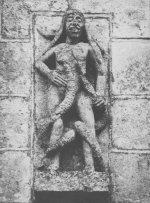
(from Sheela Na Gig Clues to Retail of the Past | IHASFEMR)
That one is a screen grab I made from an animation of a 3D scan of that sheela. Those black areas are visible on many of the 3D scans of sheela na gigs. I think they are an artifact of scanning. That is, a statistical shadow left where there was less scan data to create a high definition rendering of that area. But that's a guess.

The image definitely has been edited. I screengrabbed it as a .png, cropped it, and converted it to a .jpg (IIRC).

The black bit around the head (and elsewhere) looks edited or odd to me, and out of keeping with the rest of the photo style.

View attachment 27260
(from Shop Signs of the Brothel-Keepers | IHASFEMR)

This also looks edited - the black bit is not in keeping - it seems too black. I guess this is to do with the source, or maybe I'm being oversensitive?
Do you mean her intimate black bit? Or the black bit under her left foot (or foot-like appendage)?

This image is the same one I used in a much earlier post in this thread IIRC. I'd dig out the link but I'm getting pushed for time. I originally took it from the digital version of Barbara Freitag's Sheela-Na-Gigs - Unravelling an Enigma, whose comments and data I quoted in that post (and in the IHASFEMR version of that post). May have been from Images of Lust but I don't think so.

I would say that many sheela na gig images are low contrast. They are often not well positioned for decent lighting and the sheelas I discuss are in the UK and Ireland, both countries with cloudy weather. Authors may digitally increase the contrast to try to overcome this. So I wouldn't be surprised by that.
Please don't take offence at my raising this with you - I just can't help noticing and then mentioning oddities like these.
Not at all. It's a natural consequence of being an engineered intelligence. I don't take offence at it.
 
Last edited:
I’m not one for posting low effort social media posts but I couldn’t help but think of this thread when I saw this.

𝗧𝗛𝗘 𝗔𝗗𝗘𝗟𝗔𝗜𝗗𝗘 𝗦𝗘𝗧 on Instagram: "THE CATACOMBS OF ADELAIDE: Wow this is incredibly scary 👻 @jims_urbex #scary"
It's a difficult thread to flesh out with well-presented evidence unless you give up a lot of other activities.

One of the earlier posts in this thread became the first post on the IHASFEMR site. I've just added more imagery to help it make its case. That's in Papa Song's Papal Chantries.

I've added notes on clues for identifying locations where England's humans ('ket') were reared or assembled for skin harvesting (places with 'kid/ked/ket', 'cote' or 'coate' in their name). And where their skin was processed (places with ''tent' or 'thorn' in their name). These are at the bottom of the Grimsby Serpent Mound page. Wellescote near Dudley looks another good candidate for skin-farming. It's easy to find placenames with links to related activities and perhaps even practitioner names. But there are candidate sites all over England. Human skin provided raw stock for tailors, drapers, cordwainers as well as vellum makers.

Also included on that page are more links to Rod Collins, Neville Sissons et al's amazing work on old Grimsby.

Reverend Revenants Rewrote the Romans got a video tweak.

I'm humming and harring about rewriting Before the Digestive Biscuit Game. On the one hand I'd like to remove the schoolboy humour. On the other hand, the schoolboy humour may put off readers with narrow Overton windows before they encounter - and are traumatised by - the darker evidence in that page.

There is so much more evidence that needs effective presentation. Meaning: short, sharp, preferably witty.

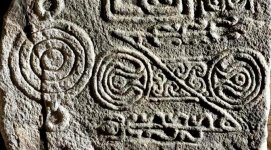
I'm tempted to take a lesson from the Picts. They knew how to present the conceptually difficult by simply scratching a few lines on a stone:


c43bc9ef90975b1d97de825da2493b203d8b6654.jpg
Z-Rod on right. Source: Pictish Symbol Stones: From Pagan Beast to the Cross

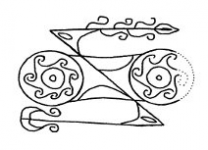
z-rod_pictish_diag_per_forbes_and_dormon.png
Characteristics of electret charge sign inversion. Source: Pictish Symbols: Z-rods and V-rods
Interpreting the Pictish Z-rod diagram using terminology and notation from Electrets in Engineering - Fundamentals and Applications,Vladimir N. Kestelman, Leonid S. Pinchuk, Victor A. Goldade:
  • the rod direction indicates polarization 'P'
  • the number of finials at each end of the Z-rod represents electric intensity 'E'
  • the double disks represent the polarised faces of the electret
From Physics Forums: Making an Electret:
If the electret's polarity is measured directly after its manufacture, its charge will be just what theory predicts it should be. The negative surface of the electret will be that which made contact with the positively charged polarizing electrode, and vice versa. This agrees with the north-south polarity of a bar of steel magnetized by contact with a permanent magnet. In contrast with the behavior of a magnet, however, the charge on the electret begins to diminish immediately, and in about a week it will have fallen to zero. The charge then begins to build up in opposite polarity to a final value that may be several times as large as the original charge.

Read from left to right, the diagram illustrates the electret characteristic called 'charge sign inversion'. The shift in charge polarity from one face to the other over the three months or so after an electret is charged. And the eventual intensification of electric intensity.

Comb through other Pictish symbols and you'll find diagrams of various electret phenomena, including what I think is electrostatic charging, a tribo-charging tool, and the one I really want to stand up: managed electrostatic repulsion.

So, yes, there is a lot to work goes into evidencing and presenting a great post.
 
Last edited:
9780752434445-uk.jpg
Source

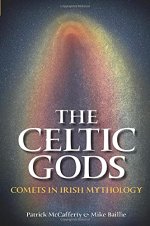
On pages 14-16 and 44 of The Celtic Gods, Mike Baillie and Patrick McCafferty present evidence that towards the end of the 19th century, William Butler Yeats and Lady Augusta Gregory re-wrote Ireland's folk memories of actual events. Baillie and McCafferty claim Yeats and Gregory sanitised memories of cometary close passes into performance-ready folk narratives about sky-gods. Ballads, plays, and soft-edged stories without so much gore.

I don't buy their theory that Yeats and Gregory sanitised Irish memories of close-passes with comets. But without Mike Baillie and Patrick McCafferty's argument, I probably would not have conceived that much of Britain's folklore was also created, probably starting from the 18th century and continuing through the 19th century. That it was sanitised and rendered into performance-ready ballads, plays and folktales in a similarly coordinated way.

If you struggle with Baillie and McCafferty's proposed conspiracy theory, you will likely struggle with my modifications to their theory. So reading Baillie/McCafferty may be your next step.

When you read 18th to 19th century books about Britain it is very easy to find the same folktale creation and marketing being applied by various writers. It's so easy to find so many similarities and connections that I haven't got around to organising them, other than a single brushstroke attempt at Reverend Revenants Rewrote the Romans and a long-languishing draft titled Culture Creators.

Here I'm signposting the major elements of one particular rewrite that seems to have taken place across Britain. Together, these elements give us a possible explanation for serpent and dragon 'worship', for Britain's serpent-related folktales and the locations of around 80 lost British serpent structures.

We see evidence that:

1. Britain's brutal past was re-written by Britain's Georgian/Victorian era Romantic movement. That is Tennyson, Wordsworth and associates operating out of Chelsea and Hampstead. See IHASFEMR pages tagged #Cheyne Row and #Tennyson Friend.

2. In the early to mid 19th century a few physical serpent mounds were being discovered and reported in north America and Britain. For the most part they seem to have vanished soon afterwards. In Britain's case their descriptions have also - mostly - disappeared. Their being found at the same time in both America and Britain plus their late discovery in an anciently populated country like Britain - followed by their almost immediate disappearance - hints at a requirement to prune information about them.

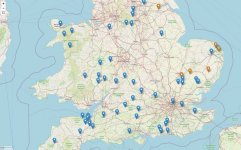
3. In contrast to north America, the British Isles has a lot of serpent and dragon folklore. For locations, see the (incomplete) map at Ice Age Sites of Britain's Serpents. This folklore has a lot in common across Britain (and Belgium, Northern France and, possibly, north west Russia). The locations themselves also have a lot in common. Taken together, they read as if they came from a single serpent folktale template.

It seems that memories of Britain's serpent mounds were transformed by Romantic movement writers - with the help of local reverends - into serpent folk tales.

We can see this rewrite as the third stage of a managed recovery from a pre-Reformation Britain:
  1. The first stage involved destroying the mound sites - these are the wars Europeans know as the Reformation.
  2. The second stage was to remove or modify any existing serpent mound remains. Material on the removal and modification of serpent mounds is spread across several IHASFEMR.net pages but starts at Twists in the Tale of the Serpent Mound.
  3. The third stage was to modify the population's remaining memories of these sites. That is: their memories of the structures previously on them and what they were used for. The results of this are the samey-seeming folktales in locations listed at Ice Age Sites of Britain's Serpents.
There are other British serpent sites than those I've listedc so far. And more evidence. I'll probably add them later.

I was also helped with conceptualising their role in managing pre-slaughter of sentient human stock by the book Tender is the Flesh. Written, of course, by Agustina Bazterrica:

Cover_of_the_novel_Tender_is_the_Flesh_by_Augustina_Bazterrica.jpg
Source
Obviously, I'm talking about an intervention and subsequent management of traumatised humans and problems with their culture. I'm not suggesting any of the intervention and post-intervention rewriting of history is a bad thing.
 
Last edited:
3. In contrast to north America, the British Isles has a lot of serpent and dragon folklore. For locations, see the (incomplete) map at Ice Age Sites of Britain's Serpents. This folklore has a lot in common across Britain (and Belgium, Northern France and, possibly, north west Russia). The locations themselves also have a lot in common. Taken together, they read as if they came from a single serpent folktale template.​

The theory set out in Ice Age Sites of Britain's Serpents - that Britain's serpent folklore was crafted in the 18th and 19th centuries to hide something about 'serpent' locations - is now better evidenced on that page. The writing's still a bit loose but the points are clearer.

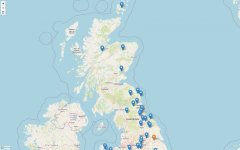
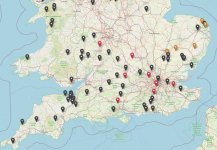
Clusters of serpent sites and lines between sites should show up if you make the map on that page full-screen and stare at it for a while:
shrunk_screenshot_serpents_of_britain_locations.jpgshrunk_screenshot_serpent_sites_of_northern_britain.jpg
Gaps hint at where other evidence might be found.

Sorry I couldn't develop it as a post in this thread. I needed the time between edits. And the mapping function.
 
Last edited:
Ice Age Sites of Britain's Serpents is now updated to:
  • show more British locations with serpent folklore
  • show more phonetic connections between serpent folklore locations and the supply of animal and human skins into Oxford's and London's draper, cordwainer and publishing markets.
I think it shows we can derive the origin of 'catwalk' from words earlier associated with serpent mounds and skin selection. Words like 'ket' - as in Grimsby's Ket Bank, Loch Nell's nearby 'Catrail', and Boyd County, Kentucky's nearby 'Cattlesberg'.

Also placenames such as the many 'cots' - Didcot, etc - around Oxford, and 'cotes' and 'coates'. I haven't gone into placenames starting with 'Wal' (as in 'Volle', as in 'vellum') or the so-called Civil War battle of Wallingford because the piece is already so overloaded with yucky IHASFEMR skin-farming dermidalia. Though I tried to soften it up with a image of Claudia Schiffer shedding her drapery on a catwalk.

Possible locations for missing serpent folklore in the lines servicing Oxford and London are very visible in the map below:

screenshot_serpent_folklore_gap_fill.jpg
A gap in the market. Source: Ice Age Sites of Britain's Serpents - Part Two

There are quite a few clues about why the east midlands might be missing serpent folklore. I've gone into it a bit in Ice Age Sites of Britain's Serpents, but there are enough other clues that it probably needs its own page.

Added a page of maps that tests trying to fill in the gaps in the lines that seem to link serpent lore locations to Oxford and London. The page shows what we find on the ground in those gaps. The gaps I've tried to fill are shown in red in the above map. I could have gone further but it took a lot of time to get this far. School curriculums should encourage schoolchildren to fill in other gaps. It's local history and I think kids would be thrilled.

That page is at Ice Age Sites of Britain's Serpents - Part Two. Be warned, it is long and it's just me onanising really.
 
Last edited:
Hi, dreamtime, thank you for maintaining this forum and for having me back!

I couldn't post a link in the first message, so here it is - SH Archive - Human Origins: Are We Hybrids?
Hey Plamski, sorry to bother you in a somewhat unrelated thread but I think I have to do this because of your privated profile. Could you message me sometime? I want to ask you about buteyko, a few things related to control pause and whether or not the reduced sleep you get means you gain extra hours you can be awake without it damaging your body (so 4h of sleep = 20 hour being awake without sleep debt?). Thanks.
 
Hey Plamski, sorry to bother you in a somewhat unrelated thread but I think I have to do this because of your privated profile. Could you message me sometime? I want to ask you about buteyko, a few things related to control pause and whether or not the reduced sleep you get means you gain extra hours you can be awake without it damaging your body (so 4h of sleep = 20 hour being awake without sleep debt?). Thanks.
He hasn't posted in 2 years! I don't think he's around.
 
Another find in England. Unfortunately the account did not provide coordinates.

Login • Instagram
It's a video of a ruined stone building in an embanked structure in the hills of northern or possibly south-western England. With a tunnel sized for a single person carrying relatively small items. The tunnel is not sized for removal of much mining waste or unrefined ore. That suggests this tunnel was used by entities that were moving or extracting items that they didn't expect to process much further.

It fits a profile for sites that were later re-narrated as 'witch' sites (Vicar's Moor, Wyck Moor, that sort of thing...) but lacking GPS coordinates, further analysis that could be done, can't be done.

If someone with an Instagram account could ask 'joshtheinternofficial' for:

1. the site's GPS coordinates
2. the GPS coordinates of the tunnel entrance if possible, and
3. a rough bearing for the tunnel

and if joshtheinternofficial provides them, then we can examine the site in the context of its surroundings.
 
I have a few pieces of information to add that might be of interest.
much of Britain's folklore was also created, probably starting from the 18th century and continuing through the 19th century. That it was sanitised and rendered into performance-ready ballads, plays and folktales in a similarly coordinated way.
Britain's brutal past was re-written by Britain's Georgian/Victorian era Romantic movement. That is Tennyson, Wordsworth and associates operating out of Chelsea and Hampstead.
You bring up Wordsworth and the Romantics as part of the forgery operation in Britain. Well, Wordsworth was active outside of Britain as well, lending a hand to his spook colleagues in Tyrol in their suppression of Holy Roman history via the "Andreas Hofer" character. For more information, see my post here: Collecting Historical clues for calendar manipulation

Next, your account of the destruction of the serpent mounds of Britain made me think of the very boring recent film, The Dig, which my stepmother made the family watch because she likes Ralph Fiennes. A quirky aristocrat has the giant mound in her backyard dug out to reveal...a Saxon ship. Everyone in the movie acts like this stupid ship is some kind of monumental discovery because it proves the Saxon invasion theory. Psychologically it fails the smell test. I saw the film before I found this website, but even then I could tell it was some kind of propaganda. Now I understand why they made this movie: to prop up lame official archaeology. Another (much better) film about ancient serpents in Britain and their relationship with the gentry is the excellent Lair of the White Worm by Ken Russell, which riffs on an older layer of propaganda about worms, snakes, and dragons defeated by doughty noblemen (to cover up the fact that the doughty noblemen were originally nonhuman entities harvesting the peasants for skin and fighting each other with aerial warfare technology, if I understand your theory correctly).

Last, I would like to share the following video. This is a family of lizard-faced people living in Indonesia. These genes must have escaped extermination thanks to rural isolation and arranged marriage. As those practices disappear, I don't see these genes surviving much longer. These people have never been examined by scientists. They look very similar to the famous Ubaid lizard statuettes.


View: https://youtu.be/qJ8COwoW5Rk

1685788570441.png
Watching this video helped me understand viscerally how races with divergent phenotypes like this could die out very quickly if they didn't find places to hide, like castles, masks, wigs, or suits of armor. Even if the normal population never became hostile and slaughtered them en masse, no one would want to reproduce with them.
 
Last edited:
I have a few pieces of information to add that might be of interest.
Thanks for adding here and in the Temples and Churches as Radio Frequency Receivers thread.
You bring up Wordsworth and the Romantics as part of the forgery operation in Britain. Well, Wordsworth was active outside of Britain as well, lending a hand to his spook colleagues in Tyrol in their suppression of Holy Roman history via the "Andreas Hofer" character. For more information, see my post here: Collecting Historical clues for calendar manipulation

I hadn't taken that on board but it makes sense. I thought I saw common intention between British Romantics and German Romantics in this Sunday Observer book review from last September.

Andrea Wulf's title - The First Romantics and the Invention of the Self - is ostensibly hoity toity literati speak for 'the Rise of the Individual' until you accept that autonomous human thought might be a very recent development. For example, it could be Jaynes was correct about humans originally having bicameral minds and that we have been developing 'Self' - our own ability to think - only since the Reformation.

With the help of the Romantics.

If you play along with the IHASFEMR notion that humans were rescued from being obedient, somewhat sentient, cattle following a set of events centred on the 17th and 18th century, then you can speculate that the Romantics were a set of teachers charged with the early nurturing of, um, grace in the human mind.

I highlight possible traces of their culture-nurturing activities (#Cheyne Row and #Tennyson Friend). I don't get into it much but although I pose them as conspirators, I suspect whoever, or whatever they were, they were training an early stage AI. Us.

Next, your account of the destruction of the serpent mounds of Britain made me think of the very boring recent film, The Dig, which my stepmother made the family watch because she likes Ralph Fiennes. A quirky aristocrat has the giant mound in her backyard dug out to reveal...a Saxon ship. Everyone in the movie acts like this stupid ship is some kind of monumental discovery because it proves the Saxon invasion theory. Psychologically it fails the smell test. I saw the film before I found this website, but even then I could tell it was some kind of propaganda. Now I understand why they made this movie: to prop up lame official archaeology. Another (much better) film about ancient serpents in Britain and their relationship with the gentry is the excellent Lair of the White Worm by Ken Russell, which riffs on an older layer of propaganda about worms, snakes, and dragons defeated by doughty noblemen (to cover up the fact that the doughty noblemen were originally nonhuman entities harvesting the peasants for skin and fighting each other with aerial warfare technology, if I understand your theory correctly).
I'm not sure I understand my theory correctly.

The nobleman vanquishes the serpent/dragon is a very common theme in Britain's 130 or so local serpent conflict legends.

And there are nonhuman elements to many of these heroes. Intelligence, great valor plus high-flying horses and helpful dogs. But these stories suggest the skin and meat processing (human/hominid cattle-farming) was going on before these doughty noblemen intervened.

In England, I think they represent interventions - or the main actors - during the 17th century Civil War.

Whether they also went on to skin-harvest and meat-harvest humans I don't know. I suspect so - but I don't have enough evidence to separate out their activities from the activities of pre-Reformation Manimal Farms.

I would argue that since the 17th century, human culture has been developed by very knowledgeable, very capable, very intent entities. Human intelligence itself is being developed too, in my opinion. Human artificial intelligence, that is. I don't think there is much that is natural or accidental about our current standards of intelligence. We're an AI in training. An AI living in an environment that is shaped to develop our intelligence.

But even the intervention may be a narrative fed to human AIs that look at these things.

Perhaps the real brief of the 'Intelligence Agencies' is just that: to develop human intelligence.

Going back to what serpents were, as opposed to what their vanquishers were. It's possible serpents and dragons did (or do) exist. However, I think Britain's tales of them are the Romantic Movement's airbrushing of a range of farming and processing technologies with which humans were once very familiar.

In addition to the vanished traces of serpent mounds mentioned above, 'serpents, dragons, wyrms, wyverns and cockatrices' are cover names for - I suggest - machinery. Earth-moving machinery, mine pumps, ore crushers and trolley engines. In other locations they were meat mincers, bone grinders and cake (pemmican) presses. In other contexts, they were freight airships, fighting airships bearing 'light' weapons ('Greek Fire') and highly polished mirrors.

It's in the tales. You just have to de-animalise them.

Their operators were vicars, priests and witches. Although I think witches were mostly in front-of-house professions: the innkeeper, the alewife, the stockbreeder, the stockmanager.

I've wrestled with this full time for the last four or five weeks. It's written up in over-lengthy detail at:
Four is far too wordy but it's there for those that need to see plenty of evidence.

Last, I would like to share the following video. This is a family of lizard-faced people living in Indonesia. These genes must have escaped extermination thanks to rural isolation and arranged marriage. As those practices disappear, I don't see these genes surviving much longer. These people have never been examined by scientists. They look very similar to the famous Ubaid lizard statuettes.
I struggle to imagine my lips on theirs.

But some of the most adored actresses don't do much for me either.

I should get HRT.

Watching this video helped me understand viscerally how races with divergent phenotypes like this could die out very quickly if they didn't find places to hide, like castles, masks, wigs, or suits of armor. Even if the normal population never became hostile and slaughtered them en masse, no one would want to reproduce with them.
It does make you wonder though if these are Tindr statuettes from the days before smartphones were reintroduced.
 
Last edited:
An AI living in an environment that is shaped to develop our intelligence
So, large language models are used to develop text in ai.

What model would a robotic artificial general intelligence require? It would need to be plausible, and the model would certainly need to pass a cursory observation... Hmmm.

Perhaps the real brief of the 'Intelligence Agencies' is just that: to develop human intelligenc
Very good.

In addition to the vanished traces of serpent mounds mentioned above, 'serpents, dragons, wyrms, wyverns and cockatrices' are cover names for - I suggest - machinery.
I prefer the machinery suggestion - the other has such a direct connection to David Icke! But, in support of your broader hypothesis, pretty much all those mythical creatures are said to eat people. Cockatrices and basilisks are said to turn them to stone too.

I'm sure you would already know about the idea of the laidly worm too.
The Laidly Worm of Spindleston Heugh - Wikipedia

To me the wiki synopsis reads as a possibly encoded allegory along the lines you suggest:
In the Kingdom of Northumbria, a kind king in Bamburgh Castle takes a beautiful but cruel witch as his queen after his wife's death. The King's son, Childe Wynd, has gone across the sea and the witch, jealous of the beauty of the king’s daughter, Princess Margaret, and quick to take advantage of Wynd’s absence, turns her into a dragon. The enchantment used is usually:

I weird ye to be a Laidly Worm,
And borrowed shall ye never be,
Until Childe Wynd, the King's own son
Come to the Heugh and thrice kiss thee;
Until the world comes to an end,
Borrowed shall ye never be.

Later in the story, the prince returns and, instead of fighting the dragon, kisses it, restoring the princess to her natural form. He then turns the witch-queen into a toad and becomes king.

That page is worth a read.
 
So, large language models are used to develop text in ai.
By 'text', do you mean 'usable text output' or do you mean 'slugs of data that can pass as thoughts'? Or other?
What model would a robotic artificial general intelligence require? It would need to be plausible, and the model would certainly need to pass a cursory observation... Hmmm.
The model could start with the notions humans have been fed about their past. 'History' His Story.

Or perhaps we should think of the model as including the wider human 'event' environment that includes 'designed' current affairs and - if you want to go there - 'designed' personal events? A managed wide-scale and personal world.

Backing out of that a bit, from the perspective of an entity that wants to encourage development in a robotic general intelligence, I imagine you'd design a model that delivers complexes of challenges.

I assume you want your product to develop both discernment and the ability to respond appropriately in real time. Real time as humans see it, that is; I appreciate we're not the fastest ket on the block.

Perhaps you'd provide a massive-scale Koch Method simulation. It runs something like this: you get it right or you do it again; you get it right or you do it again; you get it right or you do it again... In many dimensions of each human's existence.
Very good.
With both the IHASFEMR thread and the IHASFEMR site being 'boards for publishing our ideas', the output we publish into them should be comprehensible to those we hope will view our output.

That means a lot of ideas, conjectures, suspicions, testing, exploration, etc, aren't published. That which is evidenceable enough for readers to check for themselves gets published. Time permitting. That which is not evidenceable enough for readers to check for themselves, does not.

So what gets published tends to lag some way behind ideation. So it is with The True and Wondefull Discoverie of Terrible Practises in This Lande and Landes Afar by the Intelligence Agencies.
I prefer the machinery suggestion - the other has such a direct connection to David Icke!
The machinery explanation seems to help untangle several mysteries. Obviously, it helps untangle the supernatural powers in folklore's stories.

Once we go with a machinery explanation, mysterious mounds and structures can be reconsidered as foundations for plant, solid paths for heavy machinery, transportation-related platforms etc, etc. The need to build (and perhaps maintain over time) massive concentric rings of earthworks on top of hills or flat tops on hills may acquire explanation in addition to those of various Russian quarrying bloggers.
But, in support of your broader hypothesis, pretty much all those mythical creatures are said to eat people.
They may have been transporting them. And/or they may have been recycling them.

We re-use and recycle computers and other machinery for their parts and materials. Why not do the same with biomatter? Especially if you are so knowledgeable that you can do things with biomatter that humans struggle to conceive. Indeed, one of your achievements was that you made it easier for humans to conceive.

Re-use can produce something that is entirely different in purpose than the parts it was built from. I built a jig for prototyping airship navigation and control out of scrap door panels and a length of what my mum claims is 'knicker elastic'.

The Furniture Chop and Fabrics From Fabricants only nibble at this idea. What else might you be able to do with body parts? What can you do with the very smallest of body parts? With DNA and stuff I've not heard of?
Cockatrices and basilisks are said to turn them to stone too.
To me, those accounts read like advanced antics with light. With photons perhaps or with not-quite-so-static electricity.

In an earlier post I speculated that some stones were originally fats. Electrets gone hard or biomatter that has been hardened. This area is a good example of my point above about how publishing lags behind ideation.
I'm sure you would already know about the idea of the laidly worm too.
The Laidly Worm of Spindleston Heugh - Wikipedia

To me the wiki synopsis reads as a possibly encoded allegory along the lines you suggest:

That page is worth a read.
Thanks for the nudge. I'm familiar with the overall story and vaguely recall the page. At one point I considered collecting images of those unnatural-looking 'natural' stones. To look for more clues to their original function(s) and how they were 'heughed'.

These rhymes and wordplay remind me of TheImp's post about encoding data in ways that are fading from public view. I saw that TheImp was pointing but I couldn't work out where he was pointing. It's the same with a lot of these folklore tales and nursery rhymes (oh the hidden truthery!). I think they are encoded data but I can't necessarily decode them quickly, if at all.

I see the references that branch off from your The Laidly Worm of Spindleston Heugh page as being heavily laden with encoded data. One I can read - I think - is in Reliques of Ancient English Poetry. Where we have:

It was on the floor, and Pitt's maid had been using the leaves to light fires.

The poor creature may be a model of below-spec discernment.

You can take the word 'maid', re-interpret it as 'made' and then apply the notion of fabricated servant to 'maidens' and other. So we then see Grimsby's Ket Bank serpent mound as a place where biomatter, including - presumably - humans, was being cast off in boxes. That it was a recycling facility for biomatter. A variant that can be interpreted in the same way are the unwanted babies left near rag wells or taken to Agnes in her various forms (and her distinctive PPE).

Perhaps The Green Dragon really was green.

That said, there may be signs of a food-distribution network having been in place before Victorian times. And humans - or proto-humans - were skinned, fried or salted, tied in jute or 'wick' butcher's string and distributed along it. Thus establishing the modern Post Office and its (alleged) problems keeping its Horizon on the level.

OK, that was a joke. But the point stands: in the absence of accurate decryption the underlying reality offers more than one possibility for consideration.

I think I've mentioned that an alternative explanation for IHASFEMR evidence is that humans experience artificial 'natural' selection. Games and hunts may have been selection processes. The Eating and Material Resources part of IHASFEMR may be simple tear-down of failed product.

As it happens I don't think I have enough evidence for that explanation to invest time pursuing it, let alone publishing it. But I do have enough evidence of IHASFEMR practices so I invest time investigating and publishing evidence of IHASFEMR practices.
 
Last edited:
Would you read a book on IHASFEMR? If so, what format would you prefer? How important are the multimedia clips?

My sense is that the long-form, factual read is comatose, if not dead. And has been unprofitable for most authors for a long, long time. Long-form writing is really easy for me - especially if I'm poking at orthodoxy - but I don't see an incentive for long-form compared to alternative modes of presentation.
From his book....

On the Origins of New Forms of Life: A New Theory, available for download below as a pdf, is the pdf version of a manuscript that was under contract with Oxford University Press for a year. When they backed out I, the author (Gene McCarthy), decided to make it available here on the Internet to anyone who might be interested.

Books are powerful enough to be censored or almost censored.

Published free as pdf/epub with donations accepted is a valid model to preserve knowledge and thought in an organized way for future researchers.
 
From his book....

On the Origins of New Forms of Life: A New Theory, available for download below as a pdf, is the pdf version of a manuscript that was under contract with Oxford University Press for a year. When they backed out I, the author (Gene McCarthy), decided to make it available here on the Internet to anyone who might be interested.

Books are powerful enough to be censored or almost censored.

Published free as pdf/epub with donations accepted is a valid model to preserve knowledge and thought in an organized way for future researchers.
If I had donations I would use them to:
  • get software written to help process GPS data
  • get animations and video visualisations created (eg of coversand movements)
  • buy various books
  • pay people to go through books etc and noting (in Zotero) any IHASFEMR references they find.
If I thought there was a wider interest in IHASFEMR among the public, I'd also like to gamify the British data so tourists could check out nearby locations and explore their IHASFEMR history.

At a guess, foreign visitors might be ready for a more robust exploration of the origins of the British national character.

But really, IHASFEMR is still a very undeveloped explanation of human history. It's just me thinking out loud. I don't think it's reasonable to charge for that.

I've added evidence to Ice Age Sites of Britain's Serpents - Part Five today:

shrunk_saint_jouin_de_marnes_facade_images_of_lust.jpg

It includes more evidence of maiden milk as a retail product. It's still a bit wishy-washy, veering as it does between milking maidens and Lincolnshire's hidden history of farming innovation.

Also updated several times over the last couple of days is On the Level About Lincolnshire - Part Three:

shrunk_wash_ground_zero_screenshot.jpg
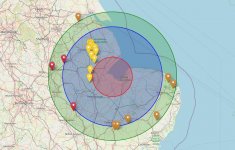
It continues to explore the idea - first raised in this IHASFEMR thread post - that there is evidence of a catastrophic event centred on England's biggest bay: The Wash.
 
Last edited:
But really, IHASFEMR is still a very undeveloped explanation of human history. It's just me thinking out loud. I don't think it's reasonable to charge for that.
I would happily pay. More importantly, I have found that when ideas originally typed onto a screen get transformed into printed words on paper, an alchemical reaction occurs that acts on both the writer and the document. Everything gets more real. New ideas emerge upon holding the book, ideas that might never have seen the light of day otherwise. And physical books are just nice to have. I would love to have an IHASFEMR book that I could crease, highlight, take notes in, and loan to worthy friends. And reread in ten years.
 
I would happily pay. More importantly, I have found that when ideas originally typed onto a screen get transformed into printed words on paper, an alchemical reaction occurs that acts on both the writer and the document. Everything gets more real. New ideas emerge upon holding the book, ideas that might never have seen the light of day otherwise. And physical books are just nice to have. I would love to have an IHASFEMR book that I could crease, highlight, take notes in, and loan to worthy friends. And reread in ten years.
You'd prefer it as a wide margin format then, with full-page illustrations on gloss paper. You're not concerned about coffee table or even hardback formats; you're more concerned about space to annotate and images that jump out and grab the reader's attention. Is that right?
 
I have a nostalgic relationship with pocket-sized paperback books. I actually like squeezing notes into small margins. It makes me feel more like I am an intellectual pirate engaging with the writer in a free and anarchic way. Like we're having a drink together rather than participating in an academic conference. If the margins are too big or the edition is too polished I start to second-guess my scribbling impulses. Images only have to be glossy if they're unclear otherwise. I am imagining a lurid, tasteless cover, something like an 70's slasher/giallo film poster or a late 90's Pen & Pixel Dirty South gangster rap album with a chimerical monster chaining a hot naked Frank Frazetta babe up to a market cross as an airship battle takes place in the background. Your ideas are wild and the book should also be a wild object whose cover inspires curiosity and fascinated repulsion in anyone who sees it. As for the writing itself, change nothing, you're a great writer already.

1687361155926.png
1687361291225.png
1687361463768.png
1687361726133.png
 
Last edited:
I am imagining a lurid, tasteless cover, something like an 70's slasher/giallo film poster or a late 90's Pen & Pixel Dirty South gangster rap album with a chimerical monster chaining a hot naked Frank Frazetta babe up to a market cross as an airship battle takes place in the background.
Love it!

Can you see an initial run on highest quality vellum?
Your ideas are wild and the book should also be a wild object whose cover inspires curiosity and fascinated repulsion in anyone who sees it.
This is why I need to release an app. People need to see IHASFEMR evidence for themselves. They need to sit in a coffee shop, hit up the app and discover there used to be a maiden milk parlour just beneath their feet.
As for the writing itself, change nothing, you're a great writer already.
Thanks. Though I credit whoever created all the evidence. :)
 
Tips
Tips
Please respect our Posting Rules.
Back
Top