1. The peculiar formation of numerals in Sumerian, Egyptian and old Canarian
2. The prefix a- as in Sumerian -a, -e as nominal particle:' cp. the prefix a- as article and demonstrative in old Canarian.
3. The prefix ta-, probably as definite article old Canarian -ta, -tu, -to (definite article, demonstrative, nominal particle) Mong. -ta [as lta, mta] (nominative particle -1, -m, with -ta), Etruscan -ta (definite article, nominal particle). Prefixes can become suffixes with the same meaning, like Canarian ta- to -ta-.
4. The prefix ti- probably indicates nominalization, like ti- in old Canarian, besides -ta- and -ta- . . . -te- (noun formation).
5. The suffix -to as nominative particle has old Canarian and Basque parallels (-te).
6. The genitive particle ni, Etr. in, old Canarian -n, -en, Mong. -in (connected with the personal pronoun for the 3rd person, cp. Sumerian -ne, -ni, Arabic -in also dative and ablative as in Etruscan, old Egyptian -n).
7. For the dative-terminative particle la we have Sumerian -ra, -re, -ri, Basque -ra (Canarian for building the possessive, e.g. i = 'you', ire = 'your'); la is also ablative in Etruscan and old Canarian (-ra), Tib. -nc.
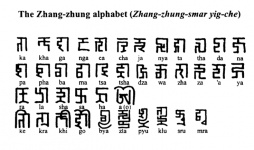
8. For ta- as collective noun we have Sumerian -da (= 'all' = gu, Sum. = gu). To the lexical examples given for the [Ural-IAltaic substratum and to the probably pseudo-Mediterranean roots gl, gr, kr, belonging to the Ural-Altaic substratum, we could add Sumerian kurkur ('circle') and the word for 'dog', Zhang-zhung ku[-ra], Chin. kou, Na-khi 2k'o, Canarian cuna, Greek ~&\jov, Lat. canis.
Sumerian Canarian and Zhang-zhung could be for instance
Sumerian lilii = Zhang-zhung li ('wind', Sum. lil = 'air');
Sumerian tag = Zhang-zhung bteg ('to throw');
Sumerian Sa = Zhang-zhung she ('heart');
Sumerian ka = Zhang-zhung khag (Tib. kha = 'mouth');
Sumerian bad ('to open') = Zhang-zhung rbad (Tib. gcod = 'to cut up, tear apart');
Sumerian zu ('knowing'), San ('wise') = Zhang-zhung shen ('to know');
Sumerian ag ('give orders') = Zhang-zhung ag ('to speak', Tib. ngag);
Canarian guaire = Zhang-zhung wer ('ruler').
The [Ural-] Altaic substratum can also throw light on the formation of Mongolian zla (= Zhangzhung 'moon') we have Mong. Sam, Canarian sel; for Sumerian dingir ('sky, god'), Mong. tengri; for Canarian era ('man, hero'), Mong. ere.