The different history of the Roman Empire

A quick hit concerning the origin of the word "Caesar", which also exists in Germany (Kaiser), Russia (Czar), the Ottoman Empire (Kaiser-i-Rumi), and probably a bunch of other places as well. I've heard multiple explanations for the origin of the name. One claim is that the name originates from the fact that Caesar was born via Cesarean section. Compare for example to the French words "césure" which just means "cut" or "ciseaux" (scissors). If I remember correctly, Fomenko attaches a lot of importance to this.

Andrey Pustogarov presents a theory which I've never heard and which makes logical sense. He claims that the word "Caesarea" (spelled different ways in different languages) comes from an Arabic word that simply means "market". So the "Caesar" is nothing but the market master. He compares this to other noble titles such as "count" (which he derives from the verb "to count", i.e. a clerk) or the German "Graf", which can be connected to writing (graphism).

That's why we have Caesars everywhere. It was an important function in the primordial monotheistic empire, of which Arabic was the original lingua franca.
Is Caesar related to cashier/caissier, cash?
 
Last edited:
Is Caesar related to cashier/caissier, cash?
Great catch. In French, the word for cash desk is "caisse". In German, it's "Kasse". So a Caesar would literally be a cashier. Supposedly these words derive from the Italian "cassa", which derives from the Latin "capsa", (money) box, which derives from the PIE root cap-, "to grasp". That jump from "cap-" to "cassa" seems sketchy, but what do I know? Pustogarov also connects Caesar with Khazar (for him Khazars are just merchants). I wonder as well if there is a connection with "kosher", which is pronouncer "kashér" in Hebrew.
 
America's White House is named after Andrew White. USA is a papal state and literally the Roman Empire. The only purpose of the nation is to exterminate all non-Catholics
 
Let's compare Tamansky's explanation for the added 1500 years with Pustogarov's.

For Tamansky: the Jewish popes create a new calendar that artificially lengthens their history. Crucially, they already adhere to the Old Testament, which is how they come up with the year 1500 as a starting point. There is a rabbinical tradition that each day of creation corresponds to a thousand years, that Adam was born at the midpoint of the fifth day, and therefore that Adam was born in the year 5500.

The calendar therefore resets at 7000 years, which is to say in the year 1500 AD, which back then was written "Year of the Incarnation of the Lord" (in Adam). For Tamansky, this is what "AD" means. It suddenly occurs to me that "AD" could also simply stand for...ADam.

Tamanksy's version therefore presuposes a pre-existing Jewish Old Testament and rabbinical tradition. No explanation for the origin of the Biblical tradition of one creation day equaling a thousand years is given.

The Popes place Adam at year zero and fill the next 1500 years with Biblical history, culminating in Pope Julius II, with whom history hits 7000 and resets. Remember, the Roman Empire is still Jewish-pagan at this point.

At some point in the 16th century, Christianity is invented by Protestants, and history is rewritten again as part a compromise between the ascendant Protestants and the Jewish-pagan Catholics, with the Protestants having the upper hand. The Papacy finally converts from Judaism to Christianity around 1555, when Paul IV issues the Cum Nimis Absurdum bull. The now-Christian Church now must find a way to whitewash their recent past. It's the middle of the 16th century and the new chronology created in the year 1500 can no longer be changed, for the simple reason that there are millions of printed books with publication dates circulating. However, some genius comes up with the brilliant idea of casting Jesus as a "new Adam". Anno Domini is retconned to refer to the birth of Jesus, not the birth of Adam, and history has to be rewritten again. The church subjects its history to a kind of Freudian cleavage/doubling, sending all the suddenly "bad" pagan and Jewish elements back 1500 years under the name of the "Roman Empire" and filling in the gaps thus created with a fabricated recent history. Artifacts such as the tomb of Pope Julius II, which features Moses, Rachel, and Leah, but no Jesus, are impossible to "rewrite" but thankfully the Church cannot bring itself to destroy all this amazing art that subtly contradicts its new history. The events of the Old Testament, which previously filled out the 1500 years between 5500 Anno Mundi and 7000 Anno Mundi (= between 0 AD and 1500 AD), now have to be projected back to the period between the creation of the world in year 0 and the birth of Jesus in 5500. The whole rabbinical tradition of Adam being born in the year 5500 is presumably simply jettisoned. The Old Testament is lengthened by assigning impossible ages to Biblical patriarchs (930 years for Noah, etc.). Even more complicated, the years between 0 AD and 1500 AD are now completely empty, and therefore a secular history must be invented that basically treads water technologically for 1500 years. Some clever person has a great idea: there was a civilization peak, then a "dark age" caused by "barbarians". This spares them a lot of complicated writing work. "But wait a moment", I can imagine some mathematically-minded person at the Council of Trent saying, "How do we explain the fact that there aren't billions of people on Earth, given that populations increase geometrically, and it's supposedly been happening for thousands of years now?" Here I imagine them scratching their beards for a few minutes before someone exclaims, "I know! There was a disease epidemic that killed everybody! If we put it 150 years before the real history begins (1500 AD), that should give us a more or less accurate population."

So, that's Tamansky's version, and I find it very convincing. However, it leaves a few things unexplained. Where does the Old Testament come from? More crucially, where does this mysterious equivalence between one day of creation and a thousand years come from? Without that, there is no reason for Julius II to choose the year 1500 as a starting point. The reasoning here is a bit circular. If it is the Julian calendar that introduces the idea of history being thousands of years old, then how could the 1 Creation Day = 1000 years tradition have existed before the Julian calendar, when there was no reason for the Jews (who ran the original empire and knew very well that their civilization was fairly recent) to invent thousands of years?

In my opinion, Pustogarov's theory is even more convincing than Tamanksy's. Best of all, the two theories don't contradict each other, but actually strengthen each other.

Pustogarov's starting point for everything is the primordial Hegelian triad formed by the extraterritorial Jews, the Habsburg Empire, and the Ottoman Empire referred to above.

1. There is a worldwide Jewish merchant empire with no states.

2. The first "negation" of this primordial extractive empire occurs when the Habsburgs kick the Jews out of Iberia, creating the first land empire. The Habsburgs are themselves renegade Jews who have chosen to abandon a pirate lifestyle for a sedentary lifestyle...kind of like a rock star who quits the band to shack up with a groupie and start a family. Inevitably the former rocker will be forced to adopt a new ethics, one based on sustainable family values, and his former bandmates, who are still banging seven-gram rocks and running through underage groupies like Pringles on tour, can only enter into conflict with him (when the family man's daughters turn sixteen and want to start going to rock concerts, for example). In other words, by transforming the nature of their empire, the Habsburgs cease being Jews.

3. The expelled Jews flee Iberia, concentrating in Constantinople, where they seize power thanks to their superior technology. They create their own land empire as an explicit counterpoint to the Habsburgs. This involves a perfect Hegelian "negation of negation", or Aufhebung, inasmuch as the expelled Jews can only become a mirror image of their persecutors. Not only that, those Jews that are refractory to this reactionary project are expelled again. In a Hegelian analysis, these doubly-expelled Jews would correspond to the residue of negativity that eternally refuses to be absorbed into any positive system (the peregrinations of this "residue" constitute the narrative of "The Phenomenology of Spirit").

4. So now we have a situation in which two "positive" mirror-image power blocs face off, with more mobile "negative" elements mediating between them. This fundamental dynamic -- Habsburgs, Ottomans, Jews -- is the matrix from which Pustogarov very effectively derives everything else.

Note that this dovetails with the idea we find in esoteric Judaism that the Biblical Leviathan and Behemoth symbolize the Roman/Habsburg/Christian West and the Ottoman/Muslim East. If we accept that both empires started Jewish and flipped, and that the Old Testament was written by the Jews who personally lived through both expulsions, it would make sense that the OT, which is a propaganda document, would encode the long-term plan to use the two plodding, heavy empires to destroy each other. Which is indeed what ended up happening.

We encounter a slight problem for Tamansky's theory here. Pustogarov (persuasively to my mind) claims that the Old Testament is the story of the Jews being kicked out of Spain and making their way by sea to Constantinople. In other words, there are no ancient patriarchs. It's a compressed story. It didn't happen over thousands or even hundreds of years, but rather over decades. And the Jews know it. Which means that there CANNOT be a tradition of one Creation Day equaling a thousand years.

CONTINUED IN NEXT POST
 
Last edited:
CONTINUED FROM PREVIOUS POST

So, how does Pustogarov explain the invention of the year 1500? He approaches it from a completely different point of view than Tamansky. His fundamental insight is that the MD in Roman dates such as "MDXIX" (for 1519, the date of the second edition of Erasmus' Bible) actually must be read "MD XIX", with MD standing for "Mortiri Domini" or "Death of the Lord". Of course! And indeed, the letters "MD" are often set off from the other Roman numerals.

But why?

The explanation is simple. After the formation of the Ottoman Empire as a rival power bloc, the Habsburgs immediately declare war on them, and invent the story of the crucified Jesus Christ as atrocity propaganda justifying war. Several real people serve as models for the Jesus character, including Sabbatai Zevi, Ignatius Loyola, and Thomas More. Perhaps we could add Atwill's Flavians to this list. Erasmus writes the New Testament in Latin and translates it into Greek in 1516. It is pure propaganda. The original date, MD XVI, is a call to arms. "Sixteen years have passed since they killed God, and we still haven't retaken Jerusalem [Constantinople]! Crusaders, get off your asses!"

Pustogarov thinks that the 16th century may also be a phantom double of the 17th century. (Marfull thinks something like this as well.) I now find myself wondering if the C in MDC dates always meant "100" or if it also originally stood for Christ. If so, "MD" and "MDC" would originally be identical. He also mentions an illustration in the Erasmus Bible with a date of IS17" which he translates as "IesuS 17".

Note that Fomenko also shows that there was some confusion between the numbers 5 and 6 at some point.

HOW IT WAS IN REALITY

Pustogarov believes that over the course of the 16th century (which may therefore also be the 17th century), relations between the Habsburgs, the Protestants, the Popes, and the Ottomans are normalized, with the result being the Bible as we know it. They are forced to invent some system that would explain the dates on all these books. Some say AD, some say IS, some say JS, some say MD, some say MDC. If Fomenko is correct, the numbers 5 and 6 are not yet fixed.

I can even imagine how they did it. The first thing to do would be to establish an equivalency between the IS/JS inscriptions and a number. Well, I and J can only be one. That leaves S, which looks kind of like a five or a six. So, either 15 or 16. From here, it's easy enough to explain "MD" as signifying 1500 in Roman numerals. Perhaps before this moment, Roman numerals only used I, V, and X, and were never used for mathematics or dating, simply for counting logs as Fomenko suggests. So, M, D, and C (?) were magically transformed into 1000, 500, and 100. Perhaps this is where 6 was made into 5. Considering that we already have Roman numerals for 1, 5, and 10, it would make sense that we would also have numerals for 50, 100, 500, and 1000, but NOT 600. So "D" cannot be 600 for reasons of logical consistency. It has to be 500.

Presuming that this is how it happened, the people trying to figure out this problem have now ALMOST streamlined everything. The problem is that they can't make 5=6 and MDC=MD. Meaning that one century's worth of dated printed books suddenly must be split into two separate centuries based on whether or not the printer chose to use "JS" or "MD" or "MDC". Presumably this entailed some serious complications. Maybe this is why so many books were printed claiming that Columbus sailed to the New World in 1592, not 1492.

(Please note that Pustogarov does not speculate about C meaning Christ, that is my own guess.)

The advantage of this theory is that it doesn't require us to base our whole argument on the rabbinical tradition of one Creation Day equaling a thousand terrestrial years. Here is where, in my opinion, Tamansky and Pustogarov's theories meet. (Tamansky barely mentions the Ottoman Empire, and Pustogarov barely mentions the Roman Empire.) Mathematically, or rather graphically, they have no choice but to add 1500 years, since there is no other coherent way to fit IS, JS, MD, and MDC together. Suddenly they have to deal with the embarrassing and inexplicable addition of 1500 years to the calendar. Perhaps it was at this point that the story of one Creation Day equaling 1000 years was created as well, with Jesus being a New Adam. In other words, Tamansky is right that there is a connection, but he has the causality backwards.

Presuming that this event occurred around the time of the Peace of Westphalia as Tamansky claims (1648), we would actually be correct to say that 48 years have passed from the supposed crucifixion of Christ and the launching of the propaganda campaign against the Ottomans. Logically, if we have just transformed one century (or one half-century) into two, then the current date must be set at 1648, not 1548, because otherwise half the books would have been written in the future. This would also allow the conspirators to conveniently send certain recent events, such as the Council of Trent or the founding of the Jesuit Order, back to the middle of the just-invented 16th century. This might also explain the discrepancy between South America being colonized in the 1500's and North America being colonized in the 1600's. Maybe this is simply because the Catholics and the Protestants used two different fonts for the letter S, with the Spanish S more closely resembling a 5 and the British S more closely resembling a 6.

Is this why the Big Bang events which jump-started history, namely the discovery of the New World and the expulsion of the Moors/Jews from Spain, were sent back to just BEFORE the crucial year 1500? The only way to get around the 15/16 confusion and make sure these events were "at the beginning" was by putting them before that crucial 15/JS/MD. To do this, they would ALSO have to backdate the invention of the printing press. This would mean that any book with a pre-1500 date was printed after 1648 (which, remember, is also 1548) and artificially backdated.

Pustogarov points out the absurdity of the Gutenberg Bible being the world's first printed book. First of all because it's a masterpiece of technical complexity (imagine a 747 being invented before a simple biplane) and second of all because it coincidentally includes only the Biblical books approved in the Council of Trent despite appearing almost a hundred years earlier.

This would also mean that the second half of the 16th century "never happened".

So, to put Tamansky with Pustogarov: Ancient Rome was created by the Habsburgs as another front in their propaganda war against the Ottomans. Remember, Constantinople was the original Rome. Did the Habsburgs use the history of their allies, the Popes, as a template for the creation of a fictional ancient Roman Empire in order to usurp the historical authority of Constantinople? Remember, the Habsburgs sacked (Jewish) Rome in 1527, and the papacy only turned against the Jews in 1555, presumably under pressure from the Habsburgs in Vienna to get on board with their new religion. Pustogarov also believes that "Ancient Greece" was a propaganda creation of the West and that most of the "Ancient Greek" texts we know were originally written in Latin (in France and Italy) before being translated into Greek. But why? Simple: the original masters of Constantinople were Greek-speaking Romaniote Jews. When the expelled Sephardim from Spain arrived en masse in Constantinople, the native Romaniote Jews were pushed out of power, with some of them fleeing to the coast of the area we now call Greece. As part of their propaganda war against the Ottomans, the Habsburgs created the twin myths of the enlightened Christian Byzantine empire and the philosophically enlightened "Ancient Greece", with Cardinal Bessarion being the point man. Isn't this amazingly similar to what is happening today with Ukraine? We see the United States and Europe pouring huge amounts of money into Ukraine as part of a propaganda war against Russia. We see what was once a Slavic dialect among others (Ukrainian) being elevated into the status of a language proper. I've met several Ukrainian refugees, whose native language is Russian, who never spoke Ukrainian at home before the war, and who today refuse to speak Russian. We even see a new history for Ukraine being created, one in which it was always independent and distinct from Russia. All it takes is one generation for a new country and a new language to be "invented". How many nations were created in this way? Pustogarov would say...all of them.

I used to have a Greek friend whose family name was Pavlogianis. They were from northern Greece. She told he her great-grandfather was originally named Pavlovsky. One day he was informed by the state that he was not Macedonian as he had believed but Greek. Fast-forward a few generations and everything is forgotten.

It makes intuitive sense to me that Periclean Athens never existed. I imagine it as a fantasy universe into which utopian, pagan-Jewish "Renaissance Humanists" in pre-Christian Florence projected their wildest political and philosophical ideas. Like Star Wars nerds writing fan fiction today.

To conclude: for Tamansky, the Popes were motivated to add 1500 years to the calendar by a desire to extend their authority to hoary antiquity as well as launder their pagan-Jewish past into a Christian present as part of a truce with the Protestants. Pustogarov places these events in a larger context, namely the all-out propaganda war between the Habsburgs and the Ottomans. For Pustogarov, Rome is a brilliant but fleeting empire, only taking off in 1463 with the discovery of alum in the region and losing their independence in 1527 with the sack of Rome and absorption by the Habsburgs. I see no contradiction between these two versions, simply a recontextualization.
 
Last edited:
When I read this:
Julius Caesar - Wikipedia
,then I get the impression I'm reading part of Jesus' life. Coincidentally, for example, the name Nicodemus is mentioned three times in the Bible, so it's important. I also find Jesus' being a "King" mysterious. Some say He and Julius were one and the same. Hmmm. Also, the power struggles that took place in both lives, the places, the events... It's possible that Julius' son is meant when people say Jesus. It's also a coincidence that Cleopatra plays a role. Also, the fact that Julius was a High Priest, an intellectual, uses crosses etc.! And that Cesar's wife cheated on him, which Jesus considered worthy of a just divorce. Furthermore, our "shepherds" are very similar to those Romans; the year, the months, especially July and August, and so on and so forth.
 
So Pontius Pilate had Jesus executed, and the Catholic Church is Roman. When are we supposed to think Rome/the Catholic Church stopped wanting to kill Jesus? Their symbol is literally Jesus Christ being tortured to death. I read that Jesus cried for his fellow "priests of Helios" while on the cross. It would make much more sense if Christ was a priest of Helios and not a "Christian" or a "Catholic." Is Helios another name for the solar disk of the Egyptians, the Aten? That would mean Akhenaten and Christ had the same beliefs. Consequently, Helios and Prometheus-Lucifer would be the same entity via Jesus's lines about being the light of the world
 
Last edited:
Andrey Pustogarov thinks that Erasmus wrote the New Testament (in Latin) and first published it in 1516 (under the title Novum Instrumentum). Apparently the Gospel of Mark (considered the earliest) shows signs of having been translated from Latin to Greek and not vice versa.

Pustogarov also thinks the 16th century may be a duplicate of the 17th century. See my earlier post suggesting that "MD" and "MDC" in Roman numeral dates did not originally mean "1500" and "1600" but rather "Mortiri Domini" and "Mortiri Domini Christus". In other words, they refer to the same date, meaning that the Erasmus Bible might actually date from 1619 rather than 1519.

Remember as well that Tamansky thinks that Julius II, Pope from 1503 to 1513, was the model for the fictitious Augustus Caesar. He originally maintained that Julius II was the model for Julius Caesar, but later changed his position.

I think we should also move him from 1503-1513 to 1603-1613.

Erasmus wrote a satire in 1514 (1614?) entitled "Julius Excluded from Heaven" in which Julius appears at the Pearly Gates after his death, only to be refused entry by St. Peter. It's short, so I read it, looking for clues that (1) Julius II was actually Jewish/Pagan as Tamansky claims and (2) Erasmus wrote the New Testament as Pustogarov claims.

Erasmus indeed presents Julius as a power- and money-hungry warrior as well as a shameless pederast. Erasmus' Julius proclaims that he is not a Jew but a Ligurian. He invokes the name of Christ, but this proves only that Erasmus wanted to present Julius as a nominal Christian and not a pagan. I find myself wondering if the word "Christian" at that time simply meant "anointed" and had nothing to do with the fictional character "Jesus" yet. Meaning that Julius could simultaneously be pagan, Jewish, and "Christian" (anointed pontifex). I wrote somewhere about the weird fact that lepers in Europe were once called "Chrestiens" and accused of being...Jews, suggesting that the word predates Jesus. The word "Jesus" does not appear in the dialogue, only "Christ".

I found a couple of interesting things in the dialogue.

- Erasmus has Julius all but admit that he is the son of Sixtus V, not his nephew.

- He has Julius II quote his "alter ego" (!) Julius Caesar, strongly suggesting that Tamansky is correct about Julius II being the model for Julius Caesar.

- Erasmus has Julius II accuse Venetians of being Greek speakers. Pustogarov believes that Greek was the original language of the Romaniote Jews of Constantinople who were expelled by the Sephardic Jews from Spain who arrived after themselves being expelled by the Habsburgs. So Venice was a Greek city, not an Italian one.

- Erasmus presents Julius II as a man bent on conquering everyone around him, not in the name of religion or ideology, but in order to take tribute, the "Greeks" in particular. This fits with Pustogarov's theory that Rome owed its wealth and power to the alum deposits discovered there in 1462. Julius would therefore have been Pope at precisely the moment that Rome was expanding and pushing out other merchant states like France and (Greek) Venice. Remember, according to Pustogarov's theory, Erasmus is the one who had the idea of making the New Testament Greek. "Ancient Greece" was a fictional country into which humanist social engineers projected their utopian fantasies (Erasmus' closest collaborator was Thomas More, author of the treatise "Utopia"). This was done to undermine the authority of the Ottoman Empire (and also the Popes, it would appear) as well as create a fake precedent for their Platonic fantasies of a "rational" society.

- Erasmus has Peter accuse Julius of being a "teacher of paganism in Christian Rome". He also accuses him of being unfamiliar with the letters of Paul as well as the Gospels (!). This sounds to me like Erasmus (who along with his buddies wrote the NT) trying to explain why Julius never refers to the NT. Not because it hadn't been written yet, but because Julius was a brute.

- He accuses him of being "equal to the sultan of the Turks".

- Erasmus has Peter say: The Christian commonwealth would expand and flourish if the gentiles could admire in it purity of life and contempt for pleasures, wealth, power, and death. At the moment, not only is it confined within a tiny area, but if you examine it carefully, you will find many who are Christians in name only. Wow, so he is basically admitting Christianity is new! Smoking gun right here.

- He ends it with the following bit of dialogue:

Peter: What did your preachers teach you?
Julius: I never heard anything but pure praise from them; they roared out fine rhetorical eulogies of me; they declared that I was Jupiter shaking the world with my thunderbolts, that there was something truly divine about me, that I was the common saviour of the world, and a lot more in the same vein.

Again, Erasmus has Julius basically admit he was always a pure pagan.

This dialogue definitely supports the theses of both Tamansky and Pustogarov.
 
CONTINUED FROM PREVIOUS POST, READ THAT ONE FIRST

This is a quick addendum. I skimmed through Machiavelli's "The Prince", published in 1532, to see if I could find anything suspicious in there.

A word search shows that the word "Jesus" does not appear once and the word "Christian" appears only twice...perhaps unusual as the book is addressed to Pope Leo X, supposedly the head of Christendom.

The word is used to described Ferdinand of Spain in particular. That is interesting, as Pustogarov believes that Ferdinand was the first person to successfully declare independence from the worldwide Jewish merchant class (which practiced a form of pagan bull worship at that time). He also believes that the biblical Pharaoh (pharaon in French) was Ferdinand. Machiavelli mentions that Ferdinand drove the Moors from Spain. Pustogarov believes that "Moor" was just another word for "Jew".

I decided to find an old Italian edition to see if anything had been tampered with in the translation of this passage. I hit paydirt, three times. Check it out:
Screenshot_20251216_232937.jpg

Screenshot_20251216_233037.jpg

First of all, Ferdinand is not "Fernando" or "Ferdinando" as the name would be rendered in modern Italian but rather "FERRANDO", which is practically "pharaon". He is called "Il primo re dei Cristiani", "The First King of the Christians", as if a "Christian" were something new. In English this is translated as "the FOREMOST king of Christendom", completely changing the meaning. This fits with what we saw in the previous post about Erasmus, in which he describes Christians as occupying a small territory.

Third of all, the people that Ferrando drove from Spain were not "mori" but MARRANI, which clearly means Jews. Perhaps it is precisely the word Marrano that ended up giving us the word Moor. At the time, however, "Marrano" simply meant both.

We go from "Ferrand, the first king of the Christians, drove out the Marranos" to "Ferdinand, foremost king of the Christians, drove out the Moors".

All that in just one paragraph! Look how easy it is to change the meaning of a text completely with just a few letters or words.

The other appearance of the word "Christian" seems to suggest, however, that Christianity is indeed something old. From Chapter 19:

But you must note that the state of the Soldan is unlike all other principalities, for the reason that it is like the Christian pontificate, which cannot be called either an hereditary or a newly formed principality; because the sons of the old prince are not the heirs, but he who is elected to that position by those who have authority, and the sons remain only noblemen. And this being an ancient custom,it cannot be called a new principality, because there are none of those difficulties in it that are met with in new ones; for although the prince is new, the constitution of the state is old, and it is framed so as to receive him as if he were its hereditary lord.

Comparing it with the Italian text, the only anomaly I can see is that "newly formed" is just "nuovo" in the original, which doesn't seem to change the meaning. But isn't "Christian pontificate" a pleonasm? Would you prefer to the Pope as the "Christian Pope"? The wording here seems to suggest that there are multiple pontificates, only one of which is Christian. This is more or less what Tamansky argues, namely that the Pontifex Maximus was just the official in charge of the lesser pontificates, each of which correspond to a different religious group. There was a Christian pontifex, a Jewish pontifex, etc.

Also, while looking for scans of old editions, I found this on Reddit:
Screenshot_20251217-110023_Reddit.jpg

This makes no sense. How does removing the title page avoid a ban? An inquisitor could simply flip through the book to see what it is. No, I guess the title page was removed because there is some discrepancy with the publication date. Remember, the Church only became anti-Jewish in 1555. Rome was sacked by the Habsburgs in 1527. The Prince was supposedly written before that, but only published in 1532.

Added: I found a photo of the title page. Nothing unusual other than the periods and spaces after the M.D., suggesting they might be, or might once have been, abbreviated letters and not numbers.
Screenshot_20251217_113728.jpg
 
Last edited:
Certainly an interconnected narrative; I've a few questions as to the interpretations of certain words which might have been contextualised quite differently in the original timeframe.

Machiavelli mentions that Ferdinand drove the Moors from Spain. Pustogarov believes that "Moor" was just another word for "Jew".
Moors, Muurs?
What is the assumed interpretation of Jew? Is there discernment (or even acknowledgement) between Jews by birthright and jews who adopted customs of another peoples and assumed their identity. Of all the forums that exist we should ensure appropriate discernment between traditional jews and biological Jews when discussing a narrative that involves Jews.

Pustogarov believes that "Moor" was just another word for "Jew".
As am aside - with an appropriate reinterpretation/recontextualisation of the identity of those labelled Jew, Pustogarovs belief makes more sense.

Remember, the Church only became anti-Jewish in 1555. Rome was sacked by the Habsburgs in 1527.
Besides the aformentioned query on the interpretation of "jew", the widely accepted identity of the Habsburgs needs some serious reassessment. This was outlined over in this post and the implications are far reaching. The figure in question is Charles V who was heir to and then head of the House of Habsburg.
Also Holy Roman Emperor and Archduke of Austria from 1519 to 1556, King of Spain (as Charles I) from 1516 to 1556, King of Sicily and Naples from 1516 to 1554, and also Lord of the Netherlands and titular Duke of Burgundy (as Charles II) from 1506 to 1555. He​

If the official pictures of Charles V and his successors are false, this calls into question all official pictures of their predecessors, parents and children - and probaly unravels a whole lot more.
 
Last edited:
Jdooz, so if I understand correctly, you've almost finished preparing a PDF or Epub of the new, expanded, 2021 version of the Tamansky book, which is twice as long as the 2018 edition available in English on Amazon (which I bought and read)?

It makes sense that the new edition would be longer, since the videos after 2018 on his YouTube channel go beyond what was in the book.

Thanks for your effort, it's really appreciated. I can't wait to read the new version. Actually, I'm happy to be "forced" to reread it since it will help me remember some of the information there.
Yes. Sorry for the delay, fellas. I'm using my modded python script I created (which took almost 5 days!) to essentially get ALL eBooks purchased on Amazon plus ANY book that is free to read through Kindle Unlimited! So I am downloading as much free stuff from Kindle Unlimited books as I can and removing the DRM before Amazon creates a truly impenetrable DRM. Rest assured, I will be releasing the polished book, complete with an expanded, detailed hyper-linked ToC, substitution of lower-resonlution pics in the original with HQ–preferably colorized–replacements, as & when I can, "Beautity HTML", remove dead hyperlinks + unused CCS styles, perhaps enabling Cslibre's Heuristic processes, supplementation of those URL's into hyperlinks, which will subsequently re-direct ALL of those hyperlinks to a caputed page from archive.org's Wayback Machine, ideally from as close to when the author posted them as possible, as sites–especially sites like Wikipedia could drastically change from what he saw to its current state, all of which will look which will look INDISTINGUISHABLE (i.e. No archive.org banners, &c.) to the (virtually) actual, landing page!

While I'm here, I'd ifigued I'd drop this here:
ePub of Andre(i/y)? Pustogarov
(Андрей Пустогаров)'s (The Beginning of History) – The Year 1492∶ The End of the World or the Beginning of History_ (2017).ePub
Enjoy! (Still needs a lot of touching up but I figured people would prefer having an ePub instead of having to click > next page (often with pop-ups, unless you have uBlockOrigin or something similar).
 
Here are photos of Chapter 19 of Flavio Barbiero's "The Secret Society of Moses". He's not a chronological revisionist, but otherwise his thesis is quite congruent with Tamansky's, and as I mentioned earlier, it's not too difficult to recalibrate his dating. Here he argues that Judaism and Catholicism were not so different until 1553, which is pretty much what Tamansky says. Barbiero sees them as literal cousin religions, with the secret society of Sol Invictus Mithras mediating between them.

I'll add that the parts of the book that describe the underground continuity of the secret priestly organization in Europe between the fall of Rome in the late 5th century and the events of 15th century are the weakest parts of the book. This makes sense considering that those years never occurred and the history that has been plugged into that gap to fill it up is a combination of fabricated events and artificially antedated events that have been cut out of their original integrated context.

Excellent read.
View attachment 35287
View attachment 35289
View attachment 35290
View attachment 35291
...
Here's an ePub I ripped from Scribd (now Everand?). I could never get my program to hyperlink the footnotes so if you're reading with TTS, it'll be like cubed-to-the-power-of-5 or some shit lol!
Barbiero, Flavio - The Secret Society of Moses: The Mosaic Bloodline and a Conspiracy Spanning Three Millennia (2010).epub
N-joy!
 
I have a few interesting data points to add.

I checked out Pustogarov's idea that our dating system starts at the year 1500 because the letters "MD", which originally meant "Mortiri Domini", were later retconned as signfying 1000 and 500.

There may be some truth to this, but only some. Pre-1500 printed books are for some reason called "incunabula". The official narrative is that printing was invented in 1439.
Screenshot_20251222_215007.jpg

Screenshot_20251222_215046.jpg

When I read this, my antennae went up. Why should books printed before exactly 1500 be considered so different that they get another name? This seemed like more evidence that Pustogarov's theory was correct and that dating began in the year 1500.

It happens that Oxford University has database of over 30,000 such "incunabula", many of which have been scanned by libraries. I spent a couple of hours clicking titles at random and scrolling down to the colophon at the end of the book in which the printing date appears. One of the distinguishing features of incunabula is that they do not have title pages. Well, what I found was...a bunch of pre-1500 dates, written in many different styles. Were these all faked after 1500? No, I don't think so. One thing I noticed was that there was no consensus on how to refer to Year Zero. For some it was Anno Domini, for others Anno ab Incarnatione Domini, for others Anno Salutis, for others Anno Gratiae, and probably more as well. (Pardon my bad Latin, I don't remember the exact words but you get the idea.) Now, there is no way these dates correspond to reality. But I see no way to save the theory that they only first appeared in 1500 and were later extended backwards.

Here are some photographs. These are incunabula chosen at random.
Screenshot_20251217_211607.jpg

Screenshot_20251217_211545.jpg

Screenshot_20251217_211519.jpg

Screenshot_20251217_211421.jpg

Screenshot_20251217_211454.jpg

Screenshot_20251217_211351.jpg

To make things even more complicated, after writing this, I came across the title page of a book that shows, indisputably, that we cannot trust the dates written in these books. I like to go to Google Books, set the date range from 1500-1600, and search for random words like "Moses". Then, when I land on some random book, I like to scroll through it, just seeing if my eyes land on anything interesting. To my great regret, I do not read Latin. It's amazing how many books were printed in the early 1500's. Who read all these books?

Anyway, I landed on a book entitled "Iosue", written by Nicolai Serarii of the Societatis Iesu Theologi (the Jesuits), listed as having been published in 1509.

Nicolai Serarii Societatis Iesu Theologi Iosue, ab vtero ad ipsum usque tumulum, è Moysis Exodo, Leuitico, Numeris, Deuteronomio; & è proprio ipsius libro toto ac Paralipomenis, libris quinque explanatus: ... tomus prior [-posterior] ..

Here is the title page:
Screenshot_20251222_212114.jpg

So, we've seen this before: this must have been the original form of the M, one forwards C and one backwards C with an I in the middle. You can even see this three-letter combination evolving into the straight M we know -- look at some of the round M's in the incunabulum dates. D is also nothing but an I next to a backwards C.
Screenshot_20251222_212143.jpg

It seems more plausible to me to presume that M and D evolved from these combinations of C and I than from "Mortiri Domini", which I've never seen written out.

("Moguntia" is the Latin name for the city of Mainz.)

We have a problem. The Jesuit order was founded in 1534. The book also constantly refers to...Joseph Scaliger, who was born in 1540 and died in 1609. So there is absolutely no way this book was published in 1509. But how then to interpret the date written on the title page? Were 1509 and 1609 once the same?

I did ctrl+F searches in the text for any possible references to years. For example, I searched for the numbers 15 and 14 (presuming I would find dates behind them like 1503 or whatever that might orient me). But I found nothing but page and index numbers. Maybe someone else wants to check more thoroughly, but I think there are no dates at all in this long book, which is very strange.

Remember, all it takes is one outlier like this to prove that something is completely off. There is no way to explain this publication date within any received framework we have.

This reminds me of all those books in which Columbus discovered the New World in 1592, not 1492. All I did was go to Google Books and search for "Columbus 1592". I found several, very easily (I also found a 1488). One might be a typo, but not five.

Bonus random anomalies:

- Here is a book in which we see "Anno Gratiae 1511" written at the beginning and "Anno Salutieseri Partus 151Z" at the end. Does that mean it was written in 1511 and published in 1512? Why is one year Anno Gratiae and the other Anno Salutiseri Partus? Is that Z a 2 or something else?

Cosmographia, parvo quodam compendio Joannis Coclei adaucta, quo geographiae principia generaliter comprehenduntur, brevis quoque Germanie descriptio

- Here we see "V S Hirgausiensis annis XIIII ad M.D. additis" which Google translates as "V S Hirgausiensis, adding 14 years to M.D." Which seems to suggest that M.D. here might correspond to Pustogarov's "Mortiri Domini"
Memorabilivm Omnis Aetatis Et Omnivm Gentivm Chronici Commentarii
Screenshot_20251222_212044.jpg


- Here is another one that seems to suggest that 1500 was a "start" year.
Screenshot_20251222_225046.jpg

Google translates this as "printed by the honest Johann grüninger in the eighth year of our redemption beyond one thousand fifteen hundred. Argentine"

Margarita facetiarum

- Here is something REALLY weird, from a 1527 (or M.D. XXVII.) book by Sebastian Munster about the Hebrew calendar:

Kalendarium Hebraicum
Screenshot_20251222_212010.jpg

Screenshot_20251222_211946.jpg

Screenshot_20251222_211915.jpg

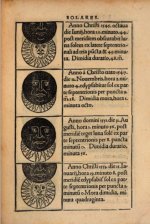
So in this eclipse list we get Anno Domini, Anno Salutis, Anno Christi, Anno a Christo Nato, Anno Incarnationis Christi, and Anno Post Christu Incarnatum, all jumbled up. Do they all mean different things? From the context here, clearly not, so why alternate them like this? Maybe the author put them together precisely to redefine them as referring to one and the same date. (Scroll to the last few pages for the long eclipse list.)

Conclusion: I have no idea what is going on with dates on these old books, but it seems clear to me that we cannot trust them. Best not to get too invested in figuring out the exact years in which an event occurred.
 

Attachments

  • Screenshot_20251222_211946.jpg
    Screenshot_20251222_211946.jpg
    816.6 KB · Views: 33
  • Screenshot_20251217_211421.jpg
    Screenshot_20251217_211421.jpg
    130.8 KB · Views: 45
Last edited:
Why should books printed before exactly 1500 be considered so different that they get another name?
The Bodleian Library houses the largest collection of western incunabula - books printed with movable metal type up to the end of 1500 - in a university library, amounting to more than 5,600 editions in 6,755 copies.
Incunabula and Blockbooks

Greek, Hebrew and Early Printing: A Polonsky Foundation Digitization Project​

Between 2012 and 2017, the Bodleian Libraries and the Vatican Library collaborated to digitize 1.5 million images of manuscripts and early printed books. The project was funded by The Polonsky Foundation, and was the first large-scale collaborative effort of its kind. The 1,567 items here represent the Bodleian's output from the project.
Collections were selected for digitization based on areas of shared strength between the two libraries: Hebrew manuscripts, Greek manuscripts, and incunabula or 15th-century printed books, primarily ones printed in Italy. In order to maximize the scholarly usefulness of the digital resource, whole shelfmark collections were digitized where possible. Over the five years of the project, the Bodleian was able to digitize nearly the entire Barocci collection of Greek manuscripts; nearly the entire Canonici, Huntington, Kennicott, Marshall, Marsh and Reggio collections of Hebrew manuscripts; and more than 500 printed books, including the Bodleian's copy of the Gutenberg Bible.
Other highlights include the Douce Pliny, the Kennicott Bible, and MS. Barocci 170, a richly illustrated copy of Leo the Wise's Oracula.
 
@OKKorral

According to Tamansky, David, Solomon, and Muhammad are Selim I Yavuz, Suleiman I, and Mehmed II, respectively.

Solomon's father was David, and Suleiman's father was Selim I Yavuz. Yavuz and David are very similar.

Suleiman, Selim Yavuz, Mehmed, and his son Bayezid II, all were open to western culture,

cn.jpg

commissioned portraits from Italian and Venetian artists. The sculpture of David who doesn't look Semitic at all.

Dvd.png

Bayezid welcomed Jewish from Spain and ordered the execution of anyone who didn't help them in the empire.

Safiyya bint Huyayya was the Jewish wife of the prophet Muhammad. If Mehmed (Muhammad) based his teachings (Islam) on Judaism, and Bayezid's mother (Safiyya) was Jewish, then Bayezid himself must have been Jewish as well.

Sophia.jpg

It's likely that Hagia Sophia was built by Bayezid in honor of his mother Safiyya, and in this 1520 city plan, it looks completely different from how it looks now. The wealthy Jewish diaspora helped with financing and architects from Western Europe, that's why it's in the style of a Romanesque Basilica with bell towers.

Another son of Muhammed, Alexander the Great, expanded the eastern borders of the empire, used cannons, conquered Persia, fought against the Scythians, spread monotheism, conquered Central Asia (TURKistan), Eastern TURKistan (Now I think I realised where the work Turk actually comes from), Northern India, etc. (see the Greco-Buddhist art). I read somewhere that Chingis Khan was a response to the conquests of Alex the Great.

Tamansky also said that after the defeat at the Battle of Lepanto, the old dynasty of Mehmed, Iskender, Bayezid, Suleiman, and Yavuz was replaced by a new dynasty (protege of the Western Coalition, according to Tamansky). This new dynasty destroyed the art (sculptures and paintings) of the old dynasty and rewrote the history and image of the Turkish sultans as purely Eastern in culture.
 
Continued

@OKKorral

Why would history be rewritten and on such a grand scale?

I've made English translation of these 2 videos, you may already know it, please watch them.

View: https://youtu.be/YjqO7utHVQA?si=_WN9k4iFK8iq-31e


View: https://youtu.be/ByXxcpIulHk?si=pcUWFLiSAyysy-bz


View: https://youtu.be/KgGZAotk3TA?si=rJAPVSYqq5MeKbX3
- audio track

In short, Napoleon did not wage war against Russia; it was Napoleon and Russia who waged war against Tartary (Muscovite) or what remained of it.

Uniforms.jpg

Look at the uniforms of the Russians and the French. The differences are minimal, except for the colors: blue for the French, green for the Russians, even though green and blue are analogous colors. You already know it. At the same time, Napoleon himself would wear green uniforms

frdlnd.jpg


Also, author tried to connect this war with the war of 1812 in American continent in which both sides had similar uniforms.
1812BR.jpg

1812US.jpg

Here too, it was the US and Britain against American Tartary.

Almost all military uniforms of countries since the 19th century have begun to look similar. Look at these Ottoman uniforms

gettyimages-1129120007-1024x1024.jpg

5998787.jpg


And the clothes of rulers began to look similar as well:

This is Mahmud II, and we also have Mehmed II. Mahmud and Mehmed are the same names. Why would he dress like this? Also, as you said, after him they start looking different from their predecessors. Could they have been impostors?
mhmdII.jpg

AlxI.jpg

Napo.jpg

Mji.jpg


Wars in South America, Napoleon's invasion of Egypt, Russo-Turkish wars, Crimean War, colonial India, War in Afghanistan, Wars in southeast Asia, War of 1812 in Russia, War of 1812 in America, etc. In all these wars all were wearing similar uniforms.

War of 1812 in Russia. After Muscovite Tartary was conquered, the next were Caucasus, Central Asia, Urals, Siberia, and then all the way to America - Alaska, remember the sale of Alaska. War of 1812 from Europe to the East and War of 1812 in America to the West as if they were fighting the same entity. Napoleon's invasion of Egypt, supposedly France against Turkey with Britain. I think it was against the Egyptian kingdom (which actually built the pyramids). Napoleon's Egypt triggered a so-called Arab renaissance.
 
Continued

@OKKorral

Why would history be rewritten and on such a grand scale?

I've made English translation of these 2 videos, you may already know it, please watch them.

View: https://youtu.be/YjqO7utHVQA?si=_WN9k4iFK8iq-31e


View: https://youtu.be/ByXxcpIulHk?si=pcUWFLiSAyysy-bz


View: https://youtu.be/KgGZAotk3TA?si=rJAPVSYqq5MeKbX3
- audio track

In short, Napoleon did not wage war against Russia; it was Napoleon and Russia who waged war against Tartary (Muscovite) or what remained of it.

View attachment 35642
Look at the uniforms of the Russians and the French. The differences are minimal, except for the colors: blue for the French, green for the Russians, even though green and blue are analogous colors. You already know it. At the same time, Napoleon himself would wear green uniforms

View attachment 35643

Also, author tried to connect this war with the war of 1812 in American continent in which both sides had similar uniforms.
View attachment 35644
View attachment 35645
Here too, it was the US and Britain against American Tartary.

Almost all military uniforms of countries since the 19th century have begun to look similar. Look at these Ottoman uniforms

View attachment 35646
View attachment 35647

And the clothes of rulers began to look similar as well:

This is Mahmud II, and we also have Mehmed II. Mahmud and Mehmed are the same names. Why would he dress like this? Also, as you said, after him they start looking different from their predecessors. Could they have been impostors?
View attachment 35648
View attachment 35649
View attachment 35650
View attachment 35651

Wars in South America, Napoleon's invasion of Egypt, Russo-Turkish wars, Crimean War, colonial India, War in Afghanistan, Wars in southeast Asia, War of 1812 in Russia, War of 1812 in America, etc. In all these wars all were wearing similar uniforms.

War of 1812 in Russia. After Muscovite Tartary was conquered, the next were Caucasus, Central Asia, Urals, Siberia, and then all the way to America - Alaska, remember the sale of Alaska. War of 1812 from Europe to the East and War of 1812 in America to the West as if they were fighting the same entity. Napoleon's invasion of Egypt, supposedly France against Turkey with Britain. I think it was against the Egyptian kingdom (which actually built the pyramids). Napoleon's Egypt triggered a so-called Arab renaissance.

Uniform thread in the archive.
SH Archive - Uniforms: Old World Order vs. New World Order
Napoleon thread in the archive.
SH Archive - Napoleonic Oddities
 
Conclusion: I have no idea what is going on with dates on these old books, but it seems clear to me that we cannot trust them. Best not to get too invested in figuring out the exact years in which an event ococcurred.
This reminded me of when i was analysing all kinds of old maps for different dates and anomalies, and imo, the disproportional amount of maps "created in the 1500s/1600s" with all kinds of variations in which the dates were written is imo proof of a narrative being built for control purposes.

And thus, just like the dates on the books, cannot be trusted. Is there a way to even try to put together a bigger picture for why all of a sudden books and maps start to be made by the 100s around 1500/1600 other than narrative control? Not that i'm aware off.
 
Does "US," The United States, actually stand for Unam Sanctum, the Papal Bull? Is THAT why America considers everyone a citizen, because the Pope believes he owns the world, the Roman Empire?
 
Yes. Sorry for the delay, fellas. I'm using my modded python script I created (which took almost 5 days!) to essentially get ALL eBooks purchased on Amazon plus ANY book that is free to read through Kindle Unlimited! So I am downloading as much free stuff from Kindle Unlimited books as I can and removing the DRM before Amazon creates a truly impenetrable DRM. Rest assured, I will be releasing the polished book, complete with an expanded, detailed hyper-linked ToC, substitution of lower-resonlution pics in the original with HQ–preferably colorized–replacements, as & when I can, "Beautity HTML", remove dead hyperlinks + unused CCS styles, perhaps enabling Cslibre's Heuristic processes, supplementation of those URL's into hyperlinks, which will subsequently re-direct ALL of those hyperlinks to a caputed page from archive.org's Wayback Machine, ideally from as close to when the author posted them as possible, as sites–especially sites like Wikipedia could drastically change from what he saw to its current state, all of which will look which will look INDISTINGUISHABLE (i.e. No archive.org banners, &c.) to the (virtually) actual, landing page!

While I'm here, I'd ifigued I'd drop this here:
ePub of Andre(i/y)? Pustogarov
(Андрей Пустогаров)'s (The Beginning of History) – The Year 1492∶ The End of the World or the Beginning of History_ (2017).ePub
Enjoy! (Still needs a lot of touching up but I figured people would prefer having an ePub instead of having to click > next page (often with pop-ups, unless you have uBlockOrigin or something similar).
Any update on the expanded Tamansky book? Thanks again for your effort.
 
Tips
Tips
Please respect our Posting Rules.
Back
Top