- Joined
- Dec 17, 2020
- Messages
- 399
- Reaction score
- 1,152
Yes, your first-born. They provide seal-pup levels of fat (16% by weight) in a convenient package. Fat is hard to find in nature. And it really matters when a 'Little Ice Age' has just begun.the first born son is placed on a silver platter, then their redemption is purchased from the high priest for 5 shekels. and the parents are given the option of keeping the baby or the 5 shekels. In light of the findings on this thread, it's very interesting that the child is already ready to be "served" if the parents choose the shekels.
Babies are also a source of uncontaminated blood. And unblemished skin suitable for processing into vellum. And besides, taxing the first-born selects away the least fertile breeding pairs.
Central American indians claim European pishtaku ('friars', 'merchants' and 'bankers' in our language) originally preyed on them for fat, then meat and blood. And they were Franciscan friars.
Then they switched to labour (slavery) and ultimately to debt economics (low-pay plus debt/interest). Remarkably, that parallels the 'developed world', where management has intensified wage destruction, debt and hidden price/tax rises through neo-liberal economics. The result is crashed family-creation and reproduction rates below replacement level.
And an obese population dependent on smartphones and the Holy Vaxx.
feralimal said:
See The Great Reset: H.G. Wells' Dystopic Vision Comes Alive or search for 'HG Wells and The Coefficients'.HG Wells was plainly a very well connected insider
feralimal said:
Wells projects the Eloi and cannibalist Morlocks into the future
There are reasons to wonder if Wells took a true story from the past, flipped it into a future event, and published it as The Time Machine. The parallels between the history of the Time Machine's Eloi and the history of Lincolnshire's real-life Elloi are very curious.
Take as a starting point Wells' proposition that the Eloi were being farmed - partly via cargo cult religious beliefs - in jungly remains above a city blasted away in a truly destructive, but forgotten war...
Orthodox historians tell us two civil wars were fought across and around England's Elloi. Local mythology adds two more 'supernatural' battles near Elloi. You'd expect the two supernatural battle stories to be weirder than the two 'authorised' stories, right?
Let's have a look.
The Last English Civil War
First, let's note the 1715 Jacobite rebellion is usually positioned as a primarily Scottish civil war. But let's keep its 1715 date in mind.
England's most recent civil war is the 1642-1651 'English Civil War'. This is Oliver Cromwell's war.
The source page for the above photo has really interesting images. Look at them and ask yourself: how tall were those soldiers? How quickly did weapons and clothing develop after this war?
Cromwell was born in Huntingdon, just south of Elloi, and later lived 20 miles south-east of Elloi in Ely (Google Maps), (Google Streetview).
The English Civil War's armies passed across and around Elloi. But the evidence of brutally destructive fighting was - and still is - very visible on the other side of Elloi. That's in the rest of Lincolnshire to the north-west and on westward into Nottinghamshire and Northamptonshire. Just to avoid offending anyone, yes, the war also raged across the rest of the country.
The countryside around Elloi was littered with ruined churches, abbeys, and monasteries, castles, manors, great halls and stately homes. By 1776 reports of rediscovered ruins were being published. The ruins were covered in vegetation and often partially covered with dirt. Church interiors were sometimes described as being draped with green slime. Probably what we would call 'algae'.
Did they teach you that in school? In Sunday School?
The ruined stately homes had apparently been deserted for some time. By 1776, some were being re-occupied and were gradually restored. After partial restoration, many were subsequently abandoned. Leach and Pacey's multi-volume "Lost Lincolnshire Country Houses" and "Lincolnshire Country Houses and Families" contain photographs of those that survived longest.
Those houses were big. Often castle-like ("crenellated"). In some cases, very 'Roman-like'. The books show this best but there are a few photos online.
When were these buildings ruined? And by what?
In 1776, William Stukeley blamed 'The Flood' and 'The Deluge' for the ruins he surveyed. In Itinerarium Curiousum (1776 edition), Stukeley says bodies are dug up in gardens and yards. Ie, not far down (see above post). Also, there is rubble under the soil and 'Roman' artifacts are being dug up all over the place.
By 1791, John Byng is part of various teams working for a relative of Lincolnshire's 'Bertie family' - Ie the family of Lord Vere Bertie, AKA the Duke of Ancaster (Google Maps), (Google Streetview), a town near Sleaford (Google Maps), (Google Streetview) in Lincolnshire. They are trying to locate the ruins of 'religious' buildings and big halls. By the end of this post, you should be able to guess what they were looking for.
What does Byng find? As reported in his Torrington Diaries, he found the same as Stukeley: many fields are full of stone rubble. But Byng also says:
- Some churches are being restored,
- Others are still ruined and/or covered with vegetation, their interiors sometimes draped with green slime.
- Few people go to them.
- New owners without a clue have taken over the empty, ruined stately homes.
- The ground floor ruins of roofless buildings are sometimes occupied by new families.
- The locals can't give directions, not even to local places.
- The locals have no idea of their locale's history.
- Few of the locals can cook - a criticism still made about the English.
- Many look foreign (Spanish in one case, more often Flemish). And Byng himself capitalises as if he were Germanic.
- Roman artifacts are still being found and have become so popular that 'Roman' coins are now being forged in Birmingham.
A couple of times, Byng says such and such a big hall or house was burned down 60 years ago (let's call that 1730). When he blames anything, he blames the 'rebellion' or 'the war'. Presumably he means 'the Civil War'. But that was 140 years earlier than Byng's time, not 60 years. (Only a small part of Byng's fenland tours are online. I summarised the above mostly from a print version of his Torrington Diaries.)
Half a century later - in 1846 - Rev George Oliver is also being paid. He's helping to set up Sunday schools and today's education system to the north of Elloi. He gushes about the progress of Lincolnshire's rebuilding:
- Churches are being rebuilt. Congregations are up.
- The land is fertile and being planted with trees. (the fens are still well-known for having few trees.)
- He claims the bad old days of barons and manors are gone.
- But Oliver also gives a lot of evidence that the land between Lincoln Edge and the Wolds was inundated by around 1730. See attached 'Chapter I' transcript.
- Despite evidence of flood, Oliver blames the ruins on Cromwell and the English Civil War.
Shortly after it was erected an itinerant showman appeared at Nocton Hall (also owned by Dunston-owner Dashwood) to exhibit the popular drama of Punch and Judy ; and from the servants' hall the portable theatre was introduced into the drawing room, which at the that time was full of company. The fellow who had been dictated to by some lover of fun in the party, after the usual exhibition, put into Punch's mouth the question, "Who erected that pillar on the heath?" "Sir Francis Dashwood" was the answer. "What was it built for?" "Nobody can tell." How the conversation might have terminated is not known, for the dialogue was suddenly stopped by Sir Francis, who was present, and Punch dismissed.
Summary:
Only Stukeley - the earliest writer - blames 'The Flood' and 'The Deluge'. From Byng onwards - 1791 - the narrative changes to 'The War'. Yet, clearly, all three writers are describing successive stages of recovery from an event that involved:
- Some fire and much water - lots and lots of moving water.
- Massive destruction and die-off.
- Recovery and repopulation, apparently starting around 1730.
An Earlier English Civil War
According to orthodox history, Elloi is the site of one the weirdest stories in English military history. King John losing his treasure in the Wash during the 1216 civil war with the Norman barons. Followed soon after by a new king and the elites all making friends again. Just like they did after the 1642-1651 Civil War 420 years later.
King John's jewellery-laden baggage train is said to have been lost when disaster struck near the marker labelled "King John's Pool" on the map below:
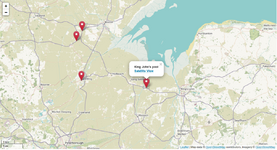
King John's 'Pool'. Anti-clockwise: Spalding, Former Bicker harbour, Former harbour navigation mark
Quoting from https://historicalragbag.com/2020/06/22/king-john-his-treasure-and-the-wash/:
the land opened in the middle of the water and caused whirlpools which sucked in every thing, as well as men and horses, so that no one escaped to tell the king of the misfortune.”
and
It is... possible that it was simply the incoming tide and the quagmire of the sands that took out King John’s train, but there has been discussion of an offshore earth quake
Elloi. Scene of earthquakes, floods and lost
Military equipment?
Russian stolen history researchers suspect jewellery is a cargo cult remnant of electronics and radio-frequency devices. See https://178.62.117.238/tag/technology.html. Or for a quick introduction: https://178.62.117.238/links-to-pro-vladimirs-electrical-equipment-of-the-past-articles.html. Or for a really quick introduction, see this spoiler:
- Gems are semiconductors.
- Silver and gold are the most malleable and best conductors.
- Copper and bronze are important at microwave frequencies.
- Early bonze cannons make better waveguides than cannons.
- The braid on sword hilts and high-ranking uniforms look like electrical conductors.
- Churches, domes and cupolas look like magnetrons and radio-frequency resonators.
- Furs and feathers are not used for their triboelectric properties today. But if you look at how Inertial Management Unit chips work, you'll find something similar to 'feathers').
And behind the following spoiler is what was claimed to among King John's lost 'jewellery':
- one wand of gold with a cross, ”to wit a sceptre” ;
- a red belt with precious stones which belonged to the ”regalia”
- another belt of black skin, padded within (furratum) with red sendal, with precious stones, cut, set in a chase;
- another belt of leather padded with red sendal with great stones set in a chase ;
- another belt of red leather padded with white leather with great cut stones set in a chase;
- another belt of black leather with roses and bars of gold without stones;
- a necklace or collar (monile) set in the middle with diamonds surrounded by rubies and emeralds ;
- nine great necklaces with many precious stones ;
- a crown with precious stones with a cross and seven flowers ;
- a royal tunic of red samite with embroideries with precious stones in orles ;
- a pair of gloves with stones and another pair with flowers of gold ;
- a white tunic of diaper banded with embroidery ;
- a ” regale ” of red samite orled and marked all over with the cross in embroidery, with stones ” great, divers and precious,” with two brooches for attaching the said pall ;
- a pair of sandals of samite with embroidery;
- two pairs of samite shoes;
- and eleven pairs of basins weighing 62 marks.
For a more thoroughly researched version of the King John story, try halfway down this page. It says its main source was this PDF. It also makes the excellent - if speculative - point that the King John of this legend may have been the slightly later John O'Gaunt. A very interesting entity, whose dad was rumoured to be a butcher from Ghent in Belgium.
So, apart from the 'jewellery = electronics' part - the above is what is conventional enough to be teachable. Now let's look at the unteachable - the two mythological aerial battles around Elloi.
A Supernatural Battle North of Elloi
One is the Byard's Leap battle recounted by Wikipedia and mentioned here, so no need to repeat it in this post. Its relevance is that this 'mythical' battle took place low in the sky over the same Lincolnshire that the last Civil War left in ruins. Variants of this story have the antagonist either as a people-eating witch or as a people-eating, wart-bearing monster. One version puts the event about 25 miles north-west of Elloi between Ancaster and Dunston (in the air above Knights Templar lands at Temple Bruer (Google Maps), (Google Streetview)); the other puts it about 25 miles north of Elloi. We'll just call both versions the same
A Supernatural Battle South of Elloi
The second mythical battle takes place about 40 miles south of Elloi over an enigmatic village called Reach (Google Maps), (Google Streetview) in Cambridgeshire. It involves fire, water, storms, cold, and many fallen trees:
Long, long, ago, when the area around Reach was a forest, there lived a chief called Hrothgar. He lived at a time when gods and demons were thought to control the earth and one demon in particular was terrifying - the fire demon! To the horror of the chief, it appeared that the fire demon desired his beautiful daughter, Hayenna.
Hrothgar told his daughter not to worry, as his very good friend, the water god, was the sworn enemy of the fire god. He knew that the water god could communicate between the under and over world and would keep her safe.
One night Hrothgar had a dream. In his dream, an old man appeared and told him that the fire demon had a new ally in the tempest god. ‘You must prepare for a great battle’, the old man told him. The next day, Hrothgar told all the giants of the forest his plans. First, they cut down all the trees to make a wide clearing. During the next three days, they built a great ditch from the river to Mount Dithon (Wood Ditton), many feet deep and seven miles long.
The tempest god had watched their work with interest and scorn. Just as they were starting to tire from the hard work, he sent a great storm to blow down the trees on top of them. The storm also brought rain, hail and snow in great quantities. The giants of the forest rounded on Hrothgar, saying he should not have angered the gods and should not have crossed the powerful fire demon. ‘Do not be afraid,’ Hrothgar told them. ‘My good friend, the water god will protect us.’
I copied this summary from Ancient-Origins, who originally copied - and summarised it - from Christopher Marlowe's Legends of the Fenland People. The book is not commonly available so I hope Ancient-Origins will appreciate the plug and bear with me.At that very moment, the rain ceased. Suddenly, under a great cloud of smoke, a terrifying wall of fire rushed towards the ditch. All but Hrothgar fled. Despite his fear, he came out from shelter and, with his bare hands, dug away the remaining strip of earth, separating the River Cam from the ditch. The water poured into the ditch with a mighty, deafening roar! The fire demon was powerless against this mighty wall of water and the fire died down, the tempest stopped and his daughter was safe. Rejoicing, the local people placed treasured items in the new stream, to thank the water god for his help. The ditch, the Devil's Dyke is still there. The fire demon never troubled the population of Reach again.
Physical Evidence on the Ground and Underground
The fallen trees are a big clue. Bog oaks were - and still are - a feature of Elloi.
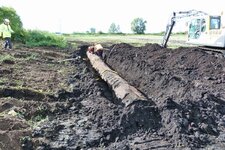
Bog oak find, 2012
Other than fallen, partially charred, tree trunks, and reports of multiple buildings on fire, do we have evidence of intense heat?
We do. And we also have an overt attempt to cover it up.
George Oliver's excavation of Temple Bruer in 1832-1833 provides two clues to intense heat. They are in the short excerpt at the end of this post above.
Those skeletons were no more calcined by ordinary fire than the bones of a Sunday roast are calcined by a household oven. Similarly, ordinary fire did not begin to glaze the crypt's limestone walls any more than ordinary fire vitrified the stones of Britain's northern hill forts. Even partial metamorphosis of limestone requires much higher temperatures than normal fires.
Evidence of Cover Up
We can also see evidence of the early phase of the cover-up. Oliver produced this plan of the partially excavated Temple Bruer:
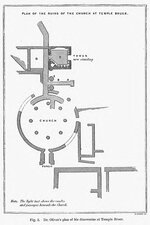
Temple Bruer, 1832-1833
In 1902, William St John Hope re-excavated Temple Bruer and claimed Oliver had imagined things. There were no skeletons and not much crypt, Hope said. Just this:
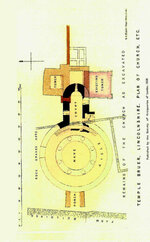
Temple Bruer, 1902
Note: I had to flip one plan 90 degrees to match the other. As a result, north is left, east is up in both plans.
Just for some brain-relief, here's today's version of how Temple Bruer looked. You'll notice there's no reference to underground rooms:
Temple Bruer fly-through by Lincolnshire Heritage. Source
You have to make your own call. My call on Oliver is that he was dilligent about citations and details, eventually realised evidence was disappearing and did what he could to preserve it.
My call on Hope is that, as part of a career apparently spent pleasing wealthy patrons, Hope produced a paper explaining some odd medieval finds. Describing shallow wooden bowls laced with gold or silver that were often fitted with an inexplicable metal disk at the bottom of the bowl, Hope wrote:
They are simple drinking vessels... called mazers.
Perhaps the fourteen pairs of 'basins' in King John's lost treasure were also called mazers.
Long before Hope came along to clean up Oliver's findings, Oliver fell out with his sponsors - the Tennyson family. But the cleaners weren't in a rush. Most of the hoi polloi could barely read in 1831, when the fall-out occurred. They were unlikely to find - let alone read - Oliver's description of Temple Bruer being burned.
From History of the Holy Trinity Guild at Sleaford, Chapter 2, note 38, page 92:
When, therefore, this Alypius had set himself to the vigorous execution of his charge (usselo note: 'his charge' means 'his task', which was to replicate the Temple of Jerusalem in Britain. Ie, to build the Knights Templar temple at Temple Bruer), in which he had all the assistance that the governor of the provinces could afford him, horrible balls of fire breaking out near the foundations, with frequent and reiterated attacks, rendered the place, from time to time inaccessible to the scorched and blasted workmen ; and the victorious element, continuing in this manner, obstinately and resolutely bent, as it were, to drive them to a distance, 5 they fled together for refuge to a neighbouring church ; some to deprecate the impending mischief ; others, as is natural in such cases, to catch at any help that presents itself ; and others again enveloped in the crowd were carried along with the body of flyers. There are those who say that the church refused them entrance ; and that when they came to the doors, which were wide open but a moment before, they found them on a sudden closed by a secret and invisible hand ; a hand accustomed to work these wonders for the terror and confusion of the impious, and for the security and comfort of godly men. This, however, is now invariably affirmed and believed by all, that as they strove to force their way in by violence, the Fire which burst from the foundations of the temple, met and stopped them, and one party burned and destroyed, and another it desperately maimed, leaving them a living monument of God's wrath against sinners. But the thing most wonderful and illustrious was a Light, which appeared in the heavens, of a Cross within a Circle.
A Cross within a Circle in the sky... following balls of fire appearing at Temple Bruer's foundations... Hmm...
Source: Futurama, S01, Ep01
But that's ridiculous. The only people talking about that kind of force are the Electric Universe people. They say a plasma blast may have destroyed Troy.
I wonder... if you had a lot of soldiers with heat burns, UV burns, and perhaps even radiation burns, would you need a lot of blood and plasma to treat them? Would it help for them to bathe in uncontaminated blood products?
And what would you call such an illness?
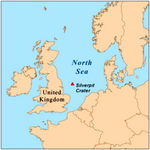
Actually, geologists have carefully considered the possibility of aerial events over this area. For example, in 2009 it was claimed an aerial event created the Silverpit crater in the bed of the North Sea just north of Lincolnshire's coast:
You should really look at the profile of the crater shown on that source page. In the 2009 photo below, members of the British Geological Society are shown voting on what created Silverpit:
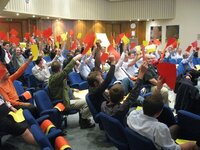
They concluded Silverpit was created by salt moving under the sea bed.
Don't laugh. Earth scientists do encounter genuine difficulties explaining Lincolnshire's geology and geomorphism ('hills and valleys' to you and me) so voting is probably as effective as any other method. Including the Scientific Method.
For example, when describing the course of the River Witham, they use words like: "most unusual" (see page 1), "anomalous" (see page 97), and "abnormal" (see page 75).
Like several Lincolnshire rivers, the Witham has two startling abilities:
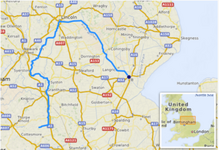
- It flows up valley sides, then
- Erodes gaps through them low enough to flow through like a normal river.
Another oddity is the way the deep rock structures under Elloi and surrounding areas taper together to the north:
That's bedrock. Even weirder, to my mind, is the near-surface 'superficial' layout. Elloi sits on shallow alluvial deposits arranged in a near-perfect circle:
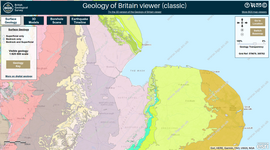
I added the red circle.
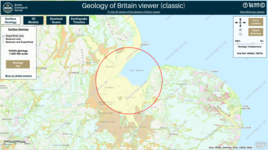
It looks as though an enormous force blast-excavated the subsoil from Elloi, leaving a shallow crater behind. Then Elloi's rivers and the North Sea flooded back in and backfilled the crater with alluvial deposits. Leaving Elloi with the expensive problem it still has today - being largely below sea-level.
Weirdly, the centre of the circle is about where
Side-note: This map has several other interesting features. A seemingly insignificant feature is that, at about 10:30 pm clockwise, the circle intersects higher ground near a village called Swineshead. There are other items of interest but Swineshead appears again in this post's next map.
Perhaps one of King John's men got boozed up, mishandled a mazer and took out Elloi. Perhaps some opposing civil war
Perhaps Elloi's superficial ground layers were scoured away by Silverpit's tidal waves. Perhaps the Silverpit creation event was one of several.
Personally, I suspect Silverpit has a separate explanation too terrible to talk about. One linked to a strange geological feature called the Immingham Channel. But regardless of what I think, when we consider the ruins, the water damage, the mudflood, the bog oaks, the scorching, the recovery and Stukeley, Byng and Oliver's write ups, we can justifiable ask: what are we actually looking at?
Could it be we are looking at evidence of a single vast war and its subsequent cover-up?
I've already shown - at least, I think I have - that there was a vast 'something'. Now I'll try to show there is the cover-up that goes beyond the state of Temple Bruer's remains. That the cover-up links the destruction of Elloi with the destruction of Russia and northern Europe.
The original draft of just this next part was even longer than this entire post. So what follows is a very short version.
Chronological Manipulation
We know some stratigraphers, chronologists and questioning historians say there is no evidence or logic to support the first millennium (AD 0 - AD 1000).
If they are correct, then it follows that the Roman invasion of England in AD 44 becomes the Roman invasion of England in AD 1044. Or, if you want, the Norman invasion of England in AD 1066 becomes the Norman invasion of England in AD 66.
Either way, if you remove the first millennium, the 'Romans invaded' narrative coincides with the 'Normans invaded' narrative.
Which might explain why some Normans arrived with Italianesque names that later became French names. For example, from Nocton Hall - A History - Metheringham Area News:
...one of William’s leading soldiers Norman de Adreci (D’Arcy) arrived to be allotted 33 parishes choosing Nocton as his base to enjoy over four decades here.
Adreci's Nocton base includes Dunston Pillar. It is about 30 miles upstream of the River Witham's current Boston outfall. Until a 1014 flood, the Witham entered the Wash via Elloi's large Bicker Haven sea harbour. Or so Wikipedia's authors allege. It lay to the west of Swineshead.
But Byng described being shown where one of the harbour's inner navigation marks had stood - before its owner sold it for timber:
So that marker - a yew tree - stood in place for 747 years. It stood through multiple wars, storms, fires, changed soil hydrology, changed climate, and mass tree falls until it was felled by market demand for timber to rebuild a ruined country. Remarkable.
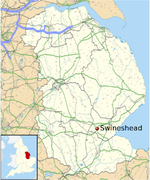
A canal also linked Nocton to Bicker's sea harbour via the Witham. It ran from the Witham to a wharf at Timberland, just south of Nocton, on top of the alleged 'Roman' 80 mile-long Car Dyke canal. The wharf was still marked on 1805 and 1815 maps.
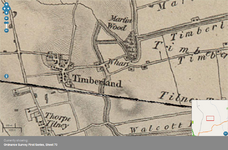
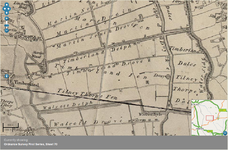
In 1808, canal engineer John Rennie (the Elder) reported Timberland Dike - the canal to the wharf - was navigable. Along with neighboring segments the Nocton Delph and the Branston Delph. This according to John Boyes and Ronald John Russell's The Canals of Eastern England, 1977, ISBN 978-0-7153-7415-3.
Which is odd because it would take a lot of effort to dig out navigable canals from the Witham to villages like Timberland - just to ship out ordinary agricultural produce from its nearby cluster of villages: Dunston, Nocton, Metheringham, Potterhanworth (also the site of a proposed pleasure gardens at the foot of a tower (Google Maps), (Google Streetview)).
Perhaps their produce fetched prices worth the investment.
There's a lot wrong with the whole 'Roman Car Dyke canal' story. Especially around Nocton. To save space, I've cut it. But its problematic nature could explain why Wikipedia's Car Dyke entry is so very cautiously worded.
And Car Dyke's name offers another clue, which we will come to.
'Romans equals Normans' theory also explains:
- Why so much Norman architecture is called 'Romanesque'.
- Why people can't distinguish between Roman and medieval structures and materials:
You say 'Roman', I say 'Norman'. Source: Time Team: Piercebridge episode
- Why 'Roman' Pompei was destroyed in 1631. Just ten years before tensions in England erupted into what we're taught was an English Civil War.
- And why, in History of the Holy Trinity Guild at Sleaford, as I said in this post, Oliver describes the area's 18th Century elite as if they had followed immediately after the Norman baronial/manorial families that - conventionally - settled immediately after the Normans. It reads as if Oliver didn't have enough anecdotes to fill the gap between, say AD 1200 and AD 1650.
In 1733, ten years before becoming Nocton's owner, Francis Dashwood visited 'newly-built' St Petersburg. He sailed via Copenhagen. From Sir Francis Dashwood's Diary of his Visit to St Petersburg in 1733 - Betty Kemp, Slavonic and East European Review, 38, page 197.
Date: 1733-05-30:
Ashore at Copenhagen... diminished by a third about 5 or 6 years ago, by a dreadfull fire, [1] that took in Severall parts of the town at once
And Kemp's footnote:
1. The great fire of October 1728, which destroyed a large part of the old town.
and later:
Near to this is the chamber, of rarities, where there are Severall rooms and a few good pictures, all going to ruin and some entirely Spoilt, except a Rubens, two Raphael, a Carlo Lotti, and one of Caraveggio, and two or three Landskip.
That last sentence could be inserted into Byng's 1791 description of Lincolnshire's ruins and you would have no idea it was about a different place, written by a different author. For examples, see Byng's descriptions of Grimsthorpe and Belvoir Castles in Torrington Diaries, pages 127 and 133.
A 1730 English Year Zero, a 1730 Danish year Zero and a 1730 St Petersburg Year Zero puts us at the Russia/Siberia reset suspected by Russian stolen history researchers based on their evidence of destruction by flood and fire. And their suspicions of thermonuclear/plasma warfare.
It's curious Dashwood and Byng were interested in paintings. Had an art market already blossomed? Or were some paintings potentially problematic if the hoi polloi saw them? In Russia, for example, some stolen history researchers no longer buy into the idea that lances and spears were the simple spearing weapons we are told they were.
Elloi shares with Russia 's several other easy-to-miss details in addition to mudflood, flat land, destroyed churches, absence of old forest, a nearby town called Peterborough and river names that visually resemble each other. Like Neva and Nene.
Neva and Nene? One of the oddities of Temple Bruer is that some of its older grafitti has the letter N reversed.
Another oddity is the 'Le Carre' family name and its variant 'Carr'. Found in Sleaford - near the north-pointing tip of Elloi - the names Le Carre and Carr also crop up in many links between Russia and England. From espionage thrillers to Lockhart Plots to political analysts specialising in early Soviet politics. To the timber business.
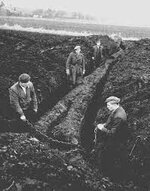
Bog oaks: a good way to get a start in the timber industry.
We encounter other odd name-related coincidences. 19th Century scientists who helpfully explain the bog oaks for us have names like 'Edward Bogg'. Another, who help explain the alluvial deposits for us had the last name 'Dikes' ('Dike' means both 'ditch' and 'low, artificial ridge' in Elloi dialect. It often gets mistranslated as 'shaft' in Russian). We have engineers of the River Witham's embanking scheme called 'Joseph Banks'. And we have local historians called 'Prior' and 'Pryor'.
I realise I am skipping here. I'm trying to keep this post readable.
Another eerie
On the 29th December 1767 the Hobarts gave a grand masquerade at Nocton Hall which may have been a house-warming to celebrate their advent. The guests were met at the door by a Turk in a white bearskin, who took their tickets. They were received by Mr Hobart as 'Pan' – his dress dark brown satin, made quite close to his shape, shag breeches, cloven feet, a round shock wig, a mask, a leopard skin over his back, and in his hand a shepherd’s pipe. Mrs Hobart was dressed in a muslin petticoat, puffed very small and spotted with spangles. Several dancers, including the hostess, had two costumes. Among the guests were Lord Exeter, Lord and Lady Vere Bertio, Lady Betty Chaplin, Sir Cecil and Lady Wray, the Huttons, the Sibthorps, the Custs, the Amcotts, the Neviles and all the great Lincolnshire families, all in fancy dress.
If you have read Dashwood's origins and interests, you'll be aware of even more resemblances than the obvious ones in the quote above.
So besides the Hobarts, it might be fair to say all the great Lincolnshire families show a remarkable resemblance to the Dashwoods. And that's hardly a surprise because if you research the Bertie family you find you are researching the Hobart family.
A love of fancy dress - especially religious-themed fancy dress - brings us to the Franciscans so feared by central America's indians. One of Francis Dashwood's quirks was to have himself painted as the Franciscans' patron: St Francis of Assisi - the patron saint of animals:
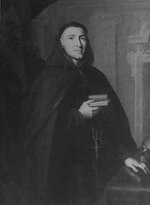
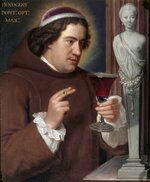
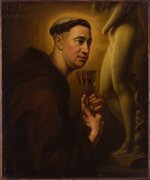
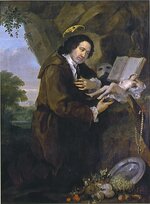
Francis Dashwood fancy dress: as clergy, pope, Franciscan monk, St Francis of Assisi
Another miss could be the frequent claim that Dashwood relished being portrayed as a sacrilegious friar - or clergyman or pope - because he ogled naked women. I think he and his friends may have made up the whole 'monk', 'friar', 'abbot' part of the religion business. But whatever, the women are portrayed with a striking feature: their anemic bloodlessness. They may also be shown limbless or hand-less. In contrast, Dashwood holds a goblet that contains red wine or blood. The women may represent butchered human carcasses. In the last image above, the lifeless woman may not be laying on a floating bedsheet but on unwrapped 'butcher paper'.
Bloodletters helped monks and became modern barbers. In Britain, the bloodletter and barber's symbol is a red and white striped pole. In some countries it also has a blue stripe. They are the three colours chosen for many national flags.
It's sometimes argued that Stanley Kubrick'sThe Shining is an encrypted history lesson. The Shining contains this scene:
Who is the caretaker? We are the caretaker. Source: The Shining, 1980
You see:
- Red and white decor.
- Jack cleans his dirty hands
- Grady wears white gloves - his hands are clean and are not expected to become dirty
- A casually-dressed working man who needs a haircut.
- A neatly-dressed, balding man (with something of a friar's cut).
- Each man's maturity - their attitude and behaviour - copies their appearance (and I trimmed even more obvious examples of this from the beginning and end of this clip).
And you understand there has been an unpleasant butchery interlude.
What does it all mean?
Hey, search me. What I think is that The Shining's caretaker theme and - arguably - its absent owners theme and the development theme also appear in Kubrick's 2001, A Space Odyssey. In 2001, Bowman is an astronaut-cum-caretaker who ends up in a room that blends 18th Century furniture with modern illumination. A bit how Oliver blends
In 2001, unseen entities whisper around Bowman. He is not dominant. He is apparently contained, seemingly watched, perhaps the focus of a whispered discussion.
From Jean Hardouin:
Jean Hardouin (1646-1729) was a scholar of classical literature. In 1685 he published an edition of Pliny's Natural History. There was nothing unusual about the edition itself, which was considered to be of merit and very well edited. What was unusual was that despite being so knowledgeable about classical literature, Hardouin had very strange ideas about its origins.
According to Hardouin, the majority of classical Greek and Roman literature had not been produced by Greek and Roman authors. Instead, it had been forged during the Middle Ages by a group of Benedictine monks. He also argued that all extant Greek and Roman coins were forgeries.
You don't need me to unpack this sentence:
despite being so knowledgeable about classical literature, Hardouin had very strange ideas about its origins.
The quote continues:
[Hardouin] never revealed why such a vast deception had occurred. He only declared, elliptically, that when he died the reason would be found written on a piece of paper the size of his hand. The reason, unfortunately, was never found.
Another memorable moment from The Shining is its final frame:
It's good to see Jack smartened up and was even invited to the party.
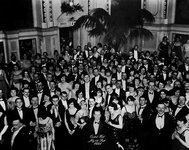
I just wonder who the other party-goers are.
Edit: cleaned up, and adds leprosy hint, fixes hyperlink
The .txt attachment below is a rough transcript of Chapter I from History of the Holy Trinity Guild at Sleaford. Rough but easier to search in than the PDF.
Attachments


Last edited: