Evidence humans were created and traded as slaves, food, entertainment and material resources (IHASFEMR)

the first born son is placed on a silver platter, then their redemption is purchased from the high priest for 5 shekels. and the parents are given the option of keeping the baby or the 5 shekels. In light of the findings on this thread, it's very interesting that the child is already ready to be "served" if the parents choose the shekels.
Yes, your first-born. They provide seal-pup levels of fat (16% by weight) in a convenient package. Fat is hard to find in nature. And it really matters when a 'Little Ice Age' has just begun.

Babies are also a source of uncontaminated blood. And unblemished skin suitable for processing into vellum. And besides, taxing the first-born selects away the least fertile breeding pairs.

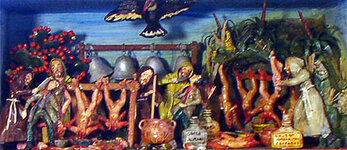
Central American indians claim European pishtaku ('friars', 'merchants' and 'bankers' in our language) originally preyed on them for fat, then meat and blood. And they were Franciscan friars.
pishtaku_top.jpg
Pishtaku evolution: phase one as shown in Nicario Jiménez's retablo. Source
Then they switched to labour (slavery) and ultimately to debt economics (low-pay plus debt/interest). Remarkably, that parallels the 'developed world', where management has intensified wage destruction, debt and hidden price/tax rises through neo-liberal economics. The result is crashed family-creation and reproduction rates below replacement level.
And an obese population dependent on smartphones and the Holy Vaxx.

feralimal said:
HG Wells was plainly a very well connected insider
See The Great Reset: H.G. Wells' Dystopic Vision Comes Alive or search for 'HG Wells and The Coefficients'.

feralimal said:
Wells projects the Eloi and cannibalist Morlocks into the future

There are reasons to wonder if Wells took a true story from the past, flipped it into a future event, and published it as The Time Machine. The parallels between the history of the Time Machine's Eloi and the history of Lincolnshire's real-life Elloi are very curious.

Take as a starting point Wells' proposition that the Eloi were being farmed - partly via cargo cult religious beliefs - in jungly remains above a city blasted away in a truly destructive, but forgotten war...

Orthodox historians tell us two civil wars were fought across and around England's Elloi. Local mythology adds two more 'supernatural' battles near Elloi. You'd expect the two supernatural battle stories to be weirder than the two 'authorised' stories, right?

Let's have a look.

The Last English Civil War

First, let's note the 1715 Jacobite rebellion is usually positioned as a primarily Scottish civil war. But let's keep its 1715 date in mind.

England's most recent civil war is the 1642-1651 'English Civil War'. This is Oliver Cromwell's war.

1018103_slice.jpg
Troops surprised as the boss arrives. Source

The source page for the above photo has really interesting images. Look at them and ask yourself: how tall were those soldiers? How quickly did weapons and clothing develop after this war?

Cromwell was born in Huntingdon, just south of Elloi, and later lived 20 miles south-east of Elloi in Ely (Google Maps), (Google Streetview).

The English Civil War's armies passed across and around Elloi. But the evidence of brutally destructive fighting was - and still is - very visible on the other side of Elloi. That's in the rest of Lincolnshire to the north-west and on westward into Nottinghamshire and Northamptonshire. Just to avoid offending anyone, yes, the war also raged across the rest of the country.

The countryside around Elloi was littered with ruined churches, abbeys, and monasteries, castles, manors, great halls and stately homes. By 1776 reports of rediscovered ruins were being published. The ruins were covered in vegetation and often partially covered with dirt. Church interiors were sometimes described as being draped with green slime. Probably what we would call 'algae'.

Did they teach you that in school? In Sunday School?

The ruined stately homes had apparently been deserted for some time. By 1776, some were being re-occupied and were gradually restored. After partial restoration, many were subsequently abandoned. Leach and Pacey's multi-volume "Lost Lincolnshire Country Houses" and "Lincolnshire Country Houses and Families" contain photographs of those that survived longest.

Those houses were big. Often castle-like ("crenellated"). In some cases, very 'Roman-like'. The books show this best but there are a few photos online.

When were these buildings ruined? And by what?

In 1776, William Stukeley blamed 'The Flood' and 'The Deluge' for the ruins he surveyed. In Itinerarium Curiousum (1776 edition), Stukeley says bodies are dug up in gardens and yards. Ie, not far down (see above post). Also, there is rubble under the soil and 'Roman' artifacts are being dug up all over the place.

By 1791, John Byng is part of various teams working for a relative of Lincolnshire's 'Bertie family' - Ie the family of Lord Vere Bertie, AKA the Duke of Ancaster (Google Maps), (Google Streetview), a town near Sleaford (Google Maps), (Google Streetview) in Lincolnshire. They are trying to locate the ruins of 'religious' buildings and big halls. By the end of this post, you should be able to guess what they were looking for.

What does Byng find? As reported in his Torrington Diaries, he found the same as Stukeley: many fields are full of stone rubble. But Byng also says:
  • Some churches are being restored,
  • Others are still ruined and/or covered with vegetation, their interiors sometimes draped with green slime.
  • Few people go to them.
  • New owners without a clue have taken over the empty, ruined stately homes.
  • The ground floor ruins of roofless buildings are sometimes occupied by new families.
  • The locals can't give directions, not even to local places.
  • The locals have no idea of their locale's history.
  • Few of the locals can cook - a criticism still made about the English.
  • Many look foreign (Spanish in one case, more often Flemish). And Byng himself capitalises as if he were Germanic.
  • Roman artifacts are still being found and have become so popular that 'Roman' coins are now being forged in Birmingham.
Byng is also disgusted by Sir Francis Dashwood's 1753 Dunston Pillar - England's lone 'land lighthouse' - calling it 'odious' and gently hinting that the stated reason for building it doesn't make sense.

A couple of times, Byng says such and such a big hall or house was burned down 60 years ago (let's call that 1730). When he blames anything, he blames the 'rebellion' or 'the war'. Presumably he means 'the Civil War'. But that was 140 years earlier than Byng's time, not 60 years. (Only a small part of Byng's fenland tours are online. I summarised the above mostly from a print version of his Torrington Diaries.)

Half a century later - in 1846 - Rev George Oliver is also being paid. He's helping to set up Sunday schools and today's education system to the north of Elloi. He gushes about the progress of Lincolnshire's rebuilding:
  • Churches are being rebuilt. Congregations are up.
  • The land is fertile and being planted with trees. (the fens are still well-known for having few trees.)
  • He claims the bad old days of barons and manors are gone.
  • But Oliver also gives a lot of evidence that the land between Lincoln Edge and the Wolds was inundated by around 1730. See attached 'Chapter I' transcript.
  • Despite evidence of flood, Oliver blames the ruins on Cromwell and the English Civil War.
He's also got a story to tell about Dunston Pillar. From History of the Holy Trinity Guild at Sleaford, Chapter I, footnote 18 (transcript attached):
Shortly after it was erected an itinerant showman appeared at Nocton Hall (also owned by Dunston-owner Dashwood) to exhibit the popular drama of Punch and Judy ; and from the servants' hall the portable theatre was introduced into the drawing room, which at the that time was full of company. The fellow who had been dictated to by some lover of fun in the party, after the usual exhibition, put into Punch's mouth the question, "Who erected that pillar on the heath?" "Sir Francis Dashwood" was the answer. "What was it built for?" "Nobody can tell." How the conversation might have terminated is not known, for the dialogue was suddenly stopped by Sir Francis, who was present, and Punch dismissed.

Summary:

Only Stukeley - the earliest writer - blames 'The Flood' and 'The Deluge'. From Byng onwards - 1791 - the narrative changes to 'The War'. Yet, clearly, all three writers are describing successive stages of recovery from an event that involved:
  • Some fire and much water - lots and lots of moving water.
  • Massive destruction and die-off.
  • Recovery and repopulation, apparently starting around 1730.
Elloi was at ground zero. It is where the water met the sea. Probably on the way in and certainly on the way out. So we should look to see if Elloi also experienced fires. Or storms, earthquakes or other events that would move large volumes of water.

An Earlier English Civil War

According to orthodox history, Elloi is the site of one the weirdest stories in English military history. King John losing his treasure in the Wash during the 1216 civil war with the Norman barons. Followed soon after by a new king and the elites all making friends again. Just like they did after the 1642-1651 Civil War 420 years later.

King John's jewellery-laden baggage train is said to have been lost when disaster struck near the marker labelled "King John's Pool" on the map below:
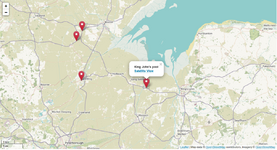
King John's pool.png
King John's 'Pool'. Anti-clockwise: Spalding, Former Bicker harbour, Former harbour navigation mark

Quoting from https://historicalragbag.com/2020/06/22/king-john-his-treasure-and-the-wash/:
the land opened in the middle of the water and caused whirlpools which sucked in every thing, as well as men and horses, so that no one escaped to tell the king of the misfortune.”

and
It is... possible that it was simply the incoming tide and the quagmire of the sands that took out King John’s train, but there has been discussion of an offshore earth quake

Elloi. Scene of earthquakes, floods and lost military equipment jewellery.

Military equipment?

Russian stolen history researchers suspect jewellery is a cargo cult remnant of electronics and radio-frequency devices. See https://178.62.117.238/tag/technology.html. Or for a quick introduction: https://178.62.117.238/links-to-pro-vladimirs-electrical-equipment-of-the-past-articles.html. Or for a really quick introduction, see this spoiler:
  • Gems are semiconductors.
  • Silver and gold are the most malleable and best conductors.
  • Copper and bronze are important at microwave frequencies.
  • Early bonze cannons make better waveguides than cannons.
  • The braid on sword hilts and high-ranking uniforms look like electrical conductors.
  • Churches, domes and cupolas look like magnetrons and radio-frequency resonators.
  • Furs and feathers are not used for their triboelectric properties today. But if you look at how Inertial Management Unit chips work, you'll find something similar to 'feathers').

And behind the following spoiler is what was claimed to among King John's lost 'jewellery':
  • one wand of gold with a cross, ”to wit a sceptre” ;
  • a red belt with precious stones which belonged to the ”regalia”
  • another belt of black skin, padded within (furratum) with red sendal, with precious stones, cut, set in a chase;
  • another belt of leather padded with red sendal with great stones set in a chase ;
  • another belt of red leather padded with white leather with great cut stones set in a chase;
  • another belt of black leather with roses and bars of gold without stones;
  • a necklace or collar (monile) set in the middle with diamonds surrounded by rubies and emeralds ;
  • nine great necklaces with many precious stones ;
  • a crown with precious stones with a cross and seven flowers ;
  • a royal tunic of red samite with embroideries with precious stones in orles ;
  • a pair of gloves with stones and another pair with flowers of gold ;
  • a white tunic of diaper banded with embroidery ;
  • a ” regale ” of red samite orled and marked all over with the cross in embroidery, with stones ” great, divers and precious,” with two brooches for attaching the said pall ;
  • a pair of sandals of samite with embroidery;
  • two pairs of samite shoes;
  • and eleven pairs of basins weighing 62 marks.

For a more thoroughly researched version of the King John story, try halfway down this page. It says its main source was this PDF. It also makes the excellent - if speculative - point that the King John of this legend may have been the slightly later John O'Gaunt. A very interesting entity, whose dad was rumoured to be a butcher from Ghent in Belgium.

So, apart from the 'jewellery = electronics' part - the above is what is conventional enough to be teachable. Now let's look at the unteachable - the two mythological aerial battles around Elloi.

A Supernatural Battle North of Elloi

One is the Byard's Leap battle recounted by Wikipedia and mentioned here, so no need to repeat it in this post. Its relevance is that this 'mythical' battle took place low in the sky over the same Lincolnshire that the last Civil War left in ruins. Variants of this story have the antagonist either as a people-eating witch or as a people-eating, wart-bearing monster. One version puts the event about 25 miles north-west of Elloi between Ancaster and Dunston (in the air above Knights Templar lands at Temple Bruer (Google Maps), (Google Streetview)); the other puts it about 25 miles north of Elloi. We'll just call both versions the same history myth and move on.

A Supernatural Battle South of Elloi

The second mythical battle takes place about 40 miles south of Elloi over an enigmatic village called Reach (Google Maps), (Google Streetview) in Cambridgeshire. It involves fire, water, storms, cold, and many fallen trees:
Long, long, ago, when the area around Reach was a forest, there lived a chief called Hrothgar. He lived at a time when gods and demons were thought to control the earth and one demon in particular was terrifying - the fire demon! To the horror of the chief, it appeared that the fire demon desired his beautiful daughter, Hayenna.
Hrothgar told his daughter not to worry, as his very good friend, the water god, was the sworn enemy of the fire god. He knew that the water god could communicate between the under and over world and would keep her safe.
One night Hrothgar had a dream. In his dream, an old man appeared and told him that the fire demon had a new ally in the tempest god. ‘You must prepare for a great battle’, the old man told him. The next day, Hrothgar told all the giants of the forest his plans. First, they cut down all the trees to make a wide clearing. During the next three days, they built a great ditch from the river to Mount Dithon (Wood Ditton), many feet deep and seven miles long.
The tempest god had watched their work with interest and scorn. Just as they were starting to tire from the hard work, he sent a great storm to blow down the trees on top of them. The storm also brought rain, hail and snow in great quantities. The giants of the forest rounded on Hrothgar, saying he should not have angered the gods and should not have crossed the powerful fire demon. ‘Do not be afraid,’ Hrothgar told them. ‘My good friend, the water god will protect us.’
At that very moment, the rain ceased. Suddenly, under a great cloud of smoke, a terrifying wall of fire rushed towards the ditch. All but Hrothgar fled. Despite his fear, he came out from shelter and, with his bare hands, dug away the remaining strip of earth, separating the River Cam from the ditch. The water poured into the ditch with a mighty, deafening roar! The fire demon was powerless against this mighty wall of water and the fire died down, the tempest stopped and his daughter was safe. Rejoicing, the local people placed treasured items in the new stream, to thank the water god for his help. The ditch, the Devil's Dyke is still there. The fire demon never troubled the population of Reach again.
I copied this summary from Ancient-Origins, who originally copied - and summarised it - from Christopher Marlowe's Legends of the Fenland People. The book is not commonly available so I hope Ancient-Origins will appreciate the plug and bear with me.

Physical Evidence on the Ground and Underground

The fallen trees are a big clue. Bog oaks were - and still are - a feature of Elloi.
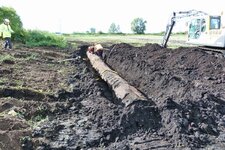
Oak-excavated-09-25-2012.jpg
Bog oak find, 2012
Bog oaks are usually huge, branchless, and some are reported to be partially charred. They are not always oak but locals call them 'bog oaks'.

Other than fallen, partially charred, tree trunks, and reports of multiple buildings on fire, do we have evidence of intense heat?

We do. And we also have an overt attempt to cover it up.

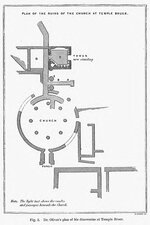
George Oliver's excavation of Temple Bruer in 1832-1833 provides two clues to intense heat. They are in the short excerpt at the end of this post above.

Those skeletons were no more calcined by ordinary fire than the bones of a Sunday roast are calcined by a household oven. Similarly, ordinary fire did not begin to glaze the crypt's limestone walls any more than ordinary fire vitrified the stones of Britain's northern hill forts. Even partial metamorphosis of limestone requires much higher temperatures than normal fires.

Evidence of Cover Up

We can also see evidence of the early phase of the cover-up. Oliver produced this plan of the partially excavated Temple Bruer:
Temple Bruer tunnel1.jpg
Temple Bruer, 1832-1833
Light grey shows underground rooms and explored tunnels. These are where evidence of intense heat was found. One of the passages was in agreement with rumours of a tunnel to Wellingore. An odd trace that supports that rumour is sometimes visible in a nearby field.

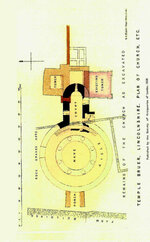
In 1902, William St John Hope re-excavated Temple Bruer and claimed Oliver had imagined things. There were no skeletons and not much crypt, Hope said. Just this:
Templer Bruer tunnel2 rotated.jpg
Temple Bruer, 1902
Just a small crypt. No skeletons, no other underground rooms, no tunnel heading north-west towards Wellingore village.

Note: I had to flip one plan 90 degrees to match the other. As a result, north is left, east is up in both plans.

Just for some brain-relief, here's today's version of how Temple Bruer looked. You'll notice there's no reference to underground rooms:
Download Video

Temple Bruer fly-through by Lincolnshire Heritage. Source

You have to make your own call. My call on Oliver is that he was dilligent about citations and details, eventually realised evidence was disappearing and did what he could to preserve it.

My call on Hope is that, as part of a career apparently spent pleasing wealthy patrons, Hope produced a paper explaining some odd medieval finds. Describing shallow wooden bowls laced with gold or silver that were often fitted with an inexplicable metal disk at the bottom of the bowl, Hope wrote:

They are simple drinking vessels... called mazers.

Perhaps the fourteen pairs of 'basins' in King John's lost treasure were also called mazers.

Long before Hope came along to clean up Oliver's findings, Oliver fell out with his sponsors - the Tennyson family. But the cleaners weren't in a rush. Most of the hoi polloi could barely read in 1831, when the fall-out occurred. They were unlikely to find - let alone read - Oliver's description of Temple Bruer being burned.

From History of the Holy Trinity Guild at Sleaford, Chapter 2, note 38, page 92:
When, therefore, this Alypius had set himself to the vigorous execution of his charge (usselo note: 'his charge' means 'his task', which was to replicate the Temple of Jerusalem in Britain. Ie, to build the Knights Templar temple at Temple Bruer), in which he had all the assistance that the governor of the provinces could afford him, horrible balls of fire breaking out near the foundations, with frequent and reiterated attacks, rendered the place, from time to time inaccessible to the scorched and blasted workmen ; and the victorious element, continuing in this manner, obstinately and resolutely bent, as it were, to drive them to a distance, 5 they fled together for refuge to a neighbouring church ; some to deprecate the impending mischief ; others, as is natural in such cases, to catch at any help that presents itself ; and others again enveloped in the crowd were carried along with the body of flyers. There are those who say that the church refused them entrance ; and that when they came to the doors, which were wide open but a moment before, they found them on a sudden closed by a secret and invisible hand ; a hand accustomed to work these wonders for the terror and confusion of the impious, and for the security and comfort of godly men. This, however, is now invariably affirmed and believed by all, that as they strove to force their way in by violence, the Fire which burst from the foundations of the temple, met and stopped them, and one party burned and destroyed, and another it desperately maimed, leaving them a living monument of God's wrath against sinners. But the thing most wonderful and illustrious was a Light, which appeared in the heavens, of a Cross within a Circle.

A Cross within a Circle in the sky... following balls of fire appearing at Temple Bruer's foundations... Hmm...
Download Video

Source: Futurama, S01, Ep01

But that's ridiculous. The only people talking about that kind of force are the Electric Universe people. They say a plasma blast may have destroyed Troy.

I wonder... if you had a lot of soldiers with heat burns, UV burns, and perhaps even radiation burns, would you need a lot of blood and plasma to treat them? Would it help for them to bathe in uncontaminated blood products?

And what would you call such an illness?

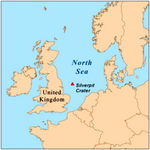
Actually, geologists have carefully considered the possibility of aerial events over this area. For example, in 2009 it was claimed an aerial event created the Silverpit crater in the bed of the North Sea just north of Lincolnshire's coast:
Silverpitlocatormapresized.png
Silverpit crater location. Source
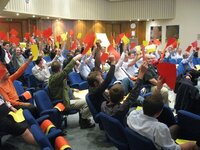
You should really look at the profile of the crater shown on that source page. In the 2009 photo below, members of the British Geological Society are shown voting on what created Silverpit:
Voteresized.JPG
British scientists do science. Source

They concluded Silverpit was created by salt moving under the sea bed.

Don't laugh. Earth scientists do encounter genuine difficulties explaining Lincolnshire's geology and geomorphism ('hills and valleys' to you and me) so voting is probably as effective as any other method. Including the Scientific Method.

For example, when describing the course of the River Witham, they use words like: "most unusual" (see page 1), "anomalous" (see page 97), and "abnormal" (see page 75).
Course of the River Witham.png
Not the shortest course. River Witham shown in blue (minus its Boston outfall). Source
Like several Lincolnshire rivers, the Witham has two startling abilities:
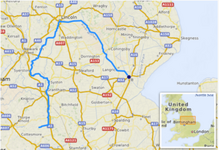
  1. It flows up valley sides, then
  2. Erodes gaps through them low enough to flow through like a normal river.
This second ability spares geography teachers from having to answer difficult questions.

Another oddity is the way the deep rock structures under Elloi and surrounding areas taper together to the north:
Eloi BGS bedroock.png
East Midlands bedrock structures. Source
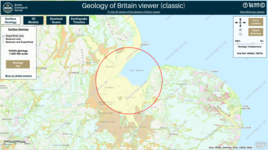
That's bedrock. Even weirder, to my mind, is the near-surface 'superficial' layout. Elloi sits on shallow alluvial deposits arranged in a near-perfect circle:
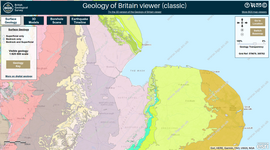
Eloi BGS superficial partial crater with circle.png
East Midlands superficial structures. Source
I added the red circle.

It looks as though an enormous force blast-excavated the subsoil from Elloi, leaving a shallow crater behind. Then Elloi's rivers and the North Sea flooded back in and backfilled the crater with alluvial deposits. Leaving Elloi with the expensive problem it still has today - being largely below sea-level.

Weirdly, the centre of the circle is about where giant John O'Gaunt King John is said to have lost his masers treasure.

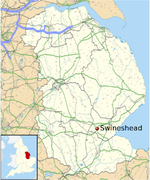
Side-note: This map has several other interesting features. A seemingly insignificant feature is that, at about 10:30 pm clockwise, the circle intersects higher ground near a village called Swineshead. There are other items of interest but Swineshead appears again in this post's next map.

Perhaps one of King John's men got boozed up, mishandled a mazer and took out Elloi. Perhaps some opposing civil war air force army took out King John's mazer battalion as they crossed the Wash.

Perhaps Elloi's superficial ground layers were scoured away by Silverpit's tidal waves. Perhaps the Silverpit creation event was one of several.

Personally, I suspect Silverpit has a separate explanation too terrible to talk about. One linked to a strange geological feature called the Immingham Channel. But regardless of what I think, when we consider the ruins, the water damage, the mudflood, the bog oaks, the scorching, the recovery and Stukeley, Byng and Oliver's write ups, we can justifiable ask: what are we actually looking at?

Could it be we are looking at evidence of a single vast war and its subsequent cover-up?

I've already shown - at least, I think I have - that there was a vast 'something'. Now I'll try to show there is the cover-up that goes beyond the state of Temple Bruer's remains. That the cover-up links the destruction of Elloi with the destruction of Russia and northern Europe.

The original draft of just this next part was even longer than this entire post. So what follows is a very short version.

Chronological Manipulation

We know some stratigraphers, chronologists and questioning historians say there is no evidence or logic to support the first millennium (AD 0 - AD 1000).

If they are correct, then it follows that the Roman invasion of England in AD 44 becomes the Roman invasion of England in AD 1044. Or, if you want, the Norman invasion of England in AD 1066 becomes the Norman invasion of England in AD 66.

Either way, if you remove the first millennium, the 'Romans invaded' narrative coincides with the 'Normans invaded' narrative.

Which might explain why some Normans arrived with Italianesque names that later became French names. For example, from Nocton Hall - A History - Metheringham Area News:

...one of William’s leading soldiers Norman de Adreci (D’Arcy) arrived to be allotted 33 parishes choosing Nocton as his base to enjoy over four decades here.

Adreci's Nocton base includes Dunston Pillar. It is about 30 miles upstream of the River Witham's current Boston outfall. Until a 1014 flood, the Witham entered the Wash via Elloi's large Bicker Haven sea harbour. Or so Wikipedia's authors allege. It lay to the west of Swineshead.

But Byng described being shown where one of the harbour's inner navigation marks had stood - before its owner sold it for timber:

Swineshead sea-mark map.png
High ground east of Bicker Haven. Source
So that marker - a yew tree - stood in place for 747 years. It stood through multiple wars, storms, fires, changed soil hydrology, changed climate, and mass tree falls until it was felled by market demand for timber to rebuild a ruined country. Remarkable.
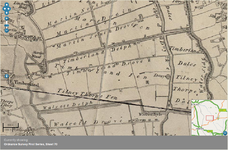
A canal also linked Nocton to Bicker's sea harbour via the Witham. It ran from the Witham to a wharf at Timberland, just south of Nocton, on top of the alleged 'Roman' 80 mile-long Car Dyke canal. The wharf was still marked on 1805 and 1815 maps.
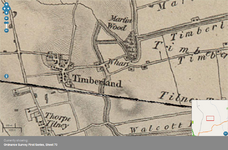
Timberland Wharf 1805 Ordnance Survey sheet 70.png
Timberland harbour. Ordnance Survey First Series, Sheet 70. Source

Timberland - Martin Wharf 1805.png
Same map, larger scale. Source

In 1808, canal engineer John Rennie (the Elder) reported Timberland Dike - the canal to the wharf - was navigable. Along with neighboring segments the Nocton Delph and the Branston Delph. This according to John Boyes and Ronald John Russell's The Canals of Eastern England, 1977, ISBN 978-0-7153-7415-3.

Which is odd because it would take a lot of effort to dig out navigable canals from the Witham to villages like Timberland - just to ship out ordinary agricultural produce from its nearby cluster of villages: Dunston, Nocton, Metheringham, Potterhanworth (also the site of a proposed pleasure gardens at the foot of a tower (Google Maps), (Google Streetview)).

Perhaps their produce fetched prices worth the investment.

There's a lot wrong with the whole 'Roman Car Dyke canal' story. Especially around Nocton. To save space, I've cut it. But its problematic nature could explain why Wikipedia's Car Dyke entry is so very cautiously worded.

And Car Dyke's name offers another clue, which we will come to.

'Romans equals Normans' theory also explains:
  • Why so much Norman architecture is called 'Romanesque'.
  • Why people can't distinguish between Roman and medieval structures and materials:

Download Video

You say 'Roman', I say 'Norman'. Source: Time Team: Piercebridge episode
  • Why 'Roman' Pompei was destroyed in 1631. Just ten years before tensions in England erupted into what we're taught was an English Civil War.
  • And why, in History of the Holy Trinity Guild at Sleaford, as I said in this post, Oliver describes the area's 18th Century elite as if they had followed immediately after the Norman baronial/manorial families that - conventionally - settled immediately after the Normans. It reads as if Oliver didn't have enough anecdotes to fill the gap between, say AD 1200 and AD 1650.
Coincident Timing with Events in Russia, Europe

In 1733, ten years before becoming Nocton's owner, Francis Dashwood visited 'newly-built' St Petersburg. He sailed via Copenhagen. From Sir Francis Dashwood's Diary of his Visit to St Petersburg in 1733 - Betty Kemp, Slavonic and East European Review, 38, page 197.

Date: 1733-05-30:
Ashore at Copenhagen... diminished by a third about 5 or 6 years ago, by a dreadfull fire, [1] that took in Severall parts of the town at once

And Kemp's footnote:
1. The great fire of October 1728, which destroyed a large part of the old town.

and later:

Near to this is the chamber, of rarities, where there are Severall rooms and a few good pictures, all going to ruin and some entirely Spoilt, except a Rubens, two Raphael, a Carlo Lotti, and one of Caraveggio, and two or three Landskip.

That last sentence could be inserted into Byng's 1791 description of Lincolnshire's ruins and you would have no idea it was about a different place, written by a different author. For examples, see Byng's descriptions of Grimsthorpe and Belvoir Castles in Torrington Diaries, pages 127 and 133.

A 1730 English Year Zero, a 1730 Danish year Zero and a 1730 St Petersburg Year Zero puts us at the Russia/Siberia reset suspected by Russian stolen history researchers based on their evidence of destruction by flood and fire. And their suspicions of thermonuclear/plasma warfare.

It's curious Dashwood and Byng were interested in paintings. Had an art market already blossomed? Or were some paintings potentially problematic if the hoi polloi saw them? In Russia, for example, some stolen history researchers no longer buy into the idea that lances and spears were the simple spearing weapons we are told they were.

Elloi shares with Russia 's several other easy-to-miss details in addition to mudflood, flat land, destroyed churches, absence of old forest, a nearby town called Peterborough and river names that visually resemble each other. Like Neva and Nene.

Neva and Nene? One of the oddities of Temple Bruer is that some of its older grafitti has the letter N reversed.

Another oddity is the 'Le Carre' family name and its variant 'Carr'. Found in Sleaford - near the north-pointing tip of Elloi - the names Le Carre and Carr also crop up in many links between Russia and England. From espionage thrillers to Lockhart Plots to political analysts specialising in early Soviet politics. To the timber business.
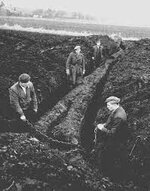
images-1.jpeg
Bog oaks: a good way to get a start in the timber industry.
Not to forget the name of the 'Roman' Car Dyke canal that linked the tip of Bicker near Sleaford to Nocton. Nor a now-forgotten 18th Century proposal to build a canal link between Sleaford and Lincoln. Part of Lincolnshire's missing documentation includes papers relating to the 18th Century draining of the 'mere' (lake) along the route of this canal.

We encounter other odd name-related coincidences. 19th Century scientists who helpfully explain the bog oaks for us have names like 'Edward Bogg'. Another, who help explain the alluvial deposits for us had the last name 'Dikes' ('Dike' means both 'ditch' and 'low, artificial ridge' in Elloi dialect. It often gets mistranslated as 'shaft' in Russian). We have engineers of the River Witham's embanking scheme called 'Joseph Banks'. And we have local historians called 'Prior' and 'Pryor'.

I realise I am skipping here. I'm trying to keep this post readable.

Another eerie similarity coincidence is between the Dashwoods and the Hobart family, who took over Nocton after the Dashwoods. The name is associated in England with Hobart's Funnies - experimental armoured warfare technologies - though I don't know for certain that he was of the same Hobart family. Nor if the Lincolnshire Hobarts are associated with Hobart the global manufacturer/distributor of meat processing equipment. What I do see is that at times, the 18th Century Hobarts show a remarkable resemblance to their Dashwood predecessors. From Nocton Hall - George Hobart:

On the 29th December 1767 the Hobarts gave a grand masquerade at Nocton Hall which may have been a house-warming to celebrate their advent. The guests were met at the door by a Turk in a white bearskin, who took their tickets. They were received by Mr Hobart as 'Pan' – his dress dark brown satin, made quite close to his shape, shag breeches, cloven feet, a round shock wig, a mask, a leopard skin over his back, and in his hand a shepherd’s pipe. Mrs Hobart was dressed in a muslin petticoat, puffed very small and spotted with spangles. Several dancers, including the hostess, had two costumes. Among the guests were Lord Exeter, Lord and Lady Vere Bertio, Lady Betty Chaplin, Sir Cecil and Lady Wray, the Huttons, the Sibthorps, the Custs, the Amcotts, the Neviles and all the great Lincolnshire families, all in fancy dress.

If you have read Dashwood's origins and interests, you'll be aware of even more resemblances than the obvious ones in the quote above.

So besides the Hobarts, it might be fair to say all the great Lincolnshire families show a remarkable resemblance to the Dashwoods. And that's hardly a surprise because if you research the Bertie family you find you are researching the Hobart family.

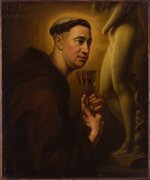
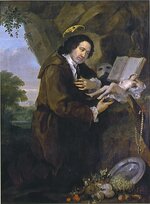
A love of fancy dress - especially religious-themed fancy dress - brings us to the Franciscans so feared by central America's indians. One of Francis Dashwood's quirks was to have himself painted as the Franciscans' patron: St Francis of Assisi - the patron saint of animals:
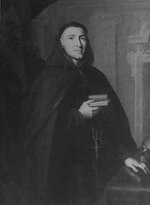
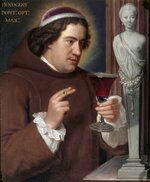
dashwood as clergy 11.jpgcarpentier-dashwood-as-pope-wycombe.jpg1-dashwood.jpghogarth-dashwood.jpg
Francis Dashwood fancy dress: as clergy, pope, Franciscan monk, St Francis of Assisi
Personally, I think these images may be faked. But regardless, western Internet commentary tends to miss the association between Dashwood's Franciscan robes and indian claims about the pishtaku's Franciscan robes.

Another miss could be the frequent claim that Dashwood relished being portrayed as a sacrilegious friar - or clergyman or pope - because he ogled naked women. I think he and his friends may have made up the whole 'monk', 'friar', 'abbot' part of the religion business. But whatever, the women are portrayed with a striking feature: their anemic bloodlessness. They may also be shown limbless or hand-less. In contrast, Dashwood holds a goblet that contains red wine or blood. The women may represent butchered human carcasses. In the last image above, the lifeless woman may not be laying on a floating bedsheet but on unwrapped 'butcher paper'.

Bloodletters helped monks and became modern barbers. In Britain, the bloodletter and barber's symbol is a red and white striped pole. In some countries it also has a blue stripe. They are the three colours chosen for many national flags.

Barber-pole-01.gif
The bloodletter's symbol and barber's pole. Source

It's sometimes argued that Stanley Kubrick'sThe Shining is an encrypted history lesson. The Shining contains this scene:
Download Video

Who is the caretaker? We are the caretaker. Source: The Shining, 1980

You see:
  • Red and white decor.
  • Jack cleans his dirty hands
  • Grady wears white gloves - his hands are clean and are not expected to become dirty
  • A casually-dressed working man who needs a haircut.
  • A neatly-dressed, balding man (with something of a friar's cut).
  • Each man's maturity - their attitude and behaviour - copies their appearance (and I trimmed even more obvious examples of this from the beginning and end of this clip).
You understand that the camera shot flips back and forth to show they are both the same man, right? The same man at different stages of his development.

And you understand there has been an unpleasant butchery interlude.

What does it all mean?

Hey, search me. What I think is that The Shining's caretaker theme and - arguably - its absent owners theme and the development theme also appear in Kubrick's 2001, A Space Odyssey. In 2001, Bowman is an astronaut-cum-caretaker who ends up in a room that blends 18th Century furniture with modern illumination. A bit how Oliver blends Roman Medieval times with the 18th Century in History of the Holy Trinity Guild at Sleaford. Except that in 2001, things are inverted: the lighting is in the floor and the 18th Century is blended with modernity.

In 2001, unseen entities whisper around Bowman. He is not dominant. He is apparently contained, seemingly watched, perhaps the focus of a whispered discussion.

From Jean Hardouin:
Jean Hardouin (1646-1729) was a scholar of classical literature. In 1685 he published an edition of Pliny's Natural History. There was nothing unusual about the edition itself, which was considered to be of merit and very well edited. What was unusual was that despite being so knowledgeable about classical literature, Hardouin had very strange ideas about its origins.

According to Hardouin, the majority of classical Greek and Roman literature had not been produced by Greek and Roman authors. Instead, it had been forged during the Middle Ages by a group of Benedictine monks. He also argued that all extant Greek and Roman coins were forgeries.

You don't need me to unpack this sentence:
despite being so knowledgeable about classical literature, Hardouin had very strange ideas about its origins.

The quote continues:
[Hardouin] never revealed why such a vast deception had occurred. He only declared, elliptically, that when he died the reason would be found written on a piece of paper the size of his hand. The reason, unfortunately, was never found.

Another memorable moment from The Shining is its final frame:
the-photograph-at-the-end-of-stanley-kubricks-the-shining-explained-by-screenwriter2.jpeg
Jack palms a piece of paper in his right hand. Source: The Shining, 1980
It's good to see Jack smartened up and was even invited to the party.
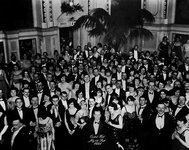
I just wonder who the other party-goers are.

Edit: cleaned up, and adds leprosy hint, fixes hyperlink

The .txt attachment below is a rough transcript of Chapter I from History of the Holy Trinity Guild at Sleaford. Rough but easier to search in than the PDF.
 

Attachments

  • Chapter I - Introduction.txt
    97.2 KB · Views: 227
  • Hope 1887 sim_archaeologia-tracts-relating-to-antiquity_1887_50.pdf
    12 MB · Views: 222
Last edited:
If they are correct, then it follows that the Roman invasion of England in AD 44 becomes the Roman invasion of England in AD 1044. Or, if you want, the Norman invasion of England in AD 1066 becomes the Norman invasion of England in AD 66.
It appears that in the year 1065 AUC (Ab Urbe Condita), which is year 312 AD (Anno Domini), 'Constantine I defeats usurper Maxentius at the Milvian Bridge, becoming the only Roman emperor in the West.' (Battle of the Milvian Bridge - Wikipedia). There are not many important battles on a bridge in history. Another important one is the Battle of Stamford Bridge in 1066 AD (Battle of Stamford Bridge - Wikipedia). Constantine connection with Britain is notorious. Is there a hidden meaning to this?

EDIT: Constantine allegedly the first christian Emperor is in some way similar to the tale about Arthur accepting the new faith. Both establish a new capital.
 
Last edited by a moderator:
It's the name of a village.
Yeah, I'm saying that in my opinion there is some sort of connection between these stories, even though I cannot swear it.

But I remember there was a battle on a bridge involved. The wiki says (Battle of Stamford Bridge - Wikipedia):
The English advance was then delayed by the need to pass through the choke-point presented by the bridge itself. The Anglo-Saxon Chronicle has it that a giant Norse axeman (possibly armed with a Dane Axe) blocked the narrow crossing and single-handedly held up the entire English army.
Here a representation, upon many, of the Milvian Bridge battle that, according to medieval lore, was a duel between Constantine and Maxentius.
7.jpg
No Norse axemen represented here, but it's nonetheless a famous duel on a bridge happening in 1065 AUC versus 1066 AD.

EDIT: no Norse involved unless Romans were Normans.
 
Last edited by a moderator:
Seems more akin to one author heard or read a tale and retold it. I remember a painting either on here or in the archive of version 1 wherein a similar giant axeman held up an opposing army, Sorry cannot recall the name of the painting or the name of the thread.
 
Yeah, I'm saying that in my opinion there is some sort of connection between these stories, even though I cannot swear it.

But I remember there was a battle on a bridge involved. The wiki says (Battle of Stamford Bridge - Wikipedia):

Here a representation, upon many, of the Milvian Bridge battle that, according to medieval lore, was a duel between Constantine and Maxentius.
No Norse axemen represented here, but it's nonetheless a famous duel on a bridge happening in 1065 AUC versus 1066 AD.

EDIT: no Norse involved unless Romans were Normans.
Paintings aren’t the only medium in which this is presented…


View: https://youtu.be/Kg2D1SrUw48
 
More excellent work - you can't help but wonder whether there are separate schools for connected people (HG Wells, Stanley Kubrick) where they are taught a different (more accurate) history.

I want to know more about Francis Dashwood (dash/destroy wood) - have I missed a write up on him?

Bog oaks in Timberland :)

I see what you mean re the red circle you use to mark the wash. In fact, it almost looks like a exit wound, where something was fired from a south-west point and was heading in a north-east direction. Maybe we're like ants living in our little corner, with bigger ants bosing us about sometimes - where creatures the size of people (stretching the metaphor of us as ants) - throw a stone or something, causing devastation to our ant colony :) On the same vein, it is also possible to view the map of the world we are presented with, that shows 'drifting continents', as a smashed plate.

In other news, I thought this wikipedia entry was interesting - from: Father of the chapel - Wikipedia :
Father of the chapel (FoC) or mother of the chapel (MoC) are the titles in the United Kingdom and Australasia referring to a shop steward representing members of a trade union in a printing office or in journalism. The FoC or MoC is assisted by the clerk of the chapel or by a deputy FoC/MoC.

In the printing trade, a chapel is the traditional name given to a meeting of compositors. The name originates in the early history of printing in Great Britain, though the National Union of Journalists states that the precise origins of the terms are unclear National Union of Journalists (NUJ): Chapels and branches .

The name also honours the origins of British trade unionism, where non-conformist churches often acted as covers for trade union activity, which was illegal at the time.
 
@usselo I'd also like to get a better understanding of the tunnel sizes. Do you know - are they giant sized, or human sized? I hope I haven't missed this info already.. sorry if you've already covered this. And I wonder what the internals are like for those houses that have large doors - they should be on a bigger scale too, which should be easy to verify. Do you know that?
 
Last edited:
It appears that in the year 1065 AUC (Ab Urbe Condita), which is year 312 AD (Anno Domini), 'Constantine I defeats usurper Maxentius at the Milvian Bridge, becoming the only Roman emperor in the West.' Is there a hidden meaning to this?

There is a hint of the same fenland bowl-creation event dated 38 years after the Milvian Bridge defeat date (Ie, 350 AD versus 312 AD). From: Britain's sinking land - exploring the Fens:
Even so, the North Sea had a nasty little jump between AD 350 and 550, flooding the coasts of northern Europe with an extra 2 feet of water and sending its inhabitants - folk known as Angles and Saxons - fleeing (although “conquering” might be the better word) into ill-prepared Roman territories.

At the start of this rise, the areas we know as the Fens were a well-settled part of Roman Britain ruled from the town of Duroliponte (Cambridge, UK) by its native people, the Christianized Romano-Celtic Iceni. Then the sea level rose, and history’s curtain went down for two centuries.

When the curtain came back up, Duroliponte and the Iceni had disappeared, and 300,000 acres of marshlands covered the northwestern flank of the pagan German kingdom of East Anglia. The modern Fens had come into existence.

For people using the "pre-1000 AD there were Romans" framework, it looks like these two events are linked. Obviously, British Heritage's article is problematic in a "dog that didn't bark" sort of way, but that's a separate problem.

Both establish a new capital.

When researching the Stamford canal/Deeping doors post, I encountered various oddities that left me wondering if The Deepings and South Holland (the former 'Elloi') districts had been a pre-London capital or perhaps its port. This based on the:
  1. Bigger implications of the River Welland's peculiar course, as described in that post. And the implications of these blog posts about ancient canals etc by various Russians bloggers.
  2. Nearby Stamford's Burghley House being given such importance (via the William and Robert Cecil entities) despite its distance from London.
In addition to the River Welland's problematic course, some of the fen drainage just outside the red circle in the British Geological Survey's 'superficial surface mineralogy' map above just begs for more investigation. Low hanging clues are the physical drainage structures themselves and the absence of financing and construction documentation.

Speculating using my model, which discards the '0 AD - 1000 AD' narrative and its Roman accoutrements:
  • A lot of what we are told was 'Roman water management' could actually be 18th Century improvement (1792-1793).
  • Some of that improvement could be small parts of pre-existing canal structures dug out after the 'event'. Or use of pre-existing technologies/skills that were still available but disappearing. That would account for the oddities of the River Welland.
Again, see the article: Britain's sinking land - exploring the Fens. The article is steganographically loaded. Put a mask - a Cardan grille - over it and some plaintext clues emerge. Explain masks/grilles to me. Once you've got the gist of using masks/grilles for encrypting/decrypting, try Orwell's Animal Farm as a mask.

The model I'm using doesn't have humans as living in 'countries' before 1540, nor before - possibly - 1730. Instead, it has humans - at least the English ones - living in small but very many manors and baronetcies controlled (Ie, farmed) by their not-human-as-we-know-it owners. See the map of just a sample of them in this post.

If - like me - you suspect humans were designed as IHASFEMR who got lucky when their owners were blown or blew themselves out of the picture... Or simply went on holiday... Or went to work quarrying another part of the domain... then there were no human-owned capital cities before that moment. So for me, the question of capitals being moved doesn't arise.

As for what our owners' urbanisation looked like. Well, we have access to some physical clues: their church, abbey and monastery ruins. They don't look like offices clustered around an administrative centre. The churches look to me more like a fast-food outlets laid out for a population that travelled a lot.

Speaking of which, is it time to talk about why one English slang word for casual food is 'grub'? Why St Christopher is the patron blood sen saint of travellers? Where the word 'Christ' comes from? Why Christ took three days to ferment rise?

feralimal said:
More excellent work

Thanks. That was at least 100 hours of research and writing over the last two weeks. I've gone back and tweaked it to bridge over some of the parts I dropped. And will do until edit expiry.

feralimal said:
I want to know more about Francis Dashwood (dash/destroy wood) - have I missed a write up on him?

The board has researched and discussed Dashwood at various times. I think he is a good example of a ponerology technique where an extended set of entities carrying out an extended range of activities are compressed into one person. RedIce also suspected this of Dashwood. That is: the creation of a highly publicised scapegoat or strawman held up and illuminated so the hoi polloi focus their attention on him rather than the others. The gang is turned into a lone gunman. Censorship and the memory hole then takes care of the rest of the cover up.

feralimal said:
it almost looks like a exit wound, where something was fired from a south-west point and was heading in a north-east direction. Maybe we're like ants living in our little corner, with bigger ants bosing us about sometimes - where creatures the size of people (stretching the metaphor of us as ants) - throw a stone or something, causing devastation to our ant colony

Yeah, it is a very interesting shape. There is another example of a proposed exit wound (followed by subsequent magma splatter over the near east). If you look at the quote above from Britain's sinking land - exploring the Fens... in my opinion, the write knows what happened (or was briefed by someone who does). They say nothing about the 'why?' of that sea level rise. Hence my comment about the dog that didn't bark.

Re ants... Appreciating that we are not the dominant creature in this domain was a key breakthrough for me last autumn. Knowing we are 'ants' - or more accurately 'IHASFEMR' - was my first step towards that breakthrough. I took that step when I accepted the evidence that this domain has been quarried on a vast scale.

Since I melded that with an acceptance of the evidence that we were created as a utility product, understanding of other aspects comes more and more easily.

feralimal said:
And I wonder what the internals are like for those houses that have large doors - they should be on a bigger scale too, which should be easy to verify. Do you know that?

In one case yes, in one case, no, and in the other case: kind of. I'm quite happy to knock on these tall doors, stare up at their giant owners and ask - in what must sound to them my squeaky little voice - if I could have a poke around. Two of them are care homes now and suspicious of potential Covid-carriers. But I have notes and images from two others to sort out. Will update this post in a day or two. However, in the case of this one in Market Deeping, taken from this post, I do have useful data.

the-laurels-care-home-deeping-png.png
Two-metre pole, three metre door. Market Deeping, UK (Google Maps), (Google Streetview)

Me and my measuring stick antics had amused a chap nearby. He told me he had been inside this building and that its internal doors are the same height as its external door. He said the upper floor was the same. It does indeed look to be the same based on window height (which you can see if you click on the Google Streetview link in the caption above).

He also said a building a few doors to the west still has high internal doors. And that normal houses along that street had once been bigger but had been partitioned with internal stone walls into smaller individual houses at some time in the undated past.

feralimal said:
I'd also like to get a better understanding of the tunnel sizes. Do you know - are they giant sized, or human sized? I hope I haven't missed this info already.. sorry if you've already covered this.

Glad you asked - it's a good question. I haven't covered it and it is a nuanced (Ie big) topic in itself even based on what I've seen and heard (from witnesses). Short answer is: they vary. Even within themselves.

Low tunnels
Lavenham: BBC Four - Pubs, Ponds and Power: The Story of the Village, Series 1, East, Lavenham's hidden tunnel

The most Erdstall-like tunnel in England (that I know of):
Fowlmere tunnel (N. Pennick) < J. Geomancy Note the seats (a feature of Erdstallen).

One of the items dropped from that post was Britain's General Post Office has small train tunnels under London. They've been discussed on one or other of the Stolen History forums before. BTW: Nocton Park also had narrow gauge railway running around the estate with a hub at the off-puttingly named hamlet of Wasps' Nest. Just for moving potato harvests around, you understand.

Normal (meaning 'our') height:
Home | Hellfire Caves/ see top of page video

Of the people I know who have been in tunnels or dealt with walled off tunnel entrances in basements (or seen doors to them), they usually say: "you could stand up in it".

Varied height:
Nottingham:


View: https://www.youtube.com/watch?v=Nu_Ef7g8yOE

https://www.youtube.com/watch?v=mjsZA3PAyZ4
Plenty of other videos for Nottingham: youtube caves of Nottingham - MetaGer

Gainsborough: same. Very varied.

St Clements caves in Hastings is very varied. Other caves in Hastings at the back of sea front shops.
The various urban tunnels discussed on this board, like the Williamson tunnels, the Sheffield tunnels, and the Camden tunnels are the same.

Weird stories:
Then you get "things that didn't happen" like a concrete mixing truck or other heavily-loaded construction truck falling into a massive cavern during construction of the Bluewater retail park at Thurrock, east of London. If I remember correctly, it fell in on a Friday morning. The site was closed and reopened the next Monday with a response like "What? Dunno what you're talking about. Sounds a bit far-fetched." in response to any questions.

Think about that story and consider its implications if true... Within three days, the right team were found and brought on site with the right equipment and supplies to fix that problem and ensure it didn't happen again.

BTW: I suspect Buxton, Derbyshire, has an untold vast tunnels story. Just by applying logic to its nature and the reasons given for the 12-year delay fixing up Buxton Crescent.

In a way, the ordinary Bluewater construction workers (and the Buxton Crescent workers, in my opinion) were doing what man was created to do. Belief and obedience were programmed into them, just like a desire to be eaten was programmed into your Hitch-Hiker's Guide to the Galaxy animal. They believe what they are told and they do what they are told.

We were made that way:

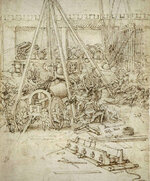
cannon-foundry.jpg
Da Vinci's Cannon Foundry. Source

Concerned at the rising cost of Health & Safety compliance? Invest in our latest hybrid slaves!
  • Dexterous and strong
  • Intelligent and gullible
  • Free **All parts usable** warranty:
    • Multiple-use waste products and secretions while alive
    • Multiple-use products after end-of-service
  • Self-reproducing plan available **requires purchase of breeding pair**
Our unique belief modifications make our AdamEve model our safest, most capable slave yet!

Lauded for tweaking our male model to believe risk-taking is a sign of manhood, we've gone not one, not two, but three tweaks further! We've programmed all our models to:

  • Detect, respect, and obey a range of uniforms - from simple neckties, to black and white patterns, to religious or military dress.
  • Believe authority figures over facts.
  • Believe death improves quality-of-life!
You won't believe it till you see it... So hurry, visit your nearest test site and request a demonstration now!

And don't forget... bring this advert to your nearest fast-food church and ask our staff for a free taster!
 
Last edited:
I managed to get to the British Library recently.

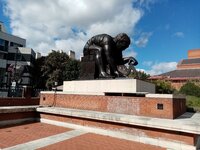
On the approach you see this statue:

IMG_20210927_121231.jpg

A not very cryptic Masonic statue (the figure is holding a compass)

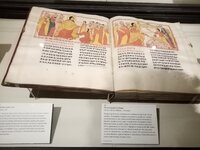
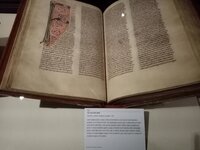
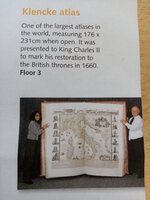
I visited their free exhibition, and you can see lots of old religious books. What is surprising is how big some of these are (but I'm not sure the photos convey that the books are pretty big):

IMG_20210927_131059.jpg
1632845022329.jpeg

I also happened to look at their leaflet with the map and spotted this:
IMG_20210927_160038.jpg

I dismiss the dates provided and the stories the British museum provides. But, just looking at the artifacts themselves, I find them in support of (one of) the ideas @usselo is setting out - that perhaps Giants were the controllers, the bible relates to them (whether they believe it or use it to influence).

If - like me - you suspect humans were designed as IHASFEMR who got lucky when their owners were blown or blew themselves out of the picture... Or simply went on holiday... Or went to work quarrying another part of the domain... then there were no human capitals before that moment. As for what our owners' urbanisation looked like. Well, we have access to some physical clues: their church, abbey and monastery ruins. The churches look to me more like a cluster of fast-food outlets laid out for a population that travelled a lot. They don't look like the offices of an administrative centre.

Whatever happened (if @usselo's thesis is good) I think we can perhaps use this as a platform to discern more about what's going on today. Perhaps even more books were left - perhaps even a literal owners manual. Perhaps some of those humans remaining were the equivalent of the house slaves, and gained access to that information. These people could have become a pretty well informed cargo cult - with everything already in place for them! With the owners in absentia, they stepped up to manage the herd.

I almost wrote 'quary' rather than 'herd' there.

Quary

a. A hunted animal; prey.
b. Hunted animals considered as a group; game.

It is interesting to me that quarry (mining) and quary (prey) intersect in this story.

The board has researched and discussed Dashwood at various times. I think he is a good example of a ponerology technique where an extended set of entities carrying out an extended range of activities are compressed into one person. RedIce also suspected this. Taht is: the creation of a highly publicised scapegoat or strawman held up and illuminated so the hoi polloi focus their attention on him rather than the others. Censorship and the memory hole then takes care of the rest of the cover up.

Right - I get it. I think I've bumped into this technique a few times. I think the Ancient philosophers may be the same, Mozart, Da Vinci, Elon Musk, Steve Jobs et al, the Queen, the president. I think of them as brands, that may be associated to a particular person, but where the message/information they delivered is unrelated to the actor(s) that may play them for a while.

Stepping back a sec, this whole thread has unlocked new possibilities to consider. The possibility that we were created as slaves makes sense - it seems that we can be trained into a very narrow view of the world, unable to consider alternative ideas even if they are logical and well reasoned. Christianity seems to be a supplemental work used to assist in managing the slave mentality - putting their morality on the inside - a policeman in each head - all the talk of serving, sacrifice, death worship. I understand that may upset some, but its hard to argue that a good Christian wouldn't also be a good slave, being 'good' in this life and getting rewards in the next. I suspect that other religions fill the same role in their regions, fwiw. Anyway, food for thought :)
 
Last edited:
I almost wrote 'quary' rather than 'herd' there.
Quary
a. A hunted animal; prey.
b. Hunted animals considered as a group; game.
It is interesting to me that quarry (mining) and quary (prey) intersect in this story.

Stepping back a sec, this whole thread has unlocked new possibilities to consider. The possibility that we were created as slaves makes sense - it seems that we can be trained into a very narrow view of the world, unable to consider alternative ideas even if they are logical and well reasoned. Christianity seems to be a supplemental work used to assist in managing the slave mentality - putting their morality on the inside - a policeman in each head - all the talk of serving, sacrifice, death worship. I understand that may upset some, but its hard to argue that a good Christian wouldn't also be a good slave, being 'good' in this life and getting rewards in the next. I suspect that other religions fill the same role in their regions, fwiw. Anyway, food for thought :)
Great stuff! Good 'quary' catch. I'm happy to lend you my measuring stick any time you want to lay it next to artifacts. :)

feralimal said:
Christianity seems to be a supplemental work used to assist in managing the slave mentality - putting their morality on the inside - a policeman in each head - all the talk of serving, sacrifice, death worship.

That's a good summary of what our 'impulse to religion' does. And by design. My sense is that it has been 'used' twice, once at human-creation time, and again some time after we were "freed".

I don't think older stone churches, abbeys, monasteries were built for the benefit of humans by humans as we understand 'humans'. I think it is likely they were built for the benefit of non-human entities as 'human processories-cum-fast-food outlets'. This would explain many, many things - including why there are no construction plans for churches until 1819 (if I recall correctly).

We seem to have been designed to accept the claim that churches, abbeys, etc, were portals to a better quality of life for us. See the 'Exaltation of the fabricant' video clip at the top of this post. Or the second video clip from the bottom of this post. Churches seem to have been used this way for some unknown time.

Then the churches and abbatoirs abbeys were ruined. During the 1642-1651 English Civil War?

And then they were rebuilt. The rebuild being in progress by 1791, having perhaps started 20 years or so before?

Modern Christianity seems to stem from that rebuild time (18th Century into the 19th Century).

The second set of church builders, re-builders, and managers - the Church Commissioners - seem to be human. Perhaps they originally rebuilt and ran the remaining churches as meat and materials processing units because there was a food emergency. My original proposition is this was caused by floods. This conjecture is what the American and European pishtaku experience seems to indicate. You can see how this situation might develop among surviving humans. If most humans were the original entities' farm animal/slaves, then any humans possessing more advanced knowledge - such as reading, writing Latin, and using church equipment, would be in a good position to take advantage of their more naive, more vulnerable human compatriots.

'Naive' in the sense that we didn't know any other function of churches and 'vulnerable' in that we did (and still do) retain our designed-in tendency to defer to authority, to uniforms, etc.

As an example of how suspiciously messed up the documentation of even recent churches is, take a look at the PDF attached to this post. It was originally by Chrisopher Webster, of the UK's Georgian Group, who was trying to work through some of the problems of 19th Century fenland churches. Scroll through the attached version looking for my yellow highlights - they get better as you go further. Despite being early 19th Century churches, their history is a mess on date and location grounds alone.

Original is at https://georgiangroup.org.uk/wp-content/uploads/2020/10/GGJ_2017_15_Webster.pdf. I'm not knocking Webster's work. It's good work. It's just not using the appropriate model.

There are a few other, not-highlighted hints in that work. I think you can also begin to pick out other parts of what went on if you use my model of recovery from ruin by parties who initially used churches to continue their function as butcheries and materials processing workshops. For example, talking on page nine of that Georgian Group PDF about the 'questionable' locations of the new chapels:
Carrington is similarly isolated, but stands opposite Carrington house, appearing almost as an estate chapel

A private slaughterhouse then? Built for another mysterious 'Carr' family, as mentioned above :).

Several of the chapels are sited at a crossroads rather than near a community. It reminded me of Rev George Oliver's comments about the locations of 'market crosses'. Which led me to pose two questions to myself: choral == corral? Chorus == Horus? As in: Horus, god of the sky and of "Time". As in "Your time has come". If that seems nonsense, it helps if you've watched the two video clips above.

We get confirmation of the date of the start of a moment of freedom, followed by its end with the imposition of new restrictions and burdens from the history of tolls on the River Welland:
The principle of there being no tolls for use of the river was established by the 1664 act of parliament. This was reversed by the 1794 act, which imposed high tolls

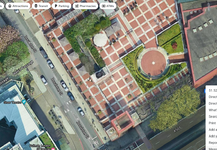
I wondered if the British Library statue was measuring a masonic chequerboard so I went to Google maps. I'm not sure I could identify the statue but I certainly identified the chequerboard:

British Library screenshot.png
British Library, Euston Road, London
If I recall correctly, there was a discussion about the building the British Library replaced. I have a faint memory that it had extensive underground vaults. Could be wrong, haven't searched.

It's interesting to see that the British Museum opened in 1753, 20 years after Year Zero; 100 years before London's Great Exhibition. A suspicious mind might wonder if its fee-paying, personally-guided visitors were triaging the usable from the unusable, the safe from the unsafe ('unsafe' in public hands, that is) and working out which technologies could be - and should be - brought on-line.
  • Libraries... liberated information.
  • Museums... curated collections of artifacts (fake and genuine).
  • Great Exhibitions... curated collections of technologies.
Dashwood, Byng and his boss Colonel Bertie were noting building remains (location, condition) and their contents. Dashwood and Byng were very focused on paintings and Colonel Bertie on church 'brasses':

stamford-brownes-hospital-seal-fig216-jpg.jpg
Brass-rubbing: a method for recording and sharing 'difficult' data? Source

And, as we see in the Dashwood quote above, in 1733 Dashwood was recording locations of paintings in burned out Copenhagen. It seems they used carefully selected remnants from the past to bootstrap current society's culture - and its technologies.

I've already speculated that they wanted to hide some paintings from the hoi polloi. Technologies too. Such as non-paper data storage:

Media of the Past - part 1
Media of the Past - part 2
Media of the Past - part 3
Media of the Past - part 4
Media of the Past - part 5
What do bronzes and DVDs have in common?

Perhaps some clues leaked into public collections like the British Library's despite the faking and curating. Books for giants.

Perhaps some clues leak out in other ways:
Download Video

"Things no-one here understands". Source: The Time Machine, 1960

From the post above:
But the thing most wonderful and illustrious was a Light, which appeared in the heavens, of a Cross within a Circle.

I am not saying: "It was God!". I am saying:
  1. If you have the correct key, you can start to read the plaintext, the underlying reality being described.
  2. If you don't have the key and you don't recognise that anything you're looking at is encrypted, then you move along none the wiser.
  3. If you don't have the key but do have the beginnings of a model of the things that were hidden, and of the encryption methods used to hide them, then you can read off some of the plaintext relatively easily.
Expanding on item 3:
And then, when you find more of the plaintext makes sense, you can figure out more about the encryption methods used. And from there you can read off yet more plaintext.

And then, you're dancing. TS Eliot's Four Quartets and Stanley Kubrick come within reach. The Shining's toilet scene in the post above starts to feel blatant. As though Kubrick was becoming desperate. Maybe that's why he later took such a risk with Eyes Wide Shut.

From A Short Analysis of T. S. Eliot’s ‘Little Gidding’:
a puzzlingly abstract poem

Little Gidding’ is slightly different: it was the name of a small religious community formed in Huntingdonshire (now part of Cambridgeshire) shortly before the English Civil War of the 1640s. Like the other three poems in Four Quartets, ‘Little Gidding’ loosely uses one of the four classical elements to suggest its imagery: here, fire with all of its suggestions of destruction, purgation, and renewal.

King Charles I, who fled to Little Gidding in May 1646 (note that Eliot has just mentioned May specifically), following his defeat at the Battle of Naseby the year before,

The ostensible subject is the destruction of English houses and other buildings (including the churches, those ‘marred foundations’ of ‘sanctuary and choir’) during the aerial bombing raids by the Germans during the Second World War.

the three previous poems in Four Quartets had taken, respectively, air, earth, and water as their ‘subjects’, with ‘Little Gidding’ taking fire,

water and fire are conjoined in one single stanza

the dove with its ‘flame of incandescent terror’ is both the Holy Spirit and the German planes terrorising London with bombing raids.

Copies of TS Eliot's Little Gidding:
- T. S. Eliot's "Little Gidding"
- PDF version

I'd like to get hold of a copy of 'Little Gidding in 1796' if anyone has a copy. I'm not up for the registration required of hoi polloi.

In the The Time Machine clip above, Yvette Mimieux says:
Things no-one here understands.

Immediately afterwards Rod Taylor adds some quick body language.
  • What does he do?
  • Who is he communicating with?
  • What is he saying?
That clip is from a two minute, 30 second-long scene set in what seems to be an old ecclesiastical building. The vault is lined with 'art' and technology. The entire scene is very, very interesting in the light of what Russian bloggers have speculated. I'd post a clip of it but the file is 24Mb.
 

Attachments

  • annotated_GGJ_2017_15_Webster.pdf.pdf
    2 MB · Views: 260
Last edited:
These types of theatrical sets - like the one in the 1960's time machine - are interesting to me. I wonder if there is a group who have a continuous thread through the time on this planet. (I'm thinking of 'they' as 'sysadmins'.)

Perhaps the sysadmins keep working museums of tech from past civilisations - they keep the tech usable and are able to re-produce it when required. This group takes the long view, and with each human civilisation that starts, they try to steer it in a particular direction using this tech. Perhaps previous iterations have given them genetic tech, energy tech etc - I'm not quite clear what they will get this time - but perhaps they are also trying to perfect the cage - that would be their crowning achievement. A perfect cage would be one where the sysadmins have very fine grained control over people, and yet the masses themselves are unaware of the cage at all. As most of us were for most of our lives. 'They' could live like gods, and likely they would get us to worship them and their system.

I even think this iteration of 'civilisation' may be pretty close to achieving that - a lot of people are a bit suspicious, but most are unaware of the technocratic system we are stepping into. I can't see us 'waking up' before the trap is sprung - they will simply acclimatise to 'owning nothing and being happy'.

Anyway, along a strand of that thought, one can also imagine that giants could be a genetic tech that was created in order to do some of the heavy lifting that was required at times. I had been thinking of giants as the administrators of this place, but then we find their houses are side-by-side normal sized houses. Perhaps it makes more sense to think that they were at the same level as us..

Always interested to hear more thoughts on this. Or on the general idea of what humans were for. The idea that we are farmed, and that the farmers aren't acting with malice towards but just have a practical approach - albeit one we don't yet understand - is what I most interested in though. I'm definitely feeling like cattle that knows something bad is coming and wants to hang out as far away from the farmer as possible - I'm looking to escape up the motorway and make the news! But, can I glean more info from inside the paddock?

Sorry - this isn't research, more an imaginative exercise.
 
Adding a third supernatural event in the skies above Elloi to the two in the Elloi post, this time above Croyland (now Crowland). From: A History of Lincolnshire by William Marrat, page 6:
In 1467 a great flood overflowed the district of Holland; and among the many prognostics of calamity, such as showers of blood, &c. there appeared in the air armies, both foot and horse, conducted by St. George with his red cross.

1467 was also a time of civil war in England - the (alleged) War of the Roses. I suspect the various English civil wars - and possibly the 1381 and 1536 peasants' rebellions - were all events from the same 1642-1651 civil war pushed back into time to create a pre-War chronology for us to believe in.

Being cynical like that, these accounts of strange lights in the sky, fireballs, and destruction remind me of a mysterious illness described to the Royal Society's Joseph Warner in 1770 by John Latham. Latham was a surgeon and midwife from Kent. Latham also enclosed a 'glove' of skin from his patient's hand, and a deformed foetus. Copy of the letter attached to this post.

In the letter, Latham describes a miller - Mr A. B. - who vomits, aches, has shortness of breath, feels very thirsty, and loses large areas of skin after milling flour. This is how Latham acquired the glove of skin. Vomiting, thirst, aching and loss of large areas of skin are not symptoms of allergy diseases like hay fever or asthma. To find something similar, you might want to look up the symptoms of radiation sickness.

More reports of flood-damaged churches. Again from John Byng's Torrington Diaries, p138-139, here describing Thurgarton church:
The inside is dark and damp, as the Church Yard Ground has risen considerably.

Note Wiki page comment about Thurgarton church:
It was restored in 1853. Parish registers exist from 1721, whereas earlier records were lost in 1780.

Funny that. Also from that page is this odd find:
At [nearby] Magsdale, in about 1810, many human bones and spear heads were dug up.

Note the bones are not described as fossilised nor found embedded in rock. So presumably these were relatively recent bones and relatively recent spear heads? I've had an idea for a while that flint spearheads are not quite what we are told they were. So finding out more about these spearheads is probably my next bit of research.

And from On Some British Kistvaens (Stone Coffins) Under the Present Churchyard of Pytchley, Northamptonshire, by the Rev. Abner W. Brown, Vicar of Pytchley, The Archaeological Journal, June 1846, another reference to green, moss-like mould growing inside churches:
Like many other country churches it had a coating of green mould or moss for five or six feet up the walls inside, and in winter and rainy weather the water soaked in from the outside and stood in pools in the remote corners of the church floor.

Possibly this constant wet may have assisted to preserve the ancient bones from entire decay. The enormous accumulations of soil outside of the walls have now been removed down to the level of the floor: and a drain (in some places nine feet deep) has been carried across the churchyard, and has effectually dried the church.

Unlike the various church ruins Byng found in the low-lying fens, Pytchley is 95 meters (311.68 feet) about sea level. Contrast with Bardney, Lincolnshire (where Byng found plenty of mud-covered ecclesiastical rubble), which is at 17 meters (55.77 feet). Think about it: that destruction wasn't caused by a high spring tide in the North Sea.

Depopulation reduced former towns to villages and hamlets. Byng describes Bolinbroke, Lincolnshire (birthplace of the Henry IV entity) reduced from a market town to a village. I mentioned Pickworth in this post as a place so littered with bones that by the early 19th Century it was economic for John Clare dig them out and burn them for lime (kiln site (Google Maps), (Google Streetview)). Let's just take another look at Pickworth:

image001.jpeg
Pre-devastation, Pickworth was two miles long. Source
in 1491 it was said to have no parishioners, and in 1598 "there is no house there nor church". By the C18th, only the church steeple remained (called Mockbeggar) and this was taken down in 1728-31. The village was revived in the C19th.
Source: Page W (ed), 1935, The Victoria History of the County of Rutland Volume 2, p265, p267 (Bibliographic reference). SLE913.

Across these posts, we get the impression of water and soil flung across a countryside in enormous quantities and likely at high speed (judging from distance travelled, and the fallen walls). The Pytchley report and the 'Roman' remains lying 2-3m (6-9ft) underground at the top of the 65m (200ft) high hill at Lincoln suggest that the force that moved this mud was not particularly bothered by height.

I think it is reasonable to wonder if all these findings were caused by the same event that created the circular geological oddity in this post:
loi-bgs-superficial-partial-crater-with-circle-png.png
Was the Norfolk chalk (along the circle south-east of the Wash) originally south of the Lincolnshire Wolds chalk north of the wash? Before being shifted eastwards?

It might also explain the tendency to earthquakes reported in non-seismic, medieval Lincolnshire. And around the non-seismic English Channel near Dover, but that's another post of its own.

@usselo I'd also like to get a better understanding of the tunnel sizes. Do you know - are they giant sized, or human sized? I hope I haven't missed this info already.. sorry if you've already covered this. And I wonder what the internals are like for those houses that have large doors - they should be on a bigger scale too, which should be easy to verify. Do you know that?
With your question in mind, I checked out the interior of Market Deeping's White Horse pub - whose door height-reducing in-fill was pictured in this post. The ground floor ceilings are about the height of the base of the grey triangle above the infill. So about 3m (call it 10ft) high. An interior porch has been installed behind the doorway, so I couldn't see what had gone on behind the in-fill. Other than that the doorway has been lowered to suit our height. I'd say the history is clear: this place was built for seven-footers and quite possibly for nine-footers.

More tunnel info has come my way since you asked that question. One was a guy who worked at The George - Stamford's poshest hotel-restaurant. He told me that, on their first day of work, the new starters were being shown where everything was kept. In the cellars they were shown a stairway down to a lower cellar, in the walls of which were five or six doors. They were told these doors sealed off old tunnels that led to local churches and "out into the countryside". And that one went to Grimsthorpe Castle (a large mansion) perhaps 15-20 miles away.

He said the doorways looked normal human height. He also said they were told there was a secret about them that couldn't be be talked about.

A couple of days ago, I was casually inspecting this entrance to the crypt beneath St George's Church, Stamford, Lincolnshire.
St Georges Stamford new crypt entrance barrier.png
Wooden safety barrier for stairwell down to crypt beneath St George's church

St George's Crypt entrance.png
Crypt entrance-height is normal, top is several feet below ground level

This crypt is now home for St George's heating system (an oil tank and heater).

Sitting nearby was an elderly chap with whom I got talking about Stamford having no tunnels. :)

He said when he and his wife first moved to Stamford decades ago they looked at the former rectory for Stamford's All Saints Church. This is a big church in the centre of town. Its former rectory is across the road (Barn Hill) from the church. The seller took them on a tour of the house.
"In its cellar there was a tunnel to the church," he said, "So the vicar could pop in and out."

Naturally, I asked how tall the door was. He said: normal human height, as best he could remember.

Fantastic! Two first-hand eye-witness accounts of six or seven sealed-off entraces to tunnels in Stamford. Of course, offiicially, Stamford has no tunnels:
I think the background to your question was about whether giants built or used the tunnels that don't exist. My guess is the tunnels served somewhat like servants' quarters in old houses: they weren't decorated, furnished or designed around the aesthetics of the house owners but around the needs of their users. Humans, in this case.

Most of the evidence I have found for giants in east England puts them at about 7ft tall with some evidence of giants 9ft tall. So, what would being 9ft tall and using normal human height infrastructure look like? We can get an idea from this video of Robert Wadlow, a 9ft tall US giant who died in 1944:
Download Video

Nine-feet tall US giant Robert Wadlow. Source

Brothers of the Serpent podcast had a good interview with Kyle Delisle about Iroquois legends of giants. Two short audio clips from that show:
Cannibal giants from the northern US. Humans helped by stones from the sky. Source

Variations among giants and giants eating babies. Source

A couple of miles north-east of Stamford is the village of Uffington, whose St Michael's and All Saints church (Google Maps), (Google Streetview) contains this beauty:
Uffington church giants grave side-on 2.png
Two meter (6ft, 6in) pole, 20cm (8inch) segments.
The grave has a headstone on the left and a small footstone on the right, surrounded by railings.

Uffington church giants grave end-on.png
1.5m (4ft, 9inches) wide

How do we know the footstone is not another headstone, perhaps for a child? Because there is a protocol for footstones. They are (were) used only when there is a risk of the foot of the grave accidentally being re-dug. They also have their own inscription rules: initials of the grave's occupant and their birth and death dates. Like this:

Uffington church giants grave footstone.png
Footstone: b. 1788, d 1845
Uffington church has two crypts, one of them 'Catholic', the other 'everything else'. 'Everything else' includes being subdivided so that the externally accessible crypt is now used as a heating crypt, just as at St George's church:

Uffington church crypt entrance 1.png
External entrance to Uffington Church crypt

Uffington chruch crypt entrance 2.png
External entrance to Uffington Church crypt

Uffington Church crypt entrance 3.png
Standard height door at the bottom. Head of door is several feet below ground level

Both of the crypts contain coffins, I was told. No-one has been into them for 70 years or more and both are sealed.

About 12-14 miles from Stamford is the village of Rippingale, where the churchyard (Google Maps), (Google Streetview) has the unmarked grave of 16-year old Anne Hardy. At 7ft 2 inches, she was allegedly the tallest woman in England when she died in 1815.

As various posts in this thread evidence, there seem to have been giants in England until very recently. I don't think they were good or bad. Their relationship to us might have been like the relationship between the shire horses and the other animals in George Orwell's Animal Farm.

Perhaps their behaviour varied like our behaviour varies - depending on personality, personal circumstances and their job.

Nearby Rutland Water is home to the iconic Normanton church, protected in place before the valley was flooded as part of becoming the main reservoir for the East Midlands.

35593776374_3aec25240e_o.jpg
Normanton Church, Rutland Water. Source

Its then vicar - Reverend Brian Nicholls - was interviewed about what he found in Normanton's crypt before the valley was flooded. After all, you wouldn't want a bunch of rotting bodies sitting at the bottom of your brand new reservoir:
Leaking lead-lined coffins in Normanton church crypt. Source

Especially if they were so radioactive they were interred in lead-lined coffins.
 

Attachments

  • Joseph Warner account of possible radiation sickness and foetal deformity - 105910.pdf
    311.6 KB · Views: 223
Last edited:
Being cynical like that, these accounts of strange lights in the sky, fireballs, and destruction remind me of a mysterious illness described in 1770 to the Royal Society by John Latham, a Kent surgeon and midwife from Kent. He describes a miller - Mr A. B. - who vomits, aches, feels very thirsty, and loses skin after milling flour. Latham enclosed a 'glove' of the skin from the miller's hand and a deformed foetus. Attached to this post.
If there was something to be exposed to, it does make sense that a miller would be impacted. Say there was a widespread 'poison' spread on fields, while the labourers in the field might tolerate it, the miller would get a lot of exposure (the crops from all the local fields) - a dose that he would inevitably inhale when the local flour is ground. It seems to me that he could be a 'canary in a coalmine' in certain circumstances.
 
Cheers for your thoughts on tunnels too, btw. This bit jumped out at me:

And that one went to Grimsthorpe Castle (a large mansion) perhaps 15-20 miles away.

He said the doorways looked normal human height. He also said they were told there was a secret about them that couldn't be be talked about.

My goodness, tunnels were like roads to these people! "I'll just dig out a 15-20 mile tunnel, so I can get to my favourite restaurant without getting wet."

Of course, even a small tunnel is a huge undertaking, and then what would be the point of a secret tunnel if everyone knew about it? There has to be a hidden reason to complete what is a huge undertaking, that is dug out by hand and only worked on by trusted insiders and without the knowledge of the locals!

And what is the secret the old man mentions, I wonder? I wonder if he knew, or just that there was a secret being kept?

Also you said:
This crypt is now home for St George's heating system (an oil tank and heater).

..which makes me think that those churches would have been quite cold places, and in particular the underground crypts would have a stable cool temperature, which (if they aren't damp) would be ideal for storage, like a wine cellar or something..
 
My goodness, tunnels were like roads to these people! "I'll just dig out a 15-20 mile tunnel, so I can get to my favourite restaurant without getting wet."
George Hotel Stamford - Grimsthorpe Castle distance.png
George Hotel, Stamford to Grimsthorpe Castle. Source: Google Maps
Similarly, from Friaries: Boston | British History Online:
They had royal licence to construct a subterranean aqueduct from Bolingbroke to their house for the use of themselves and others in 1327
Bolinbroke Castle, Bolingbroke - Grey Friars Boston distance.png
Bolinbroke to Grey Friars' site, Boston. Source: Google Maps

And in the next sentence we learn - if we trust the records - they actually built it and the participants were rewarded:
and in 1330 Bishop Burghersh granted an indulgence to those who helped in this work.

Somewhere in my collection of notes about the draining of the fens is a mention of a canal being cut under an existing river or canal. References like that stand out because a common 'seed of disbelief' sown by orthodox history writers about some tunnel legends is:
But such a tunnel would have had to pass under a river!

Of course, even a small tunnel is a huge undertaking,
They are huge undertakings for us.

My flashy new signature should explain but I'm not sure if it has 'taken' yet, so fromTorrington Diaries, John Byng, page 343:
I viewed the ruins of the old bishop's palace [at Lincoln] (Google Maps), (Google Streetview) and if a sight of caverns, sutteranes (Ie, tunnels), door ways and ruins, is wish'd for, here is enough to serve an antiquary for a week... the gardener remark'd 'that these were fine places before they were inherited''.
My italics. The first half of Animal Farm explains what the gardener meant.

Also from Torrington Diaries, page 341:
I found myself upon a fine gravelly road, which brought me to Asgarby village (Google Maps), (Google Streetview), near the road to Boston. Within view at a short distance, are several churches: my wonder was when or how all the churches of this kingdom were built! What all at the same time? and what has preserv'd them?

Who would or could build them now?
Those two quotes are like hardened drill-bits. But can they drill a hole through the fog of lies within a modern human skull?

and then what would be the point of a secret tunnel if everyone knew about it? There has to be a hidden reason to complete what is a huge undertaking, that is dug out by hand and only worked on by trusted insiders and without the knowledge of the locals!
I'm not sure they were dug by human hand.
And what is the secret the old man mentions, I wonder? I wonder if he knew, or just that there was a secret being kept?
I feel this thread has begun to answer those two questions. :)
..which makes me think that those churches would have been quite cold places, and in particular the underground crypts would have a stable cool temperature, which (if they aren't damp) would be ideal for storage, like a wine cellar or something..
Time Team's "Britain's Drowned World" episode on the sinking of Dogger has an interview in London's Trafalgar Square with a climate scientist. He says the climate turned much colder about 250 years ago. Similarly, the Michael Portillo Great Railway Journeys episode on Romney Marsh mentions the climate turning much colder 200-300 years ago. He intereviews a Romney farmer who says England developed its hardy, semi long-wool sheep breed to meet the demand for cold-weather clothing.

Even hardier long-wool sheep were bred on Lincoln Heath, Lincolnshire. The same Lincoln Heath previously discussed in this thread for its association with the Francis Dashwood entity, his Dunston Pillar, and its pleasure gardens. Francis Dashwood was also MP for... New Romney. A town created after Old Romney's coastline changed.

Romney:
Was:
Kent Cinque Ports - browser view - smaller scale.png
Romney Bay before climate change. Source: long forgotten
Is:
England South East Coast 2021.png
Romney today. Source: Google Maps

Francis Dashwood got everywhere there was climate and coastline change! So much to celebrate I guess.

We already know he and his successors held great parties. From Poem - Blankney Masquerade - Metheringham Area News:
In her book, Henry Chaplin a Memoir, his daughter The Marchioness of Londonderry writes, 'an old yellow sheet of paper has been preserved on which in faded ink is written , A List of the Company as they danced at the Masquerade at Blankney, the 9th January 1749'. Shortly before the masquerade Diana Chaplin had been married and it is thought the event may of been held in her honour. Her father Thomas Chaplin had died in 1747 and it was presumed his unmarried son John Chaplin, Diana's brother, hosted the occasion. Today's poem was written based on details from that faded piece of paper and accompanying notes.

Blankney Masquerade

It was January 1749
The event, a masquerade ball
The occasion, to mark a society wedding
The place was Blankney Hall
Diana, daughter of the late Thomas Chaplin
Had allowed her heart to be won
By Lord George Sutton Manners
The Duke of Rutland's son
To mark this great occasion
A match in heaven made
Excited servants prepared the Hall
For the Blankney masquerade
John Chaplin, brother of the bride
Acting as mine host
Was in the guise of King Henry V111
As he rose to propose the toast
The groom appeared as a Spaniard
As a Jardiniere the bride did revel
And Sir Francis Dashwood, Chancellor of the Exchequer
Was there dressed up as the Devil
Among other guests that danced that night
In their costumes so bizarre
A Priest, a Russian, a Chimney Sweeper
A Vandyke, a Turk and Huzsar
Miss Mannering wore a black gown with stars
Representing night
Dominos, Dancers and Queen of the Scots
Helped to make such a dazzling sight
Oh to have been there, that January night
As a fly upon the wall
And witnessed the rich and colourful sight
Of the Blankney masquerade ball.

Rodney Garlant

Which didn't differ much from the ball held by next-door neighbours George and Albinia Hobart 13 years later. From Nocton Hall - George Hobart:
On the 29th December 1767 the Hobarts gave a grand masquerade at Nocton Hall which may have been a house-warming to celebrate their advent. The guests were met at the door by a Turk in a white bearskin, who took their tickets. They were received by Mr Hobart as 'Pan' – his dress dark brown satin, made quite close to his shape, shag breeches, cloven feet, a round shock wig, a mask, a leopard skin over his back, and in his hand a shepherd’s pipe. Mrs Hobart was dressed in a muslin petticoat, puffed very small and spotted with spangles. Several dancers, including the hostess, had two costumes. Among the guests were Lord Exeter, Lord and Lady Vere Bertio, Lady Betty Chaplin, Sir Cecil and Lady Wray, the Huttons, the Sibthorps, the Custs, the Amcotts, the Neviles and all the great Lincolnshire families, all in fancy dress.

I already included that quote in this post above but we learn a little more about this particular ball from: Nocton Hall - Revelations of an Imp - Chapter 9:
Upstairs, the pomp and ceremony of the early introductions over, the gentle thaw set in to break the shyness of the introverts. The usual flow of alcohol disguised by such as 'a coachman's hat', 'sidesaddle', 'knickerbocker' and 'blacktea', removed barriers between the sexes. The party was away with a swing and the Hall rang to the sound of music with human tittle tattle, unlike anything in the animal world during the softening up period when boy meets girl. Albinia, with her untiring energy, motivated the gaiety and was acclaimed the best party organiser in the county. Among the guests for the December get-together were the Duke of York, the Marquis of Exeter, Lord Nevile, Albinia's parents, Lady Betty Chaplin, Sir Cecil Wray, the Huttons, Sibthorpes, Custs and Amcotts and the high flight of Lincolnshire 'upper-crust'. Albinia created a gasp when disposing of her black cloak with a fitted hood, complete with two ears, she revealed herself as a leopard in a skin tight silk costume. The dress had to stand harsh treatment. Leopards have tails and Albinia's was too tempting to be allowed to dangle. A few adventurous tweeks from the revellers split the delicate fabric and the horseplay enforced a quick change.

Whoah! Sounds like a Playboy party:
Download Video

Nocton playmates arrive in Los Angeles. Video source: Can't Get You Out of My Head

So do Albinia's wool-marketing 'stuff balls':
Because of the heat generated by a dress made from top quality wool, the ladies influenced their designs to show as much of their birthday suits as possible, to the satisfaction of their escorts. When in London, Albinia's breakfast parties in her house adjacent to Buckingham Palace were famous as a meeting place for the smart and interesting members of society.

Invited to a stuff ball? Here are your moves:
Download Video

How commoners think the wealthy danced. Source

Actually, it was more like this:
Download Video

"the ladies influenced their designs to show as much of their birthday suits as possible". Video source: Can't Get You Out of My Head
 
Last edited:
A quick side note. Spurred by this thread, I re-watched the Time Machine film from 2002. Its an enjoyable enough film (not great), and deviates quite a lot from the book and the 1960's version. But the deviations are seriously on point for this thread! I'm thinking specifically of the bits with the 'Head Morlock' played Jeremy Irons.

(Stop reading now, if you don't want to know the plot of the film.)

Basically, 800,000 years into the future, it turns out that the Morlocks have been bred into at least 3 breeds (all tunnel dwelling cannibals). There are craftsmen, hunters, and brainy Morlocks - we only see one of these (the role played by Jeremy Irons). There are also the Eloi, who aren't as brainless as in the book or earlier film. The brainy Morlock caste have developed their cerebral abilities so that they can control the other Morlocks and Eloi.

Despite appearance, the head Morlock is actually a sympathetic character. He has control, but only wants to act according to his nature. He explains that without his guidance the Eloi would be wiped out in a couple of months by the hunter Morlocks, rather than being carefully farmed into perpetuity. Also, he explains that their cannibalistic ways were due to survival in the past, but are now unavoidable - it is their way of life. To cap off the sympathetic character, he also answers the time traveller's (called 'Alexander', in this version) question, gives him a glimpse of what his life would have been like if things had worked out differently and even allows him to leave in the time machine to go back to his own time!

Here is a clip from the movie - not ideal..

View: https://www.youtube.com/watch?v=9DA6ZP96OdI

... but the clip serves to show the head Morlock is no baddie. The time traveller then acts immorally in my opinion, by trying to kill him.

To bring this back to the thread, both the Eloi and low-level Morlocks are acting according to their nature. Even the head Morlock is sympathetic - he acknowledges the barbarity but believes that he is trapped by circumstances. The only un-sympathetic character is Alexander, who what wants to know and possibly change the past and future! The time traveller with regards to this thread, is us trying to uncover the past. So, are we the immoral baddies?!?

I think not... but you can watch this film as if it has been produced for us in investigating the thread, by those head People, in order to justify their behaviour. It was their just in their nature, I guess.
 
Last edited:
Have a read of page 53 of Illusions available here https://stolenhistory.net/resources/illusions-the-adventures-of-a-reluctant-messiah.4/
Better still read the entire book

“Please to understand. I did not choose to be born vampire. Is unfortunate. I do not have many friends. But I must have a certain small amount of fresh blood every night or I writhe in terrible pain, longer than that without it and I cannot live! Please, I will be deeply hurt - I will die - if you do not allow me to suck your blood... just a small amount, more than a pint I do not need.” He advanced a step toward me, licking his lips, thinking that Shimoda somehow controlled me and would make me submit.
 
... but the clip serves to show the head Morlock is no baddie. The time traveller then acts immorally in my opinion, by trying to kill him.

To bring this back to the thread, both the Eloi and low-level Morlocks are acting according to their nature. Even the head Morlock is sympathetic - he acknowledges the barbarity but believes that he is trapped by circumstances. The only un-sympathetic character is Alexander, who what wants to know and possibly change the past and future! The time traveller with regards to this thread, is us trying to uncover the past. So, are we the immoral baddies?!?

I think not... but you can watch this film as if it has been produced for us in investigating the thread, by those head People, in order to justify their behaviour. It was their just in their nature, I guess.
Good point! Do you think Alexander's development goals might include improved tolerance and anger management forgiveness?

In our reality there is (at least) one other entity besides the Morlocks and Eloi. In this respect, Animal Farm fails as a decryption key. It doesn't explain that the animals were deliberately-bred. Hybridised like semi long-wool and long-wool sheep.

Just like chewmans.

So, in addition to understanding Animal Farm as a story of farm-animal rebellion and subsequent lost freedom (a parable for how humans became free and immediately lost their freedom to our current owners), we have to supply our origin story: that our original owners deliberately created us as edible-slaves packed with useful body-parts. That explains:
  • Our fused chromosome two
  • Our hairlessness
  • Our subcutaneous fat
  • Our relatively high-fat selves.
  • Our meaty, sometimes fatty, arses
  • Our super high-fat babies
  • Our pig-like eyes
  • Our lack of fear of water
  • Our innate submergence-in-water response when infants
  • Our poor night-sight
  • Our rich colour-sight
  • Our mental and physical speech abilities
  • Our bipedalism
  • Our dexterity
  • Our smarts
  • Our loyalty
  • Our pathetic need to virtual signal
  • Our tendency to compliance.
Intelligent Humans created as Slaves, Food, Entertainment and Material Resources.

We're a technology.

However, although we're disposable, we weren't designed as throw-away crap. We're a beautiful technology designed by entities that really understand science. Including the permaculture principle of 'stacking' multiple functions into each component.

Shame the 2002 re-make of The Time Machine dropped the 1960 version's 'talking rings' scene. Maybe they were terrified. Terrified of what we might do if we worked out how to use our second most powerful organ. Before we completed our development goals.

From Stamford Myths and Legends, Martin Smith, p66:

A Supernatural Light at St Leonard's Priory
This event is told by Robert de Graystanes, the early fourteenth-century chronicler of Durham, elected bishop in 1333. Durham Abbey owned St. Leonards's Priory in Stamford.

On 12 March 1320, Sir Henry de Stanford, the former bishop of Durham, was buried in the choir of St. Leonard's Priory at Stamford. Suddenly before the alter a 'light shining from heaven, in the manner of a sunbeam' appeared, which was seen as a sign of divine approval of Stanford's opposition to Edward II and the Pope, who had deposed him from the bishopric of Durham. What is also remarkable is that Stanford was born on St. Leonard's day, was elected bishop of Durham on St. Leonard's day and was buried in St. Leonard's Priory.

From Hidden Lincolnshire, Adrian Gray, p16:

A Supernatural Light at Bardney Abbey
Years later [St Oswald's] body was brought to Bardney Abbey by his niece but was refused entry by the monks. A miracle was necessary to convince them of foolishness of their ways, a pillar of light appearing in the night sky.

Bardney pillar of light story in slightly more detail from Bardney Abbey – Witches Of The Craft®:
during the night, a pillar of light appeared over the wagon in which the bones were being carried and shone up into the sky

48825863-10064947-The_Al_Naslaa_rock_formation_pictured_has_become_a_popular_touri-m-54_163353...jpg
Al Naslaa rock, Saudi Arabia. Source

48825861-10064947-Geologist_Cherry_Lewis_says_the_smooth_front_surface_of_the_rock-a-53_163353...jpg
Al Naslaa rock smooth face, Saudi Arabia. Source

When was the vacuum pump invented? Shortly after the 'Romans' disappeared.

How easy is to it build a laser? From The Professor's Homebuilt Lasers Site:
The nitrogen laser... is one of the easiest gas lasers to build 'from scratch' (and one which has great utility).

[It] is useful for applications ranging from micro-cutting to pumping dye lasers.


'Canal Defence Lights' - one of Percy Hobart's 'Funnies'

Haven't we we encountered the Hobart family before?


Modern 'Canal Defence Lights' on Russian armour

While we're looking at microwaves, were churches klystrons? 'Catchers' would explain their crucifix shape and klystrons would explain their east-west orientation to the Earth's magnetic field. And then there was that 18th Century obsession with finding old ecclesiastical ruins. And the careful recording of the details of 'chalices', such as in the PDF I've been trying to attach. Which, like the 'Hope' mazer PDF in the earlier post, references a shiny disk found in chalices.

And then there are the strange slots and perforations that are - or were - found in some churches. For example, the odd slot from the altar down to the crypt at Rothwell, shown in post-99448. Or the various examples shown in this 1846 Archaeological Journal PDF. Also attached as 003_299_308.pdf.

The other inexplicable thing about churches is the requirement for wax candles. If you go through old stuff like the Rev George Oliver's works, you find references to people having to supply quantities of 'wax' to monasteries. Originally I thought it was human fat, but I'm less convinced of that now.

Urns, urns, everywhere!
On top of old buildings,
Out in the air.

Capped with a lid,
Out in the sun,
All that you need,
For a...

There are two kinds of people in this world:
  1. Those can extrapolate from incomplete data.
 

Attachments

  • 003_299_308.pdf
    1.2 MB · Views: 202
Last edited:
Urns, urns, everywhere!
On top of old buildings,
Out in the air.

Capped with a lid,
Out in the sun,
All that you need,
For a...

There are two kinds of people in this world:
  1. Those can extrapolate from incomplete data.


Bowls full of melted wax?

The second kind of people aren't worthy of an answer? After a seizure my fill-in-the-blank part of my brain has been on vacation.
 
Tips
Tips
Please respect our Posting Rules.
Back
Top