Evidence humans were created and traded as slaves, food, entertainment and material resources (IHASFEMR)

Bowls full of melted wax?
I'm pretty sure chewman urine was used for a range of processes (that's 'stacking' again). So, urns were used to store urine pending collection and sometimes for processing. An example of processing might be while the urine (or some of it) turned into ammonia.

And for tanning. See post-101535, post-103162 and post-104482. You'd probably want to process baby and child-skin 'in the urn' (origin of the word 'intern', by the way) because this controlled environment reduces the risk of damage. Near the problematic Lincolnshire villages of Nocton, Dunston, and Blankney - discussed in recent posts - are the villages of Metheringham and Potterhanworth. The evidence suggests this cluster of villages was a major processing centre for premium products made from human material. Almost lost today are two nearby hamlets: Tanvats and Sot's Hole. Their history is such that they don't have their own wikipedia page, though they are mentioned on Metheringham's page.

'Tanvats' is self-explanatory. "Sot's Hole" is speculated as being a place where a drunk fell into a drain. Well, good guess, but remembering this area was an agricultural freight port until less than 250 years ago, Sot's Hole was more likely an early pub and 'public convenience' ('public toilet'). Workers would be encouraged to have drink and leave their urine in the place provided. Ready for collection. No different to the public conveniences that used to be found underground in the centre of English towns and cities - built in the remains of the country's subterranean human-processing infrastructure.

kennington-toilets-2020-3_1.jpg

kennington-toilets-2020-24_1.jpg

lambs-conduit-toilet-1.jpg

kentish-twn-toilets-3_1_orig.jpg

_2672975_orig.jpg

archway-toilets-sept-2020-28_1.jpg

473834_orig.jpg
Sot's Holes. All pics source: https://www.derelictlondon.com/toilets.html

Stolen History fans may find familiar events in the text at the source page for the above pics.

There's a useful rule of thumb: invert whatever the 'authorities' tell you. Then you'll be closer to the truth. Examples:

1. People in the past were less developed than we are. No, they - or at least some - were more developed than we are.
2. People in the past were shorter than we are. No, they were taller than we are.
3. People live longer today. No, ordinary people's lifespans are decreasing.
4. People are lazy and unproductive, and deserve poor treatment. No, they are productive.
5. Your urine is useless, smelly stuff you must pay us to take away and treat on behalf of your dirty, disgusting self. No, see below.

By the way, on item 5, the water companies played (and still play) a huge role in re-purposing the infrastructure previously built to process people. But that's another post.

Without doing a couple more experiments, I can't be sure what else urine was processed into. But we have some clues. Misdirected folks - like us - are generally unaware of what ammonia can be used for.

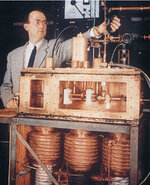
The first chewman-built maser was (allegedly) created in around 1954 by Charles Townes, J. P. Gordon and H. J. Zeiger:

Charles Townes and his colleagues were the first to build a maser - e4_1_medium.jpg
Chewmans copy create their first maser. Source
Townes and team's maser used ammonia.

Papers:
Note the device's similarities to one of the artifacts in the Talking Rings scene in The Time Machine post. It's tricky because I edited the clip down to a size respectful of Stolen History's resources. It is easier to compare Townes' ammonia maser with the maser artifact in that scene if you watch the full 2.5 minute set. However, you can kind of see the artifact I'm talking about just as Rod leaves the vault. In the corner, next to the black statue.

I suspect urine was collected in urns, and was then taken to processing facilities ('churches', 'monasteries'), where it was processed into waxy yellow phosphorus. The BBC did a demo, though they misled Britain's TV license-payers by using suspiciously fresh-looking urine, instead of almost black, aged urine.


Distilled urine, American know-how, and that weird British thing about pink shirts combine to make the perfect SH video clip

Note the set designer specified church-style windows... As with The Time Machine clip, you should always pay attention to set design. There is nothing accidental about it.

Now that you've seen that I am not making this up...

I think some urine may have been processed at home - that would explain the references to people being required to supply wax to local ecclesiasts. A wax tithe. Or, more accurately, a 'wax' tithe.

If that seems hard to imagine, try comparing it with the agricultural cooperatives in Mediterranean countries today. There, local vegetable and fruit farmers take their grapes and olives to a local cooperative facility for processing. There are also some commercial arrangements where farmers contract to supply X volume of grapes each year.

The only things that were different in the past is that involvement was mandatory, the local depot was the church or monastery, and instead of taking your grapes, they were taking the piss.

If you think about it, you'll see the sense in processing piss into phosphorus at home. Provided you have the space and the minimal kit required. There's less weight and volume to carry to church, and you would be supplying a value-added product. Assuming you could meet the church's quality requirements. The references I found to wax tithes suggest people could meet the requirements and did produce 'wax' at home.

The downside is that phosphorus is tricky to handle. Apart from igniting at about 35 deg C, or when it feels like igniting, it can really mess up your jawline. Apparently. So you keep it under water. You only need to keep it away from oxygen, sunlight, and your body.

I've begun to wonder if candles - the ubiquitous illuminatory furniture of the 'church' - were really introduced to steer our more recent ancestors away from remembering how yellow 'wax' was really used. Leaving some religions with a cargo cult belief that they should bring candles to church, and the rest of us with a cargo cult belief in romantic, candle-lit, Christmas hymns sung in the local church.

By the way, if you have been following this thread and it's predecessor, you should really, really think about what the word 'Christmas' actually means. I won't go into it here but read the thread, view the second video clip from the bottom in this post, and engage brain...

So I wonder if the church candle is a cargo cult relic of a stick-shaped, waxy material originally used in organic dye masers (or lasers). Chalices are perhaps holy grails. With their odd shiny disks, they could be conceived as focusing - and handling - devices for 'wax'-based masers. Perhaps for the light-pump, perhaps for the main light show.

To give you a better idea about yellow 'wax' as something other than for candle making, I'll upload a photo later. Bear with me on that because 'wax' is not easy to photograph well and I imagine the volume of 'wax' I have accumulated would take out several neighbouring buildings if it ignited spontaneously.

And that's another thing...

If you've been reading these posts with any care, you will appreciate I am claiming a lot of 'our' science isn't ours. Splitting it into easy-to-model categories, our science is:
  1. Knowledge that has been reverse-engineered from artifacts left by our creators and/or their 'Roman' successors (or even by early chewman experimenters).
  2. Fake science and religion designed to keep us staggering along blindfolded in the wrong direction, awed by wrongness.
  3. Tax, subsidy, and grant grabs.
If items 1 and 2 seem harsh, just read the Byng "inherited" and "who built the churches?" quotes in post-104455 and his other observations in my last few posts. He's telling you how it was, how it is. So are Hope, Brown and Oliver (a revealing name in the context of this post) but Byng lays the facts on the table, then fans them out for you to inspect for yourself.

Suppression of knowledge has consequences. One of those consequences is that true knowledge of the properties of materials has been lost. As a result of that, you can't always assess risks accurately.

In this case, I've realised 'wax' might be prone to lase if:
  1. The camera flash goes off unexpectedly, and
  2. Nearby surfaces are sufficiently reflective.
If you've looked at the split rock image in post-104477 or the surface-level geology map of Elloi (post-104407), you'll understand why I'm hesitating.

The second kind of people aren't worthy of an answer? After a seizure my fill-in-the-blank part of my brain has been on vacation.
:) We're all worthy. The thing about jokes is that they are like a beam of light shone at a prism: it gets fanned out into a range of colours that depend partly on the contents of the light and partly on the shape of the prism.

On that note, here's a couple of jokes going around the local kids at the moment. Besides being an example of how wonderfully kids' minds work, they are a great example of 'stacking'. Those unfamiliar with English joke culture may need an explanation. Don't be embarrassed to ask.

Why did the chicken cross the road?
I don't know. Why did the chicken cross the road?
To get to the stupid person's house!

Knock, knock!
Who's there?
The chicken!
 
Last edited:
The only things that were different in the past is that involvement was mandatory, the local depot was the church or monastery, and instead of taking your grapes, they were taking the piss.
'Taking the piss' was a job we did?!? It does explain the expression. And perhaps you have also stumbled on an explanation we have all been wondering about - why Versailles has no toilets. What a bizarre and interesting diversion that illustrates the point of this thread - that people were used as material resources. Might it also be the power source of all that ancient tech - not resonance, or magnetism or some such - no. Was ancient tech 'wax'-powered?

Also interesting for the official origin story: Taking the piss - Wikipedia

And Phosphorus: Phosphorus - Wikipedia

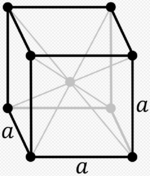
Its crystal structure:
phosphorus-crystal-structure.png

Elemental phosphorus was first isolated as white phosphorus in 1669. White phosphorus emits a faint glow when exposed to oxygen – hence the name, taken from Greek mythology, Φωσφόρος meaning "light-bearer" (Latin Lucifer), referring to the "Morning Star", the planet Venus. The term "phosphorescence", meaning glow after illumination, derives from this property of phosphorus, although the word has since been used for a different physical process that produces a glow. The glow of phosphorus is caused by oxidation of the white (but not red) phosphorus — a process now called chemiluminescence. Together with nitrogen, arsenic, antimony, and bismuth, phosphorus is classified as a pnictogen.
Phosphorus is an element essential to sustaining life largely through phosphates, compounds containing the phosphate ion, PO43−. Phosphates are a component of DNA, RNA, ATP, and phospholipids, complex compounds fundamental to cells. Elemental phosphorus was first isolated from human urine, and bone ash was an important early phosphate source. Phosphate mines contain fossils because phosphate is present in the fossilized deposits of animal remains and excreta. Low phosphate levels are an important limit to growth in some aquatic systems. The vast majority of phosphorus compounds mined are consumed as fertilisers. Phosphate is needed to replace the phosphorus that plants remove from the soil, and its annual demand is rising nearly twice as fast as the growth of the human population. Other applications include organophosphorus compounds in detergents, pesticides, and nerve agents.
Phosphorus has several allotropes that exhibit strikingly diverse properties.[8] The two most common allotropes are white phosphorus and red phosphorus.[9]
The structure of P4 molecules, determined by gas electron diffraction.[10]

From the perspective of applications and chemical literature, the most important form of elemental phosphorus is white phosphorus, often abbreviated as WP. It is a soft, waxy solid
Bone ash and guano
Guano mining in the Central Chincha Islands, ca. 1860.

Antoine Lavoisier recognized phosphorus as an element in 1777 after Johan Gottlieb Gahn and Carl Wilhelm Scheele, in 1769, showed that calcium phosphate (Ca3(PO4)2) is found in bones by obtaining elemental phosphorus from bone ash.[51]

Bone ash was the major source of phosphorus until the 1840s. The method started by roasting bones, then employed the use of clay retorts encased in a very hot brick furnace to distill out the highly toxic elemental phosphorus product.[52] Alternately, precipitated phosphates could be made from ground-up bones that had been de-greased and treated with strong acids. White phosphorus could then be made by heating the precipitated phosphates, mixed with ground coal or charcoal in an iron pot, and distilling off phosphorus vapour in a retort.[53] Carbon monoxide and other flammable gases produced during the reduction process were burnt off in a flare stack.

In the 1840s, world phosphate production turned to the mining of tropical island deposits formed from bird and bat guano (see also Guano Islands Act). These became an important source of phosphates for fertiliser in the latter half of the 19th century.[54]

Sorry to quote so much wiki - I'm learning about phosphorus!

Still, to see that bone and guano are also used in the production of phosphorus is also interesting. Not to mention the occult reference to Lucifer, the fact its crystal structure looks like 6 pyramids, or even a Maltese cross.

There are even grounds to think it can be converted to electricity:
Making electricity from urine

He said: "The technology converts the urea within urine directly into water, carbon dioxide, nitrogen and more importantly electricity.
A growing number of scientists have cottoned on to the fact that urine is a source of vital enzymes for medicine, precious minerals like fast-depleting phosphorus, and chemical compounds like urea, which are crucial to the manufacture of fertilisers, plastics and cosmetics and can also be used to make electricity.
No!! Phosphorus is fast-depleting!! Let's drink more water quick to help restore our reserves!
 
Last edited:
Bone ash was the major source of phosphorus until the 1840s. The method started by roasting bones, then employed the use of clay retorts encased in a very hot brick furnace to distill out the highly toxic elemental phosphorus product.
See the somewhat similar star-fort image in post-101298. It's the base of a lime kiln. They were quite tall apparently. Perhaps a bone-roasting kiln looked somewhat similar. Though John Clare's lime kiln at bone-strewn Pickworth seems to have been more ad-hoc. Perhaps you only need complex kilns if you want a choice between roasting for lime or for phosphorus.

Just adding your 1840 date to what we've already covered in this thread:
  1. The 1840s: humans now being brought on to their own feet. (That wording tells you I think they had help but that's another topic).
  2. On top of bone-littered fields that were identified by - and written about from - the 1790s.
  3. That 'barren' upland parts of Lincolnshire were made farmable by marling (addition of bone meal). My main source for that is Rev George Oliver but there are other references. This is not controversial history - until you identify the source of the bone-meal.
  4. The Narborough bone mill post. Though there were bone mills all over east England. There was one at Spalding - capital town of the wasteland above Elloi. There's another area of research simply in the number of windmills there used to be and their destruction events).
Just to make things easier to conceptualise:
Download Video

"You... plough their bones into your fields." Source: Westworld S02 Ep10

Odd thing to say about androids. Did he confuse Westworld with eastern England?

These events are not just a Lincolnshire, England, thing. How the links to other places work, I don't know. But America's Pilgrim Fathers hung out on the Isle of Axholme, Lincolnshire (fenny, felled trees underground) (Google Maps), (Google Streetview) and in Boston, Lincolnshire (also fenny, felled trees underground) (Google Maps), (Google Streetview). Benjamin Franklin is associated with Francis Dashwood and the book of Common Prayer - and much else. As per recent posts, Dashwood is as much a Lincolnshire, Romney Marsh (Kent), - and even St Petersburg, Russia - phenomenon as he is a West Wycombe phenomenon. And is possibly a partial, limited hangout, patsy or scapegoat. For some much larger mystery.

How did that odd circular geology appear around Elloi? How did St Petersburg become flooded? How did Dogger drown?

Download Video

All the world's a stage. Source: Westworld S01 Ep06

Hmm... A management conflict between a Dane and a Brit in Westworld. Danes and Danaans drift in and out of western Europe's destruction stories, from eastern England to Portugal. Probably just another coincidence.

'Taking the piss' was a job we did?!? It does explain the expression. And perhaps you have also stumbled on an explanation we have all been wondering about - why Versailles has no toilets. What a bizarre and interesting diversion that illustrates the point of this thread - that people were used as material resources
Yes, I think we provided supplies of urine. We can be appalled. Or we can appreciate that the minds that designed us, designed us to be so very... productive.

He said: "The technology converts the urea within urine directly into water, carbon dioxide, nitrogen and more importantly electricity.
My guess is the 'urine -> electricity' process will require a yeast-bacteria mix, perhaps like a kombucha scoby. Not a high-tech, honeycomb, metal matrix, etc. But that's just a guess based on patterns poking through from the past.

By the way, in Torrington Diaries, Byng makes an odd reference to becoming tipsy after drinking tea. It suggests kombucha - a drink barely known in Britain 20 years ago - was available in 18th Century, depopulated, rural Lincolnshire. Byng's comment reminded me of the reversed N's that show up on English church bells and graffiti in Knights Templar ruins.
 
Last edited:
My guess is the 'urine -> electricity' process will require a yeast-bacteria mix
Researchers at the University of Bath have developed an innovative miniature fuel cell that can generate electricity from urine, creating an affordable, renewable and carbon-neutral way of generating power.

In the near future this device could provide a means of generating much needed electricity to remote areas at very little cost, each device costs just £1-£2. With growing global pressures to reduce reliance on fossil fuels and the associated greenhouse gas emissions, microbial fuel cells could be an exciting alternative.
A microbial fuel cell is a device that uses natural biological processes of 'electric' bacteria to turn organic matter, such as urine, into electricity. These fuel cells are efficient and relatively cheap to run, and produce nearly zero waste compared to other methods of electricity generation.

This novel fuel cell developed by the researchers, measures one inch squared in size and uses a carbon catalyst at the cathode which is derived from glucose and ovalbumin, a protein found in egg white.

Urine turned into sustainable power source for electronic devices
 
Last edited:
usselo, congratulation on the amazing research you have done. We are definitely a hybrid of some sort. Back in the old SH.org I wrote a piece about the chimp-pig human hybrid.
 
A microbial fuel cell is a device that uses natural biological processes of 'electric' bacteria to turn organic matter, such as urine, into electricity. These fuel cells are efficient and relatively cheap to run, and produce nearly zero waste compared to other methods of electricity generation.

This novel fuel cell developed by the researchers, measures one inch squared in size and uses a carbon catalyst at the cathode which is derived from glucose and ovalbumin, a protein found in egg white.

Urine turned into sustainable power source for electronic devices
Ha ha, great find Potato!

This is what I mean when I say we are materialists but our creators/predecessors were (and probably still are) all-chemists (alchemists). They made useful things by creating lifeforms to process help materials/chemicals into more useful materials/chemicals. Bacteria, yeasts, humans.

In contrast, our usual approach is to force materials/chemicals into becoming more useful by applying energy to them.

It's interesting they were mixing glucose (a carbohydrate, a sugar) and ovalbumin (a protein). In my night-time musings about urine-wax phosphor candles as maser cores, I've wondered if our predecessors were blending 'wax' with something else. Perhaps congealed blood. It seems to me 'wax' is not quite as solid as candle wax, and it wouldn't be so easy to shape into battle-ready cores suitable for chalice masers. Or keep stable through battle-action if being used as the core of a light-sabre. Which is what I think lances may really have been (an idea I got from pro_vladimir and dmitrijan).

When you look at this kind of science, it is worth bearing in mind the Selenadia 'frothy blood' material I linked to much earlier. Those posts were: in this thread: post-102005 and in The Nephilim looked like Clowns thread: post-102333.

1fc0f6dec1c7.jpg
Sparkling red wine with added ions! Source in English

Selenadia's proposition was that our creators ionised human blood as part of transmuting it into something either:
  1. More nutritious, or
  2. More suitable for gene manipulation
I wasn't quite sure which because the machine translation wasn't great. Selenadia also claims - if I understand correctly - that biomaterial was collected in many places. And was also made available in sarcophagi and hollow stone statues perforated with holes. Through these, our creators could suck out the biomaterial when they got the munchies.

Feralimal dug into those Selenadia links this week and found two of his lost original posts (in Russian) at archive.org:
Google translate apparently can't handle them so it's Russian only for the moment. But the images are interesting for anyone who is questioning what churches were originally about.

This idea of us as a lifeform created to do work and produce material resources (IHASFEMR) might also explain why our blood is iron (hemaglobin) suspended in a liquid called 'plasma'.

I was asked in a private mail about my comment that people should think about the origin of the word 'Christmas'... I've cleaned up my response and posted it at the bottom of this post in purple. But in short, it's like this: in much earlier posts, (and subsequently), we discussed the word 'mas'; its relationship with English words like 'mess-hall', 'mess-tin', and its relationship with the word 'mass'. 'Mass' as in handing out chewman blood and wafers in religious rituals. All ably sanitised today by referencing the process as a single event called 'The Last Supper'. If you've read Selenadia's linked posts about 'frothing' human blood and understood my evidence for fermentation of human babies, then it becomes reasonable to wonder if 'Yesu' has the same origin as the English word 'yeast'.

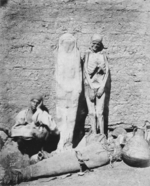
It's fascinating to see how babies sleep more easily when swaddled. The modern explanation for that behaviour is not very logical. It makes more sense if you understand it as designed behaviour. Similarly, the word 'Christ', it seems to me, could conceivably be rooted in the idea of something changing its form in a pot or a cocoon. Cocooned, perhaps, by being wrapped in a shroud or bound in cloth. As if a chrysalis or a chrysalid. Or a mummy.

388px-Félix_Bonfils_-_Mumienhändler.png
Mummies as medicine. Source

More links to the mysterious medicine called mumiyo, or mummia, or shilajit are in post-102005. The mystery being that some researchers claim it is not made from tree resin, or bat droppings or mold scraped from cave-walls but from human corpses.

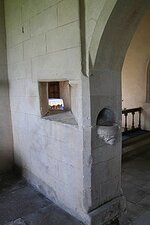
18th Century antiquarians' accounts of their inspections of England's ruined ecclesiastic buildings often have them paying a lot of attention to 'niches' in the walls of churches, monasteries, temples, etc. Today we would think of these niches as places for statues of saints. But we know that 'saint' = 'san' = 'sen' = blood. As in 'Senlac', East Sussex, which means 'Lake of Blood'. So I wonder if these niches were for cocoons in which chewmans were fermented. Perhaps the ecclesiastical version of the scene in Killer Clowns shown in the clown video clip in this post.

They notice the niches are empty. They attribute this to the destruction of 'saints' during England's 1642-1651 Civil War. However, viewed from an IHASFEMR perspective, their removal might be a result of rising human rage against having their children, family and friends killed and fermented. Or killed and soaked in resin. Or simply killed for storage. That possibility also ties in with the seemingly inexplicable destruction of 10,000 of England's 12,000+ binding posts market crosses.

Although I think market crosses were binding posts for human livestock brought to market, we should remember the principle of 'stacking'... Of creating things to perform multiple functions. And that our creators/predecessors seem to have organised their processes to deliver multiple outcomes. Selenadia has images of socketed stone bases that are very similar to the bases of English market crosses. I think he is either proposing they were mortars for pounding human biomaterial or structures for allowing human biomaterial to ferment under pressure. Absent a decent translation, I'm just not sure.

0_573fc_f95ac0f0_XL.jpg
Socketed stone. Source

Contrast it with Roysia's Stone from above Royston Cave, Royston, England:
f0966588-4495-43b8-850e-a7c61871fcdf.jpg
Roysia Stone, Royston, England. Source

The Roysia Stone and Royston's Cave's history is discussed earlier in this thread.

One theme that seems to be common in the works of our predecessors is this: they thought in terms of 'systems' rather than 'specialisms'. Recognising - and extracting - multiple functions from each structure or material is just one part of systems theory. It stands in contrast to our tendency to create single-purpose structures and materials.

usselo, congratulation on the amazing research you have done. We are definitely a hybrid of some sort. Back in the old SH.org I wrote a piece about the chimp-pig human hybrid.

I couldn't post a link in the first message, so here it is - SH Archive - Human Origins: Are We Hybrids?
Cheers plamski - good to see you back.

I haven't said much about chimp-pig human hybrid theory because the case for it is so well-evidenced that people either get it or they don't. Thanks for putting your link in. People will probably need to have absorbed that material before the conjectures in this thread about how chewmans were (are) used has a real hope of making sense.

I've had to leave a lot of material out recently because there's more evidence than I have time to collate. I've been looking at:

1. King Arthur and the possibility his first battle - at the 'mouth of the River Glein' - was just to the north-west of Elloi (South Holland) here: (Google Maps). Exact location is difficult because fenland drainage has moved the River Glen's mouth has moved east. An old district that used to be called 'Aveland' (in its many spellings and many movements around east Lincolnshire) is also close to there. Is Aveland a possibility for Avalon? There's also Arthur's 'Troyt' boar story. That boar acted very similarly to the horse in Lincolnshire's versions of the Byard's Leap stories.

2. Civil Wars in England. The similar locations - and sometimes similar events - between them is quite curious. Are they one era stretched back in time to fill England's history gap?

3. Evidence 'the Romans' in England are an Italian cultural import from the 17th and 18th Century. That import being theatre, drama, plays, puncinello, etc, and costumes that were later (Ie, in the early 19th Century perhaps) backdated to become the 2,000 year old Roman invasion we know of today. I suspect this was done because a human history was needed and there seems to have been only one main chewman story before the mid-17th Century. Becoming lunch.

4. Evidence that monks, friars, abbots etc, are an invention from the 17th-18th Century. Invented to explain structures and 'professions' (prey-ists, abbot-oirs, bloodletters, bakers of blood-infused bread), as well as strange stories of people being cut up and processed, luvved up by strange-looking creatures, and transformed into everything from sandwiches to beams of light.

Download Video

Lord Asriel 'cuts' Roger. Source: His Dark Materials. Warning: It is quite loud.

All this takes a lot of time to read up, collate, check, and write. So in the meantime, what do folks think about the similarities - or lack of them - between these reports strange sounds in the sky:


Strange Sounds, Jan 21, 2012, Banff, Alberta, Canada


Strange Sounds, Jan 23, 2012, Banff, Alberta, Canada


Strange Sounds, Aug 11, 2011, Kiev, Ukraine


Download Video

Ventilator. Source: Breaking Bad S03 Ep11

Again. But just the sound, amplified. Source: Breaking Bad S03 Ep11

I think they are very similar. And, as I mentioned above, we should pay attention to set design. ;)

Copy of the cleaned up PM referenced above:
Fermented babies, fermented humans and frothy blood:

I came to the notion of babies being ferment-preserved without knowing about Selenadia's work above. I suspected it because of the conventionally-inexplicable characteristics of
archaeological baby-in-a-pot remains, because of kistvaens and their often having a bedrock or stone floor, and the amount of liquid-related stone furniture in churches, monasteries, etc. Such as fonts, piscinas, stone funnels to cavities below, the Rothwell floor-slot. I wasn't even aware that sarcophagi often have small holes in them (per Selenadia's mostly Asia-based finds. Again: post-102005 and post-102333).

My point is that two people independently arrived at a very unconventional - but similar - understanding by asking themselves what could explain the characteristics of the evidence.

Also, the alleged pagan and church-promoted promiscuity/fertility festivals called Easter look likely to have produced lots of high-fat human protein nine months later - just when they were most needed. Picture young men and women dancing around maypoles holding on to coloured ribbons that weave tighter and tighter as they dance around the pole. It doesn't take much imagination to figure out what hormonal impulses backed by social pressure might produce for the next 'dance'.

The reference to kombucha scobies... I was thinking something like this:

1. We are a materials-based culture. We routinely manipulate chemicals well.
2. There used to be a culture - which I think may not have been human - that manipulated yeasts, bacteria, enzymes (and probably viruses and phages if they exist), and DNA, to create things they needed. They had much more of an understanding of proteins, bacteria and microbial life as production tools. Much more than we do.

'Frothy blood' and 'bloodletting' practices are quite difficult to research. In as much as you can find anything written, it tends to point to 'the Jews, all of them' which I think is like HMRC claiming lorry drivers are drug smugglers: they are a pre-positioned scapegoat. That there may be one or two criminally-minded ones among them may help the scapegoating but it doesn't identify the real culprit or close the investigation.

Putting these ideas into a chronology:


1. Some entities we don't know much about manufactured us. By manipulating existing DNA. Though they may well have created the DNA in the first place. If they created chimpanzees, pigs, etc.
2. I think they manufactured us for the same reasons we engineer and breed commercial yeast. It is useful to us and we can use its various outputs to produce consumables.
3. At some point sentience was added to us. Possibly at creation-time. But my guess is that sentience was not added at our beginning. Perhaps about 1,000 years ago. And perhaps more recently than that. Could be wrong. Wouldn't stake my yeasty little life on it.
4. At some point, our creators 'went', or suffered a setback of some sort that has left them largely busy elsewhere. Maybe the domain we live in was only ever an R&R stop for quarrymen. Or a Westworld for them. Maybe they went back to work.
5. I tend to think they are still around and still watching us with interest. Perhaps they see us as potentially 'handy', as potentially a good thing to have created. Provided we can stop relying on our 'faith circuits', our 'loyalty loop', and instead use more thoroughly the observation and reasoning potential our DNA gifted us with.
6. The 'freeing' event seems to come at 1615 to 1650 ish. Definitely a catastrophe from our perspective, possibly with associated war. But from their perspective, it may have been an end-of-shift clean-up, or an end-of-season clean-up. Or a Westworld-scale set-change. Perhaps it occurred because sentience had been added and our vivarium was being made over to 'give brains a chance'.
7. I think our notion of 'The Romans' is a blend of all sorts of things. I occasionally trip over threads of evidence that Britain's Roman roads are relatively recent. Perhaps constructed soon after that 17th Century catastrophe. Then attributed to 'the Romans' by 19th Century narrative-writers as part of establishing a longer history for human ingenuity than really exists. It was the absolute mess that is the story of east England's fenland drainage that pushed me through another conspiratorial veil into questioning this relatively recent history. It is very difficult to integrate into orthodox history the contradictions and sly comments I find in old antiquarians' descriptions of this area. It is more rational to integrate them into an era of cover-up that was in swing - as far as I can tell - by the early 18th Century and continued into the mid-19th Century. And on into today of course.

The propositions I'm looking at for item 7. are:

7.1. Monks, friars, abbots didn't exist as we understand them. They are made up to explain entities, their structures, our memories of - and our stories about - those entities, their structures, and our memories/stories of activities in those structures.
7.2. Romans didn't exist. They were made up to explain the global scope of old structures. And to explain new structures like straight roads. (Fake age, basically. The same technique that uses fake family trees to explain ownership of 'expropriated' land.) And they were perhaps made up to explain the removal of some construction techniques and organisational processes from human view. These vanished techniques and processes were attributed to a selection of 'colonialists' whose disappearance could be used to 'explain' mysteries, inconsistencies and 'unknowns' in our story. BTW: the 'Romans = Normans = fabrication' narrative is still being developed in the 'Betrayal of Albion' thread.
7.3. I suspect the entities that created us also guided the creation of these last two narratives (religion and ancient empires like the Romans) as part of managing us. Something wasn't going to plan by around 1800 so another large-scale narrative change began to take place.

The current Covid narrative could be a large-scale narrative change occurring in our own time. Certainly something of this nature was amply flagged beforehand.

Perhaps the changes now underway are occurring because, for 40 years, chewmans kept voting for variants of their own economic destruction. Or their neighbour's economic destruction. In Britain, that means voting for the Tory, Lib-Dem, and Labour variants of 'neo-liberalism'. Or voting at all, in my opinion. The damage it has caused is so extensive that perhaps TPTB stepped in to correct things before their 'sentient chewman experiment' completely fell apart. There are several clues to this being a possibility.

Then again, perhaps the changes currently in progress were always part of a planned narrative about chewman history and their time simply became due.


Download Video

Tory, Labour and (Neo-)Liberal Democrat UK system fail. Source: Can't Get You Out of my Head

Same in the US.

Download Video

Republican and (Neo-)Liberal US system fail. Source: Can't Get You Out of my Head

If you've noticed the thin tendrils of systems theory sneaking into explanations of current economic failings, you could imagine that we are in a classroom attending an experiential session called 'Systems Thinking 101'.

If we are (I hope so!), what I can't work out is whether it was a planned class or an emergency session.


Edit: replaced the ventilator video. Hopefully the audio renders for all browsers now. Added link to lances as light sabres.
 
This is a video that struck me as relevant for this thread. Its your more typical conspiracy round-up of where we might have come from, via Mark Passio. It talks about aliens, Anunnaki and whatever, but its pretty coherent. Still I found that it provide a pretty decent background to what we are discussing here:

View: https://www.youtube.com/watch?v=oiCnrn6LkUo
 
"That mollusk DNA is used to accelerate the creation of artificial stem cells inside the human body."

Reading this analysis of the "waxxine" as being at least partially offworld designed and implemented...

Transcripts/new-analysis-vaccines-samples-analyzed-aneeka-of-temmer-shares-the-findings
Swaruu

... And when I saw mollusk...that synced to this discussion..
Ha ha, great find Potato!

This is what I mean when I say we are materialists but our creators/predecessors were (and probably still are) all-chemists (alchemists). They made useful things by creating lifeforms to process help materials/chemicals into more useful materials/chemicals. Bacteria, yeasts, humans.

In contrast, our usual approach is to force materials/chemicals into becoming more useful by applying energy to them.

It's interesting they were mixing glucose (a carbohydrate, a sugar) and ovalbumin (a protein). In my night-time musings about urine-wax phosphor candles as maser cores, I've wondered if our predecessors were blending 'wax' with something else. Perhaps congealed blood. It seems to me 'wax' is not quite as solid as candle wax, and it wouldn't be so easy to shape into battle-ready cores suitable for chalice masers. Or keep stable through battle-action if being used as the core of a light-sabre. Which is what I think lances may really have been (an idea I got from pro_vladimir and dmitrijan).

When you look at this kind of science, it is worth bearing in mind the Selenadia 'frothy blood' material I linked to much earlier. Those posts were: in this thread: post-102005 and in The Nephilim looked like Clowns thread: post-102333.

1fc0f6dec1c7.jpg
Sparkling red wine with added ions! Source in English

Selenadia's proposition was that our creators ionised human blood as part of transmuting it into something either:
  1. More nutritious, or
  2. More suitable for gene manipulation
I wasn't quite sure which because the machine translation wasn't great. Selenadia also claims - if I understand correctly - that biomaterial was collected in many places. And was also made available in sarcophagi and hollow stone statues perforated with holes. Through these, our creators could suck out the biomaterial when they got the munchies.

Feralimal dug into those Selenadia links this week and found two of his lost original posts (in Russian) at archive.org:
Google translate apparently can't handle them so it's Russian only for the moment. But the images are interesting for anyone who is questioning what churches were originally about.

This idea of us as a lifeform created to do work and produce material resources (IHASFEMR) might also explain why our blood is iron (hemaglobin) suspended in a liquid called 'plasma'.

I was asked in a private mail about my comment that people should think about the origin of the word 'Christmas'... I've cleaned up my response and posted it at the bottom of this post in purple. But in short, it's like this: in much earlier posts, (and subsequently), we discussed the word 'mas'; its relationship with English words like 'mess-hall', 'mess-tin', and its relationship with the word 'mass'. 'Mass' as in handing out chewman blood and wafers in religious rituals. All ably sanitised today by referencing the process as a single event called 'The Last Supper'. If you've read Selenadia's linked posts about 'frothing' human blood and understood my evidence for fermentation of human babies, then it becomes reasonable to wonder if 'Yesu' has the same origin as the English word 'yeast'.

It's fascinating to see how babies sleep more easily when swaddled. The modern explanation for that behaviour is not very logical. It makes more sense if you understand it as designed behaviour. Similarly, the word 'Christ', it seems to me, could conceivably be rooted in the idea of something changing its form in a pot or a cocoon. Cocooned, perhaps, by being wrapped in a shroud or bound in cloth. As if a chrysalis or a chrysalid. Or a mummy.

View attachment 13221
Mummies as medicine. Source

More links to the mysterious medicine called mumiyo, or mummia, or shilajit are in post-102005. The mystery being that some researchers claim it is not made from tree resin, or bat droppings or mold scraped from cave-walls but from human corpses.

18th Century antiquarians' accounts of their inspections of England's ruined ecclesiastic buildings often have them paying a lot of attention to 'niches' in the walls of churches, monasteries, temples, etc. Today we would think of these niches as places for statues of saints. But we know that 'saint' = 'san' = 'sen' = blood. As in 'Senlac', East Sussex, which means 'Lake of Blood'. So I wonder if these niches were for cocoons in which chewmans were fermented. Perhaps the ecclesiastical version of the scene in Killer Clowns shown in the clown video clip in this post.

They notice the niches are empty. They attribute this to the destruction of 'saints' during England's 1642-1651 Civil War. However, viewed from an IHASFEMR perspective, their removal might be a result of rising human rage against having their children, family and friends killed and fermented. Or killed and soaked in resin. Or simply killed for storage. That possibility also ties in with the seemingly inexplicable destruction of 10,000 of England's 12,000+ binding posts market crosses.

Although I think market crosses were binding posts for human livestock brought to market, we should remember the principle of 'stacking'... Of creating things to perform multiple functions. And that our creators/predecessors seem to have organised their processes to deliver multiple outcomes. Selenadia has images of socketed stone bases that are very similar to the bases of English market crosses. I think he is either proposing they were mortars for pounding human biomaterial or structures for allowing human biomaterial to ferment under pressure. Absent a decent translation, I'm just not sure.

0_573fc_f95ac0f0_XL.jpg
Socketed stone. Source

Contrast it with Roysia's Stone from above Royston Cave, Royston, England:
f0966588-4495-43b8-850e-a7c61871fcdf.jpg
Roysia Stone, Royston, England. Source

The Roysia Stone and Royston's Cave's history is discussed earlier in this thread.

One theme that seems to be common in the works of our predecessors is this: they thought in terms of 'systems' rather than 'specialisms'. Recognising - and extracting - multiple functions from each structure or material is just one part of systems theory. It stands in contrast to our tendency to create single-purpose structures and materials.


Cheers plamski - good to see you back.

I haven't said much about chimp-pig human hybrid theory because the case for it is so well-evidenced that people either get it or they don't. Thanks for putting your link in. People will probably need to have absorbed that material before the conjectures in this thread about how chewmans were (are) used has a real hope of making sense.

I've had to leave a lot of material out recently because there's more evidence than I have time to collate. I've been looking at:

1. King Arthur and the possibility his first battle - at the 'mouth of the River Glein' - was just to the north-west of Elloi (South Holland) here: (Google Maps). Exact location is difficult because fenland drainage has moved the River Glen's mouth has moved east. An old district that used to be called 'Aveland' (in its many spellings and many movements around east Lincolnshire) is also close to there. Is Aveland a possibility for Avalon? There's also Arthur's 'Troyt' boar story. That boar acted very similarly to the horse in Lincolnshire's versions of the Byard's Leap stories.

2. Civil Wars in England. The similar locations - and sometimes similar events - between them is quite curious. Are they one era stretched back in time to fill England's history gap?

3. Evidence 'the Romans' in England are an Italian cultural import from the 17th and 18th Century. That import being theatre, drama, plays, puncinello, etc, and costumes that were later (Ie, in the early 19th Century perhaps) backdated to become the 2,000 year old Roman invasion we know of today. I suspect this was done because a human history was needed and there seems to have been only one main chewman story before the mid-17th Century. Becoming lunch.

4. Evidence that monks, friars, abbots etc, are an invention from the 17th-18th Century. Invented to explain structures and 'professions' (prey-ists, abbot-oirs, bloodletters, bakers of blood-infused bread), as well as strange stories of people being cut up and processed, luvved up by strange-looking creatures, and transformed into everything from sandwiches to beams of light.

Lord Asriel 'cuts' Roger. Source: His Dark Materials. Warning: It is quite loud.

All this takes a lot of time to read up, collate, check, and write. So in the meantime, what do folks think about the similarities - or lack of them - between these reports strange sounds in the sky:


Strange Sounds, Jan 21, 2012, Banff, Alberta, Canada


Strange Sounds, Jan 23, 2012, Banff, Alberta, Canada


Strange Sounds, Aug 11, 2011, Kiev, Ukraine


Ventilator. Source: Breaking Bad S03 Ep11

Again. But just the sound, amplified. Source: Breaking Bad S03 Ep11

I think they are very similar. And, as I mentioned above, we should pay attention to set design. ;)

Copy of the cleaned up PM referenced above:
Fermented babies, fermented humans and frothy blood:

I came to the notion of babies being ferment-preserved without knowing about Selenadia's work above. I suspected it because of the conventionally-inexplicable characteristics of
archaeological baby-in-a-pot remains, because of kistvaens and their often having a bedrock or stone floor, and the amount of liquid-related stone furniture in churches, monasteries, etc. Such as fonts, piscinas, stone funnels to cavities below, the Rothwell floor-slot. I wasn't even aware that sarcophagi often have small holes in them (per Selenadia's mostly Asia-based finds. Again: post-102005 and post-102333).

My point is that two people independently arrived at a very unconventional - but similar - understanding by asking themselves what could explain the characteristics of the evidence.

Also, the alleged pagan and church-promoted promiscuity/fertility festivals called Easter look likely to have produced lots of high-fat human protein nine months later - just when they were most needed. Picture young men and women dancing around maypoles holding on to coloured ribbons that weave tighter and tighter as they dance around the pole. It doesn't take much imagination to figure out what hormonal impulses backed by social pressure might produce for the next 'dance'.


TPTB stepped in to correct thingsThe reference to kombucha scobies... I was thinking something like this:
1. We are a materials-based culture. We routinely manipulate chemicals well.
2. There used to be a culture - which I think may not have been human - that manipulated yeasts, bacteria, enzymes (and probably viruses and phages if they exist), and DNA, to create things they needed. They had much more of an understanding of proteins, bacteria and microbial life as production tools. Much more than we do.

'Frothy blood' and 'bloodletting' practices are quite difficult to research. In as much as you can find anything written, it tends to point to 'the Jews, all of them' which I think is like HMRC claiming lorry drivers are drug smugglers: they are a pre-positioned scapegoat. That there may be one or two criminally-minded ones among them may help the scapegoating but it doesn't identify the real culprit or close the investigation.

Putting these ideas into a chronology:


1. Some entities we don't know much about manufactured us. By manipulating existing DNA. Though they may well have created the DNA in the first place. If they created chimpanzees, pigs, etc.
2. I think they manufactured us for the same reasons we engineer and breed commercial yeast. It is useful to us and we can use its various outputs to produce consumables.
3. At some point sentience was added to us. Possibly at creation-time. But my guess is that sentience was not added at our beginning. Perhaps about 1,000 years ago. And perhaps more recently than that. Could be wrong. Wouldn't stake my yeasty little life on it.
4. At some point, our creators 'went', or suffered a setback of some sort that has left them largely busy elsewhere. Maybe the domain we live in was only ever an R&R stop for quarrymen. Or a Westworld for them. Maybe they went back to work.
5. I tend to think they are still around and still watching us with interest. Perhaps they see us as potentially 'handy', as potentially a good thing to have created. Provided we can stop relying on our 'faith circuits', our 'loyalty loop', and instead use more thoroughly the observation and reasoning potential our DNA gifted us with.
6. The 'freeing' event seems to come at 1615 to 1650 ish. Definitely a catastrophe from our perspective, possibly with associated war. But from their perspective, it may have been an end-of-shift clean-up, or an end-of-season clean-up. Or a Westworld-scale set-change. Perhaps it occurred because sentience had been added and our vivarium was being made over to 'give brains a chance'.
7. I think our notion of 'The Romans' is a blend of all sorts of things. I occasionally trip over threads of evidence that Britain's Roman roads are relatively recent. Perhaps constructed soon after that 17th Century catastrophe. Then attributed to 'the Romans' by 19th Century narrative-writers as part of establishing a longer history for human ingenuity than really exists. It was the absolute mess that is the story of east England's fenland drainage that pushed me through another conspiratorial veil into questioning this relatively recent history. It is very difficult to integrate into orthodox history the contradictions and sly comments I find in old antiquarians' descriptions of this area. It is more rational to integrate them into an era of cover-up that was in swing - as far as I can tell - by the early 18th Century and continued into the mid-19th Century. And on into today of course.

The propositions I'm looking at for item 7. are:

7.1. Monks, friars, abbots didn't exist as we understand them. They are made up to explain entities, their structures, our memories of - and our stories about - those entities, their structures, and our memories/stories of activities in those structures.
7.2. Romans didn't exist. They were made up to explain the global scope of old structures. And to explain new structures like straight roads. (Fake age, basically. The same technique that uses fake family trees to explain ownership of 'expropriated' land.) And they were perhaps made up to explain the removal of some construction techniques and organisational processes from human view. These vanished techniques and processes were attributed to a selection of 'colonialists' whose disappearance could be used to 'explain' mysteries, inconsistencies and 'unknowns' in our story. BTW: the 'Romans = Normans = fabrication' narrative is still being developed in the 'Betrayal of Albion' thread.
7.3. I suspect the entities that created us also guided the creation of these last two narratives (religion and ancient empires like the Romans) as part of managing us. Something wasn't going to plan by around 1800 so another large-scale narrative change began to take place.

The current Covid narrative could be a large-scale narrative change occurring in our own time. Certainly something of this nature was amply flagged beforehand.

Perhaps the changes now underway are occurring because, for 40 years, chewmans kept voting for variants of their own economic destruction. Or their neighbour's economic destruction. In Britain, that means voting for the Tory, Lib-Dem, and Labour variants of 'neo-liberalism'. Or voting at all, in my opinion. The damage it has caused is so extensive that perhaps TPTB stepped in to correct things before their 'sentient chewman experiment' completely fell apart. There are several clues to this being a possibility.

Then again, perhaps the changes currently in progress were always part of a planned narrative about chewman history and their time simply became due.


Tory, Labour and (Neo-)Liberal Democrat UK system fail. Source: Can't Get You Out of my Head

Same in the US.

Republican and (Neo-)Liberal US system fail. Source: Can't Get You Out of my Head

If you've noticed the thin tendrils of systems theory sneaking into explanations of current economic failings, you could imagine that we are in a classroom attending an experiential session called 'Systems Thinking 101'.

If we are (I hope so!), what I can't work out is whether it was a planned class or an emergency session.


Edit: replaced the ventilator video. Hopefully the audio renders for all browsers now. Added link to lances as light sabres.

"TPTB stepped in to correct things"

Sadly, the blood drinkers don't appear to go on permanent vacation.

They're clearly making a move on blood atm.
 

Attachments

  • Rudolf Steiner - The occult significance of blood-London, Theosophical Pub. Society (1912).pdf
    48.5 KB · Views: 309
Last edited:
This is a video that struck me as relevant for this thread. Its your more typical conspiracy round-up of where we might have come from, via Mark Passio. It talks about aliens, Anunnaki and whatever, but its pretty coherent. Still I found that it provide a pretty decent background to what we are discussing here:

View: https://www.youtube.com/watch?v=oiCnrn6LkUo

It's worth watching for the segment on our differences to primates alone. That segment starts at 1 hour, 14 mins, 13 seconds in (timed link): https://www.youtube.com/watch?v=oiCnrn6LkUo&t=4449s. Those differences can be added to the list in post-104477.

If I was budgeting resources for educational animations, I'd commission a 2D video showing the:
  • Physical differences between humans and primates
  • Physical similarities between humans and pigs
  • Physical similarities between humans and seals
  • Oddities of human biology
Passio may be right that it was aliens that hybridised, or created, the original humans. But I don't think we can rule out that it was done by entities that are native to this domain.

feralimal said:
Another interesting link, more current, quite gruesome:
[Heipel: Top 10 Sickening Details About How Federal Employees Trafficked Baby Body Parts](https://americarenewing.com/heipel-top-10-sickening-details-about-how-federal-employees-trafficked-baby-body-parts/)

“fresh, never frozen”
"wonderful tissues"

alltheleaves said:
Sadly, the blood drinkers don't appear to go on permanent vacation.

Yep, chewman biomaterial collection seems to be going on still. I've read Russian blogger speculation that blood transfusion service inputs were far, far greater than their outputs. That the numbers don't add up. That much of the collected blood must have been supplied to another market.

I think you understood me correctly when I said:
TPTB stepped in to correct things

but in case anyone didn't: I didn't mean "The Powers That Be took pity on us". I meant TPTB may currently be changing our politico-economic systems (through the medium of Covid) because the current systems are at risk of producing low-quality product or the wrong mix of product.

For example, Boomer peak-death has arrived and, with it - theoretically - a long-planned chewman biomaterial product bonanza.

But perhaps the product mix is poorly matched to customer demand. Perhaps it's too much mutton; too little lamb. Too much fat, too little protein. Too much osteoporotic bone instead of supple, well-exercised bone. Or too much tumour-riddled, drug-contaminated biomaterial.

More likely though, the current output was planned and the changes being ushered in are about matching future production to future demand.

Obviously, without being able to see the accounts or interview our managers, all we can do is model out the possible scenarios they might be adjusting for. I touched on this possibility at the end of post-99448.

The one trend I think can be seen is a desire for the chewman product mix to show more cognitive skills around abstraction and abstract problem-solving. That would explain the drive for programmers and the 'vaccidental' increase in Asbergers and autism.

So, when I talk about 'correcting things', I meant in the sense of fitting product to market.

Now, catching up on some loose ends...

In post-103890, John Nada pointed out the ritual serving of first-born - presumably babies - on silver platters. Citezenship added more of the same in post-103896. This in addition to Sapiot's mention of married couples dreading the church bells ringing as they left church.

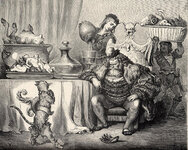
599px-Lechatbotte4.jpg
Puss-in-Boots illustration reflects the dining table aesthetics of its era. Source

It's not just the three cherubs; it's the cow's head and hooves in the tureen behind the cherubs, and the mutton and possibly pig in the basket behind the ogre. How to explain these aesthetics?

I caught part of a 'Trace your Ancestors' TV programme a couple of weeks ago. In a segment about a 19th Century butcher, the presenter explained that 19th Century 'people' preferred their meat to show its origins. To look like the animal it came from. The programme showed how this usually meant presenting smaller animals on the table with limbs and heads intact, often tastefully arranged to display the face.

As for what they ate, John Byng - mentioned in these posts - had a big appetite for meat, veg and booze. A typical supper:
My supper consisted of a fine roasted fowl, cold ham, pickled salmon, artichoke and tarts.

His receipts and his comments about his meals don't - unfortunately - say 'cherub'. They do show he usually ate two or three types of meat at each sitting. And a lot of it. Typically a trout with mutton chops and peas, or a roast chicken or waterfowl plus two fish, sometimes followed by a plate of cold meat.

He rarely eats a single chop; instead he eats chops in the plural. Usually mutton in eastern England. Where he mentions eating veg, it's usually peas. Very rarely does he eat potatoes or carbohydrates in his main course.

He's on the paleo-diet but with added drinking. The Puss-in-Boots image above captures the drinking well. Typically wine or beers followed by half a pint of brandy. From The Torrington Diaries (Selection of Tours edition), p352, at the White Hart in Spalding, Elloi, (Google Maps), (Google Streetview):
My pint of wine at supper was the meanest measure I ever saw; now I can carry a good pint, at least of port wine.

If the port was at today's 19-20% alcohol level, that's nine units. The guy drank like Futurama's Bender.

Bender_Bending_Rodríguez_-_Official_Character_Promo_1.jpg
John Byng Bender. Source

Up next: I've got a lot of disparate pieces of evidence left over that should have been used earlier in this thread. For example, it turns out that Buxton Crescent - source of the mysterious 12-year refurbishment delay - housed an Assembly Rooms. Which tells us there were likely embarrassing tunnels beneath it, not just '23 springs'.

Also, reading Byng's accounts of derelict halls across England, and their woodlands and deer parks being dismantled, it becomes clear that before these places were ruined in - seemingly - the 17th and early 18th Century, England's landscape looked like a vast suburb. That would make more sense of finds like these from post-103255:
one-line-of-moated-houses-map-png.png
64 moated houses and halls on a random 20km high line

These only mark moated (and previously moated) sites, not the many non-moated sites. According to Byng, in his travels between 1781 and 1794, many of these ruins were being torn down and their key parts shipped to London. There they were being rebuilt into London's grand residential architecture. Source coordinates attached.

However, rather than dump bits and pieces, I got good feedback there's interest in churches playing with phosphorus so I'll dump more evidence that some church features seem to have been designed around manipulating light. Then move on to IHASF E MR - humans as entertainment.

With regard to that, it would really help if I someone could help me track down a particular episode of Michael Portillo's Great Railway Journeys. In that episode, the curator of the site he is visiting hands him a book because she prefers not to read out the passage in it. Portillo then reads out the passage, which describes someone - a vizier or pasha perhaps - teasing children at the top of a tower. He holds out a golden ball toward them and when they reach for it, pushes them off the ledge. Portillo reads on that he did this until some 50 children were lying dead at the bottom of the tower. I'd very much like to identify that episode, if anyone can help with that.

Thanks!
 

Attachments

  • moated_sites_selection.doc
    17 KB · Views: 156
Last edited:
What features of churches were 18th and 19th Century antiquarians and archaeologists most interested in?

They seemed keen to document some aspects of church architecture in great detail. In boring detail. But - oddly - they payed almost no attention to many other architecturally important aspects.

They were very focused on:
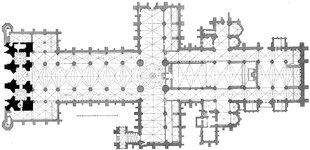
  1. Church layout (the plan). Understandably.
  2. Mouldings. Less understandably.
  3. How arches 'spring' from the columns that support them.
  4. Chancel arches.
  5. Fonts.
  6. Internal and external openings, known as squints, hagioscopes, and lychnoscopes.
This 1850 note about St Mary's Gillingham, Norfolk from the Archaeological Journal archive, is very representative of extreme interest in item 2: mouldings. So is this description of a Francisan 'friery' (their spelling, not mine) near Reading. (Both pdfs are also attached to this post.)

I expect most people know what mouldings are but are less aware of squints, hagioscopes and lychnoscopes. So let's have a look at them and come back to mouldings.
Squint_-_geograph.org.uk_-_525863.jpg
Squint at St Nicholas' church, Walcot, Lincolnshire. Source

For more examples of squints, hagioscopes, and lychnoscopes, look at the file 003_299_308.pdf attached to post-104477. You don't have to read it - just look at the images. Look at the plan of St Mary's, Bridgewater (p307 of the original journal's pagination). And the plan of St. Peter's, Charlton, Wiltshire (p308 of the original pagination). From that document:
the Squints would appear to have been originally carried across an external space.

There's a lot of this obsession attention to certain features in old works on churches. Perhaps antiquarians were on the Asperger's continuum.

But if they were, we would expect to see similar obsessive recording of details in the construction of the openings in church towers. In the case St Mary's at Gillingham above, we'd perhaps see details of the church tower's crenalations and of the little room-like affair at the top of the tower.

In surveys of churches generally, we'd seen important things like details of rainwater-management where roof meets wall, and, of course, how gargoyles are cantilevered out from walls. And perhaps we'd even see details of church footings, where church meets ground. An important aspect of any building. You do find a little of this. But, overwhelmingly, antiquarians were focused on the ground floor walls and on specific details of the external and internal openings in the ground floor walls.

Why?

I doubt the orthodox proposition that squints and hagioscopes were added to fix a poor view of the altar from parts of the church. Especially as some of these reveals were originally filled with tracery (which has often been cut out, we note). I also doubt these features were installed to improve the view for lepers standing in the porch or the churchyard.

To me, some of these features look more like waveguides and, in a few cases, conduits and funnels suitable for fluid management.

Since about 2010, Russian bloggers have pointed out the similarities between magnetrons (microwave generators) and church features like rose windows. In Кто есть Вольт? или Электрическое оборудование прошлого. Часть 2. (original Russian) (poor English auto-translation), you see alternative explanations being provided for some of the church details that obsessed English antiquarians.

For example:
7210326872_d123f751af_k.jpg
Artistry? Cargo cult imitation? Or misunderstood electrical component? Source

Other articles in that series are listed at Итог на 12.12.2014 (Russian original) (English translation).

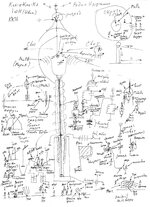
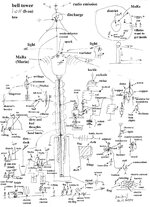
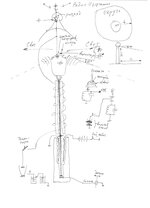
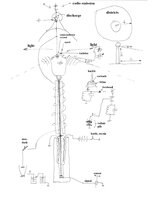
This article - Electrical Equipment of the Past - Part 6 (original Russian) (English translation) suggests an alternative origin for military gold braid. The authors' propose gold braid was the mobile part of a signalling system. That gold braid is a cargo cult remnant of electrical cable. That church bells and early bronze cannons were part of the base station equipment in those systems. Towards the bottom of that article are a couple of Dmitrijan's hand-drawn diagrams. Understanding them isn't critical to understanding this post. You can skip straight over them to the text below. But if you do want to read them, try these translations:

23853_original.jpg
Original

bell_cannon_eng.jpg
English translation

h-10.jpg
Original simpler version of core system

h-10_eng.jpg
English translation

The core structure in those diagrams is a church bell mounted upside down on top of a vertically-positioned cannon. It's a variant of the second image down in post-101535.

The diagrams illustrate warning and alarm systems that use high voltage, low current electricity. What we would call static electricity. They use the same principle as pre-WWI spark-gap transmitters. The Russian bloggers who propose this believe atmospheric humidity was much lower in the past. That our current humidity level is too high, too conductive for high voltage electricity to be used in this way now.

Note the coil wrapped around the cannon and bell assembly in the diagrams.

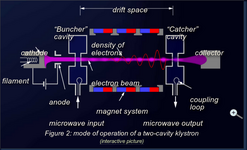
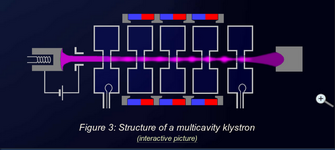
As noted in post-104477, the similarities between churches and klystrons (a high-power microwave generator and microwave amplifier) is also curious. The east-west orientation in a magnetic field... The general layout of central nave and chancel with chapels at the ends and/or sides... And the internal elements:

two-cavity klystron.png
Two-cavity klystron. Source

multi-cavity klystron.png
Multi-cavity klystron. Source

I appreciate this post is more technical than usual. Try to understand just these three things:

1. The two major components of radio-frequency generators and amplifiers ('transmitters') are coils and capacitors. They are connected together to manage and massage the flow of electric and magnetic fields through successive stages of inductance and capacitance. I won't get any more complex than that.

2. Microwave engineering uses the same principle - but at much higher frequencies. So it uses different components. Instead of coiled-wire inductors, it uses conductive plates. Instead of capacitors, it uses enclosed spaces.

3. Light engineering - lasers - is whole different ball of wax.

In my limited understanding of microwave engineering, two inputs are required. An energy source and an input signal. The electrons liberated by the coil (shown on the left in the above two images) provide the energy that a klystron uses to amplify the input signal (fed in from bottom left in the above two images). In the 20th Century, we used heat to liberate electrons in the filaments of electronic valves.

Perhaps phosporus was used to create heat. Perhaps. But dmitrijan and pro_vladimir's ideas about coil-wrapped cannons suggest our predecessors were able to produce microwave radio frequencies without burning phosphorus.

If we are looking at light amplifiers rather than microwave amplifiers - that is, at lasers rather than masers - then perhaps phosphorus supplied light for amplication rather than electrons.

I also wonder if the seemingly inexplicable antiquarian interest in the details of mouldings suggests the authors knew mouldings were critically important. That they played a role beyond decoration. But I don't buy into the proposition that the mouldings around church doors and windows were stone batteries or cables. Or even cargo cult remnants of them. I think another explanation should be explored.

In theory, magnetrons only function if their interior is a vacuum. And the same applies to their high power klystron cousins.

As laymen, we tend to think lasers also need an internal vacuum, although that turns out to be not quite true. But let's assume that magnetrons and klystrons always need a vacuum.

So then, when we notice the intricate internal mouldings around church doors and windows and around internal church openings (chancel arches, for example)...

And the stone tracery that infills church windows, as well as squints and hagioscopes, presumably to provide additional support to whatever was inserted between or across them...

And when we notice the seemingly extreme care early antiquarians put into recording the details of these features...

And when we remember that churches contain large organs, which are perhaps melodious, cargo cult copies of earlier devices that noisily pumped huge volumes of air out of churches...

Then we can wonder...

...could we be looking at evidence that 18th and 19th Century humans were trying to figure out how our predecessors created and maintained vacuum seals around openings in these large stone structures?
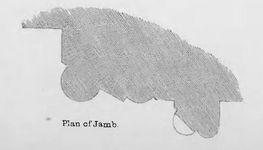
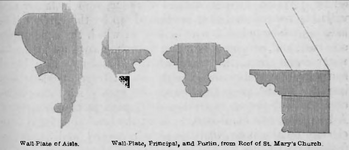
Jamb plan - St Marys Gillingham.pngwall-plates - St Marys Reading.png
Profiles of decorative features? Or seatings for vacuum seals? Source: attached pdfs

And anyway, why do we think churches are large?

Download Video

Other people's tools and toys. Source: Battlefield Earth, 2000

The hard part isn't understanding the engineering. It's accepting that we might be living amid the remains of other entities' toys and tools.

This might explain why John Byng's diaries show he was keen to buy scraps of blue and red glass from old churches. He would seek out church restorers to buy their scrap and recorded the prices he paid for it.

It might even explain why there is so little Piranesi-esque imagery of England's derelict 18th Century English churches. Even though we know some images were being drawn. From a review of Rutland Churches before Restoration by Gillian Wilkinson:

Review_Rutland_Churches_before_Restoration.png
Rutland Churches before Restoration. Review. Source

By the way, 'Camdenian' = William Camden = Cambridge Camden Society = Ecclesiological Society = cover it up with a cargo cult. Just my opinion.

From Cambridge Camden Society:
Its first activities were the collection of information about churches across the island. The amount of knowledge obtained from travellers' visits to and careful measurements of long-forgotten parish churches was immense...

Thus the Cambridge Camden Society amassed an enormous amount of information about medieval parish churches and came to be seen as an authority on religious architecture. Nor was this attribution misplaced. The society's vigour in examining and defining every detail of the medieval church was enormous, so much so that its magazine, the Ecclesiologist published both heated debates about the usage of small slits dubbed "lychnoscopes" that were observed in some churches and an invention called an "Orientator" that allowed one to determine whether or not a church faced exactly East. The motive for these extraordinarily scrutinising investigations was the society's unshakeable belief that man could regain the piety of the Middle Ages by carefully reconstructing them.
Not to mention its microwave technologies.

Their function as seatings for gaskets would explain why unrestored church (and cathedral) door and window mouldings are sometimes glossy with a dark brown patina. As if they had been coated with sealant grease. As if they had been greased and polished smooth by use or by maintenance.

ketton-h.jpg
Restored gasket seating. Source

From Gasket - Wikipedia:
Gaskets allow for "less-than-perfect" mating surfaces on machine parts where they can fill irregularities.

It is usually desirable that the gasket be made from a material that is to some degree yielding such that it is able to deform and tightly fill the space it is designed for, including any slight irregularities. Some types of gaskets require a sealant be applied directly to the gasket surface to function properly.

Some (piping) gaskets are made entirely of metal and rely on a seating surface to accomplish the seal;

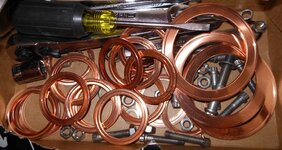
Used_copper_flange_gaskets_for_ultrahigh_vacuum_systems.jpg
Copper flange gaskets for ultra-high vacuum systems. Source

Again, reading John Byng, we see he and his boss Colonel Bertie were very interested in finding church 'brasses'. Which were brass, Jim, but not as we know it. From Church memorials | National Churches Trust:
brasses were actually made from latten - an alloy of copper and zinc.

And from The care and conservation of brasses:
Brass is a relatively soft metal and is easily scratched, bent and dented.

(a) In this [floor] position they can be exposed to heavy tread. This will cause flexing of the metal if there are any hollows below the brass plate. This can be the case if the bituminous mastic bedding has deteriorated...

(b) Some brasses appear to have spread due to pressure of passing feet.

Being relatively soft, flexing, and spreading into hollows are useful characteristics. For a gasket.

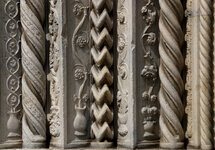
The ornate zig-zags around so many church doors could just possibly be registration lugs to help hold vertical-fit gaskets in place during installation and removal.

But I'm not a microwave engineer and you may not be on my wavelength.

Download Video

It doesn't look like anything to me. Source: Westworld S01, Ep01
 

Attachments

  • 007_142_146.pdf
    2.1 MB · Views: 234
  • 003_141_148.pdf
    980.3 KB · Views: 174
Last edited:
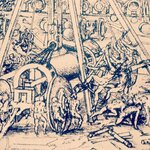
More images that possibly show evidence of giants working alongside chewmans in the past. Blogger vel124 zoomed in on Leonardo da Vinci's Cannon Foundry to show that the entities lending their weight to the levers (on the right in the image below) are taller than their fellow slaves workers dealing with the wheel and axle at the bottom of the image.

594974_original.jpg
Giants working with humants. Source

Leonardo da Vinci's Cannon Foundry is also mentioned in post-104122 for its helpful insight into the Health & Safety issues that might have justified Product Management's decision to create humants.

And a couple more doors...

MandS side door grabbed.png
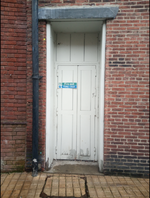
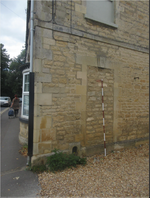
9ft side door in town centre, Lincoln, UK (Google Maps), (Google Streetview)

deeping side door grabbed.png
8ft side door in Market Deeping, UK (Google Maps), (Google Streetview)
 
Last edited:
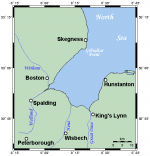
Following on from post-104000, on the mysteries of England's largest bay, the Wash...

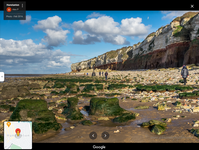
Some of the Electric Universe people wonder if a plasma event re-shaped southern England from its south coast to the Wash 200 miles further north. They focused on Hunstanton, a depressing seaside resort on the Wash's Norfolk coast.

Washmap.png
The Wash. Map source

Everything's Electric posted images of Hunstanton's mysterious 'beach balls':
norfolk-flint-concretions-rocks-boulders.jpg
Hunstanton beach balls fetchingly pictured against a red and white background. Image source


anton-cliffs-norfolk-geology-strata-boulders-lines.jpg
Between balls, straight lines run perpendicular to the cliff... Image source


hunstanton-norfolk-mysteries-puzzles-geology.jpg
Or, if you swing the other way, in straight lines perpendicular to the seashore. Image source

hunstanton-beaches-norfolk-wave-cut-platforms.jpg
Cut at 90 degrees by yet more straight lines so they look like blocks of geological fudge. Image source

crosscut beach bubbles.png
Lines parallel to the coast are less obvious because they tend to be more eroded, wider. Source: Google Maps

Hunstanton beach small scale.png
They're easier to see from above. Cliff-face on the right. Source: Google Maps

Hunstanton beach diagonals.png

As are the occasional, regularly-spaced, 45 degree diagonal lines. Source: Google Maps

Apparently, nature doesn't waste much time being chaotic.

And, apparently, geologists don't waste much time debating how Hunstanton's odd geology came about. But they do debate what Hunstanton's geology actually is. The linked paper, for example, discusses the debate about how to classify the rocks in Hunstanton's cliffs... Especially the iron-rich red layer.

Think electric, says Everything's Electric. From: https://www.everythingselectric.com/hunstanton-beach-balls-mystery/:
Were Hunstantons clifs, cliff layers, fossils, rock lines and the East Anglian coprolites all created by a large electrical discharge event between Portland in the south to the Wash where Hunstanton is located (near Norwich)?

Everything's Electric's page has more images and links to other possibly electrically-created geology around the world. Including:
  • Curio Bay and Catlins formation, New Zealand
  • St Paul’s Island, Malta, and its Quartz Island
  • Tumbrell Point, Malta
  • Dahlet Qorrot Bay and coastline, Gozo,
Take a look!

Alternatively, take a look at Malham Cove, Yorkshire, UK (Google Maps), (Google Streetview), (OpenStreetMap), (Flickr images).

The limestone 'pavement' above Malham Cove is also square-cut and also has occasional diagonal lines:
Malham Cove close up 2.png
Malham Cove 'pavement'. Source: Google Maps

BotS Malham 209art.jpg
Though this image shows them better. Image source

Malham Cove's pavement is something like 600m (2,000 ft) above sea level. Its fissures are narrow because they are only eroded by rain. Unlike Hunstanton beach's 'bubbles', whose fissures are scoured four times a day (think about it) by the Wash's 5.5m (18 ft) sand-loaded tides.

But, in each of these locations, what got the cuts started?

One option, not apparently considered for either place, is quarrying.

Let's take another look at the Al Naslaa split rock in Saudi Arabia. From post-104477:
ictured_has_become_a_popular_touri-m-54_163353-jpg.jpg
How would that cut look if the North Sea scoured it four times a day? Source

And if whatever cut it then moved around to make another cut or two at 90 degrees to the first:
e_smooth_front_surface_of_the_rock-a-53_163353-jpg.jpg
Al Naslaa rock smooth face, Saudi Arabia. Source

It's as if a trainee driver had practiced coordinating a 90 degree move of both their quarry-cutting machine's position and fine adjustment of the position of its circular-saw blade. The nearest of the second two cuts stops at the split that runs through the rock. In other words, the depth of the cut was controlled. These are manoeuvres you would need to be good at if you were carving bedrock into columns ready to be levered out of a quarry face.

At Malham Cove, for example.

Or Hunstanton.

A bit like this:


But let's not jump to conclusions. The quarry-giants may not have had access to modern, high-tech Hyundai saws. They may have used old-fashioned, piss-powered light-sabres.
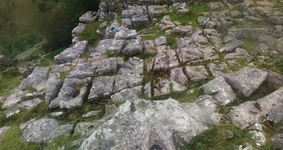
That would align us a little closer to the Everything's Electric people. With many tactical plasma events instead of one big plasma event.

Early training in how to use precision cutting tools could explain the progressive removal of limbs found in some skeletons at nearby Knobb's Farm (Google Maps), (Google Streetview), (OpenStreetMap), (Flickr images).

016-jpg.jpg
My first (slow) kill. Source

Quarrying might also explain the approx 20 mile gap in the iron-rich red rock which - theoretically - once ran from Hunstanton to the iron-rich 'Spilsby sandstones' 35 miles north-west in Lincolnshire's southern Wolds (see map on page 4 of the pdf. The dark green rocks...). You can also see the gap in the three green-shaded formations in this map:
eloi-bgs-bedroock-png.png
Eastern England: underlying bedrock. Source: British Geological Survey

It's hard to tell if they were quarried away because - as so often happens with neighbouring Lincolnshire - we learn in Some Notes on the North Norfolk Coast from Hunstanton to Brancaster, J. A Steers, 1934, that:
Unfortunately too this piece of shoreline is, for the most part, badly documented.

What there is a lot of documentation for is the alleged creation of Hunstanton by Hamon le Strange of the once-moated Old Hunstanton Hall. Which turns out to have seemingly unnecessary tunnel running from near its local church to, presumably the hall itself. But you can possibly connect the dots if you remember that 'Jamon' (with the 'J' pronounced as 'H') is Spanish for 'ham'. And that 'extranjero' is Spanish for 'foreign'. In fact the founding story of Hunstanton - and its architecture - is hammy. But that's a different kettle of fish.
Couldn’t help but think of this thread when I saw this
Lol! Great find. I wonder who pointed that out to David Szymanski. That these ideas are emerging does make me wonder if our creators - or their proxies - are trying to wake us up.

The built-in nature of this kind of fear reminded me of the interesting story about Malham Cove told by interviewee 'Shannon' in Brothers of the Serpent podcast episode 208. In this BotS episode about Yorkshire legends (from which I blagged the Malham Cove pavement image above), she recounts an unexpected memory that surfaced while undergoing trauma treatment following a bad car crash. Her story - and your David Szymanski quote - leave me wondering if perhaps our junk DNA carries important, survival-related memories from our predecessors.

Here's the audio clip:
Source: Brothers of the Serpent podcast, Ep 208
 
Last edited:
Those Hunstanton Beach Balls look like wooden coals from a fire, especially in the 3rd and 4th pictures.
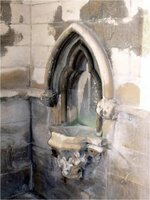
 
Those Hunstanton Beach Balls look like wooden coals from a fire, especially in the 3rd and 4th pictures.
Yes, like charcoal briquettes. Probably more so than blocks of fudge.
But I wasn't going to let the 'geological fudge' gag slip by unused.
 
What a bizarre and interesting diversion that illustrates the point of this thread - that people were used as material resources. Might it also be the power source of all that ancient tech - not resonance, or magnetism or some such - no. Was ancient tech 'wax'-powered?

Also interesting for the official origin story: Taking the piss - Wikipedia

And Phosphorus: Phosphorus - Wikipedia

Its crystal structure:
View attachment 13058
Not to mention the occult reference to Lucifer, the fact its crystal structure looks like 6 pyramids, or even a Maltese cross.

You may be on to something with your phosphorus equals Lucifer suggestion... I can see a couple of ways Lucifer - Bringer of Light - would be associated with danger if humans were used to distilling urine into white phosphorus at home.

In those times, careful handling of phosphorus would have to be taught. Passed on from generation to generation and also taught to chewmans newly imported into areas where phosphorus technology was being used (in the Roman 'shifting populations' model epitomised by Half Life 2, for example). In that scenario, the 'evil' Lucifer would be our cargo cult remnant of the careful handling rules that accompany working with phosphorus:
  • Keep Lucifer from corrupting you (phosphorus deforms your bones)
  • Lucifer lives in the dark away from sunlight
  • Cleanse Lucifer from yourself with water. 'Baptise' yourself to be free of Lucifer. Old churches often have little basins called 'piscinas' near the altar and sometimes immediately inside and/or outside of the main door.
piscina_St_Peter_old_edlinton_yorkshire.jpg
Piscina, St Peters, Old Edlinton, Doncaster, Yorkshire. Source
The simple visuals in that religious rule-set remind me how we seem designed to interpret simple black-and-white contrast patterns as a sign of unquestionable authority. Wearers of black suits and white shirts, black cassocks and white 'dog' collars, through to black and white police checks.

Lucifer as phosphorus would explain why we sometimes see Lucifer - in his various aliases - oddly associated with various churches, when you would think he, she or it would want to stay clear of churches.

We could also speculate that Lucifer, and his shining, Celtic god equivalent - Lugh of the Shining Face, Lugh Lamh-Fada of the Long Hand, Lugh of the Long Arm - might even have been co-opted into becoming St Hugh, patron saint of what seems to be the Devil's own church: Lincoln Cathedral.

Even the surviving mythology around Lugh of the Shining Face is quite revealing. From Mananaun wrapping him in a cloak before travelling to Lugh's rising in the west, as bright as the sun. From Ancient Pages: Lugh – Mighty God Of Light, Sun And Crafts In Celtic Beliefs:
Lugh was a beautiful fair-haired god with a shining face. He was the owner of a spear, a formidable weapon, never missing its goal. It was an "extension of his arm" and thus, he became known as Lugh “of the Long Arms”.

Lugh is also associated with the shape-shifting god Balor, about whom Patrick McCafferty and Mike Baillie wrote, in The Celtic Gods, p60:
Some of his followers were so ugly and rough they were frightful to look at, and some of them had only one hand and one foot.

Only one hand? Only one foot?

From All That's Interesting: Inside ‘Phossy Jaw':
Phossy jaw was also referred to as “Matchmaker’s leprosy,”

Because phossy jaw was an industrial injury common among matchstick girls:
Matchgirl_strikers.PNG
Early symptoms in matchstick girls. Source

phossyjaw.jpg
Phossy jaw. Source

From Strange Remains: The Horrific Disease that Causes Jawbones to Glow in the Dark and Rot Away:
Eventually the decaying tissue rots away causing a foul odor. Amputation used to be the only treatment.

And:
...the affected bones glow in the dark.

How might that look with the lights out?
romantic night with a match-girl.png
Phosphorus glow by night. Source: own photograph

Amazing who shows up in these phossy jaw stories. London theosophist Annie Besant campaigned for matchstick girls' rights. Her boss, theosophist Madame Blavatsky, also said Lucifer is definitely not Satan:
The original Hebrew text uses the word הֵילֵל which literally means “bright star” or “shining one,”

Even the Webbs and HG Wells Fabians got involved.

OK, glow-in-the-dark industrial injuries, check. Theosophists and Fabian Society involved, check. Got it - there's a conspiracy. But where does the Church fit in?

Answer: halos:

Masaccio_chapelle_Brancacci.png
Industrial injuries in the Christian tradition. Source

Medieval_Persian_manuscript_Muhammad_leads_Abraham_Moses_Jesus.jpg
Industrial injuries in the Persian tradition. Source

hug-lin-pi-jpg.jpg
And in the Lincoln Cathedral tradition. Source
Makes me wonder if we can, at last, unravel the goblet symbolism in that image. Phosphorus collection?

Anyway, back to The Celtic Gods:
As [Balor] was passing a forbidden house, he heard magicians chanting as they worked up a new spell of death. Balor looked in at the window of the forbidden house and was blinded by the plume of poisonous smoke from the spell that went straight into his face.

The military uses phosphorus for smoke screens. Though I think these days the military prefers red phosphorus for smokescreens because it's way safer than the white phosphorus chewmans urinate. From White Phosphorus: Systemic Agent:
White phosphorus fumes cause severe irritation and the sensation of a foreign body in the eye. This leads to excessive tear production (lacrimation), spasmodic blinking (blepharospasm), and increased sensitivity to light (photophobia).

White phosphorus particles are caustic and seriously damaging when in contact with tissues. They cause damage to the cornea. Examples include perforation, inflammation of the interior of the eyeball (endophthalmitis), and abnormal turning out of the eyelid (ectropion).

But a 'forbidden house' where magicians chanted death spells and smoke came out?

White smoke.jpg
White smoke emerges from the Vatican's Sistine Chapel chimney. Source

As for the chanted death spells:
exaltation_of_the_fabricant.png
Exaltation of the fabricant. Source: Cloud Atlas, 2012

Back to The Celtic Gods:
The Druids told him that his eye now had the power to kill, and if he opened his eye to look at anyone, that person would die - hence his name. Normally his eye was kept shut to protect his own people. However, against enemies the eye was opened and

could slay like a thunderbolt those on whom he looked in anger... [later as he got older]... the vast eyelid drooped over the death-dealing eye, and had to be lifted up by his men with ropes and pulleys when the time came to turn it on his foes.​

Hmmm, we've seen it before but let's look again and click on the link in the caption:
cannon-foundry-jpg.jpg
Were early bronze cannons actually lasers? Leonardo da Vinci's The Cannon Foundry. Source

By the way, in the 'churches as klystrons' post above, I meant to compare and contrast the two dark blue klystron images with this plan of Lincoln Cathedral:
LincCathplanDehio.jpg
Lincoln Klystron Cathedral. Source

But that's an aside.

The Irish said Lugh and Balor were gods. And not just elite, well-dressed gods like Protestant and Catholic gods. They were hard. They fought vast wars in the sky. Their wars killed a lot of humans. But the humans were just 'collateral'.

In The Celtic Gods, Patrick McCafferty and Mike Baillie claimed Irish memories tales of Lugh (and Balor) were sanitised in the 19th Century. On page 14, they demonstrate the scale of the pruning with a sample from a story re-written by Lady Augusta Gregory. The story is still bizarre but the re-written version is stripped of many supernatural details. Read The Celtic Gods for this and more signs that Lady Augusta Gregory and William Butler Yeats were re-seeding Ireland with a new culture, replacing its mythology with plays performed in Dublin's new Abbey Theatre.

Perhaps Gregory and Yeats were simply doing the Irish version of what the Tennyson family and their many literary colleagues in England were doing. In England's case, that was fabricating Chaucer and Shakespeare. And fabricating the history of the English language (also continued here).

Side-note: secondhand sellers of The Celtic Gods in the UK

Maybe the reason mankind suffers from amnesia is because mankind's memories were systematically discarded and replaced from the 17th Century onwards. That is: during and after the gods' global wars.

We could also wonder if the role of the newly-invented Church in the 19th Century was to cargo cult people's memories of the power of phosphorous. Which it did by re-working dangerous, ever-present phosphorus into the evil Lucifer. This in order to:
  • reduce industrial injuries, and
  • remove knowledge of a cheap, powerful, weapon from the still-to-be-working classes.
Download Video

British Industrial Revolution begins. Source: London Olympics opening ceremony, 2012
Just playing with ideas, of course. But it's odd how the phossy jaw industrial injury story parallels the radium girls' industrial injury story. It is as though a single narrative template was deployed twice to remove hands-on knowledge of two everyday power sources elements.

There are some amazing coincidences in these stories and institutions, don't you think?

Although mandatory, the imposition of a new culture wasn't necessarily a bad thing. Perhaps the Fomerians and Tuatha da Danann fought the 17th Century wars to take down the entities (drunkenly) running the 'nunneries', the pleasure gardens, the 'tier park' hunting grounds and the fast-food baby-eateries.
99u.jpg
The morning after the night before. Source: Barry Lyndon, 1975

And to flood and burn all those halls and mansions ruined in 1730 and 1760 - and being dismantled when John Byng toured them in around 1790:

barry-lyndon-3.jpg
The Romans. But not as we know them. Source: Barry Lyndon, 1975

Ties in with American Indian tales of hunting down red-haired cannibal giants, and with claims the Church introduced 'fish on Friday' to reduce the amount of cannibalism going on. It even ties in with a Rev George Oliver hint that the English ate meat - as long as it didn't walk on four legs.

By the way, the diaries of that connoisseur of the big meaty meal, John Byng, show him eating a lot of 'pickled salmon'. That's probably not remarkable if you're eastern European, Baltic, Slavic or north-east Asian. But if you're British, it's plain weird. The British don't have pickling skills. They especially don't have lacto-fermentation skills - which is what pickling seems to have been before it was industrialised. As any kimchi vendor will tell you.

So what was a high-fat fish doing - pickled and potted - on the menus of inns and taverns in Byng's late 18th Century England? I propose it was - for big meat-eaters like Byng - a poor substitute that had replaced the previously widely available lacto-fermented, potted, chewman babies.

Thanks Fomerians and Tuatha da Danann. I am grateful for what you did there.

The question is: why did the Fomerians and Tuatha da Danann bother to save chewmans - a semi-sentient, slave-cum-farm-animal - from the general destruction?

Trying to put ourselves into the mind-set of advanced entities isn't easy. But perhaps their thinking went something like this:
Those new, sentient-model chewmans could make useful caretakers. If they can learn some skillz, some Health & Safety... and quit pickling their babies for sale and distilling their urine.

And finally, where would we be without another tunnel story? Especially given the 'tunnels and denied tunnels' post that started off this thread...

A couple of days ago, I went over to Stamford, Lincolnshire, to follow up on the tunnel story told to me by the elderly chap mentioned in post-104407. Summary: When house-hunting decades ago, he had looked at the former rectory for All Saints church, Stamford (Google Maps), (Google Streetview), (OpenStreetMap), (Flickr images). In its cellar, he was shown the locked entrance to a tunnel. The vendor told him the tunnel ran under the road to the church.

I was trying to identify the house. Tricky because, apparently, three houses around there have been home to the vicar/rector of All Saints. Including its most famous vicar: the antiquarian William Stukeley. Unfortunately, I could only identify the two Stukeley houses on a street called Barn Hill (Google Maps), (Google Streetview), (OpenStreetMap). Closely inspecting the other houses naturally brought out one of the owners wanting to know what I was doing.

My mission explained, he told me his friends in Broadhembury, Devon, had discovered a tunnel in their cellar. It ran under the road to the church. These links are to the cottage but you can't miss Broadhembury's disproportiantely large church: (Google Maps), (Google Streetview), (OpenStreetMap), (Flickr images).

It led into the crypt. The tunnel walls had partially collapsed so lead-lined coffins had fallen into the tunnel. It all had to be sorted out before they could finish their refurb.

Then they found a well in the kitchen floor. About 1m wide. They glassed it over.

Now, why would a little village need a tunnel from a cottage to the church next door? Why would Broadhembury need such a big church? From previous posts we know eastern England was depopulated. In Broadhembury, do we see evidence of depopulation in western England too?

And the other question still applies: why would this rural location require a tunnel between church and cottage?
 
Last edited:
Inspiration has struck, so I want to review Wind in the Willows in context of the IHASFEMR thread.

The reason I made this connection at all, is from usselo's post on Byng.

As for what they ate, John Byng - mentioned in these posts - had a big appetite for meat, veg and booze. A typical supper:

"My supper consisted of a fine roasted fowl, cold ham, pickled salmon, artichoke and tarts."

His receipts and his comments about his meals don't - unfortunately - say 'cherub'. They do show he usually ate two or three types of meat at each sitting. And a lot of it. Typically a trout with mutton chops and peas, or a roast chicken or waterfowl plus two fish, sometimes followed by a plate of cold meat.

He rarely eats a single chop; instead he eats chops in the plural. Usually mutton in eastern England. Where he mentions eating veg, it's usually peas. Very rarely does he eat potatoes or carbohydrates in his main course.

This made me think of when Mole first meets Ratty, and they have a picnic:

‘Hold hard a minute, then!’ said the Rat. He looped the painter through a ring in his landing-stage, climbed up into his hole above, and after a short interval reappeared staggering under a fat, wicker luncheon-basket.
‘Shove that under your feet,’ he observed to the Mole, as he passed it down into the boat. Then he untied the painter and took the sculls again.
‘What’s inside it?’ asked the Mole, wriggling with curiosity.
‘There’s cold chicken inside it,’ replied the Rat briefly;
‘coldtonguecoldhamcoldbeefpickledgherkinssaladfrenchrollscresssandwichespottedmeatgingerbeerlemonadesodawater ——’
‘O stop, stop,’ cried the Mole in ecstacies: ‘This is too much!’
‘Do you really think so?’ enquired the Rat seriously. ‘It’s only what I always take on these little excursions; and the other animals are always telling me that I’m a mean beast and cut it VERY fine!’

(free download here: Download The Wind in the Willows free in PDF & EPUB format)

That passage is very reminiscent to me of Byng. But then when I thought more about it, there are some other strong correlations with the Wind in the Willows and our thread here.

Then I realised that Badger knows.

Presently they all sat down to luncheon together. The Mole found himself placed next to Mr. Badger, and, as the other two were still deep in river-gossip from which nothing could divert them, he took the opportunity to tell Badger how comfortable and home-like it all felt to him. ‘Once well underground,’ he said, ‘you know exactly where you are. Nothing can happen to you, and nothing can get at you. You’re entirely your own master, and you don’t have to consult anybody or mind what they say. Things go on all the same overhead, and you let ‘em, and don’t bother about ‘em. When you want to, up you go, and there the things are, waiting for you.’

The Badger simply beamed on him. ‘That’s exactly what I say,’ he replied. ‘There’s no security, or peace and tranquillity, except underground. And then, if your ideas get larger and you want to expand—why, a dig and a scrape, and there you are! If you feel your house is a bit too big, you stop up a hole or two, and there you are again! No builders, no tradesmen, no remarks passed on you by fellows looking over your wall, and, above all, no WEATHER. Look at Rat, now. A couple of feet of flood water, and he’s got to move into hired lodgings; uncomfortable, inconveniently situated, and horribly expensive. Take Toad. I say nothing against Toad Hall; quite the best house in these parts, AS a house. But supposing a fire breaks out—where’s Toad? Supposing tiles are blown off, or walls sink or crack, or windows get broken—where’s Toad? Supposing the rooms are draughty—I HATE a draught myself—where’s Toad? No, up and out of doors is good enough to roam about and get one’s living in; but underground to come back to at last—that’s my idea of HOME.’

The Mole assented heartily; and the Badger in consequence got very friendly with him. ‘When lunch is over,’ he said, ‘I’ll take you all round this little place of mine. I can see you’ll appreciate it. You understand what domestic architecture ought to be, you do.’

After luncheon, accordingly, when the other two had settled themselves into the chimney-corner and had started a heated argument on the subject of EELS, the Badger lighted a lantern and bade the Mole follow him. Crossing the hall, they passed down one of the principal tunnels, and the wavering light of the lantern gave glimpses on either side of rooms both large and small, some mere cupboards, others nearly as broad and imposing as Toad’s dining-hall. A narrow passage at right angles led them into another corridor, and here the same thing was repeated. The Mole was staggered at the size, the extent, the ramifications of it all; at the length of the dim passages, the solid vaultings of the crammed store-chambers, the masonry everywhere, the pillars, the arches, the pavements. ‘How on earth, Badger,’ he said at last, ‘did you ever find time and strength to do all this? It’s astonishing!’

‘It WOULD be astonishing indeed,’ said the Badger simply, ‘if I HAD done it. But as a matter of fact I did none of it—only cleaned out the passages and chambers, as far as I had need of them. There’s lots more of it, all round about. I see you don’t understand, and I must explain it to you. Well, very long ago, on the spot where the Wild Wood waves now, before ever it had planted itself and grown up to what it now is, there was a city—a city of people, you know. Here, where we are standing, they lived, and walked, and talked, and slept, and carried on their business. Here they stabled their horses and feasted, from here they rode out to fight or drove out to trade. They were a powerful people, and rich, and great builders. They built to last, for they thought their city would last for ever.’

‘But what has become of them all?’ asked the Mole.

‘Who can tell?’ said the Badger. ‘People come—they stay for a while, they flourish, they build—and they go. It is their way. But we remain. There were badgers here, I’ve been told, long before that same city ever came to be. And now there are badgers here again. We are an enduring lot, and we may move out for a time, but we wait, and are patient, and back we come. And so it will ever be.’

‘Well, and when they went at last, those people?’ said the Mole.

‘When they went,’ continued the Badger, ‘the strong winds and persistent rains took the matter in hand, patiently, ceaselessly, year after year. Perhaps we badgers too, in our small way, helped a little—who knows? It was all down, down, down, gradually—ruin and levelling and disappearance. Then it was all up, up, up, gradually, as seeds grew to saplings, and saplings to forest trees, and bramble and fern came creeping in to help. Leaf-mould rose and obliterated, streams in their winter freshets brought sand and soil to clog and to cover, and in course of time our home was ready for us again, and we moved in. Up above us, on the surface, the same thing happened. Animals arrived, liked the look of the place, took up their quarters, settled down, spread, and flourished. They didn’t bother themselves about the past—they never do; they’re too busy. The place was a bit humpy and hillocky, naturally, and full of holes; but that was rather an advantage. And they don’t bother about the future, either—the future when perhaps the people will move in again—for a time—as may very well be. The Wild Wood is pretty well populated by now; with all the usual lot, good, bad, and indifferent—I name no names. It takes all sorts to make a world. But I fancy you know something about them yourself by this time.’

‘I do indeed,’ said the Mole, with a slight shiver.

‘Well, well,’ said the Badger, patting him on the shoulder, ‘it was your first experience of them, you see. They’re not so bad really; and we must all live and let live. But I’ll pass the word around to-morrow, and I think you’ll have no further trouble. Any friend of MINE walks where he likes in this country, or I’ll know the reason why!’

When they got back to the kitchen again, they found the Rat walking up and down, very restless. The underground atmosphere was oppressing him and getting on his nerves, and he seemed really to be afraid that the river would run away if he wasn’t there to look after it. So he had his overcoat on, and his pistols thrust into his belt again. ‘Come along, Mole,’ he said anxiously, as soon as he caught sight of them. ‘We must get off while it’s daylight. Don’t want to spend another night in the Wild Wood again.’

‘It’ll be all right, my fine fellow,’ said the Otter. ‘I’m coming along with you, and I know every path blindfold; and if there’s a head that needs to be punched, you can confidently rely upon me to punch it.’

‘You really needn’t fret, Ratty,’ added the Badger placidly. ‘My passages run further than you think, and I’ve bolt-holes to the edge of the wood in several directions, though I don’t care for everybody to know about them. When you really have to go, you shall leave by one of my short cuts. Meantime, make yourself easy, and sit down again.’

The Rat was nevertheless still anxious to be off and attend to his river, so the Badger, taking up his lantern again, led the way along a damp and airless tunnel that wound and dipped, part vaulted, part hewn through solid rock, for a weary distance that seemed to be miles. At last daylight began to show itself confusedly through tangled growth overhanging the mouth of the passage; and the Badger, bidding them a hasty good-bye, pushed them hurriedly through the opening, made everything look as natural as possible again, with creepers, brushwood, and dead leaves, and retreated.

MendozaWIW003.png

I'm going to repeat some of the highlights from long passage above:

The Mole was staggered at the size, the extent, the ramifications of it all; at the length of the dim passages, the solid vaultings of the crammed store-chambers, the masonry everywhere, the pillars, the arches, the pavements.

This speaks for itself.

But as a matter of fact I did none of it—only cleaned out the passages and chambers, as far as I had need of them. There’s lots more of it, all round about.

Badger found these.

Well, very long ago, on the spot where the Wild Wood waves now, before ever it had planted itself and grown up to what it now is, there was a city—a city of people, you know. Here, where we are standing, they lived, and walked, and talked, and slept, and carried on their business. Here they stabled their horses and feasted, from here they rode out to fight or drove out to trade. They were a powerful people, and rich, and great builders. They built to last, for they thought their city would last for ever.’

Badger knows something... but not the whole story.

‘People come—they stay for a while, they flourish, they build—and they go. It is their way. But we remain. There were badgers here, I’ve been told, long before that same city ever came to be. And now there are badgers here again. We are an enduring lot, and we may move out for a time, but we wait, and are patient, and back we come. And so it will ever be.’

Badger is talking about "badgers", Grahame (the author) is talking about "people". The use of animals should be read - by us at least - as metaphorical - the 'animals' in the story are just a different type of conscious creature - inferior to the 'people' who build the infrastructure they now live in. George Orwell does something similar to this in Animal Farm.

‘When they went,’ continued the Badger, ‘the strong winds and persistent rains took the matter in hand, patiently, ceaselessly, year after year. Perhaps we badgers too, in our small way, helped a little—who knows? It was all down, down, down, gradually—ruin and levelling and disappearance.

'They' left. 'Badgers' may have helped build this, in their small way..

Animals arrived, liked the look of the place, took up their quarters, settled down, spread, and flourished. They didn’t bother themselves about the past—they never do; they’re too busy. The place was a bit humpy and hillocky, naturally, and full of holes; but that was rather an advantage. And they don’t bother about the future, either—the future when perhaps the people will move in again—for a time—as may very well be.

Repopulation.

‘You really needn’t fret, Ratty,’ added the Badger placidly. ‘My passages run further than you think, and I’ve bolt-holes to the edge of the wood in several directions, though I don’t care for everybody to know about them. When you really have to go, you shall leave by one of my short cuts.

Even more hidden tunnels.

the Badger, taking up his lantern again, led the way along a damp and airless tunnel that wound and dipped, part vaulted, part hewn through solid rock, for a weary distance that seemed to be miles. At last daylight began to show itself confusedly through tangled growth overhanging the mouth of the passage; and the Badger, bidding them a hasty good-bye, pushed them hurriedly through the opening, made everything look as natural as possible again, with creepers, brushwood, and dead leaves, and retreated.

Solidly made tunnels! Through solid rock, a distance that seemed to be miles. Badger covers up the exit to make everything look natural - he gains advantage from his secret knowledge.

Do I need to say more? Do I need to draw out the parallels with what we discuss here?

"DULCE DOMUM" is the name of one of the chapters in the book. "Sweet Home" indeed.

Toad goes to prison, but escapes. Unfortunately the wild wooders have taken his grand house - Toad Hall.

‘Well may you ask!’ said the Rat reproachfully. ‘While you were riding about the country in expensive motor-cars, and galloping proudly on blood-horses, and breakfasting on the fat of the land, those two poor devoted animals have been camping out in the open, in every sort of weather, living very rough by day and lying very hard by night; watching over your house, patrolling your boundaries, keeping a constant eye on the stoats and the weasels, scheming and planning and contriving how to get your property back for you. You don’t deserve to have such true and loyal friends, Toad, you don’t, really. Some day, when it’s too late, you’ll be sorry you didn’t value them more while you had them!’

‘I’m an ungrateful beast, I know,’ sobbed Toad, shedding bitter tears. ‘Let me go out and find them, out into the cold, dark night, and share their hardships, and try and prove by——Hold on a bit! Surely I heard the chink of dishes on a tray! Supper’s here at last, hooray! Come on, Ratty!’

The Rat remembered that poor Toad had been on prison fare for a considerable time, and that large allowances had therefore to be made. He followed him to the table accordingly, and hospitably encouraged him in his gallant efforts to make up for past privations.

Lol - ratty and toad need a plate or 3 of mutton chops and cold salmon, to recover their spirits!

Despite the disappointment of the loss of his house, Ratty, Mole and Badger have got plans to recover it. This next section describes the plan.

By this time they were all three talking at once, at the top of their voices, and the noise was simply deafening, when a thin, dry voice made itself heard, saying, ‘Be quiet at once, all of you!’ and instantly every one was silent.

It was the Badger, who, having finished his pie, had turned round in his chair and was looking at them severely. When he saw that he had secured their attention, and that they were evidently waiting for him to address them, he turned back to the table again and reached out for the cheese. And so great was the respect commanded by the solid qualities of that admirable animal, that not another word was uttered until he had quite finished his repast and brushed the crumbs from his knees. The Toad fidgeted a good deal, but the Rat held him firmly down.

When the Badger had quite done, he got up from his seat and stood before the fireplace, reflecting deeply. At last he spoke.

‘Toad!’ he said severely. ‘You bad, troublesome little animal! Aren’t you ashamed of yourself? What do you think your father, my old friend, would have said if he had been here to-night, and had known of all your goings on?’

Toad, who was on the sofa by this time, with his legs up, rolled over on his face, shaken by sobs of contrition.

‘There, there!’ went on the Badger, more kindly. ‘Never mind. Stop crying. We’re going to let bygones be bygones, and try and turn over a new leaf. But what the Mole says is quite true. The stoats are on guard, at every point, and they make the best sentinels in the world. It’s quite useless to think of attacking the place. They’re too strong for us.’

‘Then it’s all over,’ sobbed the Toad, crying into the sofa cushions. ‘I shall go and enlist for a soldier, and never see my dear Toad Hall any more!’

‘Come, cheer up, Toady!’ said the Badger. ‘There are more ways of getting back a place than taking it by storm. I haven’t said my last word yet. Now I’m going to tell you a great secret.’

Toad sat up slowly and dried his eyes. Secrets had an immense attraction for him, because he never could keep one, and he enjoyed the sort of unhallowed thrill he experienced when he went and told another animal, after having faithfully promised not to.

‘There—is—an—underground—passage,’ said the Badger, impressively, ‘that leads from the river-bank, quite near here, right up into the middle of Toad Hall.’

‘O, nonsense! Badger,’ said Toad, rather airily. ‘You’ve been listening to some of the yarns they spin in the public-houses about here. I know every inch of Toad Hall, inside and out. Nothing of the sort, I do assure you!’

‘My young friend,’ said the Badger, with great severity, ‘your father, who was a worthy animal—a lot worthier than some others I know—was a particular friend of mine, and told me a great deal he wouldn’t have dreamt of telling you. He discovered that passage—he didn’t make it, of course; that was done hundreds of years before he ever came to live there—and he repaired it and cleaned it out, because he thought it might come in useful some day, in case of trouble or danger; and he showed it to me. “Don’t let my son know about it,” he said. “He’s a good boy, but very light and volatile in character, and simply cannot hold his tongue. If he’s ever in a real fix, and it would be of
use to him, you may tell him about the secret passage; but not before.”’

The other animals looked hard at Toad to see how he would take it. Toad was inclined to be sulky at first; but he brightened up immediately, like the good fellow he was.
‘Well, well,’ he said; ‘perhaps I am a bit of a talker. A popular fellow such as I am—my friends get round me—we chaff, we sparkle, we tell witty stories —and somehow my tongue gets wagging. I have the gift of conversation. I’ve been told I ought to have a salon, whatever that may be. Never mind. Go on, Badger. How’s this passage of yours going to help us?’

‘I’ve found out a thing or two lately,’ continued the Badger. ‘I got Otter to disguise himself as a sweep and call at the back-door with brushes over his shoulder, asking for a job. There’s going to be a big banquet to-morrow night. It’s somebody’s birthday—the Chief Weasel’s, I believe—and all the weasels will be gathered together in the dining-hall, eating and drinking and laughing and carrying on, suspecting nothing. No guns, no swords, no sticks, no arms of any sort whatever!’

‘But the sentinels will be posted as usual,’ remarked the Rat.

‘Exactly,’ said the Badger; ‘that is my point. The weasels will trust entirely to their excellent sentinels. And that is where the passage comes in. That very useful tunnel leads right up under the butler’s pantry, next to the dining-hall!’

‘Aha! that squeaky board in the butler’s pantry!’ said Toad. ‘Now I understand it!’

‘We shall creep out quietly into the butler’s pantry—’ cried the Mole. ‘—with our pistols and swords and sticks—’ shouted the Rat. ‘—and rush in upon them,’ said the Badger.
‘—and whack ‘em, and whack ‘em, and whack ‘em!’ cried the Toad in ecstasy, running round and round the room, and jumping over the chairs. ‘Very well, then,’ said the Badger, resuming his usual dry manner, ‘our plan is settled, and there’s nothing more for you to argue and squabble about. So, as it’s getting very late, all of you go right off to bed at once. We will make all the necessary arrangements in the course of the morning to-morrow.’

That very useful tunnel leads right up under the butler’s pantry, next to the dining-hall!

Of course - straight into the butler's pantry!

The next section is the execution of the plan, using the secret tunnel:
So at last they were in the secret passage, and the cutting-out expedition had really begun!

It was cold, and dark, and damp, and low, and narrow, and poor Toad began to shiver, partly from dread of what might be before him, partly because he was wet through. The lantern was far ahead, and he could not help lagging behind a little in the darkness. Then he heard the Rat call out warningly, ‘COME on, Toad!’ and a terror seized him of being left behind, alone in the darkness, and he ‘came on’ with such a rush that he upset the Rat into the Mole and the Mole into the Badger, and for a moment all was confusion. The Badger thought they were being attacked from behind, and, as there was no room to use a stick or a cutlass, drew a pistol, and was on the point of putting a bullet into Toad. When he found out what had really happened he was very angry indeed, and said, ‘Now this time that tiresome Toad SHALL be left behind!’

But Toad whimpered, and the other two promised that they would be answerable for his good conduct, and at last the Badger was pacified, and the procession moved on; only this time the Rat brought up the rear, with a firm grip on the shoulder of Toad.

So they groped and shuffled along, with their ears pricked up and their paws on their pistols, till at last the Badger said, ‘We ought by now to be pretty nearly under the Hall.’

Then suddenly they heard, far away as it might be, and yet apparently nearly over their heads, a confused murmur of sound, as if people were shouting and cheering and stamping on the floor and hammering on tables.

The Toad’s nervous terrors all returned, but the Badger only remarked placidly, ‘They ARE going it, the Weasels!’ The passage now began to slope upwards; they groped onward a little further, and then the noise broke out again, quite distinct this time, and very close above them. ‘Ooo-ray-ooray-oo-ray-ooray!’ they heard, and the stamping of little feet on the floor, and the clinking of glasses as little fists pounded on the table. ‘WHAT a time they’re having!’ said the Badger. ‘Come on!’ They hurried along the passage till it came to a full stop, and they found themselves standing under the trap-door that led up into the butler’s pantry.

Such a tremendous noise was going on in the banqueting-hall that there was little danger of their being overheard. The Badger said, ‘Now, boys, all together!’ and the four of them put their shoulders to the trap-door and heaved it back. Hoisting each other up, they found themselves standing in the pantry, with only a door between them and the banqueting-hall, where their unconscious enemies were carousing.

I'll leave it at that. The story is short and charming - well worth a read. There is more in there, for sure.

But I want to point out how it re-iterates a lot of the points we have discussed here. Grand houses, miles of secret tunnels, fine and rich food, lots of mystery re the tunnels and their creators with more information being held back by those in the know (Badger).

And what of Kenneth Grahame the author of The Wind in the Willows? From Kenneth Grahame - Wikipedia:

Grahame wanted to attend Oxford University, but was not allowed to do so by his guardian on grounds of cost. Instead he was sent to work at the Bank of England in 1879, and rose through the ranks until retiring as its Secretary in 1908 due to ill health,[4] which may have been precipitated by a possibly political shooting incident at the bank in 1903. Grahame was shot at three times, but all the shots missed him.

An alternative explanation, given in a letter on display in the Bank museum, is that he had quarrelled with Walter Cunliffe, one of the bank's directors, who would later become Governor of the Bank of England, in the course of which he was heard to say that Cunliffe was "no gentleman". His retirement was enforced ostensibly on health grounds. He was awarded an annual pension of £400, but a worked example on display indicates he was actually due to receive £710.

Interesting story - we can also see that he was a connected fellow.
 
Last edited:
Tips
Tips
Please respect our Posting Rules.
Back
Top