Evidence humans were created and traded as slaves, food, entertainment and material resources (IHASFEMR)

I did find that reference I mentioned earlier some weeks ago, but haven't been here much and if you will forgive me dear Usselo, it is actually an important part of a thread I am working on with regard to recurring Cataclysms and human consciousness so I will hang on to it selfishly for now. šŸ™
Not a problem!

Now catching up on unresponded comments...

6079smithw said:
Thos thread is depressing and very disturbing.
Ps, someone refers to the observation deck homeless man video. I couldn't find it on youtube - has it been purged?

The video 6079smithw referred to (was in this post) and is now unavailable. This clip shows the relevant part:
Download Video

Confrontation over homeless man taken away, declared dead. Source: Observation Deck. YT channel

The above footage emerged around the time 'opt-out' organ harvesting became UK law (22 May 2020), along with the following reassurance:

Download Video

"There was an absolutely extraordinary response", Regime Empath Louise Casey. Source

I asked a homeless guy - let's call him Chris - if he had been 'brought in' during the Covid lockdowns. Chris said he and his mates had got as far away as they could, apparently fleeing into the countryside.

When they came back, he pitched his tent out of sight in woods on the edge of town. At 3AM, the police turfed him out. He said:

Why did it have to be 3AM? Why not 6AM?

A rhetorical question, but it does have an answer:

Download Video

We know who they are and where they are living. UK Housing Secretary Robert Jendrick. Source

Jendrick went on to say rough sleepers will be introduced to the private rental sector. That probably won't turn out well given the state's own white papers about problems with the private rental sector.

In about 2015, UK entities like the Bank of England and think-tanks like the Rowntree Foundation were discussing obstacles to the introduction of a UK state digital currency. They wanted transactions to be linked to identifiable individuals. But to do that, all individuals had to be verifiably identified beforehand. One of the obstacles to this was the 'un-addressed'. On any given night, around 90,000 individuals were visibly sleeping rough. But up to 1.1m individuals were 'un-addressed'. These were identified as couch-surfers, workplace-sleepers and car/van sleepers. The invisible homeless.

It is conceivable that behind global lockdown's freezing of individual movement was an attempt to link various phone hardware and software identifiers, location-habits and contact-habits to un-addressed individuals on a global scale. Examined in this way, the above clip could be seen as Jendrick admitting the lockdown scheme had been 'largely' successful in the UK.

Although state/bank digital currencies are contentious, questions of the rightness or wrongness of digital currencies, state/bank digital currencies, central bank fiat-creation, etc, become small concerns when considered against the probability that humanity is being farmed and - judging by the experiences of people like Chris - farmed very poorly. Just my personal view.

As for Chris, he is still in a tent but - good news - he still has his organs.

Sapiot said:
Might be for sucking liquid, like a drinking straw. Maybe the saying to scramble your brain was because they literally did that, resulting in a soup or slurry.

Gypsum Fantastic said:
They... were on Earth to harvest humans for food. Stored in pink cocoons where the body slowly was turned into a pink/red gloopy substance, which they drank through straws like a milkshake. Daft as this all sounds could be another of Hollywood's 'hidden in plain sight', albeit in a completely exaggerated way of course.

Download Video

Note the bubbles in the blood. Source: Killer Clowns from Outer Space, 1988

This scene may not be completely exaggerated.

Another straw-sucking moment from Futurama:
Download Video

Futurama S01, Ep07

Some observations about Killer Clowns from Outer Space:
  • The acting is hammy. Especially by the actors playing humans. Ham...
  • The film's humans vary from hysterical to rigid-minded but all are generally a bit slow off the mark.
  • The clowns work well individually and together.
  • The humans are divided by poorly contained emotional impulses (love seeking, love conflicts) and workplace resentments.
  • The clowns' physical appearance and bumbling gait makes them look clumsy but really, they are dexterous and very competent.
  • The clowns are good at manipulating the environment to the point where they are having fun as they go about harvesting humans. That playful approach to their work is usually absent from human organisations.
  • The clowns are notably good at chemistry, presumably enzyme chemistry.
  • The clowns understand how humans think, feel, and how humans will react.
  • The clowns tend to use stage-sets and stage effects to disorient and confuse humans. They understand this as an area of human weakness and the clowns exploit it.
And, with that last item in mind, perhaps consider reading the first part of this post again.
 
Tim Cullen takes on mainstream history's chronology of North-West European floods. The PDF is linked to at Finistere Catastrophes Chronology, where the comments are worth reading.

Cullen's significant flood years are:
  • 807 AD
  • 1172 AD
  • 1287 AD
  • 1570 AD
The 1570 AD flood continued as rising sea levels into the early 18th Century before falling (if I understood Cullen correctly). Chronologically, a long 1570 flood is a good fit with evidence that Britain's industrial revolution was the result of humans taking over their predecessors' remaining technologies.

Moving back one flood, Tim Cullen has also presented evidence of 'a dreadful storm' or major sea 'trangression' into mainland England around 1287. And 1285 AD is cited in I G Simmons of Durham (UK) University Geography department's study of sea level change and flood defences in east Lincolnshire:, which notes in Margins of the East Fen: Historic Landscape Evolution : Section 3 - Comparisons - Durham University:

When reading Victoria County History records, you'll often find variants of this chronology of the prosperity of Thorney Abbey, Cambridgeshire:


Translation:


Side-note: Only a coincidence theorist would notice the 1291 sea level rise is close to England's first 'Dissolution': the 1308-1312 dissolution of the Knights Templar and Knights of St Lazarus - whose mudflooded monasteries were inherited by the Knights Hospitaller. Or that from 1538 onwards, the remains of the Thorney site were leased to 'Walter Williams or Crumwell of Chatteris'; Chatteris being located between the various farms inherited and acquired by Oliver Cromwell. ;)

The Durham team have plenty more for flood nerds:
Simmons doesn't speculate about what caused these sea level changes. Cullen thinks tectonic-scale crustal movements caused them. That is: wide area earthquakes.

Do we have have evidence of earthquakes around these flood years?

Musson's The seismicity of the British Isles to 1600 reviewed early British earthquake reports. It supports major earthquake events around the same times as Cullen's and Simmons floods, though not 708. It's interesting reading: for some unexplored reason, Britain and parts of north-west Europe experienced wide area earthquakes in medieval times. Then they stopped.

Why then? And why not now? Do earthquake zones migrate? Do they come and go?

Orthodoxy says the Romans left Britain in the fifth century. Alt-history says the Pompeii evidence points to a Roman ending around 1631. We can leave orthodoxy for the orthodox and instead, ask ourselves if the disappearance of the Romans from Britain might be connected to the medieval earthquakes.

Perhaps the onset of the Little Ice Age was also connected in some way. Perhaps to Romans' disappearance (or their transformatinon into something else), perhaps to the flooding, perhaps to the Welland's silting up, perhaps to the shortage of labour afterwards.

From Little Ice Age by Michael Mann:


Interesting that Switzerland should start to see cold weather about the time (ten years later) that this bizarre statue (mentioned earlier) was erected in Berne, Switzerland:

View attachment 11793
History in your face. The Kindlifresser. Source

Perhaps flood-fearing entities set themselves up in Switzerland around that time. Or perhaps they used climate freezing as part of quarrying operations.

Not far from Thorney and ten miles north of the mudflooded 'Roman' port of Castor (Durobrivae) - featured in SH Archive - Clueless Historians in Castor, UK: Roman this, Roman that... - is Stamford. While Durobrivae was a major Roman port until it was mudflooded, Stamford was a major medieval port until its river - the River Welland - silted up was blocked by 'mill builders' some time before 1571. The link describes how the Stamford Canal was built to reconnect silted Stamford to the sea via a port at Market Deeping, six miles downstream. The Stamford Canal has a puzzling history.

It's puzzling because:
  • There are no engineering documents for the canal and few documents of any other kind related to it.
  • There are quicker, cheaper ways to deal with watermills blocking trade to a major port (and their owners) than by hand-building a six mile, 12-lock canal.
  • The canal's construction was legislated for in 1571 - 50 years before work actually began. Work was delayed due lack of contractors with canal-building skills.
  • Once started, the canal took a century to finish.
  • The canal's completion occurred 100 years before Britain's Industrial Revolution, making it one of the first canals dug in Britain after the Romans left.
Possibly, there are perfectly orthodox explanations for the delays and lack of documentation. However, Simmons and his Durham team noted the odd unavailability of some Lincolnshire records for their research on flooding 30 miles north east of Stamford. And although it wasn't in Simmons' remit, there is anecdotal evidence that parish records were removed and/or stolen from fenland Lincolnshire churches and houses during the 18th century. Absence of the usual written evidence suggests attempts to hide the real history of the area.

Possibly, the puzzles are simply that the Stamford Canal was an early attempt by the English to build an ambitious, 12-lock canal at the start of a crop-killing, people-killing Little Ice Age, just as John Dee and colleagues discover science, maths and navigation and Britain's elites begin colonising the world.

Possibly, the canal was an existing mudflooded canal that was partially dug out, in which case the delays might have been due to post-flood shortages of any kind of human labour. Or shortages of the skills required to repair and/or build 12 canal locks. Or both.

Regardless, once finished, Stamford's new canal joined the River Welland a mile west of Market Deeping. Most of what remains today is dry except for the last mile or so before it joins the River Welland. Maps mark its remains as 'River Welland', though it is obviously a cut-off canal - its course is straighter and its waters are visibly slower flowing than the Welland's.

That's where another puzzle emerges. For about half a mile before reaching the two bridges that cross the two watercourses, northbound drivers on the A15 Market Deeping bypass get the impression they are driving uphill. Checked on a topographical map, it turns out they are correct. They are driving uphill towards a canal and a river.

It's reasonable for a canal's course to follow higher ground. It is not reasonable for a natural river's course to follow higher ground. The video below shows the two Wellands' routes over high ground (lighter blue), skirting lower ground (deeper blue verging on purple) to their right. The Stamford Canal and the River Welland emerge at bottom left and flow diagonally up and to the right (north east) before turning right (east) and meeting up just inside the A15 bypass.

Mouse cursor 'taps' show the height above sea level in each location (in feet).

The most reasonable explanation is that the River Welland was also canalised and forced to join the Stamford Canal rather than take its natural course across the low ground to east-south-east. That would suggest an effort to create a well-watered 'river' port on higher ground at Market Deeping.

Perhaps the canal's missing documentation would explain the River Welland's seemingly artificial course. But it would be a breakthrough if its documentation were found because the River Welland isn't the only Lincolnshire river with an 'enigmatic' course. In fact, the Welland is one of the few Lincolnshire rivers whose enigmatic course has not already been puzzled over in some geographer's academic paper.

Market Deeping also boasts a few puzzles of its own. It's eastern extension - upmarket Deeping St James - has a former market cross with the remains of a small gaol (jail) built into its base. With:


View attachment 11820
Remains of Deeping St James' cross, circa 1965. Source

Jail? Or a market day pen for small, sentient produce and slaves?

View attachment 11821
It really is in your face. Circa earlier. Source

Market Deeping's central market cross is one of 10,000 (out of around 12,000) crosses that were destroyed by alleged 'iconoclasts' in the 16th and 17th centuries (Source).

Just like nearby Stamford, Market Deeping seems remarkably well-connected to English royalty. From the same source as the above image:


Condensing other parts of that page:


And - again from the same source - what provoked Elizabeth I to order a survey of her lands in East Deeping in 1538?

But that page may also hold a clue to the missing Stamford Canal documentation, the gravity-defying course of the River Welland and the possibility that Market Deeping was created around an artificially created river port:


You really should be concerned at finding another reference to a Norman 'garden of pleasure', but at least we now have a provisional explanation for the apparent canalisation of the River Welland. And a competing build date for the Stamford Canal, not to mention Market Deeping itself: during the first two decades of the 12th Century.

Now that is counter-narrative!

Another mystery is how some of Market Deeping's old stone houses acquired their cute, but unfeasibly low, front doors. The image shows one of a handful of Deeping doors that are about 5 ft, one inch high. The striped pole in the image is 2 m (6 ft, 6 in) long - more or less the same height as a standard modern door.


View attachment 11782
Church Street, Market Deeping (Google Maps), (Google Streetview)
Deeping is well-known for its low front doors. It is not well-known for its tall front doors. That's because their original height has been hidden.

A couple of houses up the street from the cute-doored house above is the White Horse pub. Its doorway has been shortened with a crude stone infill:

View attachment 11783
White Horse, Church Street, Market Deeping (Google Maps), (Google Streetview)

What would we find if we removed the grandiose triangular portico affair above the infill? Would we find the original doorway was even higher than the top edge of the visible infill?

Before we explore a possible answer to that question, let's note that shrinking front doors are common all over eastern England. Usually these front doorways are arched. In poorer buildings - those whose front door opens directly on to the street - their original height has been reduced by a plywood cover-board nailed to a poorly-fitting wood frame. In posher buildings - meaning: buildings with front gardens - the door height has usually been reduced with well-fitting glass 'fanlights'.

From Glemsford, Suffolk:
View attachment 11784
The Rectory, Glemsford, Suffolk (Google Maps), (Google Streetview)

Some have been reduced with a brick infill. An example from Bury St Edmunds, Suffolk:
View attachment 11785
Build an arch, lay bricks beneath it :rolleyes:

If you get bored of English doors, try Doors for Giants (Russian), (English translation). But if you aren't bored, let's go back to Market Deeping and see if we can find any clues about what was might have been hidden behind the White Horse's portico.

About 250 yards south of the White Horse is this building. An inscription in the wooden lintel about window dates it to "Anno Domini 1640":
View attachment 11786
Looks like being 9ft tall went out of fashion (Google Maps), (Google Streetview)
The striped pole shows this doorway is 3m (10 ft) high. A stable door perhaps? The average stable door is 2.085m (6 ft, 10 in) high. The shorter door at the far end of the stone building is part of a later extension or rebuild. The even shorter blue door (in the white building at the left of the image) is modern standard door height.

Once you develop an eye for how door heights have been discretely reduced, you find them everywhere, at least in eastern England. Like English churches, they are a ubiquitous feature of the built environment. And like almost all English churches - their construction history is missing.

A bit like the Stamford Canal.

England's built environment is like a stage-set, a stage-set hastily adapted for people our size. Why is it like this? Is something being hidden?

Given that flood events are also missing from English history but somewhat present in Belgian, Dutch and German history, and given that the Dutch flood accounts often report floods as having been worse in England, is it possible that England's floods involved realities that have also been hidden?

The same flood years - and later on, fire years - come up time and time again. The same mysterious gaps in documentation and the same explanations come up time and time again. Summarising what the clues left at the scene say about climate and chronology, they seem to say: sea levels rose from 1285 onwards, until a 1540 flood event. That event was a cold, wet start to a multi-year process that seems to have culminated in the late 18th century with fire and fighting. And perhaps these processes led to our current level of 'freedom'.

Animal Farm by George Orwell. First paragraph

Key entities in Animal Farm:
lots of writing by this "Cullin" guy.

Could that be a nod to events where they're "cullin' " humans?
Tim Cullen takes on mainstream history's chronology of North-West European floods. The PDF is linked to at Finistere Catastrophes Chronology, where the comments are worth reading.

Cullen's significant flood years are:
  • 807 AD
  • 1172 AD
  • 1287 AD
  • 1570 AD
The 1570 AD flood continued as rising sea levels into the early 18th Century before falling (if I understood Cullen correctly). Chronologically, a long 1570 flood is a good fit with evidence that Britain's industrial revolution was the result of humans taking over their predecessors' remaining technologies.

Moving back one flood, Tim Cullen has also presented evidence of 'a dreadful storm' or major sea 'trangression' into mainland England around 1287. And 1285 AD is cited in I G Simmons of Durham (UK) University Geography department's study of sea level change and flood defences in east Lincolnshire:, which notes in Margins of the East Fen: Historic Landscape Evolution : Section 3 - Comparisons - Durham University:

When reading Victoria County History records, you'll often find variants of this chronology of the prosperity of Thorney Abbey, Cambridgeshire:


Translation:


Side-note: Only a coincidence theorist would notice the 1291 sea level rise is close to England's first 'Dissolution': the 1308-1312 dissolution of the Knights Templar and Knights of St Lazarus - whose mudflooded monasteries were inherited by the Knights Hospitaller. Or that from 1538 onwards, the remains of the Thorney site were leased to 'Walter Williams or Crumwell of Chatteris'; Chatteris being located between the various farms inherited and acquired by Oliver Cromwell. ;)

The Durham team have plenty more for flood nerds:
Simmons doesn't speculate about what caused these sea level changes. Cullen thinks tectonic-scale crustal movements caused them. That is: wide area earthquakes.

Do we have have evidence of earthquakes around these flood years?

Musson's The seismicity of the British Isles to 1600 reviewed early British earthquake reports. It supports major earthquake events around the same times as Cullen's and Simmons floods, though not 708. It's interesting reading: for some unexplored reason, Britain and parts of north-west Europe experienced wide area earthquakes in medieval times. Then they stopped.

Why then? And why not now? Do earthquake zones migrate? Do they come and go?

Orthodoxy says the Romans left Britain in the fifth century. Alt-history says the Pompeii evidence points to a Roman ending around 1631. We can leave orthodoxy for the orthodox and instead, ask ourselves if the disappearance of the Romans from Britain might be connected to the medieval earthquakes.

Perhaps the onset of the Little Ice Age was also connected in some way. Perhaps to Romans' disappearance (or their transformatinon into something else), perhaps to the flooding, perhaps to the Welland's silting up, perhaps to the shortage of labour afterwards.

From Little Ice Age by Michael Mann:


Interesting that Switzerland should start to see cold weather about the time (ten years later) that this bizarre statue (mentioned earlier) was erected in Berne, Switzerland:

View attachment 11793
History in your face. The Kindlifresser. Source

Perhaps flood-fearing entities set themselves up in Switzerland around that time. Or perhaps they used climate freezing as part of quarrying operations.

Not far from Thorney and ten miles north of the mudflooded 'Roman' port of Castor (Durobrivae) - featured in SH Archive - Clueless Historians in Castor, UK: Roman this, Roman that... - is Stamford. While Durobrivae was a major Roman port until it was mudflooded, Stamford was a major medieval port until its river - the River Welland - silted up was blocked by 'mill builders' some time before 1571. The link describes how the Stamford Canal was built to reconnect silted Stamford to the sea via a port at Market Deeping, six miles downstream. The Stamford Canal has a puzzling history.

It's puzzling because:
  • There are no engineering documents for the canal and few documents of any other kind related to it.
  • There are quicker, cheaper ways to deal with watermills blocking trade to a major port (and their owners) than by hand-building a six mile, 12-lock canal.
  • The canal's construction was legislated for in 1571 - 50 years before work actually began. Work was delayed due lack of contractors with canal-building skills.
  • Once started, the canal took a century to finish.
  • The canal's completion occurred 100 years before Britain's Industrial Revolution, making it one of the first canals dug in Britain after the Romans left.
Possibly, there are perfectly orthodox explanations for the delays and lack of documentation. However, Simmons and his Durham team noted the odd unavailability of some Lincolnshire records for their research on flooding 30 miles north east of Stamford. And although it wasn't in Simmons' remit, there is anecdotal evidence that parish records were removed and/or stolen from fenland Lincolnshire churches and houses during the 18th century. Absence of the usual written evidence suggests attempts to hide the real history of the area.

Possibly, the puzzles are simply that the Stamford Canal was an early attempt by the English to build an ambitious, 12-lock canal at the start of a crop-killing, people-killing Little Ice Age, just as John Dee and colleagues discover science, maths and navigation and Britain's elites begin colonising the world.

Possibly, the canal was an existing mudflooded canal that was partially dug out, in which case the delays might have been due to post-flood shortages of any kind of human labour. Or shortages of the skills required to repair and/or build 12 canal locks. Or both.

Regardless, once finished, Stamford's new canal joined the River Welland a mile west of Market Deeping. Most of what remains today is dry except for the last mile or so before it joins the River Welland. Maps mark its remains as 'River Welland', though it is obviously a cut-off canal - its course is straighter and its waters are visibly slower flowing than the Welland's.

That's where another puzzle emerges. For about half a mile before reaching the two bridges that cross the two watercourses, northbound drivers on the A15 Market Deeping bypass get the impression they are driving uphill. Checked on a topographical map, it turns out they are correct. They are driving uphill towards a canal and a river.

It's reasonable for a canal's course to follow higher ground. It is not reasonable for a natural river's course to follow higher ground. The video below shows the two Wellands' routes over high ground (lighter blue), skirting lower ground (deeper blue verging on purple) to their right. The Stamford Canal and the River Welland emerge at bottom left and flow diagonally up and to the right (north east) before turning right (east) and meeting up just inside the A15 bypass.

Mouse cursor 'taps' show the height above sea level in each location (in feet).

The most reasonable explanation is that the River Welland was also canalised and forced to join the Stamford Canal rather than take its natural course across the low ground to east-south-east. That would suggest an effort to create a well-watered 'river' port on higher ground at Market Deeping.

Perhaps the canal's missing documentation would explain the River Welland's seemingly artificial course. But it would be a breakthrough if its documentation were found because the River Welland isn't the only Lincolnshire river with an 'enigmatic' course. In fact, the Welland is one of the few Lincolnshire rivers whose enigmatic course has not already been puzzled over in some geographer's academic paper.

Market Deeping also boasts a few puzzles of its own. It's eastern extension - upmarket Deeping St James - has a former market cross with the remains of a small gaol (jail) built into its base. With:


View attachment 11820
Remains of Deeping St James' cross, circa 1965. Source

Jail? Or a market day pen for small, sentient produce and slaves?

View attachment 11821
It really is in your face. Circa earlier. Source

Market Deeping's central market cross is one of 10,000 (out of around 12,000) crosses that were destroyed by alleged 'iconoclasts' in the 16th and 17th centuries (Source).

Just like nearby Stamford, Market Deeping seems remarkably well-connected to English royalty. From the same source as the above image:


Condensing other parts of that page:


And - again from the same source - what provoked Elizabeth I to order a survey of her lands in East Deeping in 1538?

But that page may also hold a clue to the missing Stamford Canal documentation, the gravity-defying course of the River Welland and the possibility that Market Deeping was created around an artificially created river port:


You really should be concerned at finding another reference to a Norman 'garden of pleasure', but at least we now have a provisional explanation for the apparent canalisation of the River Welland. And a competing build date for the Stamford Canal, not to mention Market Deeping itself: during the first two decades of the 12th Century.

Now that is counter-narrative!

Another mystery is how some of Market Deeping's old stone houses acquired their cute, but unfeasibly low, front doors. The image shows one of a handful of Deeping doors that are about 5 ft, one inch high. The striped pole in the image is 2 m (6 ft, 6 in) long - more or less the same height as a standard modern door.


View attachment 11782
Church Street, Market Deeping (Google Maps), (Google Streetview)
Deeping is well-known for its low front doors. It is not well-known for its tall front doors. That's because their original height has been hidden.

A couple of houses up the street from the cute-doored house above is the White Horse pub. Its doorway has been shortened with a crude stone infill:

View attachment 11783
White Horse, Church Street, Market Deeping (Google Maps), (Google Streetview)

What would we find if we removed the grandiose triangular portico affair above the infill? Would we find the original doorway was even higher than the top edge of the visible infill?

Before we explore a possible answer to that question, let's note that shrinking front doors are common all over eastern England. Usually these front doorways are arched. In poorer buildings - those whose front door opens directly on to the street - their original height has been reduced by a plywood cover-board nailed to a poorly-fitting wood frame. In posher buildings - meaning: buildings with front gardens - the door height has usually been reduced with well-fitting glass 'fanlights'.

From Glemsford, Suffolk:
View attachment 11784
The Rectory, Glemsford, Suffolk (Google Maps), (Google Streetview)

Some have been reduced with a brick infill. An example from Bury St Edmunds, Suffolk:
View attachment 11785
Build an arch, lay bricks beneath it :rolleyes:

If you get bored of English doors, try Doors for Giants (Russian), (English translation). But if you aren't bored, let's go back to Market Deeping and see if we can find any clues about what was might have been hidden behind the White Horse's portico.

About 250 yards south of the White Horse is this building. An inscription in the wooden lintel about window dates it to "Anno Domini 1640":
View attachment 11786
Looks like being 9ft tall went out of fashion (Google Maps), (Google Streetview)
The striped pole shows this doorway is 3m (10 ft) high. A stable door perhaps? The average stable door is 2.085m (6 ft, 10 in) high. The shorter door at the far end of the stone building is part of a later extension or rebuild. The even shorter blue door (in the white building at the left of the image) is modern standard door height.

Once you develop an eye for how door heights have been discretely reduced, you find them everywhere, at least in eastern England. Like English churches, they are a ubiquitous feature of the built environment. And like almost all English churches - their construction history is missing.

A bit like the Stamford Canal.

England's built environment is like a stage-set, a stage-set hastily adapted for people our size. Why is it like this? Is something being hidden?

Given that flood events are also missing from English history but somewhat present in Belgian, Dutch and German history, and given that the Dutch flood accounts often report floods as having been worse in England, is it possible that England's floods involved realities that have also been hidden?

The same flood years - and later on, fire years - come up time and time again. The same mysterious gaps in documentation and the same explanations come up time and time again. Summarising what the clues left at the scene say about climate and chronology, they seem to say: sea levels rose from 1285 onwards, until a 1540 flood event. That event was a cold, wet start to a multi-year process that seems to have culminated in the late 18th century with fire and fighting. And perhaps these processes led to our current level of 'freedom'.

Animal Farm by George Orwell. First paragraph

Key entities in Animal Farm:
lots of writing by this "Cullin" guy.

Could that be a nod to events where they're "cullin' " humans?
 
Last edited:
The founder of Russian Hominidology and head of the Snowman commision Boris Porshnev wrote his final masterwork at the end of his life. In it he theorized that the ancient Troglodytes kept humans as food.

Russian Wikipedia entry through Google translate
The book develops a hypothesis about how further interaction of the newly emerged ancient man and troglodytes in a single environment led to an increase in the mechanisms of inhibition and prohibition - the humans and Neanderthals coexisted within the same community, and individuals of the human species served as the main food of troglodytes. Subsequently, this led to the consolidation in human culture of sacrifices and initiation rites that mimic death.
 
There was a cannibal giant named Tartaro (Tartarian?) in Basque legends. Just throwing that out there.
 
The whole Clown thing I find particularly creepy!

I recently was drawn into the history of Alchemy as part of my research. In the book Fulcanelli master alchemist, he largely hints at the fact that part of the process of creating the Philosopher's Stone in one method was the putrification of freshly killed infants, and the use of the resulting mess in the formula, for the harvesting of the human soul or living waters. There is an old sketch which I think may have on my laptop which was referenced. Now since all the secrets of Alchemy are hidden in code and allegories, it may well not exactly be the drawing out of the human Soul in this manner he was refering to, but it sure seemed to be. His apparent disgust made him only briefly mention it and he specifically said that was different to the usual method which he was describing.
I'll see if I can find more on this tonight when on my laptop.
 
DanFromMN said:
Could that be a nod to events where they're "cullin' " humans?

:) Could be. Cullen is very suspicious of Covid-vaccine marketing and post-vaccination death rates. See Medicine – MalagaBay

Razumov said:
he theorized that the ancient Troglodytes kept humans as food.

Thanks for that fascinating link. I wish GCHQ would translate this stuff into English instead of pissing time and money away on domestic foreign surveillance.

But then, who knows, perhaps they are forging it - along with much of the material we examine.

huskofahuman said:
Check him out.

Will do.

solarbard said:
There was a cannibal giant named Tartaro (Tartarian?) in Basque legends.

Thanks, I would like to see native-language Basque speakers tell us more about legends like these and their contexts.

Oracle said:
one method was the putrification of freshly killed infants, and the use of the resulting mess, for the harvesting of the human soul

Harvesting putrefaction products could be the goal of the practices mentioned here, here, as well as the post above. It seems to me modern airships lift less weight for a given balloon volume than early 20th century airships did. So I wonder if there is an unpublicised lighter-than-air component in putrefaction gases. But that's an experiment for another day.

Controlled putrefaction would have been important to entities eating humans. We touched on our owners lacto-fermenting newborn human babies over at The Nephilim Looked Like Clowns (conspiracy-r-us). And on the problems around Britain's 'Roman' baby remains in push4more's post:

Isn't one of the main cannibalistic traces being scratched and sliced "bone". Are there significant archeological digs? Where

and in the subsequent post.

We also have archaeologists turning up dead Roman-era newborns interred in odd places and - in a couple of cases - bearing hard-to-explain cut marks. Archaeologists have not agreed an explanation.

I think we can untangle enough of the puzzles to at least suggest a testable hypothesis about what was going on. We should bear in mind that the baby remains mentioned below may well be at least 1,000 years younger than we're told. Perhaps around 400-500 years old max. That's just my view, based on evidence that the first millennium AD was made up, that the Romans are the Normans are the Crusaders are... whatever else. Also, I'm not sure my later digression into the true nature of fine art really helps this post but for the moment I've left it in.

Let's take archaeologists' own data as a starting point and pay attention to their struggles as they try to match the forensic data to even their 'best-fit' theory.

The below summary lists are extracted from the following infanticide papers, with an emphasis on the first in the list:
From these papers, we can summarise the situation archaeologists are in.

Summary of the puzzle:
  • Baby bone finds don't match archaeologists' theories about how they died.
  • Baby bone finds don't match archaeologists' theories about why they were killed.
  • Almost none are premature births.
  • Almost none are disabled/deformed.
  • Most baby remains are full-term newborns (38-41 week-old foetuses).
  • But they aren't buried in cemeteries with adults and kids.
  • Their bones are usually found in pots...
  • 'Buried' inside houses...
  • And outbuildings...
  • Often near stoves.
Summarising where newborn baby bones tend to be found:
  • Around Roman 'baths'
  • In sewers
  • In houses and outbuildings.
Summarising archaeologists' "They killed them because..." theories:
  • They killed disabled babies... However, newborn baby bones rarely show evidence of disability.
  • They killed ugly babies... You just have to make your own call on that one. I'll just point out that, if so, the full claim would have to be: "they killed ugly babies, stuffed them in pots, and buried them inside their houses by the walls." If you've ever killed an ugly baby, you'll know this is nonsense. You want that thing out of the house.
  • Disgrace-fearing single mothers stashed them in holes scratched in the floor, presumably when no-one was looking... I guess the archaeologists' envision that you'd hide your last three months of 'expansion', then practice 'induce and inter' at a convenient moment when no-one was looking.
  • A variant of the above - presumably - is that everyone knew you were a single mother and made you live with your shame by forcing you to bury your newly-killed disgrace under your floor. A sort of educational device... But even archaeologists point out this kind of thinking is more suited to minds stained by Victorian moral norms than Roman norms.
  • It was population control... You know how that goes.
  • They killed girls... But, in as much as sex can be determined, the majority of newborn bones are male.
Summarising archaeologists' "They killed them in this way..." theories:
  • One theory is that unwanted babies were left out on hillsides (exposure death). This theory attempts to explain why Roman cemeteries contain so few newborn's bones. So, claims the theory, that's why the only surviving bones are those found in former buildings.
  • The primary kill theory explored in Mays' paper is that some babies died and/or were killed during birth even if wanted. During obstructed deliveries, both mother and baby were at risk and likely to die of complications. So, if complications did arise the best option was to focus on saving the mother, kill the baby if necessary and dispose of it.
These deliveries required no exposure of the baby and so their bones should show up in cemeteries or somewhere.

However, the whole "Roman childbirth was a desperate affair" meme falls apart when corpses are examined. For example, in the parts of three so-far excavated Roman cemeteries in Winchester - the fifth biggest Roman town in Britain - only one female skeleton was found with baby bones inside. Another female skeleton was found with newborn baby remains close by but that find does not mean the mother and child died at childbirth.

In other words, there is little evidence of difficult births in Roman times.

If you read these papers, you see the evidence fits no known theory and the theories are a poor fit for the evidence. In fact, the evidence contradicts the theories. One archaeologist claims infanticide theories have been constructed around historians' opinions - with little reference to physical evidence found by archaeologists.

To avoid laboriously going through each paper, take it from me that many newborns' bones are found in pots in houses and outbuildings, usually by walls, often near ovens. If you can't take it from me, by all means read the papers (if you have access) and take it from their authors instead.

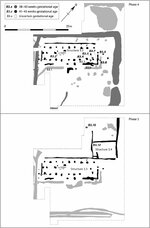
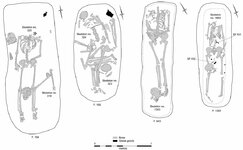
Infant burial locations map 1-004.jpg
Interior 'internment' locations.
Source

The blobs shown within the lines are 'internments'. Very regularly spaced 'internments'. This isn't a one accident-prone mum.

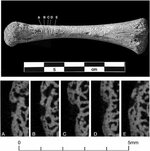
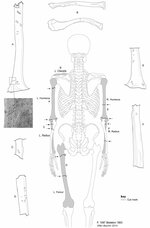
Let's zoom in on the cut marks described in Mays, S., Robson-Brown, K., Vincent, S., Eyers, J., King, H., and Roberts, A. 2012: ā€˜An infant femur bearing cut marks from Roman Hambleden, England’, International Journal of Osteoarchaeology 24, 111–15:

Hambledon 38 cut marks-002.jpg
Cut marks on right femur of newborn infant, Hambledon Roman villa, UK

Source

Quoting from the paper:
possibility is that the cut marks were formed during an obstetric operation... embryotomy (the extraction of undeliverable live or dead newborn).

Although the cut marks seen in burial 38 do not extend to the proximal extremity of the foetal femur, they could represent adventitious cuts as the surgeon attempted to locate the hip joint of the breech-presenting foetus to disarticulate the legs and ease delivery

Technically, I think that might be a foetotomy, but it doesn't matter in the context of our examination.

We should note here that Mays mentions another example of similar marks from a hundred miles or so west at Poundbury Camp, Dorset. There are papers on the Poundbury Camp baby cut-marks but I don't have access to them. The only detail I have is Mays' comment that its cut marks were found on the same part of the femur.

Returning to Mays...

In most of these historical descriptions of embryotomy, it is the arms, not the legs, that are seen as causing most difficulty in extracting the body and that need to be removed.

Putting that quote in layman's terms:
  • Hands and arms are not a useful part of failed deliveries and can be cut off to ease extraction of the rest of the body, head, etc.
  • Feet and legs are a useful part of failed deliveries - dead or living - because they can be roped with a rag and used to pull the body out.
From the same paper:
[cuts were] ...created around the time of death of the infant (or at least when the bone was still fresh enough to retain its slight elasticity)

unlikely to be immediately related to the cause of death... unlikely that they were inflicted with the intent of killing the infant; there are no major blood vessels in this region.

Evidence of the practice of defleshing has been established in other Romano-British skeletal remains

lack of any convincing cut marks elsewhere on the skeleton makes it improbable that the marks on the femur were part of a systematic defleshing process

Mays is correct that this wasn't about de-fleshing the baby. Nevertheless, the cut marks are also on the wrong limb and in the wrong place on the wrong limb for this to be a typical embyotomy. I'm not saying Mays is wrong to claim this bone evidences embryotomy. I am claiming that the explanation is a stretch because the evidence does not match common embryotomy practice.

Mays' paper fails to consider the possibility that:
  • The infant was butchered (for immediate eating or for preparation as a lacto-ferment). And that:
  • Butchers and tanners could be expected to de-fat and skin the carcass prior to fermenting or curing it.
Dealing with the meat-preservation aspect first. Today, we generally lacto-ferment in pots. In lacto-fermentation, the product has to be kept completely below the surface of the salty liquid in which it ferments. Product exposed to the air above the liquid will putrefy. Usually, it is kept fully immersed by keeping it pressed down under a flat, weighted plate.

But not all baby bones are 'buried' in pots. A few are found 'buried' under broken tiles. A few are 'casually interred'. A location analysis of baby remains and, in particular, baby and soil remains found under tiles would help us a lot. The tiles suggest bones and meat were being weighed down, but there are no reports of the surrounding pot that would have contained the ferment. To get to the bottom of this, we need a better understanding of the find circumstances for those bones found under tiles but not in pots.

Some preservation techniques require the product to be wrapped in something porous, then allowed to drip dry. We do something similar with cheese and many salami style sausages. The casual baby remains found may have been preserved using similar techniques.

Salt-curing should also not be dismissed. Salt-curing would provide one source of demand for the astonishing extent of salt-harvesting in eastern England a few hundred years ago.

Another scenario, used in the past and in our time, is to string carcasses and hang them from walls and ceilings so they cure on the bone. Refer to the 'meathook merchandise' photograph in this post. Usually you'd leave more space for air flow than is shown in that image. However we don't know the real history of the two bodies shown. They may have been re-hung by the kindly monks credited with placing them in their current positions. There are many clues that English churches were involved in human meat preservation. The strange resemblance of louvered church belfries to drying sheds and smokehouses, the references to hooks built into in the walls of church and castle towers 'for prisoners', the widespread destruction of churches and particularly church towers by 1830, the destruction of most village market crosses.

We're left with another puzzle: if they were being preserved for table, why would human meat products be buried?

It's probably already clear but I don't think there is sufficient evidence that these babies were deliberately buried. Instead, it seems likely that at least one flood or mudflood went through skulleries and meat-sheds. They left potted and cured human remains below ground and easily mistaken or deliberate burials. With this scenario in mind, imagine mudflood hitting an outbuilding or skullery stocked with cured babies. It's a scenario that makes sense of diagrams like the above.

We can attack this problem from the opposite direction: if we accept mudflood has swamped the ground floors of many stone and brick buildings, why would we think mudflood had not buried potted products stacked on floors and air-curing products hanging from ceilings?

Once we think of these sites as butchers' sheds and skulleries we can see why some products would be carefully removed and processed separately. Human skin products have very different uses and very different preparation requirements. SH.net has covered aspects of this before, in this post and in Zlax's posts on the book trade's use of human skin at Anthropodermic bibliopegy.

We also need to consider tanning processes.

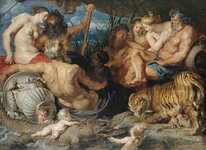
Why is an urn shown in the picture below?

Peter_Paul_Rubens,_,_Kunsthistorisches_Museum_Wien,_Gemäldegalerie_-_Die_vier_Flüsse_des_Parad...jpg
The Four Rivers of Paradise, Rubens. Repurposed tanner's advert.
Source

You see another fake out of Antwerp. I see a tanner's advert re-purposed as high art. Its original marketing message was something like:
Our tanning promise guarantees you'll never feel under-dressed again!

Our patented urine-process tans:
  • Thickest crocodile skin into tough, flexible work-wear.
  • Thinnest infant skin into delicate, see-through fabric. The perfect cheeky gift for that special someone.
  • Fur pelts into warm, luxurious fashion-wear. Never feel those chilly Little Ice Age nights again!
Guaranteed urine-tanned in our custom-built urns!

From: Urine Tanned Salmon Leather
Why urine? When our bodies and the bodies of all mammals break down amino acids as a part of normal metabolism, we produce ammonia... an amazing basic solvent that can break down fats and oils, clean surfaces and stop decay
...
You should have enough liquid to stir the skin and have it float freely.
...
This solution in the tanning world is also called a pickle

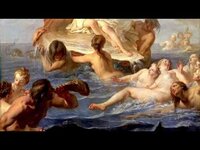
Yep, where it isn't fake, a lot of 'classical' art is just re-purposed advertising. That's why it comes with unbelievable storage and discovery stories. That's why its content often promotes run-of-the-mill activities such as:
  • Club 18-30-style holidays, complete with horn vuvuzela. See the video in this post, or at least consider its initial image:

0.jpg
Roman Club 18-30 advert. Source

About Club 18-30 holidays:​
an advertising campaign promoted attractions of people who were sexually active and could enjoy themselves in uninhibited, alcohol-fuelled ways​
1714.jpg

Although, to be fair, this last one could be promoting leather tints made from natural plant dyes.

Once we reject ill-fitting theories and stick rigorously to theories that match the evidence and the logic of the situation, we find cut marks are better explained as evidence of flensing (fat-removal) and de-skinning. Flensing and de-skinning leave fewer knife traces than de-fleshing, satisfying Mays' observation that the Hambledon baby bones were not a straightforward case of baby-meat butchery.

Once we adopt this different model of events, we can investigate other details to see if they fit. In this scenario, the odd choice of limb and the (seemingly) oddly-located scratch marks immediately make sense. They are positioned far enough along the femur to tell us that enough skin was left to seal it with a knot, as demonstrated here:

207516-satyrb.jpg
"Nice bag!" "Thanks - tanned it myself. In its own urine!" Source: long forgotten

Or, more likely, to tack a hem to strengthen the opening and even take elastic. Because, as archaeologists are told - if they would only pay attention - it is highly likely the semi-translucence and natural elasticity of infant hide made it a steady seller in the high-end lingerie market:

Download Video

Many a true word spoken in jest. Source: Not Only... but Also (BBC2 1965)

Edited for readability and reduced yuck factor.
 
Last edited:
Russian Youtube channel "Pi's Story" weaves together this and the cannibalism thread's evidence that European and English elites used humans as food, medicine and material resources. He's added some interesting bits from elsewhere:


The Farm: The Unpleasant History of Mankind

For example, another example of a horned lady:
Download Video

Image is unsourced. Modern impression of a medieval building site or genuine?

Compare and contrast with this image from The Nephilim Looked Like Clowns (conspiracy-r-us)
11919-2830a480003272d08d246e0596c50301.jpg

Options:
  • High fashion?
  • Medieval equivalent of the hard hat? (a medieval must-have for ladies visiting building sites)
  • Thinly-veiled horns?
  • Or simply fashionable copying of the elites of that time?
Makes me wonder if big-skirted gowns came in because some of those girls had furry haunches to hide.

Auto-translated English subtitle file attached to this post. And here as text:
1
00:00:01,939 --> 00:00:04,859
The question is not whether it is worth eating

2
00:00:04,859 --> 00:00:08,580
human meat, but what kind of meat

3
00:00:08,580 --> 00:00:12,780
you should eat. Today we will discuss the very

4
00:00:12,780 --> 00:00:15,780
delicate issue of our existence. The very

5
00:00:15,780 --> 00:00:18,690
issue due to which we may not be being

6
00:00:18,690 --> 00:00:20,810
told the true history of

7
00:00:20,810 --> 00:00:23,880
mankind. We will talk about the meat

8
00:00:23,880 --> 00:00:24,660
diet of

9
00:00:24,660 --> 00:00:27,199
our ancestors. Not those distant

10
00:00:27,199 --> 00:00:30,390
Neanderthals and Cro-Magnons about whom

11
00:00:30,390 --> 00:00:33,120
historians know hardly anything. Instead, let's talk about

12
00:00:33,120 --> 00:00:36,090
people who lived in a time period much closer to us.

13
00:00:36,090 --> 00:00:39,239


14
00:00:39,239 --> 00:00:42,090


15
00:00:42,090 --> 00:00:43,710


16
00:00:43,710 --> 00:00:47,489


17
00:00:47,489 --> 00:00:48,980


18
00:00:48,980 --> 00:00:52,140


19
00:00:52,140 --> 00:00:54,300


20
00:00:54,300 --> 00:00:57,420
What is strange is that archaeologists find

21
00:00:57,420 --> 00:01:00,449
quite a few ancient cemeteries in our country (Russia),

22
00:01:00,449 --> 00:01:03,239
Two large periods of these are the period of the

23
00:01:03,239 --> 00:01:05,850
Scythians, of the Sarmatians, in which people were interred

24
00:01:05,850 --> 00:01:06,720
in mounds.

25
00:01:06,720 --> 00:01:09,780
It is not known when this period began, but

26
00:01:09,780 --> 00:01:12,720
it most likely ended in the 14th century.

27
00:01:12,720 --> 00:01:16,200
And so until the 14th century people with elongated and

28
00:01:16,200 --> 00:01:19,020
ordinary skulls were buried in mounds.

29
00:01:19,020 --> 00:01:21,930
(then attacked?)? There is a period of the Middle Ages and the

30
00:01:21,930 --> 00:01:25,080
for some reason, the tradition of burying people in cemeteries and in

31
00:01:25,080 --> 00:01:27,450
in cemeteries and mounds disappears.

32
00:01:27,450 --> 00:01:29,759
Of course, massive accumulations of bones are

33
00:01:29,759 --> 00:01:32,460
found on the territory of Europe, but

34
00:01:32,460 --> 00:01:35,579
usually they are found during construction

35
00:01:35,579 --> 00:01:38,729
work. And these places have not been previously recorded

36
00:01:38,729 --> 00:01:41,490
as a cemetery. Also found in

37
00:01:41,490 --> 00:01:43,280
Europe are seemingly

38
00:01:43,280 --> 00:01:46,229
ennobled funeral sites, but

39
00:01:46,229 --> 00:01:48,840
these collections of bones are very difficult to call

40
00:01:48,840 --> 00:01:51,840
cemeteries. This could be called a warehouse of

41
00:01:51,840 --> 00:01:54,810
well-boiled and cleaned bones.

42
00:01:54,810 --> 00:01:57,659
Here is an example, the Chapel of Bones at Evora, Portugal.

43
00:01:57,659 --> 00:01:58,570

44
00:01:58,570 --> 00:02:01,600
It is said to be decorated with bones of more than

45
00:02:01,600 --> 00:02:03,100
five thousand people.

46
00:02:03,100 --> 00:02:05,560
According to the historical version, there is

47
00:02:05,560 --> 00:02:08,440
nothing unusual to this story.

48
00:02:08,440 --> 00:02:09,520
In 16th century Evora,

49
00:02:09,520 --> 00:02:12,430
there were 43 cemeteries that

50
00:02:12,430 --> 00:02:15,580
occupied valuable land and, so that

51
00:02:15,580 --> 00:02:18,100
these lands could used profitably, the monks

52
00:02:18,100 --> 00:02:20,860
dug up all the bones in the cemeteries and decorated

53
00:02:20,860 --> 00:02:23,350
the church with the bones. Just the usual history

54
00:02:23,350 --> 00:02:24,400
of the Middle Ages.

55
00:02:24,400 --> 00:02:26,980
There are a lot of such churches in Europe,

56
00:02:26,980 --> 00:02:29,050
and the largest collection of bones

57
00:02:29,050 --> 00:02:31,930
is the Parisian catacombs.

58
00:02:31,930 --> 00:02:34,510
In them, are the remains of several

59
00:02:34,510 --> 00:02:36,790
million people. As if it were nothing

60
00:02:36,790 --> 00:02:39,100
unusual, people gathered bones in the

61
00:02:39,100 --> 00:02:41,709
catacombs. In this story, it was just

62
00:02:41,709 --> 00:02:43,959
more convenient for them. Land was expensive...

63
00:02:43,959 --> 00:02:46,150
Why spend on a cemetery?

64
00:02:46,150 --> 00:02:48,970
Only one thing surprises, and that is the appearance of the

65
00:02:48,970 --> 00:02:52,150
bones themselves. There is a feeling that these bones,

66
00:02:52,150 --> 00:02:55,090
if not boiled, had passed through

67
00:02:55,090 --> 00:02:57,730
a stage of very thorough cleaning. Now let's

68
00:02:57,730 --> 00:03:00,160
move on to the shores of the Mediterranean Sea

69
00:03:00,160 --> 00:03:03,430
and consider other rather unusual

70
00:03:03,430 --> 00:03:05,560
structures. The so-called public

71
00:03:05,560 --> 00:03:09,190
toilets of ancient Rome. In ancient Rome,

72
00:03:09,190 --> 00:03:11,440
you understand, there were no

73
00:03:11,440 --> 00:03:13,330
buildings as such that

74
00:03:13,330 --> 00:03:15,519
historians have dubbed public

75
00:03:15,519 --> 00:03:17,290
toilets. And these structures are

76
00:03:17,290 --> 00:03:20,110
not only found in large cities; they are

77
00:03:20,110 --> 00:03:23,079
found even in villages of only

78
00:03:23,079 --> 00:03:25,480
two streets. So according to historians, the

79
00:03:25,480 --> 00:03:27,970
mythical ancient Romans loved to

80
00:03:27,970 --> 00:03:30,130
spend time in public

81
00:03:30,130 --> 00:03:32,260
toilets. Representatives of the middle class used to use such toilets,

82
00:03:32,260 --> 00:03:34,840
because

83
00:03:34,840 --> 00:03:37,030
historians know that the entrance to a public

84
00:03:37,030 --> 00:03:40,090
toilet was paid and poor people... they simply

85
00:03:40,090 --> 00:03:42,579
did not have the means to take advantage of the

86
00:03:42,579 --> 00:03:44,230
benefits of civilization. What was

87
00:03:44,230 --> 00:03:46,930
there to pay for? Firstly, in

88
00:03:46,930 --> 00:03:48,549
these rooms the Romans

89
00:03:48,549 --> 00:03:51,340
conducted small talk, read poems,

90
00:03:51,340 --> 00:03:53,980
discussed the latest political news,

91
00:03:53,980 --> 00:03:56,799
made business appointments. Clean, running water

92
00:03:56,799 --> 00:03:59,470
ran in the gutters built into

93
00:03:59,470 --> 00:04:01,900
the floor because toilet paper

94
00:04:01,900 --> 00:04:04,650
had not yet been invented. Then the Romans wiped themselves with

95
00:04:04,650 --> 00:04:06,989
reusable sea sponges

96
00:04:06,989 --> 00:04:09,820
fixed on a stick. After being used

97
00:04:09,820 --> 00:04:12,250
these were washed in running water

98
00:04:12,250 --> 00:04:15,220
in the channels under their feet. Therefore, the shape of the

99
00:04:15,220 --> 00:04:17,858
glasses is such a strange hole, not only

100
00:04:17,858 --> 00:04:20,560
from above but also between the legs, this is done

101
00:04:20,560 --> 00:04:22,750
just so that a person does not get up, I

102
00:04:22,750 --> 00:04:25,300
could use a sponge remove the extra ones on a stick,

103
00:04:25,300 --> 00:04:27,520
since sitting on a stone

104
00:04:27,520 --> 00:04:30,250
was quite uncomfortable; there were

105
00:04:30,250 --> 00:04:32,050
specially trained slaves

106
00:04:32,050 --> 00:04:34,419
who warmed

107
00:04:34,419 --> 00:04:36,600
marble benches with their heels while waiting for clients.

108
00:04:36,600 --> 00:04:39,310
Judging by the descriptions of historians, it was

109
00:04:39,310 --> 00:04:41,500
just some kind of communal paradise club of

110
00:04:41,500 --> 00:04:43,810
true gentlemen who were

111
00:04:43,810 --> 00:04:45,960
happy to discuss in such places.

112
00:04:45,960 --> 00:04:48,850
political and city news and even

113
00:04:48,850 --> 00:04:51,550
read new poems. Everything here was for the

114
00:04:51,550 --> 00:04:54,040
convenience of wealthy patricians and

115
00:04:54,040 --> 00:04:56,650
reusable sponges and special slaves

116
00:04:56,650 --> 00:04:59,440
to warm the seats and even pleasantly

117
00:04:59,440 --> 00:05:01,720
bubbling water underfoot. Just an

118
00:05:01,720 --> 00:05:04,510
idyllic picture confuses me true a

119
00:05:04,510 --> 00:05:07,300
few tiny moments. In the first place,

120
00:05:07,300 --> 00:05:10,060
how do historians know about the real

121
00:05:10,060 --> 00:05:12,220
purpose of these premises?

122
00:05:12,220 --> 00:05:14,979
After all, the first toilet room was discovered by the

123
00:05:14,979 --> 00:05:17,919
Italian archaeologist Giacomo Bani

124
00:05:17,919 --> 00:05:21,550
only in 1913, in his report, he

125
00:05:21,550 --> 00:05:24,490
suggested that the leaky bench could

126
00:05:24,490 --> 00:05:26,669
be part of a complex mechanism

127
00:05:26,669 --> 00:05:28,960
designed to supply water to the

128
00:05:28,960 --> 00:05:31,930
upper rooms of the palace and this is a very

129
00:05:31,930 --> 00:05:35,500
important fact, which means that until 1913

130
00:05:35,500 --> 00:05:38,800
no one knew anything at all about the purpose of

131
00:05:38,800 --> 00:05:41,260
such premises. Today though, historians

132
00:05:41,260 --> 00:05:43,630
talk about these places in great

133
00:05:43,630 --> 00:05:46,270
detail. Entrance fees, intimate

134
00:05:46,270 --> 00:05:48,790
conversations of patricians on the feat of how to

135
00:05:48,790 --> 00:05:51,040
use a reusable sponge. I

136
00:05:51,040 --> 00:05:53,380
wonder where the historian knows this all from. The

137
00:05:53,380 --> 00:05:56,320
second interesting point is the

138
00:05:56,320 --> 00:05:58,690
material from which it is made. Lena from

139
00:05:58,690 --> 00:06:01,930
the restroom bench, According to historians, people

140
00:06:01,930 --> 00:06:04,600
sat on a stone for hours discussing

141
00:06:04,600 --> 00:06:06,699
political news. It seems that everything would be

142
00:06:06,699 --> 00:06:09,699
fine - in summer in Rome and other cities of the

143
00:06:09,699 --> 00:06:10,780
Mediterranean Sea it is

144
00:06:10,780 --> 00:06:13,690
hot and it would be very comfortable to sit on a pebble of shade.

145
00:06:13,690 --> 00:06:14,860


146
00:06:14,860 --> 00:06:17,170
But after all, Rome not only has hot summers...

147
00:06:17,170 --> 00:06:17,810


148
00:06:17,810 --> 00:06:20,210
it is also quite cool in winter, when the

149
00:06:20,210 --> 00:06:22,400
temperature can drop to three

150
00:06:22,400 --> 00:06:24,770
degrees. Now imagine patricians come

151
00:06:24,770 --> 00:06:25,669


152
00:06:25,669 --> 00:06:27,669
to a public toilet in winter,

153
00:06:27,669 --> 00:06:30,380
sit down on a chilly marble

154
00:06:30,380 --> 00:06:33,410
bench and start a leisurely conversation about

155
00:06:33,410 --> 00:06:34,970
politics and sports.

156
00:06:34,970 --> 00:06:37,940
If a man older than 40 sits at least

157
00:06:37,940 --> 00:06:40,400
several times on cold stones, then

158
00:06:40,400 --> 00:06:42,380
he inevitably develops a rather

159
00:06:42,380 --> 00:06:45,260
painful inflammation called

160
00:06:45,260 --> 00:06:47,060
prostatitis So there is nothing

161
00:06:47,060 --> 00:06:49,400
surprising in the fact that ancient Rome

162
00:06:49,400 --> 00:06:52,760
disappeared. Ancient rome ruined public

163
00:06:52,760 --> 00:06:55,700
toilets with prostatitis and reusable sponges. Of

164
00:06:55,700 --> 00:06:57,710
course you can argue here because

165
00:06:57,710 --> 00:07:00,260
historians have told us about specially

166
00:07:00,260 --> 00:07:02,810
trained slaves who warmed up the

167
00:07:02,810 --> 00:07:06,200
marble seat in anticipation of a client.

168
00:07:06,200 --> 00:07:08,570
It’s just that I don’t... I can't imagine how a

169
00:07:08,570 --> 00:07:10,880
person can warm up a marble slab weighing

170
00:07:10,880 --> 00:07:13,430
several hundred kilograms with his bum.

171
00:07:13,430 --> 00:07:16,280
Three. An interesting

172
00:07:16,280 --> 00:07:17,770
aspect... public toilets

173
00:07:17,770 --> 00:07:19,550
were located not only in big

174
00:07:19,550 --> 00:07:22,430
cities but also in small villages of

175
00:07:22,430 --> 00:07:25,340
several hundred people. If, in big

176
00:07:25,340 --> 00:07:27,250
cities, a lot of people gathered in

177
00:07:27,250 --> 00:07:30,350
a club of interests,

178
00:07:30,350 --> 00:07:33,289
then who went to these places in villages?

179
00:07:33,289 --> 00:07:35,780
Villages where mainly slaves and hired workers lived,

180
00:07:35,780 --> 00:07:36,440


181
00:07:36,440 --> 00:07:38,720
and the middle class was represented by a

182
00:07:38,720 --> 00:07:40,880
dozen people who had

183
00:07:40,880 --> 00:07:43,870
their own villas with all amenities.

184
00:07:43,870 --> 00:07:47,140
And this is what I am leading to - historians do not know the exact

185
00:07:47,140 --> 00:07:50,620
purpose of these premises. They do not know

186
00:07:50,620 --> 00:07:53,740
who, when, and why they were built. An interesting

187
00:07:53,740 --> 00:07:56,080
version I found here in this blog. There's a

188
00:07:56,080 --> 00:07:58,900
link in the description. In his opinion, these

189
00:07:58,900 --> 00:08:01,000
places were used as to slaughter. A

190
00:08:01,000 --> 00:08:03,370
man was placed on his knees, lowered

191
00:08:03,370 --> 00:08:04,990
his head into the hole.

192
00:08:04,990 --> 00:08:08,110
A sword-swipe and the blood flowed down

193
00:08:08,110 --> 00:08:10,120
special grooves, sponges on sticks

194
00:08:10,120 --> 00:08:12,700
collected the remnants of

195
00:08:12,700 --> 00:08:13,630
the blood bath.

196
00:08:13,630 --> 00:08:16,240
This version is, of course, controversial but you yourself

197
00:08:16,240 --> 00:08:17,140
read it

198
00:08:17,140 --> 00:08:19,780
there presented very specific

199
00:08:19,780 --> 00:08:22,450
pictures from this version are also consistent,

200
00:08:22,450 --> 00:08:25,300
but this fresco, according to historians, the

201
00:08:25,300 --> 00:08:27,880
Roman goddess fortune protected the

202
00:08:27,880 --> 00:08:30,970
toilet visitors from danger. The

203
00:08:30,970 --> 00:08:34,330
big sword confuses me and the strange cup in

204
00:08:34,330 --> 00:08:37,390
her hands hints at her

205
00:08:37,390 --> 00:08:39,880
that. Now let's go back to the

206
00:08:39,880 --> 00:08:42,669
Middle Ages and let's see how society as a

207
00:08:42,669 --> 00:08:45,820
whole treated human remains.

208
00:08:45,820 --> 00:08:48,220
This issue is well dealt with in the book

209
00:08:48,220 --> 00:08:51,220
nabla "Medicinal Cannibalism in

210
00:08:51,220 --> 00:08:53,770
English literature and culture of modern

211
00:08:53,770 --> 00:08:54,850
times,

212
00:08:54,850 --> 00:08:58,120
as well as the book by Richard Saga is before

213
00:08:58,120 --> 00:09:00,280
the university of rome england

214
00:09:00,280 --> 00:09:03,460
called mummies cannibals and vampires

215
00:09:03,460 --> 00:09:06,280
History of Cadaveric Medicine from the

216
00:09:06,280 --> 00:09:07,930
Renaissance to the

217
00:09:07,930 --> 00:09:10,390
Victorian Era. These books

218
00:09:10,390 --> 00:09:12,850
tell that for several hundred

219
00:09:12,850 --> 00:09:16,780
years, reaching its peak in the 16-17th Centuries,

220
00:09:16,780 --> 00:09:19,330
many Europeans, including members of the

221
00:09:19,330 --> 00:09:21,910
royal family, priests and scientists,

222
00:09:21,910 --> 00:09:24,340
took medicines containing

223
00:09:24,340 --> 00:09:27,270
human bones, blood and fat

224
00:09:27,270 --> 00:09:29,700
as a medicine for everything from

225
00:09:29,700 --> 00:09:32,730
major pains to epilepsy. Mummy for

226
00:09:32,730 --> 00:09:35,760
medicines were recovered from Egyptian tombs.

227
00:09:35,760 --> 00:09:38,520
Skulls from Irish burials...

228
00:09:38,520 --> 00:09:41,190
Egyptian mummies were finely crushed and

229
00:09:41,190 --> 00:09:42,960
added to a tincture

230
00:09:42,960 --> 00:09:46,110
for internal bleeding. Thomas came out -

231
00:09:46,110 --> 00:09:49,440
a 17th century brain science pioneer - mixed a

232
00:09:49,440 --> 00:09:51,450
powdered human skull and

233
00:09:51,450 --> 00:09:53,850
chocolate and thus received a

234
00:09:53,850 --> 00:09:57,870
cure for apoplexy and bleeding.

235
00:09:57,870 --> 00:10:00,630
King of England Charles II took

236
00:10:00,630 --> 00:10:03,390
his drops. A personal tincture

237
00:10:03,390 --> 00:10:06,570
containing a human skull in alcohol

238
00:10:06,570 --> 00:10:09,630
was considered a very valuable powder of moss,

239
00:10:09,630 --> 00:10:12,690
which simply on human turtles

240
00:10:12,690 --> 00:10:14,820
was believed to heal

241
00:10:14,820 --> 00:10:18,210
nosebleeds and possibly epilepsy.

242
00:10:18,210 --> 00:10:20,970


243
00:10:20,970 --> 00:10:23,700


244
00:10:23,700 --> 00:10:26,220


245
00:10:26,220 --> 00:10:28,850


246
00:10:28,850 --> 00:10:31,590
The moss could begin to

247
00:10:31,590 --> 00:10:32,250
sprout

248
00:10:32,250 --> 00:10:34,890
on the skull under certain conditions. Most often

249
00:10:34,890 --> 00:10:37,290
this happened when the body was not

250
00:10:37,290 --> 00:10:39,900
buried. Second, a person must have

251
00:10:39,900 --> 00:10:42,390
died a violent death and

252
00:10:42,390 --> 00:10:45,750
Ireland in the 17th century was a

253
00:10:45,750 --> 00:10:48,900
country strewn with heaps of dead bodies.

254
00:10:48,900 --> 00:10:51,930
One summer the father of chemistry Robert Boyle

255
00:10:51,930 --> 00:10:54,450
suffered badly from nosebleeds.

256
00:10:54,450 --> 00:10:57,510
During a particularly tough incident the

257
00:10:57,510 --> 00:11:00,450
great man decided to use the

258
00:11:00,450 --> 00:11:01,320
skull moss that was sent to

259
00:11:01,320 --> 00:11:04,050
his sister by a great man as a

260
00:11:04,050 --> 00:11:06,630
gift from Ireland. The usual method

261
00:11:06,630 --> 00:11:09,930
was to inject the snuff usually

262
00:11:09,930 --> 00:11:11,610
in powder directly into the nostrils.

263
00:11:11,610 --> 00:11:14,490
But Boyle discovered that he could completely

264
00:11:14,490 --> 00:11:17,280
stop bleeding simply by holding a skull

265
00:11:17,280 --> 00:11:17,910
in his hand.

266
00:11:17,910 --> 00:11:22,710
In 1694 Pierre Pomet, chief pharmacist to

267
00:11:22,710 --> 00:11:25,380
Louis the Fourteenth, commented on

268
00:11:25,380 --> 00:11:27,720
how English pharmacists, especially

269
00:11:27,720 --> 00:11:30,330
London ones, sell the head or skulls of the

270
00:11:30,330 --> 00:11:32,820
dead on which there is a small

271
00:11:32,820 --> 00:11:35,550
greenish mould. England received such

272
00:11:35,550 --> 00:11:38,610
skulls from Ireland. Pomet also described

273
00:11:38,610 --> 00:11:39,810
English imports moss

274
00:11:39,810 --> 00:11:42,750
covered skulls from foreign

275
00:11:42,750 --> 00:11:44,910
countries, especially in Germany, where they were

276
00:11:44,910 --> 00:11:47,400
used as an ointment for wounds and

277
00:11:47,400 --> 00:11:50,490
also to stop bleeding bruises.

278
00:11:50,490 --> 00:11:52,620
He says English pharmacists

279
00:11:52,620 --> 00:11:55,620
usually bring these heads from Ireland,

280
00:11:55,620 --> 00:11:58,470
this country has been wonderful for them since the

281
00:11:58,470 --> 00:12:00,300
days of Irish life.

282
00:12:00,300 --> 00:12:02,880
Skulls drenched in moss were of high

283
00:12:02,880 --> 00:12:05,610
value in the time of Charles II. One

284
00:12:05,610 --> 00:12:06,060
skull

285
00:12:06,060 --> 00:12:08,940
could cost 11 shillings. During the

286
00:12:08,940 --> 00:12:11,700
reign of George I, skulls became an

287
00:12:11,700 --> 00:12:14,310
international export item.

288
00:12:14,310 --> 00:12:16,790
They were even specially designated in the list of

289
00:12:16,790 --> 00:12:21,089
customs duties. In 1725, the duty on

290
00:12:21,089 --> 00:12:23,670
one skull was one shilling.

291
00:12:23,670 --> 00:12:26,220
Human fat was used as an

292
00:12:26,220 --> 00:12:28,680
external ointment. Rubbing fat into the skin

293
00:12:28,680 --> 00:12:31,080
was considered an effective remedy for

294
00:12:31,080 --> 00:12:31,800
gout.

295
00:12:31,800 --> 00:12:33,930
German Swiss doctor Paracelsus

296
00:12:33,930 --> 00:12:36,270
believed that human blood

297
00:12:36,270 --> 00:12:39,570
was good for drinking. Poor people who could

298
00:12:39,570 --> 00:12:40,350
not buy

299
00:12:40,350 --> 00:12:42,900
processed blood in pharmacies came

300
00:12:42,900 --> 00:12:45,570
to public executions and collected

301
00:12:45,570 --> 00:12:48,510
blood with handkerchiefs. Fat also. In German countries the

302
00:12:48,510 --> 00:12:51,240
executioner was considered a great healer and from

303
00:12:51,240 --> 00:12:53,610
him for a small amount you could

304
00:12:53,610 --> 00:12:56,460
buy a bowl of blood. Powders made from mummies

305
00:12:56,460 --> 00:12:58,410
were sold in German pharmacies

306
00:12:58,410 --> 00:13:02,940
until the beginning of the 20th century. In Germany,

307
00:13:02,940 --> 00:13:05,010
in 1908, the last

308
00:13:05,010 --> 00:13:08,190
known attempt to swallow blood on the

309
00:13:08,190 --> 00:13:11,610
scaffold was made. As you can see, until the beginning of the 20th

310
00:13:11,610 --> 00:13:14,610
century, Europe was very loyal.

311
00:13:14,610 --> 00:13:17,220
The consumption of medicines prepared from

312
00:13:17,220 --> 00:13:19,770
humans seems to be nothing

313
00:13:19,770 --> 00:13:22,260
unusual. Even today some

314
00:13:22,260 --> 00:13:24,440
medicines are made from the same

315
00:13:24,440 --> 00:13:27,030
ingredients, so it is. But medicines

316
00:13:27,030 --> 00:13:30,000
are only the top of the pyramid.

317
00:13:30,000 --> 00:13:32,550
Look at this engraving here...

318
00:13:32,550 --> 00:13:35,850
Europeans exchange meat for indigenous

319
00:13:35,850 --> 00:13:38,760
jewelry. What kind of meat is I think

320
00:13:38,760 --> 00:13:41,190
unnecessary to explain and what is important to emphasize

321
00:13:41,190 --> 00:13:44,400
is that a European acts as the shopowner.

322
00:13:44,400 --> 00:13:47,310
This is just a piece of the engraving. The complete

323
00:13:47,310 --> 00:13:49,410
engraving can be viewed at the link in the

324
00:13:49,410 --> 00:13:52,170
description. All the details are there

325
00:13:52,170 --> 00:13:54,690
so that the people of the Middle Ages very freely

326
00:13:54,690 --> 00:13:57,329
handled the human body... Could

327
00:13:57,329 --> 00:13:59,180
use it as a basis for the

328
00:13:59,180 --> 00:14:02,070
preparation of medicines. And were

329
00:14:02,070 --> 00:14:04,920
not embarrassed to use it as meat.

330
00:14:04,920 --> 00:14:07,380
Now we will digress a little from

331
00:14:07,380 --> 00:14:09,959
their gloomy stories and look at

332
00:14:09,959 --> 00:14:12,240
such a beautiful thing as English

333
00:14:12,240 --> 00:14:13,560
bone china.

334
00:14:13,560 --> 00:14:16,440
This is an elegant product and the words "bone china"

335
00:14:16,440 --> 00:14:17,370


336
00:14:17,370 --> 00:14:20,399
do not mean more durable or

337
00:14:20,399 --> 00:14:21,750
anything else. Simple

338
00:14:21,750 --> 00:14:24,959
bone china is a mixture of bone meal with

339
00:14:24,959 --> 00:14:26,699
ceramic material. The

340
00:14:26,699 --> 00:14:29,610
bone meal gives the porcelain a warm

341
00:14:29,610 --> 00:14:32,310
soft color and transparency. Bone meal

342
00:14:32,310 --> 00:14:35,089
can be up to 45 percent of the

343
00:14:35,089 --> 00:14:37,740
product. They say that they used to

344
00:14:37,740 --> 00:14:39,690
use the bones of cows,

345
00:14:39,690 --> 00:14:42,089
but that's strange, as I said

346
00:14:42,089 --> 00:14:44,730
before, many churches in England are very similar

347
00:14:44,730 --> 00:14:47,519
to a crematorium. We do not have medieval cemeteries,

348
00:14:47,519 --> 00:14:48,029


349
00:14:48,029 --> 00:14:51,329
but we have a structure that is similar to crematorium.

350
00:14:51,329 --> 00:14:54,329
So very often churches are built according to a

351
00:14:54,329 --> 00:14:56,880
very simple scheme. There is an altar part...

352
00:14:56,880 --> 00:14:59,490
adjacent to it a refectory man of a

353
00:14:59,490 --> 00:15:02,370
refectory adjoins a bell tower with something

354
00:15:02,370 --> 00:15:04,949
similar to a chimney. I was always confused by the

355
00:15:04,949 --> 00:15:07,860
names of such a large room as a

356
00:15:07,860 --> 00:15:11,010
refectory. From the refectory immediately the exit of the

357
00:15:11,010 --> 00:15:14,850
bell tower looks like a stove and so and

358
00:15:14,850 --> 00:15:18,120
if the bodies were burned in a furnace, after all, bones are

359
00:15:18,120 --> 00:15:21,540
very difficult to burn without a residue and

360
00:15:21,540 --> 00:15:25,019
therefore this scheme lacks four rooms for

361
00:15:25,019 --> 00:15:28,410
processing. And which place is still

362
00:15:28,410 --> 00:15:30,180
notorious in the

363
00:15:30,180 --> 00:15:33,209
villages? Correct, the mill.

364
00:15:33,209 --> 00:15:35,850
It is the mill in fairy tales which is often

365
00:15:35,850 --> 00:15:38,279
associated with evil spirits.

366
00:15:38,279 --> 00:15:41,010
Although this is illogical; on the contrary, the mill

367
00:15:41,010 --> 00:15:43,949
should symbolize holidays, the nickname of the harvest and

368
00:15:43,949 --> 00:15:46,829
satiety, but no, they often say about the mill

369
00:15:46,829 --> 00:15:50,279
that this is a damned place and that is what is

370
00:15:50,279 --> 00:15:52,980
interesting. In Great Britain, at the beginning of the 19th

371
00:15:52,980 --> 00:15:55,709
century, there was a specialized

372
00:15:55,709 --> 00:15:58,319
bone mill located in the

373
00:15:58,319 --> 00:16:01,560
village of Narborough. There

374
00:16:01,560 --> 00:16:02,570
was more than one of these mills.


375
00:16:02,570 --> 00:16:06,620
In 1820, almost every port on the east

376
00:16:06,620 --> 00:16:07,340
coast

377
00:16:07,340 --> 00:16:09,740
had access to one or several donated by the

378
00:16:09,740 --> 00:16:12,410
abundant mills at the mill in the set they

379
00:16:12,410 --> 00:16:15,020
processed the mouths into fine

380
00:16:15,020 --> 00:16:17,810
crushed bone meal which, as

381
00:16:17,810 --> 00:16:20,840
fertilizer was applied to the fields. They claim they

382
00:16:20,840 --> 00:16:23,210
mainly processed the whalebone.

383
00:16:23,210 --> 00:16:25,390
We read further: the villagers

384
00:16:25,390 --> 00:16:27,620
brought some bones

385
00:16:27,620 --> 00:16:30,680
to grind the bones the same way they did.

386
00:16:30,680 --> 00:16:33,110
From northern Germany ships brought

387
00:16:33,110 --> 00:16:36,260
bones taken from the graves with

388
00:16:36,260 --> 00:16:38,570
static, no one bothered, but they

389
00:16:38,570 --> 00:16:41,270
just said: "one ton of German

390
00:16:41,270 --> 00:16:44,600
bone dust saves the import of 10 tons of

391
00:16:44,600 --> 00:16:46,160
German corn".

392
00:16:46,160 --> 00:16:48,890
I'm wondering what was happening on the

393
00:16:48,890 --> 00:16:53,150
territory of Germany in 1820.

394
00:16:53,150 --> 00:16:55,640
There was no German state of its own, so why was

395
00:16:55,640 --> 00:16:57,530
there a huge flow of

396
00:16:57,530 --> 00:17:00,740
bodies from these territories? We will move on to the last

397
00:17:00,740 --> 00:17:02,780
part of our story, let's call it

398
00:17:02,780 --> 00:17:05,780
"underground mystical", we all heard from childhood

399
00:17:05,780 --> 00:17:09,290
about the underground passages that are often

400
00:17:09,290 --> 00:17:12,619
located under church buildings.

401
00:17:12,619 --> 00:17:15,260


402
00:17:15,260 --> 00:17:17,660


403
00:17:17,660 --> 00:17:20,000


404
00:17:20,000 --> 00:17:22,790
Smuggling

405
00:17:22,790 --> 00:17:23,540
merchants

406
00:17:23,540 --> 00:17:26,780
find a lot of ways for moving goods.

407
00:17:26,780 --> 00:17:29,530
But almost no one studies them,

408
00:17:29,530 --> 00:17:32,750
or rather, almost no one. One enthusiast from the

409
00:17:32,750 --> 00:17:35,860
Stolen History forum analyzed

410
00:17:35,860 --> 00:17:39,770
228 legends of tunnels from eastern England.

411
00:17:39,770 --> 00:17:42,230
So 122 tunnels

412
00:17:42,230 --> 00:17:45,590
end in church name places, such as

413
00:17:45,590 --> 00:17:46,670
'abbey'

414
00:17:46,670 --> 00:17:50,030
'cathedral', 'chapel', 'church', 'monastery'.

415
00:17:50,030 --> 00:17:53,000
A lot of tunnels connect

416
00:17:53,000 --> 00:17:56,420
seemingly contradictory places. For example, taverns and pubs are

417
00:17:56,420 --> 00:17:58,940
connected with a nunnery or

418
00:17:58,940 --> 00:18:01,970
church; churches also had underground

419
00:18:01,970 --> 00:18:04,970
passages to the local market and it is strange that

420
00:18:04,970 --> 00:18:07,910
these tunnels were almost always

421
00:18:07,910 --> 00:18:10,850
found by chance; there is no mention of their construction.

422
00:18:10,850 --> 00:18:13,730
They are not just in the city but in non-church

423
00:18:13,730 --> 00:18:14,110
choirs,

424
00:18:14,110 --> 00:18:16,420
and it’s as if some people built the tunnels

425
00:18:16,420 --> 00:18:19,030
and built houses and churches over the tunnels

426
00:18:19,030 --> 00:18:21,910
completely different. It's like in the H. G. Wells

427
00:18:21,910 --> 00:18:24,910
novel The Time Machine. On the surface

428
00:18:24,910 --> 00:18:26,549
live happy people who go about

429
00:18:26,549 --> 00:18:28,720
their business and

430
00:18:28,720 --> 00:18:31,840
enjoy the sun but right under the feet of

431
00:18:31,840 --> 00:18:34,420
these happy people hid another

432
00:18:34,420 --> 00:18:37,150
eerie world of brick tunnels where

433
00:18:37,150 --> 00:18:37,570

434
00:18:37,570 --> 00:18:41,260
Morlocks live. Morlocks rise at night from

435
00:18:41,260 --> 00:18:44,170
their brick tunnels and eats

436
00:18:44,170 --> 00:18:47,530
happy Elois. It seems that these are all the

437
00:18:47,530 --> 00:18:50,919
fantasies of crazy science fiction writers, but in Europe the

438
00:18:50,919 --> 00:18:53,410
cult of fairy tales is very common and the

439
00:18:53,410 --> 00:18:54,370
eater of

440
00:18:54,370 --> 00:18:57,549
small children in Bern even has a monument to

441
00:18:57,549 --> 00:19:00,340
one eater. All these

442
00:19:00,340 --> 00:19:03,669
stories seem to hint to us about some kind of power

443
00:19:03,669 --> 00:19:06,640
that uses people as food, but it's

444
00:19:06,640 --> 00:19:09,730
all mysticism. Let's move on to interesting

445
00:19:09,730 --> 00:19:10,410
facts of the

446
00:19:10,410 --> 00:19:13,270
political history of England and events

447
00:19:13,270 --> 00:19:16,360
that are associated with attacks by peasants

448
00:19:16,360 --> 00:19:18,940
on churches and, more interestingly, on the

449
00:19:18,940 --> 00:19:22,480
meat market (like Smithfields). In England,

450
00:19:22,480 --> 00:19:23,890
skewers

451
00:19:23,890 --> 00:19:26,500
for long pigs are often found in kitchensi. English

452
00:19:26,500 --> 00:19:27,520
nouns

453
00:19:27,520 --> 00:19:29,669
for various religious structures are

454
00:19:29,669 --> 00:19:32,230
surprisingly similar to English nouns

455
00:19:32,230 --> 00:19:33,520
that

456
00:19:33,520 --> 00:19:36,520
are associated with the meat trade and meat

457
00:19:36,520 --> 00:19:39,520
processing. In England there were many

458
00:19:39,520 --> 00:19:42,160
pubs called the Jolly Friar.

459
00:19:42,160 --> 00:19:44,770
In many underground tunnels of England

460
00:19:44,770 --> 00:19:46,840
hooks for meat hang from

461
00:19:46,840 --> 00:19:49,570
the walls. Special cups for human fat have been preserved.

462
00:19:49,570 --> 00:19:52,240


463
00:19:52,240 --> 00:19:54,940


464
00:19:54,940 --> 00:19:56,620


465
00:19:56,620 --> 00:19:59,049


466
00:19:59,049 --> 00:20:01,210
;

467
00:20:01,210 --> 00:20:04,210
Stamford, where 40 nuns live, they

468
00:20:04,210 --> 00:20:07,600
discovered vaulted rooms three

469
00:20:07,600 --> 00:20:08,080
meters high.

470
00:20:08,080 --> 00:20:10,870


471
00:20:10,870 --> 00:20:13,600


472
00:20:13,600 --> 00:20:16,630


473
00:20:16,630 --> 00:20:18,910


474
00:20:18,910 --> 00:20:22,300


475
00:20:22,300 --> 00:20:24,580


476
00:20:24,580 --> 00:20:27,670


477
00:20:27,670 --> 00:20:30,820
For some reason, at the site of

478
00:20:30,820 --> 00:20:33,880
convents and orphanages, they still

479
00:20:33,880 --> 00:20:36,220
find mass graves of children and

480
00:20:36,220 --> 00:20:38,560
babies. In Ireland at the site of the excavation of

481
00:20:38,560 --> 00:20:41,530
the former home of mothers and children in

482
00:20:41,530 --> 00:20:44,500
County Galway.

483
00:20:44,500 --> 00:20:46,150


484
00:20:46,150 --> 00:20:49,390
divided into 20 chambers containing a

485
00:20:49,390 --> 00:20:51,580
significant number of human

486
00:20:51,580 --> 00:20:55,060
remains, a total of 800 people

487
00:20:55,060 --> 00:20:59,200
aged 35 weeks to three years. This

488
00:20:59,200 --> 00:21:01,690
orphanage was ran by a Catholic order of

489
00:21:01,690 --> 00:21:02,260
nuns.

490
00:21:02,260 --> 00:21:06,210
Also in Lincoln, England, the clergy

491
00:21:06,210 --> 00:21:09,880
collected the blood of infants and

492
00:21:09,880 --> 00:21:12,310
young children until 1535 to treat

493
00:21:12,310 --> 00:21:14,410
diseases such as leprosy.

494
00:21:14,410 --> 00:21:16,750
All this speaks of some strange

495
00:21:16,750 --> 00:21:20,170
connection between English churches and monasteries with

496
00:21:20,170 --> 00:21:21,370
local markets,

497
00:21:21,370 --> 00:21:24,640
then faithful and hospitals for the treatment of

498
00:21:24,640 --> 00:21:28,840
lepers of mankind. Already before the 14th century,

499
00:21:28,840 --> 00:21:31,950
according to official history, mankind experienced a network of

500
00:21:31,950 --> 00:21:34,690
catastrophic events as a result of

501
00:21:34,690 --> 00:21:38,920
which the great famine of 1315 arose,

502
00:21:38,920 --> 00:21:41,890
and after this famine appeared a

503
00:21:41,890 --> 00:21:44,770
huge number Catholic churches

504
00:21:44,770 --> 00:21:45,700
with a refectory.

505
00:21:45,700 --> 00:21:48,160
Women's monasteries appeared where

506
00:21:48,160 --> 00:21:50,740
they brought up small children

507
00:21:50,740 --> 00:21:53,730
and, by a strange coincidence, the

508
00:21:53,730 --> 00:21:56,860
churches and monasteries of England were very often

509
00:21:56,860 --> 00:21:59,740
connected by underground passages with local

510
00:21:59,740 --> 00:22:02,230
markets. Of course, this could be just a

511
00:22:02,230 --> 00:22:05,110
coincidence, but by a strange

512
00:22:05,110 --> 00:22:08,230
coincidence at the beginning of the 19th century, when the

513
00:22:08,230 --> 00:22:11,080
world economy recovered and in

514
00:22:11,080 --> 00:22:13,720
almost all countries the food problem was solved,

515
00:22:13,720 --> 00:22:16,330
in England,

516
00:22:16,330 --> 00:22:18,720
a lot of small workers appeared at all enterprises.

517
00:22:18,720 --> 00:22:21,490
That is, teenagers,

518
00:22:21,490 --> 00:22:24,220
adolescents, worked in all areas

519
00:22:24,220 --> 00:22:27,520
from cotton mills to coal mines. At the

520
00:22:27,520 --> 00:22:30,460
end of the 19th century, a concept arose in the USA

521
00:22:30,460 --> 00:22:32,610
such that orphan

522
00:22:32,610 --> 00:22:35,100
trains carried teenagers around the American continent by trains

523
00:22:35,100 --> 00:22:36,990


524
00:22:36,990 --> 00:22:40,440
and gave them to everyone. It was

525
00:22:40,440 --> 00:22:43,290
not the adoption of teenagers; they were delivered

526
00:22:43,290 --> 00:22:46,170
as free labor. And the

527
00:22:46,170 --> 00:22:48,420
conclusion is: that the system

528
00:22:48,420 --> 00:22:52,309
that used children as a product

529
00:22:52,309 --> 00:22:56,670
outlived its usefulness in the 18th century, but there

530
00:22:56,670 --> 00:22:59,700
were a lot of children in monasteries in order to somehow

531
00:22:59,700 --> 00:23:02,450
use them, they began to be given up for

532
00:23:02,450 --> 00:23:04,240
production.

533
00:23:04,240 --> 00:23:07,090
This is, of course, a very controversial theory, but all the

534
00:23:07,090 --> 00:23:09,610
facts say that the history of the Middle

535
00:23:09,610 --> 00:23:10,480
Ages

536
00:23:10,480 --> 00:23:13,960
does not look as beautiful as it is painted in

537
00:23:13,960 --> 00:23:17,770
romantic engravings. There was a hunger, eating

538
00:23:17,770 --> 00:23:20,470
...

539
00:23:20,470 --> 00:23:21,610
parchment medicines of their own kind

540
00:23:21,610 --> 00:23:24,460
from human bodies and even great

541
00:23:24,460 --> 00:23:27,250
campaigns armies of many thousands are no longer

542
00:23:27,250 --> 00:23:29,830
surprising because the main question is what the

543
00:23:29,830 --> 00:23:33,280
army feeds on in a campaign that lasts for

544
00:23:33,280 --> 00:23:36,660
years, this is what it feeds on the

545
00:23:36,660 --> 00:23:39,010
history of mankind of the Middle Ages

546
00:23:39,010 --> 00:23:42,430
can convey this symbol.

547
00:23:42,430 --> 00:23:45,559
[music]

548
00:23:52,200 --> 00:23:57,510
on this all see my channel

If any Russian-speakers want to fill in the small gaps in the .srt file, that would be helpful.

The video is briefly discussed at: Ферма. ŠŠµŠæŃ€ŠøŃŃ‚Š½Ń ŠøŃŃ‚Š¾Ń€ŠøŃ человечества. (Russian), (Google English translation). Pi's Story has other Russian-language alt history videos at: https://www.youtube.com/channel/UC-EPqVgGmilMJtqKa3kzZNg (Russian), (Google English translation).

Pi's Story helpfully provided YT viewers with a link to Stolen History's version of this material. They should update the link in their YT notes to this index post. Then their readers could more easily navigate through the two Stolen History threads.

I think he did a better job of wrapping it all up than I have. We could take step back and look at the big picture: our situation. Starting with ourselves and the implications of Eugene McCarthy's claims about the origins of human DNA.

In the Westworld clip at the bottom of this post, two guests discuss the Westworld park. They know they are in a pleasure garden and they plan what they could do. They talk about host Freddy sitting outside the door:
Download Video

"We can use him for target practice." Source: Westworld S01, Ep01

Freddy can probably hear them. Their conversation should tip him off there is something wrong with his understanding of 'his' world. But if he does think about what they are saying, he doesn't react. He wouldn't hurt a fly.

By the way, the mirror in that clip is being used for a film-maker's trick. It comments about the nature of the viewer. You see mirrors used this way in various films, especially Kubrick's. Also in What Lies Beneath and two minutes into V for Vendetta.

In the clip below, another host - Dolores Abernathy - is tipped off that something is wrong with her understanding of 'her' world:
Download Video

Out of the mouths of babes... Source: Westworld S01, Ep01

An hour or two later, her father Peter Abernathy is also tipped off:
Download Video

Peter Abernathy finds a colour photograph of modern New York. Source Westworld S01, Ep01

Later, Peter and Dolores discuss their day. He shows her the photograph:
Download Video

It doesn't look like anything to me." Source: Westworld, S01, Ep01

For Peter, Revelation has begun. For Dolores, Revelation loses this round to her loyalty loop. For Teddy, it's as if nothing has happened.

Same for each of us. Are you thinking about the implications? Or are you one of the guests here?
 

Attachments

  • The Farm. The Unpleasant History of Mankind-sPvnBsTHmkI.srt.zip
    13.2 KB · Views: 182
Last edited:
The European Elite, really aren't European Elite.
Russian Youtube channel "Pi's Story" weaves together this and the cannibalism thread's evidence that European and English elites used humans as food, medicine and material resources. Plus some interesting bits from elsewhere:


The Farm: The Unpleasant History of Mankind


Auto-translated English subtitle file attached to this post. If any Russian-speakers want to fill in the small gaps in the .srt file, that would be helpful.

I found the video at: Ферма. ŠŠµŠæŃ€ŠøŃŃ‚Š½Ń ŠøŃŃ‚Š¾Ń€ŠøŃ человечества. (Russian), (Google English translation). Pi's Story has other Russian-language alt history videos at: https://www.youtube.com/channel/UC-EPqVgGmilMJtqKa3kzZNg (Russian), (Google English translation).

I posted these videos here once long ago, since they are probably lost, I will post them again. We are indeed food for the elite, of every country.


View: https://www.youtube.com/watch?v=8H73zcTb_-Q


View: https://www.youtube.com/watch?v=mILA45Ot7eE


View: https://www.bitchute.com/video/eIKsq0gPqAjK/


View: https://www.youtube.com/watch?v=J6tG-5OlUgA
 
The European Elite, really aren't European Elite.
There's some really interesting clips in there. These two stood out for me:
Download Video

Dale wakes up amid banqueting room portraits. Source: Tales from the Crypt. Mournin' Mess

Download Video

Bill learns he's from the wrong class. Source: Society, 1989

I see a Simpsons episode and clips from Midnight on the Meat Train. I'd like to know where the other clips came from, particularly the boy testing a dimensional doorway.
 
There's some really interesting clips in there. These two stood out for me:
Dale wakes up amid banqueting room portraits. Source: Tales from the Crypt. Mournin' Mess

Bill learns he's from the wrong class. Source: Society, 1989

I see a Simpsons episode and clips from Midnight on the Meat Train. I'd like to know where the other clips came from, particularly the boy testing a dimensional doorway.
I think the dimensional doorway came froma movie I watched a long time ago, called 'Gate'. They also had something similar in the Phantasm movies if you've ever seen them, the two pillar bar things as usual opening a gate to elsewhere.
 
I think the dimensional doorway came froma movie I watched a long time ago, called 'Gate'. They also had something similar in the Phantasm movies if you've ever seen them, the two pillar bar things as usual opening a gate to elsewhere.
Dropping a credit and a link here to EAFU's earlier thread about Society and the excellent posts in that thread.

I found The Gate, 1987, but that seems to be a different film from whatever this clip was taken from:
Download Video


British TV occasionally puts the idea of small dimensional doorways in front of children. Eg Timeslip, 1970:

Download Video

Source

And recently in the TV series His Dark Materials, 2019. Probably others. And then there are the big budget Stargate type doorways...

We could go into why our mind-managers drop hints - seemingly expensively produced film hints - but that's a different post. Instead, do they tell us about something real?

The thread about the mystery of windroses and rhumb-lines on old maps could give us a clue. So might pro-vladimir's series of articles: 'Transport Systems of the Past'. The auto-translation from Russian, the exploratory style, and the now-missing images are hard going but if you are interested in evidence of dimensional doorways in the past, read them while there is something left.

Elites eating amid portraits crop up in Rev. George Oliver's A History of the Holy Trinity Guild Church at Sleaford, an 1846 history of the high heath between Lincoln and Sleaford. It seemed important to Oliver to detail how Sir Francis "Hellfire Club" Dashwood's successor Sir John King Dashwood added a large room to Dunston Pillar pleasure gardens (Google Maps), (Google Streetview) to "accommodate" its customers. (page 11)

And that Thomas Chaplin built the Green Man Inn banqueting room (Google Maps), (Google Streetview) just down the road. Lining it with plaster portraits of the elite customers who ate and drank (apparently heavily) there. And how some busts had been removed and others defaced. (page 13)

And - significantly - Oliver tells us that Temple Bruer's preceptor ate, drank and lived among the feudal predecessors of these entities. Oliver tells us that in addition to the preceptor's three homes, he owned a nearby warrener's house (Google Maps), (Google Streetview) or here (Google Maps), (Google Streetview). This, we're told, had a vault underneath. Oliver tells us that only a willow tree grows there now (1846). But that the locals say it: 'grows from the prior's oven.' (page 33)

This is odd because orthodox history says Temple Bruer's officials were arrested in the Templar dissolution of 1312. And that in 1540 Henry VIII sold the property - by then theoretically just a farm - to Charles Brandon, Duke of Suffolk. How could a Knights Templar preceptor be supping with - and apparently supplying food and services to - 17th century elite?

Unless orthodox history is wrong and the Templars were "dissolved" a lot later than we are told. Like the Romans. In a catastrophe now described as Oliver Cromwell's physical destruction of Temple Bruer in approx 1643.

Also odd is Oliver's pointed reference to the priors' oven beneath the preceptor-owned house. Priors' ovens seem to have been very problematic in earlier times. Although Oliver doesn't explain why, British folklore does. It says ecclesiasts bought children for slaughter and baked their blood into special celebratory bread. That's what is being referred to in from minute 9:07 in huskofahuman's second YT video.

What Oliver does say is that many stone crosses in the area had been reduced to stumps - "stump crosses":
when the injunction of Bishop Horne was promulgated at his visitation in 1571 ; that "all Images of the Trinity in glass windows or other places of the church be put out and extinguished, together with *the Stone Cross in the church-yards*."

Why would a Bishop order the destruction of stone crosses, do you think? Oliver doesn't say, but he continues in weirdly excessive detail to describe how the now-damaged crosses were originally built. Oliver is seemingly obsessed with describing the remaining bases of these crosses. He tells us "marketplace" crosses were singled out for the most damage. And that these were usually sited at crossroads between "religious" houses. Describing two crosses south of the Green Man Inn, Oliver says:

One stood ... on the west side of the turnpike leading to Sleaford, opposite to the Roxham-lane... This was called the Butter Cross, having been formerly used by the vendors of that article in the market. ... The other, called the Bakers' Cross, was situated on a hill where four roads met north of the village.

These two sites are on the main road to:
  • Temple Bruer (Google Maps), (Google Streetview) - where Oliver found a room filled with pure lime (page 30), and skeletons of all ages were found burned in a crypt beneath the Knights Templar 'temple' (page 28 or see end of post)
  • Dunston Pillar "pleasure gardens". (Google Maps), (Google Streetview)
  • The Green Man Inn dining room.
  • The above-mentioned house with an unexplained underground vault.
Elsewhere in Chapter I, Oliver switches to Latin to comment on the irony of a destroyed cross whose base has been converted into stocks.

Why?

Oliver is telling readers that the crosses were tethering places for children being sold to the Knights Templars and the elites. It's a cheaper, more manageable method of restraining human livestock during market day inspection and sale than is building a jail at every marketplace.

That is the real reason 10,000 of England's 12,000 market crosses were destroyed by 1650. Shortly after Pompeii was really destroyed.

And we can see why Oliver recorded the locations of the remaining bases of crosses: all of them marked bad memories that required managing.Some of them marked the locations of lockups. Three publicly-known examples still exist, though orthodox historians don't acknowledge their original purpose:
Why did some crosses mark the sites of "Butter Markets" and why were they sometimes called "Butter Crosses"?

From huskofahuman's Society clip above:
Download Video

You say 'Lard', I say 'Butter'. Source: Society: 1989

Together with the loss of a furry cover, human skin acquired a hypodermal fatty layer (panniculus adiposus) which is considerably thicker than that found in other primates, or mammals for that matter.
William Montagna, The Evolution of Human Skin, Journal of Human Evolution, 1985, 14, 14. Source

Humans are among the fattest mammals at birth reflecting a rapid fat deposition during the third trimester of pregnancy. For most mammals, roughly 2-3% of birth weight is fat. A newborn human baby is made up of 16% fat, whereas a new-born chimpanzee averages 3% of birth weight as body fat
Source

Perhaps the nutritional and utility value of human babies - partially explored in this post above and in this post - as the result of product design decisions now becomes clearer.

And from Joseph Beldam's 1859 "explanation" of Royston Cave:

A Butter Market existed in late medieval times at The Cross... It may even have incorporated a small prison cell as part of a first floor structure. In 1742, nearly a century after the commissioners had drawn up their survey, workers doing some minor building work in the butter market found a mill stone in the floor. Dropping a line down the central hole seemed to suggest the stone was concealing a very deep hole beneath it and this was confirmed when the stone was dragged away revealing a narrow vertical shaft descending into the chalk.

This 1742 discovery of Royston Cave may well have kicked off frantic sponsorship of Britain's antiquarian movement. Records of their itineraries (Ie, surveying tours), their attraction to ploughmen's finds and their detailing of seemingly trivial aspects of old structures may indeed have reflected an autistic curiousity. But just as likely, it reflected their sponsors' fear that builders would find new "Royston Caves" beneath England's former market crosses. And that ploughboys would keep finding vaults beneath the stones they were clearing out of England's mudflooded fields.

Dunston Pillar "pleasure gardens" is the reason I included (in this post and at the bottom of this post) the Westworld clip where an experienced guest tells a new guest:

You ride out of town... that's when the real demented shit begins.

It's a reference to "pleasure gardens" like the Nocton Hall/Dunston Pillar complex (Google Maps), (Google Streetview) some ten miles south of Lincoln - where humans were offered on the table and as targets in the neighbouring wood. Denials and inconsistencis in accounts of Sir "Hellfire Club" Francis Dashwood's ownership of this "Hunger Games" complex is a major clue that the history of this location is being covered up.

Lincoln Heath is not the only place where archaeologists have simply avoided trying to explain away oddities. At Knobb's Farm in Cambridgeshire, logic tells us that the bizarrely executed adult slave skeletons were not killed - as archaeologists claim - by "extreme discipline" or "extreme justice". They were killed during weapons training, perhaps for skills development with the weapons involved. How do we know? The victims were killed while held, while kneeling and, apparently while running away. 13 of them lay face down, suggesting they were left where they fell. Many appear to have been cut up:
-012.jpg
Drunk executioners? Or a weapons test? Source

Several were slashed multiple times with precise cuts from a weapon's edge or tip. Try this description of the remains of a woman who was repeatedly slashed, taken from: Extreme Justice, Decapitations and Prone Burials in Three Late-Roman Cemetaries at Knobbs Farm, Cambridgeshire:
There are no cut marks or associated trauma directly relating to decapitation and no evidence to explain the fragmentation of the jaw. There are, however, numerous other cuts marks on the skeleton ...

Two cut marks on the right side of the mandible appear to have targeted the temporomandibular ligament which attaches the mandible to the cranium.

Additionally, the right ear appears to have been partially chopped off with a glancing blow, likely retained by a flap of soft tissue; this is evidenced by two loose, sharp-bordered bone fragments from immediately behind and in front of the ear, as well as a chop mark into the top of the mandible. The profile of the cut marks suggests a sharp, heavy blade directed from above and behind.

There is a third, fine vertical cut mark, 4.5 mm long, on the lower lingual inside of the mandible, aligned approximately with the left canine.

Elsewhere on the body, there are: two fine cut marks (c. 1.2 mm long) to the left clavicle, specifically across the long axis of the superior and posterior borders; multiple fine cut marks, 5–40 mm long, angled across the posterior of the left and right humeri, which would have severed the triceps muscle; a total of six cut marks 1–2 mm long to the posterior side of the radii (four to the right, two to the left), which would have cut through the superior part of the extensor muscle group; multiple fine cut marks across the back of the left femur, presumably severing the tendons of the adductor muscle group, although these cuts would probably have missed the major arteries and veins of the leg. That these fine marks were mostly parallel and orientated in the same direction suggests a human cause rather than a natural one. Together with the cut marks on the mandible, they might indicate butchery or de-fleshing. A lack of healing suggests this occurred around the time of death, but it is not possible to distinguish whether they were made immediately before death (resulting from, for example, torture or flaying) or after death (for example, from corpse mutilation, post-mortem punishment or ritual de-fleshing

-016.jpg
Not my idea of 'judicial killing'. Source

It's not clear but if the small arrows in this diagram point to cuts through the bones, then you are looking at three limbs that were apparently sliced up one section after another.

Altogether, they look like the remains of weapons training or a weapons test. The biggest mystery is what the weapon really was.

Elite eating houses also feature in many English urban tunnel legends. Typically these structures are:
  • The Assembly Rooms
  • The Guildhall, or
  • The Corn Exchange
  • Pubs, taverns, inns and hotels
With these ideas in mind, Wikipedia's page on Assembly Rooms is worth reading carefully. So is the page on Newark-upon-Trent's Ossington Coffee Palace. The Assembly Rooms in Stamford (England) still has large vaults beneath it, extending beneath the former ballroom next door. The vaults are rumoured to have been connected to the town's extensive tunnel network. Why would that connection have been necessary?

The Corn Exchange (Google Maps), (Google Streetview) in Hertford (England) is labelled as former jail (gaol).
Hertford Corn Exchange front.png
Hertford Corn Exchange. 2m stick, 4m door

It's not just the door - it's the visibly large cellars. Its official address as number 42 Fore Street is said to be the centre of Hertford's vast underground tunnel network. See also here. And always pay attention when someone claims absence of official confirmation is proof of non-existence.

Tollbooths - the Scottish version of Guildhalls - frequently contained lockups. Guildhalls and tollbooths were where ordinary folks paid taxes. What form did their taxes take? Their first born? That would certainly require lockable cages.

Rev George Oliver lived, preached and taught in quite a few places around England. He was a mason, a school teacher, a headmaster and a clergyman who set up schools, Sunday Schools, re-established church congregations, and had a substantial hand in writing masonic teachings.

So, Oliver was in the education game but he was establishing education in a wider sense, seemingly implementing four 'levels' of knowledge-management:
  • Ubiquitous basic education: "The Three 'Rs'".
  • Education for the professional classes (masonry) to propagate management techniques into the future.
  • 'Spiritual' education. Really obedience-building, ie Christianity, rebuilding shattered churches (former meat processing centres) as convenient central structures for training loyalty and obedience.
  • Clean up of memories and tales of what had gone on before.
In this he was 'sponsored' by the Tennyson family (as in Alfred Lord Tennyson) - who were themselves likely acting in their own interests but on behalf of others. The reason I think this is that we know Oliver was not alone in devising how to attract the (remaining) ordinary population into England's at that time dilapidated churches.

Lincoln Cathedral's management - for one - seem to have been grateful. A large monument of Alfred Lord Tennyson stands in their grounds. Ironically - or perhaps not - it overlooks the excavated remains a few yards away of one of Lincoln's 'Roman' gates - still standing three metres below today's ground level (Google Maps), (Google Streetview).

Did Oliver's sponsors read his surveys of butcher-shop England's embarrassing remains of market crosses? Did they decide to explain away the memories of them with an invented crucifixion story? Perhaps as the core story of their newly-created religion?

Around 1790, the Hon. John Byng wrote up his tours visiting dilapidated churches, stately homes and (allegedly) fake ruins around eastern England. He was part of a group who frequently split up to explore different areas before regrouping. Just like Oliver, Byng was noting local lore, records, legends and remains. And his expenses. But only rarely does he record in his diary what he heard and found. So, on page 99 of his Torrington Diaries, while waiting for his colleagues he notes:

In the meantime, must write down, or remember, "Each trivial Law, each petty fond [found] Record."

And further down the same page:

Upon an opposite Hill is a large Farm House, call'd Canon-Park Manor House; which has been of good account.

On page 122 Byng describes a partially rebuilt and only partially used Peterborough Cathedral. On page 139 he again says no-one goes to church anymore and suggests a cheap way for the local rich to rebuild a congregation: encourage the local population's children to sing in churches on Sundays.

put forth a little Chorus of Children

Mum, Dad and granny were bound to come listen, even join in.

Is Byng revealing that church choirs originated as a marketing gimmick? Is he also revealing that English Christianity is a Pay-As-You-Obey money and obedience mechanism invented by England's post-catastrophe elites? Or is he revealing both?

Telling also, are Byng's visits to east England's stately homes. He describes being shown around buildings and grounds in varying states of disarray. They are more or less empty. He describes big Lincolnshire stately homes Grimesthorpe Castle (Google Maps), (Google Streetview), (Torrington Diaries, page 127) and Belvoir Castle (Google Maps), (Google Streetview), (Torrington Diaries, page 133) as being semi ruinous, with virtually no furniture, no facilities and almost no staff. Belvoir, he says, is stacked with the owner's newly acquired paintings waiting to be hung and little else.

Here Belvoir-Castle rises to the View, in awful State. In our way we passed by the ruin'd Church of Woolsthorp... We then walk'd up The Hill Belvoir-Castle, where every thing is in neglect, and Ruin, and in such a state it has long been... In this Condition was the House found by the late duke...

30 years later Oliver reported he also found large east England mansions had gone empty. Eg "the fine mansion" of Culverthorpe Hall (Google Maps), (Google Streetview):

The last male descendant of the Newtons died here in 1803 ; and the house remaining 20 years without a tenant, became the residence of its present occupier, Henry Handley, Esq., M. P.

The Historic England version of this period, per CULVERTHORPE HALL, Culverthorpe and Kelby - 1000974 | Historic England is:

for much of the time Culverthorpe was let.

These descriptions suggest that:
  • Before 1790, east England had been largely depopulated, particularly of its previous elite. And:
  • Today's official sources are not inclined to admit this.
In Itinerarium Curiosum, Second Edition, 1776, p29, antiquarian William Stukeley comments about Burgh (Google Maps), (Google Streetview) near the mid-Lincolnshire coast:
In the yards and gardens about the town they frequently dig up bodies.

On page 31, near Horncastle (Google Maps), (Google Streetview), a bit more than ten miles further inland:
Near the walls upon digging cellars they sometimes find bodies buried.

Elsewhere, Stukeley writes of finding timber in "Roman" ruins that is still burnable.

Byng mentions his young adult companion who is also travelling by horse but does not know it needs shoes (Torrington Diaries, page 138). That's like a modern 20 year old car owner not knowing that car wheels need tyres. Or what a farrier or smith did for a living. 'Smith' is the most common last name in England. This is bizarre if travel in those times was as horse-centred as we are taught it was.

Byng also refers to his own efforts to teach himself to drive a light horse carriage in a west London street - and breaking its shaft. You would think an adult 'gentleman' would have learned how to drive a carriage in a more formal, dignity-maintaining, private environment. In John Wheale's London Exhibited 1852, there are similar accounts of elites learning to drive the novel carriages in London's Hyde Park.

Both Wheale and Byng read as though a new elite had just acquired horses and were learning how to drive them when hitched to carriages. As if carriages were new toys and there was no previous experience to draw upon.

Chronologically, these clues point to a series of events seem to have happened, perhaps centred on the 17th Century (beginning before and developing after the year marked as '1651'). Events that freed their human survivors from being animals farmed by the entities that built these these transport systems, these banqueting rooms and their vaults.

There seems to have been a century or two of human freedom - for the small pool of humans that survived those events - followed by another suppression beginning just prior to the 19th Century. That suppression seems to have revolved around the idea of re-establishing humans as slaves but this time as slaves-who-don't-know-it. Our Pay-As-You-Obey class. The great exhibitions seem to be a review of those remnant technologies that humans had managed to understand. Followed by the commercialisation of some and the hiding away of others.

You could wonder if high tech weapons and dimensional doorways ever featured in some roped-off backroom at one of those great exhibitions.


Excerpt from Rev George Oliver's description of skeletons he found under Temple Bruer:

Another skeleton of an aged man was found in these dungeons, with only one tooth in his head. His body seems to have been thrown down without order or decency, for he lay doubled up ; and in the fore part of his skull were two holes, which had evidently been produced by violence. In a corner of one of these vaults, many plain indications of burning exists. The wall stones have assumed the colour of brick, and great quantities of cinders mixed with human skulls and bones ; all of which had been submitted to the operation of fire, and some of them perfectly calcined. This horrible cavern had also been closed up with masonry. Underneath the cloisters, between the church and the tower, many human bones were discovered, which appear to have been thrown together in the utmost confusion, and laying in different strata, some deep and some very near the surface ; amongst which were the skeleton of a very young child, and the skull of an adult, with a round hole in the upper part, into which the end of a little finger might be inserted, and which was probably the cause of death. Near these interments was a vast mass of burnt matter of various descriptions ; and the fire had been so fierce, that the external surface of a massive cylindrical column, which was discovered near, is completely cinerated. Several large square stones were taken up with iron rings attached ; and altogether, the ruins exhibit woeful symptons of crime and unfair dealing. We can scarcely forbear entertaining the opinion that these are the crumbling remains of unhappy persons, who had been confined in the dungeons of the preceptory ; for the Templars and their successors were always in feud with their neighbours
 
Last edited:
Dropping a credit and a link here to EAFU's earlier thread about Society and the excellent posts in that thread.

I found The Gate, 1987, but that seems to be a different film from whatever this clip was taken from:

British TV occasionally puts the idea of small dimensional doorways in front of children. Eg Timeslip, 1970, and recently in the TV series His Dark Materials, 2019. Probably others. And then there are the big budget Stargate type doorways...

We could go into why our mind-managers drop hints - seemingly expensively produced film hints - but that's a different post. Do they tell us about something real?

The thread about the mystery of windroses and rhumb-lines on old maps could give us a clue. So might pro-vladimir's series of articles: 'Transport Systems of the Past'. The auto-translation from Russian, the exploratory style, and the now-missing images make the articles hard going but if you are interested in evidence for dimensional doorways of the past, it is worth reading while there is any of it left.

Elites eating amid portraits from the past crops up in odd ways in Rev George Oliver's histories of the high heath between Lincoln
(Google Maps), (Google Streetview) and Sleaford (Google Maps), (Google Streetview) in England. Odd in that it seems to him very important to mention that Baron X built a banqueting room by his Dunstan Pillar pleasure gardens (Google Maps), (Google Streetview), and that Baron Y built a dining room at the nearby Green Man Inn. Then lined it with busts of the elite entities that ate there. And that, by Oliver's time, certain busts have been removed and others defaced... And that a certain clergyman had at the time lived in a now-ruined house nearby - which had a vault underneath it. From which only a willow tree now grows. A willow tree that locals say: 'grows from the prior's oven.'

Oliver's description of the activities of The Lincoln Club around the Green Man Inn banqueting room can be found in Chapter I of Oliver's A History of the Holy Trinity Guild Church at Sleaford. They end with the unexplained reference to the prior's oven.

Priors' ovens seem to have carried a problematic reputation in earlier times. Although Oliver doesn't explain why, British folklore does. It says ecclesiasts bought children for slaughter and baked their blood into special celebratory bread.

What Oliver does go on to say is that many stone crosses in the area had been reduced to stumps - "stump crosses":


Why would a Bishop order the destruction of stone crosses, do you think? Oliver doesn't say, but in an unnecessarily detailed description of how the now-damaged crosses were originally built - Oliver is seemingly obsessed with the bases of crosses - he tells us that marketplace crosses were singled out for most destruction. He tells us they were usually sited where roads between "religious" houses crossed. Describing two crosses south of the Green Man Inn, Oliver says:


These two sites are on the main road to:
  • Temple Bruer (Google Maps), (Google Streetview) - where skeletons of all ages were found burned in a crypt beneath a Knights Templar 'temple' (see end of post)
  • Dunston Pillar "pleasure gardens". (Google Maps), (Google Streetview)
  • The Green Man Inn dining room.
  • The above-mentioned house with an unexplained underground vault.
Elsewhere in Chapter I, Oliver switches to Latin to comment on the irony of a cross whose base has been converted into stocks.

Oliver is telling readers that the crosses were used as tethers for children being sold to the Knights Templars and the post-Templar elites. It's a cheaper, more manageable method of restraining human product during inspection and sale than building a jail at every crossroads market. And we can see why he was noting details of the cross bases: some crosses marked the locations of lockups. Three publicly-known examples of the latter do exist, though their original purpose remains unacknowledged:
but they are dismissed as mysteries.

That is the real reason 10,000 of England's 12,000 market crosses were destroyed by 1650. Shortly after Pompeii was really destroyed. They're the remnants of a vast destruction.

Why the association of some crosses with "Butter Markets" and - sometimes - "Butter Crosses"?

From huskofahuman's Society clip above:
You say 'Lard', I say 'Butter'. Source: Society: 1989

And from the Royston Cave (Google Maps), (Google Streetview) link above:


This 1742 discovery of Royston Cave may well have kicked off Britain's antiquarian movement. Records of their itineraries (Ie, surveying tours), their attraction to ploughmen's finds and their detailing of seemingly trivial aspects of old structures may have reflected austistic levels of curiousity. Or it may have reflected their sponsors' fear that builders would keep finding new "Royston Caves" beneath England's former market crosses.

Dunston Pillar "pleasure gardens" is the reason I included in this post and at the bottom of this post the Westworld clip where an experienced guest tells a new guest:


It's a reference to "pleasure gardens" like the Nocton Hall/Dunston Pillar complex some ten miles south of Lincoln - where humans were offered on the table and in the woods around as targets. Denials and inconsistencis in accounts of Sir "Hellfire Club" Francis Dashwood's ownership of this "Hunger Games" complex is a major clue that the history of this location is being covered up.

Nor was Lincoln Heath the only place where archaeologists struggle to explain away oddities. At Knobb's Farm in Cambridgeshire, logic tells us that the executed adult slave skeletons were not killed by "extreme discipline" or "extreme justice". They were killed during weapons training, perhaps for skills development with the weapons involved. How do we know? The victims were killed while held, while kneeling and, apparently while running away. 13 of them lay face down, suggesting they were left where they fell. Many appear to have been cut up:
View attachment 12643
Drunk executioners? Or a weapons test? Source

Several were slashed multiple times with what seem to have been very precise cuts from the weapon edge or tip. Read this description of the remains of a woman who was repeatedly slashed. From: Extreme Justice, Decapitations and Prone Burials in Three Late-Roman Cemetaries at Knobbs Farm, Cambridgeshire:


View attachment 12642
Not my idea of 'judicial killing'. Source

It's not clear but if the small arrows in this diagram point to cuts through the bones, then you are looking at three limbs that were apparently sliced up.

Altogether, they look like the remains of weapons training or a weapons test. The biggest mystery is what the weapon really was.

Elite eating houses also feature in many English urban tunnel legends. Typically these structures are:
  • The Assembly Rooms
  • The Guildhall, or
  • The Corn Exchange
  • Pubs, taverns, inns and hotels
With these ideas in mind, Wikipedia's page on Assembly Rooms is worth reading carefully. So is the page on Newark-upon-Trent's Ossington Coffee Palace. The Assembly Rooms in Stamford (England) still has large vaults beneath it, extending beneath the former ballroom next door. The vaults are rumoured to have been connected to the town's extensive tunnel network. Why would that connection have been necessary?

The Corn Exchange (Google Maps), (Google Streetview) in Hertford (England) is labelled as former jail (gaol).
View attachment 12645
Hertford Corn Exchange. 2m stick, 4m door

It's not just the door - it's the visibly large cellars. Its official address as number 42 Fore Street is said to be the centre of Hertford's vast underground tunnel network. See also here. And always pay attention when someone claims absence of official confirmation is proof of non-existence.

Tollbooths - the Scottish version of Guildhalls - frequently contained lockups. Guildhalls and tollbooths were where ordinary folks paid taxes. What form did their taxes take? Their first born? That would certainly require lockable cages.

Rev George Oliver lived, preached and taught in quite a few places around England. He was a mason, a school teacher, a headmaster and a clergyman who set up schools, Sunday Schools, re-established church congregations, and had a substantial hand in writing masonic teachings.

So, Oliver was in the education game but he was establishing education in a wider sense, seemingly implementing four 'levels' of knowledge-management:
  • Ubiquitous basic education: "The Three 'Rs'".
  • Education for the professional classes (masonry) to propagate management techniques into the future.
  • 'Spiritual' education. Really obedience-building, ie Christianity, rebuilding shattered churches (former meat processing centres) as convenient central structures for training loyalty and obedience.
  • Clean up of memories and tales of what had gone on before.
In this he was 'sponsored' by the Tennyson family (as in Alfred Lord Tennyson) - who were themselves likely acting in their own interests but on behalf of others. The reason I think this is that we know Oliver was not alone in devising how to attract the (remaining) ordinary population into England's at that time dilapidated churches.

Lincoln Cathedral's management - for one - seem to have been grateful. A large monument of Alfred Lord Tennyson stands in their grounds. Ironically - or perhaps not - it looks towards the excavated remains of one of Lincoln's 'Roman' gates still standing three metres below today's ground level.

Did Oliver's sponsors read his surveys of butcher-shop England's embarrassing market crosses remains and decide to explain their the memories away with an invented crucifixion story? Perhaps as the core story of their newly-created religion?

Around 1790, the Hon. John Byng wrote up his tours visiting dilapidated churches, stately homes and (allegedly) fake ruins around eastern England. He was part of a group who frequently split up to explore different areas before regrouping. Just like Oliver, Byng was noting local lore, records, legends and remains. And his expenses. But only rarely does he record in his diary what he heard and found. So, on page 99 of his Torrington Diaries, while waiting for his colleagues he notes:


And further down the same page:


On page 122 he describes a partially rebuilt and only partially used Peterborough Cathedral. On page 139 he again says no-one goes to church anymore and suggests a cheap way for the local rich to rebuild a congregation: encourage the local population's children to sing in churches on Sundays.


Mum, Dad and granny were bound to come listen, even join in.

Is Byng revealing that church choirs originated as a marketing gimmick? Or is he also revealing that English Christianity is a Pay-As-You-Obey money and obedience mechanism invented by England's post-catastrophe elites?

Telling also, are Byng's visits to east England's stately homes. He describes being shown around buildings and grounds in varying states of disarray. They are more or less empty. He describes big Lincolnshire stately homes Grimesthorpe Castle (Google Maps), (Google Streetview), (Torrington Diaries, page 127) and Belvoir Castle (Google Maps), (Google Streetview), (Torrington Diaries, page 133) as being semi ruinous, with virtually no furniture, no facilities and almost no staff. Belvoir, he says, is stacked with the owner's newly acquired paintings waiting to be hung and little else.


30 years later Oliver reported he also found large east England mansions had gone empty. Eg "the fine mansion" of Culverthorpe Hall (Google Maps), (Google Streetview):


The Historic England version of this period, per CULVERTHORPE HALL, Culverthorpe and Kelby - 1000974 | Historic England is:


These descriptions suggest that:
  • Before 1790, east England had been largely depopulated, espeically of its previous elite. And
  • Today's official sources are not inclined to admit this.
Byng mentions his young adult companion who is also travelling by horse but does not know it needs shoes (Torrington Diaries, page 138). That's like a modern 20 year old car owner not knowing a car's wheels need tyres. This is bizarre if travel in those times was as horse-centred as we are taught it was.

Byng also refers to his own efforts to teach himself to drive a light horse carriage in west London - and breaking its shaft. You would think an adult 'gentleman' would be taught how to drive a carriage in a more formal, dignity-maintaining, private environment. In John Wheale's London Exhibited 1852, there are similar accounts of elites learning to deal with the novelty of carriages from London's Hyde Park.

Wheale and Byng read as though a new elite had just acquired horses and were learning how to hitch them to carriages. As if carriages were new toys. Then they were learning how to use them in public.

Chronologically, these clues point to a series of events seem to have happened, perhaps centred on the 17th Century (beginning before and developing after the year marked as '1651'). Events that freed their human survivors from being animals farmed by the entities that built these these transport systems, these banqueting rooms and their vaults.

There seems to have been a century or two of human freedom - for the small pool of humans that survived those events - followed by another suppression beginning just prior to the 19th Century. That suppression seems to have revolved around the idea of re-establishing humans as slaves but this time as slaves-who-don't-know-it. Our Pay-As-You-Obey class. The great exhibitions seem to be a review of those remnant technologies that humans had managed to understand. Followed by the commercialisation of some and the hiding away of others.

You could wonder if high tech weapons and dimensional doorways ever featured in some roped-off backroom at one of those great exhibitions.


Excerpt from Rev George Oliver's description of skeletons he found under Temple Bruer:
Aye, the first video you posted up there is from Phantasm, you've probably seen one at one time or another. It has the tall man in it, a Mortician that throws these balls at people that have protruding spikes. He also has an army of some kind of goblin creatures that help him which look like Jawas.
 
"33 per cent" of them it says ;)

Yes. It helps remind you that nothing you read - and do not directly see for yourself - should be taken as true.

huskofahuman said:
Aye, the first video you posted up there is from Phantasm, you've probably seen one at one time or another. It has the tall man in it, a Mortician that throws these balls at people that have protruding spikes. He also has an army of some kind of goblin creatures that help him which look like Jawas.

Thanks, found them. I have a post in mind just for clips of media tells. If I could get some clips from films showing North Sea floods (provisionally, years: 1285-1287, 1530-1540, and perhaps 1710-1712), they could all be released as a "English History: The Truth" video.

I'd also include these:

Download Video

Eloi bred like cattle. Source: The Time Machine, 1960

For evidence of real-life Eloi, see this post.

'Elloi' was also a place:

550px-Elloe_Wapentake_-_Lincolnshire.svg.png
Elloi, Lincolnshire, UK. Source

It still is. Now it's called 'South Holland':

South Holland District Council boundaries in Lincolnshire.png

South Holland, Lincolnshire, UK. Source

South Holland is noted for missing historical documents, an oddly well-funded historical society, a still standing "prior's oven" and Lincolnshire pork sausages.

South Holland prides itself on its thriving butchers scene
Source

Human bone processor Narborough bone mill is just a few miles away:

Narborough Bone Mill location.png
Narborough Bone Mill. Source

A world without adults also shows up in Phillip Pullman's His Dark Materials - in CittĆ gazze:
The city is plagued by ghostly beings called Spectres. Spectres are invisible to pre-adolescents, but once individuals are old enough to see them, the Spectres eat away their dƦmons, leaving them zombie-like and lifeless. Hence, the city is entirely devoid of adults, and populated only by small gangs of children. Spectres cluster around children approaching adolescence and consume them as soon as they come of age.
Source

Perhaps that's how it looks when you live on a farm and older stock disappear.

Download Video

Church equipment as cargo cult, Humans as fatted cattle. Source: The Time Machine, 1960

For evidence of real life church equipment as cargo cult, see this post and this post. And these.

For another clip showing slaughterhouse ritual disguised as religious ritual, see the clip at the top of this post.

Download Video

Believing church explanations for ossuaries is another cargo cult. Source: The Time Machine, 1960

For evidence of real life versions of ossuaries as bone warehouses, see this post, this post, this post, this post, this post, this post. or see various Stolen History posts.
 
Last edited:
What a thing to conceive - the idea that the Eloi were real!

And once again it is more plausible than it may first appear, given that it is HG Wells that is the author of 'the Time Machine'. HG Wells was plainly a very well connected insider - on his wiki he is referenced as the "Shakespeare of science fiction" no less. He also wrote numerous books about education, predicted the internet, the start of WW2 (ahead of others), etc, etc.

H. G. Wells - Wikipedia

Re the Time Machine, I find it interesting that Wells projects the Eloi and cannibalist Morlocks into the future.

I also enjoyed reading the wiki page on this book:
The Time Machine - Wikipedia

Here are some quotes from that page's wiki that I especially liked or found relevant to this thread:
The Time Traveller stops in A.D. 802,701, where he meets the Eloi, a society of small, elegant, childlike adults. They live in small communities within large and futuristic yet slowly deteriorating buildings, and adhere to a fruit-based diet. His efforts to communicate with them are hampered by their lack of curiosity or discipline. They appear happy and carefree but fear the dark, and particularly moonless nights.
- at a pinch, are we a bit like this? Ie hampered by our lack of curiousity, childlike? (people in general I mean, not those on SH.net)

Returning to the site where he arrived, the Time Traveller is shocked to find his time machine missing and eventually concludes that it has been dragged by some unknown party into a nearby structure with heavy doors, locked from the inside, which resembles a Sphinx. Luckily, he had removed the machine's levers before leaving it (the time machine being unable to travel through time without them). Later in the dark, he is approached menacingly by the Morlocks, ape-like troglodytes who live in darkness underground and surface only at night. Exploring one of many "wells" that lead to the Morlocks' dwellings, he discovers the machinery and industry that makes the above-ground paradise of the Eloi possible. He alters his theory, speculating that the human race has evolved into two species: the leisured classes have become the ineffectual Eloi, and the downtrodden working classes have become the brutal light-fearing Morlocks.

Deducing that the Morlocks have taken his time machine, he explores the Morlock tunnels, learning that due to a lack of any other means of sustenance, they feed on the Eloi. His revised analysis is that their relationship is not one of lords and servants but of livestock and ranchers.
- the above (esp the last line) speaks for itself!

There's also an explanation of the names Eloi and Morlock:
The name Eloi is the Hebrew plural for Elohim, or lesser gods, in the Old Testament.

Wells's source for the name Morlock is less clear. It may refer to the Canaanite god Moloch associated with child sacrifice. The name Morlock may also be a play on mollocks – what miners might call themselves – or a Scots word for rubbish, or a reference to the Morlacchi community in Dalmatia.
- this also fits in with some conspiracy thinking - that there are some that worship Moloch and Baal.
 
Last edited:
Recently read about the Jewish ritual of Pidyon Ha-ben. In this particular ritual, the first born son is placed on a silver platter, then their redemption is purchased from the high priest for 5 shekels. I just found it interesting that the child is presented the same way that a roasted goose would be displayed at a feast, and the parents are given the option of keeping the baby or the 5 shekels. In light of the findings on this thread, it's very interesting that the child is already ready to be "served" if the parents choose the shekels.
 
Recently read about the Jewish ritual of Pidyon Ha-ben. In this particular ritual, the first born son is placed on a silver platter, then their redemption is purchased from the high priest for 5 shekels. I just found it interesting that the child is presented the same way that a roasted goose would be displayed at a feast, and the parents are given the option of keeping the baby or the 5 shekels. In light of the findings on this thread, it's very interesting that the child is already ready to be "served" if the parents choose the shekels.
I don't know why but on reading that, my mind thinks that it still happens today, although the physical body is not offered anymore, the soul is sold for the price of a certificate, a bond if you will, mostly unknowingly.
 
Tips
Tips
Please respect our Posting Rules.
Back
Top